



15 Inch Tamper Evident Tear Away Secure Cable Ties: Top Picks
A tamper-evident seal is a device that stops tampering with an item. A zip tie does not serve the same purpose since it can be cut and replaced cheaply. A security seal operates differently from a zip tie since it cannot be reused if removed and cannot be opened while secured. The key difference between the two is that one has a locking device and identification number.
A significant part of the confusion about the use of this term is connected with the incorrect use of three terms. In particular, “secure” is a word that can be used for describing the brand as well as the characteristic of the product. “Tamper evident” is about protection from destruction rather than advertising goods. Finally “15-inch” is about the length of the entire bundle and not the length of the bundle that is going to be closed, which caused problems for consumers trying to buy this product.
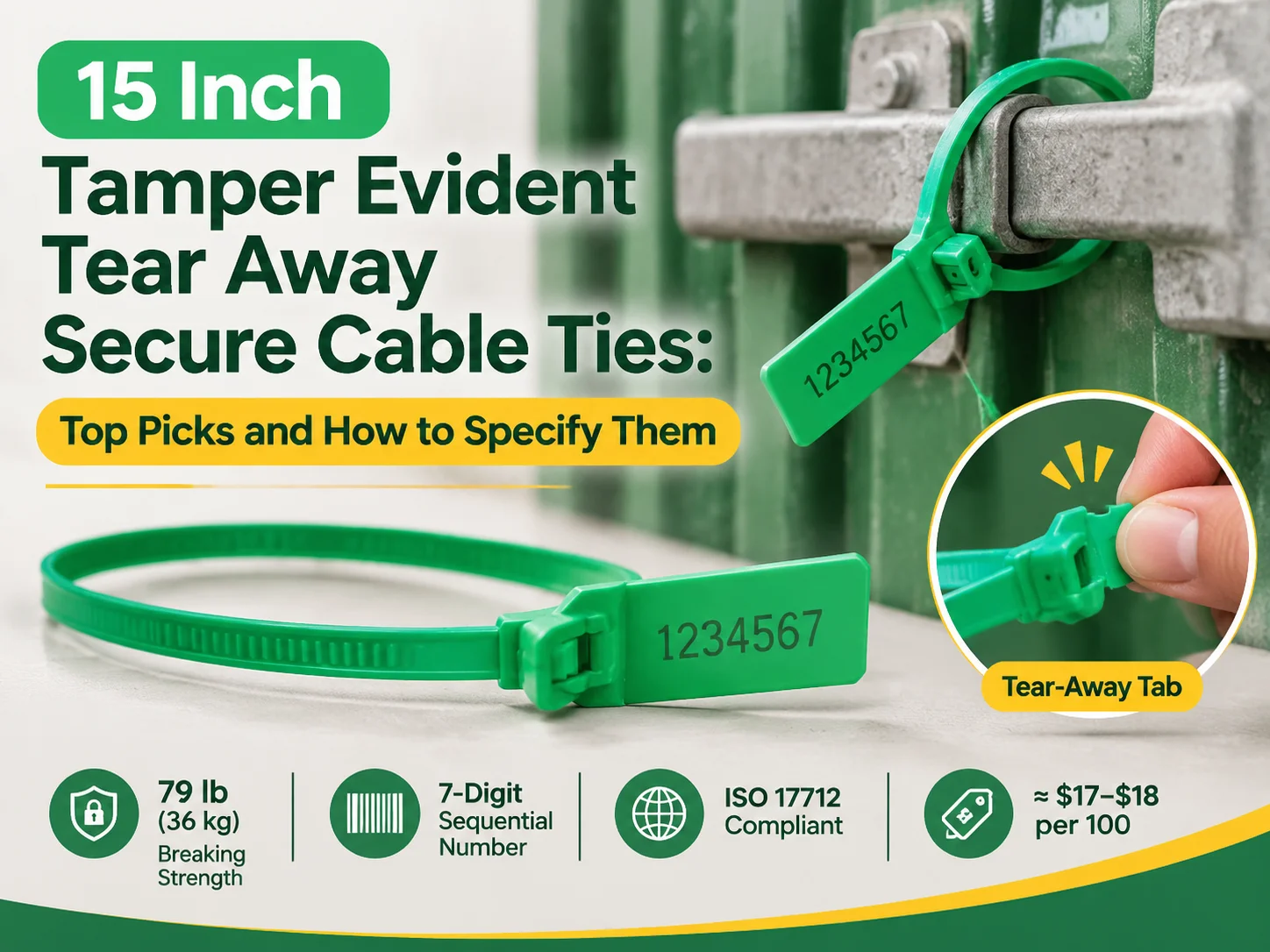
A tamper-evident seal measuring 15 inches in length consists of a pull-tight fastening. Usually constructed of high-density polypropylene, it is meant for single use. The overall length of such a seal is approximately 381 mm comprising a one-way locking pawl that can be easily separated after use. It can tolerate weight of about 79 lb (36 kg) with the high-quality seals having laser-etched identification numbered from one to seven. The selling price for a common version is around $17-$18 per 100 products, with discounts of two to six percent available when the order is larger than normal. These seals are certified as complying with the ISO 17712 standard.
What “15 Inch Tamper Evident Tear Away” Actually Describes
In the case of four items, each performing different functions, there is a length of 15 inches, or the equivalent of 381 mm, which provides a usable circumference of approximately 300 mm. Tamper evident means that the closure can’t be opened without damaging it, so the tampering is visible, but not avoided. Tear away means that it has a tab which allows the seal to be opened with bare hands without cutting tools, and secure in this case usually means that the product has the brand name Secure Cable Ties, of the series PS-57836, which is the most common match for this search.
It is thanks to the tear-away tab that a cargo seal differs from a zip tie. A zip tie will have to be cut, meaning that the recipient of the goods will have access to cutting tools so that the tool will be available to open the closed package. A tear-away seal allows removing it in one motion by the authorized person and leaves a broken tab as the proof of opening.
Mistakes regarding length often take place in this industry. A 15-inch seal will be able to close bundles of cargoes or close hasps that would equal no more than 300 mm of the circumference of the packaging. Hence, it will be a capacity of sealing a truck door handle, a latch of a box, a door of a trolley, or metering cabinet. It will be unable to seal a door lock of a cargo container and would take much more material to seal a small bag than a 7-inch seal would. The standard cable tie size reference is the right place to check the relationship between overall length and bundle diameter before choosing a size.
Tamper Evidence Is a Mechanism, Not a Claim
The various methods can be reduced to three specific forms of packaging, but only one of the forms is truly one-time.
- A one-use device consists of a moulded tooth that is part of the closure mechanism and prevents the opening of the device. The attempt to open the device inevitably results in either snapping off of the tooth or marring the cable.
- Then comes a metal insert, which is a pin made of stainless steel and encased in a plastic material. Unlike the previous type of device, which can only be used with a single instance of opening, this device is designed for heavy-duty seals.
- Another method of design is called the breakaway tail system. The seal automatically breaks in a specific place while leaving behind the stub that can no longer be rejoined.
If the device is designed in such a way that it can be opened by using an ordinary knife and then closed again, it cannot be treated as tamper proof. There exists a simple test that can be run, which can indicate whether the package can be opened without drawing attention to the same.
The Security Seal Ladder: Indicative, Security, High Security
Freight container seals are classified into three strengths, and the ordering process is greatly assisted when a buyer decides which of them to use.
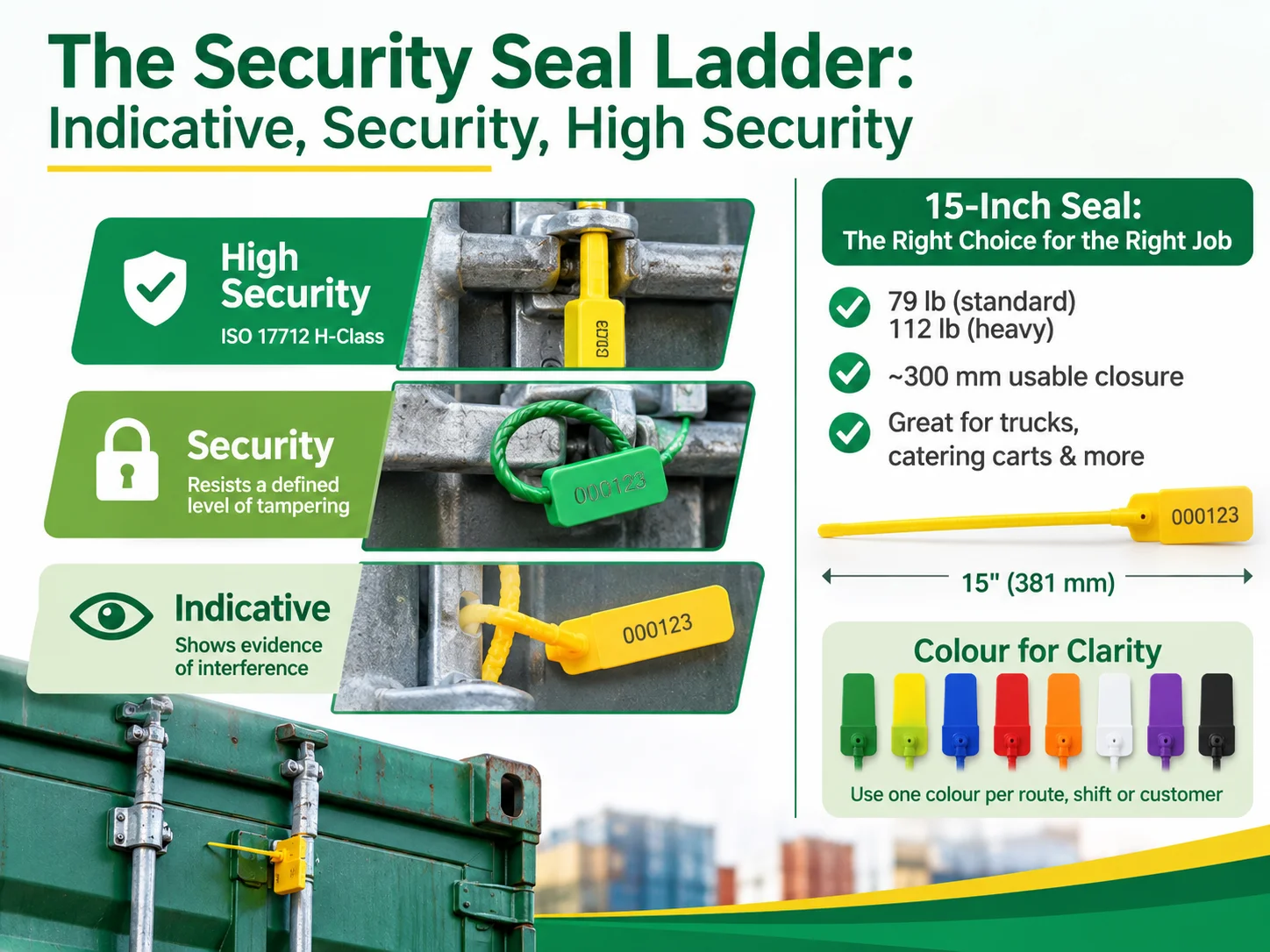
- Indicative seals provide evidence of tampering, but they cannot prevent determined efforts to remove them. Plastic pull-tight seals, such as the 15 inch tear-off seals, fall into this category. Their intended use is in cases where there is an opportunistic threat and where interference is detectable.
- Security seals resist a certain degree of force and tampering for a certain duration; however, such seals pass tests according to the criterion set by ISO 17712.
- High security seals refer to bolt seals and cable seals certified according to ISO’s class H requirements, which is the standard required by customs authorities for sealed containers entering the USA. Using plastic tear-off seals instead of the proper security seals to have a sealed container shipped internationally is deemed an offense for non-compliance with the customs rules.
This is an important distinction to make as terms used here can cause confusion. Thus, 15 inch tamper evident seals would work well in cases of domestic shipments involving cash bags, food carts, meter panels, etc. However, such seals cannot be used for sealing containers bound for US ports, where proper high-security seals must be utilized. The comparison of what is commonly used to secure wire bundles and loads covers the adjacent products and where each one stops.
Sizes and Strengths: What 15 Inches Buys You
| الحجم | Overall length | Typical breaking strength | Usable closure | الاستخدام النموذجي |
|---|---|---|---|---|
| 7 inch | 178 mm | 40 to 60 lb | Small pouch, zipper pull | Cash bags, sample pouches, small totes |
| 11 inch | 279 mm | 60 to 79 lb | Around 200 mm | Tote boxes, meter covers, equipment cases |
| 15 inch | 381 mm | 79 lb standard, 112 lb heavy | Around 300 mm | Truck doors, catering carts, utility cabinets |
There is a necessity for explaining the strength number here. Breaking strength is the load at which a seal fails in a tensile test, but this is not necessarily the same as tamper-proofing, as a seal might be defeated without breaking it. A 79 lb seal is strong enough so that a person cannot pull it apart by hand, which means that it is practically impossible.
Where a 15 inch tie is wanted for bundling, not sealing, the same length is available in a 4.8 mm section as the A5 series 15 inch nylon tie, which uses a slimmer head profile and suits tighter bundle control than the 5.0 mm ET5 section.
Color serves a purpose rather than being a decoration. There are eight colors commonly used. The idea is to use one color at each point along the route, to indicate whether the seal on a consignment is in order. For example, if the seal on a truck is green while it should actually be yellow, we will have an understanding before checking the shipping bill.
Numbering, Colours and the Marking That Makes a Seal Work
A seal that lacks a number is a seal that could be substituted for. It is the number that converts the physical device into a document: the dispatch note contains the number of the seal, which the receiving clerk checks upon receipt, and for which any mismatch is an accounted fact rather than a matter of dispute.
Laser marking is the technology that is to be used for marking. It cuts into the surface instead of printing on it, thus making marking impossible to erase or reprint and making it resistant to the effects of the weather or handling. Seven digits is the standard, which gives ten million combinations in one run, which is sufficient for the volumes issued by one shipper and small enough to guarantee that novelty would be easy to notice.
There are two failures that ought to be avoided. Sequential numbering that starts from the same number in every batch means that there can be two identical seals in circulation at one time, which negates the purpose of the system. Using a supplier that offers numbering as an option instead of making it obligatory indicates that most suppliers do not buy it because they find it unnecessary, which gives the impression that the goods in question are purchased as a tie.
Custom marking is the next step, and this is where OEM order differs from catalogue order. The head may contain the name, the logo, the barcode or the QR code together with the number. The OEM colour and marking service is the route for that, and the practical lead time is longer than a stock order because the tooling has to be engraved.
Where These Ties Get Used
The natural application of the product is wherever there is a transfer of responsibility and the verification of continuity is necessary.
- Maritime shipping. Trailer door locks, side curtain fasteners and tailgate locks. The seal number is written on the shipping documents, it is checked by the receiving party as they enter the dock and this operation takes four seconds.
- Air travel. Trolleys and carts are locked at the catering facility and opened in the aircraft galley, with the seal number being indicated in the trolley records.
- Cash and valuables transportation. Bags and boxes are sealed with numbered cables and the seal number is verified at both ends, noting that this is a common example – the plastic seal acts purely as deterrent and evidence, rather than a prevention against active assault.
- Utilities and telecommunications. Meter cabinets, letterboxes, enclosures and outdoor equipment. The sealed number on the meter shows that the last object opened the cabinet legally, but it doesn’t determine its security.
- Medicine and laboratory. Packaging bags and room for substance controlled storage, with the seal being part of the custody chain.
- Manufacturing. Scrap boxes, quarantine containers and calibration equipment room. The numbered seal on quarantine box prevents informal “take one” options that undermine quality assurance.
Top Picks and What Each Is Good For
| المنتج | البناء | القوة | الأفضل لـ | إشارة السعر |
|---|---|---|---|---|
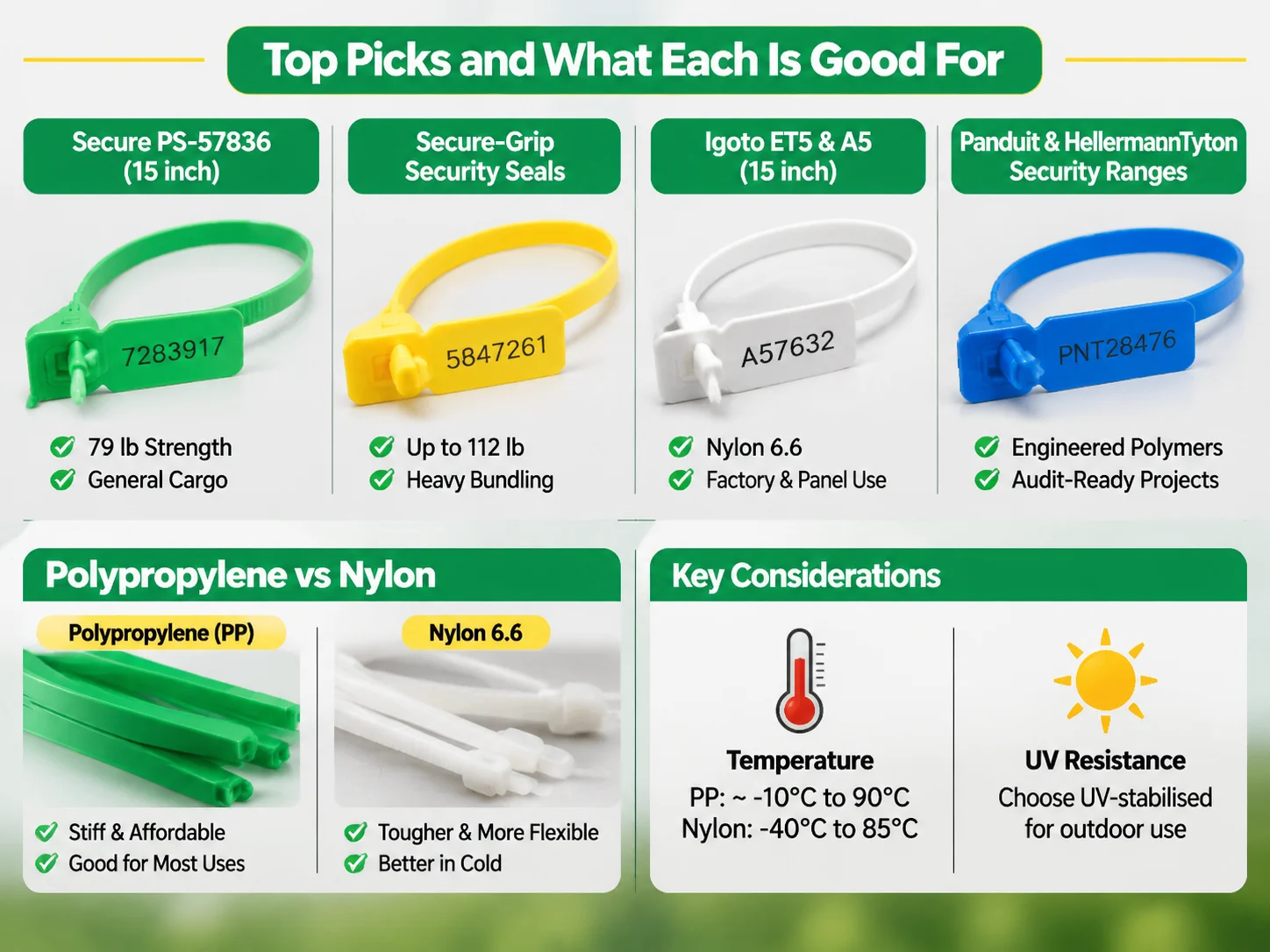
| Secure PS-57836 series, 15 inch | High-density polypropylene, tear-away tab, 7-digit laser-etched number | 79 lb | General cargo, trailers, tote boxes | Around $17 to $18 per 100, 2 to 6% off at 10 to 50 packs |
| Secure-Grip security seals | Pull-away tightening tab, tool-free, 7, 11 and 15 inch | Up to 112 lb | Heavy bundling, industrial cargo | Higher per unit than the standard series |
| Igoto ET5 and A5 series, 15 inch | Nylon 6.6, 5.0 mm and 4.8 mm widths, UV-stabilised options, OEM marking | Quoted per size to UL 62275 | Factory and panel use where a numbered seal is wanted on a standard tie | Factory-direct, volume dependent |
| Panduit and HellermannTyton security ranges | Engineering-grade polymers, documented tensile data | Per datasheet | Specified projects with an audit trail requirement | Premium, distributor channel |
The difference between the first two rows and the third is important since a security seal has to be broken in the process of taking it off and carries a number. A marked cable tie refers to a cable tie that can be traced back. Both are effective but serve different purposes. Indeed, a nylon tie with a number on can still be cut, exchanged, and re-tightened by anyone with scissors and a spare cable tie of the same color.
Polypropylene vs Nylon: The Material Decision
Almost all 15 inch tear-away seals are manufactured from high-density polypropylene. This is obviously not an accident.
Polypropylene plastically deforms much better than nylon for greater ease of thin strap formation, combined with lower cost. However, it also has lower impact strength. If you drop a polypropylene seal on concrete from a height of 1 meter at -10 degrees C, it may crack. Compared to that, nylon 6.6 is much tougher, more flexible and better for cold applications. However, it costs more and may be less suitable for making hi-tech thin security seals.
درجة الحرارة is the difference maker. Polypropylene is able to remain intact at temperatures of up to 90 degrees C, while nylon is fine with temperatures as low as -40 degrees C or up to 85 degrees C. For a trailer being used in northern winter season, it has to be nylon.
The second factor is مقاومة الأشعة فوق البنفسجية. A seal that is placed on an outdoor meter will be subjected to sunlight for a long period of time. Regular polypropylene deteriorates, and this results in creating a seal that will simply break apart rather than tear. So, whenever expecting a seal to remain outdoors for more than a season, choose UV-stabilised material.
What to Check Before You Order Ten Thousand
- Numbering procedure and consistency. Check how the sequential numbering is performed when producing hundreds of batches. Otherwise, if the producer fails to underline the details of the process, he/she will create two sets of numbers that are totally the same.
- Marking technique. The marking is laser marking. Ask to receive the sample and try to erase the number from the surface of the sample with a solvent.
- Proof of breaking strength report. It should be emphasized that it is not mere size indicated in the certificate; it is a test result. The breaking strength figure without a test means nothing.
- Colour consistency. Order the pack of every coloured containers and check how it differs within one batch. One batch will be useless for traceability because of company colour variations.
- Cold performance. If the seals are used under freezing condition, put the sample into the freezer overnight and try to close. If the product cracks when closed in the freezing conditions, its being cracked in other situations is inevitable.
- Closure feel. Manually close twenty samples packs. The ratchet mechanism should work normally without forcing. If it does not function properly, it means that there is the problem of technology used in producing this pack.
Where Igoto Fits
Our products are cable ties and not specific security seals, therefore we would describe our situation as follows: in case you need a seal which is to be numbered and used only once with cargo, you would need to acquire a seal. In case you need a tie which is 15 inches long and can be used in factories or to bundle panels and that has a number or a mark printed on it to make it traceable internally, that is what we can deliver to you.
ال 15 inch nylon tie in the ET5 series is 5.0 mm wide at 380 mm long, which is the general-purpose heavy section for cable and conduit bundling, and the A5 series at the same length uses a 4.8 mm section with a different head profile for tighter bundle control. Both are available UV-stabilised for outdoor use, and the OEM programme covers colour, marking and packaging.
What we do not engage in is selling a plastic tie as a high-security seal since it is not one to begin with, and a client who finds out otherwise at a port gate has lost a lot more than just the price difference. When a plant requires a numbered tie for internal controls instead of for the customs, the two products find themselves similar, with a marked nylon tie being the less expensive solution.
الأسئلة الشائعة
What is a tamper evident tear away seal?
It is a unique type of plastic tie that can only be used once, and has an irreversible locking mechanism along with a tab made with the help of moulding, which also enables its removal without using cutters. In fact, it is made so that it cannot be reopened without being damaged, meaning that any attempt to do so will be visible afterwards. The size of the spots is approximately 386 mm, and they are typically made from polypropolene and can withstand breaking strength of about 80 lbs.
Are these the same as security cable ties?
That’s not completely correct. The distinction is important for customs. A security seal is made to be destroyed when it’s removed and has a number, while a cable tie with printed number is just a tie that is traceable and can be cut off and replaced. According to ISO 17712, plastic pull-tight seals fall under the category of indicative seals, which is good enough for domestic shipments and internal purposes, yet does not meet the requirements for high-security seals for loaded containers arriving in the USA.
What length do I need for a truck door?
Usually, a fifteen inch (381 mm) seal is used for a trailer door latch, a curtain-sider buckle, or a tail-lift latch which gives about three hundred mm of wrap-ending after accounting for road and back. An 11 inch seal works for tote boxes and meter boxes, while a seven inch seal is suitable for envelopes and cash bags. Always measure the circumference of the hasp rather than the width of the door, since the seal only needs to fit around the locking point.
Can these seals be reused?
No, and that is the whole point. The locking machine only engages the serrations on the tail in one direction, which means that un-locking either breaks the tooth or leaves visible marks. The removal is done by the tear-off tab, which leaves behind a broken piece. Any seal that can be open and resealed without traces leaves no tampering evidence and therefore it is worth testing such a sample before placing big orders.
What does the number on the seal do?
It transforms a physical object into a record. The number will be indicated on the delivery document where it will be confirmed at receiving, so if mismatched, it is recorded. Laser etching is the technique of choice because it makes an incision in the material and cannot be erased. The normal number of digits used is seven, which results in ten million combinations for every run, and suppliers should be able to account for the management of the series across different batches.
Are plastic seals accepted for international shipping?
Generally, sealed containers will have no concerns. The customs regulations of the United States demand that all containers carry high security seals that conform to ISO17712 H Class specifications. Since plastic pull-tight seals don’t fall within these specifications, they are not allowed to be used on loaded containers despite the fact that their breaking strengths may give them the appearance of being strong enough. However, plastic seals can be used for domestic road transport, airline catering, cash bags, utility cabinets and other internal factory controls.
What strength should I specify?
A 15 inches seal standard is approximately 79 lb (36 kg). Heavier versions have breaking strengths up to as much as 112 lb and should be used when seal is subjected to load, e.g. curtain-sider is exposed to wind pressure. Breaking strength does not imply the same thing as tamperproofness, so don’t convert numbered and one-time use mechanism for a one with a bigger strength.
المراجع
- Cable Ties Unlimited — Break Ties and Security Seals
- Panduit — Cable Tie and Identification Products
- HellermannTyton — Cable Management and Sealing Systems
- Unisto — Security Seals and Tamper Evidence
- U.S. Customs and Border Protection — Container Seal Requirements
الخاتمة
Acquisition should begin with mechanism, numbering and ending with the dimension. A resealing seal is a type of tie that is more securely made than a regular one. In addition, a no-number seal does not mean any high efficiency. For length measurement please use the hasp width but not the door size.
Then make a decision regarding the type of application. Domestic transport, food delivery or internal rules of your factory – it needs an indicative seal that can be bought for seventeen dollars per hundred pieces. On the contrary, if the loaded container crosses the boarders, the standard plastic ties do not fit your requirements as far as the usage. Please, name the application and the hasp perimeter and say whether it needs matching number.