




Bridas de Marca: Cómo Poner la Suya en la Brida
One searches for the name-brand cable ties where one is the distributor who would like to purchase 200000 cable ties and print his name on the heads of the ties. The other one is the foreman from the panel shop whose dilemma is whether he should pay four times more for the product in the box he has in his hand than for the one in the adjoining box. Both of them arrive at the same search results and even though they go through many web pages, none of them seem to provide the necessary answer to their questions.This article is able to satisfy them both. However, it does clarify that both questions are connected.
Briefly put, “branded cable ties” consists of one of three options: ties from an established brand (e.g., Panduit, HellermannTyton, Thomas & Betts, 3M), ties that carry the distributor’s own private label; or ties that are printed with the customer’s logo so that they can be resold or used for site identification. Prices for retail go approximately go from $0.04 to $1.00 each depending on tier, and the premium that you are paying is for certified material grades, UL 62275 listing and batch consistencies, rather than actual strength of the ties. Private labeling is an option offered by Chinese manufacturers such as igoto, usually involving pad printing at the end or strap, and providing custom bagging with a quoted MOQ depending on size.

What “Branded” Means in the Cable Tie Trade
The term can be understood in three different contexts, which are not interchangeable.
An established brand refers to the situation when the manufacturer has become a brand that indicates a kind of product. For example, when a drawing of a data center indicates Panduit, it does not refer to a specific type of this device but informs a contractor about the requirements regarding the set of documents, the proof of tensile strength and the UL number accepted by the client.
The term private label describes the producer’s name on a product created in the factory. In this case, the same machines are used in the factory, which makes the same product; however, the only difference between them is their color and inscription on the packaging. This is how a local distributor can make 40 products no one else sells in the market.
The printed tie is the simplest version of all. It is represented by a simple logo or part number placed on a standard tie mainly used for identifying the site and doing the asset tagging. Companies and enterprises such as airlines or telecom construction companies have greatly utilized this option since colored ties with printed codes perform two functions at the same time.
Once again, the option that one chooses determines the area of business communication. Thus, the first option refers to the comparison of documents, while the second and the third options are aimed at comparing the printing quality and packaging.
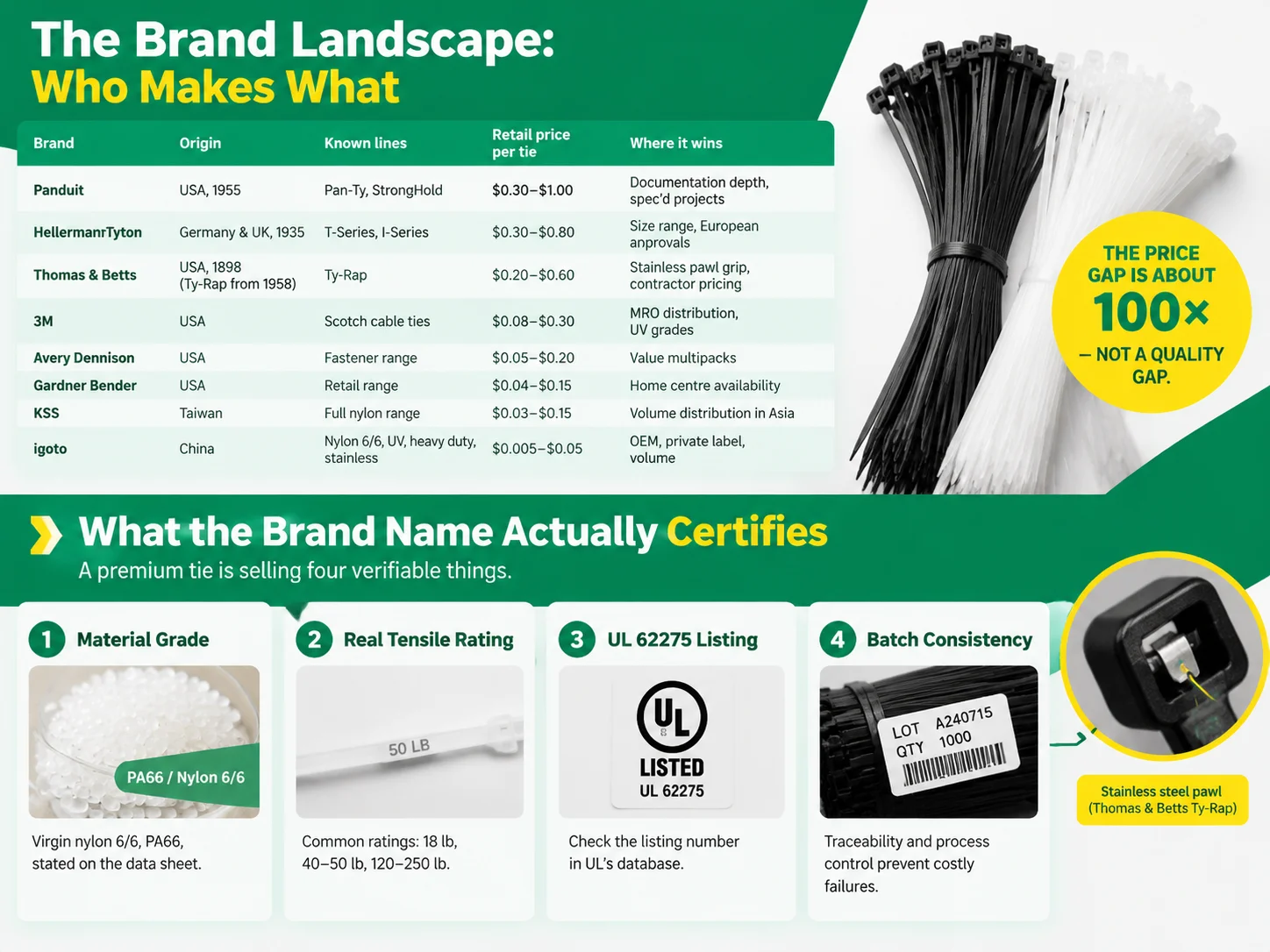
The Brand Landscape: Who Makes What
| Marca | Origen | Known lines | Retail price per tie | Where it wins |
|---|---|---|---|---|
| Panduit | USA, 1955, Tinley Park IL | Pan-Ty, StrongHold | $0.30–$1.00 | Documentation depth, spec’d projects |
| HellermannTyton | Germany and UK, 1935 | T-Series, I-Series | $0.30–$0.80 | Size range, European approvals |
| Thomas & Betts | USA, 1898, Ty-Rap from 1958 | Ty-Rap | $0.20–$0.60 | Stainless pawl grip, contractor pricing |
| 3M | EE. UU. | Scotch cable ties | $0.08–$0.30 | MRO distribution, UV grades |
| Avery Dennison | EE. UU. | Fastener range | $0.05–$0.20 | Paquetes de valor múltiple |
| Gardner Bender | EE. UU. | Retail range | $0.04–$0.15 | Home centre availability |
| KSS | Taiwán | Full nylon range | $0.03–$0.15 | Volume distribution in Asia |
| igoto | China | Nylon 6/6, UV, heavy duty, stainless | $0.005–$0.05 factory-direct | OEM, private label, volume |
These figures are single-unit retail equivalents for late 2026 and fluctuate with the price of resins, which follow crude oil prices with a lag of approximately a quarter or two. The difference between the upper and lower ends of the table is approximately two orders of magnitude, but this is not a quality difference of two orders of magnitude, rather a cost difference for documentation, distribution and branding.
Thomas & Betts deserves mention because Ty-Rap distinguishes itself with its unique design. The locking mechanism is made of stainless steel rather than nylon which allows the Ty-Rap to maintain better grip during vibrations.
What the Brand Name Actually Certifies
Remove all marketing, and a high-end tie is able to provide four proven features.
Type of the material. In the data sheet, it is stated that virgin nylon 6/6, i.e. PA66 is used. Cheap ties are blended with regrind which becomes brittle over time and causes ties to break when the installer tightens it and start cracking while being in operation several months later.
Real tensile strength. Nylon ties are normally rated for 18 lb for light bundling, 40–50 lb for general applications, and 120–250 lb for heavy-duty purpose. A brand name tie’s rating is usually in the range of the tested rating; a generic tie’s rating is sometimes too good to be true. The mechanics of what that number actually measures are worth understanding before you compare two boxes that both say 50 lb, as this guide to cuán fuertes son realmente las bridas de nylon explains.
A certification under UL 62275. This is in fact the standard that governs the use of cable ties in electrical applications and it is very easy to check the listing number in UL’s product database. If a cable tie without the UL listing is used in installation but carries a UL logo, it is safe to assume it is fake.
Consistency of batches. This is the most relevant factor for someone purchasing in large quantities. A faulty batch produced through the wires in a harness does not mean getting a refund, it means a product recall. Manufacturers that are reputable share information about their processing protocols and the info related to the batches of products; this is what price difference is for.
Private Label: What a Factory Needs From You
Branding a tie is simple as long as the parties involved agree on five points beforehand.
The tie. The parameters (size, type, tensile strength), colour of the tape and fabric type, as well as any UV and heat resistant markings are to be taken into account. The colour specification needs to be precise, as “black” and “black with UV resistance” are entirely different entities with different service life.
The printing. The location of printing, colour, dimension and material of printing will have to be given. One colour on the strap would cost the least and would be the easiest to read. Printing in two or three colours on the head is possible, though costly, as the printing process would need to be repeated several times.
Packaging. The package can be a poly bag with a printed cardboard tab, standard bag, a box or can be customer design. Generally speaking, the artwork needs to be provided as vector graphics, along with die line.
Volume and costs. It is essential to receive costs for three volumes and write down the breakdown for each of them. A single number doesn’t give any information about the implementation costs and cost of the engine.
Regulatory documents. It is important to receive UL certificate, RoHS certificate and MSDS that will contain PA66. If the supplier does not have them before you place the trial order, you shouldn’t even start talking.
How the Branding Is Applied
There are three different ways of making markings, but they are not the same.
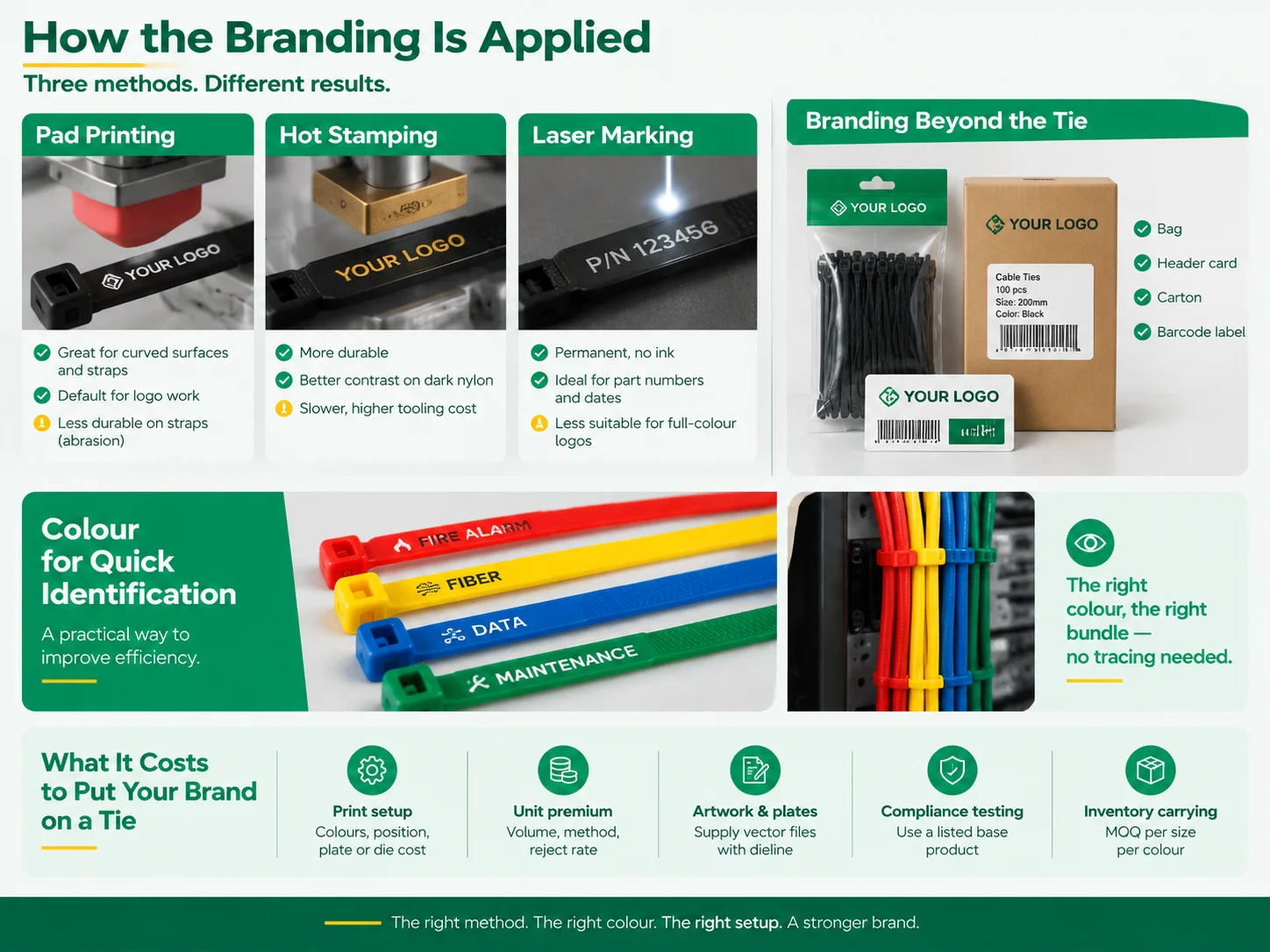
Pad printing is a technique that uses plates covered with ink to impress designs of the tie in question with the help of a silicone pad. The advantages of this technology are the ability to mark any curved surfaces and its usability for making markings on belts, while its disadvantage is the susceptibility of printed marks to damages (such marks will become worn out when dragged through a pipe).
Hot stamp printing is a method of impressing a heated stamp into the surface of items. The result of using this technology is a more distinct branding with longer life, while its disadvantage is that it requires more time and has a higher cost of equipment. Because of this reason, hot stamp printing is mainly used for making logos on high-volume items.
Laser marking is a technology that burns or removes material in order to get a logo that will last long time. This technology is the best for branding serial numbers and dates in technical ties, while it hardly ever works for logos of this kind.
Besides the tie itself there are additional items that can be branded. Special attention has to be paid to branding those additional items that package the tie. Many companies underestimate this factor.
Colour is the other lever. A branded range usually includes a colour option for identification, and there is a real operational argument for it beyond aesthetics, as the uses for colour cable ties in OEM identification schemes show. Red for fire alarm, yellow for fibre, blue for data, and the maintenance technician reads the bundle instead of tracing it.
What It Costs to Put Your Brand on a Tie
| Cost element | What drives it | How to reduce it |
|---|---|---|
| Print setup | Number of colours, print position, plate or die cost | One colour on the strap, one location |
| Unit premium over plain tie | Volume, print method, reject rate | Order multiple sizes together |
| Packaging artwork and plates | Whether you supply print-ready files | Send vector artwork with a dieline |
| Compliance testing | Whether the base tie is already listed | Select a listed base product, print on it |
| Inventory carrying | MOQ per size per colour | Fewer sizes, fewer colours at launch |
The table shows that the principle of complexity holds water: complexity costs money, but most often complexity exists on the buyer’s side of the transaction. A program with only three sizes, one color, one location of print, and one format of packaging can be much better priced than the same volume spread out over eight SKUs.
When it comes to either big or small private-label program, a manufacturer has to already be equipped for it as if it were a normal activity instead of something extraordinary. Manufacturers who do OEM work as a regular activity will make sure that artwork is approved and pre-production samples and packaging changes are done without putting the project out for quote every time the question arises. That is the practical meaning of an OEM and ODM cable tie programme, and it is worth asking any supplier how they handle a revision to an approved print.
Choosing a Brand for Your Own Use
Here are four questions that must be answered in sequence to eliminate virtually every market until prices dominate the conversation.
- Where is the tie installed? If installed indoors, no temperature regulation is required. If the tie is located outdoors, on a roof or a solar panel, UV stabilization is mandatory, but brand matters less than grade. If installed under a hood or near a furnace, heat stabilization is essential.
- What load is the tie supporting and what happens if it fails? A bundle of Cat6 cable requires 18 lbs, and that works. A tie supporting a 4 kg luminaire from a ceiling grid should be heavy duty and be rated, with the cost of the tie irrelevant.
- What paperwork will be required? Regulated industries, data centers, and utility work will always request documentation, whereas not for a home. Buying paperwork that is never used is what turns a $0.05 purchase into $0.60.
- What the volume of ties that need to be purchased and over what period? Volume is the most important factor. If the volume is 500 ties per year, retail is the way to go. If 500,000 ties is needed, then you are negotiating for a private label, even if you didn’t want to.
When the application is heavy enough that the rating is the specification and not a detail, the selection criteria shift toward construction and testing rather than brand, which is the argument in this guide to choosing heavy-duty cable ties.
Red Flags in a Branded Supply Agreement
Logo without file number. The listing is not verified and often incorrect. It concerns a specific family of products rather than a brand.
“Nylon” without grade. Nylon 6 and nylon 6/6 have different behavior qualities. One cannot tell how much recycled material is used till the ties start breaking. Request PA66 in the data sheet.
Tensile strength without reference. Identification must lead to a method of testing.
Unreliable print quality of samples and actual results. Request a sample from the actual production batch and not a prototype.
Nothing regarding the ownership of the graphics. You own the logo and file. Ensure that you have a written confirmation that the graphics will either remain yours or be destroyed at the end of the project.
Dónde encaja igoto
The company igoto produces nylon 6/6 cable ties in heavy-duty, UV-protected, heat-stabilized grades and provides stainless steel ties, and private branding is part of its services, meaning that clients can count on this kind of assistance without paying extra for it. The range of products includes printed ties, tie bagging, colour options, and numbering under the OEM system.
There are some important limitations that have to be discussed. First of all, it has to be mentioned that igoto is not a renowned brand, so highly professional engineers who have mentioned the products of such brands as Panduit and HellermannTyton in their specifications will not accept igoto ties without replacing them with the products of these brands. igoto does not have unique engineering achievements that it can be proud of, but in return, it provides its clients with the opportunity to buy the products directly from the manufacturer at a good price depending on the order volume.
To distributors who have built their own brand, this trade-naïveté may be good. In case the client has specifically mentioned the brand name in the specification it does not work as they could expect, otherwise, people waste their time.
Preguntas Frecuentes
What is the best brand of cable ties?
There is no one single best answer and the correct response varies depending on what it is used for (application). The Panduit brand is well known for its documentation and consistency for data centre specifications*. The HellermannTyton company offers the greatest range of sizes of products and enjoys the highest acceptance in Europe. The brand Thomas & Betts Ty Rap has become popular among contractors for its ability to withstand vigorous vibrations given that the product is manufactured with a stainless steel pawl.In terms of mass production and private labels, factory pmad may also provide customers with the same product but at a more competitive prices i.e. lower per-unit cost.
¿Cuáles son las bridas de cable de mejor calidad?
Quality can be verified without relying on a logo. There are four points to note here: nylon 6/6 specified on the data sheet, a certification number printed on the tie, UL 62275 certification number, and batch traceability by the supplier. Any tie that has all of them will work; any tie that does not have any one of them is an uncertain gamble.
¿Hay alguna diferencia entre bridas y bridas de cremallera?
In most of the situations, the terms refer to the same item; hence most of the users do not know the difference. To be more precise, the term “cable tie” is used in a broader sense, while the term “zip tie” is narrower and focuses on the very product that has the serrated surface. The distinction that matters commercially is material and rating, not the name, as this explanation of si las bridas de nylon son las mismas que las bridas de cierre sets out.
¿Cuál es la brida más fuerte?
When comparing tensile strength, stainless steel cable ties exceed any kind of nylon tie. Their ratings could be in hundreds of pounds with no creep under constant load. Among nylon cable ties, heavy-duty wide strap ties in the range of 120-250 lbs are at the top of the standard range, and beyond that the limiting factor is not the tie itself but the mounting point.
Referencias
- Panduit — Cable Tie and Cable Management Products
- HellermannTyton — Cable Ties and Fixing Systems
- Thomas & Betts — Ty-Rap Cable Tie Systems
- Gardner Bender — Retail Cable Management Range
- UL Solutions — UL 62275 Cable Ties for Electrical Installations
Conclusión
A brand on a cable tie signifies the quality of materials, specifications and documentation. In some instances the brand is worth sixty cents a cable tie because the installation will be supervised and the project file checked. In others, the brand doesn’t matter at all since it’s just holding a Cat6 cable above the ceiling.However, if the brand on the cable tie is yours, getting the material grade in writing becomes your responsibility. You must insist that the material meets at least the minimum quality requirements according to the UL listings of the product.


