


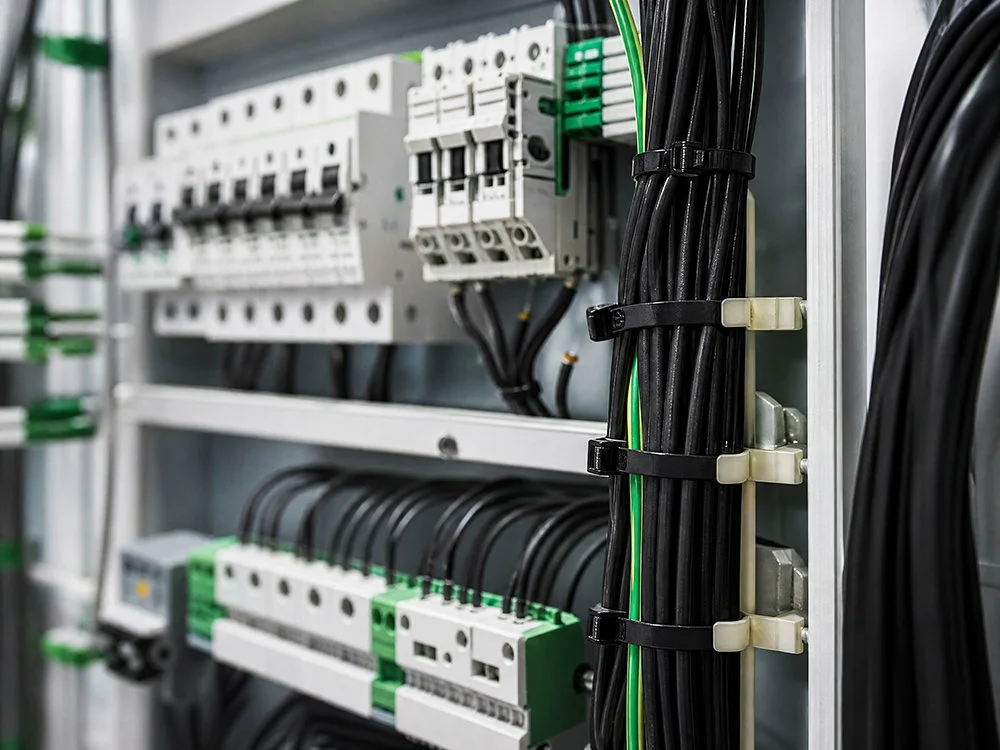

Can Zip Ties Hold 1,000 Pounds?
People come upon the figure of a thousand pounds in two different ways. There are times when this figure refers to kg of items in question, while at other times it indicates kg in the claims of a product name. Regardless of how the number is arrived at, the bottom line is that two words – ‘nylon’ or ‘stainless steel’ can be used to describe it, and these two words represent products that have nothing in common except their shape. Confusion can arise due to this, resulting in having cable ties in a factory in the early hours when the maintenance crew thinks that these ties fail to serve the purpose although the real issue is that they simply got confused with the category of the product.
Below you will find a comprehensive buyer’s guideline instead of an academic article: the first thing to learn is what the figures for weight actually mean, in what categories they can be found, who makes these products, their costs and how to select them in accordance with your field of activity. The testing part at the end of the guide is the most relevant part of it for anybody whose job entails losing money because of equipment failures.
Quick answer: Nylon zip ties cannot hold 1,000 pounds. The strongest standard nylon tie has about a 250 lb in same 1/2-inch body, with most industrial ties rated from 50 lb to 175 lb. To reach 1,000 lb you need stainless steel cable ties: Panduit’s Pan-Steel MLT series is rated from 800 to 1,200 lb; HellermannTyton’s MBT series runs from 121 to 607 lb in double-wrapped configurations that test at around 1,570 lb; and Igoto supplies a tie in the same range of 304 and 316 band. Apply a 4:1 safety factor and a 1,000 lb load actually needs a tie rated around 4,000 lb, which means two bands, a double wrap or a bolted fixing instead of a tie. Prices range from $5 per hundred for small nylon ties to $1-3 per piece for the wide stainless; specifications that matter are width, material grade, and locking mechanism rather than length.
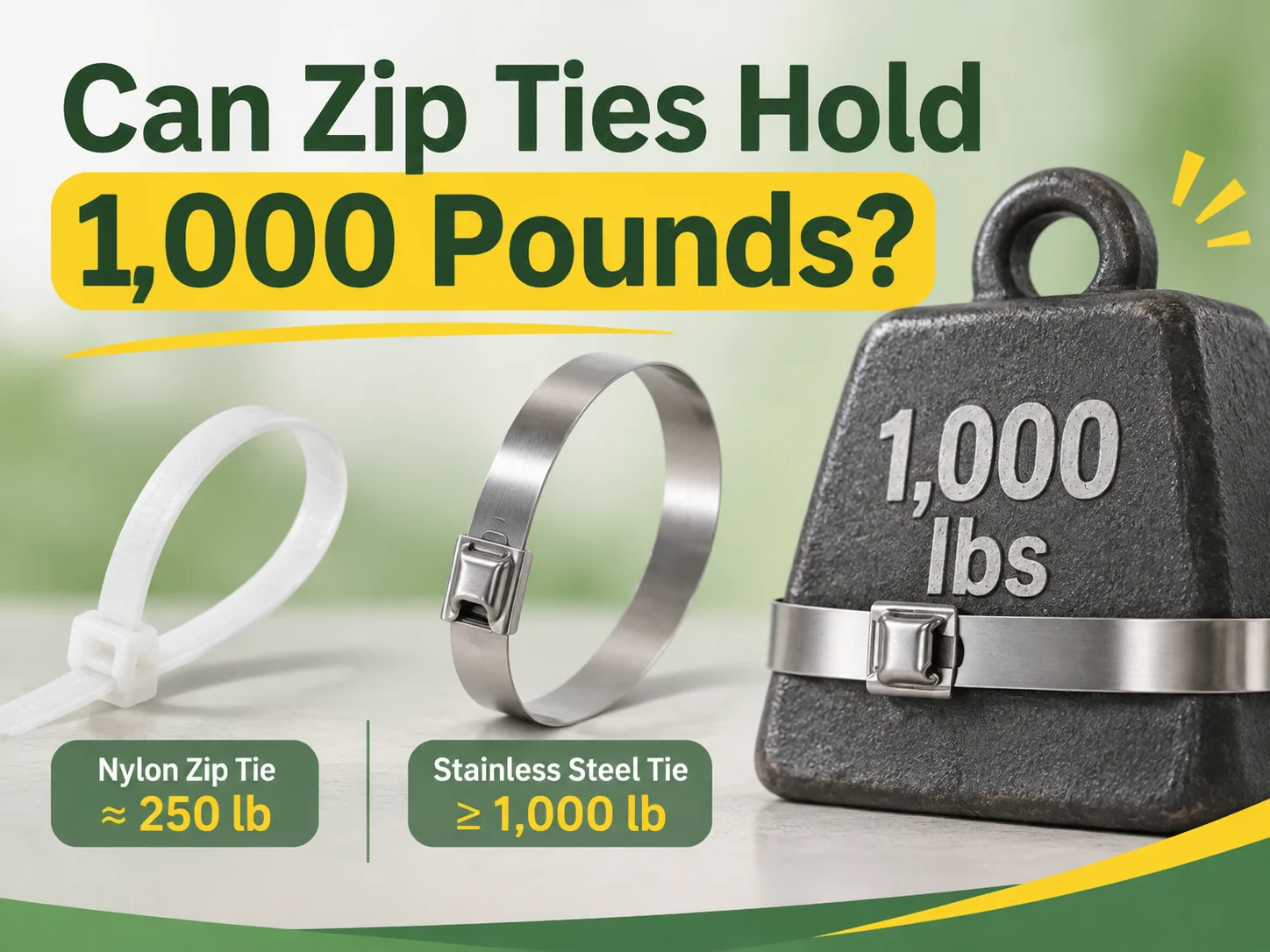
The Short Answer: Nylon No, Stainless Yes
The two types of ties operate using different methods of fastening, rather than being distinct kinds of the same article in various thicknesses. The nylon style makes use of a clasp that locks onto a notched strap, so that the weight is borne by one tiny tooth located at its end. The stainless alternative has a ball or roller fitting tightly against a metallic strap, so that the load is carried by metal, not by a tooth that is moulded into the nylon. Hence, the significant differences in the maximum weight limits of the two materials even when they are of the same size.
Nylon cannot be considered a negative factor in this case as the strap rather than the material becomes the restriction. The wider strap provides more teeth in parallel, but it is the clasps that reach limits long before the strap can.
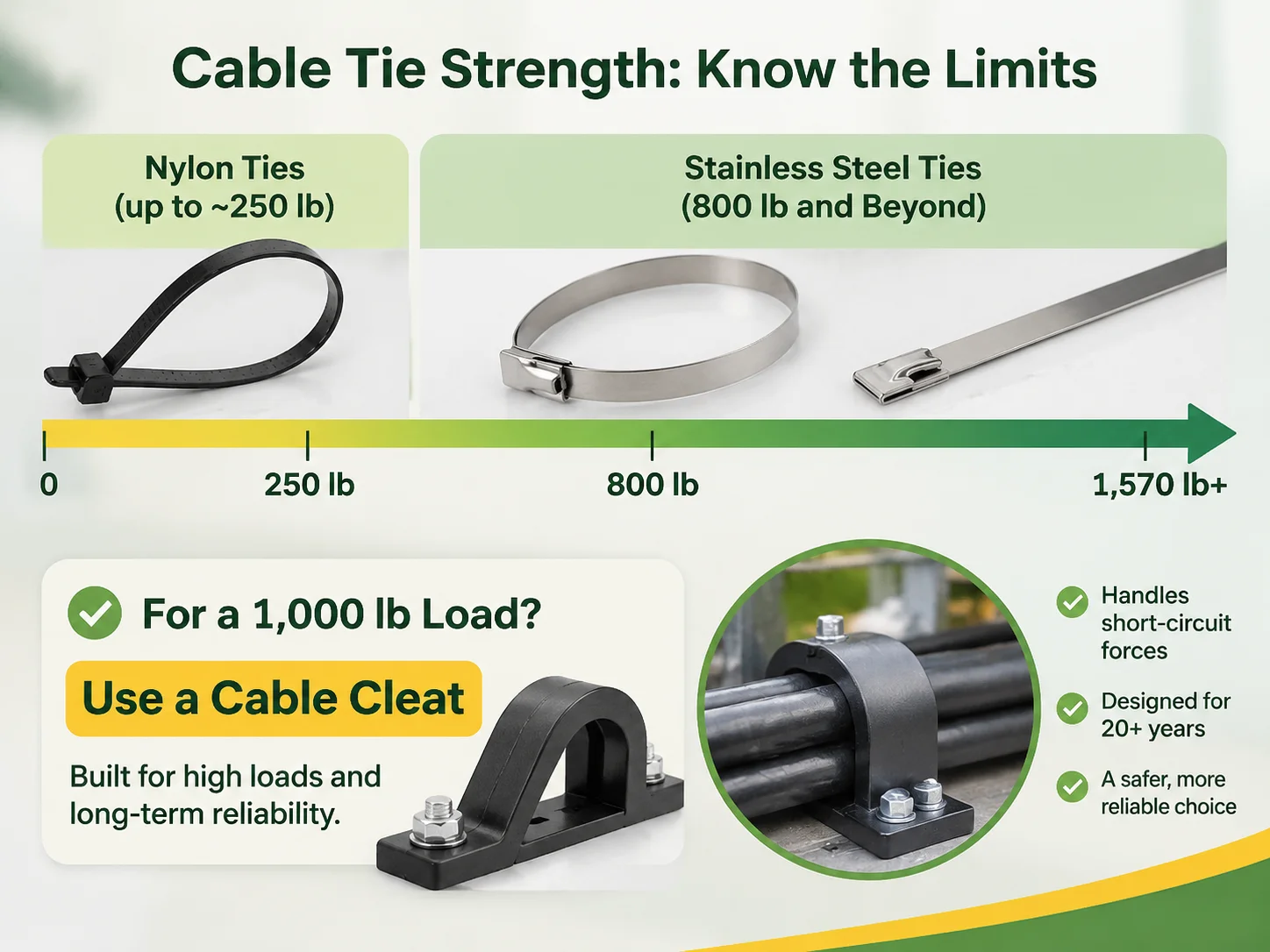
Stainless, on the other hand, does change everything. A 12.7 mm 316 stainless tie from the Panduit MLT range is rated at 800 lb and is intended for operation in continuous mode at 538°C. The same limits apply to Hellermanntyton’s MBT series where a single band can be rated from 121 to 607 lb; it would bear up to 7,000 N (approx. 1,570 lb) when coiled twice. The numbers of the tensile tests were the same as those of nylon.
What is more, the stainless option provides something that nylon cannot produce even theoretically: it does not suffer ultraviolet damage or creep under the load, does not absorb water or produce any fire hazard.
What the Breaking Strength Number Really Means
The tensile strength of a tie is the amount of force that a new tie can withstand when pulled in a straight line at 23 degrees Celsius until it fails. This does not provide information on how long a tie can keep a bundle against a wall with a bolt attached to it.
There are four elements that contribute to the discrepancy in the stated values. Safety factor is the most reliable and is often quoted as 4:1 for any static load or 5:1 or higher when the equipment is exposed to vibrations and is being utilized by people. The second reason is temperature, as nylon becomes weaker with an increase in temperature, while the catalogue data assume standard temperature. Thirdly, UV radiation is another factor that weakens nylon unless it is treated. Fourthly, the way in which a tie is installed will also determine its performance.
Dividing the 1,000 pounds by 4, gives us the actual requirement of around 4,000 pounds and not the maximum load from different manufacturers that are stated. In summary, the expression means that hanging the bundle at the desired location should be safe.
Static and dynamic loads have different natures. Static loads refer to those forces that act on certain elements at a given time. On the other hand, dynamic loads refer to those forces that add up cumulatively over the period and reach thousands of pounds.
The Types of Heavy Duty Zip Tie and What Each One Holds
Five product groups are defined in the “heavy duty” category and cannot be confused with one another.
- Wide nylon components with a thickness of 7.6 mm to 12.7 mm is widely used in the bundling industry: the capacity of 120 lb for a 7.6 mm thickness, 175 lb in some high-strength applications, and 250 lb for a 12.7 mm thickness. There is a UV black option for outdoor usage and a natural version for indoor use. This option is inexpensive, quick to install, and achieves average results for cable trays, harnesses, and conduits.
- Stainless steel band, coated or uncoated. The breaking strength of such a band varies from 121 to 1,200 lb depending on the width and thickness. Uncoated stainless steel model 316 is used in chemical production and off-shore applications, while a coated band (polyester or nylon) protects the weak spots of the cables. This is the family of products answering the question of 1,000 lb.
- Releasable and reusable fasteners. This product is the most convenient for temporary installations and applications where cables require regular re-installation and removal. However, due to the release mechanism, a releasable fastener is not as powerful as the regular one.
- Mounting ties and specialty ties. Mounting ties comprise screws, edge clips, pipe clamps, and marker ties. The capacity of a screw-mount fastener rated with a 50 lb strength rating is greater than the capacity of the 50 lb fastener fixed to a beam. Mounting ties allow concentrating the force on the mounting screw instead of a strap.
- Hook and loop fasteners and twist ties. This product isn’t meant for carrying loads, but could be included in the product range.
| Tipo | Tensión típica | Working load at 4:1 | Best use |
|---|---|---|---|
| Nylon 4.8 mm | 50 lb / 220 N | 12 lb | General cable bundling |
| Nylon 7.6 mm | 120 lb / 530 N | 30 lb | Heavy harness, conduit |
| Nylon 12.7 mm | 250 lb / 1,110 N | 62 lb | Largest nylon, tray support |
| Stainless band, 4.6 mm | 121 to 200 lb | 30 to 50 lb | Signage, light cable, outdoor |
| Stainless band, 12.7 mm | 800 lb / 3,560 N | 200 lb | Heavy cable, risers, offshore |
| Stainless double wrapped | up to 1,570 lb | 390 lb | Loads beyond a single band |
The Brands, and What Each One Is Good At
The market is led by four companies, and each has its own territory and does not cover everything.
- For stainless steel, Panduit is the standard brand. The name commonly seen in specifications is Pan-Steel MLT, with MLT4DEH-Q316 being the most-known 12.7 mm 316 product up to 800 lb and 538 °C for continuous use. The benefits of Panduit as a brand are its datasheets and documents, files from UL E56854 allowing checking the product and its widespread distribution network covering a majority of markets.
- HellermannTyton competes within the entire market and not only at the top. The MBT range includes metal parts’ features between 540 N and 2,700 N as well as double-wrapped types tested up to 7,000 N and nylon products from miniature size to heavy duty of 12.7 mm and a variety of cable management accessories. For any buyer wanting all products from one supplier, this option is often chosen.
- Thomas & Betts (now part of ABB) operates in North America planting brands intended to be sold to electrical contractors that buy products such as cable ties, connectors and terminals. Distribution is its advantage and not the quality of products.
- Cable Ties Unlimited and some specialized distributors tend to be known for supplying small quantities, odd dimensions, and in particular stainless steel where buyers are 50 instead of 5,000 needed.
As for a company like Igoto, it offers the same technology as the brands above for OEM projects with specifications offered for coatings, widths, lengths and packing for each order.For a distribution board builder ordering 200,000 ties a year, that is a different commercial conversation from buying a hundred pieces from a distributor, and it is where the fabricación de ataduras de cable de alta resistencia side of the business operates.
Prices: What Heavy Duty and Stainless Ties Cost
Prices below are indicative 2026 figures, and the spread within each row is brand and quantity, not quality alone.
| Producto | Precio típico | Notas |
|---|---|---|
| Nylon 4.8 mm x 200 mm, bag of 100 | $4 to $10 | Natural or UV black, 50 lb |
| Nylon 7.6 mm x 300 mm, bag of 100 | $10 to $25 | 120 lb, heavy duty |
| Nylon 12.7 mm x 500 mm, bag of 100 | $25 to $60 | 250 lb, largest standard nylon |
| Stainless 4.6 mm x 200 mm, pack of 100 | $20 to $45 | 121 to 200 lb, 304 or 316 |
| Stainless 12.7 mm x 500 mm, pack of 100 | $70 to $180 | 800 lb, coated or uncoated |
| Stainless 12.7 mm, branded, per piece | $1 to $3 | Panduit MLT class, UL recognised |
| Stainless tensioning tool | $150 to $600 | Required to reach rated tension |
There are two details in that table that are hard to see but important if you want to get this project done correctly. The first one to discuss is the equipment: many times the tie made of stainless steel is not capable of even half its maximum capacity as the lock ball requires certain forces to lock it in place. So when we talk about a project estimated at having 300 tie jobs without any tool, we can say that all the ties are not under stress enough. However, the cost of the tool is much lower than the cost of redoing the ties.
The second point is the average price of brand-name stainless steel. It can be said that the price per tie is $2. This means that the project that requires having 1.000 ties will cost $2,000 just for buying ties which is the reason why huge number of jobs are done at the factory that supplies goods in bulk.
How to Choose by Industry
The application decides the material, the coating and the fixing, and the six sectors below cover most of the volume.
| Industria | What fits | Por Qué |
|---|---|---|
| Electrical contracting and panel building | Nylon 4.8 to 7.6 mm, UV black outdoors | Speed, cost, adequate strength for cable support |
| Data centres and structured cabling | Hook and loop in racks, nylon 4.8 mm for cable tray | No over-compression of Cat6, easy moves and changes |
| Solar and wind | Stainless 316, 4.6 to 8 mm, coated | UV, thermal cycling, 25-year life, no creep |
| Marine, offshore and rail | Stainless 316, 12.7 mm, coated | Salt spray, vibration, fire load, regulatory acceptance |
| Food and beverage plants | Stainless 316, detectable or coated options | Wash-down, chemical cleaning, metal detection |
| Construction and HVAC | Nylon 7.6 to 12.7 mm, plus screw-mount fixings | Support of conduit and duct, low cost per fixing |
Examine the chart carefully to determine the failure of the situation that is beyond tolerable. In case we’re talking of the cable pack sinking behind the wall, nylon is the solution. If we’re referring to cable tray crashing in a tunnel or to a photovoltaic array losing its phase in a storm, stainless would be used without reference to the load specifications, as the mechanism of the failure is said to be environmental not mechanical. The guide to choosing heavy duty cable ties walks through the width and material decision in more detail.
Specification Table: What to Put on a Purchase Order
The six points identify if a tie is the tie right for the job and all six count in the specification, not in a discussion.
- Width and length. Width determines the strength and length determines the limit of the bundle diameter. An excessively long tie must lose its end and more often than not it’s this cut end that causes the ties fail.
- Material type. A tie made of nylon 6/6 for ties, stainless steel made of 304 and 316, with the molybdenum that makes the 316 resistant to chlorides at a coastal location or in a plant near hypochlorite.
- Loop strength in Newton and Pounds. Give both values because they are not always adequately converted into each other and sometimes a difference of a whopping 20 percent occurs.
- Temperature. Nylon works well at about 85 degrees centigrade for normal grades and at 105 degrees for heat-treated nylon, and the strength drops before that.
- UV and chemical resistance. Nylon does well when treated with black UV and is perfect for outdoor applications; in case of chemical exposure do not take someone’s word of mouth but rather ask to see compatibility data.
- Certification. UL certificate with a file number is a necessary component. The certification and test documentation behind a product is what an auditor will ask for, and it is worth confirming before the order, not after.
Testing a Tie Before You Trust It
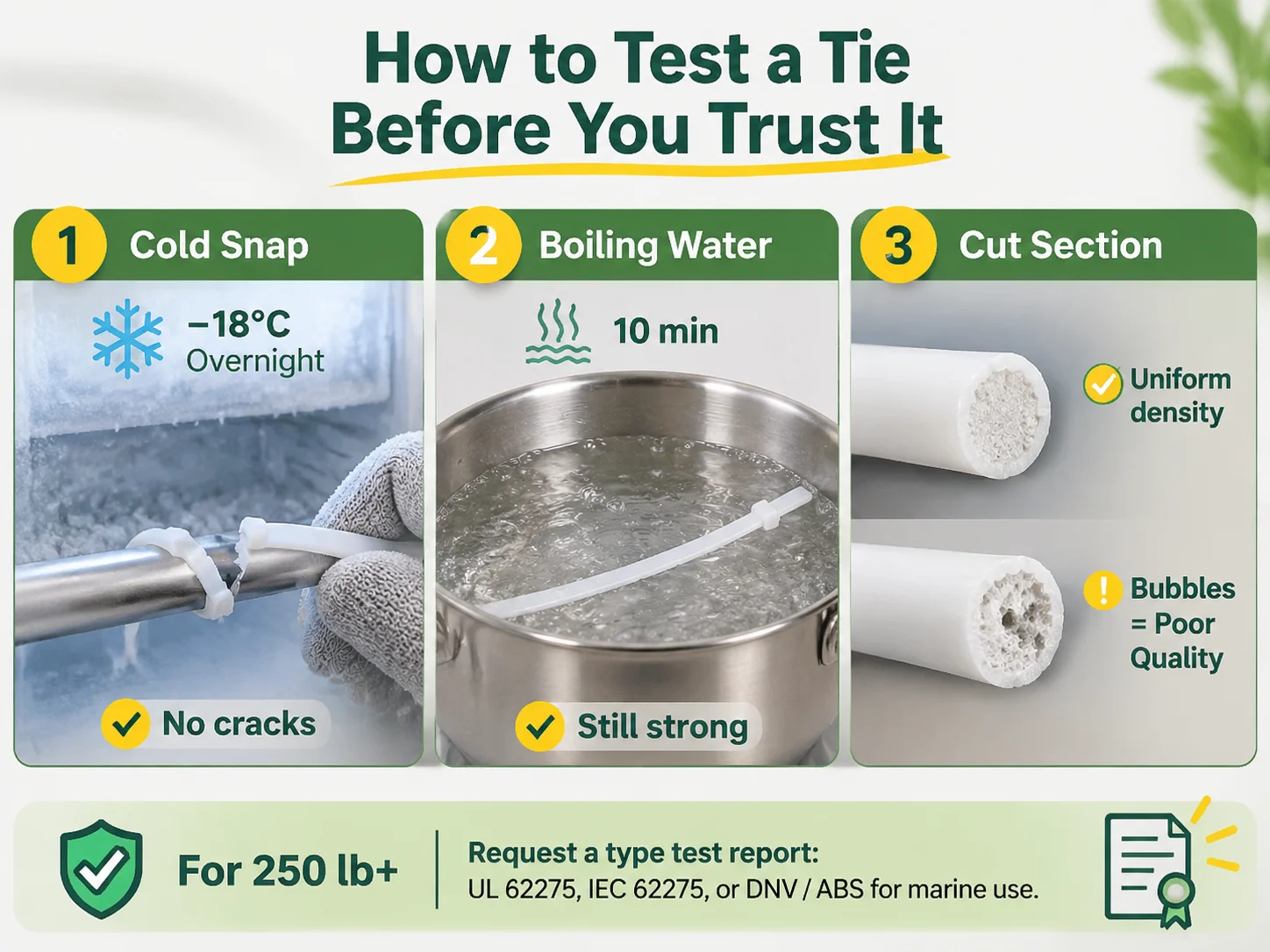
If the project involves 1,000 lb, it is necessary to test it despite not needing a lab.
For practical testing use a dead hang. Attach an example of the tie in the same way it will be installed when in use, and hang a weight that is equal to twice the working load, leaving it like this for 24 hours and in the same room temperature it will be exposed to when used. If the tie holds under these conditions, it should work in practice unless subjected to UV or other chemical influences.
If the device being tested vibrates, a dynamic test should be conducted as well. After applying the weight, the machine should be operated for an hour. Without a doubt, vibration will loosen the locking mechanism and cause abrasions on the strap in the place of the head, which will allow identifying flaws that could not be found using dead hang testing. If the strap shows any shiny spots after being subjected to vibration in that spot, it will certainly fail in practice regardless of the specifications.
One product in the range makes the test easy to skip: the 8 inch black UV heavy duty tie supplied in packs of 100 is the volume product most plants standardise on for general cable work, and its rating is well documented, so a quick hang test confirms the batch, not the design.
Where 1,000 lb Loads Actually Go
In case you are sure that your requirement is indeed 1.000 lb. two arrangements will meet it and neither of them is a single nylon tie.
- One large stainless steel tie. The product rating is approximately 1200 lb. It meets heavy cabling needs in vertical risers as well as offshore supports and rails. Being rated for 1200 lb., this tie will carry not more than 83% of its rating at a static load of 1000 lb thus not complying with the rule of 4:1 and being usable only under static loading conditions in a safe environment.
- Two stainless steel ties in parallel. Two 800 lb. ties that are placed around the bundle so that the head quarters and tensioned with a tool would give a theoretical working load of 1600 lb. It must be taken into account that in reality the load will not be evenly divided so it is better to accept the value of 1.3 of one of the ties thus giving approximately 1040 lb. This is the value that is used in most cases.
- Double ribbon wrapping. Double wrapping by means of taking one tie through one head allows the distribution of the load better since the tension is established once. That is the reason for the existence of the tested 7000N solution.
- Completely different fixation. In case of total of 1000 lb. the best solution is a clevis, strut clip or simply bolted structure and a nylon tie would not work.
El comparison of stainless and nylon ties is worth reading before committing to either, because the decision is usually about environment, not load, and the load question tends to resolve itself once the environment is clear.
Where Igoto Fits
Our product range includes all kinds of cable ties such at mini cable ties, normal, heavy-duty, extra heavy-duty and stainless steel cable ties with 304 and 316 size in uncoated and coated, as well as their different coatings. Most of cable ties we produce sold to OEMs, panel builders or distributors who require numerous cable ties in their production.
The most common inquiry we receive from different buyers in this category is that they would like to know the strongest cable tie that we have produced. The response usually takes form of 12.7 mm cable tie made from stainless 316 steel and supplied with tensioning tools.
We avoid making false statements such as stating that the nylon tie can carry a weight of 1000 lb. None of the nylon cable ties in the industry do that and as a result a customer becomes dissatisfied and never comes back for the repeat of our service.
Preguntas Frecuentes
How much weight can a zip tie support?
Dimensions and type of construction influence nylon tie strength. The 2.5 mm size can take in 18 lbs; common 4.8 mm nylon ties take about 50 lbs; heavy duty 7.6 mm ties take 120 lbs, while a 12.7 mm wide nylon tie can take as much as 250 lbs. Stainless steel ties start their maximum at 121 lbs and can reach 1,200 lbs in the longest configurations.
What are the heaviest duty zip ties?
It is the use of stainless steel band ties instead of nylon ties. Panduit Pan-Steel MLT management reaches 1200lb in its heaviest versions and the 12.7mm 316 stainless steel tie is rated 800lb while maintaining 538 °C continuous. HellermannTyton MBT series achieves about 607lb for one band tied while the double wrapped variant amount to 7000N, which is approximately 1570lb. No nylon band can achieve 1000lb on the market.
¿Cuánta fuerza se necesita para romper una brida?
The breaking loop tensile strength is defined as the amount of pulling force required for the breakage of an untouched nylon tie when passing through a special fitting at 23 °C as indicated in a manufacturer’s datasheet. The breaking force for 4.8 mm tie is about 50 lb, 7.6 mm does it with 120 lb, and 12.7 mm breaks at 250 lb. In operation because of many factors like sharp edges, temperature, UV and installation quality the loop tensile strength for the tie in use will be lower and as a consequence, the working load is actually one-fourth of the indicated loop tensile strength.
How much weight can an 8 inch zip tie hold?
While length may not be the best indicator for the strength of tie, the width is. Typical 8-inch ties come with a width of about 4.8mm and are rated around 50 lb, however, one can also find 8-inch products structured in a 7.6mm variation rated at that can hold up to 120 lb. It is important to check the width from the data sheet rather than looking for a length of a tie on its package because two ties can be if different strength capacity despite being of the same length. Furthermore, an 8-inch tie might be too long for a small bundle, thus compromising the strength when the tails need to be cut.
Referencias
- Panduit — Pan-Steel Stainless Steel Cable Tie Systems
- HellermannTyton — MBT Metal Cable Tie Range
- Cable Ties Unlimited — Tensile Ratings and Material Data
- UL Solutions — Cable Tie Recognition and Testing
- Thomas & Betts — Cable Management and Fixing Products
Conclusión
A nylon tie cannot withstand a load of 1,000 lb, the maximum strength of the strongest nylon tie is about 250 lb before its rated capacity is reduced. This is a failure of the system with an engagement of a pawl with a toothed strap – it simply can fail under a load.
However, there are stainless steel ties that can endure this load, and many manufacturers offer ties with ratings of 800 to 1,200 lb. Nevertheless, in order to achieve the required 1,000 lb in static condition with a 4:1 safety factor, the steel tie must have a strength of 4,000 lb, which amounts to two bands, double wrapping or using cross bolted fixings instead of a tie. You need to make up your mind as to which option would be your choice, otherwise, if you make a mistake, the tie would be the least expensive part of the whole rigid fixing system.