




¿Qué es un separador de bridas y cuándo necesitas uno?
A zip tie spacer refers to a tiny molded block which is placed between two cable bundles, or between a bundle and a surface, where one nylon tie can support two runs preventing them from rubbing against each other. A zip tie spacer has an extremely low price, is rarely noticed by people who deal with wires and solves a problem which eventually destroys the wiring: the rubbing of two bundles during vibrations, heat, and strong wind conditions.
This handbook shows what the zip tie spacers are and the major forms which can be encountered by people, where installers make use of them and how to choose a zip tie which passes through the opening. The final part of the guide is the most important because the spacer is only reliable when the zip tie holds it tight in its position.
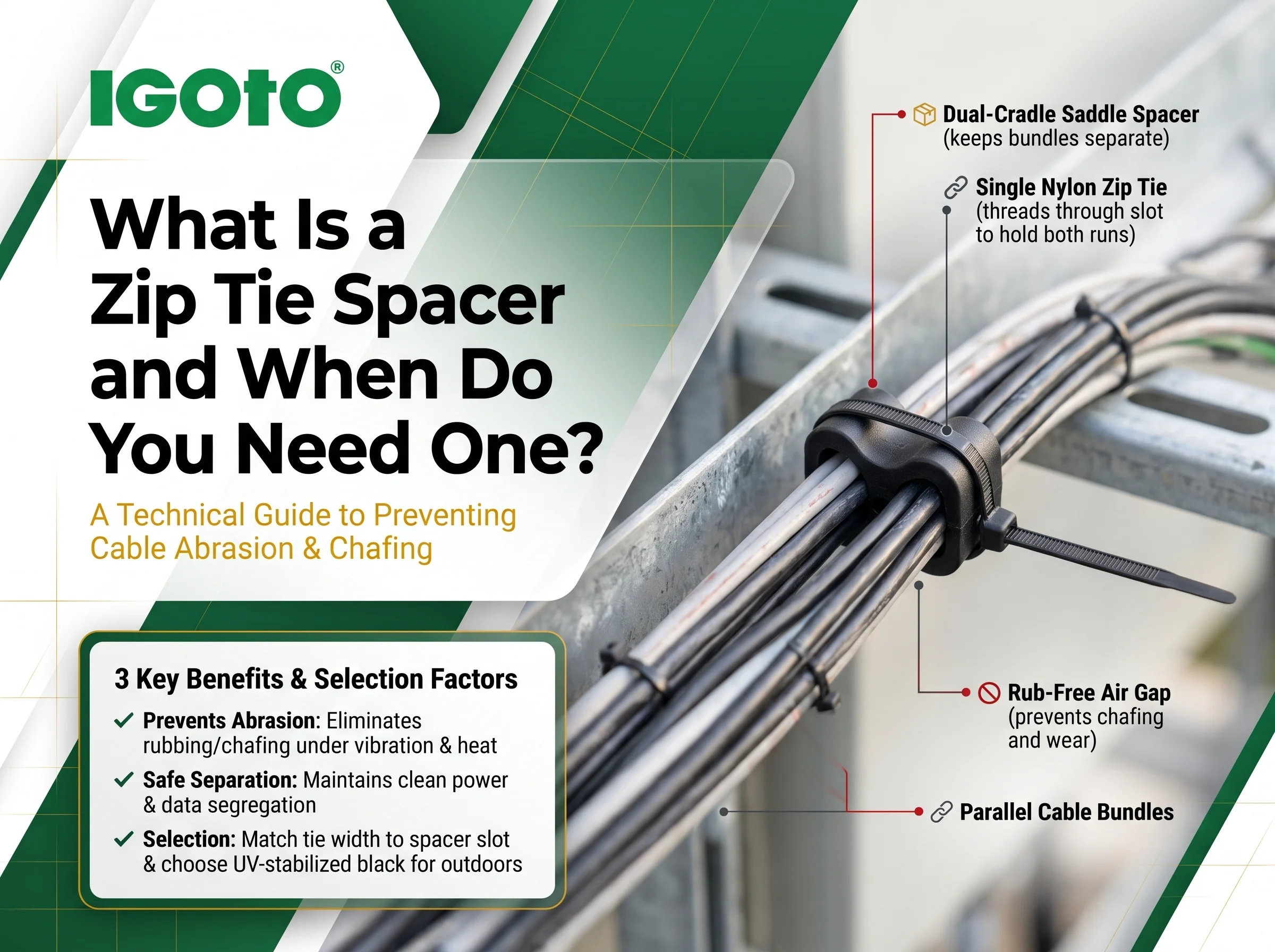
A zip tie spacer is a saddle made of nylon or polymer that holds two bundles of wire, cable, tubing or hose parallelly or crossed with a particular gap. A regular cable tie successfully passes through its slot and wraps around both bundles while the twin cradles of the spacer prevent them from touching. What you get at the end is less wear and tear, better airflow, improved separation of power and data lines and simpler servicing.
What Is a Zip Tie Spacer?
Picture a small bridge that has a saddle on each end. One of the bundles is placed in the top cradle and the other bundle is placed in the bottom cradle. Then a tie passes through the center to keep everything well attached. The tie provides the clamping force while the spacer provides the geometry.
In the absence of a spacer, the common solution is to join the two bundles directly using one lengthy tie. That way may last for only a week but in the course of months frequent movements will make the jackets rub against each other just at that very point where the tie acts as a force. With a cable tie spacer, the contact point becomes smooth plastic separated from the bundles by some air space.
The idea itself is not new. The first patents appeared decades ago and the latest description of a single-piece lashing support spacer tie gives us the idea of the problem: installers were using different spacers and conventional ties while tying the cables. Today’s spacers let do the job faster and in a more systematic way.
Various Kinds of Zip Tie Spacers
Upon searching the term, you will find that many different types of parts go under the same name. Below are all of their kinds.
Parallel Bundle Spacers
This is the classical version: two semicircular brackets oppose each other and there is a pole slot in addition. Moreover, the reels are installed parallel to each other at a distance of more than 1 cm measured between the items. This solution finds frequent applications in harnesses, body frames, and control boxes where either a power supply or signal transmission follows the same path.
Spacer Crosses for 90-Degree Junctions
A spacer cross keeps one bundle perpendicular to another. This is used wherever a branch crosses the trunk; otherwise the two bundles would be placed one on top of another. Small nylon 6.6 versions are made for mini, medium, and standard cross-sectional tie sizes, so they fit roughly ties 2.5 to 4.8 mm wide.
Stackable Standoff and Aerial Spacers
This is a taller and heavier block, usually made as a UV-stabilized black device designed to be snap-fitted on top of another. Telecom teams use this product to maintain fiber/cable away from the overhead messenger cable, while utility teams use it to keep conductors off the support device. Such devices are used together with heavy and extra-heavy ties, or even made of stainless steel working in harsh environment.
Rebar Spacers Fixed With Zip Ties
The construction industry applies the same name for a different thing. A rebar spacer fulfills the function of holding the steel cage at a constant distance from the template, while concrete cover is being formed, being designed to be locked onto the rebar.
DIY and 3D Printed Spacers
Hobbyists print small spacers used to hold narrow patch cables in position relative to switch ports, locking them in with a neat mini tie.
One-Piece Alternatives
Double-ended or dual-loop ties perform the separation function using the zip tie’s design with two heads and one spacer in the middle. Thus, this device has some advantages but is more expensive.
Why Separate Bundles?
One might wonder if using the spacer technology is indeed worth it or not. However, for most professionals, the choice comes down to the five following key considerations when they make their decision:
1. Abrasion resistance – any vibrations produced by the wind, vehicles, motors, and compressors will turn the place of contact between two wires into a grinding wheel. With spacer that slick nylon material will be used as a pad instead of the rubber belt.
2. Temperature control – when a wire transmits electricity, the electricity produces heat. When two wires are pressed against one another, the heat is trapped between the two wires and cannot dissipate, whereas spacer ensures there will be an air space between the two wires.
3. Avoidance of spurious signals – the closer the two wires are to each other, the more interference will be introduced into the data signal. That is especially important for server equipment and wiring as discussed in our article about server wire management.
4. Ease of maintenance – if one wire fails, the technology makes it possible to fix it without disconnecting the whole system.
5. Clarity of wiring – the technicians or inspectors can trace the cable through the harness without having to spend time deciphering where it leads.
The Use of Zip Tie Spacers in Various Applications
Spacers are not the most exciting look, they seem to be always present in the installations where cables need to work in uncontrolled environments.
Installations of Solar Power Generation Systems
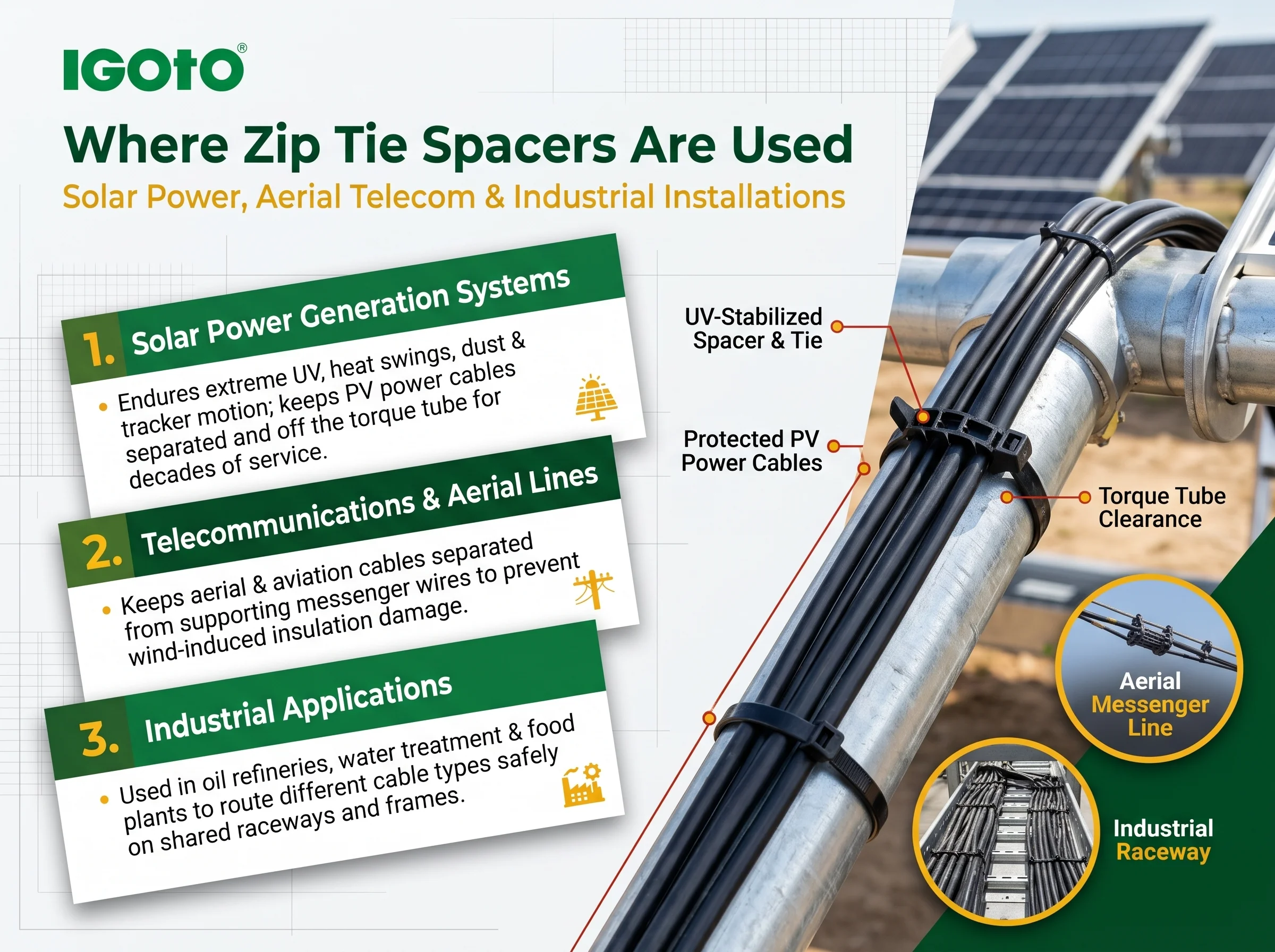
Utility scale and commercial solar power systems located in the southern states of the USA are subject to extreme environmental conditions (high intensity of UV rays, high temperature variations, dust, etc. and have motion in the tracking systems). Spacers keep the power cables separated and stop them from touching each other and prevent them from rubbing against the torque tube. It is important to note that the makers of solar power systems pay a lot of attention to the wire management because it is a matter of durability of the system for decades, and it is impossible to use ordinary indoors.
Telecommunications and Aerial Lines
The use of spacers is also common in the telecommunication and aerial lines. A great example is the aviation cables. The spacer helps keep the cable away from the supporting cable, so that wind doesn’t cause damage to the insulation.
Industrial Applications
In industrial applications, the oil refineries, water treatment plants and food manufacturing factories utilize the spacer systems in the power cables. Due to the use of spacers it is possible to place different types of the cables on the same raceways and frames.
Choosing the Cable Tie That Goes Through the Spacer
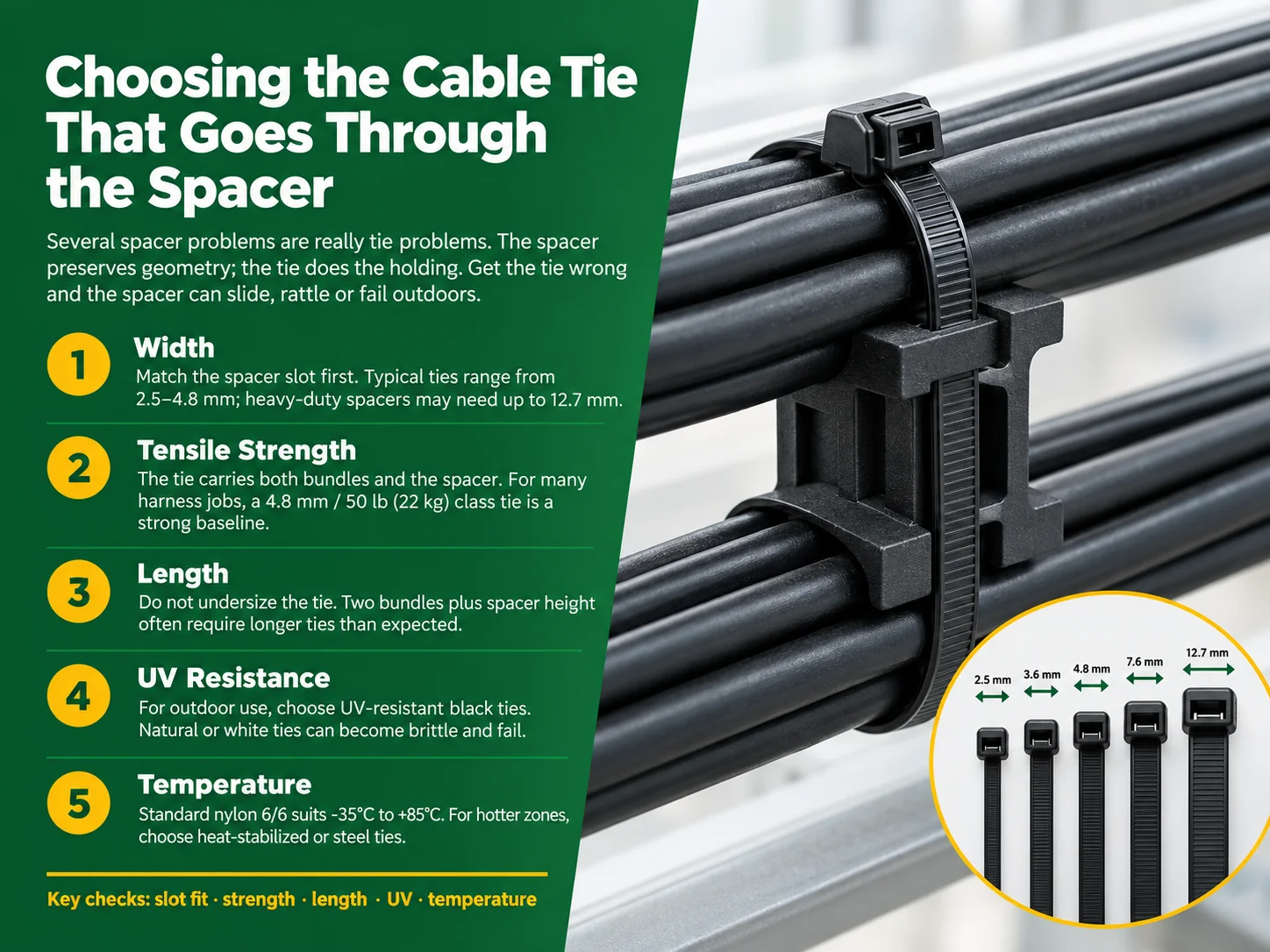
Several spacer problems are nothing more than tie problems. The function of a spacer is to maintain geometrical integrity while the tie does everything else. Attention to this matters.
Select the tie width that fits the spacer slot prior to anything else. If the tie is too thin, it allows the spacer to slide and rattle, whereas a tie that is too thick will either block off the passage or get scraped every time the package moves.
1. Width
Check the dimensions of the slot using the datasheet of the spacer. Small spacers allow using ties from mini- to standard size (about 2.5 – 4.8 mm in width). A heavy bundle spacer requires ties of greater width, up to 0.5 inches or 12.7 mm. Refer to our guía de tamaños de bridas to find what lengths correspond to tension classes.
2. Tensile Strength
The tie now has to hold two bundles in addition to the spacer itself and must involve a leverage effect due to offset influence. Choose an oversized tie instead of an undersized one. For example, a 4.8 mm tie from a 50 lb (22 kg) class like our super-strong cable tie is sufficient for most harnessing and panel operations. If the task involves heavy hoses or prolonged activities on mobile devices, opt for a really thick, durable tie.
3. Length
people often purchase a tie that is shorter than required. In case of two connections made by the spacer, an approximate calculation is as follows:
Tie length ≈ 1.57 × (D1 + D2) + (D1 + D2) + 2 × spacer height + 35 mm for the head and the additional part.
| Bundle diameters | Spacer height | Estimated length | Suggested tie |
|---|---|---|---|
| 2 × 10 mm | 10 mm | about 107 mm | 150 mm (6 in) |
| 2 × 20 mm | 15 mm | about 168 mm | 200 mm (8 in) |
| 2 × 30 mm | 20 mm | about 229 mm | 300 mm (12 in) |
| 2 × 50 mm | 25 mm | about 342 mm | 370 mm (14.5 in) |
4. UV Resistance
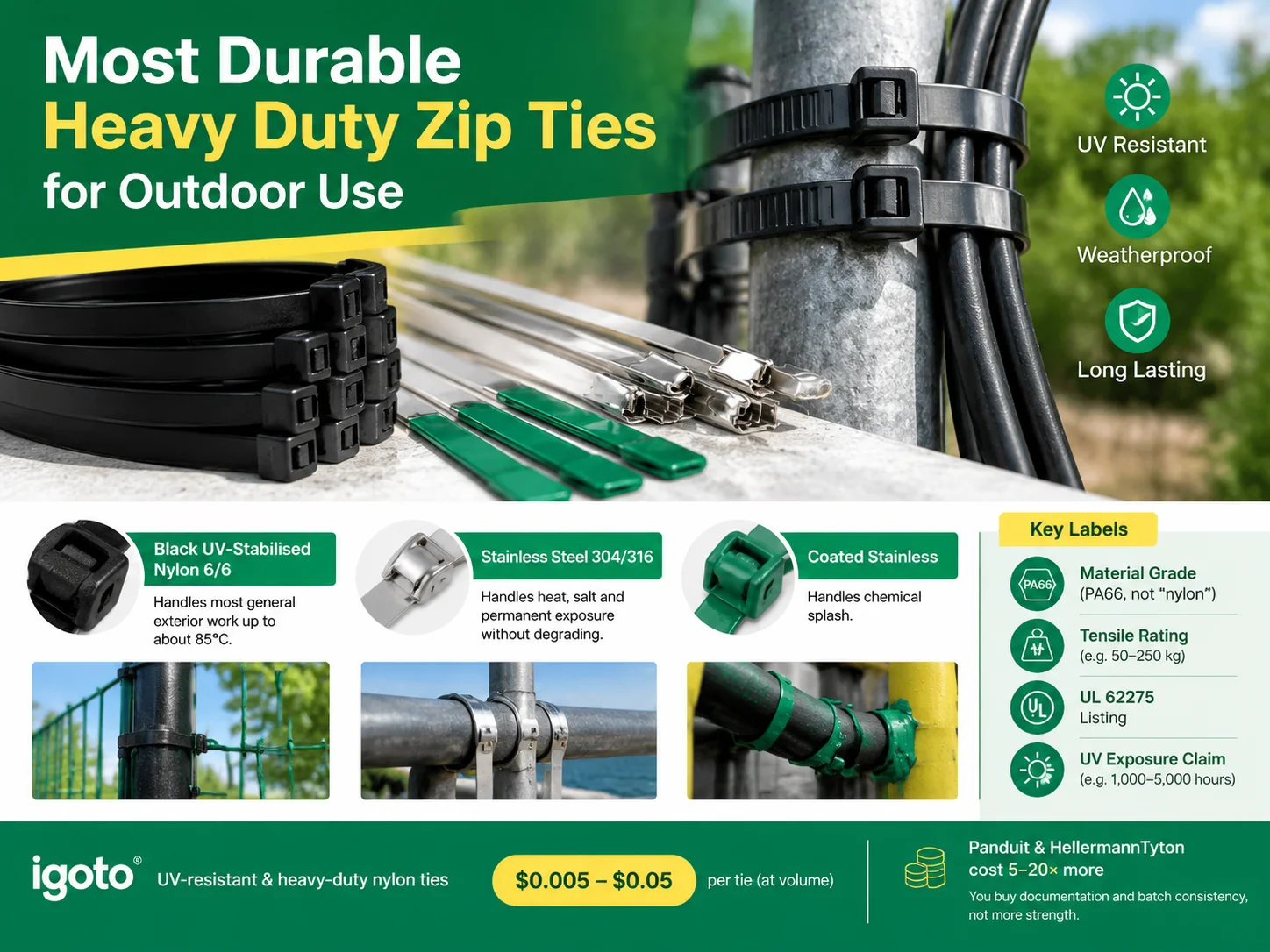
When the spacer device is used outside, a UV-proof tie must be selected. Natural or white ties are not strong enough outside, and the spacer will simply fall off once the tie breaks.
UV-proof ties are assessed using xenon-arc exposure tests such as ISO 4892-2. According to the IEC 62275 / UL 62275 family, the ties must be exposed for at least 1000 hours to be called UV-proof. Our UV resistant black cable ties are made for exactly this kind of solar, telecom and outdoor electrical work, and the article on the mejores bridas para uso exterior compares nylon 6/6, nylon 12 and stainless options in more depth.
5. Temperature
Standard nylon 6/6 ties can be used within the range of -35°C and +85°C. It is OK for connections or outdoor set-ups, yet not for some areas like engine rooms and others. If the ties will be used near high temperatures, heat stabilizing or steel ties should be selected.
How to Install a Zip Tie Spacer Correctly
- Position both bundles along their final route prior to making any attachments, so that the spacers land on the straight portions and not on corners.
- Locate the first bundle in one of the hauls and the other bundle in the other one. One can check on the spacer cross to make sure that the branch actually has a 90-degree angle.
- Push the tie-in its designated slot if it is indicated, then encircle the bundles with it and finally put it in place.
- Pull gently using hand tools and then proceed with tools to make sure that every spacer in the installation got the same amount of tension applied. More on tensioning however can be found in the message on zip tie guns.
- Trim the end without any sharp edges. This is crucial as a small sharp edge can damage the cable jacket and skin tissue The flush-cut methods in this guide keep that edge smooth.
- Space the assemblies evenly according to the diagram, manufacturing recommendations, or appropriate code applicable to the project.
- Shake the structure to make sure that all spacers remain fixed without any gap between the cradle and bundle.
Errores comunes a evitar
- Excessive tightening. Pulling on the tie too much will reshape the cradle and cause a fracture of the thin spacers, which can lead to pinching of the cable located beneath them.
Outdoor application of indoor ties. Ties in their natural color used in the rooftop spacer assembly are a recipe for failure.Ignoring the anchoring process. The purpose of the spacer is to keep the two bundles separate; it does not provide the attachment of the bundles to the surface like a wall or a structure. If the bundles need to stick to the surface, one of the mounting methods discussed in our article on cómo elegir bridas de cable montables. - Injury through the use of the wrong material combination. Nylon ties run through metal spacers have sharp edges and will eventually cut through. The edges of the part must be deburred or compatible parts should be picked.
Can You Skip the Spacer?
At times, yes. While going for short runs indoors, not causing any vibration, having two distinct ties in tandem with two separate mounts makes it possible to separate wires without adding any more parts to the set. Having a dual-head tie solves this issue by using only one part. Having either a split loom or a spiral wrap over one bundle would stop the two runs from wearing through each other.
The great thing about a spacer is using it on long runs in outdoor conditions. For example, its usage on solar trackers, aerial telecommunications, on truck chassis or in large industrial installations pays off quickly, ensuring years of effective problem-free operation if the right tie is used. You can browse widths, lengths and grades on our nylon cable ties and cable glands page.
Preguntas Frecuentes
What is a zip tie spacer used for?
It keeps two bundles of cable, wire, hose or tubing at a fixed distance from each other while one tie holds both. The goal is to prevent abrasion, improve airflow and keep different cable types separated.
Do you need special zip ties for a spacer?
No special type, just the right width and length. The tie must fit the spacer’s slot, be long enough to wrap both bundles plus the spacer, and suit the environment, which outdoors means UV-stabilized black nylon.
What is the difference between a spacer and a double-head cable tie?
A spacer is a separate part used with an ordinary tie, so you can choose the tie size freely. A double-head tie has the separation molded into the tie itself, which is quicker to install but less flexible on width and length.
How far apart should zip tie spacers be placed?
It is impossible to provide a single figure. Consult the installation harness drawing, the cable manufacturer’s advice, or the corresponding law. In the case of vibrating equipment, keep the spacers closer together and as close as possible to the place where two runs could bump into each other.
Can zip tie spacers be used outdoors?
Yes, if both the spacer and the tie are UV-stabilized. Black UV-resistant nylon is the usual choice, with stainless steel ties for coastal, chemical or extreme-heat sites.
Referencias
- Brida, Wikipedia
- US9958089B2, Lashing support spacer tie, Google Patents
- Rebar spacer, Wikipedia
- Understanding Solar PV Wire Management, Greentech Renewables
Conclusión
Zip tie spacer are the cheapest and the most functional elements of any wiring work, able to prevent the slow and hidden damage. Choose the right kind of spacer depending on the geometry: parallel, crossed or standoff. Then turn your attention to the actual zip tie: it must have the proper width that matches the slot, the proper length to zip together both bundles and sufficient strength capable of holding everything together and UV-stabilized black nylon in case the sun can reach it.