




Cintas de Cabo Resistentes ao Frio para Instalações Árticas e Abaixo de Zero
A IGOTO fabrica cintas de cabo resistentes ao frio para locais onde a instalação não pode esperar por um dia quente: fazendas solares, armários elétricos externos, torres de telecomunicações, armazenamento a frio e trabalho de utilidade em toda a Europa do Norte, Canadá, Ásia Central e no norte dos Estados Unidos.
Duas classificações para frio são produzidas na mesma linha que a gama padrão. A classificação de PA66 modificada para impacto é classificada para instalação até -20°C, e a classificação de PA12 (nylon 12) mantém sua resistência ao impacto até -40°C com menor absorção de umidade e melhor estabilidade UV para trabalho exposto ao ar livre.
Cada cinta de cabo para temperaturas baixas é moldada a partir de PA66 ou PA12 virgem, estabilizada com negro de carbono para UV, e fornecida com um registro de tração por lote. Tamanhos padrão de 2,5 mm a 4,8 mm de largura estão disponíveis com seu rótulo, sua cor e sua embalagem.

O que Torna uma Cinta de Cabo Resistentes ao Frio?
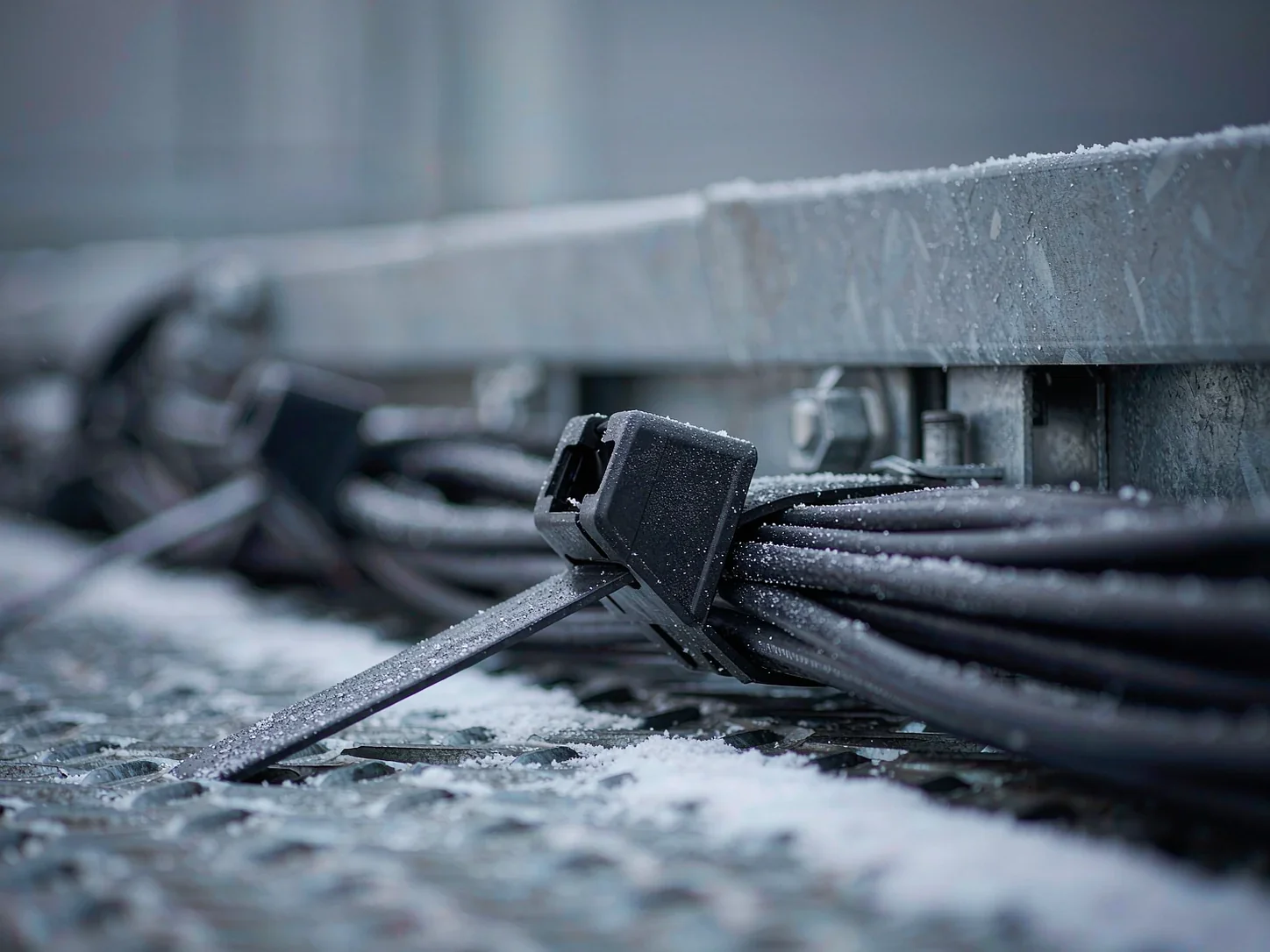
Uma cinta de cabo resistente ao frio não é simplesmente uma cinta preta vendida para o inverno. A diferença está no polímero e na geometria da cabeça de bloqueio, pois é aí que uma cinta falha quando a temperatura cai.
O nylon 66 absorve umidade do ar. Em baixa temperatura, essa umidade endurece a cadeia polimérica e a resistência ao impacto cai drasticamente, de modo que a cinta não se flexiona mais em torno de um feixe ou sobre uma borda afiada. A própria cinta geralmente está boa; o trinco dentro da cabeça é o que se quebra.
As classificações para frio resolvem isso de três maneiras: um polímero de baixa umidade como o PA12, um modificador de impacto que mantém a cabeça dúctil abaixo de zero, e uma seção de trinco ligeiramente mais espessa que distribui a carga em vez de concentrá-la em um dente.
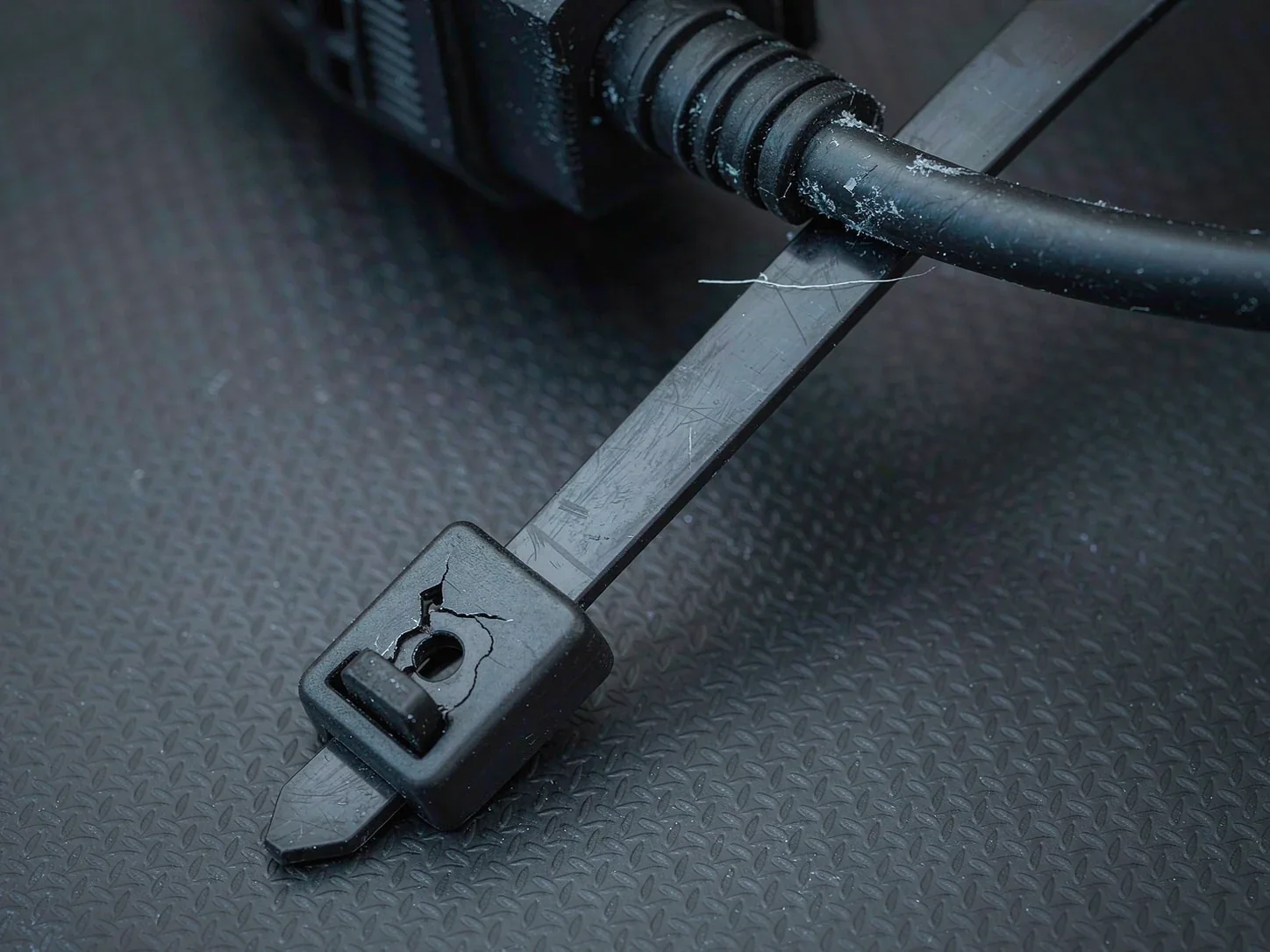
Por que Cintas de Nylon Padrão Quebram em Temperaturas Baixas
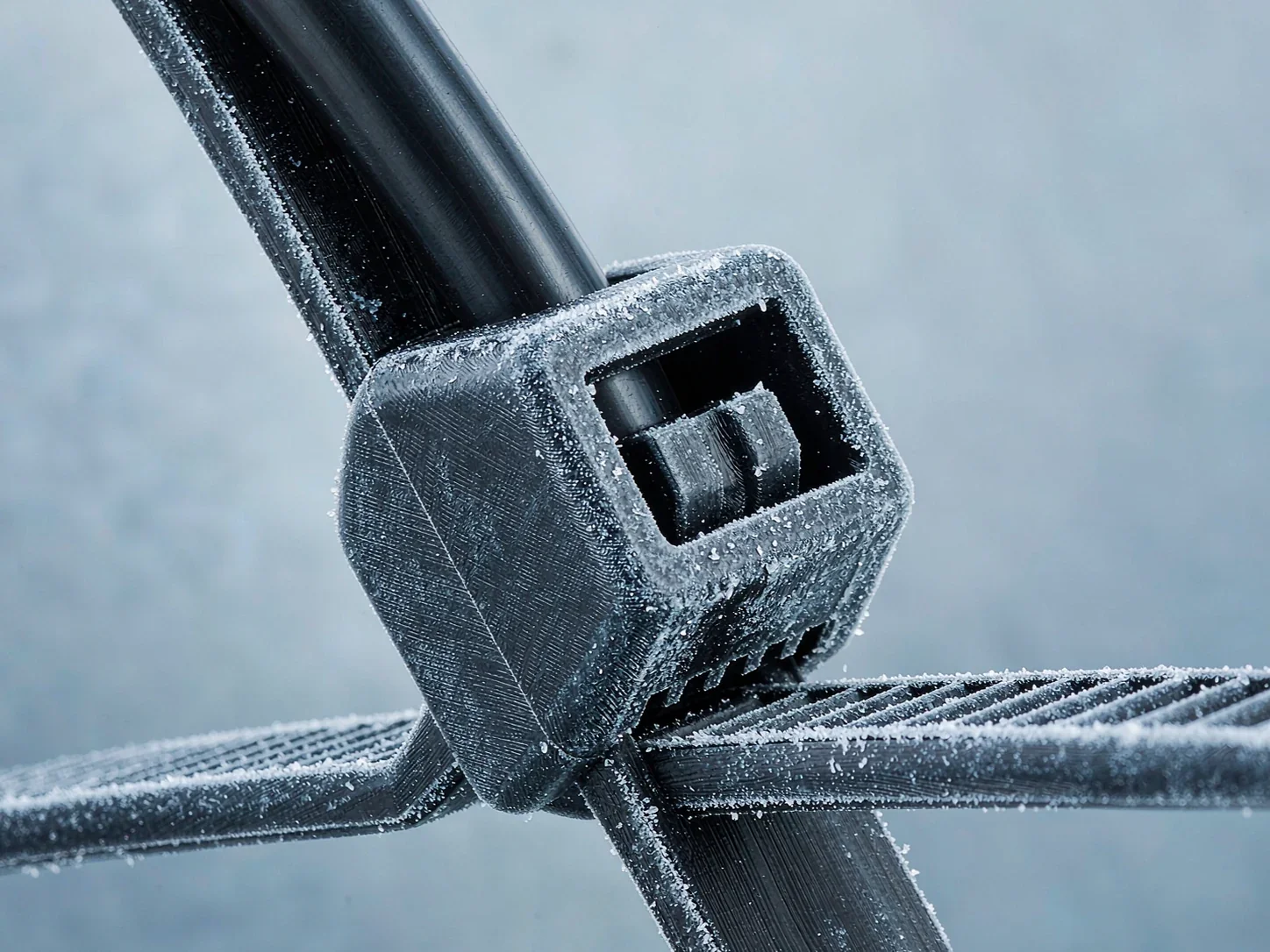
Uma cinta que esteve em serviço por dois invernos raramente falha sozinha. Ela falha durante a instalação, nos dois ou três segundos em que a cauda é puxada através da cabeça e o trinco precisa se dobrar.
Abaixo de cerca de -10°C, uma cinta padrão de PA66 perde a maior parte de sua resistência ao impacto. Puxe com muita força, ou dobre a cauda contra a borda de um suporte de cabos, e a cabeça se quebra em vez de se flexionar. A mesma cinta instalada em julho e deixada intocada teria durado anos.
A segunda causa é a sobre-tensão. Uma cinta puxada até seu limite a 20°C já está sob estresse; a -30°C esse estresse fica em um material quebradiço durante todo o inverno. Cintas para temperaturas baixas são especificadas com uma ferramenta de tensão e deixadas ligeiramente mais soltas do que uma instalação de verão.
Cinta de Cabo para Temperaturas Baixas Faixa de Temperatura
A temperatura de serviço e a temperatura de instalação são dois números diferentes. Uma cinta pode suportar -40°C em serviço e ainda assim quebrar se for instalada a -25°C, então ambas as colunas são importantes ao especificar.
| Grau do material | Temperatura de serviço | Temperatura de instalação | Melhor para |
|---|---|---|---|
| PA66 padrão, preto UV | -35°C a +85°C | -10°C e acima recomendado | Fiação interna, gerenciamento geral de cabos, climas amenos |
| PA66 modificado para impacto | -40°C a +85°C | -20°C | Armários externos, canteiros de obras, dever em clima frio geral |
| PA12 (nylon 12) | -40°C a +85°C, curto prazo +110°C | -30°C | Fazendas solares, locais costeiros, alta UV e condições de frio úmido |
| Grau especial de baixa temperatura | -60°C sob solicitação | -40°C | Locais árticos, cadeia fria, salas de refrigeração e congelamento |
Os valores são para o grau, não para um único cupom de teste. A faixa de serviço final depende da largura da fita, do diâmetro do feixe e se a amarração está sob tensão contínua. Confirme o grau em relação à temperatura mínima do local antes de fazer o pedido.
Tamanhos de Amarração Resistente ao Frio e Resistência à Tração
Os graus frios usam os mesmos moldes que a linha padrão, portanto, o tamanho que você já utiliza pode ser fornecido em um material de inverno sem alterar o feixe, a ferramenta ou o desenho.
| Modelo | Largura × comprimento | Resistência | Typical bundle |
|---|---|---|---|
| ET-3×100 | 2.5 × 100 mm (4″) | 8 kg | up to 22 mm |
| ET-3×200 | 2.5 × 200 mm (8″) | 8 kg | up to 50 mm |
| ET-4×300 | 3.5 × 300 mm (12″) | 18 kg | up to 76 mm |
| A5×400 | 4.8 × 400 mm (16″) | 22 kg | up to 110 mm |
| ET-5×500 | 4.8 × 500 mm (20″) | 22 kg | up to 140 mm |
Bundle figures are a working guide at 80% of usable strap length. Tensile values are loop tensile at 23°C; at -40°C the PA12 grade retains most of that figure while a standard PA66 tie loses a significant part of it.
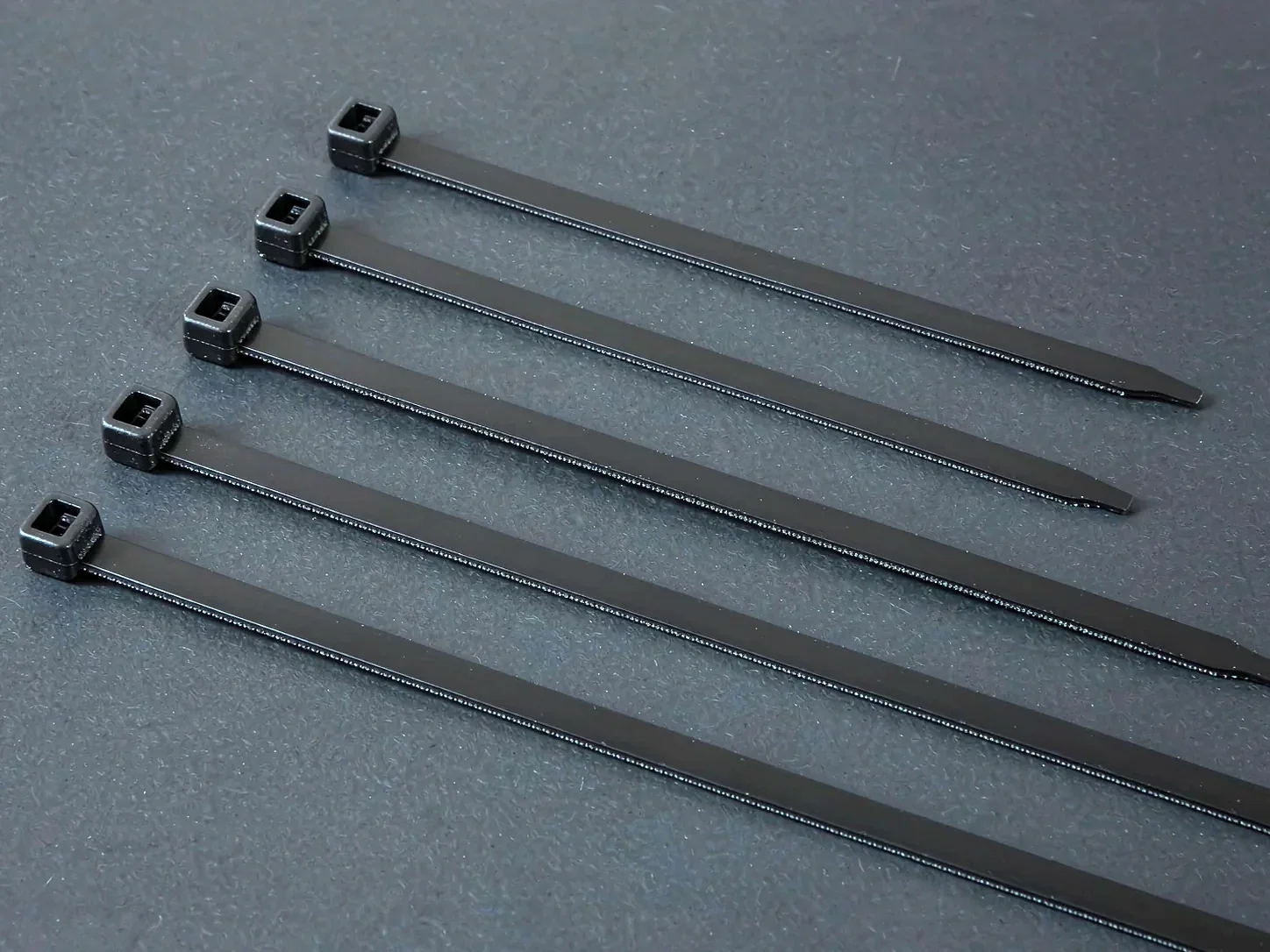
Sizes 100 mm to 500 mm, width 2.5 mm to 4.8 mm, in standard black or a custom colour.
Where Cold Weather Cable Ties Are Used
Cold resistance matters most where the tie is installed outdoors, in an unheated building, or on equipment that is commissioned in winter and then left alone for years.
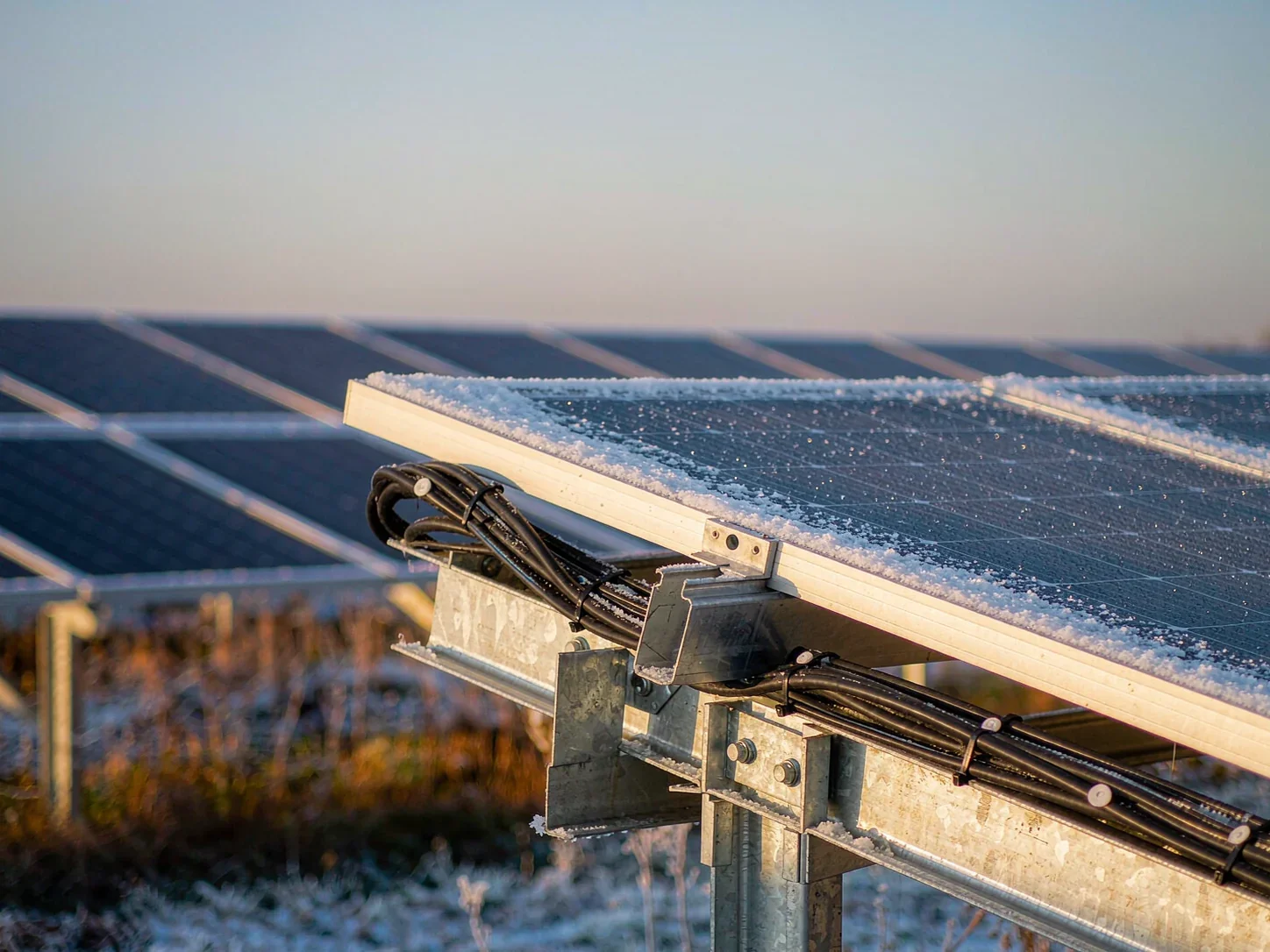
Solar and Outdoor PV
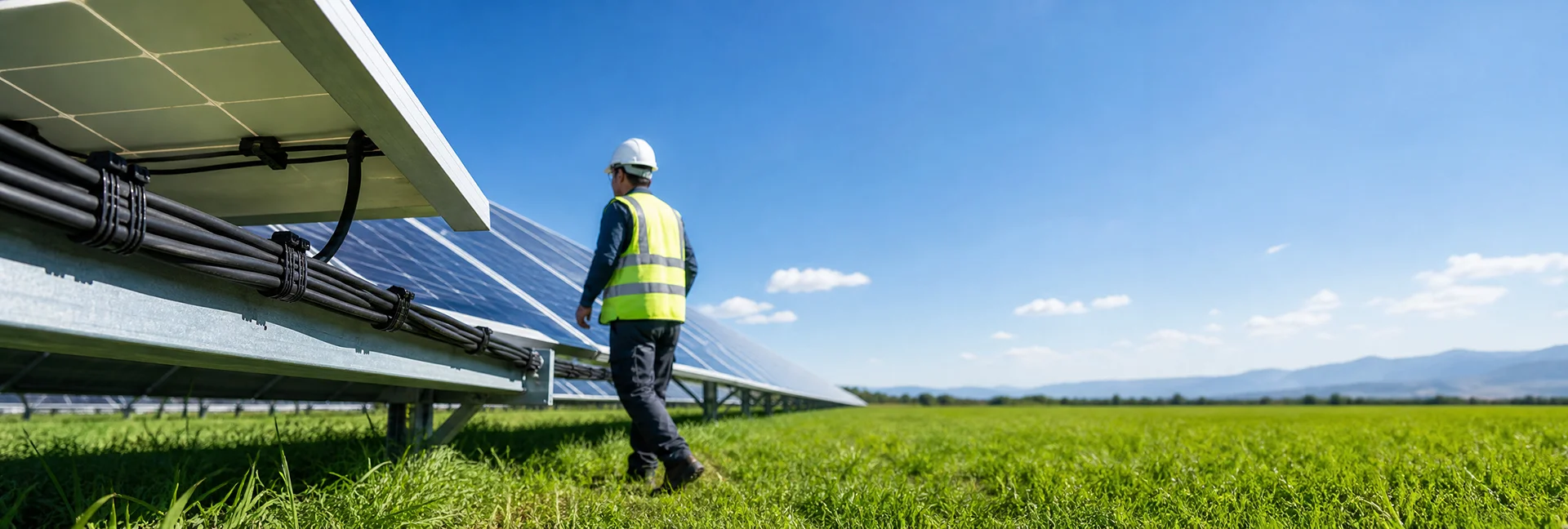
Array cabling is fixed in winter and inspected in summer. PA12 resists both the cold snap at installation and the UV load of twenty summers on the rail.
View UV Resistant Cable Ties →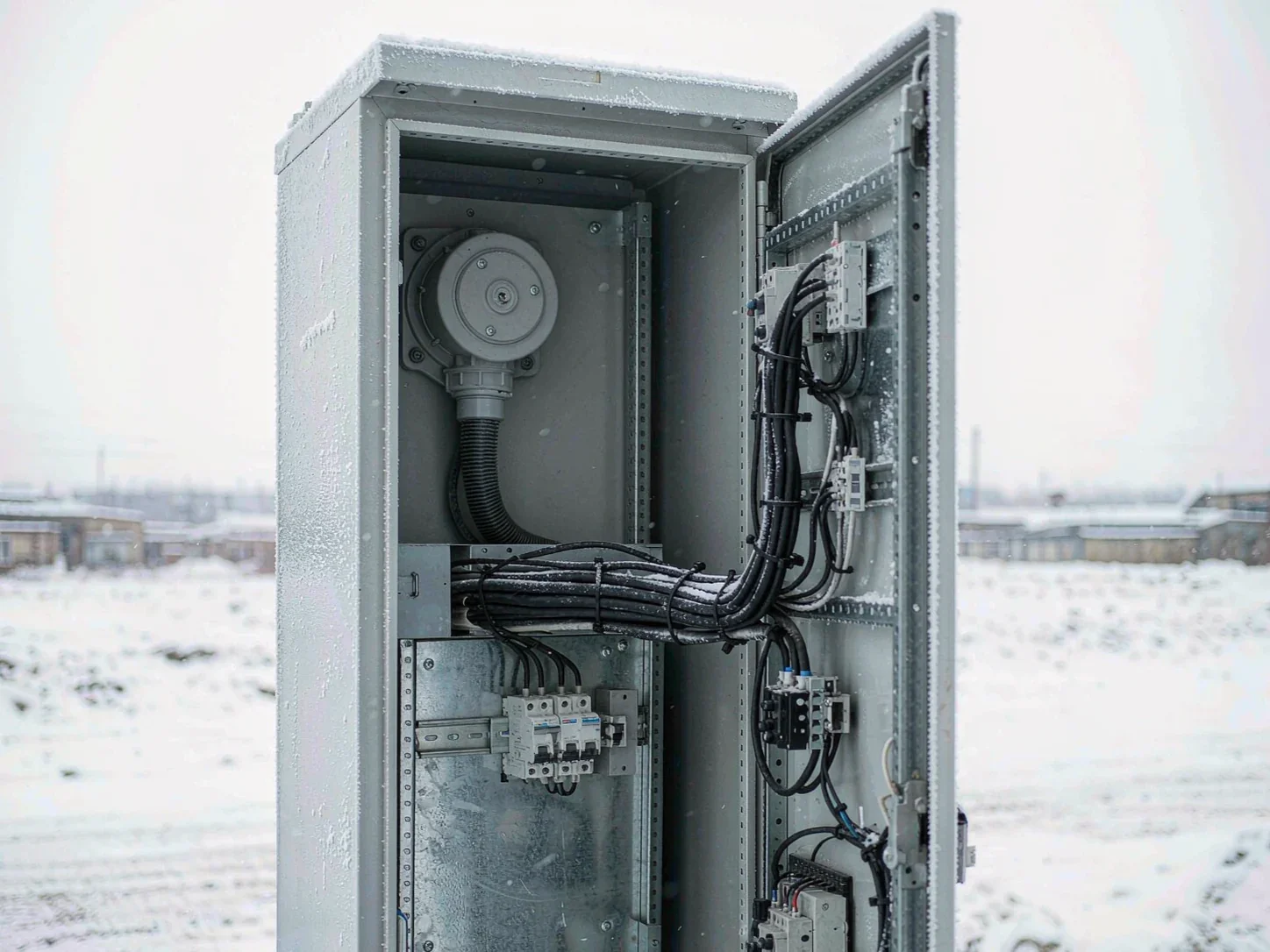
Outdoor Cabinets and Telecom
Distribution cabinets, CCTV poles and telecom enclosures are often wired on site in sub-zero weather, then sealed for years without inspection.
View Cabinet Cable Ties →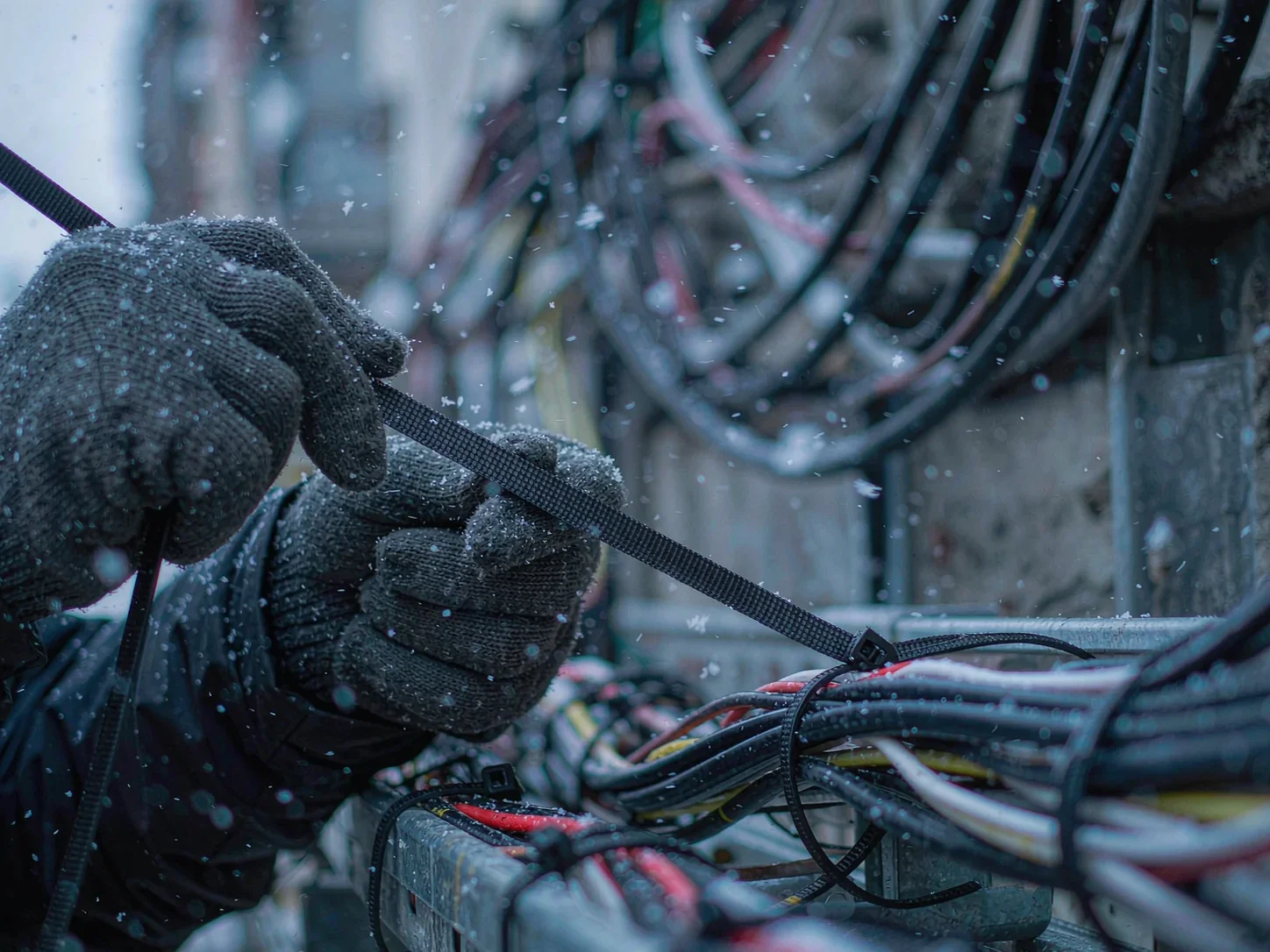
Winter Site Work and OEM Kits
Contractors working through winter need a tie that survives a gloved hand and a cold tail. Distributors can stock the grade under their own label.
Ver Opções OEM →Material Options for Cold Weather Cable Ties
- Impact-modified PA66: the cost-effective cold grade, installable to -20°C and suitable for most outdoor cabinet and construction work.
- PA12 (nylon 12): lower moisture absorption and better low-temperature impact, installable to -30°C and rated to -40°C in service.
- UV stabilised black: carbon black masterbatch for exposed sites; natural (white) is not recommended outdoors.
- Flame retardant option: UL-94 V2 available where the enclosure specification calls for it, with a small reduction in low-temperature impact.
- Colour: black as standard, custom colours matched to a sample or a Pantone reference for brand and identification work.
How to Specify the Right Grade
- Start with the lowest site temperature, not the average winter figure. A -25°C night decides the grade, not a -5°C afternoon.
- Separate installation from service. If the tie is fitted in a heated workshop and installed later, a cheaper grade may be acceptable.
- Check UV exposure. Cold and sun often come together on solar and high-altitude sites; specify black, stabilised material.
- Allow for gloves. A longer tail and a wider strap are easier to handle at -20°C than a 2.5 mm tie.
- Ask for the batch record. Tensile results and material grade on paper are what an inspector will ask for later.
Private Label Packing for Cold Grade Ties
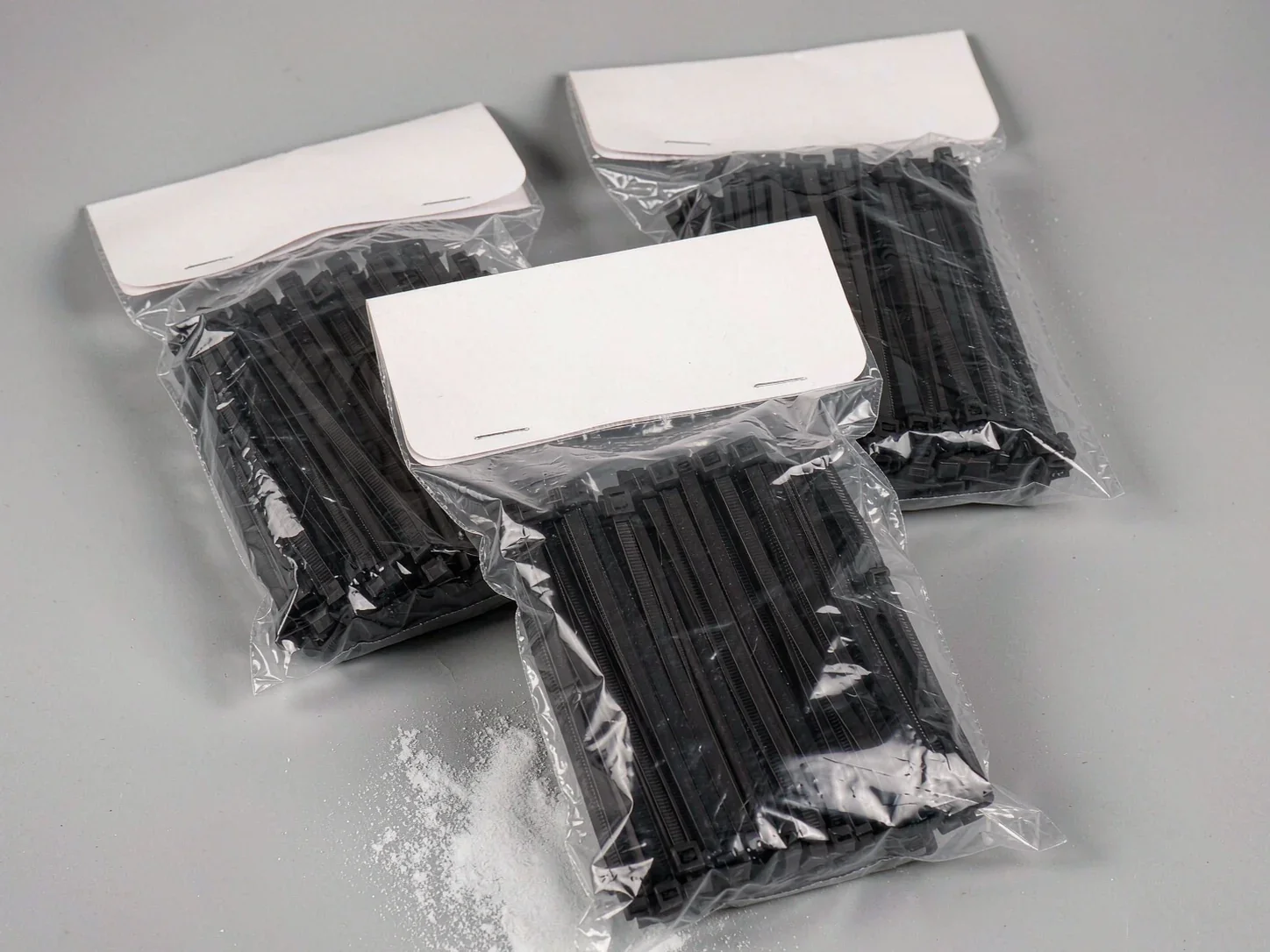
Cold grade ties are usually bought by distributors and contractors who need their own brand on the shelf, not a generic bag. IGOTO packs to your artwork: header card, poly bag with printed label, barcode and export carton, with the grade and temperature range printed on the label rather than left to memory.
- Header card, poly bag or bulk carton, sized to your shelf or your site store
- Label carries the model, tensile strength and service temperature range
- Mixed cartons for a distributor range, or one size per carton for project delivery
How Every Cold Weather Batch Is Tested
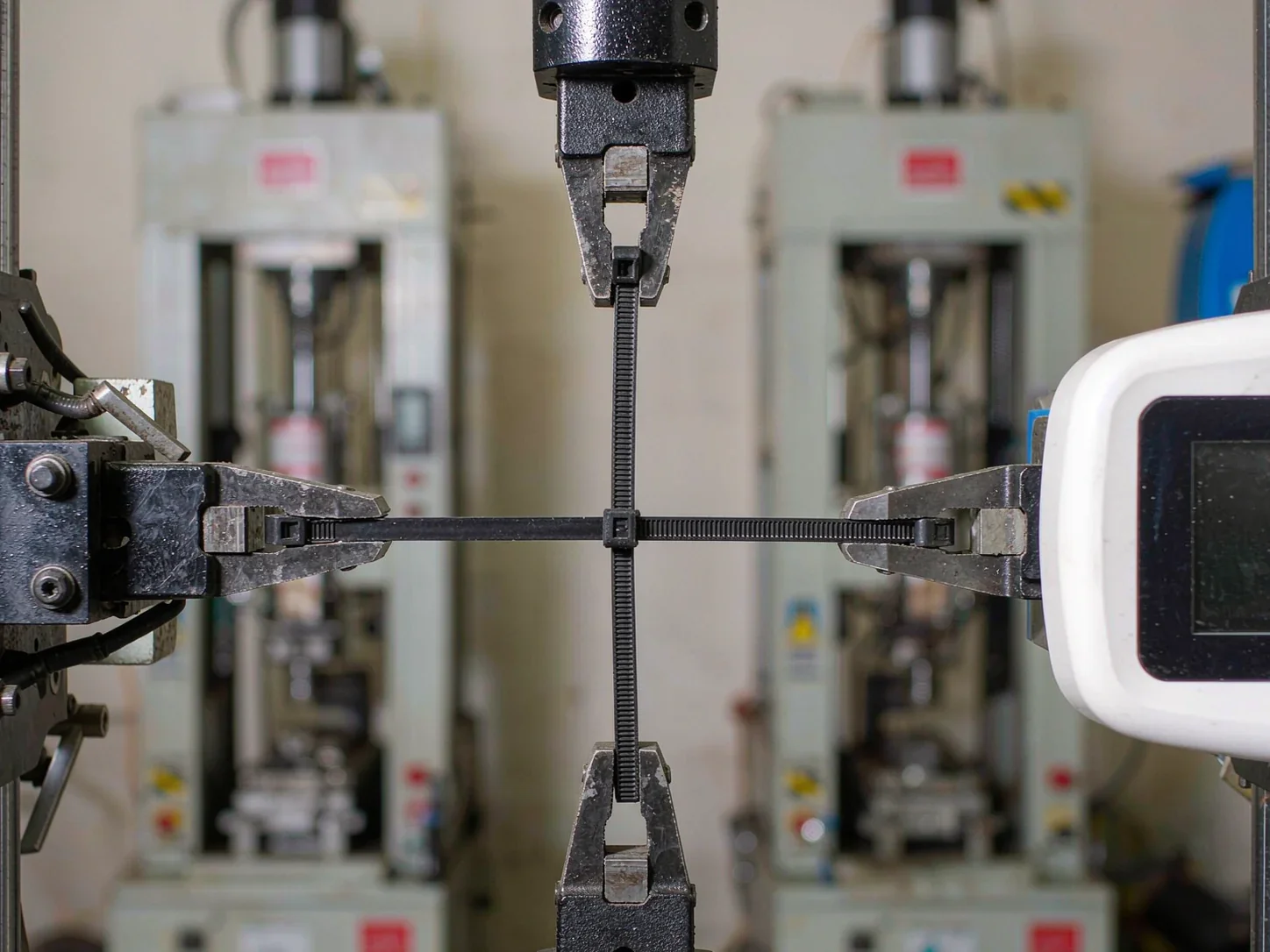
Cold performance is not a claim on a label. It is a measurement, and these are the checks that run on each production batch before the cartons are sealed.
| Test item | Método | What it proves |
|---|---|---|
| Resistência à tração de laço | Pull test to UL 62275 / EN 50146 at 23°C | The tie holds the load printed on the bag |
| Low-temperature impact | Conditioned at the declared minimum, then looped and struck | The head flexes instead of cracking during installation |
| Locking performance | Pull-back test on the pawl and teeth | No tooth slip under vibration and thermal cycling |
| UV ageing | Accelerated exposure to ISO 4892-3 | Retained strength after years of outdoor exposure |
| Dimensions | Width, thickness and length against the drawing | The tie fits the tool and the cable duct |
| Inflamabilidade | UL 94 vertical burn | V2 rating where the enclosure specification requires it |
Test reports are supplied per batch on request, and a witnessed inspection can be arranged before shipment. The controle de qualidade page shows the same stations on the factory floor.
Cold Weather Cable Tie FAQ
What is the maximum temperature zip ties can withstand?
For standard nylon 66 cable ties the continuous service limit is about 85°C, with short excursions to roughly 105°C. Heat-stabilised grades extend the continuous figure to about 105°C. Above that, nylon softens and the pawl loses its grip, so the next step is a different polymer: PPS ties are used to about 170-200°C, PEEK to about 250°C, and stainless steel where temperature and fire risk are both present. The melting point of PA66 is around 255°C, but the useful limit is far below it because the tie creeps under load long before it melts.
Quais são algumas fitas de alta temperatura resistentes?
Heat-stabilised nylon 66 is the common first step, rated to about 105°C for engine bays, lighting and industrial cabinets. Beyond that, PPS ties cover roughly 170-200°C, PEEK ties about 250°C, and ETFE or PTFE ties are used where chemical resistance matters as much as heat. Stainless steel ties are specified for exhaust wrapping, kilns and fire-rated routes because they have no polymer to soften. IGOTO supplies heat-stabilised PA66 as standard and can quote the higher-temperature polymers against a sample.
Do snow tire zip ties work?
They work for a short distance in an emergency, and they are not a substitute for chains or winter tyres. The idea is to loop heavy ties around the tyre and rim so the heads bite into snow, which gives a little extra traction on a stuck vehicle. Two limits matter: a standard nylon tie becomes brittle well below zero and snaps within a few hundred metres, and a broken tie can wrap around the brake caliper or the ABS sensor. If the method is used at all, specify a 4.8 mm PA12 tie for cold impact strength, fit them on driven wheels only, keep the speed very low, and cut every tie off before returning to a public road.
At what temperature do plastic zip ties melt?
There is no single melting point for plastic zip ties because the polymer decides it. Nylon 66 melts at roughly 255°C and nylon 12 at roughly 178-180°C, while PVC ties soften around 80°C. In practice the useful limit is much lower than the melting point: a nylon tie under continuous load begins to creep at around 85°C, and a nylon 12 tie loses rigidity earlier than a nylon 66 tie at the same temperature. That is why cold-resistant PA12 is specified for winter and not for hot enclosures.
Start Your Cold
Resistant Cable Tie Project
Tell us the lowest site temperature, the tie size, the quantity and the packing you need. We will confirm the grade, send samples and quote against a written specification.