




Can You Use Zip Ties on a Construction Site?
If you step foot in a construction site, you will most likely notice how zip ties are used for a variety of applications by lunch time. They can help hold a silt fence to post made of steel, tie up PEX tubes to wire mesh, bundle out cables in a rough-in, be used as clamps for flexible ducts, or pinning banners to temporary fences. Zip ties are cost effective, required no specialized skills, which is exactly why they are often misused.
In this guide you will learn why zip ties are used in construction, what really the codes say about these items, what functions they cannot perform, and what to look for in zip ties that will endure heat and sun and handle concrete without problems.
Construction zip ties are made of stainless steel or nylon materials that can be used for rebar and radiant tubes, electrical wiring, HVAC flex ducts, as well as silt and temporary fencing. Codes and regulations allow zip ties to be used in construction but with some restrictions; for example, NEC states that only certain zip ties should be used for NM cables, while UL1644 standards require the use of zip ties for flex ducts. Zip ties cannot serve as fasteners; therefore, they should not be a part of scaffolding or other construction tools.
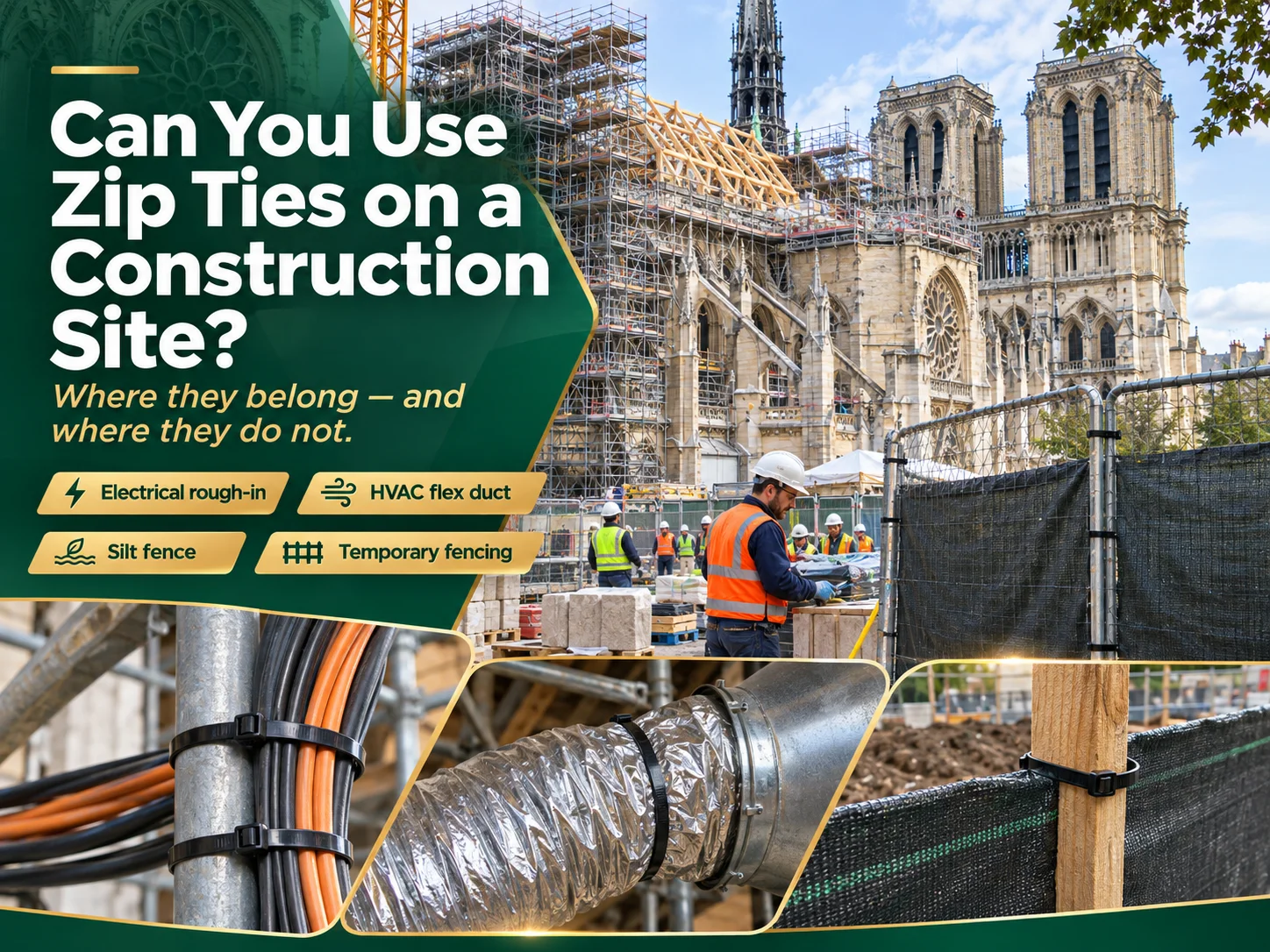
How Zip Ties Came to Dominate Construction Sites
While other fastening materials like tie wires, staples, hose clamps and screws retain their usefulness in many instances, zip ties are superior when time is of the essence for the following reasons.
Speed. A tie can be installed in just a few seconds using one hand without the need for any twisting of the wire.
Reliability. A tensioning tool maintains a consistent tension each time, unlike twisted wires.
No sharp edges. A flush-cut nylon tie does not leave any wire protruding that could pose a danger to workers.
There is a point to remember when using zip ties: the same tie could be great for one job and dangerous for another.
The Use of Zip Ties in Construction Work
Reinforced Steel Bars, Wire Mesh, and Radiant Tubing
Are Zip Ties Suitable for Rebar? Yes. Although it depends on the construction codes and rules that have been set by expert engineers. There are no specific regulations set apart by the ACI while it comes to using plastic ties for reinforcing steel. Furthermore, the plastic ties have been found useful in jobs where using steel wires seemed impractical. Some contractors also take it further where the coated bars are concerned. For example, the specifications set by Iowa DOT allow the use of tie wires made of plastic, nylon, epoxy-coated steel while working with the epoxy-coated bars. In short, it is always the building specifications to decide whether to use zip ties in any worksite.
However, zip ties are usually able to withstand small loads while working with slab-on-grade steel mesh, footings and radiated flooring. Moreover, most manufacturers of such systems offer plastic zip ties of about 220 mm in length.
Of course, the zip ties become less effective in combination with columns and heavy reinforcements.As far as the requirements for NM cable (known as Romex), the National Electrical Code stipulates that various methods can be used for securing and supporting the cable: staples, straps, hangers, and cable ties that are explicitly rated as suitable for securing and supporting the cable. It is especially important to point that regular cable tie from a hardware store does not mean that a cable tie in question is considered acceptable for securing NM cable. Only ties that are listed as appropriate for fabrication and support can be used. It is also important to follow usual NEC requirements: NM cable should be secured within 12 inches from a junction box and not spaced more than 4.5 feet from the next secured point.
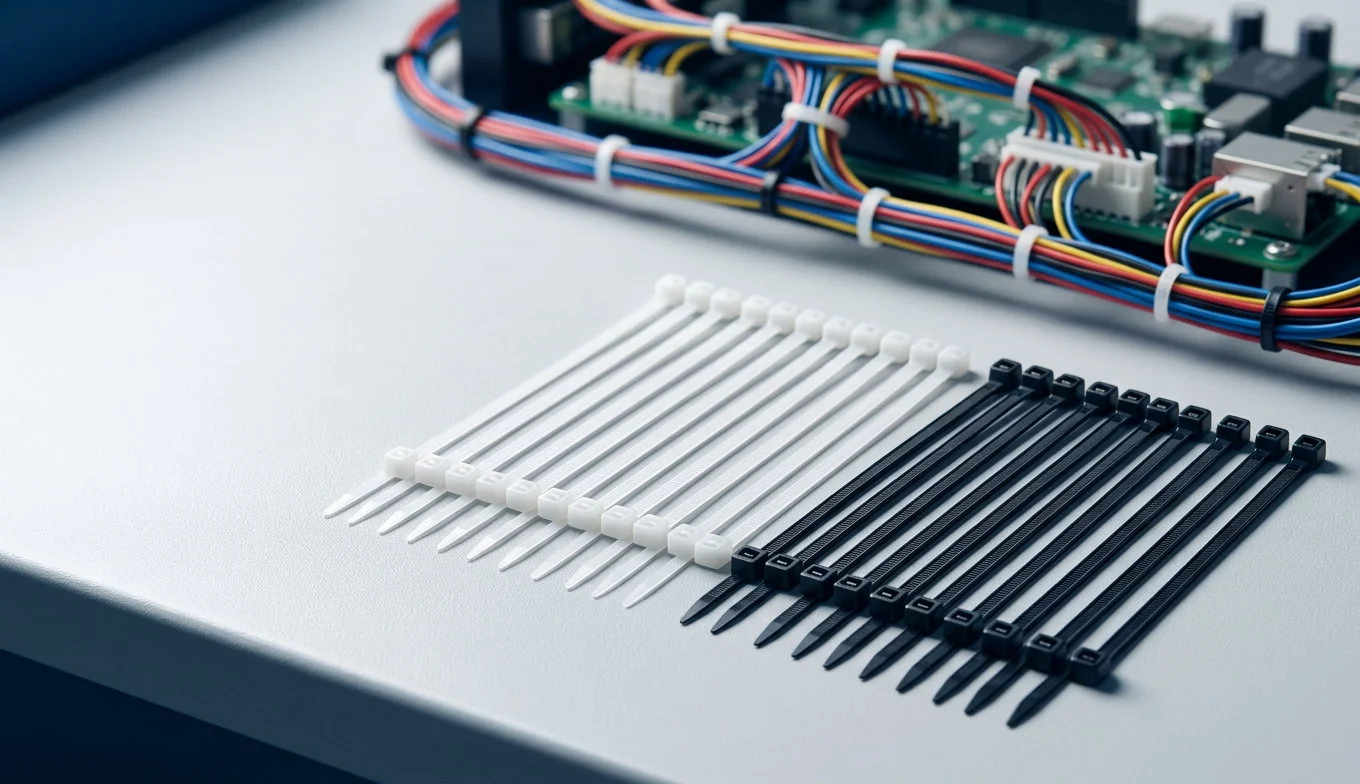
Using ties for bundling conductors inside panels and for properly dressing low-voltage cable is not an issue. If ties are going to be used in areas with strict airflow requirements, only those ties which are specifically marked for such use should be used, and in fire-rated assemblies, firestop system guidelines should be strictly followed.
Flex duct in HVAC industry
When it comes to installation projects that involve flexible ducts, it is usually the case that a flexible duct is secured to the collar or fitting using long nylon cable ties. The Air Diffusion Council standard states that nonmetallic clamps approved by UL 181B and labeled 181B-C should be utilized, whereas the National Renewable Energy Laboratory has its own requirements for tie bands that would require UL 181 approval and the use of tensioning tools for installation of the tie bands.
In practice, it is very important to remember that the ties should be tightened properly. The cable tie should be inserted into the collar before the first bead or rib of the collar, and then it should be sealed using mastic or tape and tightened.It is crucial to acknowledge that hot temperatures can ruin nylon, therefore make use of heat-rated and heavy-duty duct ties. It is important to bear in mind that although the ties do attach the duct to the fitting, the duct requires its own support straps to be held in place.
Silt Fencing and Erosion Control
Erosion control happens to be one of the few applications which make explicit mention of zip ties. For example, the city of Minot in North Dakota has specified that the silt fencing needs to be secured to the posts by means of at least three zip ties rated with a tensile strength of 50 lbs in the upper eight inches of the fabric. In Wisconsin, the technical regulations state that silt fence fabric can be attached to steel posts with 50 lbs plastic ties or wire fasteners in at least three locations. The ends need to be pointed away from the fabric. There are some other entities which advocate the use of wire, cord or staples, so it would be worthwhile to check the local regulations.
Temporary Fencing, Banners, and Signs
Almost all temporary fences, privacy screens, safety signs, and advertising banners are zip-tied to the poles they are secured to. This is done without any regard to the fact that those ties are exposed to sun and wind. Therefore it is highly recommended to use UV-stabilized zip ties of at least 50 lbs of weight.
Debris Netting and Screens
Debris netting is often secured on building edge by means of the ties. While this makes sense for a net that is aimed at catching small debris it does not apply for other situations.
Plumbing, Low-Voltage, and Everything Else
Plumbers use ties to fasten PEX pipes as well as wires, workers in low-voltage industry use ties to bundle data wires, and each industry makes good use of color-coded ties to mark their wiring. When a tie needs to anchor into masonry or concrete rather than wrap a bundle, use a proper anchor or screw mount; our guide on fixação de amarras de cabos em drywall, concreto ou tijolo. walks through the options.
Zip Ties vs Tie Wire for Rebar
Because “can I use zip ties for rebar” is one of the most common jobsite questions, here is how the two methods compare. The short version: zip ties for light mats and tubing, tie wire for heavy structural cages.
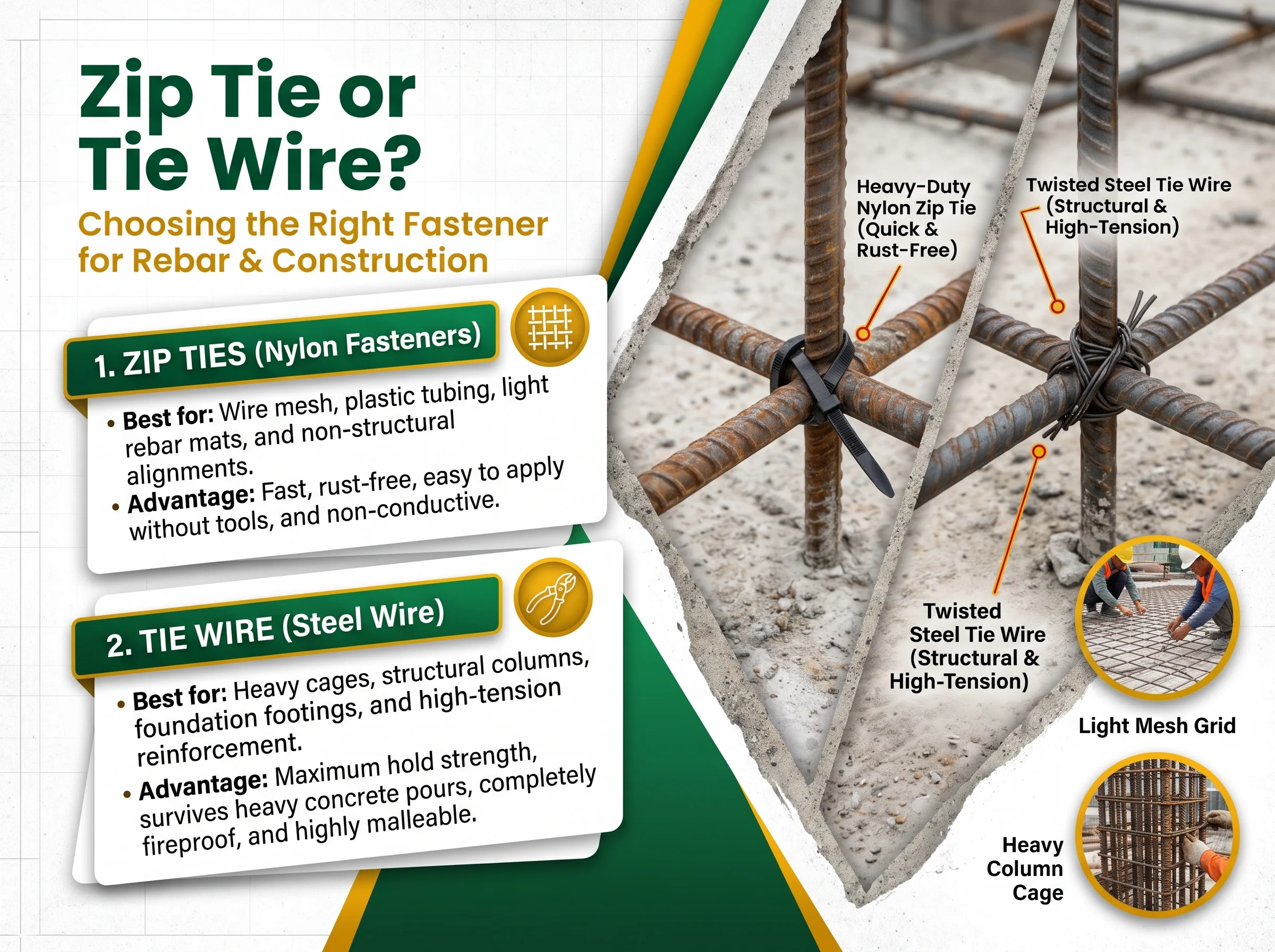
The full comparison:
| Fator | Nylon zip ties | Steel tie wire |
|---|---|---|
| Velocidade | Very fast, one-handed | Fast for experienced ironworkers, slower for others |
| Skill needed | Minimal | Moderate; tie style and twist matter |
| Holding power | Fine for light mats and tubing | Better for heavy cages, columns and lifted assemblies |
| Corrosion in the cover zone | Nenhum | Bare wire can rust and stain; coated wire avoids this |
| Coated or FRP bars | Non-conductive and gentle on coatings | Must be coated wire to protect epoxy |
| Custo por cinta | Usually higher | Usually lower |
| Spec acceptance | Varies by project and agency | Universally accepted |
Many crews end up using both: steel wire for the structural cage, zip ties for mesh, chairs, radiant tubing and embedded conduit. Whatever you choose, cut zip tie tails short so loose plastic does not end up floating to the surface of the concrete.
What Zip Ties Should Never Do on a Jobsite
Zip ties are not structural or life-safety fasteners. Never use them to attach guardrails, midrails, toeboards, scaffold planks, ladders or fall arrest components, and never let a tie carry a load that would hurt someone if it failed.
On a scaffold, the difference is easy to see: steel clamps hold the rails, while zip ties only hold the debris netting.
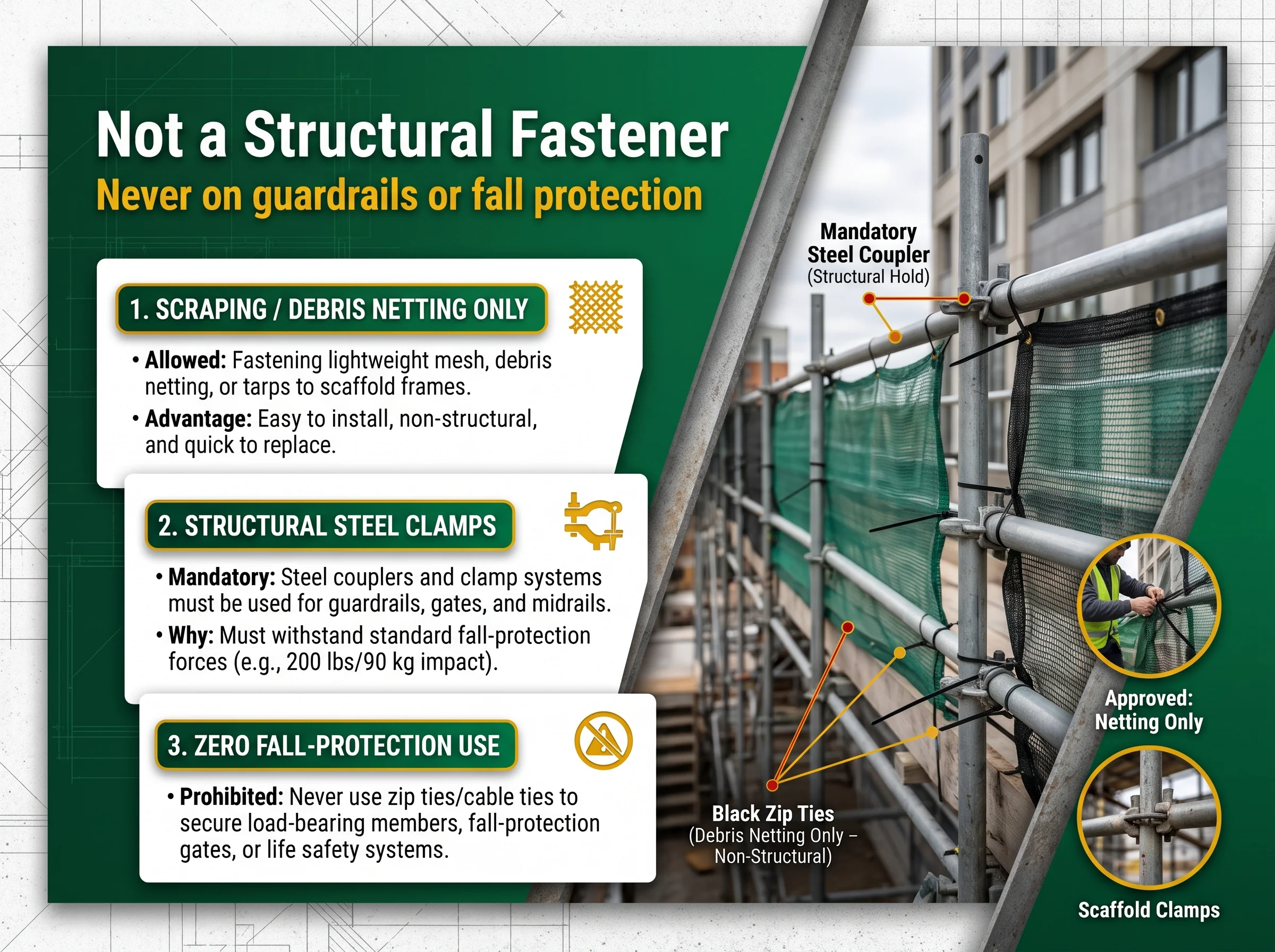
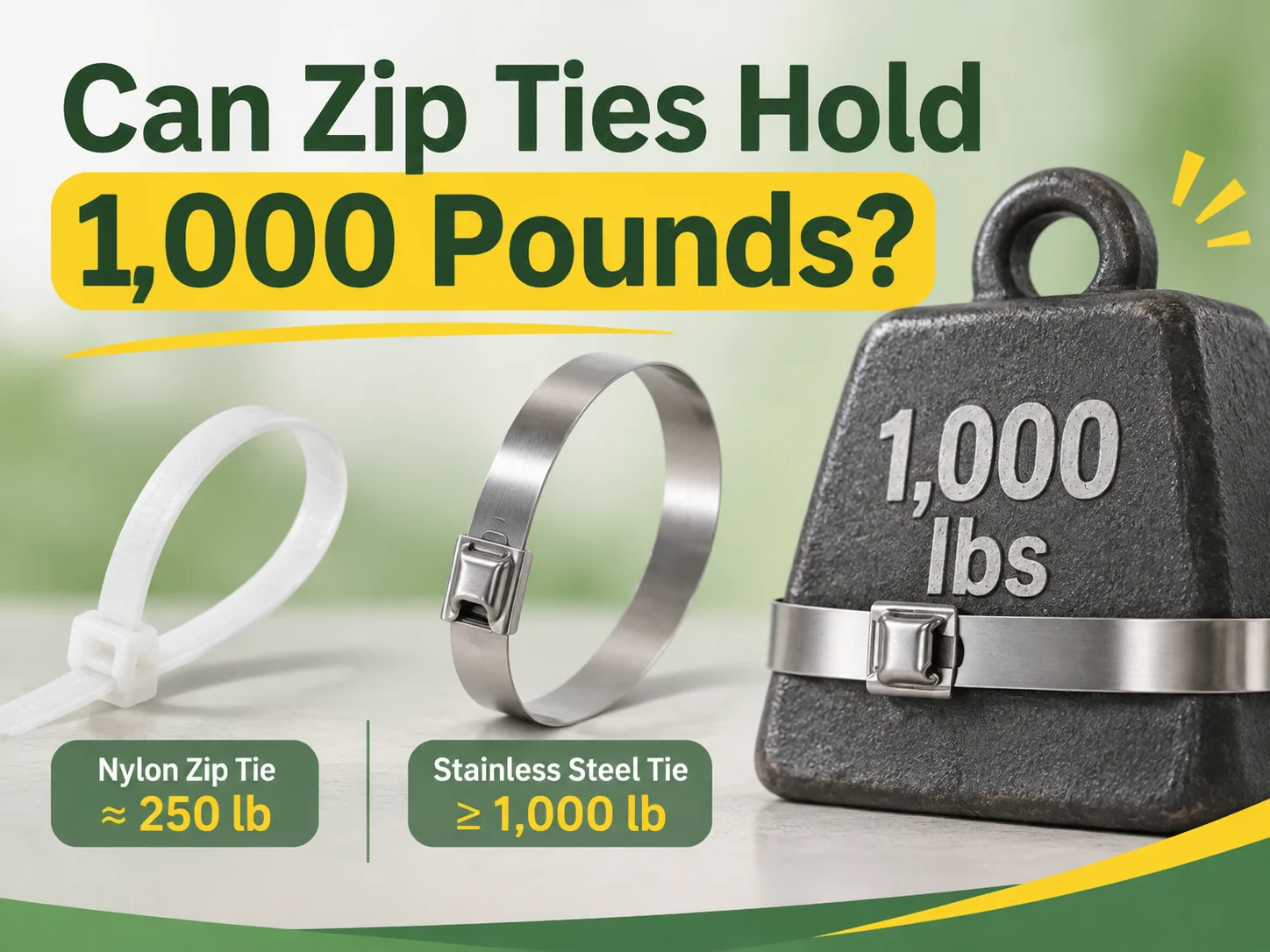
According to OSHA, top rails of guardrails must resist a force of a minimum of 200 pounds while midrails should withstand a force of not less than 150 pounds without breaking. It is important to note that OSHA’s scaffold regulations do not require any particular type of material used for fixing the rails; it is enough to comply with the above-mentioned criteria. It is true that usual nylon ties can bear the maximum force of about 50 pounds. However, in the course of time, even durable ties lose strength due to aging and exposure to sun rays and may easily be cut with a sharp edge, which places workers in dangerous conditions.
Other situations that require avoiding the use of zip ties:
Hanging any types of loads from the structure (e.g., light fixtures, pipe installations, etc.).
Replacing engineered hangers or clamps or using seismic bracing.
Securing gas, fuel and high-pressure lines where a particular type of clamp is required.
Holding the formwork in its position.
Choosing the Right Construction Zip Ties
| Trabalho | Laço típico | Material | Notas |
|---|---|---|---|
| Rebar mesh, radiant PEX | 4.8 mm x 200 to 300 mm | Nylon 6/6 | Follow the project spec; avoid on heavy cages |
| Electrical rough-in | 3.6 to 4.8 mm, listed types | Nylon 6/6, plenum-rated where needed | Use ties listed for securement and support for NM |
| Flex duct | Long duct ties, often 600 mm and up | Heat-rated nylon 6/6 | UL 181B-C marked, tool tensioned |
| Silt fence | 4.8 mm, 50 lb class | UV-stabilized black nylon | Minimum three per post where specified |
| Fencing, signs, banners | 4.8 to 7.6 mm, 50 to 120 lb | UV-stabilized black nylon | Close spacing for wind load |
| Coastal, chemical or very hot sites | Gravatas de aço inoxidável | 304 or 316 stainless | Edge protection on soft jackets |
Anything that will sit outdoors for more than a few weeks needs UV-stabilized black ties. Natural and white nylon turns brittle in sunlight, and on a construction site that means silt fence lying in the mud, banners blowing across the road and screens flapping loose before the inspector arrives.
For most general jobsite work, a 4.8 mm tie in the 50 lb (22 kg) class, such as our laço de alta resistência, is the everyday size. For anything exposed to the weather, our laços de cabo pretos resistentes a UV are built for long outdoor exposure, and our article on the melhores laços zip para uso externo explains when to move up to stainless steel. If you are working out lengths for big bundles or wide posts, the guia de tamanhos de laços de cabo maps lengths to bundle diameters.
Technique That Passes Inspection
- Tension with a tool. Flex duct, electrical bundles and silt fence all benefit from consistent force. Our guide on como usar uma pistola de fita covers tension settings and automatic cut-off.
- Cut tails flush. Sharp tails on fences, rebar mats and scaffolds slice gloves, forearms and fabric. The techniques in como cortar laços de cabos leave a smooth edge.
- Point tails away from the material. On silt fence and netting, standards ask for ends to face away from the fabric so they cannot tear it.
- Do not over-crush cable. On electrical work, a tie that deforms the cable jacket is a defect, not extra security.
- Remove failed ties properly. When ties snap or loosen, cut them off rather than adding new ones beside the old ones. Our guide on como remover cabos de amarração shows how to do it without nicking insulation or fabric.
Purchasing and Keeping Zip Ties for a Project Site
Some techniques that help save money and minimize incidents on larger projects:
Calculate by a project instead of per bag. Purchasing in bulk helps teams save money and helps them avoid taking whatever they can find first.
Separate outdoor and indoor ties. Label outdoor black UV zip ties in boxes clearly so natural ties are not shown on fences.
Help keep the stock safe from hot conditions. The temperature in a closed trunk soars during summer so the nylon will be harder and more likely to crack if exposed to heat.
Make use of color codes. Different colors may be used for different inspection statuses, trades or zones so anyone can see immediately what a tie means.
Request datasheets. For specification-based projects, know what is the recommended usage of the product.
IGOTO has made nylon cable ties for more than 25 years for contractors, distributors and OEMs in the United States, the Middle East and beyond. You can compare widths, lengths and UV-stabilized grades on our laços de nylon e conectores de cabo página.
Perguntas Frequentes
Can you tie rebar with zip ties?
In many cases, this is true and used for lightweight loads such as slab mesh, small footings, and radiant tubes when the construction specification permits its use. For heavier cages, columns, and lifted assemblies, it is imperative to follow the instructions of the engineer whose specifications recommend the use of at least steel tie wires.
Are zip ties allowed for securing Romex?
The NEC allows the use of cable ties that are recognized and listed for use in holding NM wires. Normal cable ties that do not bear that designation may be rejected by the inspector, so be sure to verify your product’s packaging or datasheet.
What zip ties should be used for flex duct?
Use nylon duct ties listed to UL 181B and marked 181B-C, tightened with a tensioning tool behind the bead of the collar. Hand tightening is not enough.
How strong should zip ties be for silt fence?
Several erosion control standards call for plastic ties rated about 50 lb tensile, at least three per post near the top of the fabric. Always confirm the local detail.
Can zip ties be used on scaffolding?
This applies only to the non-structural items such as debris netting, signage or cable management. Guardrails, planking, ladders, and fall protection systems must be installed using fasteners that meet OSHA strength requirements rather than zip ties.
Referências
- Section 4151, Steel Reinforcement, Iowa Department of Transportation
- ERO-2 Silt Fence Supported detail, City of Minot
- Standard Work Specifications, Mechanical Fastening, National Renewable Energy Laboratory
- OSHA standard interpretation on securing scaffold guardrails, April 2010
- 29 CFR 1926.502 fall protection criteria, Cornell Legal Information Institute
Conclusão
Construction zip ties earn their place on every jobsite: they are quick to use, consistent with a tool and accepted by many specifications for rebar mesh, radiant tubing, NM cable, flex duct and silt fence. Use listed ties where the code asks for them, UV-stabilized black ties wherever the sun reaches, and the project specification as the final word. Just as important, keep them away from guardrails, scaffolds, overhead loads and anything else where a failed tie could hurt someone.