


Biodegradable Cable Ties in PLA: 10 Options Ranked
The biodegradable ties produced today aren’t genuine composting ties. Despite being made from plant polymer, they decompose in industrial composting facilities, but otherwise remain intact for many years. This is a key issue since it dictates whether the tie in question can truly be regarded as an eco-friendly product.
This article explains what PLA is, lists some mandatory certificates which help distinguish true eco-friendly products from the fake ones, ranks the ten most popular items in this field by their pros and cons, compares PLA’s and nylon’s performance, and also looks more closely at the occasions when PLA should not be used.
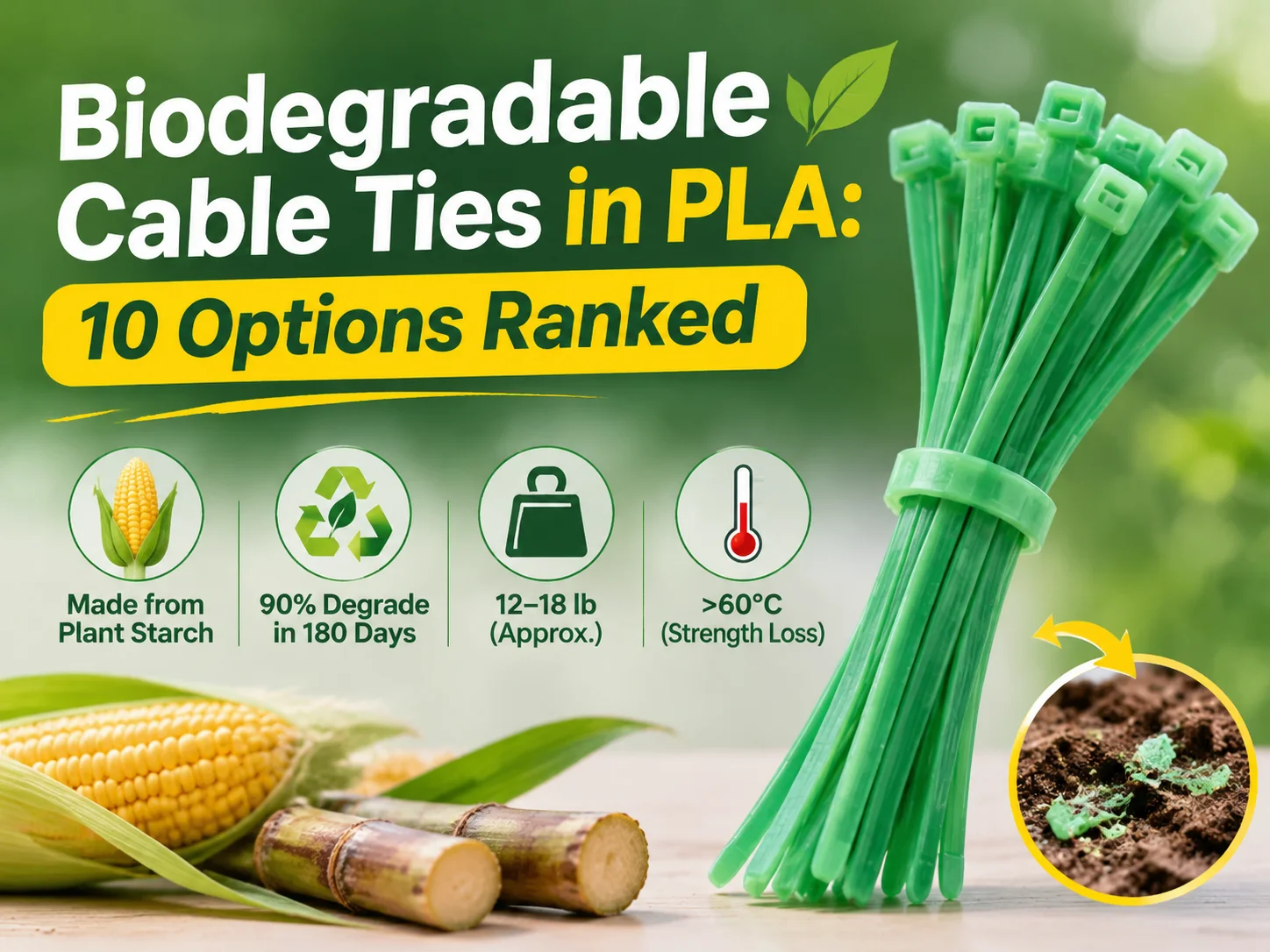
Brief answer: The PLA or polylactic acid cable ties are made of sugarcane/corn and fully break down within 180 days when disposed of under industrial conditions. This meets ASTM D6400 or EN 13432 specifications. Cable ties made of PLA can hold a weight of approximately 12 to 18 pounds, while nylon cable ties can hold 30 pounds or more. PLA ties are two to four times more expensive compared to nylon ties. Use of PLA ties is accepted in any temporary event, and support in construction and landscape connections.
What a PLA Cable Tie Is, and What It Is Not
PLA is a type of thermoplastic polyester, and it is manufactured by turning plant starches into lactic acid and subsequently polymerizing it. This means that it really is bio-based, truly compostable under the right circumstances, and actually possesses lower mechanical and thermal capabilities compared to nylon 6.6. These three statements hold true simultaneously.
The temperature limit can be attributed to the glass transition temperature, which is around 60 °C. This means that above this temperature the polymer will start becoming pliable and tie in tension will begin to creep. Therefore, the PLA tie placed on the wire that is warm because it runs near a radiator or in the roof space will not fail catastrophically but will lose its tension. Melting point is much higher, around 150–160 °C, which means that rather than ignition the failure mode will be deformation.
The second thing to mention about PLA is that it is not household compostable in the literal sense of this term. Home composting sites barely reach temperatures and microbe activity levels that certification assumes, and thus a tie left in the garden heap can take years to break down. Certification is for industrial composting and this is the method it is intended to be used for.
What it actually is: a tie that has the same physical shape and size as any other tie of the same ladder, therefore no size-changing rules are being broken.Width and length still determine bundle capacity, and the conventional bands still apply, which this guide to tamaños estándar de bridas sets out if the sizing is unfamiliar.
The Certifications That Separate Compostable From Wishful
A supplier who is unable to identify one of the two certifications is making a claim rather than actually selling a product.
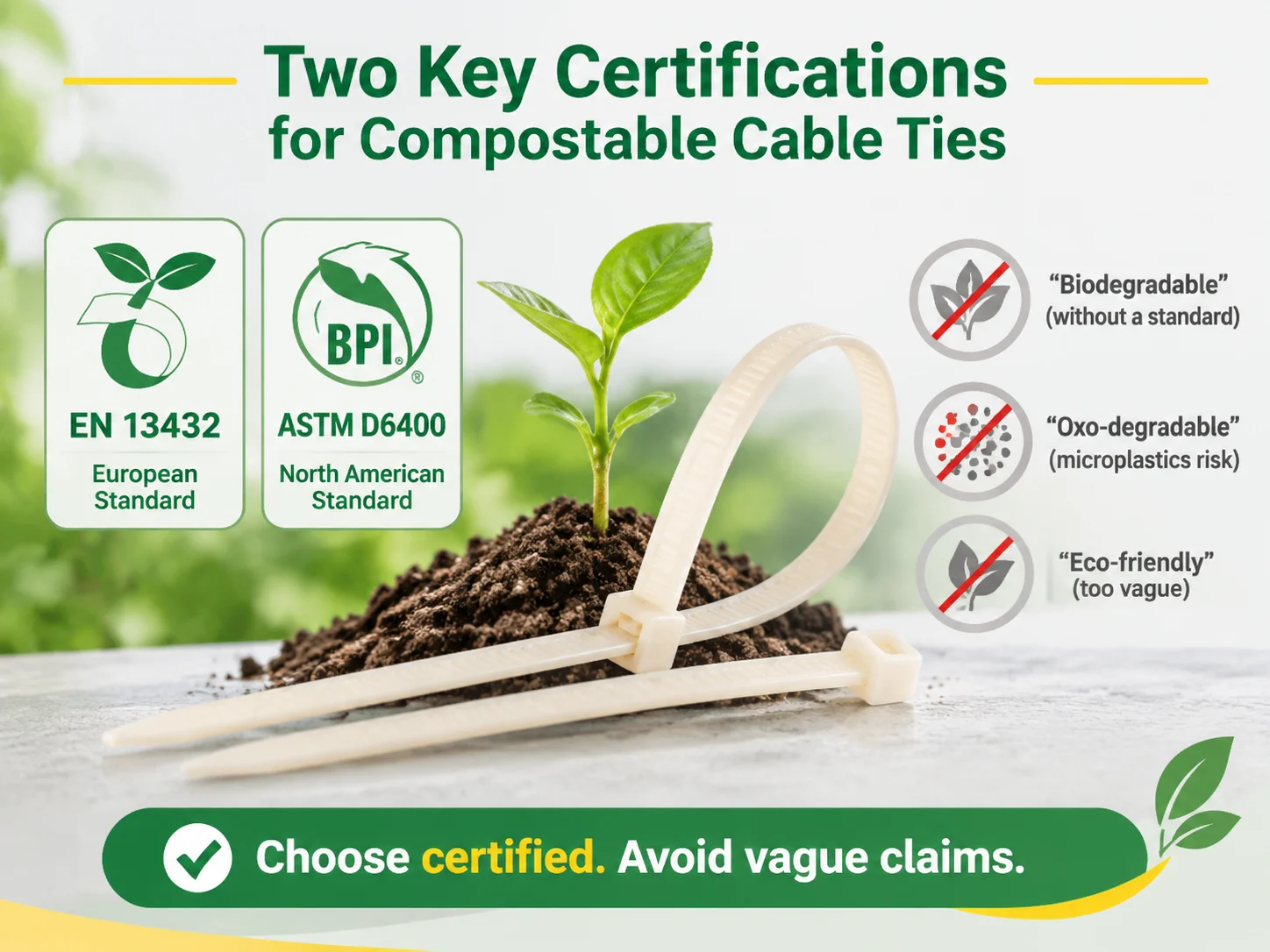
- The EN 13432 standard is the European standard for commercially compostable packaging. Being able to demonstrate compliance with this standard means that at least 90% of the packaging material must decompose completely in controlled composting conditions within a period of 180 days, and the leftover material must not be toxic for the environment and contain heavy metals within specified limits. Products certified to EN 13432 standard carry the seed symbol on their packaging.
- Meanwhile, ASTM D6400 is the North American equivalent of the EN 13432 and Biodegradable Products Institute carries out certification against ASTM D6400 standard. The two standards are very similar, so products certified to one will qualify for certification under the second one too.
Three phrases are less meaningful though: “biodegradable” (not backed up by any standard), “oxo-degradable” (which is a material that only breaks into microplastic rather than degrading biologically), and “eco-friendly” (which is completely empty). The second of these concepts is the one that must be rejected.
For a procurement file, ask for the certificate number and the certification body, not the logo. That is the same discipline that applies to any compliance claim on a cable accessory, and the equivalent questions for the metal alternatives are set out in this comparison of bridas de acero inoxidable y nylon.
Ten Options, Ranked by What They Are Good At
Speaking of honesty, there are hardly any SKUs with verifiable statistics, and the rest refer to purchasing configurations when it comes to consumers’ actual decision-making process. The preferred brands are nicely applied in line with how closely each of them corresponds to the reason why people look for biodegradable ties.
| Opción | Lo que es | Mejor para |
|---|---|---|
| 1. Certified PLA ties, 4.8 mm | EN 13432 or ASTM D6400, 200 to 300 mm | Events and temporary installations where disposal matters |
| 2. Certified PLA ties, 2.5 mm | Small cross-section, 100 to 150 mm | Cable dressing in packaging and retail displays |
| 3. Starch-blend compostable ties | Starch or PBAT blend, not pure PLA | Higher flexibility, better low-temperature behaviour |
| 4. PLA ties in natural or white finish | Uncoloured, no pigment load | Composting streams where pigment is a concern |
| 5. PLA with a paper or PLA header | Retail-ready packaging, no plastic bag | Brands selling the tie as a consumer product |
| 6. PLA ties with a printed legend | Custom marking for events and venues | Wristbands and accreditation ties |
| 7. Home-compostable blends | Certified to a home composting scheme where available | Gardeners and horticultural users |
| 8. Biodegradable horticultural ties | Wide, soft, often with a twist format | Plant support where the tie stays in the ground |
| 9. Compostable cable tie with a natural fibre core | Paper or fibre reinforcement | Light loads where compostability is the only criterion |
| 10. Factory-direct PLA, own brand | Custom mould and marking, minimum order | Distributors and brands building a range |
In this place mentioned is a reference named as GTSE, which produces biodegradable ties that comply with both standards and exhibit honesty in the indication of the operating limits inclusive of their minimum degradation period of two years along with necessary conditions for degradation. This candour is valuable than a stronger declaration.
For our own part, the honest position is that PLA is not what we specialise in. Our volume is in nylon 6.6, UV-stabilised and stainless ranges, and the fabricación de bridas de alta resistencia line is where most of that sits. We can produce PLA ties to a specification and to a certification requirement, and we will say plainly that a nylon tie of the same size will hold twice the load.
How PLA Performs Against Nylon, in Numbers
The comparison is not close, and knowing the gap is what stops a buyer from specifying PLA in the wrong place.
| Propiedad | PLA or compostable blend | Nylon 6.6 |
|---|---|---|
| Loop tensile, 2.6 mm width | About 5 kg | About 8 kg |
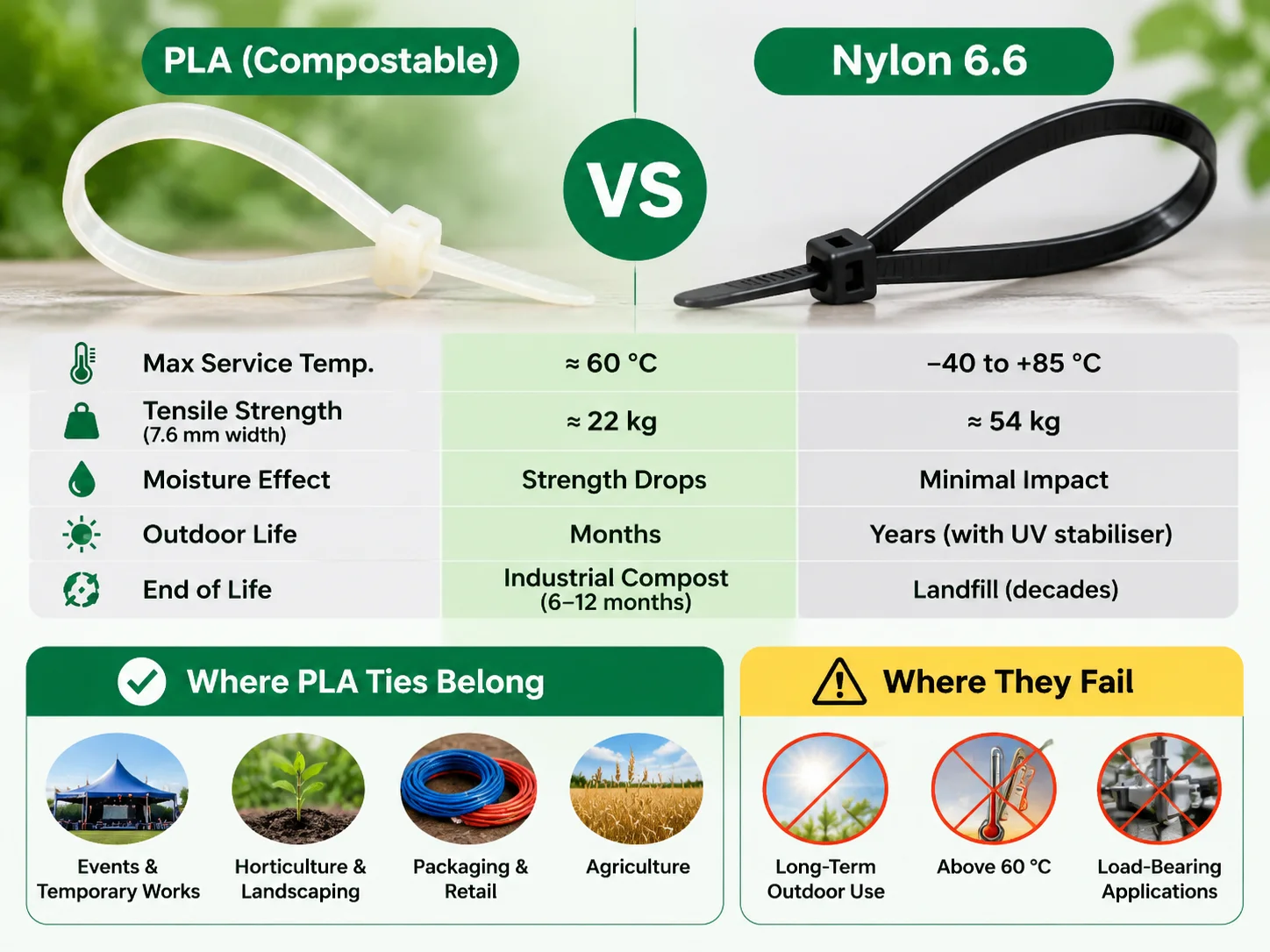
| Loop tensile, 7.6 mm width | About 22 kg | About 54 kg |
| Temperatura de servicio continua | Up to about 60 °C | −40 a +85 °C |
| Vida al aire libre | Months, and it is meant to be short | Years, with UV stabilisation |
| Effect of moisture | Strength falls as it absorbs water | Largely unaffected |
| Cost per tie, same size | Two to four times nylon | Línea base |
| End of life | Industrial compost, 6 to 12 months | Landfill, decades |
When you observe the final two rows together, the trade-off is evident. A PLA tie is more expensive and less functional, which means it only offers the opportunity of disposal. This is a reasonable expense for an event that cares about sustainability and has a contract for industrial composting. But it is a bad purchase in terms of solar mounting frame.
The temperature row is the one that makes people think. A PLA tie inside a vehicle, under a roof or on a cable that operates at 70°C will even melt and loosen, but the outcome will not look like a failure in terms of the material used but a workmanship issue.
Where Biodegradable Ties Belong, and Where They Fail
The selection of applications is precise and limited.
- Temporary works and events. Construction barriers such as festivals and exhibitions. The design lifespan of the tie is several days, and disposal is monitored, and the product used is appropriate to its application.
- Landscaping and horticulture. Plant ties used in a paper form and added to soil and compost since a nylon tie fragments for years.
- Retail and packaging. Hose or cable arranged for sale and cut by the end user. The tie is disposed of in commercial waste.
- Food processing and agriculture. Any tie found in the harvest is a contamination risk, thus the use of the compostable alternative is preferred.
The list of failures is also narrow. Anything intended for outdoor use for one season or more since UV and moisture will have their effect and the tie is discarded at an unsuitable time. Up to 60 °C. Load-bearing applications since tensile units are only 50% that of nylon. Applications that require long-term certification, since the compostable material is classified as a liability. UV behaviour in general is worth understanding before specifying any polymer outdoors, and this explanation of si las bridas son resistentes a los UV covers what stabilisation does and does not achieve.
Prices and What the Premium Buys
There are three cost categories, and they are mainly subcategories of the essential elements: the certified polymer and the certification process, rather than the molding steps.
- Explicit premium. The highest price per tie since one has to refer to the certified polymer with a special additional price for every purchase. All extra money buys is a certificate number, a batch number and a company that will answer questions about disposal.
- Factory-direct premium. A cheaper cost per unit when purchasing in bulk since it comes with a certificate only that is not packed for retail sales. The most logical variant after a purchase of approximately 10,000 ties.
- Non-certified so-called “biodegradable”. The cheapest option, and the one that is not recommended since the label does not tell anything regarding the ties’ performance in the actual use or disposal phases.
The method of cost analysis used in most projects does not involve the cost per tie. Rather, it is the cost per whole event as well as per hectare, compared to which saving in case of disposal is negligible.
A Buying Recommendation by User
A breakdown of the five buyer types, and an explanation of what to consider when choosing your product.
- Event organizer. Certified PLA of 4.8 mm diameter and length between 200 and 300 mm; in thousands; with certification saved; and composting contractor in the name. No uncertified product just to save money, as the whole point of the product is certification.
- Horticulture supplier. Soft horticultural ties on the basis of wide ties and not cable ties, as it is needed to be low load and with no abrasion. Compostability is the key here, tensile is not.
- Retail brand. PLA ties supplied with headers printed, in a size that is adequate for the product category, and with packaging specification that avoids a plastic bag wrapping the compostable product.
- Manufacturer of packing cable or hose. Certified PLA supply from direct production with certification document mentioned on the drawing not allowing substitution.
- Anyone who specifies outdoors or above 60 degrees Celcius. Nylon or stainless.A compostable tie is the wrong answer whatever the sustainability policy says, and the selection logic for the load-bearing cases is set out in this guide to elegir correas de cable de alta resistencia.
Preguntas Frecuentes
Are biodegradable cable ties really compostable?
Certified ones are, in the conditions of industrial composting according to EN 13432 or ASTM D6400. In a home composting container or landfill, they break down much more slowly, meaning that the certification is totally dependent on their final location.
How strong is a PLA cable tie?
Nylon ties of comparable width are approximately half as strong as respective nylon ties. The 2.6 mm PLA tie can withstand approximately 5 kg, in contrast to 8 kg for nylon, while for 7.6 mm tie, the corresponding weight is approximately 22 kg, as against 54 kg for a nylon tie. No, size up for safety near the limit.
Can PLA ties be used outdoors?
If the purpose is to let them vanish, they are typically used for one season or even less. They can deteriorate because of the sun’s rays, humidity and temperature.
Are biodegradable ties more expensive?
Usually, it takes 2 to 4 nylon ties of the same size and the extra cost comes from the polymer and certification received, not the production method. As the volume increases the gap decreases but does not close completely.
Referencias
- ASTM International — D6400 Compostable Plastics Specification
- UL Solutions — Certificación de Bridas UL 62275
- Panduit — Cable Tie Material and Performance Data
- HellermannTyton — Cable Tie Materials and Applications
- Grainger — Bridas y Gestión de Cables
Conclusión
The choice of the biodegradable tie may not be worth it in terms of performance. Still, it is a product consciously made for the benefit of the planet. Even though it is more expensive and has fewer merits, its lifespan does not exceed a season. However, the biodegradable tie will decompose using industrial composting technology. Purchase the biodegradable ties in a place that allows for the exchange of the product.
For the time being, nylon remains the best choice when it comes to belts and accessories of this kind. Nevertheless, the problem of sustainability has to be taken into consideration in the item description.