



¿Para qué se utilizan las bridas de soporte aéreo?
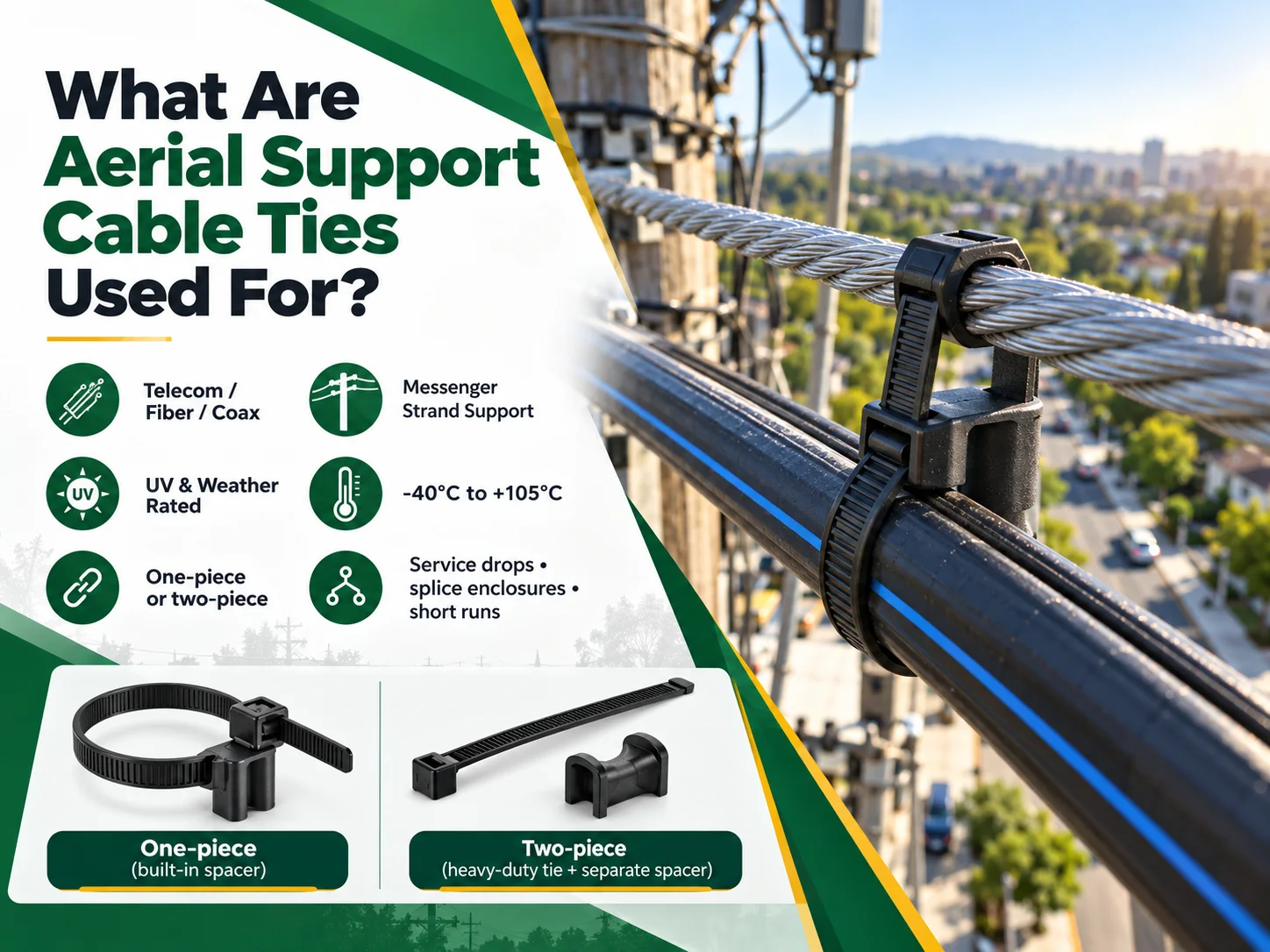
Bridas de soporte aéreo son productos altamente duraderos diseñados para soportar condiciones climáticas adversas. Su función principal consiste en sujetar cables de telecomunicaciones, coaxiales o de fibra óptica en cables de acero colocados en postes de servicios públicos. La mayoría de ellos consta de dos lazos y un pequeño espaciador producido mediante un proceso de moldeo. De manera sencilla, un lazo envuelve el cable, mientras que el otro se sujeta alrededor del hilo. Con la ayuda del espaciador, los dos no se tocan entre sí.
Esta guía tiene como objetivo educar a las personas sobre las bridas aéreas, los tipos de bridas más populares utilizados por los trabajadores, los parámetros importantes de una brida aérea, la distancia a la que se deben fijar las bridas aéreas, así como cómo determinar si la brida aérea resistirá condiciones climáticas severas.
Una brida de soporte aéreo, a menudo denominada brida de soporte aéreo o brida espaciadora aérea, es una brida de cable clasificada para exteriores que sirve para sujetar un cable a un hilo mensajero o cualquier otro cable de soporte. Una brida de soporte aéreo de una sola pieza constará de un lazo de cable, un lazo de hilo y un espaciador incorporado de aproximadamente 12.7 mm (1/2 pulgada), mientras que un sistema de dos piezas se basa en una brida aérea convencional de alta resistencia equipada con un espaciador apilable separado. Dado que las bridas aéreas se utilizan al aire libre en postes y cables durante muchos años, están fabricadas con nylon 6/6 estabilizado UV, estabilizado térmicamente y a menudo modificado para impactos o polipropileno resistente a la intemperie, con una temperatura de funcionamiento que varía de −40 °C a +105 °C.
¿Qué son las Bridas de Soporte Aéreo?
El cable en las líneas telefónicas aéreas típicas no tiene peso propio. El cable mensajero de acero se sostiene utilizando postes para mantener el cable en su lugar. El cable mensajero puede soportar una carga de aproximadamente 6,000 libras, dependiendo de su grosor.
Un método de sujeción del cable aéreo es la brida de soporte aéreo. Su diseño común de una sola pieza consta de los siguientes pasos:
La correa envuelve el cable y pasa por la primera ranura de la cabeza para formar el lazo alrededor del cable.
La correa envuelve el mensajero y pasa por la segunda ranura en la cabeza para completar el lazo alrededor del cable mensajero.
Se crea un espaciador en el diseño de la cabeza para mantener el cable alejado del cable mensajero, evitando el desgaste de la funda del cable.
En operación, las bridas se instalan con el uso de las manos, posiblemente mientras se usan guantes, desde un camión de canasta o una escalera. Por lo tanto, la mayoría de los diseños tienen cabezas grandes y una cola doblada para facilitar la sujeción.
Dónde encajan las Bridas en la Planta Aérea
Entender lo que las bridas deben y no deben hacer en un camino aéreo es esencial. Para tramos largos, el proceso habitual sigue siendo el de atado, donde un alambre de atado hecho de acero inoxidable se enrolla continuamente alrededor del cable y el hilo, que generalmente mide entre 0.038 y 0.045 pulgadas. En general, los municipios tendrán especificaciones que consideran el alambre de atado como predeterminado y permiten bridas de nylon negro para exteriores como material sustituto siempre que su uso esté especificado en un contrato dado.
El hilo mensajero es responsable de llevar la carga en un tramo mientras que la brida no lo es. El papel de la brida es sostener y posicionar el cable correctamente a lo largo del hilo bajo la tensión requerida. Por lo tanto, si un diseño requiere bridas para soportar un cable, entonces tal diseño es incorrecto y no es la brida.
Las bridas asumen el control en los puntos donde el amarre es incómodo o imposible. En una línea de postes típica, esos puntos se ven así:
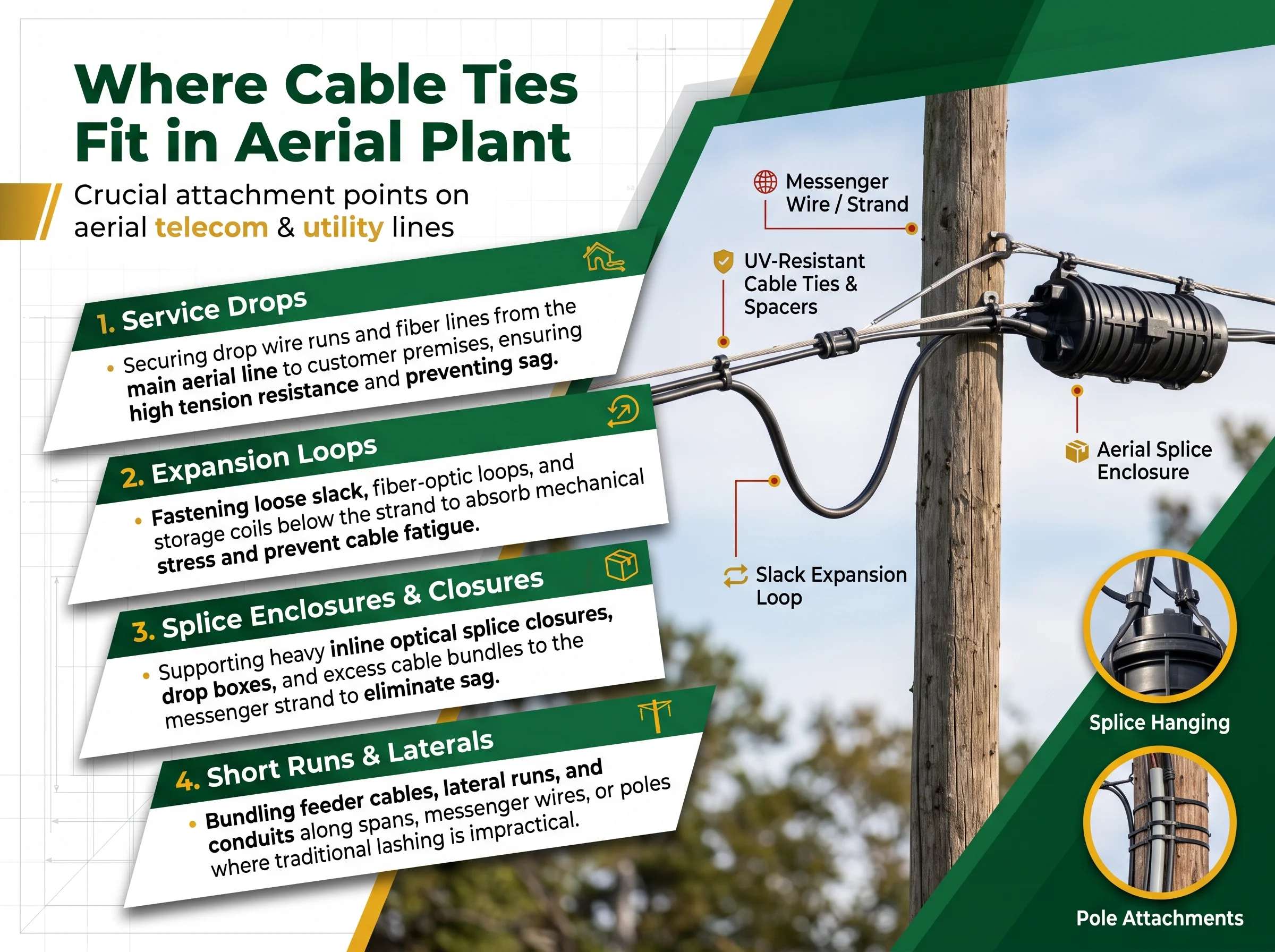
Aquí está lo que implica cada uno de esos trabajos.
Caídas de Servicio
La caída conectada desde el poste a las instalaciones es el aspecto básico de las instalaciones. El cable de caída está anclado al alambre de soporte a través de bridas de soporte aéreo.
Bucles de Expansión en los Postes
El equipo de instalación hace bucles de expansión en los postes para que el cable pueda expandirse y ceder cuando el hilo se calienta en verano y se contrae en invierno. Las pautas de instalación del cable requieren que el bucle sea más del doble de largo que su profundidad, y más del doble de grande que el radio de curvatura mínimo del cable. Las bridas y los separadores mantienen la forma del bucle y evitan que entre en contacto con el hardware del poste.
Enclosures de Empalme y Almacenamiento de Holgura
A medida que la fibra entra en el cierre de empalme aéreo, necesita ser alimentada en el ángulo correcto. Se utiliza una pila de separadores para segregar las entradas de fibra.
Tramos Cortos y Cable en Figura-8
Algunas normas establecen que en tramos cortos de interconexión de señales de tráfico, se pueden usar bridas bloqueadas o alambre de amarre, donde cualquiera se coloca con un espaciado máximo de 12 pulgadas, o de lo contrario se supone que se deben usar bridas con la instalación de cable en figura-8.
Sostenes Temporales y Elevadores
También es importante sostener el cable temporalmente mediante el uso de bridas de alambre fuertes con resistencia a los UV cuando es necesario amarrar el cable.
Los Tipos Primarios de Bridas de Soporte Aéreo
Bridas de Una Sola Pieza Que Incluyen Separadores Preconstruidos
Este es el tipo típico. Una sección representativa mide 270 mm de longitud y 12.7 mm de ancho, puede sostener paquetes de cables con un diámetro aproximado de 70 mm, moldeado de nylon 6/6 estabilizado por calor y UV, modificado por impacto, clasificado de −40°C a +105 °C. No hay forma de liberar las bridas una vez que están unidas.
Bridas Aéreas de Polipropileno Releasables
Una familia diferente utiliza polipropileno resistente a la intemperie con separadores integrados de 1/2 de largo para adaptarse a líneas de tamaño 1/4 o 5/16, coaxiales y cables telefónicos. Las bridas se pueden desmontar, lo que facilita la disposición de las caídas, aunque su tirón mínimo de bucle es inferior a 75 lb, además las longitudes varían de 142 mm para un paquete de 25 mm hasta 254 mm para un paquete de 63 mm.
Bridas Estándar Equipadas Con Separadores
Una solución de dos partes utiliza un bloque separador entre dos piezas. Los separadores aéreos apilables se encajan entre sí y permiten aumentar el espacio en incrementos de 1/2 pulgada, lo que es efectivo para conectar puntos o donde varias líneas se unen a un solo hilo. Los separadores dan forma mientras que las ataduras aportan la resistencia. La guía de separadores para ataduras contiene información sobre cómo corresponder la longitud y el ancho de la atadura con la ranura del separador.
Ataduras de Acero Inoxidable
En entornos como áreas costeras, zonas altamente industrializadas o en condiciones de intenso calor, se debe cambiar a ataduras de acero inoxidable. Tales ataduras resisten la corrosión y los rayos UV, sin embargo, la dificultad de instalación es mayor en comparación con todos los otros tipos.
Especificaciones que realmente importan
| Especificación | Qué buscar | Por qué es importante |
|---|---|---|
| Material | Nylon 6/6 estabilizado contra UV, estabilizado contra calor, idealmente modificado para impacto; o polipropileno resistente a la intemperie | La luz solar y los ciclos de calor son lo que destruye las ataduras exteriores |
| Color | Negro | El negro de carbón es el estabilizador UV en la mayoría del nylon exterior |
| Ancho | Alrededor de 11 a 12.7 mm en ataduras aéreas dedicadas | Las correas más anchas distribuyen la carga y resisten la abrasión del viento |
| Tensión | Desde aproximadamente 75 lb (polipropileno) hasta 120 lb y más (nylon 6/6) | La carga de hielo y el viento añaden fuerza muy por encima del peso del cable |
| Temperatura | −40 °C a +105 °C o mejor | Los hilos bajo el sol del desierto y en inviernos del norte ven ambos extremos |
| Cierre | No liberables para trabajos permanentes; liberables para caídas que cambian a menudo | Permanent spans should never rely on a release tab |
| Strap design | Outside serrations | Keeps teeth off the cable jacket |
Using common nylon zip ties, white nylon or indoor nylon is never allowed for aerial span applications. Over time, without any UV stabilization, the tie becomes brittle when exposed to sunlight. Snapping of ties 20 feet above dramatically increases the risk of sagging cables which, in turn, will generate the need for locksmithing and additional repairs.
The absolute minimum for outdoor aerial work is black nylon 6/6. Some manufacturers state that their specialized ties can last 15 years or more when made of special resins. However, actual conditions will matter, so the performance of aerial ties will depend on the climate. For general outdoor tie work at poles, risers and cabinets, our bridas negras resistentes a los UV are made for solar, telecom and outdoor electrical jobs, and the comparison of the mejores bridas para uso exterior covers when to step up to nylon 12 or stainless steel.
Spacing and Placement
There is not a conclusive number, which is universally applicable. The cable owner’s construction standards, the utility’s joint-use agreement, and local regulations form the basis of how the spacing is set. Still, some patterns keep on cropping up repeatedly:
Tight spacing on tie-only runs. One interconnect standard required by a public agency states that locking cable ties or lashing wire should be no more than 12 inches apart.
A tie at every transition. Where the cable leaves a strand for a drop, a riser, or closure, place one tie where it makes the departure and another approximately 4 inches from it.
Respect the bend radius. Ties at an expansion loop or closure entry should hold the shape yet not force the cable tighter than its minimum bend radius. Fiber optic cable is especially sensitive to this.
Stay clear of the pole hardware. Spacers and tie heads should not rub on bolts, clamps, or guy attachments.
How to Install Aerial Support Ties
Once a crew has the rhythm, each tie takes well under a minute. The order never changes: cable first, strand second, spacer in between.
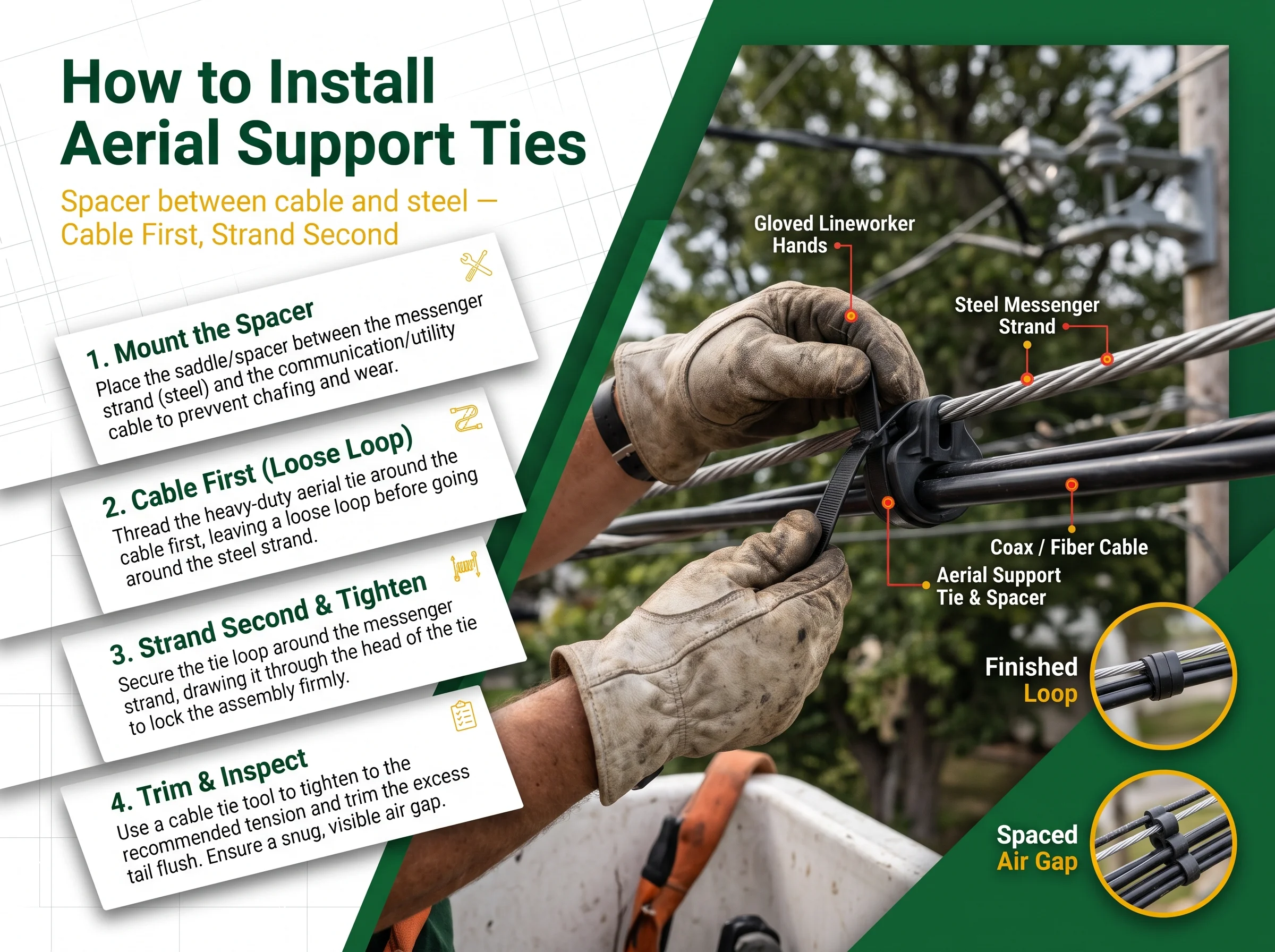
Step by step:
- Verify the size of both the strand and the cable. Make sure the diameter of the strand, measured in 1/4, 5/16 or 3/8 inches, and that of the cable lies within the specifications of the tie.
- Begin with the cable. Loop the strap around the cable with the prongs outward and pull it through the cable-side of the strap.
- Wrap the messenger. Bring the strap around the strand and send the strap through the strand-side of the strap.
- Tighten to an appropriate amount. Hand-tighten it till the union cannot slide down the strand anymore. For long linear installations, a tool can apply effective tension as is shown in the guide for cómo usar una pistola de bridas. Overtightening will damage the coaxial cable and perhaps affect its performance.
- Cut the excess properly. A long tail will whip in the wind and damage the cable while an uneven one will catch on the gloves during the next job. The tools and technique in cómo cortar lazos de cable leave a smooth edge.
- Examine the line visually. Check the installation for proper spacing and orientation and make sure nothing is pinched in the loops or joints.
Aerial work close to parked power lines can be done only by licensed personnel who observe the respective regulations and safety rules.
Choosing Ties for Hot, Cold and Coastal Sites
The climate plays a greater part in the choice of materials than the majority of the data sheets are willing to acknowledge.
Desert and Gulf temperatures. Constant ultraviolet (UV) light and high temperatures demand the use of UV-stable black nylon and impact-modified plastics to ensure the ties can handle the expansion and contraction caused by daily temperature changes.
Cold weather. Nylon becomes less flexible when temperatures drop below freezing. Impact-modified plastics stay tough, and installers must not use ties that have been stored in a truck overnight at freezing temperatures until they warm up.
Ice and wind zone. Ice adds weight, wind adds vibration. Therefore, wider straps should be considered, more strict spacing standards adhered to, and tensile load verified.
Coastal and industrial air. All the chemical and salt exposure have to be addressed by the use of stainless steel wire and stainless fasteners at crucial parts and nylon ties for drops and bends.
For pole, riser and cabinet work alongside dedicated aerial ties, a 4.8 mm tie in the 50 lb (22 kg) class, such as our brida de cable de alta resistencia, handles most small bundles, and our guía de tamaños de bridas helps match longer and wider ties to bigger bundles.
Common Mistakes on Aerial Runs
- Not enough ties. By increasing spacing beyond the accepted norm, the cable droops in-between ties creating additional loads on them due to wind and ice.
Skipping spacers. Cables pressed directly against strands of steel wear out faster than expected, especially in areas with wind.
Over-tightening coax and fiber. A tie that squashes coax changes its impedance and a tie that applies pressure to fiber creates signal loss.
Mixing tie grades in one run. A single natural nylon tie in a series of dark UV ties is the first one to fail.
Leaving long tails. They flap in wind, damage the cable and fail the inspection.
Ignoring the aged ties. An existing run should have failed or damaged ties removed altogether instead of just adding new ones beside them. Our guide on cómo quitar bridas covers cutting them off without nicking the cable.
Inspecting Aerial Ties Over Time
Once an aerial plant is installed, it is easy to overlook it, which is why tie issues often go unnoticed. Most problems can be caught early simply by checking aerial plant equipment periodically during regular inspections or whenever a crew visits the pole.
Color and texture. Black ties that have turned gray, appear chalky, or have developed fine surface cracks show signs of UV protection failure.
Flexibility. If a tie breaks under light stress, all ties from the same batch should be suspected.
Location. Ties that have slipped along the span, turned to the point at which the spacer is no longer between the wire and the rod, or moved from where they are supposed to be need adjustment.
Jacket damage. The presence of shiny or flattened areas in the vicinity of a tie indicates the presence of vibration-induced friction, which occurs when either the spacer is absent or the tie is not tightened enough.
Ties that have been identified as potentially faulty should be replaced either all at once in one operation or in batches. The date and details of the ties should be logged so that the next crew that arrives knows what has been done.
Preguntas Frecuentes
What are aerial support cable ties used for?
They connect telephone, fiber optic, coax or a signal cable to a messenger wire between different poles, usually at some service drops, expansion loops, splice chambers or short runs. The integrated spacer keeps the cable away from the steel wire to avoid damage.
Can I use regular zip ties on a messenger strand?
Only if the black outdoor ties are UV-stabilized, are of suitable width and strength, and are permitted by the specifications of the cable owner. Indoor-style ties deteriorate under sunlight and are not suitable for outdoor use.
How far apart should aerial cable ties be?
Adhere to the construction standard of the cable’s owner or agency. For instance, the public agency’s interconnect standard specifies that ties must not exceed 12 inches apart, and that there must be additional ties wherever the wire leaves the strand at any point.
Are aerial support ties better than lashing wire?
Their functions differ. Lashing wire is quicker and the default solution to long distances, while ties are better suited for drops, loops, closures and other short distances where a lashing technique is not viable. Numerous roads use both.
How long do aerial support ties last outdoors?
High-grade heat- and UV-stabilized nylon ties are designed for many years outdoors, with some manufacturers claiming 15 years or more. Actual life depends on UV intensity, heat, wind and installation quality, so inspect aerial plant regularly.
Referencias
- Brida, Wikipedia
- Aerial interconnect design standard, Florida Department of Transportation
- Construction specification, Section 804 Cables, City of Toronto
- Aerial workmanship, The Fiber Optic Association
Conclusión
Bridas de soporte aéreo are small parts with a long, exposed working life. The load is carried by the messenger strand while the function of the tie is to hold the cable in position and keep it well spaced throughout the period of the heat wave, ice storms and wind. Use black and UV- and heat-stabilized cable ties of proper width and strength, have the cable properly spaced from the strand with a spacer, stick to the guidelines in your construction code when it comes to spacing specifications, tension the cables without crushing them and cut off the excess tails making them flush. For the standard outdoor ties that support aerial work at poles, risers and cabinets, browse our bridas de nylon y pasacables.