


PAN.TY Cable Ties: Lo que cubre la gama insignia de Panduit
La condición bajo la cual varios clientes obtienen PAN.TY es comparable a la que tienen muchos otros productos. Se realiza un dibujo, un distribuidor lo tiene disponible, y a nadie le importa si las cosas se compran correctamente. Los esfuerzos están absolutamente justificados, ya que, como es bien sabido, algo bueno generalmente se compra. La amplia gama de productos está en línea con los requisitos, los documentos están disponibles, y el número de parte indica el tamaño si se lee correctamente.
No se debe preguntar si PAN.TY es bueno, sino si su alto precio refleja su valor.
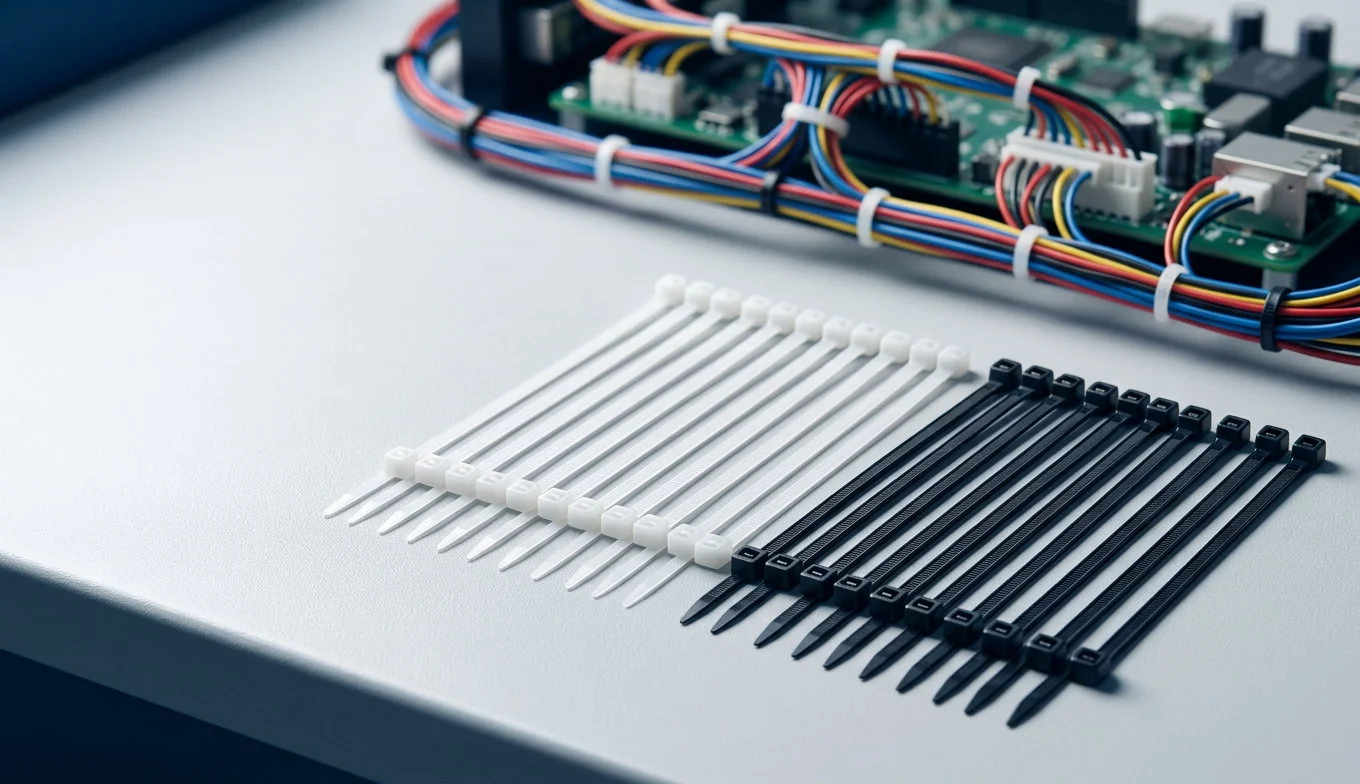
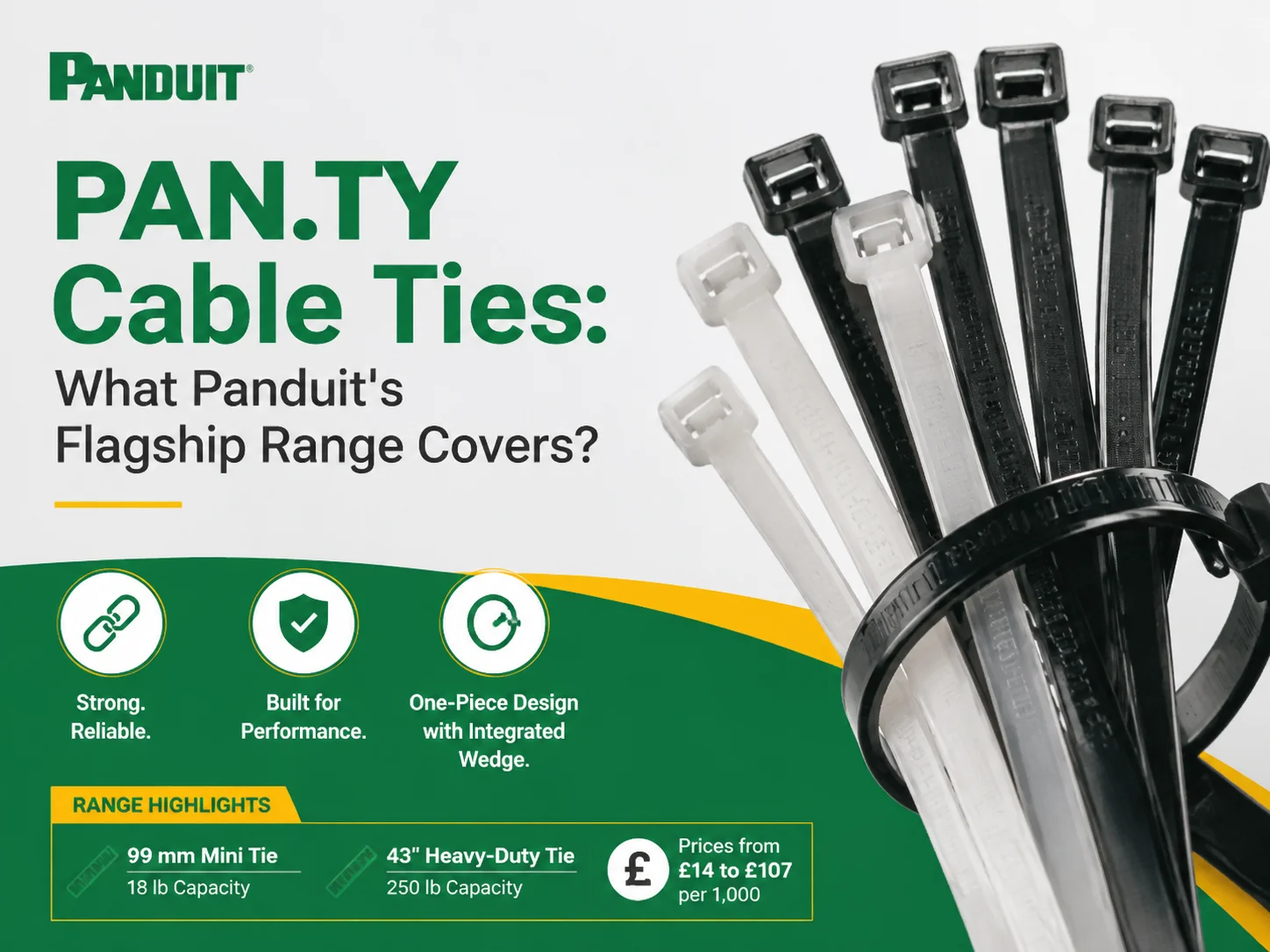
Una breve descripción: PAN.TY es una colección de sujetadores ofrecida por Panduit, que se fabrica utilizando una sola pieza de resina sintética nylon 6.6 y tiene una cuña integrada. La línea incluye varias opciones, como un mini lazo compacto de 99 mm de largo con una capacidad de peso de 18 lb o un modelo de servicio pesado de 43 pulgadas capaz de soportar 250 lb de peso. Los precios comienzan en £14/1,000 para lazos mini negros y pueden llegar hasta £107 para modelos con la sección estándar de 368 mm.
Lo que realmente es PAN.TY
Las bridas son uno de los elementos de ingeniería más básicos en el sitio de fabricación, y esto las hace complejas de copiar. PAN.TY ha desarrollado una brida que utiliza una sola pieza de nylon moldeado con un gancho de bloqueo dentro de su cabeza. La cola está roscada, y la cuña se engancha lo suficiente para que el pestillo se presione contra la serración del paso.
Es posible notar tres detalles relacionados con la forma en que estas bridas funcionan en operación. El primer problema es el diseño de la cabeza que permite una baja resistencia al enhebrado; esto no parece importante hasta que se piensa en tener que apretar 400 elementos en un turno, creando un cuello de botella en la producción dependiendo de las manos de alguien. El segundo factor es una punta curva que permite la conexión desde una superficie plana siendo recogida con una mano. Y el último factor es el tipo de construcción de una sola pieza que asegura que el número de tensión en el documento técnico se refiere a un solo molde y no representa un ensamblaje de dos partes que pueden separarse normalmente bajo la influencia de la vibración.
Las especificaciones para la producción de nylon están en el rango de −60 °C a +85 °C, lo que incluye el cumplimiento de UL 62275 Tipos 2 y 21, así como el certificado UL Reconocido y la certificación CSA. Si un artículo está marcado con las tres especificaciones, hay una mayor probabilidad de que PAN.TY pase exitosamente la prueba de especificación que un producto genérico.
El Catálogo, Organizado por Sección Transversal
Aquí es donde la gente se confunde. Panduit utiliza primero el tamaño de la sección transversal y luego la longitud al categorizar sus bridas, con el número de parte codificando ambos tamaños. El prefijo “PLT” significa Part Lock Tie, la banda de longitud está indicada por el número, mientras que las letras del sufijo representan el tamaño de la sección transversal: ‘M’ indica tamaño mini =2.5mm, ‘I’ es para intermedio=3.6-3.7mm, ‘S’ indica tamaño estándar en=4.8mm, y por último ‘LH’ o ‘EH’ representan tamaños de carga ligera y bridas de tamaño extra pesado respectivamente.
| Número de parte | Longitud × ancho | Máximo paquete | Tensión de bucle |
|---|---|---|---|
| PLT1M | 99 mm × 2.5 mm | 22 mm | 18 lb (80 N) |
| PLT2M | 203 mm × 2.5 mm | 51 mm | 18 lb |
| PLT1.5I | 142 mm × 3.6 mm | 35 mm | Clase de 30 lb |
| PLT2I | 203 mm × 3.6 mm | 51 mm | Clase de 40 lb |
| PLT2.5I | 246 mm × 3.7 mm | 61 mm | Clase de 50 lb |
| PLT3I | 290 mm × 3.7 mm | 76 mm | Clase de 50 lb |
| PLT2S | 188 mm × 4.8 mm | 48 mm | Clase de 50 lb |
| PLT3S | 292 mm × 4.8 mm | 76 mm | Clase de 50 lb |
| PLT4S | 368 mm × 4.8 mm | 102 mm | Clase de 50 lb |
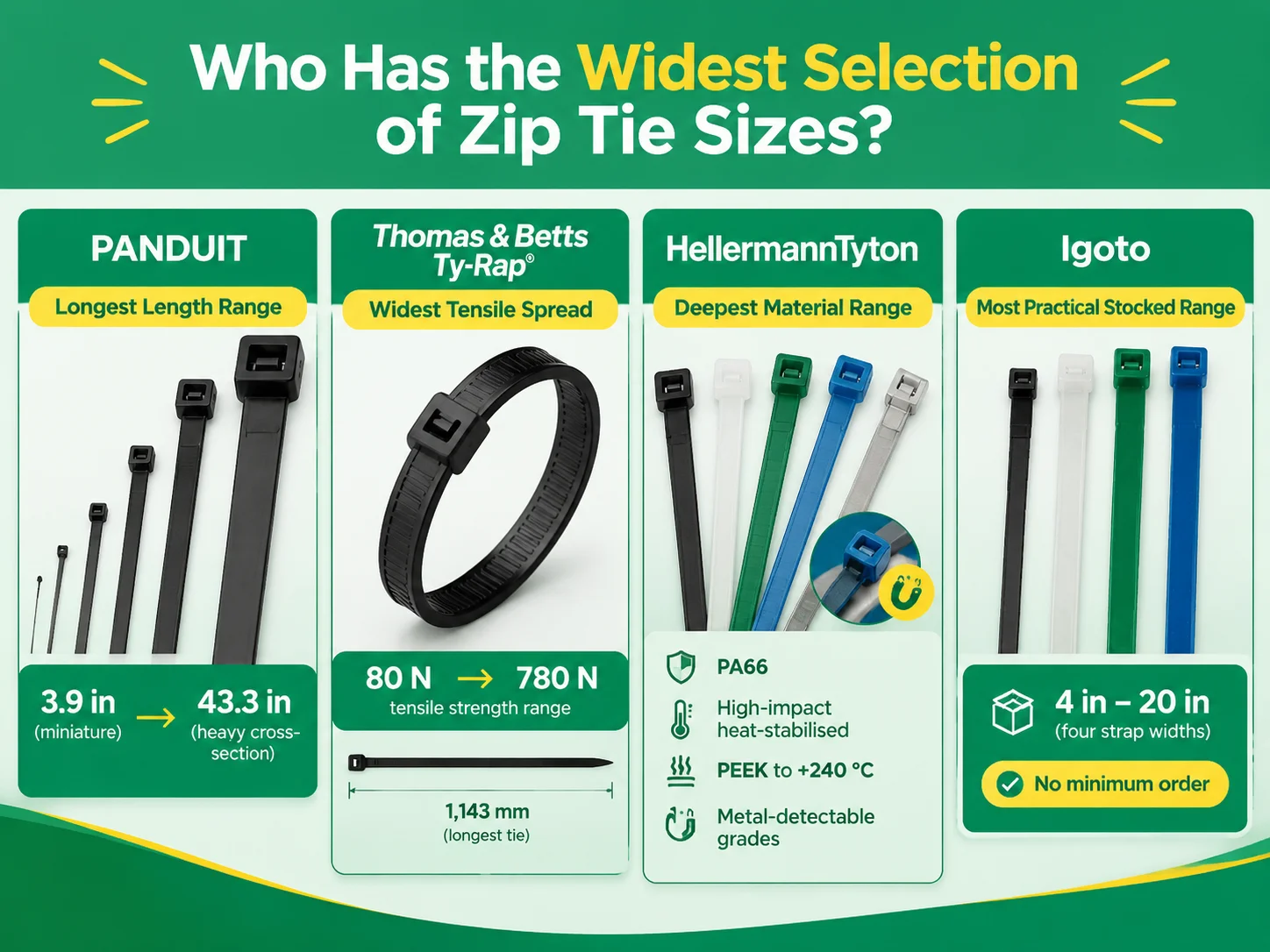
La gama continúa más allá de la sección transversal estándar con una brida ligera-pesada de 43 pulgadas para 175 lb y una brida extra pesada para 250 lb. En el otro extremo de la gama, hay bridas tan pequeñas como 71 mm para el uso de conexiones dentro de cajas.
Las razones por las cuales la sección transversal es significativa también tienen que ver con el hecho de que el ancho y el grosor determinan la resistencia a la tracción, y la longitud solo se utiliza para determinar la cantidad de bridas necesarias para crear el paquete. Si eliges solo por longitud, estás eligiendo por la dimensión menos importante, y esta guía para cómo se especifican las bridas negras por tamaño, resistencia y costo establece los compromisos, incluida la cuestión de los UV que decide si una brida negra es una brida resistente a la intemperie o solo una brida negra.

Lo que pagas, tamaño por tamaño
Los precios listados aquí se refieren a los precios del comercio del Reino Unido por 1000 unidades sin IVA de un catálogo de 2026 que ya ha sido publicado. Por favor, convierte los precios según sea necesario, ya que las relaciones entre los varios tamaños son más importantes que los valores reales.
| Parte | Por 1,000 (GBP, sin IVA) | Approx. per tie |
|---|---|---|
| PLT1M 99 mm black | 14.45 | £0.014 |
| PLT2M 203 mm black | 34.48 | £0.034 |
| PLT1.5I 142 mm black | 33.17 | £0.033 |
| PLT2I 203 mm black | 45.45 | £0.045 |
| PLT2.5I 246 mm black | 54.30 | £0.054 |
| PLT2S 188 mm black | 48.40 | £0.048 |
| PLT3I 290 mm black | 70.95 | £0.071 |
| PLT3S 292 mm black | 75.85 | £0.076 |
| PLT4S 368 mm black | 106.75 | £0.107 |
There are two observations to be made when negotiating. The first is about pricing, since prices are normally proportional to the volume, approximately three times the price of a 2.5 mm miniature tie can be paid compared to a 4.8 mm standard tie, even if they have the same length. The other observation is about the fact that black UV stabilized ties are more expensive than the natural ones and that the price varies based on the size of the item. Thus mixed orders should be priced individually rather than by averages.
When buying small packages it is more disadvantageous. For example, a single PLT1M from the package of 100 costs significantly more than that from the package of 1000.
One material breaks the ladder entirely. Stainless steel ties cost several times what a nylon tie of the same length costs, which is why they get specified for a 20-year life, not for a cable bundle, and why the comparison between stainless steel and nylon cable ties belongs in the budget conversation, not at the point of order.
The Design Details That Carry the Premium
If you are attempting to substantiate the use of PAN.TY in contrast to a lower-priced tie in a bid, these are the aspects that will stand up.
- Consistency in molding. The strength value represents a limit and is determined by sample tests, with only a small variation. It is this aspect that allows the application device to operate without jamming.
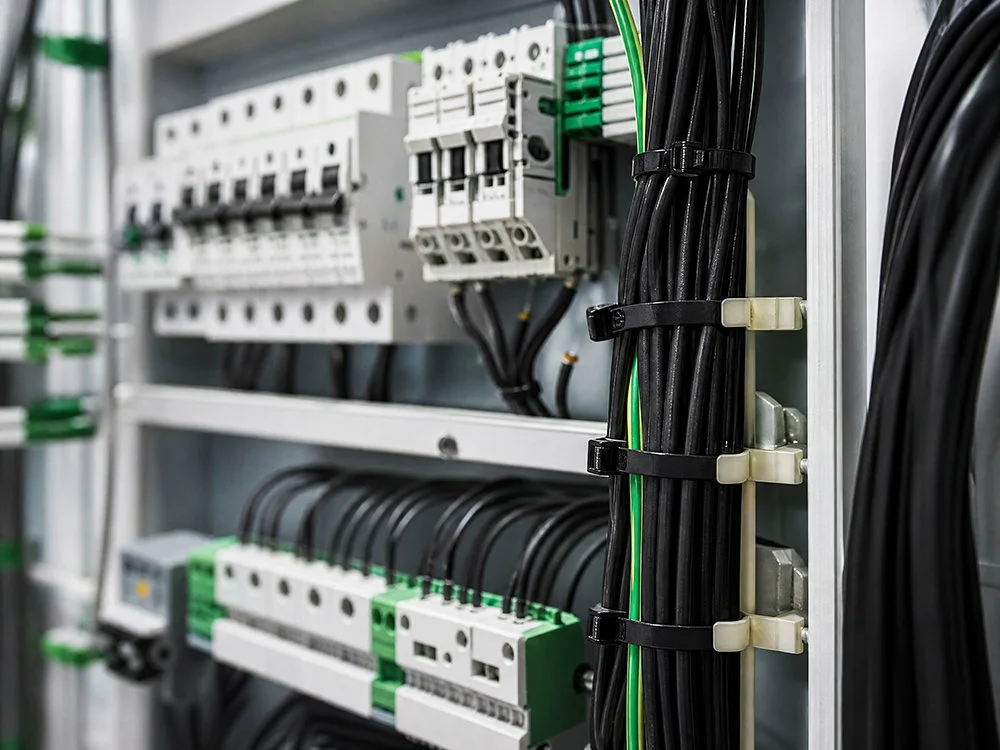
- Proof of compliance. Compliance with UL 62275 Type described and UL recognition with a file number as well as CSA certificate. For any panel manufactured in accordance with UL 508A and any machine supplied to Canada these certificates are of utmost importance.
- Military or aerospace modifications. The presence of MS3367 cross-reference is the reason why PAN.TY appears in military specifications.
- Material possibilities apart from nylon. Possibilities to have PEEK executions for high-temperature applications, detectable material for foodlines, and heat-stabilized nylon for high surrounding temperatures. The catalog is a material platform, rather than one product pith.
- Integration of tooling. Tensioning tools are created for specific type of the tie, thus providing reproducible tension. Only hand tensioning provides the variance of up to 30 %.
Where PAN.TY Is the Wrong Choice
There are three common cases.
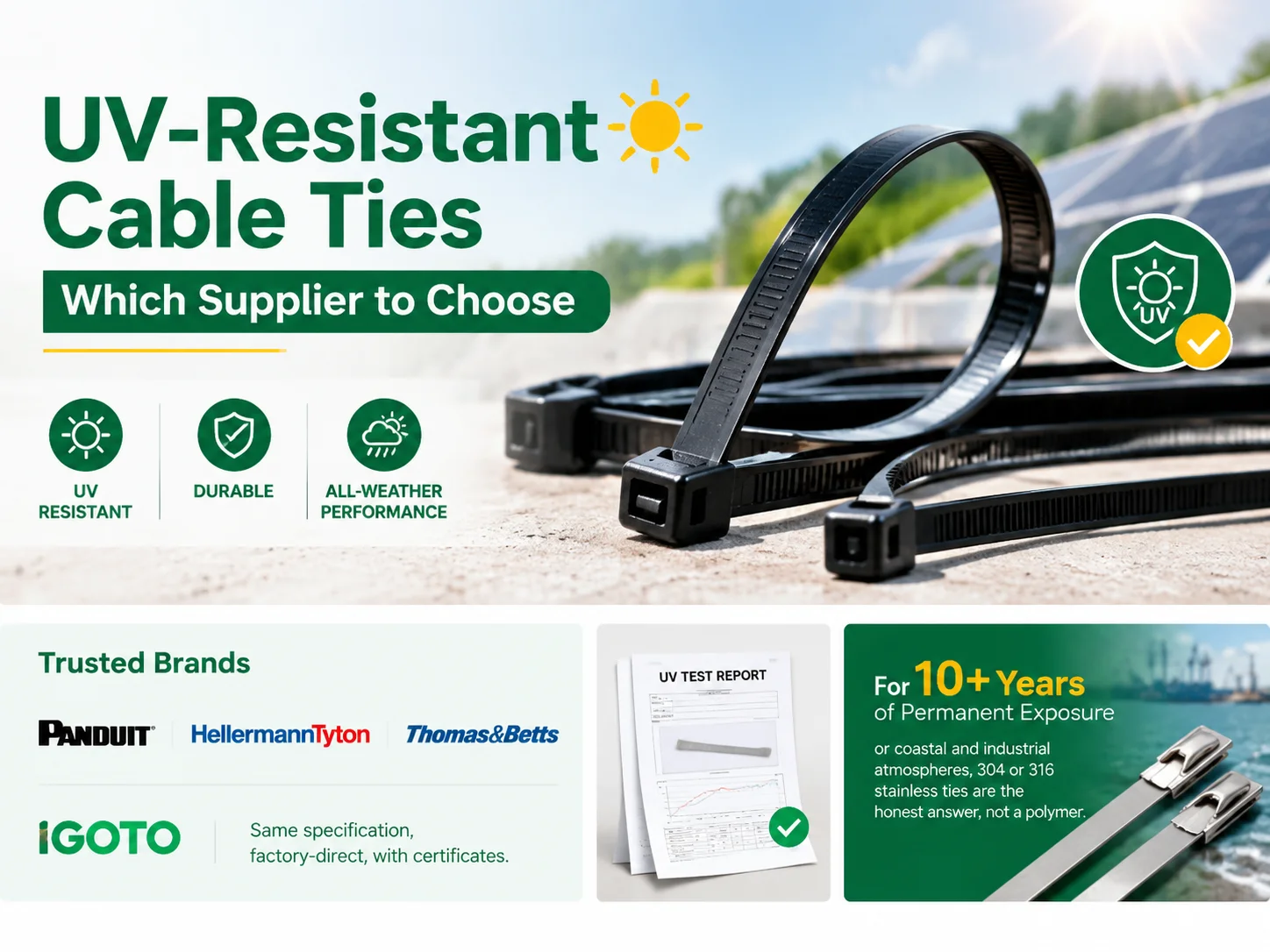
- Long exposure outdoors when there is strong UV. Black nylon material has some degree of UV stability, but not permanently. A rooftop, coastal or solar mounting installation that lasts five years requires a stainless-steel tie and specially formulated UV-resistant material, because the type of polymer used does not matter when in the sun.This is where the specification should move to a dedicated UV-resistant cable tie range instead of a general-purpose tie in black.
- The high capacity with the price being the limitation. A factory that is using 40 thousand ties each week is spending money for paperwork that it does not need. Given that level of production, it makes sense to buy a factory-direct tie, at a much lesser unit price, which comes with a material certificate and a tensile test report.
- The use of an uncommon color or marking. The Panduit company offers colors, but if you want a private-label program with your own part number and own legend printed on it, you have to speak to the factory, not the distributor.
The Alternatives, Compared Honestly
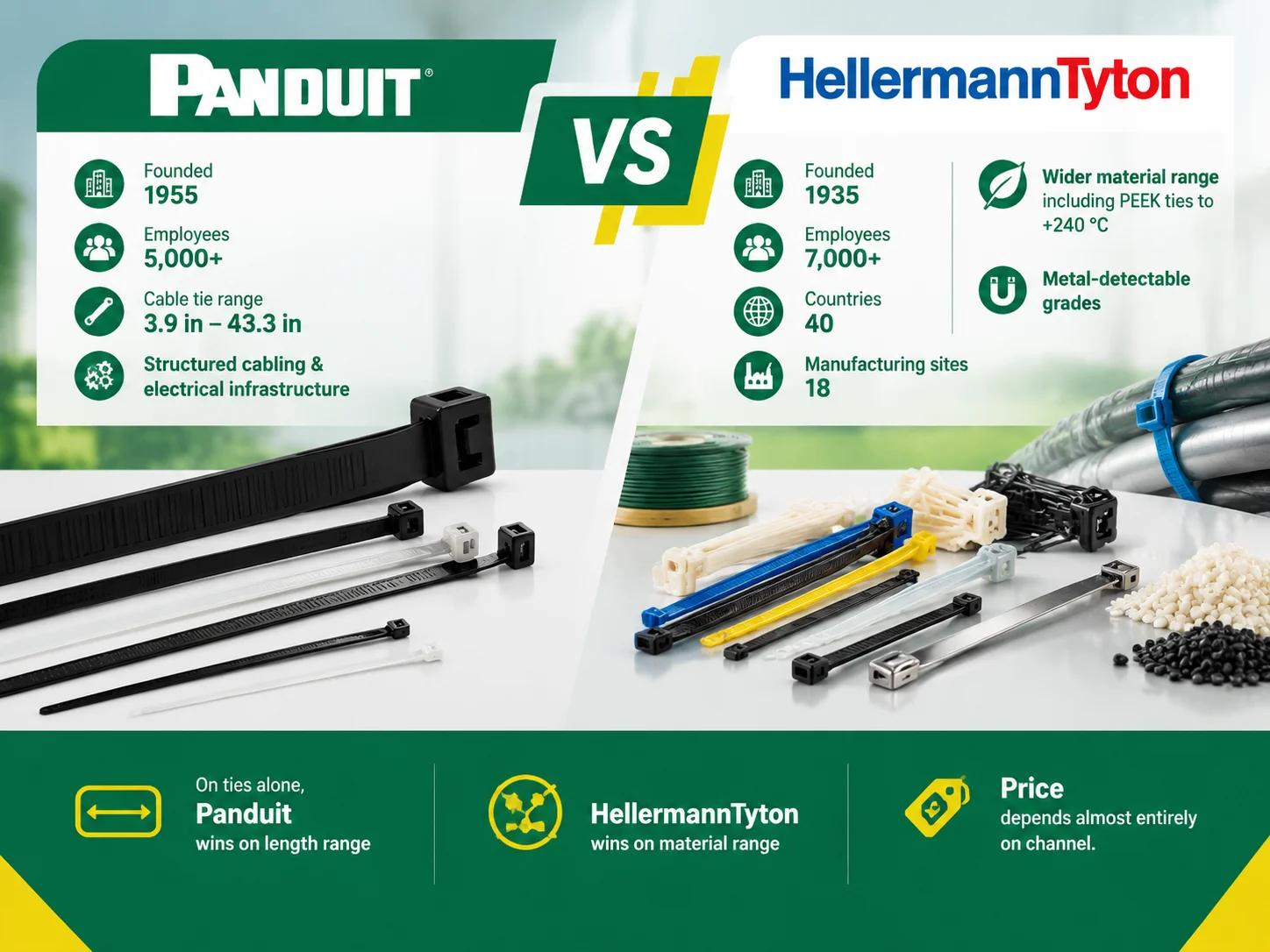
HellermannTyton. The other benchmark brand in Europe, which has much more material variety, and boasts PEEK at +240 °C.. Using similar quality and documentation, it differs through its distributor network footprint.
Thomas & Betts Ty-Rap. The original player in the category, it is credited for being the first choice when vibrations are strong since it employs a metal locking pawl instead of a nylon lever. However, the downsides are related to the metal piece in the head.
Igoto and similar brands. Four families range from 3.0 to 5.0 mm in width, with a total of 32 sizes from 100 to 500 mm, with variations available in UV-resistant material, UL62275-approved production, and OEM-marked products. The heavy-duty cable tie manufacturing side of that range is where most of the volume sits. Per-tie cost is a fraction of the branded price. What you give up is the depth of the catalogue and, in some markets, the instant availability.
Stainless steel. In most cases, it is not a good alternative to nylon and is acceptable only in specific areas, especially when fire-resistant, chemically-proof materials or lifetime of more than 20 years outdoors are required.
A Practical Way to Specify
Process involves four steps which must be followed in the same sequence.
- The starting point is the cable bundle, measured in terms of the real diametr. Then 20% must be added in order not to face problems with running out of the cable clamping device or using oversized one. If the was oversized, there will be extra expenses for additional equipment and long tail.
- Once loading is set, it must be taken into consideration that a cable clamping device that holds static cable has to be capable of withstanding an insignificant amount of tensile the right attribute must have sufficient properties to fulfill the task.
- The next step is fixing the environment. The impact of temperature, UV radiation, chemicals or whether detection is necessary makes selecting materials possible.
- Finally, one only needs to check if the documentation is required. If yes, choose the device bearing the brand, if not buy device according to its measured tensile and grade and request test report. The checklist in this guide to elegir correas de cable de alta resistencia turns those four steps into a form you can send to a supplier.
Preguntas Frecuentes
Is PAN.TY a brand or a product?
The PAN.TY locking cable tie range is a collection of related products operating under the Panduit umbrella. People often refer to all PLT locking cable ties under the term “Panduit tie.”
What does the number in a PLT part mean?
The numbers show the length size and the letter shows the cross-sectional area. The PLT1M is a small 99 mm tie, while the PLT4S is a tie with a standard cross-sectional area of 368 mm. Width and thickness determine the amount of tension; length only determines the diameter of the bundle.
Are PAN.TY ties UV resistant?
The black varieties are UV stabilized, and are the right variety for outdoor use in most applications. Stabilizing is not a permanent process and a stainless steel tie or a specially made UV compound are preferable to any nylon tie for long exposure, such as on a roof or coastal site.
What is the strongest PAN.TY tie?
The extra–heavy cross sections are 250 lb of loop tensile; the light-heavy segment is 175 lb less than those. Both numbers fit well above what is needed for most of the harness and panel work, and the tooling needed for their installation is to be bought separately.
Can I use a cheaper tie in a UL-listed panel?
When it comes to panel standard, a panel standard is concerned only with the listed product not with the invoice. It is possible that if UL notated the tie, then there may be a problem with the listing in the assembly due to the inspector possibly requesting evidence of the component. If the panel is not listed with the standard that lists the tie, a tested unbranded tie will be accepted in normal situations.
Referencias
- Panduit — Cable Management and PAN.TY Product Data
- HellermannTyton — Bridas y Sistemas de Fijación
- Thomas & Betts — Ty-Rap Cable Tie Range
- Newark — Passive Component and Cable Accessory Distribution
- Grainger — Cable Ties and Wire Management
Conclusión
Since it is associated with being the benchmark in its category, PAN.TY is quite famous also because of the quality of the product itself. The mouldings provide consistent quality, quality assurance is exercised throughout the manufacturing process and the product number enables you to know the size of the product in case you have this data. When it comes to UL stamped panels, the documents become the basis of the product in the batch exported or inspected by the customer.
In terms of other types of products, when selecting the product you should not look at the brand name but at whether the tensile strength has been checked and whether the test documentation is available.