



Para que servem os laços de suporte aéreo?
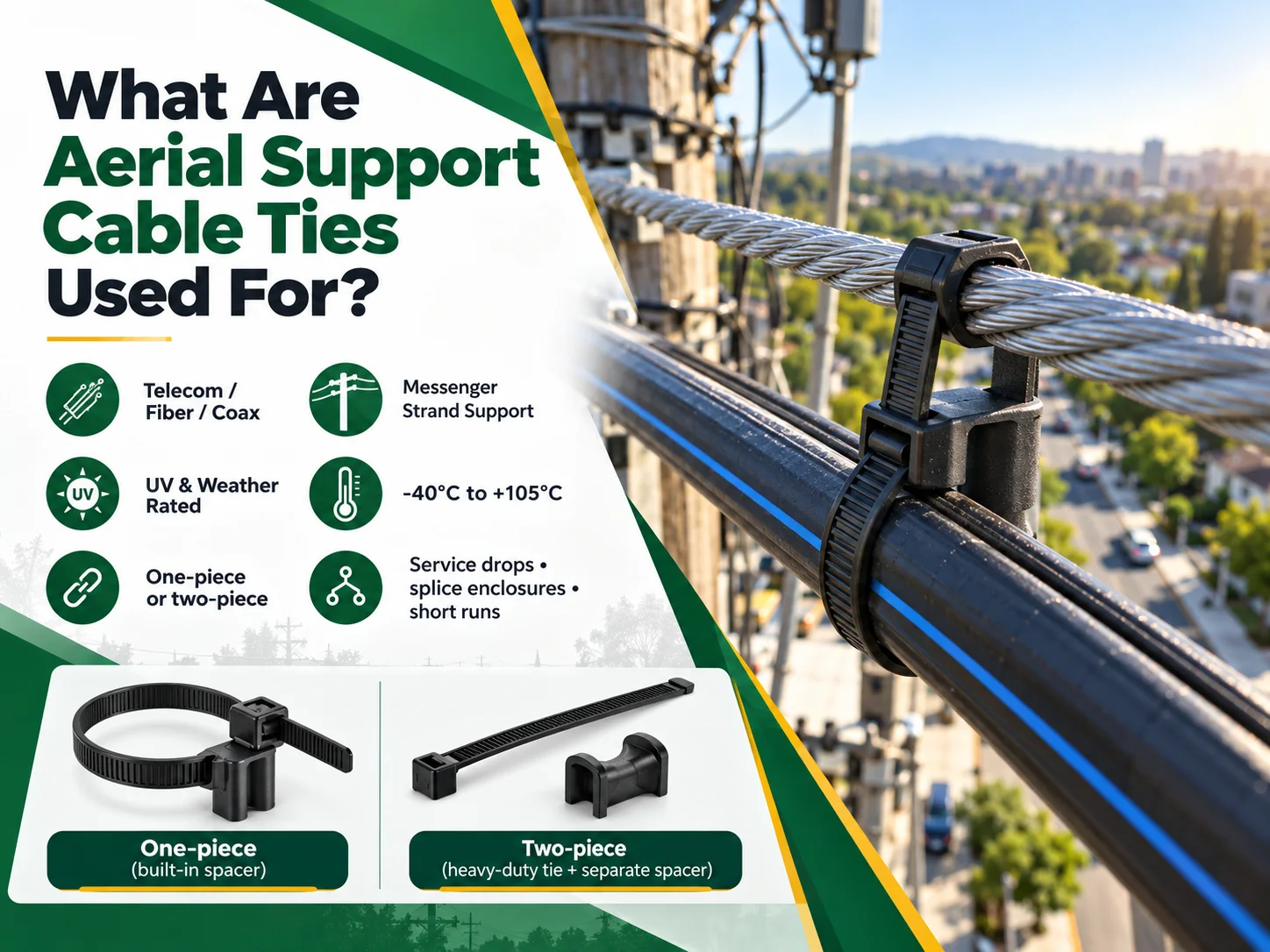
Laços de suporte aéreo são produtos altamente duráveis projetados para suportar condições climáticas adversas. Sua função principal envolve a fixação de cabos de telecomunicações, coaxiais ou de fibra óptica em cabos de aço colocados em postes de utilidade. A maioria deles consiste em dois laços e um pequeno espaçador produzido por meio de processo de moldagem. Simplificando, um laço envolve o cabo, enquanto o outro é fixado ao fio. Com a ajuda do espaçador, os dois não se tocam.
Este guia tem como objetivo educar as pessoas sobre laços de cabo aéreo, os tipos mais populares de laços usados por trabalhadores, os parâmetros importantes de um laço de cabo aéreo, quão distantes os laços de cabo aéreo devem ser fixados, bem como como determinar se o laço de cabo aéreo suportará condições climáticas severas.
Um laço de suporte aéreo, frequentemente referido como laço de suporte de cabo aéreo ou laço espaçador aéreo, é um laço de cabo classificado para uso externo que serve para prender um cabo a um fio mensageiro ou qualquer outro cabo de suporte. Um laço de suporte aéreo de uma peça consistirá em um laço de cabo, um laço de fio e um espaçador embutido de cerca de 12,7 mm (1/2 polegada), enquanto um sistema de duas peças é baseado em um laço aéreo convencional de alta resistência equipado com um espaçador empilhável separado. Como os laços aéreos servem ao ar livre em postes e fios por muitos anos, eles são feitos de nylon 6/6 estabilizado contra UV, estabilizado contra calor e frequentemente modificado para impacto ou polipropileno resistente às intempéries, com a temperatura de operação variando de −40 °C a +105 °C.
O que são Laços de Suporte Aéreo?
O cabo em linhas telefônicas aéreas típicas não tem peso próprio. O fio mensageiro de aço é suportado usando postes para manter o cabo em seu lugar. O fio mensageiro pode suportar uma carga de cerca de 6.000 libras, dependendo de sua espessura.
Um método de fixação do cabo aéreo é o laço de suporte aéreo. Seu design comum de uma peça consiste nas seguintes etapas:
A cinta envolve o cabo e passa pela primeira fenda da cabeça para formar o laço ao redor do cabo.
A cinta envolve o mensageiro e passa pela segunda fenda na cabeça para completar o laço ao redor do fio mensageiro.
Um espaçador é criado no design da cabeça para manter o cabo afastado do fio mensageiro, evitando o desgaste do revestimento do cabo.
Em operação, os laços são instalados com o uso das mãos, possivelmente enquanto se usa luvas, de um caminhão de cesto ou escada. Assim, a maioria dos designs tem cabeças grandes e uma cauda dobrada para facilitar a fixação.
Onde os Laços de Cabo se Encaixam na Planta Aérea
Compreender o que os laços devem e não devem fazer em um caminho aéreo é essencial. Para longas distâncias, o processo usual ainda é a amarração, onde o fio de amarração feito de aço inoxidável é girado continuamente ao redor do cabo e do fio, geralmente medindo entre 0,038 a 0,045 polegadas. Em geral, os municípios terão especificações que consideram o fio de amarração como padrão e permitem laços de cabo de nylon preto para uso externo como material substituto sempre que seu uso for especificado em um determinado contrato.
O fio mensageiro é responsável por suportar a carga em um vão, enquanto a amarração não. O papel da amarração é segurar e posicionar o cabo corretamente ao longo do fio sob a tensão necessária. Portanto, se um projeto exigir amarrações para suportar um cabo, então tal projeto está incorreto e não é a amarração.
As amarrações assumem o controle nos pontos onde a amarração é difícil ou impossível. Em uma linha de postes típica, esses pontos se parecem com isto:
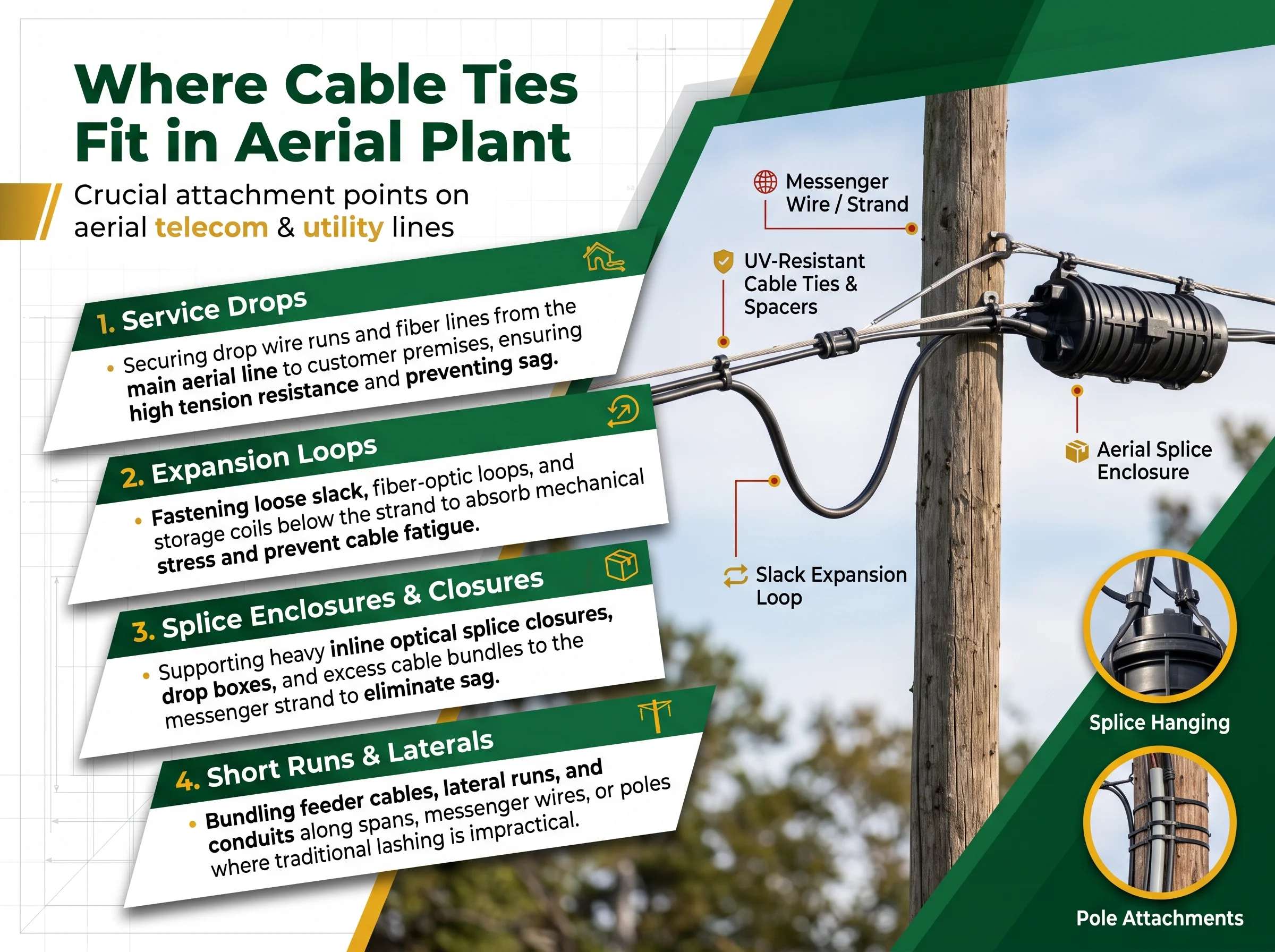
Aqui está o que cada uma dessas funções envolve.
Quedas de Serviço
A queda conectada do poste às instalações é o aspecto básico das instalações. O cabo de queda é ancorado ao fio de suporte através de amarrações de suporte aéreo.
Laços de Expansão em Postes
A equipe de instalação faz laços de expansão nos postes para que o cabo possa se expandir e ceder quando o fio aquece no verão e contrai no inverno. As diretrizes de instalação do cabo exigem que o laço seja mais do que duas vezes o comprimento de sua profundidade e mais do que duas vezes maior que o raio de curvatura mínimo do cabo. Amarrações e espaçadores mantêm a forma do laço e evitam que ele entre em contato com o hardware do poste.
Fechamentos de Emenda e Armazenamento de Folga
À medida que a fibra entra no fechamento de emenda aéreo, ela precisa ser alimentada no ângulo correto. Um conjunto de espaçadores é usado para segregar as entradas de fibra.
Corridas Curtas e Cabo em Figura-8
Algumas normas afirmam que em corridas curtas de interconexão de sinais de tráfego, podem ser usadas amarrações trancadas ou fio de amarração, onde qualquer um é colocado com um espaçamento máximo de 12 polegadas, ou caso contrário, amarrações devem ser usadas com a instalação de cabo em figura-8.
Suportes Temporários e Subidas
Também é importante segurar o cabo temporariamente utilizando amarrações de fio forte com resistência a UV quando for necessário amarrar o cabo.
Os Tipos Primários de Amarrações de Suporte Aéreo
Amarrações de Uma Peça que Incluem Espaçadores Pré-fabricados
Este é o tipo típico. Uma seção representativa mede 270 mm de comprimento e 12,7 mm de largura, pode segurar feixes de cabos com um diâmetro aproximado de 70 mm, moldado em nylon 6/6 estabilizado contra calor e UV, modificado para impacto, classificado de −40°C a +105 °C. Não há como soltar as amarrações uma vez fixadas.
Amarrações Aéreas Reutilizáveis de Polipropileno
Uma família diferente utiliza polipropileno resistente às intempéries com espaçadores embutidos de 1/2 de comprimento para se encaixar em linhas de 1/4 ou 5/16, coaxiais e fios telefônicos. As amarrações podem ser destacadas, o que facilita a disposição das quedas, embora sua força mínima de puxão do laço seja inferior a 75 lb, além disso, os comprimentos variam de 142 mm para um feixe de 25 mm até 254 mm para um feixe de 63 mm.
Amarrações Padrão Equipadas com Espaçadores
Uma solução de duas partes utiliza um bloco espaçador entre duas peças. Espaçadores aéreos empilháveis são clicados uns nos outros e permitem aumentar o espaço em incrementos de 1/2 polegada, o que é eficaz na conexão de pontos ou onde várias linhas se juntam a um fio. Espaçadores moldam a forma enquanto os laços trazem a força. O guia para espaçadores de laços contém informações sobre como corresponder o comprimento e a largura do laço ao slot do espaçador.
Laços de Aço Inoxidável
Em ambientes como áreas costeiras, zonas industrializadas pesadas ou em condições de calor intenso, é necessário mudar para laços de aço inoxidável. Esses laços resistem à corrosão e aos raios UV, no entanto, a dificuldade de instalação é maior em comparação com todos os outros tipos.
Especificações Que Realmente Importam
| Especificação | O que procurar | Por que isso importa |
|---|---|---|
| Material | Nylon 6/6 estabilizado contra UV, estabilizado contra calor, idealmente modificado para impacto; ou polipropileno resistente às intempéries | Ciclos de luz solar e calor são o que danificam os laços externos |
| Cor | Preto | Preto de carbono é o estabilizador UV na maioria dos nylons externos |
| Largura | Cerca de 11 a 12,7 mm em laços aéreos dedicados | Faixas mais largas distribuem a carga e resistem à abrasão do vento |
| Resistência | De cerca de 75 lb (polipropileno) a 120 lb e mais (nylon 6/6) | Carga de gelo e vento adicionam força bem além do peso do cabo |
| Temperatura | −40 °C a +105 °C ou melhor | Fios sob o sol do deserto e invernos do norte veem ambas as extremidades |
| Fechamento | Não liberável para trabalho permanente; liberável para quedas que mudam frequentemente | Permanent spans should never rely on a release tab |
| Strap design | Outside serrations | Keeps teeth off the cable jacket |
Using common nylon zip ties, white nylon or indoor nylon is never allowed for aerial span applications. Over time, without any UV stabilization, the tie becomes brittle when exposed to sunlight. Snapping of ties 20 feet above dramatically increases the risk of sagging cables which, in turn, will generate the need for locksmithing and additional repairs.
The absolute minimum for outdoor aerial work is black nylon 6/6. Some manufacturers state that their specialized ties can last 15 years or more when made of special resins. However, actual conditions will matter, so the performance of aerial ties will depend on the climate. For general outdoor tie work at poles, risers and cabinets, our laços de cabo pretos resistentes a UV are made for solar, telecom and outdoor electrical jobs, and the comparison of the melhores laços zip para uso externo covers when to step up to nylon 12 or stainless steel.
Spacing and Placement
There is not a conclusive number, which is universally applicable. The cable owner’s construction standards, the utility’s joint-use agreement, and local regulations form the basis of how the spacing is set. Still, some patterns keep on cropping up repeatedly:
Tight spacing on tie-only runs. One interconnect standard required by a public agency states that locking cable ties or lashing wire should be no more than 12 inches apart.
A tie at every transition. Where the cable leaves a strand for a drop, a riser, or closure, place one tie where it makes the departure and another approximately 4 inches from it.
Respect the bend radius. Ties at an expansion loop or closure entry should hold the shape yet not force the cable tighter than its minimum bend radius. Fiber optic cable is especially sensitive to this.
Stay clear of the pole hardware. Spacers and tie heads should not rub on bolts, clamps, or guy attachments.
How to Install Aerial Support Ties
Once a crew has the rhythm, each tie takes well under a minute. The order never changes: cable first, strand second, spacer in between.
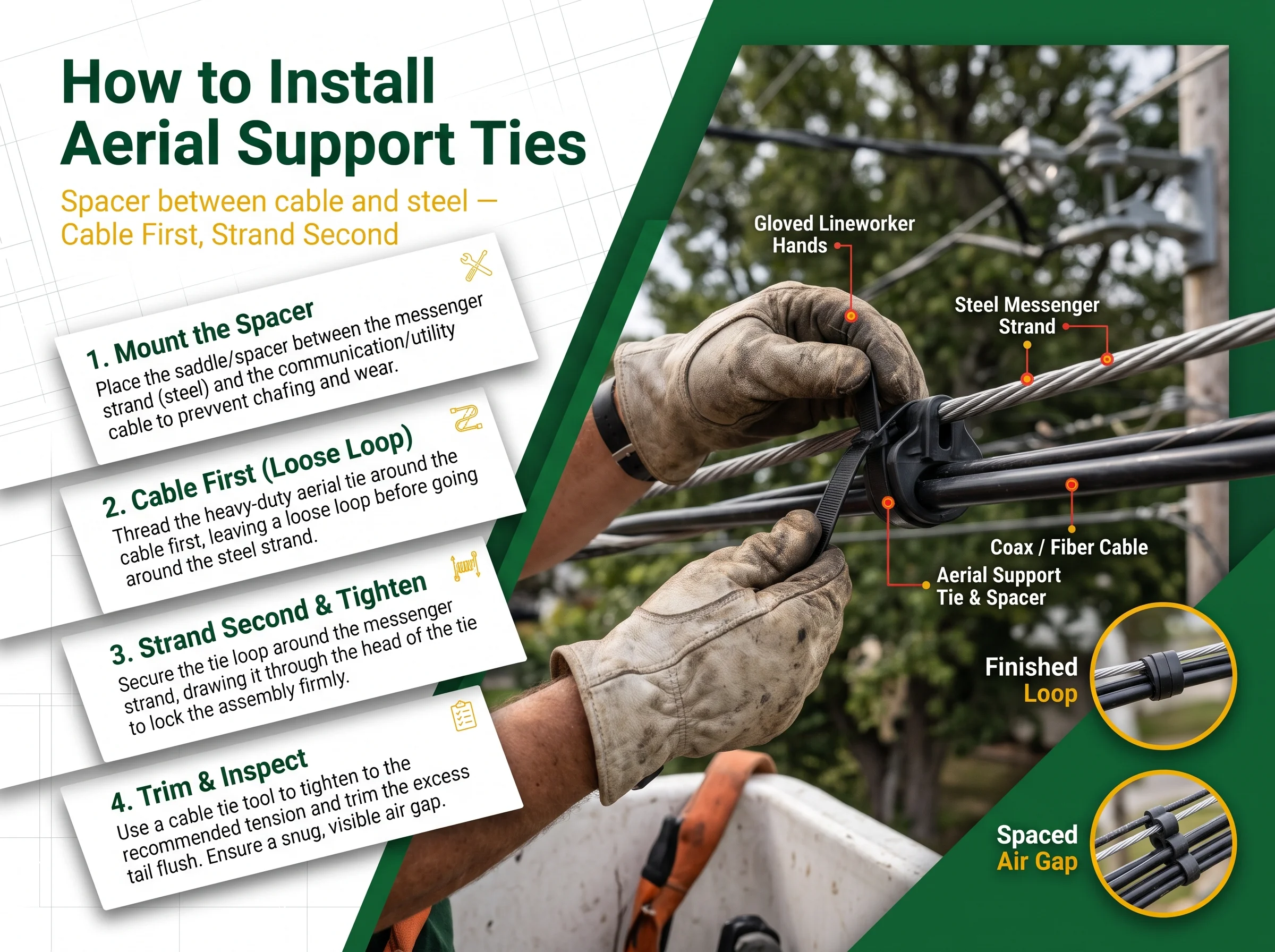
Step by step:
- Verify the size of both the strand and the cable. Make sure the diameter of the strand, measured in 1/4, 5/16 or 3/8 inches, and that of the cable lies within the specifications of the tie.
- Begin with the cable. Loop the strap around the cable with the prongs outward and pull it through the cable-side of the strap.
- Wrap the messenger. Bring the strap around the strand and send the strap through the strand-side of the strap.
- Tighten to an appropriate amount. Hand-tighten it till the union cannot slide down the strand anymore. For long linear installations, a tool can apply effective tension as is shown in the guide for como usar uma pistola de fita. Overtightening will damage the coaxial cable and perhaps affect its performance.
- Cut the excess properly. A long tail will whip in the wind and damage the cable while an uneven one will catch on the gloves during the next job. The tools and technique in como cortar laços de cabos leave a smooth edge.
- Examine the line visually. Check the installation for proper spacing and orientation and make sure nothing is pinched in the loops or joints.
Aerial work close to parked power lines can be done only by licensed personnel who observe the respective regulations and safety rules.
Choosing Ties for Hot, Cold and Coastal Sites
The climate plays a greater part in the choice of materials than the majority of the data sheets are willing to acknowledge.
Desert and Gulf temperatures. Constant ultraviolet (UV) light and high temperatures demand the use of UV-stable black nylon and impact-modified plastics to ensure the ties can handle the expansion and contraction caused by daily temperature changes.
Cold weather. Nylon becomes less flexible when temperatures drop below freezing. Impact-modified plastics stay tough, and installers must not use ties that have been stored in a truck overnight at freezing temperatures until they warm up.
Ice and wind zone. Ice adds weight, wind adds vibration. Therefore, wider straps should be considered, more strict spacing standards adhered to, and tensile load verified.
Coastal and industrial air. All the chemical and salt exposure have to be addressed by the use of stainless steel wire and stainless fasteners at crucial parts and nylon ties for drops and bends.
For pole, riser and cabinet work alongside dedicated aerial ties, a 4.8 mm tie in the 50 lb (22 kg) class, such as our laço de alta resistência, handles most small bundles, and our guia de tamanhos de laços de cabo helps match longer and wider ties to bigger bundles.
Common Mistakes on Aerial Runs
- Not enough ties. By increasing spacing beyond the accepted norm, the cable droops in-between ties creating additional loads on them due to wind and ice.
Skipping spacers. Cables pressed directly against strands of steel wear out faster than expected, especially in areas with wind.
Over-tightening coax and fiber. A tie that squashes coax changes its impedance and a tie that applies pressure to fiber creates signal loss.
Mixing tie grades in one run. A single natural nylon tie in a series of dark UV ties is the first one to fail.
Leaving long tails. They flap in wind, damage the cable and fail the inspection.
Ignoring the aged ties. An existing run should have failed or damaged ties removed altogether instead of just adding new ones beside them. Our guide on como remover cabos de amarração covers cutting them off without nicking the cable.
Inspecting Aerial Ties Over Time
Once an aerial plant is installed, it is easy to overlook it, which is why tie issues often go unnoticed. Most problems can be caught early simply by checking aerial plant equipment periodically during regular inspections or whenever a crew visits the pole.
Color and texture. Black ties that have turned gray, appear chalky, or have developed fine surface cracks show signs of UV protection failure.
Flexibility. If a tie breaks under light stress, all ties from the same batch should be suspected.
Location. Ties that have slipped along the span, turned to the point at which the spacer is no longer between the wire and the rod, or moved from where they are supposed to be need adjustment.
Jacket damage. The presence of shiny or flattened areas in the vicinity of a tie indicates the presence of vibration-induced friction, which occurs when either the spacer is absent or the tie is not tightened enough.
Ties that have been identified as potentially faulty should be replaced either all at once in one operation or in batches. The date and details of the ties should be logged so that the next crew that arrives knows what has been done.
Perguntas Frequentes
What are aerial support cable ties used for?
They connect telephone, fiber optic, coax or a signal cable to a messenger wire between different poles, usually at some service drops, expansion loops, splice chambers or short runs. The integrated spacer keeps the cable away from the steel wire to avoid damage.
Can I use regular zip ties on a messenger strand?
Only if the black outdoor ties are UV-stabilized, are of suitable width and strength, and are permitted by the specifications of the cable owner. Indoor-style ties deteriorate under sunlight and are not suitable for outdoor use.
How far apart should aerial cable ties be?
Adhere to the construction standard of the cable’s owner or agency. For instance, the public agency’s interconnect standard specifies that ties must not exceed 12 inches apart, and that there must be additional ties wherever the wire leaves the strand at any point.
Are aerial support ties better than lashing wire?
Their functions differ. Lashing wire is quicker and the default solution to long distances, while ties are better suited for drops, loops, closures and other short distances where a lashing technique is not viable. Numerous roads use both.
How long do aerial support ties last outdoors?
High-grade heat- and UV-stabilized nylon ties are designed for many years outdoors, with some manufacturers claiming 15 years or more. Actual life depends on UV intensity, heat, wind and installation quality, so inspect aerial plant regularly.
Referências
- Braçadeira, Wikipedia
- Aerial interconnect design standard, Florida Department of Transportation
- Construction specification, Section 804 Cables, City of Toronto
- Aerial workmanship, The Fiber Optic Association
Conclusão
Laços de suporte aéreo are small parts with a long, exposed working life. The load is carried by the messenger strand while the function of the tie is to hold the cable in position and keep it well spaced throughout the period of the heat wave, ice storms and wind. Use black and UV- and heat-stabilized cable ties of proper width and strength, have the cable properly spaced from the strand with a spacer, stick to the guidelines in your construction code when it comes to spacing specifications, tension the cables without crushing them and cut off the excess tails making them flush. For the standard outdoor ties that support aerial work at poles, risers and cabinets, browse our laços de nylon e conectores de cabo.