




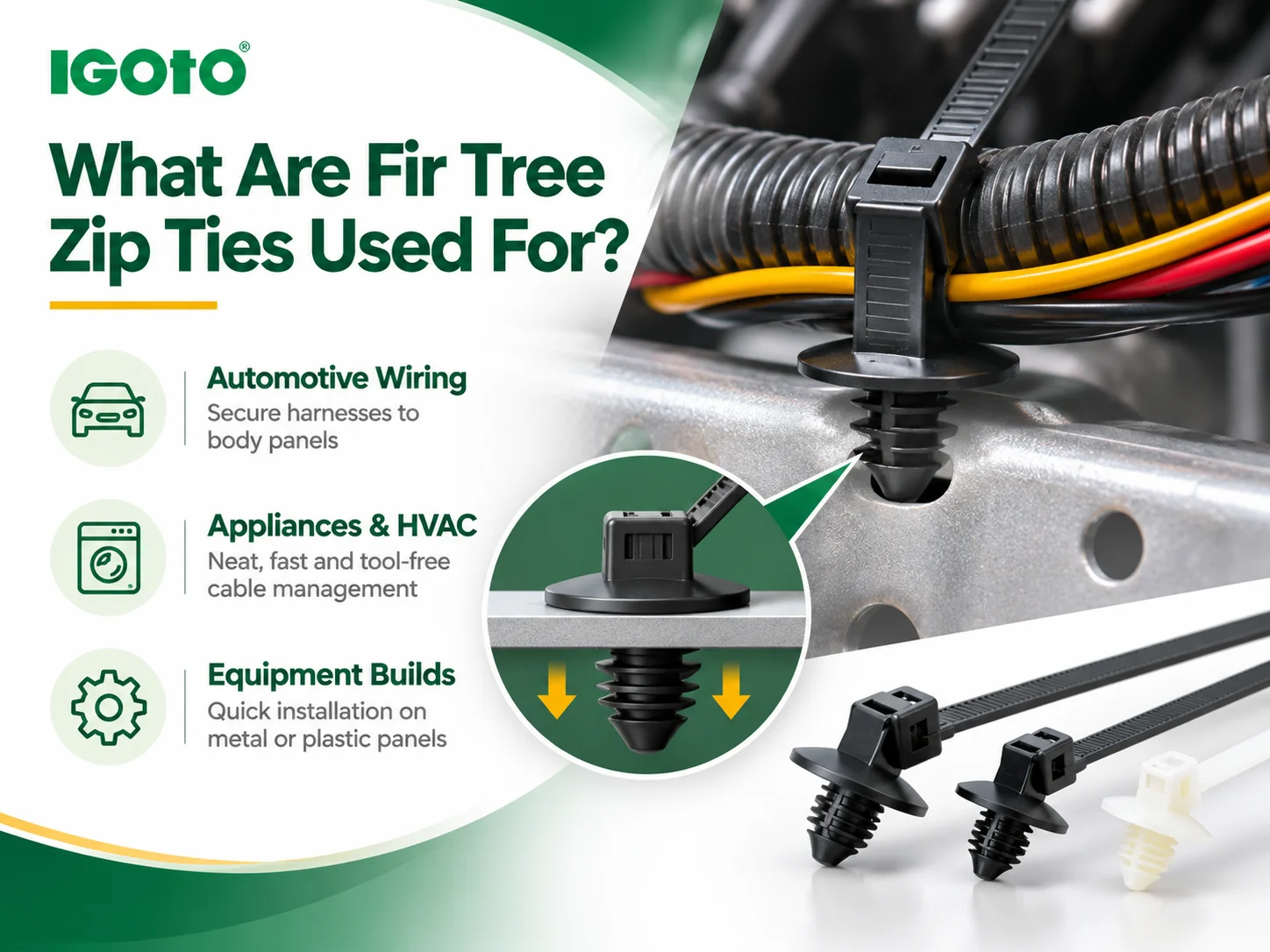
Для чего используются стяжки с еловыми деревьями?
Зажимы в форме елочки are cable ties with a ribbed, Christmas-tree-shaped pin molded onto or clipped under the head. The pin is then inserted into a hole in a panel, allowing the ribbed arms to collapse during the insertion process and then spread out on the other side, thus securing the tie in place without the use of screws, adhesives or tools. Next, the wire bundle is wrapped in the strap and fastened like any other type of zip tie.
Zip ties have long been used by automobile manufacturers for securing wire bundles against body panels, as well as by appliance manufacturers, HVAC companies, and other equipment manufacturers. This guide provides insights into the functioning of these zip ties, their hole and panel sizes, their differences with arrowhead and dogleg mounting systems, and how to reuse them without damaging the mounting plates.
A fir tree zip tie, or fir tree cable tie or push mount tie, is a type of nylon cable tie that includes a fluted pin that locks into a punched or drilled hole. The fluted design allows them to be inserted with minimal effort and removed with great resistance. A dish or disc under the head presses against the panel to block any rattle. Fir tree mounts have a wider range in panel thickness than arrowheads, ranging typically from under 1 mm up to about 8 mm, with holes most often around 6.3 to 7 mm. They can be found either as one-piece ties or two-piece mounts, which take a distinct standard tie. Heat-stabilized nylon 6/6 is the standard material for engine bays and other hot locations.
How Fir Tree Zip Ties Work
The pin of a fir tree cable tie comprises a stem and a group of small, slanted ribs called flutes or branches. The ribs lean back towards the head like fir tree branches.
When you insert the pin into the hole, the ribs bend in to allow the pin to pass through. When the ribs move past the back of the panel, they change positions to grip the hole. Since the ribs are slanted backwards, it is easy to insert the pin. An automotive supplier gives figures of 10 lbf for insertion force while the retention force is over 40 lbf. This was not the case in older designs of the cable tie as needed insertion force was 30 to 40 pounds that exerted pressure on the workers.
Most fir tree ties have a disc located between the head and the pin like the one using the mechanism described above. The disc on the fir tree tie presses on the panel and ensures that the tension is maintained in the joint so that the cable bundle does not vibrate against the metal.
Для чего используются стяжки с еловыми деревьями?
Автомобильная Проводка
This is where they truly belong. Bodies of cars and trucks are filled with factory holes caused by extinguishing of the holes on the high-quality assembly with fir tree zip ties put in place by harness designers. That makes it possible to manufacture an entire assembly of the whole wiring system within seconds. It is mentioned in a bulletin issued by Daimler Trucks Company that it is essential to choose the right type of a fir tree part depending on the size of the mounting hole.
Aftermarket and DIY Wiring for Automotive Use
Those who want to install a dash camera, LED light bar, trailer wiring harness, winch, amplifier, etc. can implement this trick as well. Existing holes, used for original clips installation, will fit perfectly if the sizes suit fir tree zip ties. This way, any new wiring can be installed without any drilling. The only requirement is to use black fire retardant zip tie in case of working with pickups and off-road vehicles.
Wiring for appliances and HVAC equipment
Washing machines, washing machines, fridges and rooftop HVAC systems are also equipped with wiring that must be separated from moving parts on the machinery, hot surfaces and fan blades. Fir tree zip ties, secured in pre-drilled holes of the chassis, will ensure that wiring is placed and secured as per the demand of the designers time and time again.
Electrical enclosure wiring and machinery
Electrical control cabinets, generator sets, solar inverters, packaging machines, and so forth are examples of equipment using fir tree zip ties to securing wiring in the electrical cabinet and control panels. Similar idea works for telecommunication equipment, especially preventing disruption of air circulation.
Other Uses of Fir Tree Zip Ties
Marine applications, RVs, farming equipment and sign makers use fir tree ties anywhere skinny panels with holes are used instead of screw installment.
Fir Tree vs Arrowhead vs Winged Push Mounts
All three are push mounts, and shoppers often treat them as the same thing. They are not, and picking the wrong one is the most common reason a push mount tie falls out. The difference is easiest to see side by side.
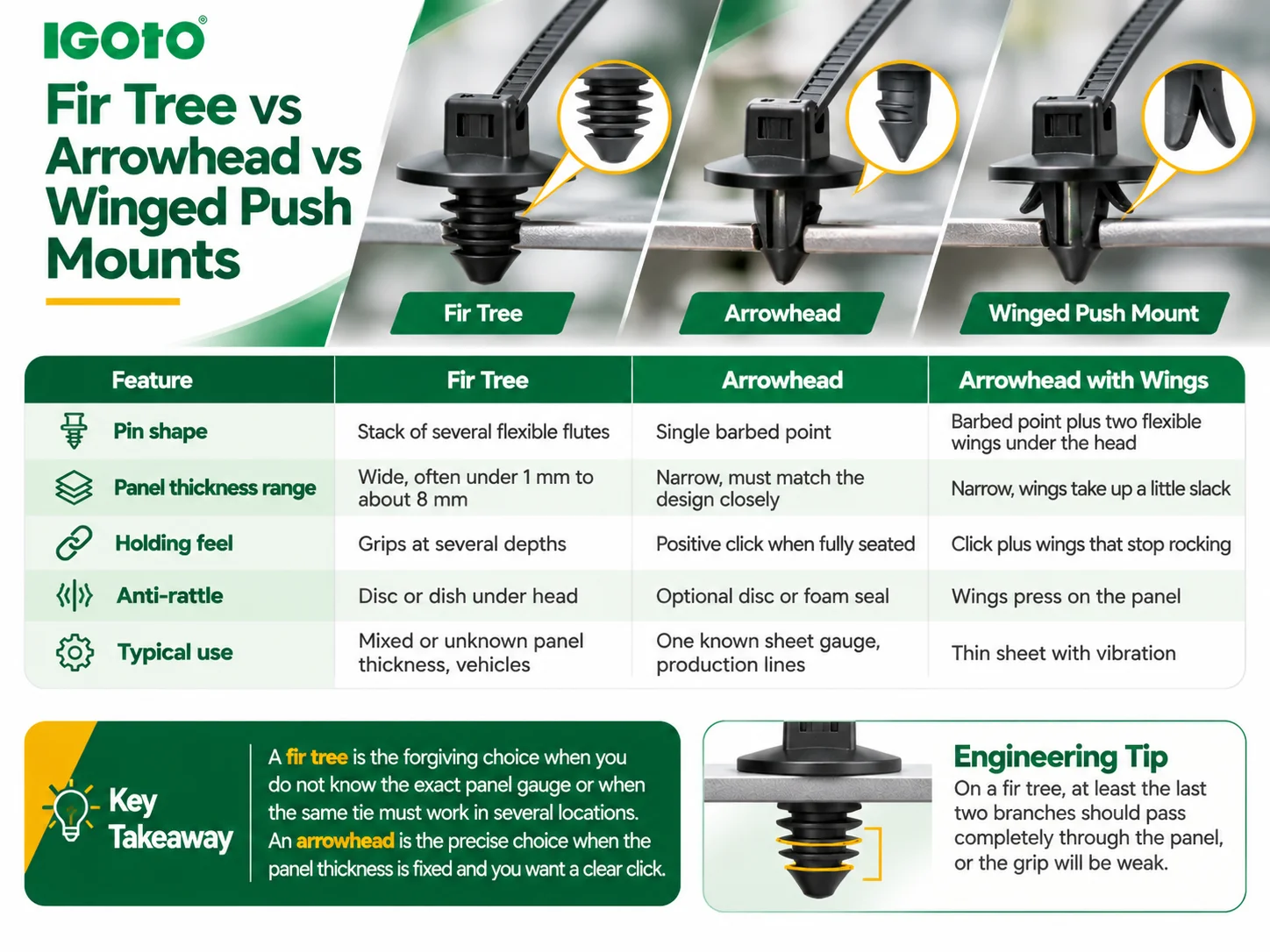
Here is how they compare in practice:
| Особенность | Фирменное дерево | Arrowhead | Arrowhead with wings |
|---|---|---|---|
| Pin shape | Stack of several flexible flutes | Single barbed point | Barbed point plus two flexible wings under the head |
| Panel thickness range | Wide, often under 1 mm to about 8 mm | Narrow, must match the design closely | Narrow, wings take up a little slack |
| Holding feel | Grips at several depths | Positive click when fully seated | Click plus wings that stop rocking |
| Anti-rattle | Disc or dish under head | Optional disc or foam seal | Wings press on the panel |
| Типичное использование | Mixed or unknown panel thickness, vehicles | One known sheet gauge, production lines | Thin sheet with vibration |
Important note: the fir tree is the best option in cases where the panel gauge is unknown or when the same tie must be used in many different places. Conversely, the arrowhead is the best choice if the thickness of the panel is well known. In addition, according to engineering literature, one last important rule is valid here: at least two last branches of the fir tree should go through the panel completely.
Sizing: Hole Diameter, Panel Thickness and Bundle
Match the pin to the hole before you buy anything else. A hole that is too large lets the flutes slip straight back out, and a hole that is too small forces you to hammer the pin in, which cracks the flutes and the tie never seats properly.
Be sure to review the technical information to get the exact details for the part in question but here is what specifications for products looks like:
For fir tree ties we usually see holes of about 6.3mm to 7.2mm, which corresponds to the standard sizes of a 1/4 drill bit or a 6.5mm round punch.
The heat stabilized nylon 6/6 type fir tree tie of 220mm long and 5.1mm in width is designed for holes ranging from 6.5 to 7.2mm and thicknesses of the panel – 0.6 to 8.5mm , it has a tensile strength of 50 lbs and will accommodate maximum bundle of 50mm.
A general push mount tie fitted with a skirt, is compatible perfectly with holes of 6.5 to 13mm and panels of 0.7 to 5mm, while consulting with the measurement of the maximum bundle of 35mm.
The heavy truck fir tree mounts fit holes of thickness ranging from around 4.5mm to 10mm – some of the variations used in car machines also require the use of threaded M6 and M8 and M10 holes.
When you drill your own holes, you need to measure the pin but not the packaging. First, make a hole in the sample material of similar thickness, insert the tie and perform a strong tug. If the tie will come out with less effort than it was put in, it means the hole was too big.
At the final step check the size of the bundle. The tie should wrap the bundle, leaving enough material to pull the strap through its head. In case the bundle is almost at the maximum of its range of dimensions, you should get the longer version of the strap. Our руководство по размерам стяжек lists standard lengths with their bundle diameters in both metric and inch.
One-Piece vs Two-Piece Fir Tree Ties
“One-piece ties have the pin incorporated into the head, making them the easiest and quickest to install, as there’s nothing to lose or get out of alignment, which is the reason production lines favor them.
On the other hand, the two-piece design uses a separate fir tree mount that consists of a small base with a pin at the bottom and a slot or saddle at the top; you thread a standard cable tie through it. Its advantages become apparent when it comes to servicing the wiring; you only have to cut and replace the tie while retaining the mount in the panel. You can choose the strap based on your preferences: wide for large bundles, UV-stabilized black for outdoor applications, etc.”
That flexibility is why many maintenance teams stock two-piece mounts plus a box of plain ties. For the strap, a 4.8 mm tie in the 50 lb (22 kg) class, such as our высокопрочный нейлоновый хомут, fits the slot of most standard fir tree mounts. For a wider look at mount styles, including screw, adhesive and rivet versions, see что такое монтируемые кабельные зажимы and our guide on том, как выбрать крепежные стяжки.
Material and Temperature
Almost all tree ties are molded from nylon 6/6; within tolerable limits, the grade means much more than most people have ever apprehended.
Standard nylon 6/6 is generally given a rating for continuous use of around 85 °C. This temperature rating is suitable for inner cabins, kitchen appliances, and enclosures that exist indoors. One might assume standard nylon 6/6 can handle a temperature of about 85°C, but herein lies both the grief and identifying potential within rough circumstances.
10-105 °C will go slightly better in engine bays, near exhausts, and room-temperature swelters of that darling-design adopted in hotter climates-settings like Arizona or Gulf summers, where metal roofs or truck firewalls are heated to a frightening degree.
UV-stabilized black nylon is the safe bet whenever the tie will be subjected to sunlight, such as trailer tongues, solar combiner boxes, outdoor HVAC units, and boat consoles. Natural and white ties are made with sun-imbibed. When a fir tree tie snaps, the pin remains stuck within the hole. Our черные кабельные стяжки, устойчивые к УФ-излучению are made for this outdoor work.
In dealing with moisture, nylon absorbs some moisture from the air to retain flexibility. A tie placed within an area that is very dry or one that comes from a cold truck in the winter may be very stiff and break apart on insertion; give them a warm-up and the ease comes back to them.
Как установить стяжки типа "елочка"
Installation takes seconds once the hole is right, and removal is just as quick with the proper tool. The visual below shows both jobs at a glance, and the steps that follow go through each one in detail.
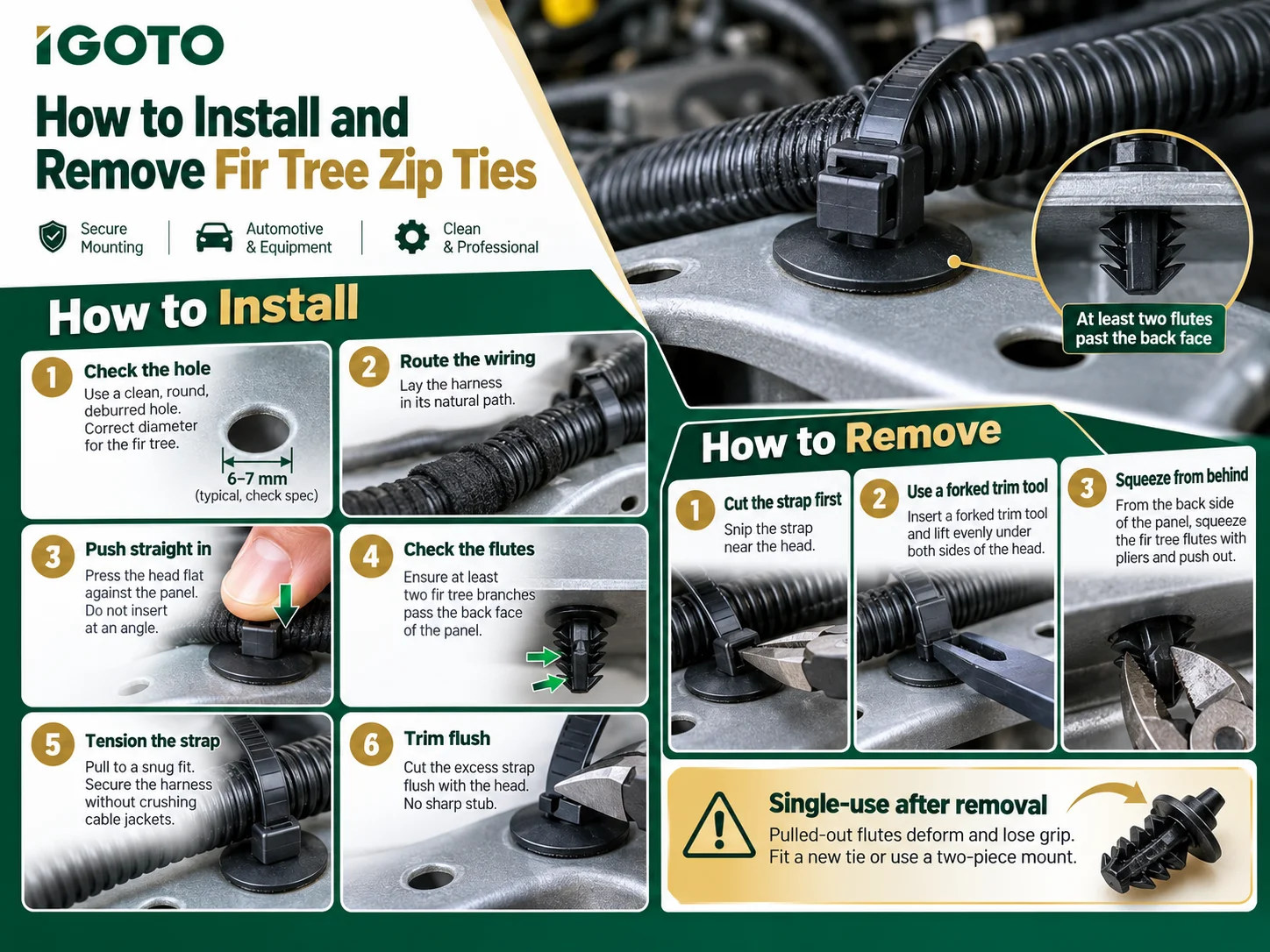
1.Inspect the hole and make sure the diameter is suitable for the tie. If the hole was created using a drill or punch, any jagged edges must also be removed.
2.Route wiring first. Position the harness following its final path so that each tie is placed in its natural position.
3.Punch the pin straight in. Use your thumb to press the pin down until the disk is flush with the surface of the panel.
4.Check that enough flutes have extended out of the hole. Try to see behind the panel if it is possible; there should be at least two full branches out of the hole.
5.Wrap and tighten the strap. Make sure the strap is tight; if necessary, use a tensioning device.
6.Cut the excess strap off. A sharp edge of the strap may scratch hands or insulate wires. Our guide on том, как резать зажимы covers flush-cut tools and technique.
How to Remove a Fir Tree Zip Tie
Fir tree clips are made not to let go quite easily, so the work of pulling one out of a painted panel or a plastic trim takes some skill.
- Cut off the strap. Make cuts as close to the head so that the wiring is out of the way, allowing for better visualization. Our article on как удалить стяжки explains how to cut without nicking the insulation.
- Employ a forked trim tool or panel-clip pliers. Slide the fork under the head on either side of the pin and pull up vertically, putting pressure close to the hole. Pulling from one side makes the pin tilt and damages the plastic trim.
Squeeze the backside if the access is available. If you can reach the back of the panel, use pliers to pinch the flutes together and force the pin out toward the front.
Consider each fir tree pin as disposable. Even though the pin has been already removed from a vehicle, when reused, the flutes will still retain some deformations from the previous installation.
Common Mistakes
- Estimating the hole size. The difference between the 6 mm and 7 mm hole is negligible going by appearance; however, this is not the case when fir tree pins are applied.
Using fir trees with extra thick material. In case of thick panels, the pin cannot achieve the required depth, resulting in insufficient amount of fluting to pull through.
Mounting fasteners in soft materials. Fir tree pins have reasonable performance with sheet and stiff plastic but fail with drywall and other soft materials. For walls, an anchor or screw mount works better, as covered in our guide to fixing cable ties to drywall, concrete or brick. - Using natural nylon in places exposed to heat or sun. When mounting underneath the hood or outside apply black heat or UV-stabilized fasteners.
Hanging heavy objects. Fir tree fasteners serve to attach a harness, not to conduct heavy pipes or cables. In case of heavy loads, use smaller spacing or change for a screw type fastener.
Часто задаваемые вопросы
What size hole do fir tree zip ties need?
Most common fir tree ties fit holes of about 6.3 to 7.2 mm, roughly a 1/4 inch drill. Other sizes exist from about 4.5 mm up to 10 mm or more, so always check the rating on the specific part.
Are fir tree zip ties reusable?
Usually not. The flutes deform when the pin is pulled out, so it holds less firmly the second time. With a two-piece system, the mount can stay in place while you replace only the strap.
What is the difference between fir tree and push mount ties?
Fir tree is one type of push mount. Push mount is the general term for any tie that anchors by pushing a pin into a hole; fir tree pins have several flexible flutes, while arrowhead pins have a single barb.
Can fir tree zip ties be used outdoors?
Yes, if the tie is made from UV-stabilized black nylon. Natural or white ties degrade in sunlight and can snap, leaving the pin stuck in the panel.
Will a fir tree tie hold in plastic panels?
Yes, in rigid plastic of the right thickness, which is why they are common on car interior trim and appliance housings. Avoid soft or foam materials, where the flutes have nothing firm to catch.
Ссылки
- Кабельный зажим, Википедия
- Cable tie with fir-tree type fastener, US patent application 20060239796
- Freightliner Parts Technical Bulletin, Cable-Tie Reference 00-024, via NHTSA
Заключение
Зажимы в форме елочки convert any hole that has been punched or drilled into an instant anchor point. Fir tree zip ties feature tall flutes that can easily be inserted. They are resistant to being pulled out and have a disc underneath the head that prevents the wiring from buzzing on a vibrating panel. In order to use them you need to choose a pin that matches the hole diameter, make sure the thickness of the panel is appropriate, choose either heat-stabilized or UV-stabilized black nylon for hot areas or outdoors and use only once. If you want to change the wiring, consider a fir tree mount with a high quality standard tie. You can find widths, lengths and grades for those straps on our нейлоновые стяжки и кабельные вводы странице.