


أفضل أربطة كابل نايلون مثبتة ضد الحرارة
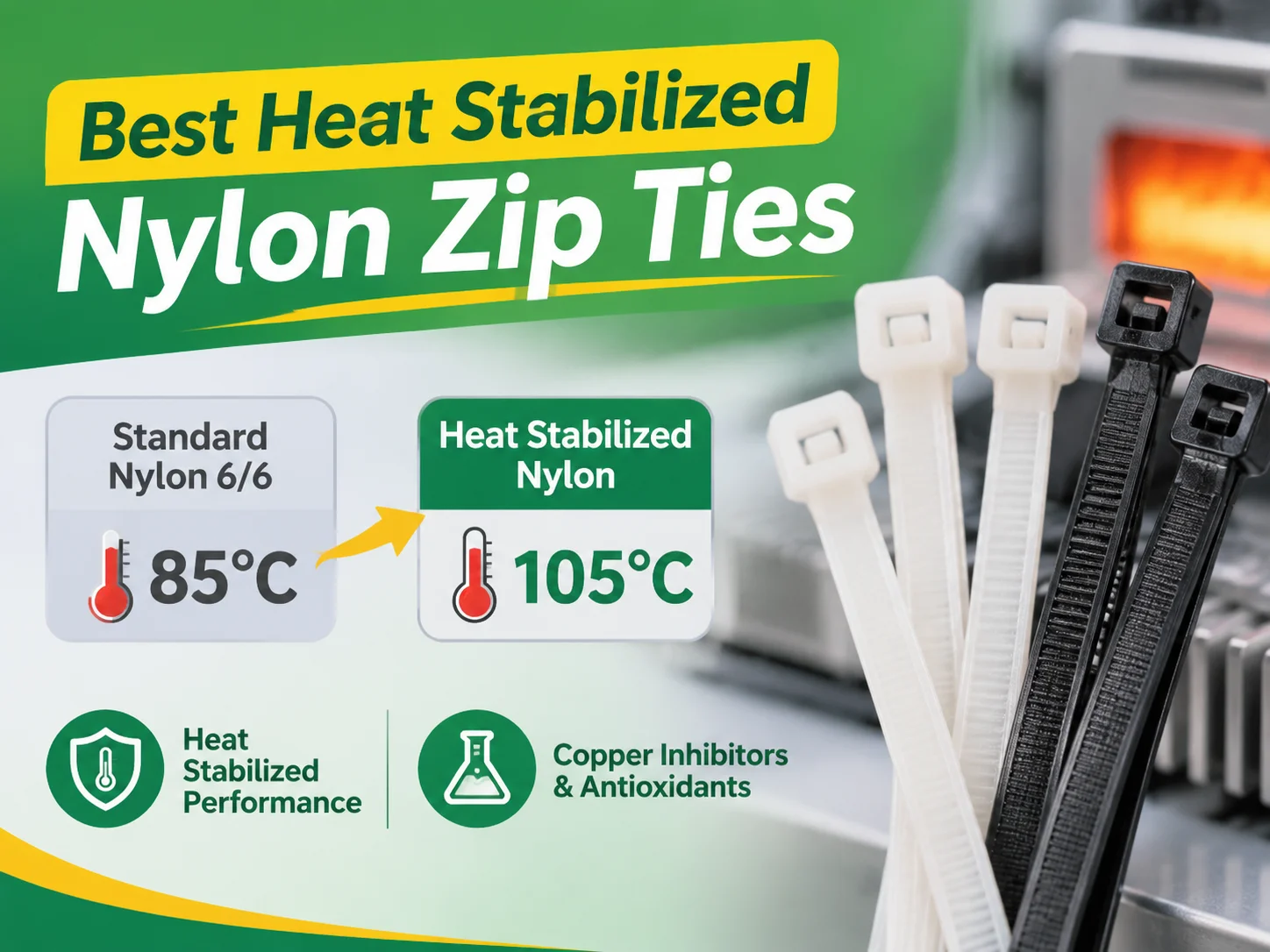
المصطلح “مثبت حرارياً” يظهر بشكل متكرر عند وصف أربطة الكابلات النايلون، مما يؤدي غالبًا إلى سوء الفهم. التعريف الدقيق ليس أن أربطة الكابلات المثبتة حرارياً يمكنها تحمل الحرارة الناتجة في حجرة المحرك إلى الأبد، ولا يشير التثبيت الحراري إلى أي شكل من أشكال مقاومة الأشعة فوق البنفسجية. بل يشير التثبيت الحراري إلى الإضافات الكيميائية المضافة إلى النايلون التي تبطئ من تحلل النايلون الحراري، مما يسمح بزيادة درجة حرارة الخدمة بحوالي 20 درجة مئوية (36 درجة فهرنهايت) مقارنة بأربطة الكابلات النايلون القياسية ويسمح بتصنيف ربطة الكابل لدرجة حرارة خدمة مستمرة تبلغ حوالي 105 درجة مئوية (221 درجة فهرنهايت).
إجابة سريعة: أربطة الكابلات النايلون 6/6 القياسية لها تصنيف خدمة مستمرة نموذجي يبلغ حوالي 85 درجة مئوية، بينما أربطة الكابلات النايلون المثبتة حرارياً لها تصنيف درجة حرارة خدمة مستمرة يبلغ حوالي 105 درجة مئوية. الإضافات المثبتة حرارياً التي تسمح بزيادة التصنيف هي مثبطات النحاس ومضادات الأكسدة التي تمنع تحلل أربطة الكابلات النايلون الناتج عن التعرض لكل من الحرارة والنحاس. بينما يزيد التثبيت الحراري من تصنيف أداء أربطة الكابلات النايلون، لا يمكن افتراض أن أربطة الكابلات المثبتة حرارياً مقاومة للأشعة فوق البنفسجية ما لم تحتوي على صبغة الكربون الأسود الموجودة في أربطة الكابلات النايلون السوداء. لذلك، إذا كانت ربطة الكابل ستتعرض لظروف خارجية، يجب أن تكون ربطة كابل نايلون سوداء بدلاً من ربطة كابل نايلون مثبتة حرارياً.
ستناقش الأقسام المتبقية الإضافات الكيميائية المستخدمة في إنتاج أربطة الكابلات النايلون المثبتة حرارياً (وكيف تؤثر على أربطة الكابلات النايلون)، والتصنيفين لربطات الكابلات المثبتة حرارياً والمثبتة ضد الأشعة فوق البنفسجية، مقارنة بين أربطة الكابلات المثبتة حرارياً والمثبتة ضد الأشعة فوق البنفسجية وما يتفوق فيه كل مصنع، الأحجام المتاحة لأربطة الكابلات النايلون، نطاقات الأسعار لكل نوع من أنواع أربطة الكابلات النايلون وما يفشل فيه كل نوع أثناء الخدمة، اختيار أربطة الكابلات النايلون حسب التطبيق، مكان إنتاج المصنع ضمن صناعة أربطة الكابلات النايلون وكيف يمكن للعميل التحقق من ادعاءات المصنع قبل تقديم طلب الشراء.
ما المقصود فعلياً بالتثبيت الحراري
يعتبر النايلون 6/6 نوعًا من البولي أميد. تتحلل البولي أميدات عند التعرض للحرارة بسبب الأكسدة. تحدث هذه العملية عادة بمعدل بطيء عند درجة حرارة الغرفة؛ ومع ذلك، مع ارتفاع درجة الحرارة، تزداد سرعة التحلل أيضًا. عندما تتحلل أربطة البلاستيك بسبب التعرض لدرجات حرارة عالية، تتحول من شفافة إلى صفراء، ثم بنية، وعادة ما تفشل في نقطة ما بسبب فقدان المرونة.
كجزء من خاصية التثبيت الحراري، يقوم المصنعون بإضافة مواد مضافة تمنع الأكسدة عن طريق مقاطعة التفاعل التسلسلي الذي يؤدي إلى تدهور الأداء. عندما تختبر الشركات أداء منتج النايلون الخاص بها، فإنها تفعل ذلك باستخدام درجة الحرارة التي حافظ فيها المنتج على نسبة محددة من قوته الأصلية على مدى فترة طويلة من التعرض لدرجة الحرارة المحددة للاختبار.
طريقة أخرى يتدهور بها منتجات النايلون هي من خلال التدهور المحفز بالنحاس. يلتف النحاس حول الموصلات النحاسية ليخلق اتصالًا مباشرًا مع معدن النحاس. تسبب نقطة الاتصال تأكسد النايلون بشكل أسرع من نقاط أخرى على ربطة النايلون. يحدث فشل ربطة النايلون من هذا النوع من التدهور دائمًا في الموقع الذي يتصل بالنحاس. لذلك، يتم تضمين مثبط للنحاس في تركيبة التثبيت الحراري، ولهذا السبب تُباع روابط النايلون المثبتة حراريًا عادةً فقط بدرجات مختارة للاستخدام في الأعمال الكهربائية، على الرغم من أنها ليست بالضرورة معرضة لدرجات حرارة عالية.
المواد المضافة للتثبيت الحراري لا ترفع نقطة الانصهار للنايلون 6/6. لذلك، بغض النظر عما إذا كانت ربطة النايلون مثبتة حراريًا أم لا، تظل نقطة الانصهار تقريبًا عند 250 درجة مئوية وبالتالي تظل مادة غير مناسبة للاستخدام في درجات حرارة أعلى. فوق حوالي 150 درجة مئوية، لن تكون روابط النايلون المثبتة حراريًا مادة مناسبة ويجب استبدالها ببوليمر آخر أو ربطة من الفولاذ المقاوم للصدأ. تحدد حدود درجة الحرارة القصوى المرتبطة بتصنيع روابط النايلون القياسية درجة الحرارة التي يصبح عندها النايلون غير مناسب للأغراض الهندسية، لذا من المهم للمصممين التعرف على هذه المواصفات قبل افتراض أن روابط النايلون المثبتة حراريًا مناسبة للاستخدام في بيئات درجات الحرارة العالية.
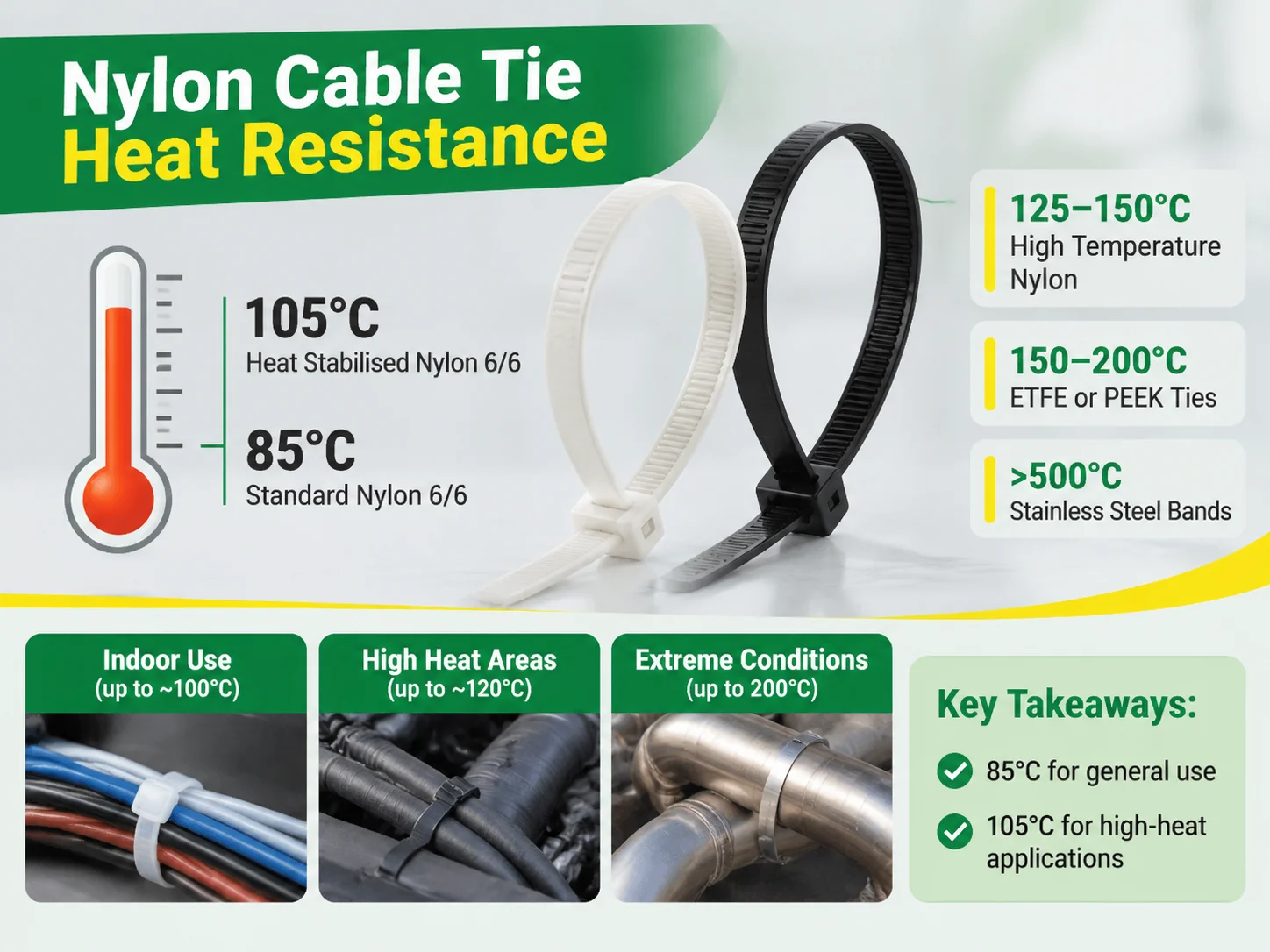
القيمتان الحراريتان: 85 °م و 105 °م
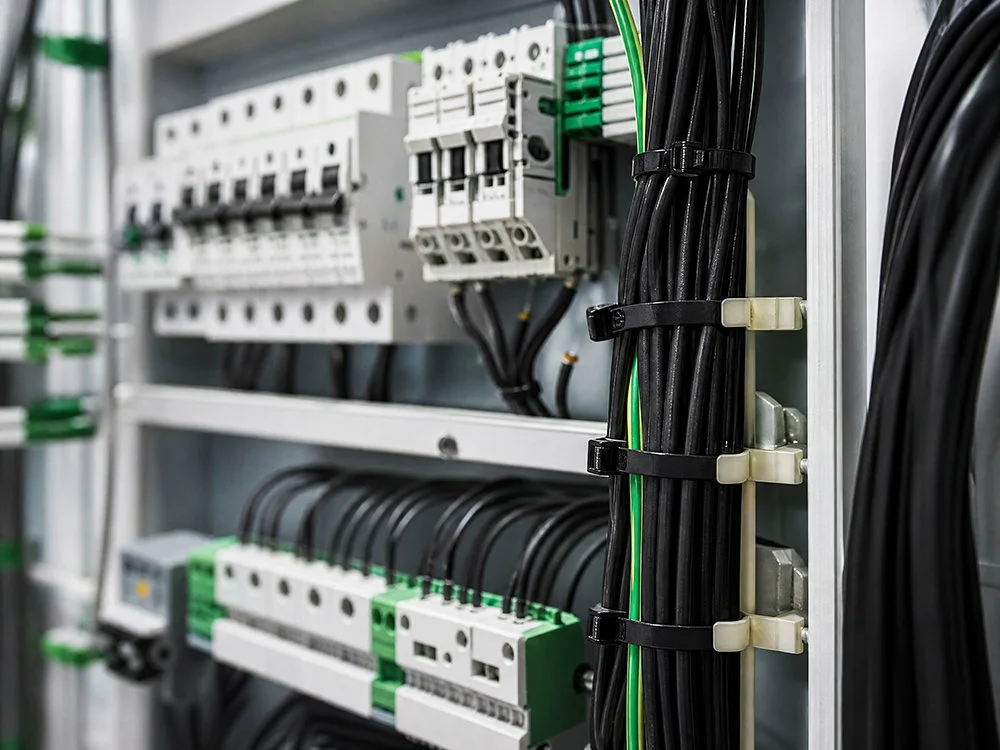
الرقم 85 °م يشير عمومًا إلى منتجات النايلون ليس فقط للتطبيقات المثبتة بشكل دائم، ولكن أيضًا تلك التي تُباع عادة بالجملة. الرقم 105 °م يشير إلى منتج نايلون مكافئ مثبت حراريًا، ويجب البحث عن هذا الرقم عندما تنص المواصفة على استخدامه في موقع يتعرض لحرارة عالية (مثل حجرات المحرك، محولات الإضاءة، حاويات مفاتيح التبديل، صناديق التوصيل الشمسية).
| الدرجة | درجة الحرارة (°م) | نطاق درجة الحرارة (°م) | الاستخدامات النموذجية |
|---|---|---|---|
| نايلون 6/6 القياسي | 85 °م | حتى ~100 °م لفترة قصيرة | تجميع الكابلات الداخلية، اللوحات، الخزائن |
| نايلون 6/6 مثبت حراريًا | 105 °م | حتى ~120 °م لفترة قصيرة | محولات الإضاءة، مفاتيح التبديل، حجرات المحرك، الطاقة الشمسية |
| نايلون عالي الحرارة | 125-150 °م | أعلى، حسب الدرجة | أجزاء داخلية للأجهزة، بالقرب من السخانات |
| روابط ETFE أو PEEK | 150-200 °م | أعلى، حسب الدرجة | تعرض كيميائي شديد، حرارة قصوى |
| أشرطة من الفولاذ المقاوم للصدأ | أكثر من 500 °م | غير قابل للتطبيق | العادم، الأفران، الهيكل الخارجي |
يجب أن تؤخذ في الاعتبار أمران لأي من القيم في هذا الجدول: 1) تصنيف درجة الحرارة ينطبق فقط عندما يتم استخدام الرباط باستمرار عند الحمولة الكاملة المصنفة؛ و 2) الرباط الذي يحمل أقصى قوة شد له في بيئة دافئة سيشيخ بسرعة أكبر من الذي يحمل ثلث قوة الشد الخاصة به، وتصنيف درجة الحرارة هذا يعتمد على بيئة غير محصورة (محاطة بالهواء)، وليس صندوقًا مغلقًا، يتعرض لدرجات حرارة داخلية وخارجية.
تُصنف أربطة النايلون المثبتة حراريًا بنفس تصنيف مواصفاتها. وهذا يشمل كيفية تفسير ادعاء المورد حول التثبيت الحراري، وما يجب طلبه، بما في ذلك دليل الأداء. عندما يطلب العميل أربطة نايلون مثبتة حراريًا لدرجات حرارة تتجاوز قدرات المادة المزودة، ستكون مواصفة أربطة النايلون المثبتة حراريًا هي نقطة المرجع الخاصة بك.
التثبيت الحراري ليس تثبيتًا للأشعة فوق البنفسجية، واللون يخبرك بالفرق
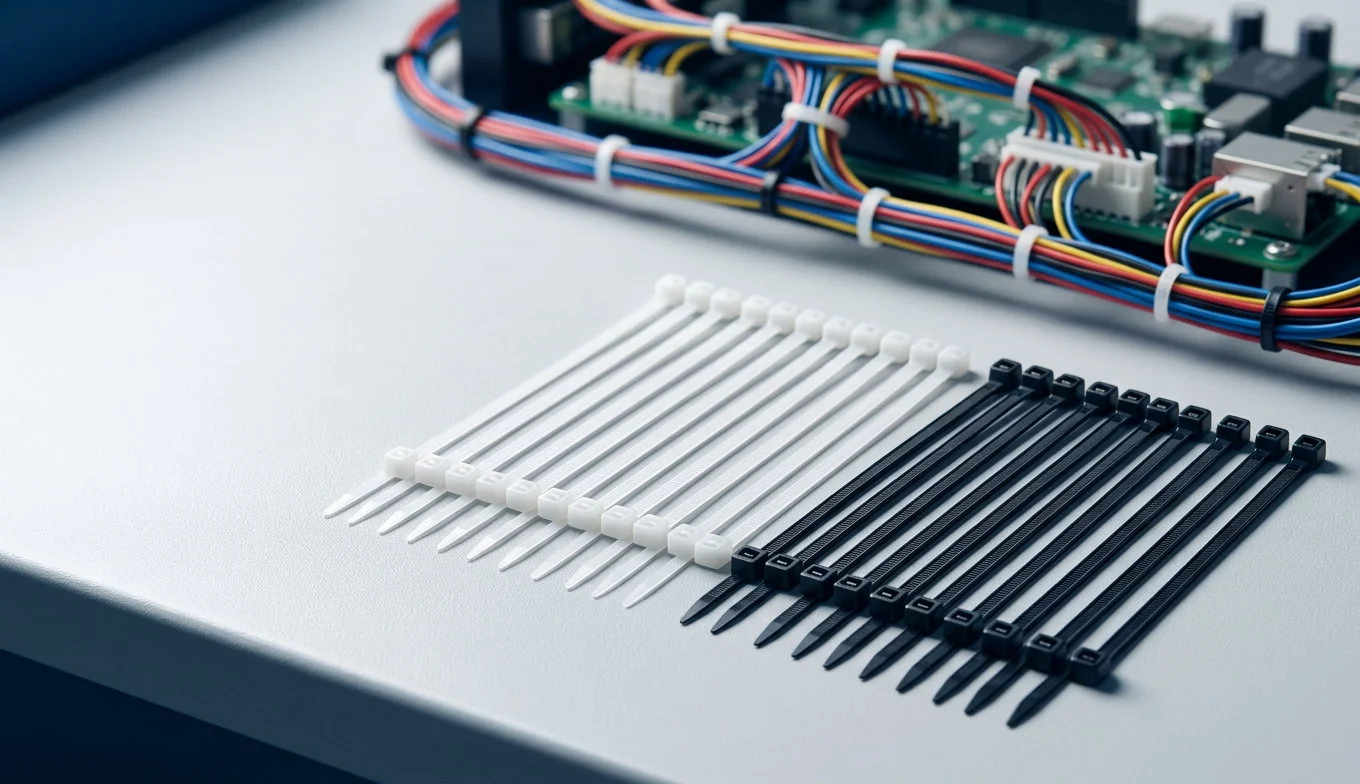
التثبيت الحراري والتثبيت للأشعة فوق البنفسجية هما حزمتان مضافتان مميزتان للمنتج. لذلك، من الممكن أن يحتوي رباط نايلون على نوع واحد من التثبيت، وليس كلاهما. اللون الأسود لرباط النايلون يشير إلى أن الكربون الأسود قد تم استخدامه كمثبت للأشعة فوق البنفسجية عن طريق امتصاص إشعاع الأشعة فوق البنفسجية قبل أن يتلف سلسلة البوليمر. وبما أن الكربون الأسود أسود، فإن رباط النايلون الأسود يشير إلى أنه مصمم للاستخدام الخارجي، في حين أن رباط النايلون الطبيعي أو الأبيض لن يوفر تثبيتًا للأشعة فوق البنفسجية.
يعتمد التثبيت الحراري على كيميائيات مختلفة مقارنة بالتثبيت للأشعة فوق البنفسجية وهذه الاختلافات غير قابلة للتحديد بصريًا. قد يكون رباط نايلون أسود مثبت حراريًا أو لا، ومن الممكن إنتاج رباط نايلون مثبت حراريًا بلون طبيعي؛ لذلك، لن يوفر خصائص تثبيت للأشعة فوق البنفسجية. يمكن أن يسبب هذا الاختلاف ارتباكًا، مما يجعل رباط نايلون طبيعي مثبت حراريًا يفشل على السطح خلال عامين إذا كان لدى المثبت انطباع بأن المواصفة تتطلب التثبيت الحراري.
بالإضافة إلى خاصيتي التثبيت، يوفر لون رباط النايلون معلومات حول تحديد الدائرة أو الحزمة التي تم صبغ الرباط لتحديدها. على سبيل المثال، يتم إنتاج أربطة النايلون باللون الأزرق والأخضر والأحمر والأصفر والرمادي من أصباغ مختلفة توفر تحديد الدائرة أو الحزمة، لكن هذه الأصباغ اللونية تقلل عمومًا من خصائص تثبيت الأشعة فوق البنفسجية لرباط النايلون مقارنة بتثبيت الكربون الأسود الأسود.
توفر توافر أربطة النايلون السوداء في السوق بشكل عام يشير إلى مدى مقاومة الأشعة فوق البنفسجية للاستخدام الخارجي بشكل عام ويشير إلى أن المشروع الذي يستخدم ألوانًا أخرى من أربطة النايلون في البيئة الخارجية يجب أن يقبل بتقليل العمر الافتراضي و/أو مادة بناء مختلفة. اللون والمادة هما الإجابتان الحاسمتان فيما إذا كانت أربطة النايلون مقاومة للأشعة فوق البنفسجية, thus the first thing to determine when evaluating Zip Tie UV resistance is to check the colour and material of the Zip Ties before reviewing the temperature rating.
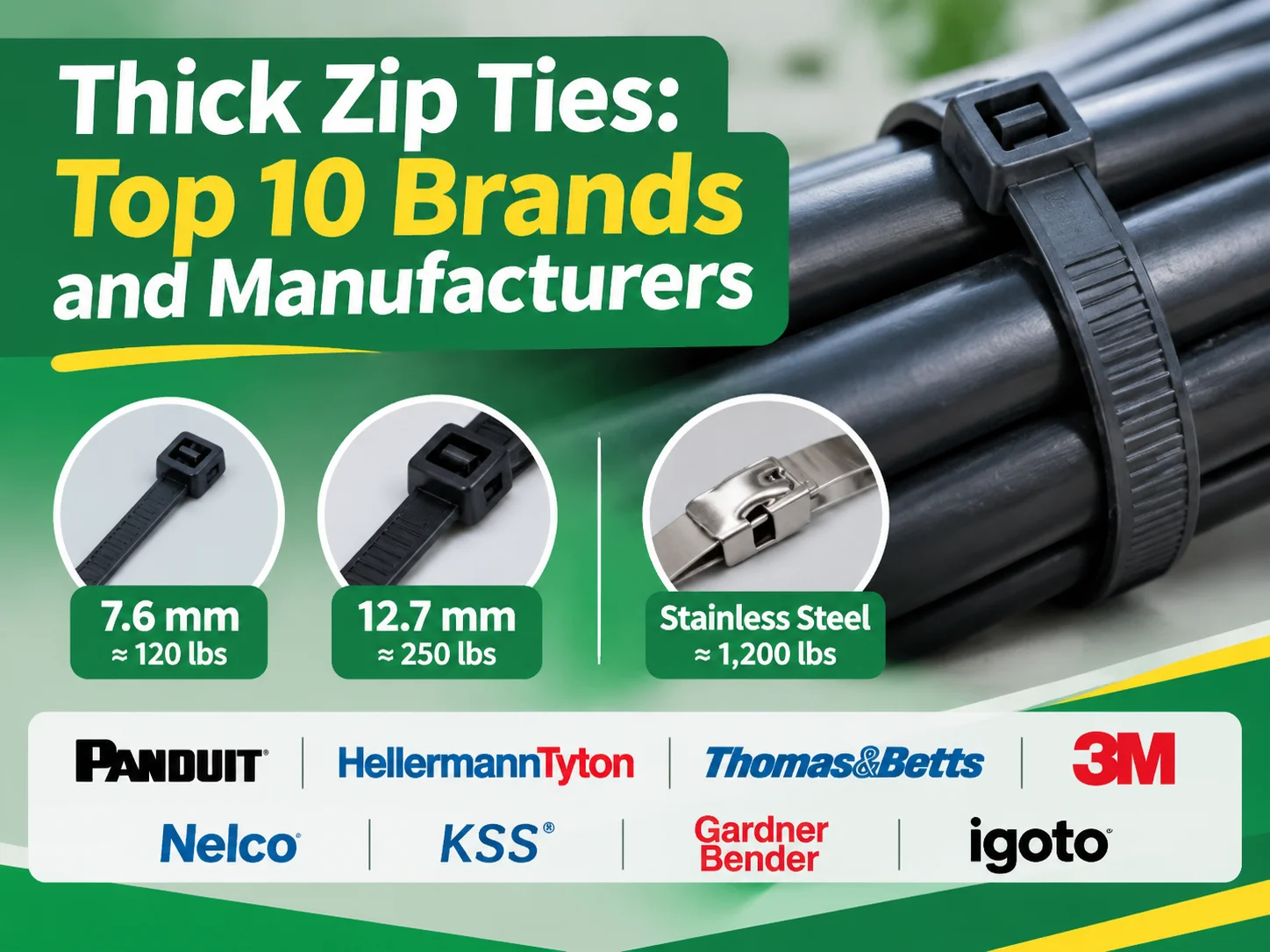
The Brands Worth Shortlisting
The list below represents the individuals involved in developing the specification for Zip Ties. Each of these manufacturers provides a temperature rating, a UV resistance claim and a tensile rating for their products by size, and this is what allows a comparison between them.
| العلامة التجارية | Product Location | Base/Product strength/Product Cost | موقع السعر |
|---|---|---|---|
| بانديت | Tinley Park, Illinois USA | Widest range/Published data/Controlled Tension Tooling | الأعلى |
| هيليرمان تايتون | Milwaukee USA & Hamburg, Germany | Automotive panel building/Heat & chemical Grades | عالية |
| Thomas and Betts | Memphis Tennessee USA/ABB Group | Ty-Rap Stainless pawl/Electrical Distribution Market | عالية |
| 3M | St. Paul Minnesota USA | Speciality materials/adhesives & identification products | عالية |
| كيسس | اليابان | Precision moulding/Small sizes/Consistent quality | Mid to High |
| نيلكو | الهند | Volume production/Competitive export pricing | متوسط |
| أفيري دينيسون | Glendale California USA | Identification & Labelling Integration | عالية |
| إيغوتو | الصين | Factory supply/OEM/Private Label/UL listed ranges | Low to Mid |
The range between the highest-priced brand and the lowest-priced brand for equal-sized Zip Ties is three to four times higher than the lowest-priced option, and this does not account for all of the margins involved in the manufacturing process.
The differences between various manufacturers and the uses for their products can become confusing if you don’t look closely. In short, each manufacturer has advantages over another and each one provides specific products to meet specific needs.
What Each Brand Is Good At
The main advantage of Panduit is that they are the definitive source for specifications; all products manufactured by Panduit come with the manufacturer published values for tensile strength and retained strength during use.
HellermannTyton’s principal strengths are in automotive and panel building, where the product must tolerate vibration, oils and heat, in addition to maintaining its mechanical properties.
Thomas & Betts are the electrical distribution industry standard. The use of stainless steel pawls in their Ty-Rap ties provides a much better grip on the tied wire than does the nylon pawl of a similar product. Nylon pawls will soften and lose grip in heat while stainless steel pawls will maintain their grip.
KSS and Nelco provide volume options with better consistency than unbranded factory products. Avery Dennison provides a product that serves two purposes; it is a label as well as a tie.
We are at the factory end of the spectrum, with a broad range of products because of the various manufacturers that we represent.
Sizes, and Where Each One Fits
Tie sizes are generally determined by their bundle diameters; the more rope needed, the wider the rope will need to be. The chart below offers the general measurements and uses for most of the ties within the 4-inch and 14-inch range.
| Tie Length | Typical Tie Width | Tie Tensile Load | Tie Bundle Diameter | التطبيق |
|---|---|---|---|---|
| 4″ (100 مم) | 5 مم | 18 رطل | Up to 22mm | Small harnesses/panel wiring |
| 6″ (150 مم) | 6 مم | 40 – 50 lb | Up to 35mm | General Cable Bundling |
| 8″ (200 مم) | 8 مم | 50 – 75 lb | Up to 50mm | Most Common Size in Plant |
| 11″ (280mm) | 4.8 – 7.6mm | 75 – 120 lb | Up to 80mm | Larger Looms, Conduit, Duct |
| 14″ (356mm) | 7.6mm | 120 – 175 lb | Up to 100mm | Heavy Bundles, Outdoor, Industrial |
The 8-inch size is the most popular because it provides the best fit for the typical control and power bundles, and that is the size that most plants have in stock. If a specification only covers the use of 4-inch and 14-inch ties, there is a strong chance that neither size will adequately cover the range of applications for which it needs to be used.
In terms of overall strength, the width of the strap is more important than the length, which is why the 14-inch tie is so much stronger.
Choosing a long and narrow tie is often the weakest combination and can happen by accident when there is a large bundle and all the stores only sell ties in one width.
What They Cost, by Size and Volume
All prices shown below (per one hundred) are for standard nylon, heat-stabilized nylon, and nylon with UV black coloration, as bagged products sold at the factory and distributor level; therefore, they correlate directly with the nylon resin prices as well as the prices for the additive packages used in the nylon.
| الحجم | Standard Price (per 100) | Heat Stabilized Price (per 100) | UV Black Price (per 100) |
|---|---|---|---|
| 4-inch Tie, 18 LB | 3 to 7 dollars | 6 to 12 dollars | 5 to 10 dollars |
| 6-inch Tie, 40 to 50 LB | 5 to 10 dollars | 8 to 16 dollars | 7 to 14 dollars |
| 8-inch Tie, 50 to 75 LB | 6 to 12 dollars | 10 to 22 dollars | 8 to 18 dollars |
| 11-inch Tie, 75 to 120 LB | 12 to 22 dollars | 18 to 35 dollars | 15 to 30 dollars |
| 14-inch Tie, 120 to 175 LB | 18 to 32 dollars | 25 to 48 dollars | 22 to 40 dollars |
Furthermore, the heat-stabilized tie will typically cost about 40 to 60 percent more than standard ties of the same size due to the price of the additives used in the production of heat-stabilized ties and the greater control exercised during the manufacturing process of heat-stabilized ties. When considering the purchase of heat-stabilized ties in greater volumes, the price difference between the two types will be less and more attributable to the relatively small price increase of the additive when the cost of moulding and labour are spread across larger quantities.
In the majority of plants, a coloured heat-stabilised tie must be placed as a special order which will involve minimum quantities and longer lead times than a black or natural tie would be associated with.
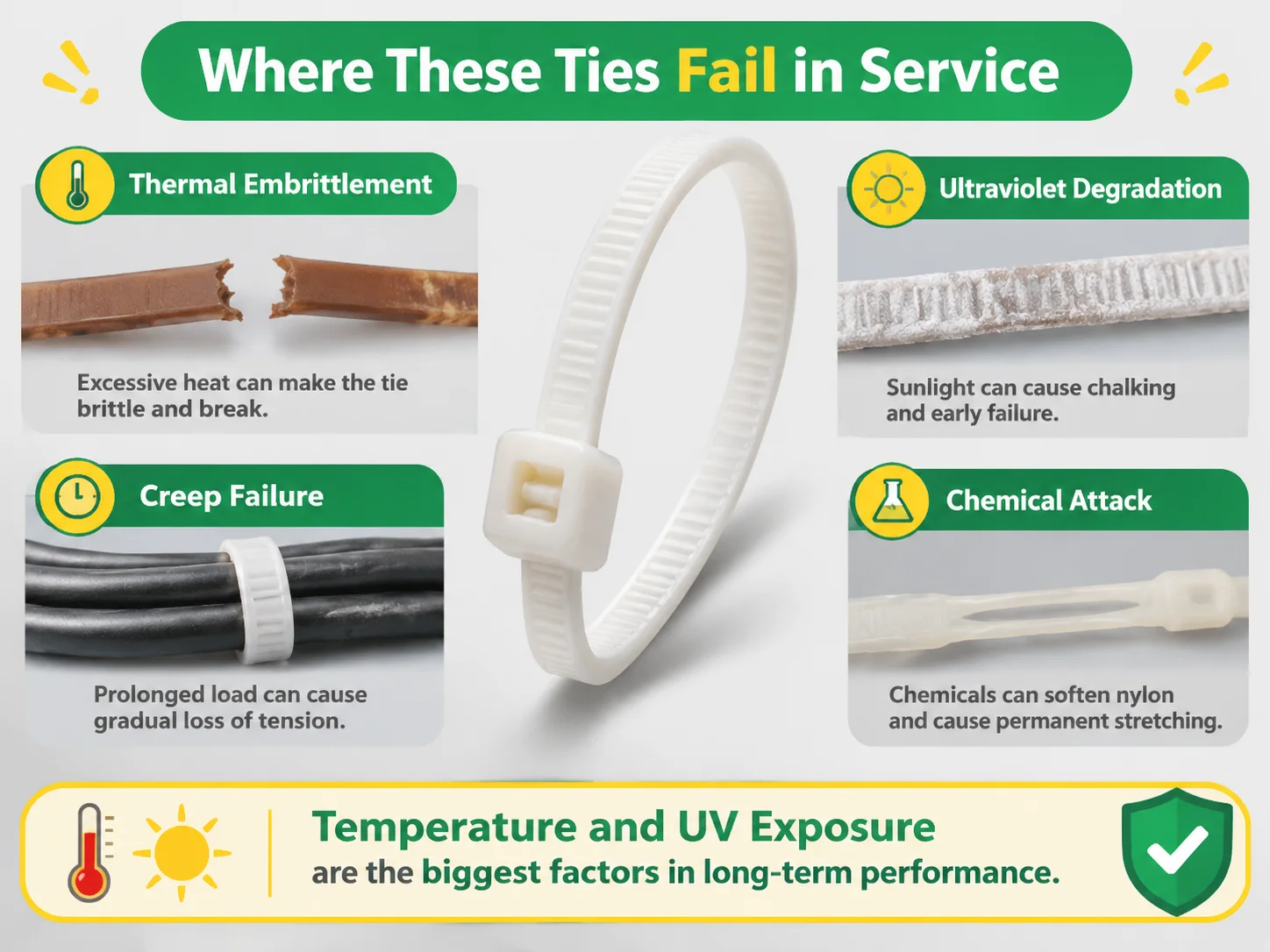
Where These Ties Fail in Service
The majority of claims for tie failures can be attributed to four modes of failure, none of which relate to manufacturing defects in an ordinary sense.
- Thermal embrittlement occurs when a tie operates continuously at an excessive temperature, causing the polymer to oxidise and become brittle and break rather than elongate. When a tie fails due to thermal embrittlement, it will have a clean and brown fracture.
- Ultraviolet Degradation occurs when a coloured or milky-white tie is exposed to sunlight, causing the tie surface to develop chalking, leading to failure at the first point of binding.
- Creep failure occurs when a tie is subjected to a prolonged tensile load at a specific temperature, causing the tie to lose tension gradually and the tied bundle to lose its securing ability without breaking.
- Chemical Attack occurs when the nylon tie comes into contact with chemicals such as solvents, fuels, and hydraulic oils, resulting in softening of the nylon material, causing unrecoverable elongation or stretching.
In view of the presence of three of four modes of failure relating to environmental concerns rather than strength-related concerns, temperature, and ultraviolet exposure are the greatest determinants of how well a tie will perform, irrespective of its rated tensile strength. For example, a properly graded 50 lb tie would outlive a non-properly graded 175 lb tie, all other factors being equal.
Choosing by Application
The chart below illustrates a relationship between the common applications and the properly graded tie, assuming that the tie would be installed using the proper tensioning tool (rather than relying upon manual installation methods).
| التطبيق | Recommended grade |
|---|---|
| Panel and cabinet wire (indoors) | Standard or heat-stabilized |
| Switchgear/ballasts | Heat-Stabilized |
| Rooftop conduit/Solar junction boxes | Heat-Stabilized, UV-black |
| Engine Compartment/Machine Housing | Heat-Stabilized or High-Temp |
| Outdoor/Coastal/Rooftop Areas | Stainless Steel Band |
| Food and Pharmaceutical Areas | Detectable Nylon and Stainless |
| Circuit ID | Standard Colors, Indoor Use Only |
| Plant Room Cable Tray | Heat-Stabilized |
The solar junction box has historically been an area of confusion for purchasers, as the rooftop combiner box must both be hot and exposed. A single tie that carries claims on both heat and UV properties is more effective than two separate ties for each property.
Where Igoto Fits
Igoto manufactures nylon cable ties in standard grades (heat-stabilized/UV black) and heat-stabilized, with sizes ranging from 4” to 14”. Igoto supplies these ties both as private labels and under its own name to distributors.
The business segment that produces heavy-duty cable ties has a unique structure; it is essentially based upon two factors: yearly contracts and container quantities, where the differences in pricing between non-branded and branded products are the most pronounced.
For specification purposes, we provide evidence rather than adjectives, including the nylon grade, additive package, retained strength at 105 °C, and black nylon UV properties. While we cannot make claims about temperatures that the materials cannot hold up to, a request for a nylon cable tie at 150 °C will usually result in using another material, rather than simply raising an older number.
How to Verify a Claim
Distinguishing between a rated product and one that is labelled requires answering four questions. These include: what the continuous service temperature is and what test method was used to obtain that figure; what percentage of the original tensile strength is retained at that temperature after 1,000 hours; are black nylon cable ties UV stable with carbon black and to what test? and is there a batch-level tensile strength record available, or is there only a type test for a sample?
A supplier who can answer all four questions is a source of rated products. A supplier that deflects the remaining three questions while providing an answer to the first question is only a source of a heat-stabilized standard tie. It is common enough to ask these questions always.
To perform the fifth check, physically examine the product. Bend the product back onto itself and look for any visible signs of cracking or deterioration. This will take less than a minute.
A high-quality nylon cable tie will flex at the bend without developing a whited out zone at the bend; if the tie has too much filler or is made from a degraded material, it will develop white stress marks very quickly. This does not serve as a laboratory test for the cable ties in question; however, we are able to identify manufacturing defects in large numbers of cable ties during the shipment process.
Documentation will contain the answers to most of the questions about cable tie specifications; we do have a separate page for certification and test documentation, as well as a list of what is dispatched with each shipping container. This list will include all UL Listed Ranges that have this type of listing, RoHS and REACH Declarations, and any batch strength record.
الأسئلة المتكررة
Is nylon rated for heat?
Nylon 6/6 is rated for continuous use at approximately 85°C. This is acceptable for Panels and Cabinets; however, it is not acceptable for Ballast Enclosures or Engine Bays. For Ballast Enclosures or Engine Bays, we offer two other grades of nylon: heat stabilized grades, which will provide use up to 105°C, and another grade of nylon for use above ~150°C. For applications above 150-160°C, a different polymer will be necessary or, alternatively, a stainless steel cable tie.
What is considered a heat stabilised cable tie?
A nylon zip tie that contains an additive package that slows thermal aging and protects it against copper catalyzed degradation. As it is not a different polymer, the melting point remains the same. It will not be UV stabilized unless the tie is black and the supplier indicates that it is.
What are some good heat resistant zip ties?
There are a few suppliers, including Panduit, HellermannTyton and Thomas & Betts, who maintain data on the retained strength of their product when exposed to temperature. The retained strength is the figure that should be used for product comparison between suppliers. KSS and Nelco produce similar product quality but at a lower cost, and Igoto manufactures the same grades as KSS and Nelco at factory level. The brand has less importance than the published retained strength figure (if available) and the grade.
For how long will nylon zip ties be outside?
In temperate climates, a UV stabilized black tie will typically last between five and ten years while a natural or coloured tie will generally last between one and three years. A black nylon tie will experience even faster degradation near the equator, and at high altitudes or in environments with a high salt content. Therefore, in these instances, the use of a stainless band would be a more practical option.
What does heat stabilized mean? Does it mean that I can put it in an oven or near an exhaust?
No. 105 °C is significantly below the temperature of an exhaust component and is well below the melting point of nylon. The term heat stabilized means that the tie can withstand higher temperatures for a more extended period and will not degrade as quickly due to prolonged exposure to a warm environment.
Can I use a black tie outside without checking anything else?
Black ties provide UV protection; therefore they fulfil one of the two necessary criteria. The other criteria is that they should be made to operate in extreme temperatures. Black standard ties (85 °C) are still considered black, so when using a tie on a rooftop or in a solar box, opt for black and heat stabilized.
المراجع
- Panduit — Cable Tie Material and Temperature Ratings
- HellermannTyton — Cable Tie Selection by Application
- حلول UL — أنظمة إدارة الكابلات UL 62275
- NEMA — Wiring Products and Material Standards
- Grainger — Cable Ties and Material Specifications
الخاتمة
من خلال تثبيت حرارة رباط النايلون، سيحصل المستخدم على رباط يمكنه تحمل بيئة ذات حرارة عالية (20 درجة مئوية) أو تعرض طويل للنحاس. ومع ذلك، فإن تثبيت الحرارة للرباط لا يوفر حماية من الأشعة فوق البنفسجية، حيث يتم توفير الحماية من الأشعة فوق البنفسجية بواسطة مادة مضافة ولون منفصلين. لا يؤثر تثبيت الحرارة على نقطة انصهار النايلون.
The two numbers to specify when ordering a nylon zip tie would be 105 °C and black (to provide UV protection). A nylon zip tie that is capable of withstanding both will perform adequately in a rooftop or ballast enclosure (i.e., to prevent failure) while it is still fresh, while a nylon zip tie that is capable of carrying one of the two will fail in the second summer.