


Best Heat Stabilized Nylon Zip Ties
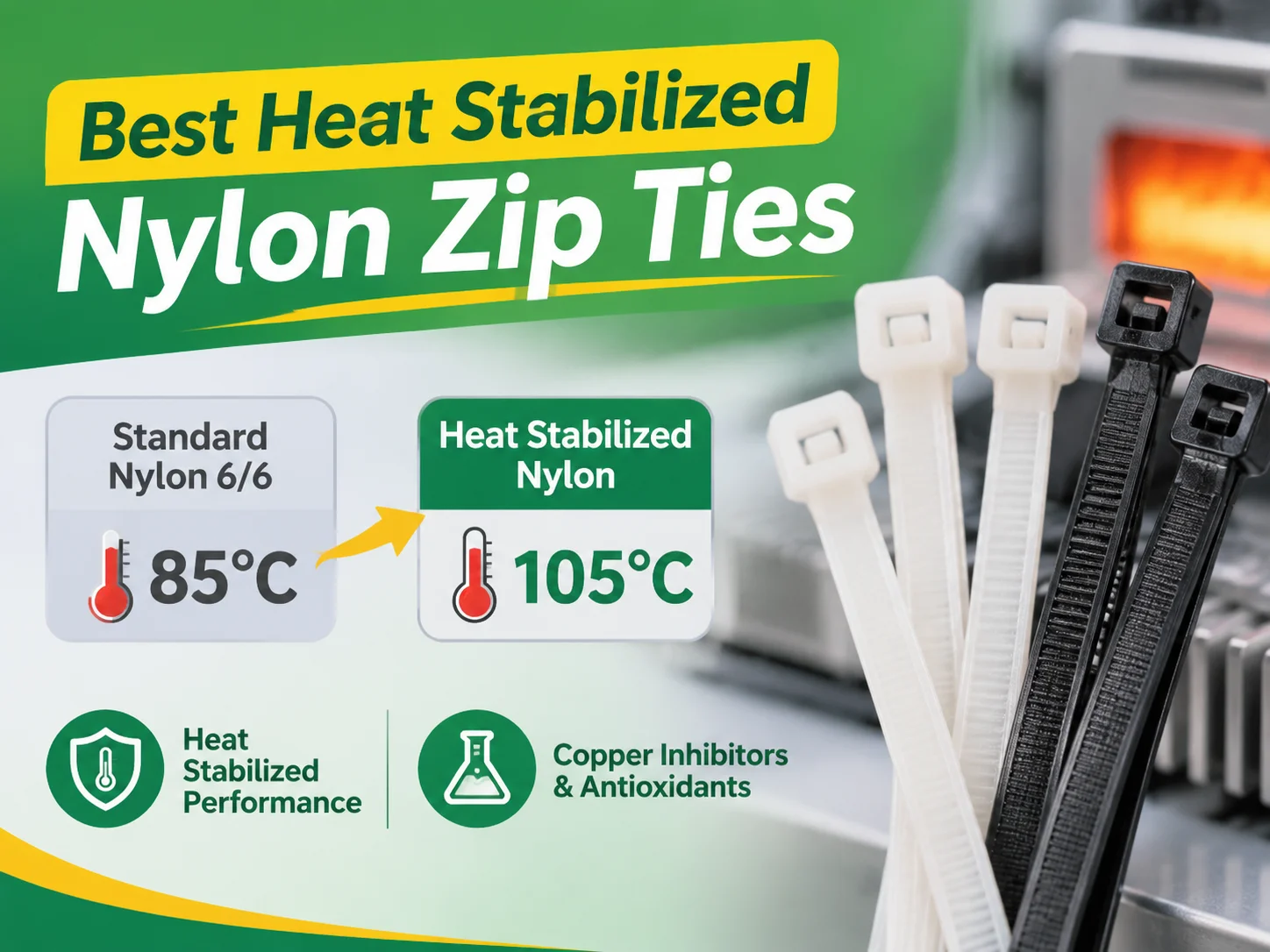
The term “heat stabilized” appears frequently when describing nylon cable ties, often leading to misunderstanding. The exact definition is not that heat stabilized cable ties can endure the heat generated in an engine bay forever, nor does heat stabilization indicate any form of UV resistance. Rather, heat stabilization refers to the chemical additives added to the nylon which slow down thermal degradation of the nylon material, allowing for a service temperature increase of approximately 20 °C (36 °F) compared to the standard nylon cable ties and allowing for the cable tie to be rated for approximately 105 °C (221 °F) continuous service temperature.
Quick answer: standard nylon 6/6 cable ties have a typical continuous service rating of approximately 85 °C, while heat stabilized nylon cable ties have a continuous service temperature rating of approximately 105 °C. The heat stabilization additives that allow for the increase in rating are copper inhibitors and anti-oxidants that prevent the degradation of nylon cable ties caused by exposure to both heat and copper. While heat stabilization increases the performance rating of nylon cable ties, heat stabilized cable ties cannot be assumed to be UV resistant unless they contain the carbon black pigment found in black nylon cable ties. Therefore, if a cable tie will be exposed to outdoor conditions, it should be a black nylon cable tie rather than a heat stabilized nylon cable tie.
The remaining sections will discuss the chemical additives used in the production of heat stabilized nylon cable ties (and how they affect nylon cable ties), the two ratings for heat and UV stabilized cable ties, a comparison between heat and UV stabilized cable ties and what each manufacturer excels at, the available sizes of nylon cable ties, the price ranges for each type of nylon cable tie and what each type fails at during service, the selection of nylon cable ties by their application, the place of the manufacturer’s production within the nylon cable tie industry and how the customer can verify manufacturer’s claims prior to placing a purchase order.
What Heat Stabilized Actually Means
Nylon 6/6 is considered to be a type of polyamide. Polyamides degrade when exposed to heat due to oxidation. This process generally occurs at a slow rate when at room temperature; however, as the temperature rises, the speed of degradation also increases. When plastic ties degrade by exposure to high temperatures, they change from translucent to yellow, brown and then typically fail at some point in time due to lack of elasticity.
As part of their heat stabilizing property, manufacturers incorporate additives that prevent oxidation by interrupting the chain reaction that leads to degradation of performance. When companies test their nylon product’s performance they do so using the temperature at which a product has maintained a specified percentage of its original strength over an extended period of exposure to the specified testing temperature.
Another way in which nylon products degrade is through copper catalyzed degradation. Copper wrapped around copper conductors creates a direct connection to copper metal. The contact point causes the nylon to oxidize more rapidly than at other points on the nylon tie. The failure of the nylon tie from this form of degradation will always occur at the location in contact with copper. Therefore, a copper inhibitor is included in the heat stabilizing formulation, and that is why heat stabilizing nylon ties are generally sold only as selected grades for use with electrical work, even though they are not necessarily subjected to high temperature.
The heat stabilizing additives do not raise the melting point of nylon 6/6. Therefore, regardless of whether or not a nylon tie has been heat stabilized, the melting point remains approximately 250 degrees centigrade and thus remains as a material that is inappropriate for use at higher temperatures. Above approximately 150 degrees C, heat stabilized nylon ties will no longer serve as an appropriate material and should be replaced with another polymer or a stainless steel tie. The maximum temperature limits associated with the manufacturing of standard nylon zip ties specify the temperature at which nylon is not suitable for engineering purposes such that it is important for designers to familiarize themselves with these specifications before assuming that heat stabilized nylon ties are appropriate for use in high-temperature environments.
The Two Temperature Values: 85 °C and 105 °C
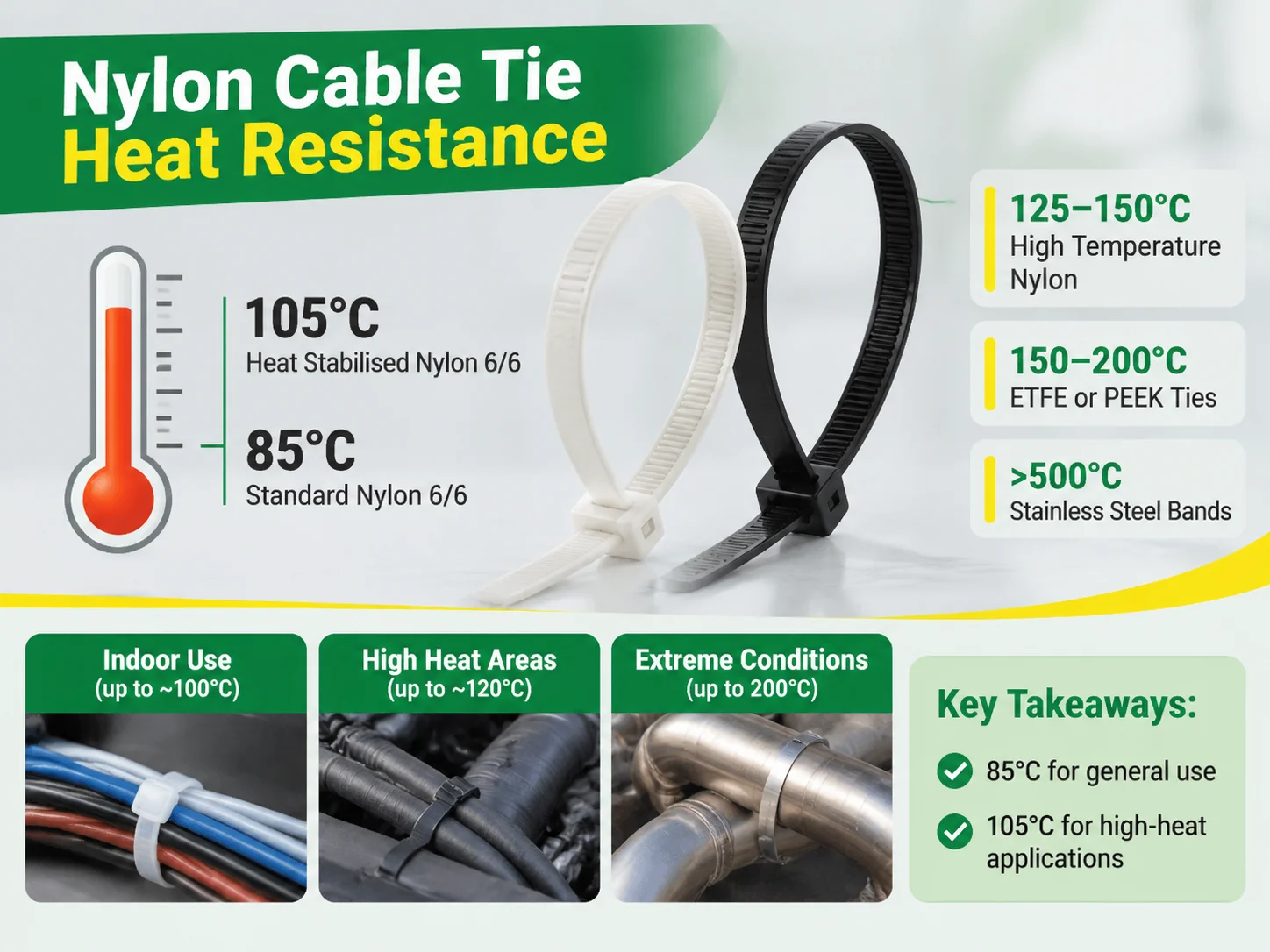
The 85 °C number refers generally to nylon products not just for permanently installed applications, but also those that are commonly sold in bulk. The 105 °C number refers to a corresponding nylon product that is heat stabilised, and you should look for this number when the specification states that it is to be used in a location that has high heat (e.g engine compartments, lighting ballasts, switchgear enclosures, solar junction boxes).
| Grade | Temperature (°C) | Temperature Range (°C) | Typical Uses |
|---|---|---|---|
| Standard nylon 6/6 | 85 °C | To ~100 °C for a short time | Indoor cable bundling, panels, cabinets |
| Heat stabilised nylon 6/6 | 105 °C | To ~120 °C for a short period of time | Light ballasts, switchgear, engine compartments, solar |
| High temperature nylon | 125-150°C | Higher, depending on grade | Appliance internal parts, near heaters |
| ETFE or PEEK ties | 150-200°C | Higher, depending on grade | Severe chemical exposure, extreme heat |
| Stainless steel bands | Greater than 500 °C | Not applicable | Exhaust, furnaces, exterior structural |
Two things must be kept in mind for any of the values in this table: 1) The temperature rating is only applicable when the score is being used continuously at full rated load; and 2) A tie that is carrying its maximum tensile strength in a warm environment will age more quickly than one that is carrying one third of its tensile strength, and that temperature rating is based on an unconfined (air surrounded) environment, not a closed box, that is subject to inside and outside temperatures.
Heat stabilised nylon zip ties are classified the same as for their specifications. This includes how to interpret a supplier’s claim about heat stabilisation, and what to ask for, including evidence of performance. When a customer requests heat stabilised nylon ties for temperatures above the capabilities of the material being supplied, the heat stabilised nylon zip tie specification will be your reference point.
Heat Stabilized Is Not UV Stabilized, and Colour Tells You Which
Heat stabilisation and UV stabilisation are two distinct product additive packages. Therefore, it is possible for a nylon tie to have one stabilisation type, but not both. The black colour of a nylon tie indicates that carbon black has been used as a UV stabiliser by absorbing UV radiation prior to it degrading the polymer chain. Since carbon black is black, a zip tie that is black indicates that it has been designed for outdoor use, while a natural or white nylon tie will offer no UV stabilisation.
Heat stabilisation relies on different chemistries in comparison to UV stabilisation and these differences are not visually identifiable. A black nylon zip tie could or could not be heat stabilised and it is possible for a heat stabilised nylon zip tie to be produced in a natural colour; therefore, it would provide no UV stabilisation properties. This difference can create confusion, making a heat stabilised natural nylon zip tie fail on a roof within two years if the installer had the impression that the specification required heat stabilisation.
In addition to the two stabilisation properties, the colour of a nylon zip tie provides information about the identification of the circuit or bundle that the tie has been pigmented to identify. For example, blue, green, red, yellow, and grey nylon zip ties are produced from different pigments that provide circuit or bundle identification, but these colour pigments generally reduce UV stabilisation properties of the nylon zip tie when compared to a black carbon black stabilisation.
The overall availability of black zip ties in the marketplace indicates the extent of UV resistance for outdoor use in general and indicates that a Project using other colours of zip ties in the outdoor environment must accept a reduced life expectancy and/or a different material of construction. Colour and material are the definitive answers as to whether Zip Ties are UV resistant, thus the first thing to determine when evaluating Zip Tie UV resistance is to check the colour and material of the Zip Ties before reviewing the temperature rating.
The Brands Worth Shortlisting
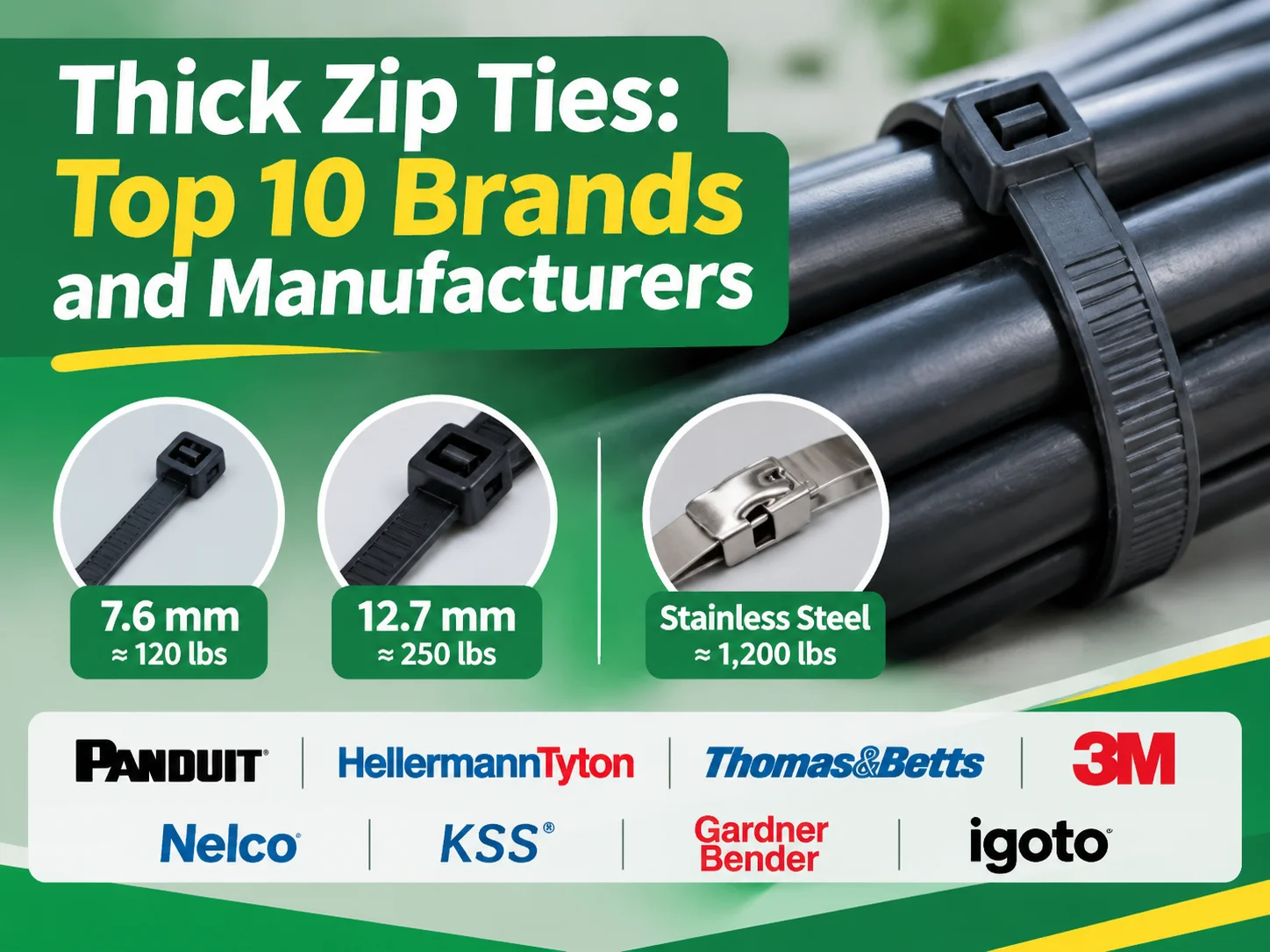
The list below represents the individuals involved in developing the specification for Zip Ties. Each of these manufacturers provides a temperature rating, a UV resistance claim and a tensile rating for their products by size, and this is what allows a comparison between them.
| Brand | Product Location | Base/Product strength/Product Cost | Price position |
|---|---|---|---|
| Panduit | Tinley Park, Illinois USA | Widest range/Published data/Controlled Tension Tooling | Highest |
| HellermannTyton | Milwaukee USA & Hamburg, Germany | Automotive panel building/Heat & chemical Grades | High |
| Thomas and Betts | Memphis Tennessee USA/ABB Group | Ty-Rap Stainless pawl/Electrical Distribution Market | High |
| 3M | St. Paul Minnesota USA | Speciality materials/adhesives & identification products | High |
| KSS | Japan | Precision moulding/Small sizes/Consistent quality | Mid to High |
| Nelco | India | Volume production/Competitive export pricing | Mid |
| Avery Dennison | Glendale California USA | Identification & Labelling Integration | High |
| Igoto | China | Factory supply/OEM/Private Label/UL listed ranges | Low to Mid |
The range between the highest-priced brand and the lowest-priced brand for equal-sized Zip Ties is three to four times higher than the lowest-priced option, and this does not account for all of the margins involved in the manufacturing process.
The differences between various manufacturers and the uses for their products can become confusing if you don’t look closely. In short, each manufacturer has advantages over another and each one provides specific products to meet specific needs.
What Each Brand Is Good At
The main advantage of Panduit is that they are the definitive source for specifications; all products manufactured by Panduit come with the manufacturer published values for tensile strength and retained strength during use.
HellermannTyton’s principal strengths are in automotive and panel building, where the product must tolerate vibration, oils and heat, in addition to maintaining its mechanical properties.
Thomas & Betts are the electrical distribution industry standard. The use of stainless steel pawls in their Ty-Rap ties provides a much better grip on the tied wire than does the nylon pawl of a similar product. Nylon pawls will soften and lose grip in heat while stainless steel pawls will maintain their grip.
KSS and Nelco provide volume options with better consistency than unbranded factory products. Avery Dennison provides a product that serves two purposes; it is a label as well as a tie.
We are at the factory end of the spectrum, with a broad range of products because of the various manufacturers that we represent.
Sizes, and Where Each One Fits
Tie sizes are generally determined by their bundle diameters; the more rope needed, the wider the rope will need to be. The chart below offers the general measurements and uses for most of the ties within the 4-inch and 14-inch range.
| Tie Length | Typical Tie Width | Tie Tensile Load | Tie Bundle Diameter | Application |
|---|---|---|---|---|
| 4″ (100mm) | 2.5mm | 18 lb | Up to 22mm | Small harnesses/panel wiring |
| 6″ (150mm) | 3.6mm | 40 – 50 lb | Up to 35mm | General Cable Bundling |
| 8″ (200mm) | 4.8mm | 50 – 75 lb | Up to 50mm | Most Common Size in Plant |
| 11″ (280mm) | 4.8 – 7.6mm | 75 – 120 lb | Up to 80mm | Larger Looms, Conduit, Duct |
| 14″ (356mm) | 7.6mm | 120 – 175 lb | Up to 100mm | Heavy Bundles, Outdoor, Industrial |
The 8-inch size is the most popular because it provides the best fit for the typical control and power bundles, and that is the size that most plants have in stock. If a specification only covers the use of 4-inch and 14-inch ties, there is a strong chance that neither size will adequately cover the range of applications for which it needs to be used.
In terms of overall strength, the width of the strap is more important than the length, which is why the 14-inch tie is so much stronger.
Choosing a long and narrow tie is often the weakest combination and can happen by accident when there is a large bundle and all the stores only sell ties in one width.
What They Cost, by Size and Volume
All prices shown below (per one hundred) are for standard nylon, heat-stabilized nylon, and nylon with UV black coloration, as bagged products sold at the factory and distributor level; therefore, they correlate directly with the nylon resin prices as well as the prices for the additive packages used in the nylon.
| Size | Standard Price (per 100) | Heat Stabilized Price (per 100) | UV Black Price (per 100) |
|---|---|---|---|
| 4-inch Tie, 18 LB | 3 to 7 dollars | 6 to 12 dollars | 5 to 10 dollars |
| 6-inch Tie, 40 to 50 LB | 5 to 10 dollars | 8 to 16 dollars | 7 to 14 dollars |
| 8-inch Tie, 50 to 75 LB | 6 to 12 dollars | 10 to 22 dollars | 8 to 18 dollars |
| 11-inch Tie, 75 to 120 LB | 12 to 22 dollars | 18 to 35 dollars | 15 to 30 dollars |
| 14-inch Tie, 120 to 175 LB | 18 to 32 dollars | 25 to 48 dollars | 22 to 40 dollars |
Furthermore, the heat-stabilized tie will typically cost about 40 to 60 percent more than standard ties of the same size due to the price of the additives used in the production of heat-stabilized ties and the greater control exercised during the manufacturing process of heat-stabilized ties. When considering the purchase of heat-stabilized ties in greater volumes, the price difference between the two types will be less and more attributable to the relatively small price increase of the additive when the cost of moulding and labour are spread across larger quantities.
In the majority of plants, a coloured heat-stabilised tie must be placed as a special order which will involve minimum quantities and longer lead times than a black or natural tie would be associated with.
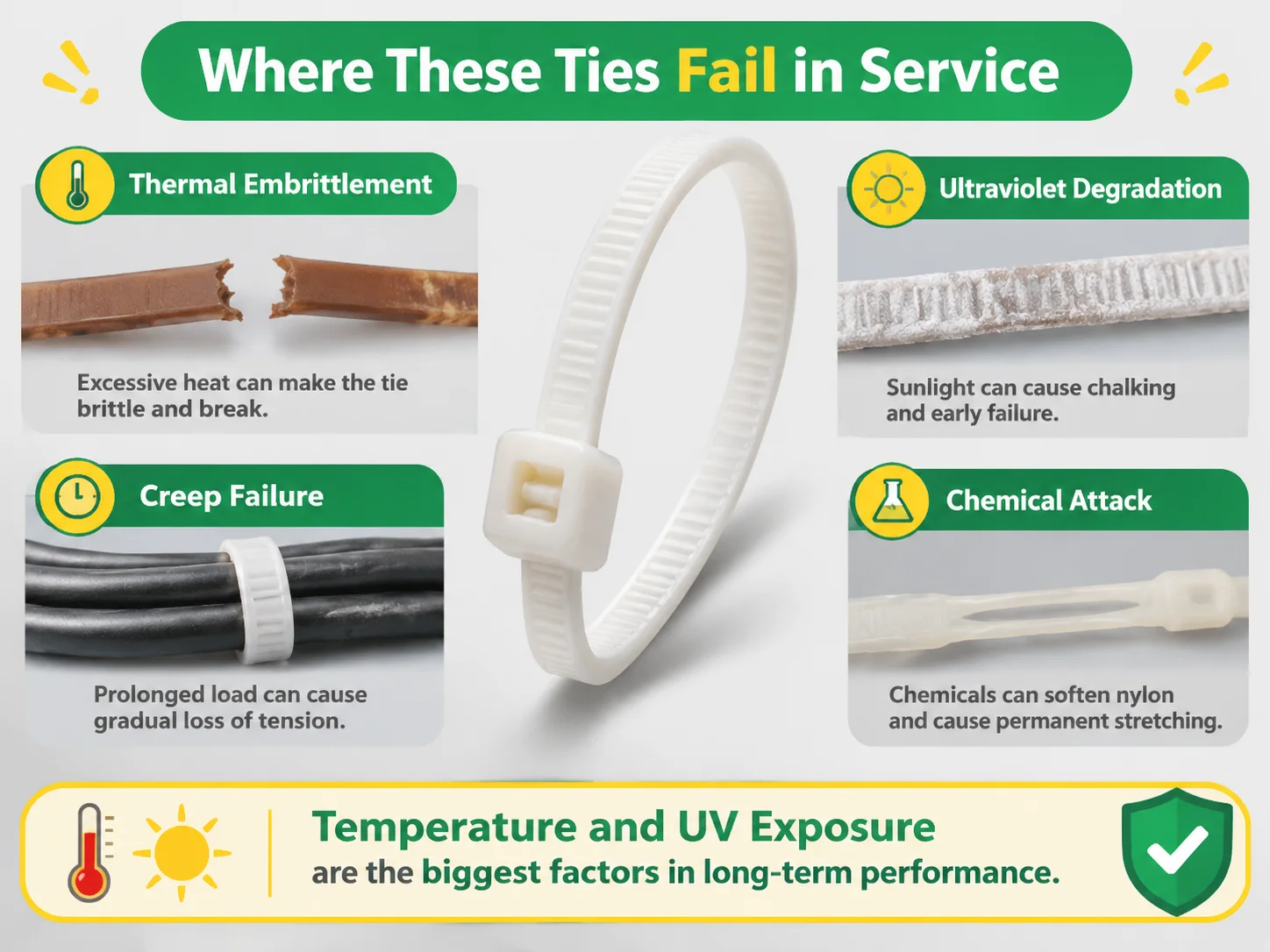
Where These Ties Fail in Service
The majority of claims for tie failures can be attributed to four modes of failure, none of which relate to manufacturing defects in an ordinary sense.
- Thermal embrittlement occurs when a tie operates continuously at an excessive temperature, causing the polymer to oxidise and become brittle and break rather than elongate. When a tie fails due to thermal embrittlement, it will have a clean and brown fracture.
- Ultraviolet Degradation occurs when a coloured or milky-white tie is exposed to sunlight, causing the tie surface to develop chalking, leading to failure at the first point of binding.
- Creep failure occurs when a tie is subjected to a prolonged tensile load at a specific temperature, causing the tie to lose tension gradually and the tied bundle to lose its securing ability without breaking.
- Chemical Attack occurs when the nylon tie comes into contact with chemicals such as solvents, fuels, and hydraulic oils, resulting in softening of the nylon material, causing unrecoverable elongation or stretching.
In view of the presence of three of four modes of failure relating to environmental concerns rather than strength-related concerns, temperature, and ultraviolet exposure are the greatest determinants of how well a tie will perform, irrespective of its rated tensile strength. For example, a properly graded 50 lb tie would outlive a non-properly graded 175 lb tie, all other factors being equal.
Choosing by Application
The chart below illustrates a relationship between the common applications and the properly graded tie, assuming that the tie would be installed using the proper tensioning tool (rather than relying upon manual installation methods).
| Application | Recommended grade |
|---|---|
| Panel and cabinet wire (indoors) | Standard or heat-stabilized |
| Switchgear/ballasts | Heat-Stabilized |
| Rooftop conduit/Solar junction boxes | Heat-Stabilized, UV-black |
| Engine Compartment/Machine Housing | Heat-Stabilized or High-Temp |
| Outdoor/Coastal/Rooftop Areas | Stainless Steel Band |
| Food and Pharmaceutical Areas | Detectable Nylon and Stainless |
| Circuit ID | Standard Colors, Indoor Use Only |
| Plant Room Cable Tray | Heat-Stabilized |
The solar junction box has historically been an area of confusion for purchasers, as the rooftop combiner box must both be hot and exposed. A single tie that carries claims on both heat and UV properties is more effective than two separate ties for each property.
Where Igoto Fits
Igoto manufactures nylon cable ties in standard grades (heat-stabilized/UV black) and heat-stabilized, with sizes ranging from 4” to 14”. Igoto supplies these ties both as private labels and under its own name to distributors.
The business segment that produces heavy-duty cable ties has a unique structure; it is essentially based upon two factors: yearly contracts and container quantities, where the differences in pricing between non-branded and branded products are the most pronounced.
For specification purposes, we provide evidence rather than adjectives, including the nylon grade, additive package, retained strength at 105 °C, and black nylon UV properties. While we cannot make claims about temperatures that the materials cannot hold up to, a request for a nylon cable tie at 150 °C will usually result in using another material, rather than simply raising an older number.
How to Verify a Claim
Distinguishing between a rated product and one that is labelled requires answering four questions. These include: what the continuous service temperature is and what test method was used to obtain that figure; what percentage of the original tensile strength is retained at that temperature after 1,000 hours; are black nylon cable ties UV stable with carbon black and to what test? and is there a batch-level tensile strength record available, or is there only a type test for a sample?
A supplier who can answer all four questions is a source of rated products. A supplier that deflects the remaining three questions while providing an answer to the first question is only a source of a heat-stabilized standard tie. It is common enough to ask these questions always.
To perform the fifth check, physically examine the product. Bend the product back onto itself and look for any visible signs of cracking or deterioration. This will take less than a minute.
A high-quality nylon cable tie will flex at the bend without developing a whited out zone at the bend; if the tie has too much filler or is made from a degraded material, it will develop white stress marks very quickly. This does not serve as a laboratory test for the cable ties in question; however, we are able to identify manufacturing defects in large numbers of cable ties during the shipment process.
Documentation will contain the answers to most of the questions about cable tie specifications; we do have a separate page for certification and test documentation, as well as a list of what is dispatched with each shipping container. This list will include all UL Listed Ranges that have this type of listing, RoHS and REACH Declarations, and any batch strength record.
Frequently Asked Questions
Is nylon rated for heat?
Nylon 6/6 is rated for continuous use at approximately 85°C. This is acceptable for Panels and Cabinets; however, it is not acceptable for Ballast Enclosures or Engine Bays. For Ballast Enclosures or Engine Bays, we offer two other grades of nylon: heat stabilized grades, which will provide use up to 105°C, and another grade of nylon for use above ~150°C. For applications above 150-160°C, a different polymer will be necessary or, alternatively, a stainless steel cable tie.
What is considered a heat stabilised cable tie?
A nylon zip tie that contains an additive package that slows thermal aging and protects it against copper catalyzed degradation. As it is not a different polymer, the melting point remains the same. It will not be UV stabilized unless the tie is black and the supplier indicates that it is.
What are some good heat resistant zip ties?
There are a few suppliers, including Panduit, HellermannTyton and Thomas & Betts, who maintain data on the retained strength of their product when exposed to temperature. The retained strength is the figure that should be used for product comparison between suppliers. KSS and Nelco produce similar product quality but at a lower cost, and Igoto manufactures the same grades as KSS and Nelco at factory level. The brand has less importance than the published retained strength figure (if available) and the grade.
For how long will nylon zip ties be outside?
In temperate climates, a UV stabilized black tie will typically last between five and ten years while a natural or coloured tie will generally last between one and three years. A black nylon tie will experience even faster degradation near the equator, and at high altitudes or in environments with a high salt content. Therefore, in these instances, the use of a stainless band would be a more practical option.
What does heat stabilized mean? Does it mean that I can put it in an oven or near an exhaust?
No. 105 °C is significantly below the temperature of an exhaust component and is well below the melting point of nylon. The term heat stabilized means that the tie can withstand higher temperatures for a more extended period and will not degrade as quickly due to prolonged exposure to a warm environment.
Can I use a black tie outside without checking anything else?
Black ties provide UV protection; therefore they fulfil one of the two necessary criteria. The other criteria is that they should be made to operate in extreme temperatures. Black standard ties (85 °C) are still considered black, so when using a tie on a rooftop or in a solar box, opt for black and heat stabilized.
References
- Panduit — Cable Tie Material and Temperature Ratings
- HellermannTyton — Cable Tie Selection by Application
- UL Solutions — UL 62275 Cable Management Systems
- NEMA — Wiring Products and Material Standards
- Grainger — Cable Ties and Material Specifications
Conclusion
By heat stabilizing a nylon zip tie, the user will have a tie that can withstand either a high-heat environment (20 °C) or a prolonged exposure to copper. However, heat stabilizing a tie does not provide UV protection, as UV protection is provided by a separate additive and colour. Heat stabilization does not affect the melting point of nylon.
The two numbers to specify when ordering a nylon zip tie would be 105 °C and black (to provide UV protection). A nylon zip tie that is capable of withstanding both will perform adequately in a rooftop or ballast enclosure (i.e., to prevent failure) while it is still fresh, while a nylon zip tie that is capable of carrying one of the two will fail in the second summer.