



¿Cómo se dice Zip Ties en italiano?
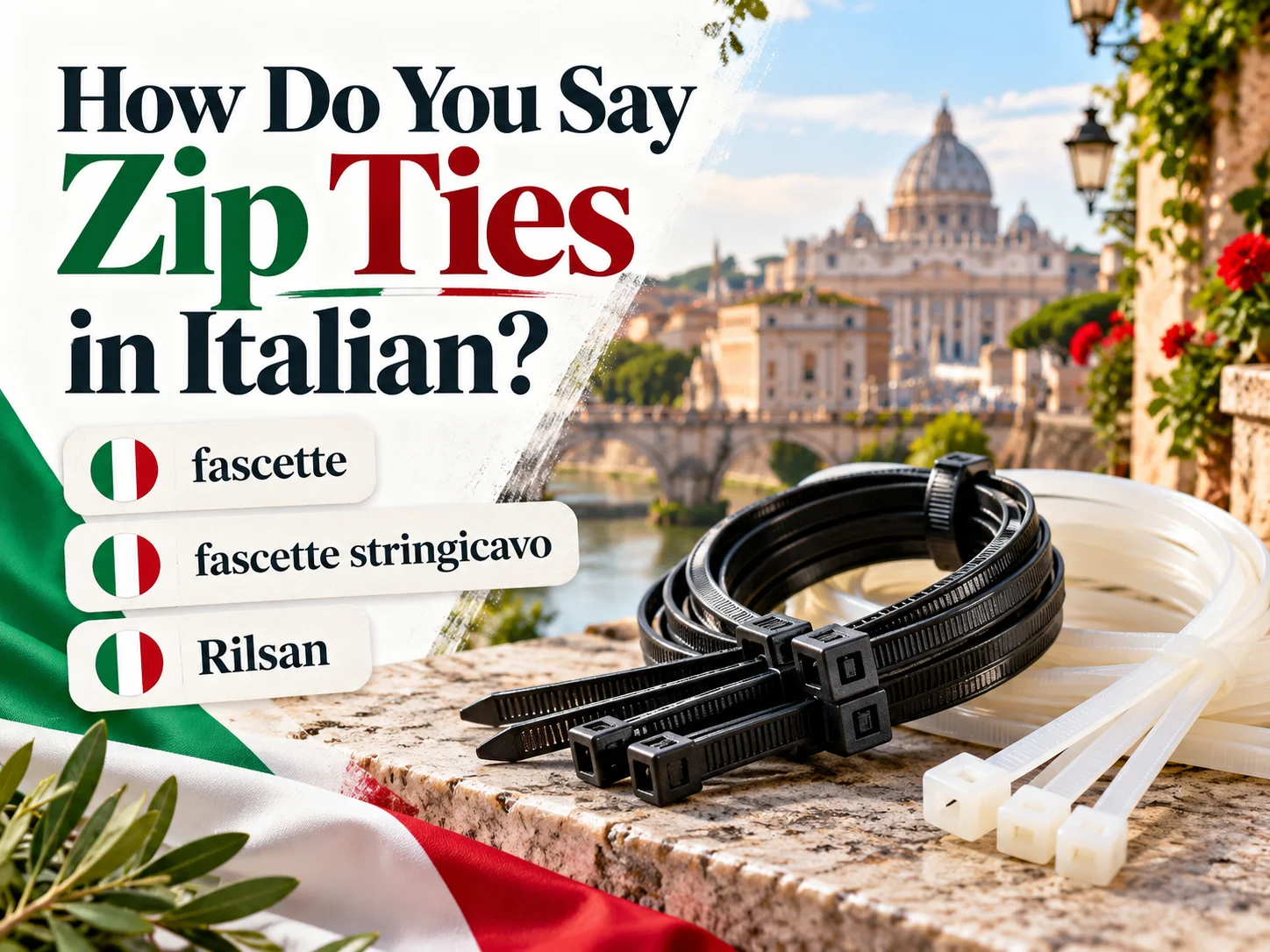
The term you need to remember when looking for zip ties in Italian is fascette, with fascetta being the singular form. In hardware stores, electrical wholesalers, and product labels, fascette stringicavo is used, which translates as “cable tighteners”. The term fascette in nylon is used, along with fascette da elettricista, and, whilst on the subject, everyone uses Rilsan on an everyday basis.
This term may be enough when at the cash register. But if you are reading an Italian data sheet, emailing a supplier in Milan, or translating an instruction manual, you should know more about various terminologies for different tie types used in Italian language and their closeness to the original meanings.
In Italian, a zip tie or cable tie is una fascetta (plural le fascette), and the technical term is fascetta stringicavo, also written fascette stringicavi or fascette serracavo. Self-locking ties are autobloccanti, releasable ties are riapribili or sganciabili, stainless steel ties are fascette in acciaio inox, and UV-resistant ties are resistenti ai raggi UV. Many Italians call nylon ties Rilsan, after a polyamide brand name. Be careful with fascetta stringitubo, which usually means a metal hose clamp, and with fascette a strappo, which are hook-and-loop straps. Sizes are written width by length in millimeters with a decimal comma, for example 4,8 x 300 mm.
How to Say Zip Ties in Italian: Quick Reference
| English | Italian singular | Italian plural | Where you will see it |
|---|---|---|---|
| Zip tie, cable tie | la fascetta | le fascette | Everyday speech, shops |
| Cable tie (technical) | la fascetta stringicavo | le fascette stringicavo / stringicavi | Catalogs, packaging, wholesalers |
| Cable tie (alternative) | la fascetta serracavo | le fascette serracavo | Some catalogs and listings |
| Electrician’s tie | la fascetta da elettricista | le fascette da elettricista | Trade articles, DIY guides |
| Nylon zip tie | la fascetta in nylon | le fascette in nylon | Product titles |
| Self-locking tie | la fascetta autobloccante | le fascette autobloccanti | Product descriptions |
Fascetta is a feminine noun, so it takes la in the singular and le in the plural, and adjectives agree with it: fascette nere (black ties), fascette bianche (white ties), fascette riapribili (releasable ties).
Pronunciation
Since Italian spelling follows fixed rules, knowing only three of them will help you pronounce all words accurately.
Fascetta is pronounced fa-SHET-tah. The letters sc make the “sh” sound, and the second t is pronounced for a little longer time than the first.
Fascette is pronounced as fa-SHET-tay. The last e is always pronounced as “eh.”
Stringicavo is pronounced streen-jee-KAH-voh. The letter g is soft when followed by i.
Autobloccante is ow-toh-block-KAHN-teh.
Rilsan is pronounced the same as it is normally spelled: REEL-sahn.
Origin of the Terms
The term fascetta derives from the word fascia, meaning a strip or ribbon. Its diminutive form -etta means “little band”, which is appropriate for the meaning of cable ties. This root is also used in terms such as hose clamps, bandages or straps for watches and indicates that context influences the use of the terms.
Stringicavo is formed with the use of words stringere and cavo. The word serracavo uses the verb serrare. The word autobloccante consists of auto (self) and bloccante (locking).
The origin of the name Rilsan is more complicated. The term Rilsan is used as a trademark that refers to nylon 11, a resin produced in France that belongs to polyamide family and is offered by Arkema. The name Rilsan became so popular in Italy that people started using it to refer to plastic ties in general. This can be compared to the usage of the word Velcro in English language. Today most ties are produced from nylon 6/6 (the same as polyamide 6.6 or PA66).
False Friends That Cause the Wrong Order
Always add stringicavo or in nylon when you search or order. The word fascette on its own also covers metal hose clamps, hook-and-loop straps and even pipe clips, so a short query can easily bring back the wrong product.
The three products most often confused look nothing alike once they sit side by side:
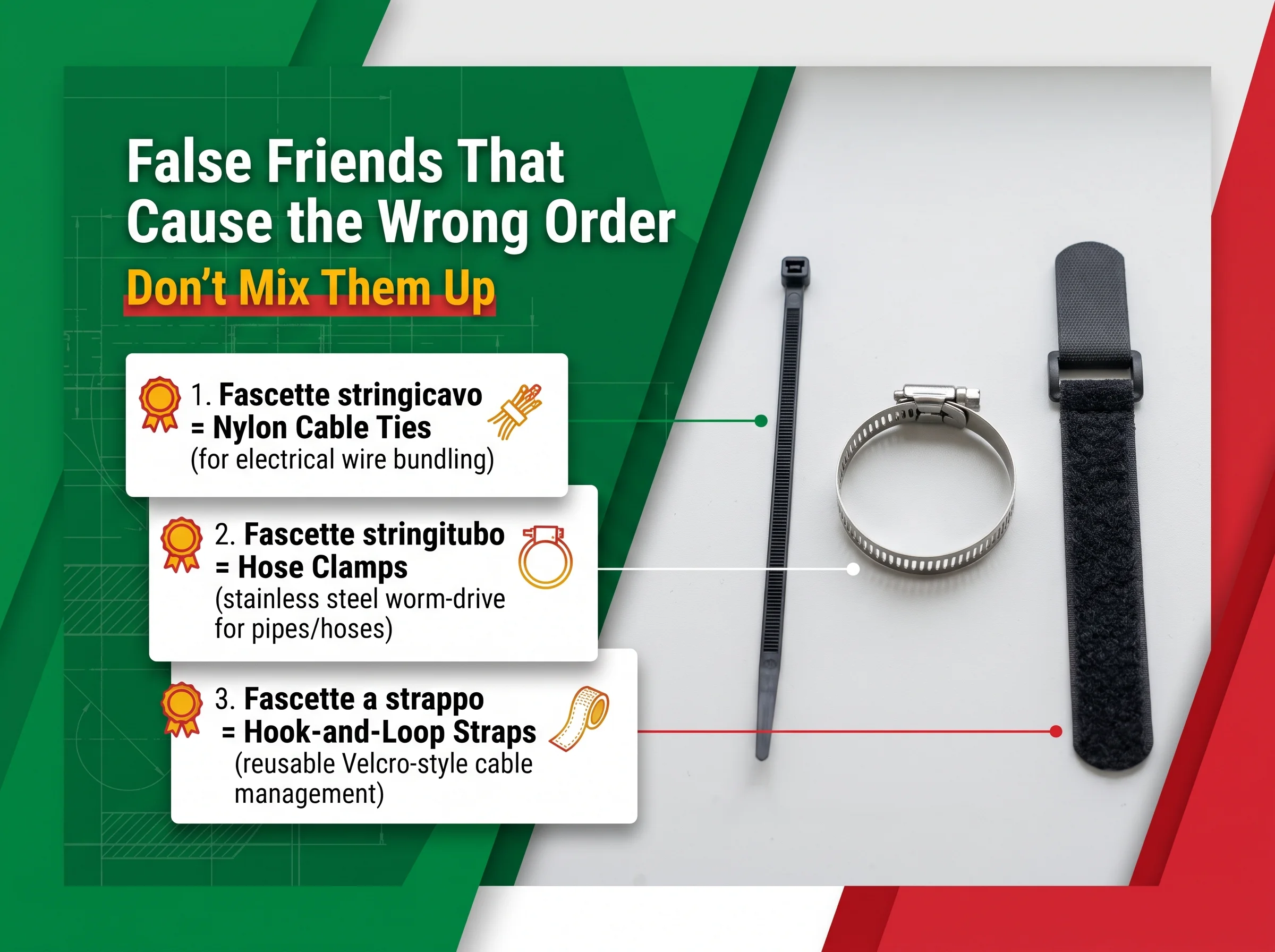
Here is how to tell the terms apart:
- Fascetta stringitubo means a hose clamp, the metal band with a screw that tightens around a rubber hose. Professional distributors file them under fascette a vite e collari stringitubo (screw clamps and hose collars). Some marketplace sellers do label nylon cable ties as stringitubo as well, which adds to the confusion, so check the photo and the material.
- Fascette a strappo, fascette in velcro or fascette a velcro are hook-and-loop straps, the soft reusable wraps used for computer and audio cables.
- Fermacavo or fermacavi can mean a cable clip or cable clamp that holds a wire to a surface. Catalogs often group them with ties under fascette e fermacavi, but they are not the same item.
- Fascetta metallica can be either a stainless steel cable tie or a metal hose clamp. For cable ties, say fascette in acciaio inox.
- Fascia on its own means band, strip, sash or range (as in fascia di prezzo, price range). It is not a cable tie.
Italian Names for Each Type of Cable Tie
When looking at the Italian catalog, you would observe a certain level of consistency in the usage of cable tie names. Here are some of the most popular Italian terms for cable ties.
Fascette standard: simple and manual single-use nylon ties.
Fascette riapribili or fascette sganciabili: deployable or reusable cable ties that have an unscrewing button.
Fascette a testa doppia: double-headed cable ties2 used for holding-two bundles to each other. The gap here has a job description that can be covered by means of a separate gap filler.
Fascette a doppio bloccaggio: double locking cable ties with two stops for extra reliability.
Fascette con attacco a vite or con occhiello: screw fastening cable ties that have a mounting eye.
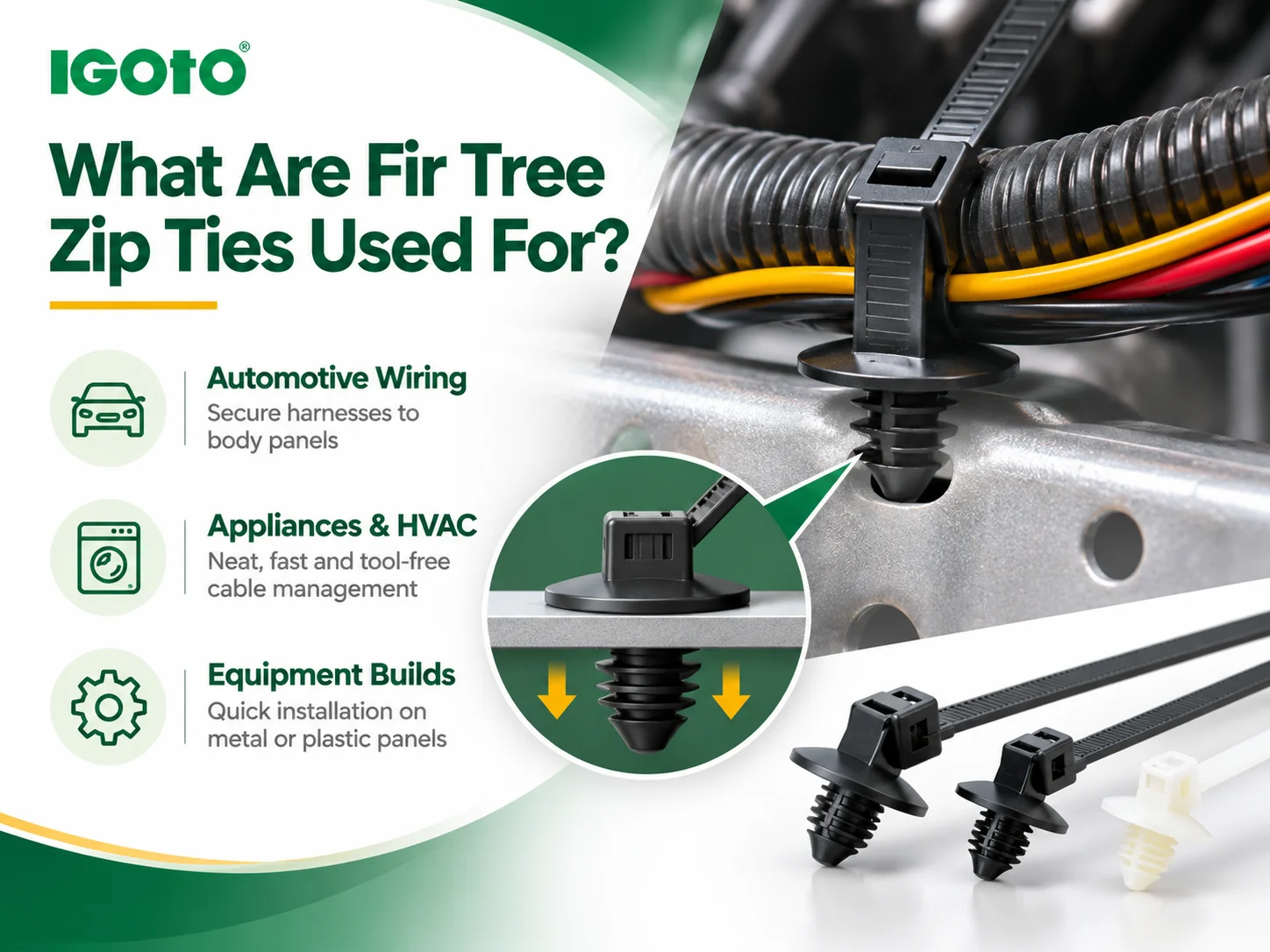
Fascette con montaggio a innesto: push-fitting cable ties that get fixed into a hole in the whole.
Fascette autoadesive: ties with a sticky basis, or alternatively those called separate sticky pads.
Fascette in acciaio inox: the stainless steel variant for high-temperature operating environment.
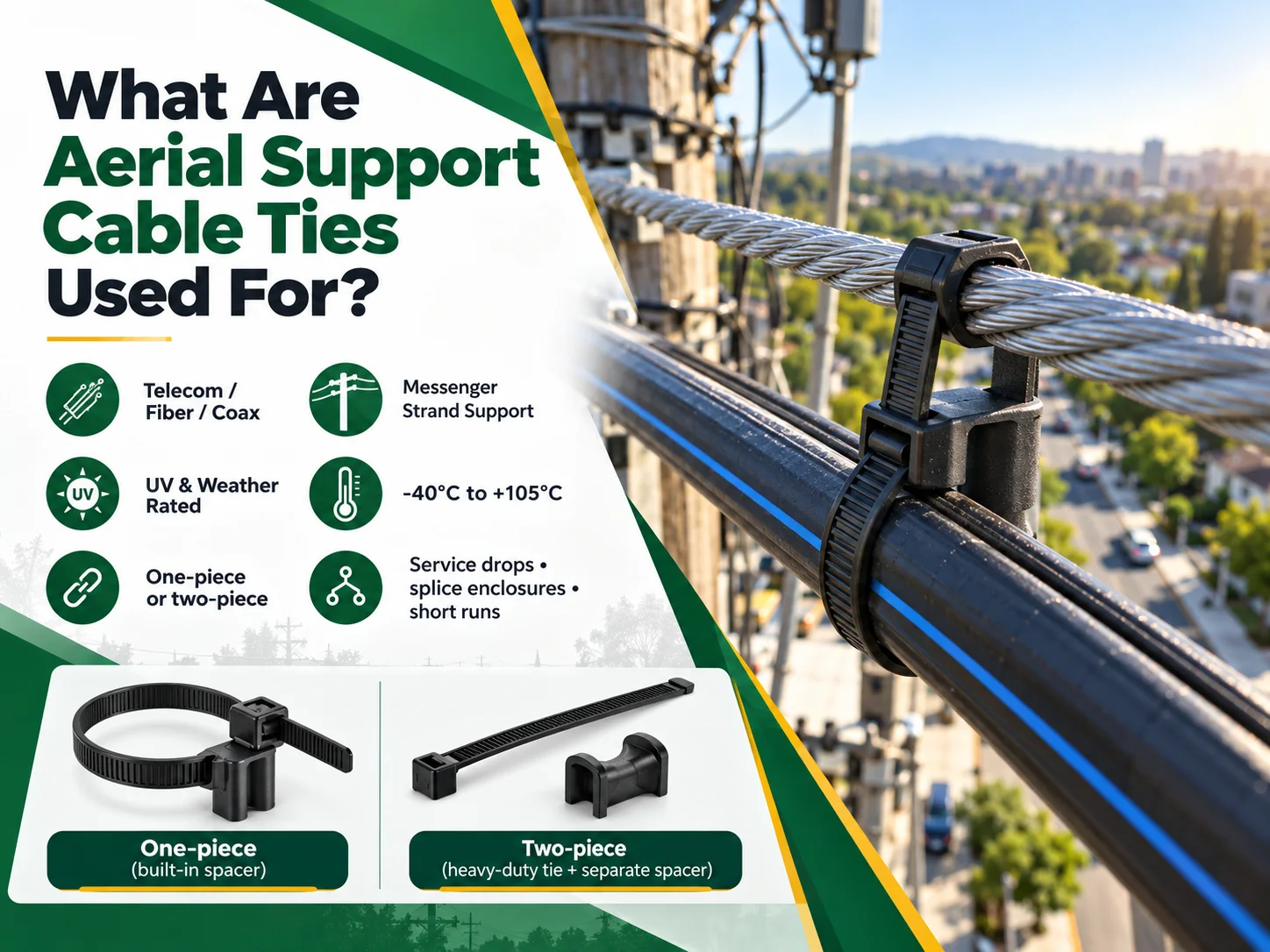
Fascette resistenti ai raggi UV or fascette per esterni: UV-resisting cable ties, usually of black color and thus contrarily to the vast majority of cable ties used for outdoor applications, since usually black color is used in order to mark appropriate circuits. Our article on bridas de cable montables explains how each mount style works.
Fascette colorate: cable ties in any color that could be utilized for circuit coding.
Reading an Italian Cable Tie Datasheet
In all specifications sheets and catalogs in Italy a certain set of terminology is used. Thus the above-mentioned list must be kept at hand when comparing Italian products or translating manuals. There are four terms, namely: width, length, strength and diameter, which will be met in nearly every specification.
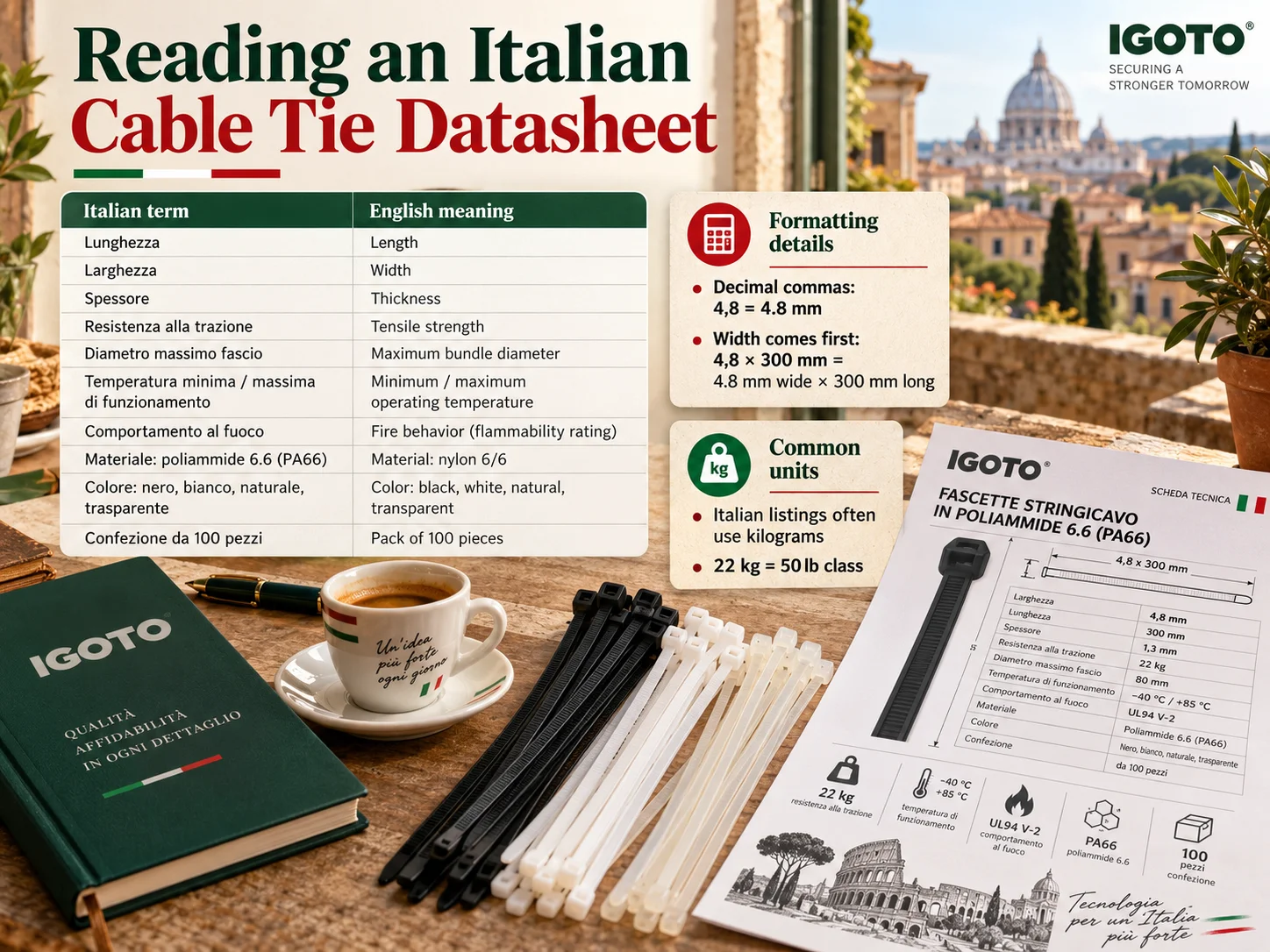
The full set of terms:
| Italian term | English meaning |
|---|---|
| Lunghezza | Longitud |
| Larghezza | Ancho |
| Spessore | Grosor |
| Resistenza alla trazione | Resistencia a la tracción |
| Diametro massimo fascio | Diámetro máximo del paquete |
| Temperatura minima / massima di funzionamento | Minimum / maximum operating temperature |
| Comportamento al fuoco | Fire behavior (flammability rating) |
| Materiale: poliammide 6.6 (PA66) | Material: nylon 6/6 |
| Colore: nero, bianco, naturale, trasparente | Color: black, white, natural, transparent |
| Confezione da 100 pezzi | Pack of 100 pieces |
Two formatting details trip up English-speaking buyers.
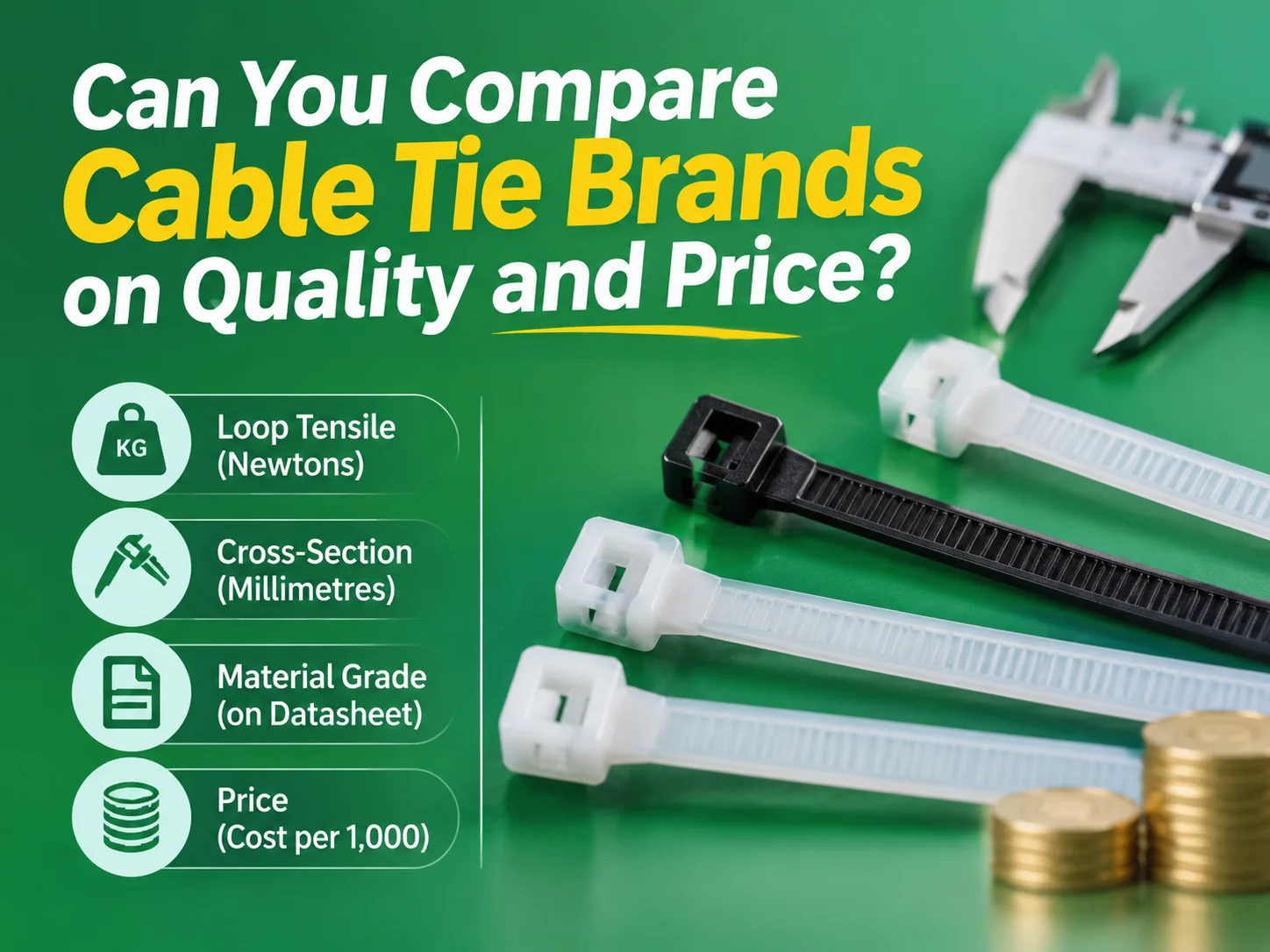
- Decimal commas. Italy writes 4,8 where English writes 4.8. A listing for fascette 4,8 x 300 mm is a 4.8 mm wide, 300 mm long tie, about 12 inches.
- Width comes first. The usual order is width x length, so 2,5 x 100 is a small 100 mm tie and 3,6 x 150 is a 150 mm tie. If you think in inches, our guía de tamaños de bridas converts the common metric sizes.
Italian retail listings also often quote tensile strength in kilograms, for example 22 kg for a 4.8 mm tie, rather than in newtons or pounds. A 22 kg tie is the same 50 lb class as our brida de cable de alta resistencia.
Parts of a Cable Tie and the Tools, in Italian
Italian technical writing names the parts of a tie like this:
- La testa: the head, where the locking mechanism sits.
- Il braccio or la coda: the strap or tail that wraps around the cables.
- La cremagliera: the row of teeth on the strap, literally a rack, as in rack-and-pinion.
- Il fascio or la matassa: the bundle of wires being tied.
For tools, a cable tie gun or tensioning tool is a pinza tendifascette, pinza stringi fascette or pistola tirafascette. Our guide on cómo usar una pistola de bridas explains why installers prefer one on large jobs. A flush cutter for trimming tails is a tronchesino, and cutting a tie off is tagliare la fascetta. If you need to get ties off without damaging the wires, the methods in our guide on cómo quitar bridas apply no matter what language the label is in.
Related Electrical Words You Will Meet Alongside Fascette
Cable ties rarely appear alone in an Italian document. On a wiring diagram, a spare parts list or a panel builder’s quote, they sit next to a handful of other words worth knowing.
| Italian | English |
|---|---|
| Il cavo / i cavi | Cable / cables |
| Il filo / i fili | Wire / wires |
| Il pressacavo / i pressacavi | Cable gland / cable glands |
| La canalina | Cable duct, wiring trunking |
| La guaina / il tubo corrugato | Sheath / corrugated conduit |
| Il quadro elettrico | Electrical panel, switchboard |
| Il morsetto | Terminal, terminal block |
| Il capocorda | Cable lug, crimp terminal |
| Il cablaggio | Wiring, wire harness |
Pressacavo is worthy of note because it constitutes the second part of a neat cable entry: the gland closes and secures the cable at the point where it gets into the enclosure, while the ties arrange it inside. The two are to be found together in almost each and every Italian panel-building quotation.
Example: Translating a Spare Parts Line
The above sentence illustrates the typical entry one can find in a spare parts inventory of an Italian-made machine, and the way to interpret it.
Fascette stringicavo nere PA66 resistenti ai raggi UV, 7,6 x 370 mm, resistenza alla trazione 54 kg, confezione da 100 pezzi.
And just in English: black PA66 cable ties, UV resistant, width 7.6 mm and length 370 mm. Tensile strength 54 kg (120 lb approximately) delivered in a box of 100 items. The string reflects all the necessary information: material, color, UV properties, width, length, tensile strength and packing quantity. After learning how to decipher one entry like that, one can easily procure any cable ties based on the defined parameters from any dealer worldwide.
If the line says per esterni (for outdoor use) or mentions an installation near a heat source, check the temperature range as well. Our comparison of the mejores bridas para uso exterior explains when standard UV-stabilized nylon is enough and when to move to nylon 12 or stainless steel.
Useful Phrases for Shops and Supplier Emails
These phrases can be used to have any conversation in a ferramenta (hardware store or in a materiale elettrico counter (electrical supply outlet) or in correspondence with an Italian distributor.
Avete fascette stringicavo in nylon? = Do you have nylon ties?
Mi servono fascette nere resistenti ai raggi UV per esterni. = I need black ties for outdoor use, which are UV resistant.
Che resistenza alla trazione hanno? = What is their tensile strength?
Avete la misura 4,8 x 300 mm? = Do you have 4.8 x 300 mm size?
Quante fascette ci sono in una confezione? = How many ties there are in one package?
Sono riapribili? = Are they releasable?
Mi serve anche una pinza tendifascette. = I also need a tool to tighten the ties.
Potete inviarmi la scheda tecnica? = Can you send me the data sheet?
It is important to ask about the resistenti ai raggi UV that have been tested for effectiveness, not just about the stucko which is black only. Color itself does not imply that they have made them with UV-stabilized materials because the ties died black will begin to break very soon, just like the ones made of natural material.
That point matters well beyond Italy. Whether the job is a rooftop in Texas or a solar field in Saudi Arabia, the rule is the same, and our bridas negras resistentes a los UV are made for that kind of outdoor work.
Who Needs These Terms
Those who work with materials in daily work might think that the translation is trivial, but many professionals deal with this vocabulary in daily work.
Maintenance teams working with Italian-built machinery, from packaging lines to food-processing equipment, which use wiring diagrams and parts lists that are often in Italian; engineers and buyers on international projects with Italian contractors or equipment suppliers, common mainly in construction, oil and gas, and electricity throughout the Middle East; importers and distributors sourcing for customers in Europe looking to get the product listings and tenders in standard, correct Italian; travelers and expats who need to buy something as simple as a pack of zip ties at their local hardware store.
The good news is that this product itself is international. Therefore, a 66-variety tie, measured in millimeters, rated in kilograms or newtons, and labeled UV-protected, is the same tie in Milan, Houston, or Dubai. You can compare widths, lengths and grades on our bridas de nylon y pasacables página.
Preguntas Frecuentes
What is the Italian word for zip ties?
Fascette, the plural of fascetta. The full technical term is fascette stringicavo, and you will also see fascette serracavo and fascette in nylon.
Why do Italians call zip ties Rilsan?
Rilsan is a brand name for nylon 11 resin. It became so linked with plastic ties in Italy that people use it as a generic word for any nylon zip tie, much as English speakers use Velcro for hook-and-loop fasteners.
Is fascetta stringitubo the same as a cable tie?
Usually not. Fascetta stringitubo normally means a hose clamp, the metal band with a screw. For cable ties, search for fascette stringicavo or fascette in nylon.
How do you say cable tie gun in Italian?
Pinza tendifascette is the most common term. You will also see pinza stringi fascette and pistola tirafascette.
How are cable tie sizes written in Italy?
Width by length in millimeters, with a decimal comma: 2,5 x 100 mm, 3,6 x 150 mm, 4,8 x 300 mm. Tensile strength is often shown in kilograms.
Referencias
- Brida, Wikipedia
- Hose clamp, Wikipedia
- Nylon 66, Wikipedia
- Rilsan, CAMEO Materials Database, Museum of Fine Arts Boston
Conclusión
In order to locate zip ties in Italian, simply ask for fascette, or fascette stringicavo for greater accuracy. Include the classification of the desired zip tie, for example, riapribili, in acciaio inox or resistenti ai raggi UV, and remember to read the sizes as width times length in millimeters instead of as a decimal. Note that stringitubo corresponds to hose clamps and strappo denotes hook-and-loop straps. Thus, with such a limited glossary, an Italian catalog or shop becomes as simple to deal with as an English one.