


How Does HellermannTyton Compare to Panduit?
There is no discrepancy in terms of the cable ties produced by either of the companies. The companies supply the panels, data halls, and OEM lines as well. Ultimately, the decision is made based on the specifications regarding the cable ties and not the actual product itself. Specifications refer to things like size of the cable tie, the tool used for fastening it, and certificates provided together with the product.
This information is required for the purchasing engineer in the order in which it is to be decided upon.
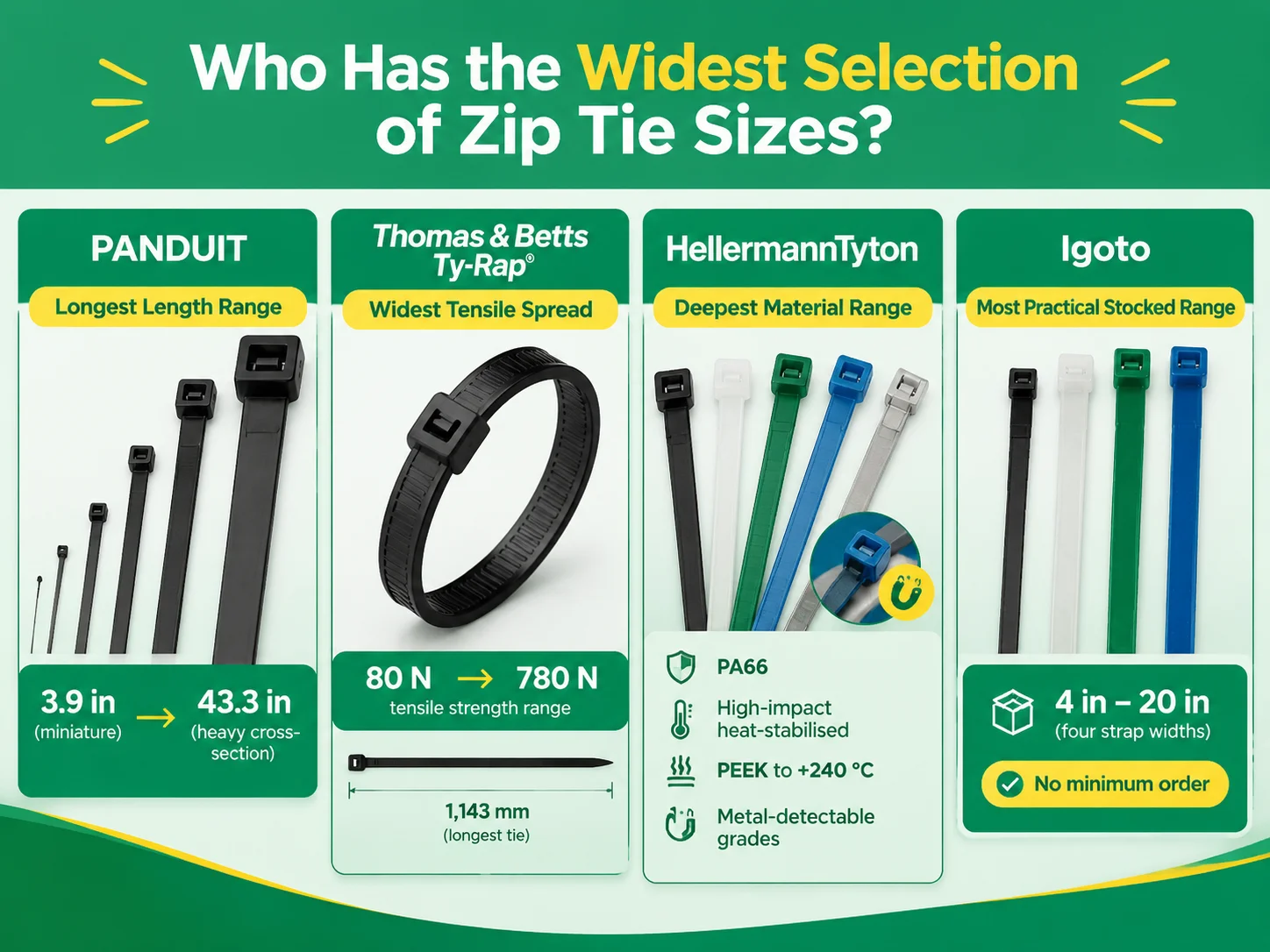
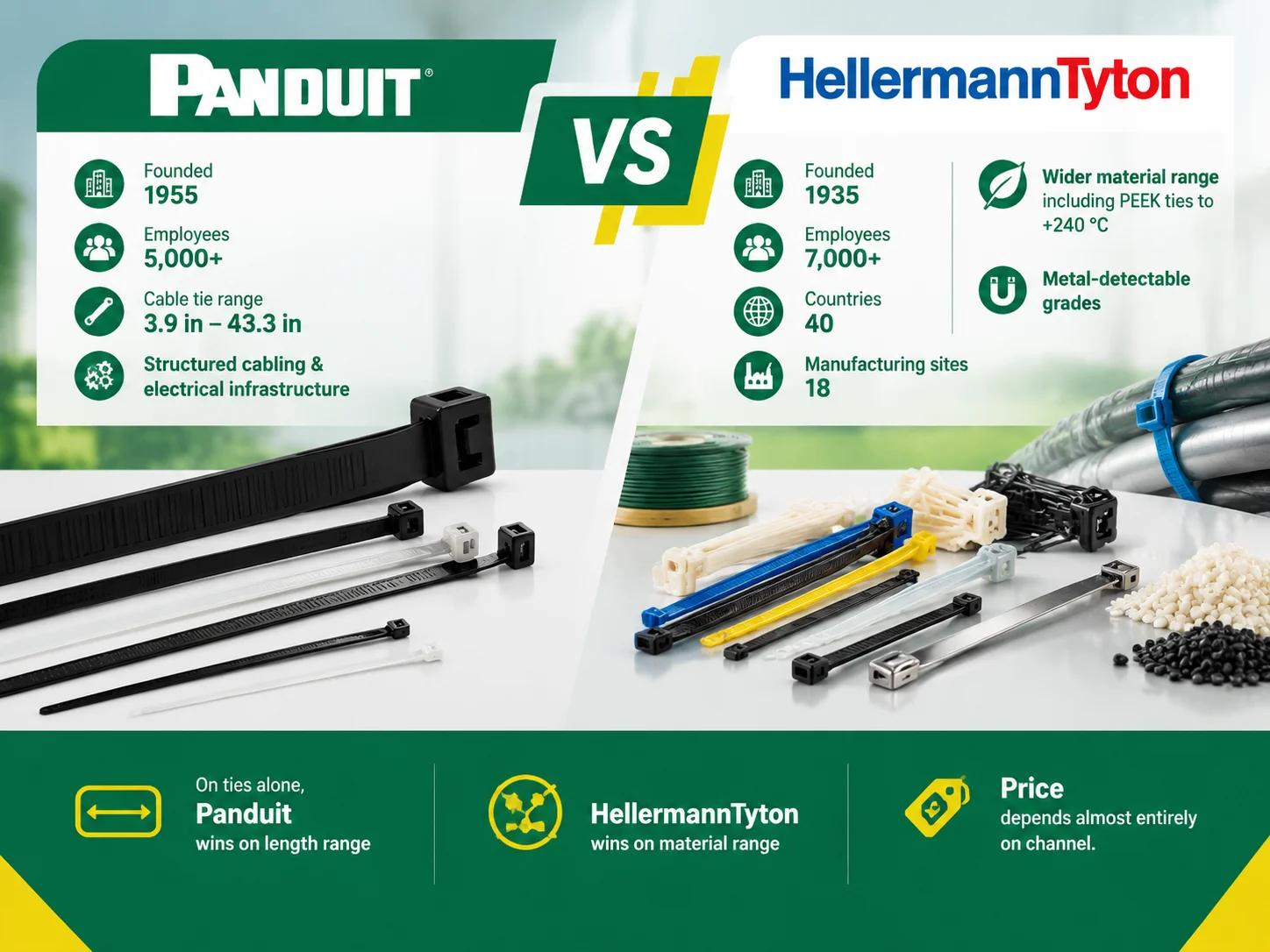
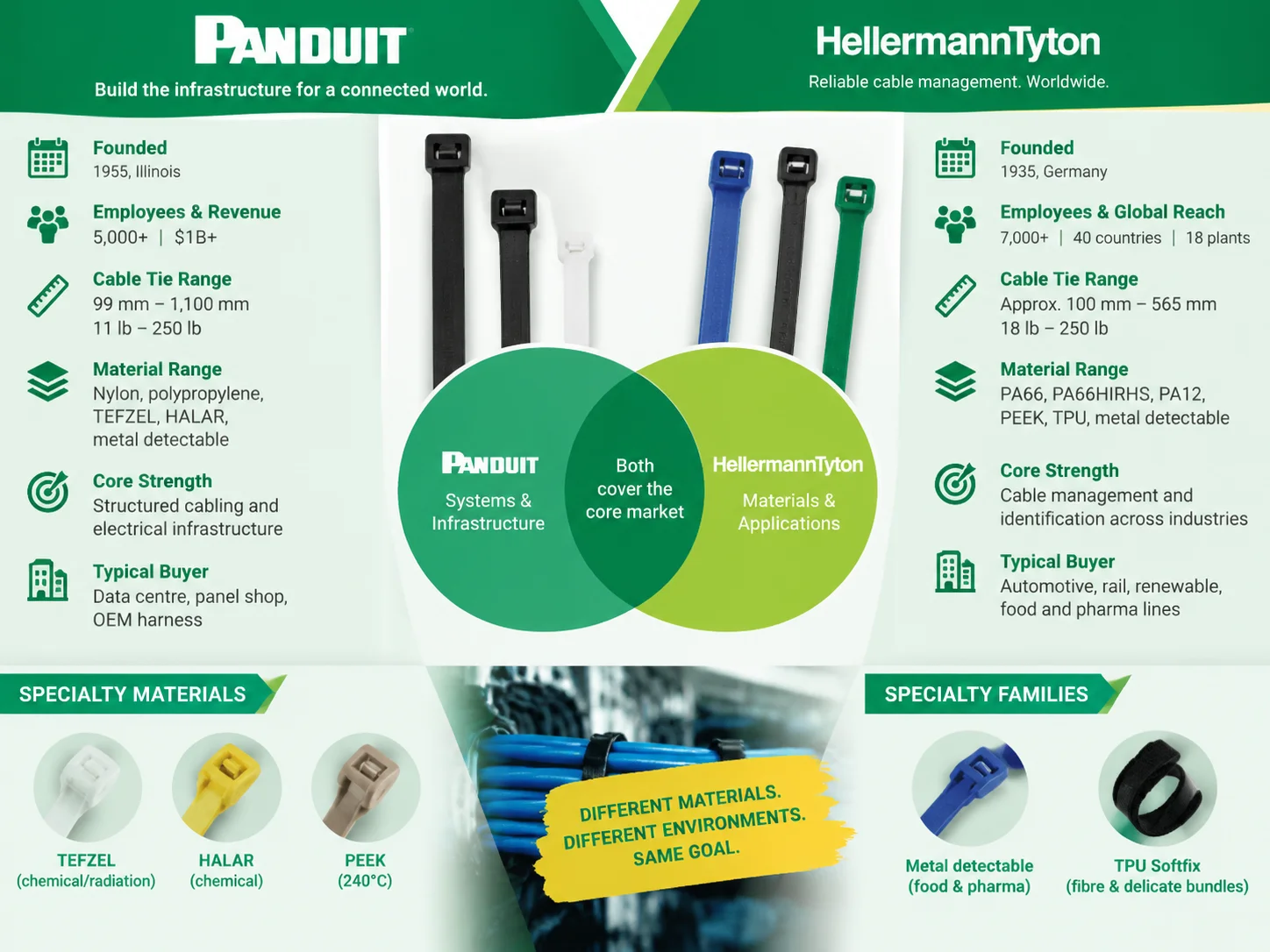
Brief answer: Panduit is the larger systems company: it was founded in 1955, is privately-owned, employs 5,000+ people, and produces cable ties from 3.9 to 43.3 inches in length and works in structured cabling and electrical infrastructure. HellermannTyton is the smaller material producer: it was founded in 1935, employs 7,000+ people in 40 countries, has 18 factories, and produces the largest range of materials, as well as PEEK ties that can withstand up to 240 °C and also can be detected by metal. Panduit wins with lengths of more than HellermannTyton produces, while HellermannTyton is better in variety of materials, while price depends on channel.
At a Glance
| Panduit | HellermannTyton | |
|---|---|---|
| Founded | 1955, Illinois | 1935, Germany |
| Ownership | Privately held by the founding family | Part of a listed industrial group |
| Scale | 5,000+ employees, $1B+ revenue | 7,000+ employees, 40 countries, 18 plants |
| Cable tie range | 99 mm to 1,100 mm, 11 lb to 250 lb | Approx. 100 mm to 565 mm, 18 lb to 250 lb |
| Material range | Nylon, polypropylene, TEFZEL, HALAR, metal detectable | PA66, PA66HIRHS, PA12, PEEK, TPU, metal detectable |
| Core strength | Structured cabling and electrical infrastructure | Cable management and identification across industries |
| Typical buyer | Data centre, panel shop, OEM harness | Automotive, rail, renewable, food and pharma lines |
Interpret the last couple of rows. The companies are the same at the middle of the marketplace, but at its outskirts, they differ, and it is the outskirts with respect to which specifications become dominant ones.
The Two Companies
Panduit was founded in the year 1955 with a plastic wire management duct along with the introduction of the two-piece cable tie in 1958. The company uses a systematic way of viewing the whole process so that the cable tie comes as a whole along with a few other accessories like a mounting device, duct, labeling system, and even cabinets. Panduit currently deals in structured cabling, electrical infrastructure, and industrial products; and being a private company helps it survive with longer product life cycles.
HellermannTyton was founded in Germany in 1935 and started its journey by focusing on industrial wire management and not on the network sphere. The product catalogue of HellermannTyton has a wide array of products that lists different materials providing different properties for the wire tie. The company has 18 manufacturing sites in 40 different countries making its products better.
The differences in the offerings matter while purchasing products. When the product is requested in a standard format like “cable tie, 200 mm, PA66, black”, both Panduit and HellermannTyton will be able to meet the request; however, if the request is made using specific terms like “metal detectable, blue, for HACCP line”, Panduit will only be able to deliver the item, while HellermannTyton cannot meet the request. Certificates and approvals follow the same pattern, and our certification library exists because that paper trail is what a quality auditor asks for first.
Where the Cable Tie Ranges Diverge
Mechanical specifications are usually where the comparison begins and it is important to inquire, not just base this on what the catalogue states.
- Length. Panduit’s PAN-TY family has a wide range of vlaues, from 3.9 inches for the small-size tie weighing 11 lbs to a 43.3 inches heavy duty tie with 175 lb and an extra heavy duty tie with 250 lb. HellermannTyton’s T-series ranges from T18 weighing 18 lbs to T255 weighing 250 lbs with the length of 565 mm.Approved by tortoise corporation.
- Width and tensile strength in the Panduit line is stated in terms of cross-sectional area, which makes the choice mechanical: choose the cross-section for given load, and then select length for the bundle. HellermanTyton does it in terms of T-number, which represents tensile strength in lbs, and it is quick once you know this specification. The conventions themselves are set out in this guide to standard cable tie sizes.
- Materials. This is where the comparison between the two companies becomes less valid. HellermannTyton has a PEEK tie that can stand temperature of -55°C to +240°C which means it can be used in any engine compartment, railway systems or in offshore applications, which is not suitable for the nylon. Panduit uses TEFZEL and HALAR ties that serve different purposes.
- Specialties. The two manufacturers have a range of ties that can be detected by a metal detector in food and pharmaceutical environments, including releasable or adjustable types. HellermannTyton produces ties for sensitive wire bundles. Panduit is focused on identification of products, e.g. with the help of special tags.
Quality Systems and Documentation
Both parties hold certificates in UL 62275 and IEC 62275, both deliver data on loop tensile tests and both provide declaration of compliance. Materially the real differences become apparent when looking deeper into documents.
Documentation of Panduit is based on system compatibility: each tie, support and tool is provided as a system with known installation characteristics. This is useful when the customer needs to replicate the data centre project and it should give exactly the same results in three countries.
Documentation of the HellermannTyton focuses on the materials and environment: temperature ratings, chemical resistance, flammability, as well as the approvals required in the specific industries. This important when it is not the matter of “will it hold” but “is it allowed here.”
For a customer it is enough to ask both companies to provide the document that the customer’s certifying body requires. One company will provide the document in an hour and another company, having provided general attestation will lose in the market, regardless of the price per ton.
Tools and Installation
The tie forms an essential part of the system. If the tie has poor tensioning, it loses most of its capacity. The choice of the tool takes care of the necessary tension.
Panduit gives its customers a complete line of products as it offers everything from hand tools to automatic and pneumatic tensioning tools and makes sure the tool used matches the type of wires used in a harness. The company HellermannTyton provides similar services, but it specializes in automatic bundling systems for mass production applications and places much attention on ergonomics for repetitive bench tasks.
If a panel shop installs only 200 ties per day, manual tools are sufficient. However, if a harness line is busy installing around 20,000 ties, automatic tools make themselves profitable because of the constancy of tension instead of speed. The tension question is covered in this look at heavy-duty cable tie production, where the same principle applies at the top of the range.
Price and Availability
Both of these companies do not sell their products directly to lower-end customers using price lists. As a result, the customer has to look for the right information depending on various channels available. When it comes to standard nylon tied products, distributors are going to price it for a few cents, which in case of specialty materials and low-volume products would lead to a more significant difference than just the name of the brand.
However, the same three patterns can be observed in the market:
- Regular black nylon is considered a commodity, and both brands’ prices are almost the same.
- When it comes to specialty materials it is only the brand because there are no equivalents to be used.
- Low volumes completely invert the comparison. Buying a box of 100 from a distributor may cost several times more than when using even 10,000 pieces.
That last point is the reason that many customers comparing Panduit and HellermannTyton don’t purchase either brand for their everyday use and only consider them for the specifications that reference them.
What a Third Option Looks Like
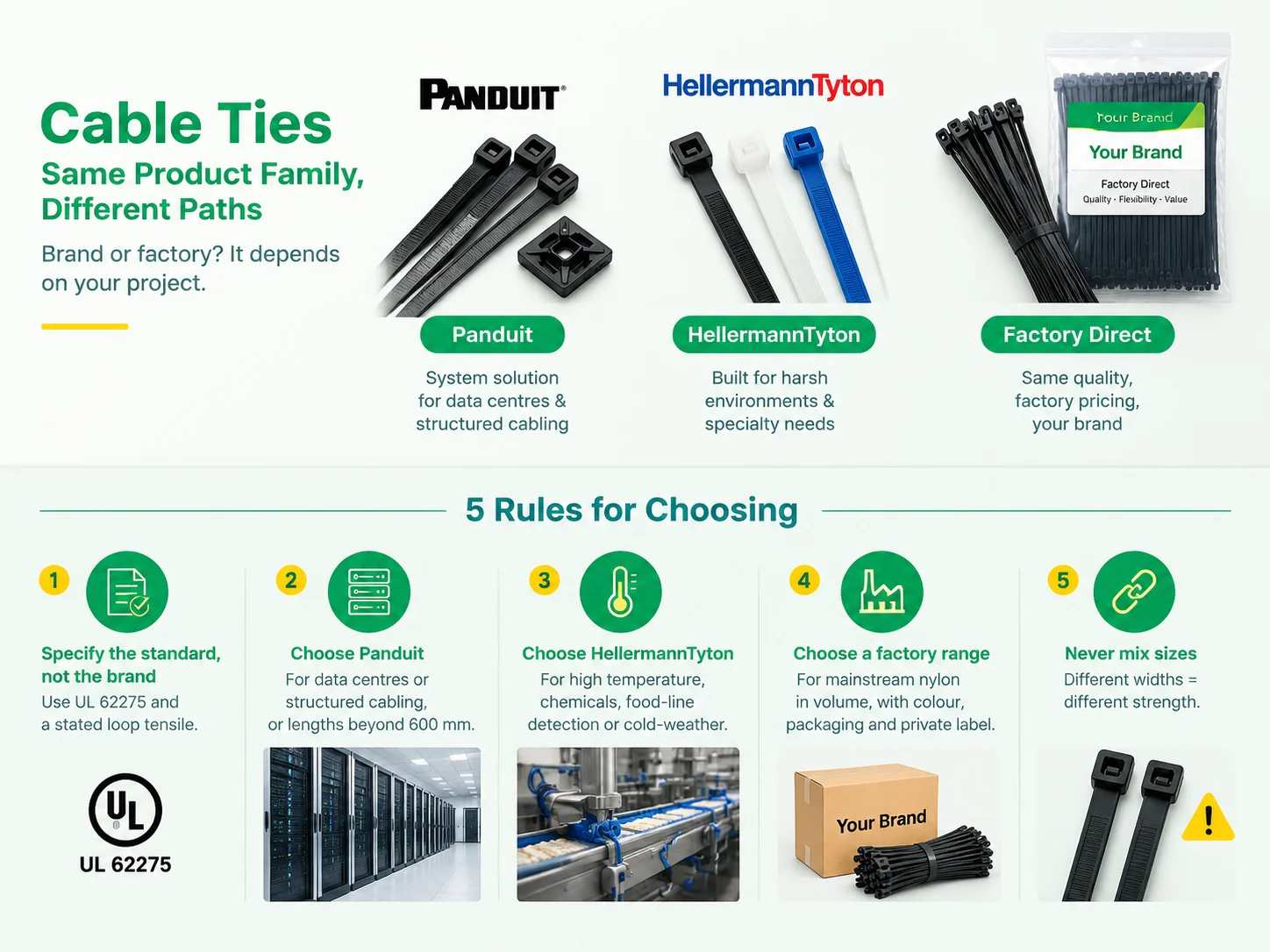
There is a third entity in terms of market players, recent analysis shows that this manufacturer produces the same range at factory prices and has the relevant certificates for a verified purchase while offering the possibility of printing the customer’s brand on the ties and bags.
Thus, this third party cannot replace either of the above-mentioned companies in every case. For instance, if there is a specification that mentions Panduit, the customer will have to use the services of Panduit without a second thought. But when the query is simply “PA66, black, UV-stabilized, 200 mm, 18 lb, UL-listed”, a factory price list’s advantage is self-evident.
Our nylon cable tie manufacturing covers four families across 32 size combinations from 4 in to 20 in, in standard, UV-stabilised and flame-retardant compounds. The goal of the range is not to win against either brand at the extremes; it is to fill in the middle of the ladder where the majority of orders are at a price that eliminates the cost incurred by two levels of distribution.
Which One to Specify
In total, there are five key guidelines that govern most decision-making processes.
- Do not name the brand preference, unless the customer specifically requests it. Hence, commissioning a project with specifications based on UL 62275 and a loop tensile specification is a simpler, cheaper and more efficient approach.
- Whenever there is talk of data centers or structured cabling building the recommendation would be to choose Panduit. It would be useful when the project requires a tool, a tie and a mount to operate as a systemic unit or when there is a need for a length of more than 600 mm.
- When an environment becomes an issue – like high temperature or presence of chemicals, food chain detection or need for operation in a cold climate – HellermannTyton products should be selected.
- Factory brand products can be used when high volume nylon is needed and colour, packaging and private labeling rather than brand reputation are important.
- A rule of thumb is to never mix the sizes of the ties just to achieve a cost-effective purchase order. Even the ties that look alike cannot be used in tandem if they have different sizes of width – otherwise, while in operation they wouldn’t be able to perform stably in the batch.The relationship between width and strength is set out in this note on zip tie width.
FAQ
Are HellermannTyton cable ties better than Panduit?
Both cable tie producers are the same. HellermannTyton has broader range of materials, including PEEK that can withstand +240 °C. Panduit has longer length range and better integration across complete sets including brackets and toolsets. In the case of standard nylon ties with mass order, both are equivalent suppliers and the main factor is channel through which the buying happens and the price.
Which brand of cable tie is cheaper?
Basically, the price difference is negligible for regular nylon cable ties since freight costs will determine which brand to use. In case of specialty materials, the price difference is there, because no alternative product exists. For small quantities the retailers’ markup is usually the main deciding factor for both brands chosen.
Can I use Panduit and HellermannTyton ties interchangeably?
As long as the size, material, and tensile strength are the same – yes, since both companies are certified according to UL 62275 and IEC 62275 and also provide breaking strength information. The only exceptions are specialty cable ties, which are undetectable to x-rays and metal detectors.
Who makes the strongest cable tie?
The strongest regular nylon cable ties can be produced by both manufacturers up to 250 pounds and everything else that is made of stainless steel can withstand even higher weight. Strength rating is more important than limiting weight here because if the tie is too wide, it may not fit the space where it is needed.
References
- Panduit — Company Profile and PAN-TY Cable Ties
- HellermannTyton — Cable Ties and Fixings Portfolio
- UL Solutions — UL 62275 Cable Management Systems
- Cable Ties Unlimited — Distributor Pricing and Size Listings
- Heyco — Nylon Cable Ties and Wire Management
Conclusion
Panduit for system solutions, HellermannTyton for materials, and factory range for regular supplies that the market does not cater to. The majority of professional buyers choose two from the three.
Whenever you provide us with your size requirement, tensile strength, type of material and annual consumption we will recommend the right producer.