




Zip Tie Width: How It Affects Strength, Selection, and Performance
When an apprentice made a choice to use a bunch of ties to attach a packet of armored wires to a tray, he went for the longest ties available to him at that point — ties with a length of 12 inches that could cover the entire cable. By the end of the workday, three straps had already broken. The size was appropriate, but the width of the ties was wrong. Instead of using ties that were 3.6 mm in width and could sustain a load of 50 pounds, he actually should have chosen ties that were at least 7.6 mm wide and could carry about 120 pounds. Indeed, what determines the tensile strength of the cable tie is its width rather than its length. In order to choose cable ties easily without making mistakes, it is essential to realize how width is related to tensile strength, that different types of widths are used for different types of applications, and how these aspects connect with the material and the environment.
Why Zip Tie Width Matters More Than Length
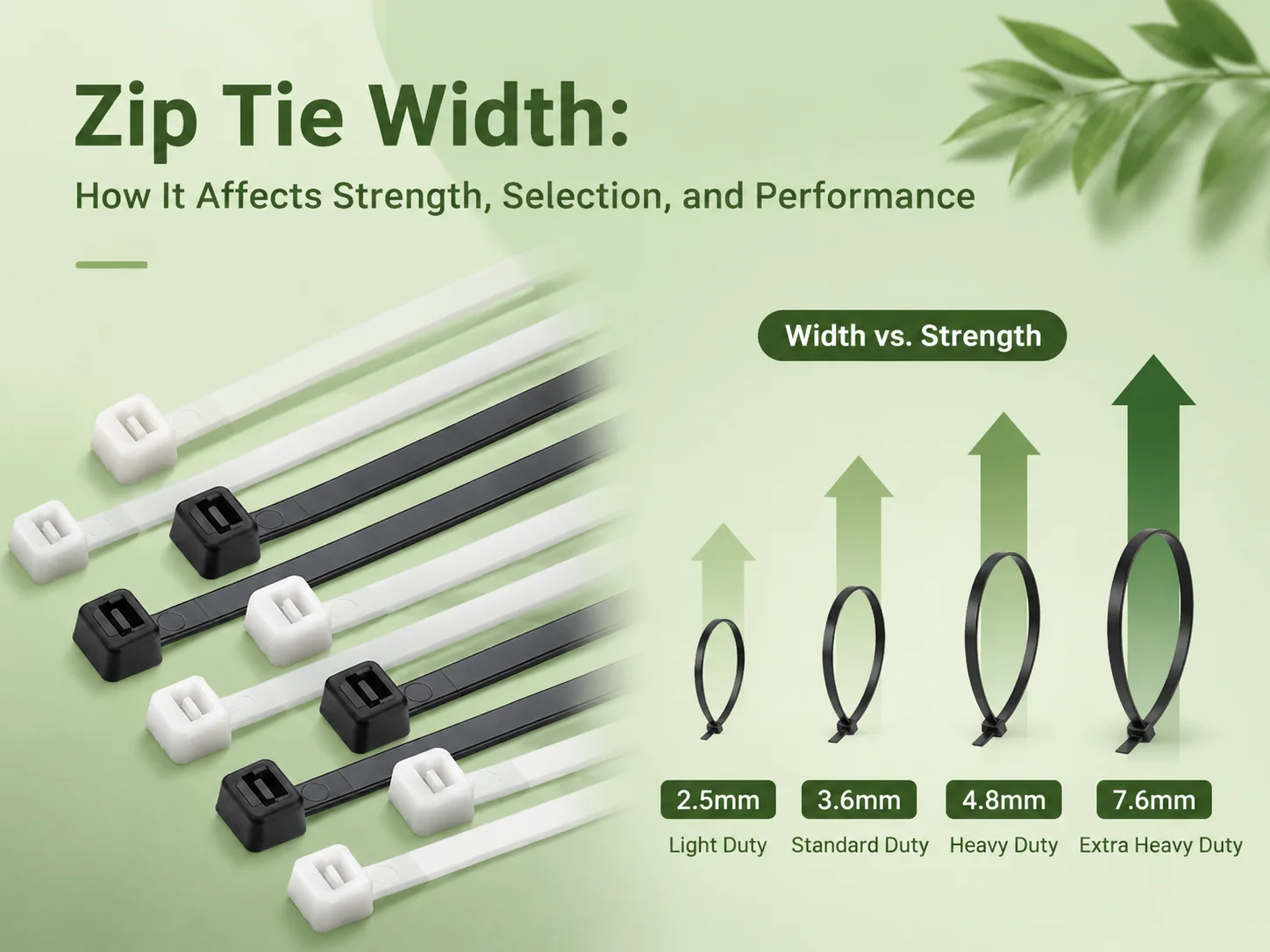
The width of a cable tie is the most important factor in establishing its tensile strength, or how much force it can tolerate before it breaks. A tie’s tensile strength relies on its cross-sectional area: the width and the thickness of the tie. The only influence of the length of the tie is in determining how thick the bundle can be that it wraps around; it does not influence the strength. Hence, a 50-pound tie of 8 inches and a 50-pound tie of 14 inches will exhibit both the same tensile strength since it has the same width and thickness. The extra length simply accommodates a larger bundle. For a detailed breakdown of how length interacts with width and strength across the full product range, our guide on cable tie sizes covers the complete dimensional framework.
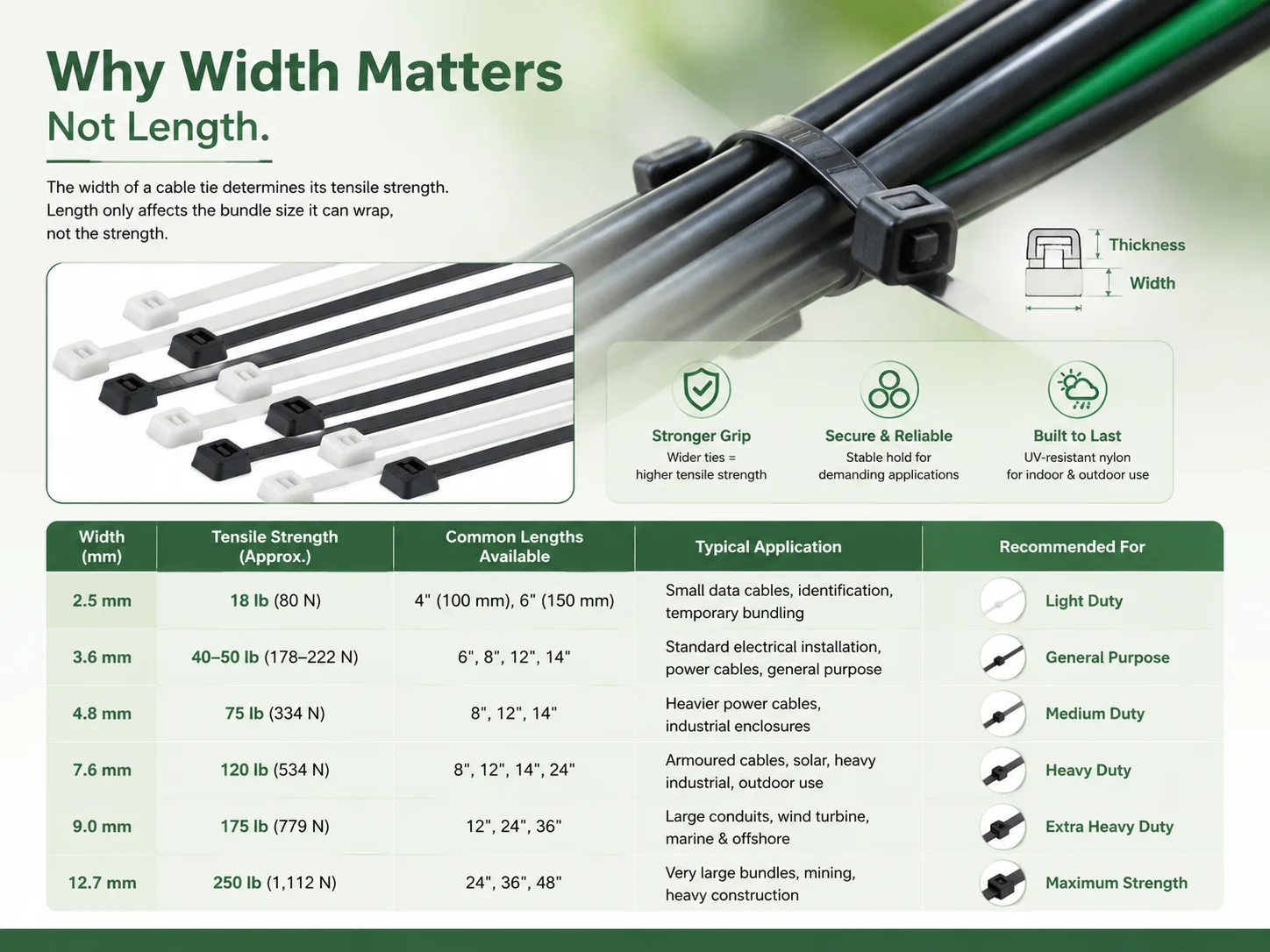
The table below provides a reference for the standard widths, their corresponding tensile strength classes, and the typical applications for each. These dimensions are consistent across the industry for nylon 6/6 cable ties manufactured to UL 62275 or equivalent standards, and they are the sizes that electrical supply houses and B2B suppliers stock as standard.
| Width (mm) | Width (Inches, Approx.) | Typical Tensile Strength | Common Lengths Available | Typical Application |
|---|---|---|---|---|
| 2.5 mm | 0.10 in | 18 lb (80 N) | 4″ (100 mm), 6″ (150 mm) | Small data cables, cable identification, temporary indoor bundling, electronics assembly |
| 3.6 mm | 0.14 in | 40–50 lb (178–222 N) | 6″ (150 mm), 8″ (200 mm), 12″ (300 mm), 14″ (360 mm) | Standard electrical installation — power cables, panel wiring, cable tray, general‑purpose indoor and outdoor bundling |
| 4.8 mm | 0.19 in | 75 lb (334 N) | 8″ (200 mm), 12″ (300 mm), 14″ (360 mm) | Heavier power cables, industrial enclosures, outdoor electrical, bundles requiring a higher safety margin |
| 7.6 mm | 0.30 in | 120 lb (534 N) | 8″ (200 mm), 12″ (300 mm), 14″ (360 mm), 24″ (610 mm) | Armoured cables, solar farm DC bundles, heavy industrial, suspended bundles, wind‑exposed outdoor installations |
| 9.0 mm | 0.35 in | 175 lb (779 N) | 12″ (300 mm), 24″ (610 mm), 36″ (915 mm) | Large‑diameter conduits, wind turbine internals, structural bundling, marine and offshore |
| 12.7 mm | 0.50 in | 250 lb (1,112 N) | 24″ (610 mm), 36″ (915 mm), 48″ (1,220 mm) | Very large bundles, mining, heavy construction, any application requiring the maximum nylon tensile strength |
How Width Varies Across Different Cable Tie Materials
The width classes described above are standard for nylon 6/6 cable ties. When the material changes — to stainless steel, to ETFE, or to a specialty nylon grade — the relationship between width and tensile strength shifts, because the base material itself has a different strength. The table below provides a comparison.
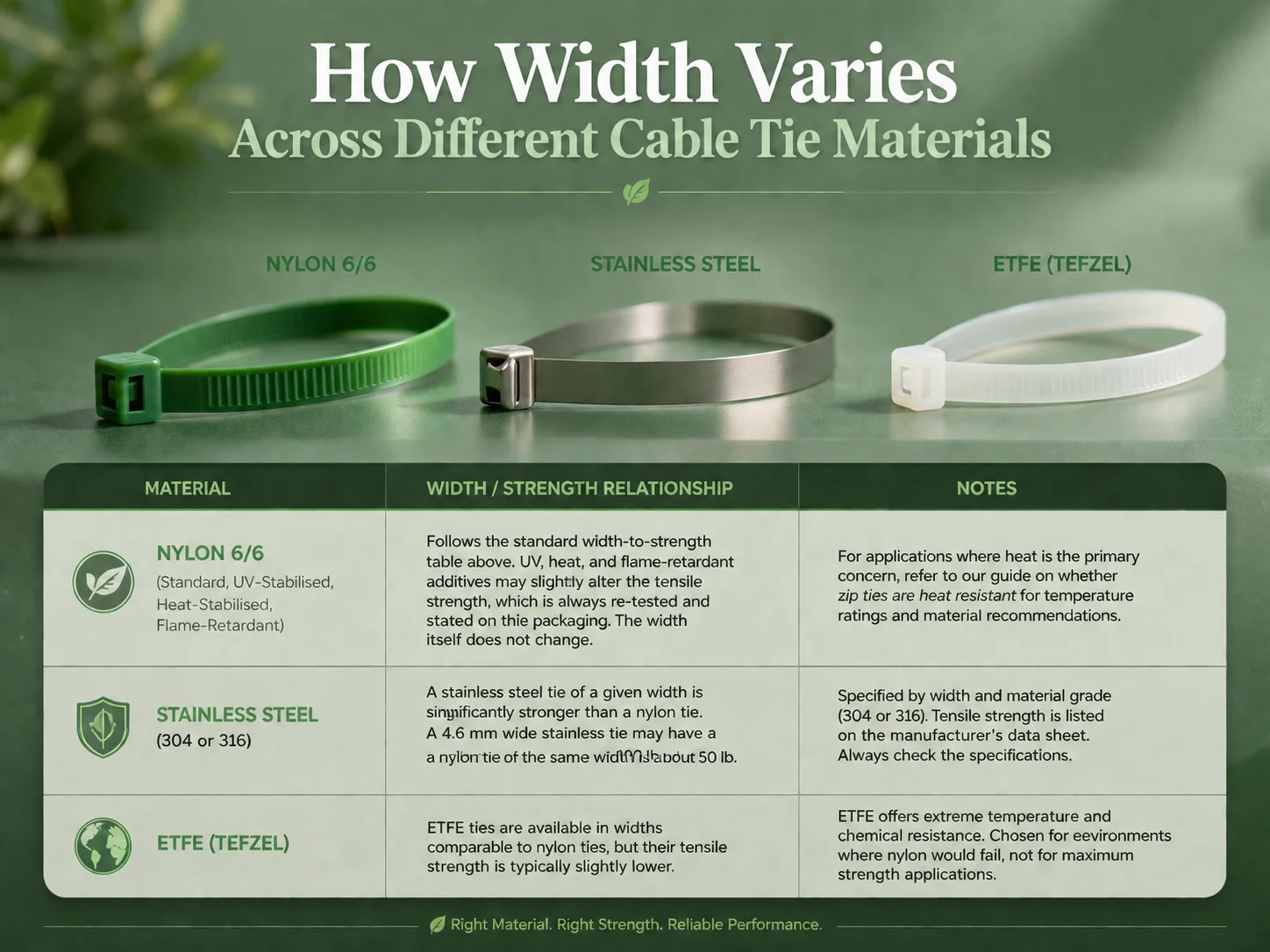
| Material | Width / Strength Relationship | Notes |
|---|---|---|
| Nylon 6/6 (Standard, UV‑Stabilised, Heat‑Stabilised, Flame‑Retardant) | Follows the standard width‑to‑strength table above. UV, heat, and flame‑retardant additives may slightly alter the tensile strength, which is always re‑tested and stated on the packaging. The width itself does not change — a 3.6 mm UV‑stabilised tie is the same width as a 3.6 mm natural nylon tie. | For applications where heat is the primary concern, our guide on whether zip ties are heat resistant covers the temperature ratings for each nylon grade and when to move to a different material entirely. |
| Stainless Steel (304 or 316) | A stainless steel tie of a given width is significantly stronger than a nylon tie of the same width. A 4.6 mm wide stainless tie may have a tensile strength exceeding 100 lb, whereas a nylon tie of the same width would be rated for approximately 50 lb. The width‑to‑strength conversion is fundamentally different because the material is metal, not plastic. | Stainless steel ties are typically specified by their width and their material grade (304 or 316), with the tensile strength stated on the manufacturer’s data sheet. The widths themselves are often in millimetres and match the standard nylon width classes in some cases but not all. Always check the manufacturer’s specification. For a full comparison of nylon and stainless steel across all dimensions and performance criteria, our guide on stainless steel zip ties vs nylon cable ties covers the trade‑offs in detail. |
| ETFE (Tefzel) | ETFE ties are available in widths comparable to nylon ties, but their tensile strength is typically slightly lower than an equivalent‑width nylon tie. The advantage of ETFE is not strength but extreme temperature and chemical resistance. An ETFE tie is specified for environments that would destroy nylon, not for applications requiring the highest possible holding force. | ETFE ties are used in aerospace, nuclear, and chemical processing. Their width is selected to match the bundle and the load, but the material choice is driven by the environment, not by a need for maximum strength. |
Choosing the Correct Zip Tie Width for Your Application
Choosing the appropriate width of cable tie involves two steps, starting with the mechanical load and finishing with the surroundings. The whole process is systematic and requires less than 60 seconds when a bundle with components is available.
- First, determine the required tensile strength. Calculate the tension and weight that the tie will bear in order to sustain the bundle which is hanging vertically and is only supported by cable ties. A bundle which is hanging vertically only with cables has to be secured by the ties which have the combined tensile strength that is enough for it being 2:1 for static indoor or 3:1 for any dynamic, outdoors or overhead load as it should exceed the weight of the bundle itself. The minimum width of the tie is determined with the help of the required tensile strength. 30-pound load requires at least a 50-pound tie (3.6 mm in width) to maintain safety margin. 80-pound load requires at least a 120-pound tie (7.6 mm in width).
- Second, match the material to the environment. Choose a black UV-stabilized tie of the required width for outdoor. For hot environment, a heat-stabilized tie is to be selected. For a marine or chemical environment, a stainless steel tie of the required width and strength class is needed.
When it comes to indoor wiring and general applications, a 3.6 mm-wide tie (50 kg) dominates the market. This model is sufficiently resistant to hold almost any power jumble, available in various sizes ranging from 6 in to 14 in, as well as the most cost-effective of all the tie widths. The question that needs to be raised is whether the increase in width (4.8 mm, 7.6 mm, etc.) will be significant enough to justify the increased cost. While spending on unnecessary size is not crucial, an inadequate tie will certainly lead to failures.
Frequently Asked Questions
What is the width of a normal zip tie?
The common zip tie, which is very frequently used for electrical fittings, has a width of 3.6 mm and has a recommended load capacity of 50 pounds. The 8-inch length zip tie, which is rated for the maximum load will be an apt choice for your basic tying purposes. The next most-commonly used zip tie has a width of 2.5 mm for light tasks and 7.6 mm for heavy-duty industrial applications.
What is the standard tie width?
For electrical and industrial uses, the regular width of cable ties is usually measured at 3.6 mm (0.14 inches). This width is widely accepted based on the class of being assigned for use in the 40-pound and 50-pound tensile strength ratings, available in different length variations ranging from 6 inches to 14 inches. It is frequently used for making panels, installing cables, and building bundles.
How wide are 4 inch zip ties?
4‑inch zip ties are normally 2.5 mm (0.10 inches) broad and hold up to 18 pounds (80 N) of tensile score. This ties are built to be lightweight and is meant for a tiny group of data wire, wire labeling and building of electronic devices. A 4-inch cable tie in a wider type of 3.6 mm is less suitable that can still be found in case one needs short tie with more holding strength.
Is a 4 inch tie too wide?
Usually the question means: ”Is a 4-inch-wide cable tie too wide for my purposes?” The width of a cable tie is not a measurement in inches: a 4-inch cable tie is measuring its duration, not its width. The usual width of a 4-inch-long cable tie is 2.5 mm. If you are asking whether there exists a cable tie that measures 4 inches in width, the answer is that the widest cable tie made out of nylon is 12.7 mm (0.50 inch). A cable tie with a width of 4 inches would not be a standard product, since the most commonly used cable tie measuring 12.7 mm is already very durable (rated for a maximum weight of 250 pounds). In case you need a tie that is stronger than that, the standard solution is a steel cable tie.
References
- Panduit — Cable Tie Width, Tensile Strength, and Dimensional Data. Manufacturer of a full range of nylon and stainless steel cable ties with published width and strength specifications for every size.
- HellermannTyton — Cable Tie Product Dimensions and Material Properties. Global manufacturer providing detailed technical data on cable tie widths, tensile strengths, and material performance across nylon, stainless steel, and specialty grades.
- UL 62275 — Cable Management Systems. The defining standard for cable tie testing, including the measurement and certification of tensile loop strength as a function of width and material.
- MIL‑STD‑23190 — Military Specification for Cable Ties. The U.S. Department of Defense standard defining dimensional tolerances and minimum strength requirements, including width‑to‑strength correlations for military‑grade ties.
The width of a zip tie is the number that determines how much it can hold. Length tells you how much it can wrap. The thickness of the material tells us its durability. However, the width – 2.5 mm, 3.6 mm, 7.6 mm, 12.7 mm – is the most reliable indicator of strength. Choosing the appropriate width means making sure that the tie fits the load, providing sufficient safety margin and checking the material’s endurance in the given environment. An installer who selects the tie based on the width, instead of its length or colour, is an installer who will never find himself in a situation of a broken tie!