





Why the Zip Tie on Your Fire Extinguisher Is Supposed to Snap
The majority of zip ties could be classified as trying to clench tight. However, the zap tie used on the fire extinguisher is required to do just the opposite. To be defined in its functions, the task of the zip tie attached to the fire extinguisher is to break as soon as the fire extinguisher is put to use. Hence, if someone wants to use the extinguisher in a difficult situation, he should be able to unfasten the zip tie. Hence, people seek the fire extinguisher zip ties because it appears to be a zip tie; in reality, it cannot be treated as such, the common misunderstanding in the process.
Our company produces cables ranked among the strongest in the market. Therefore, it might be considered absurd to begin explaining how to use useless items correctly. Nevertheless, the article points out the specific type of the zip tie usually attached to the fire extinguisher, tells about it, the norms connected with it, and what to do if it is damaged.
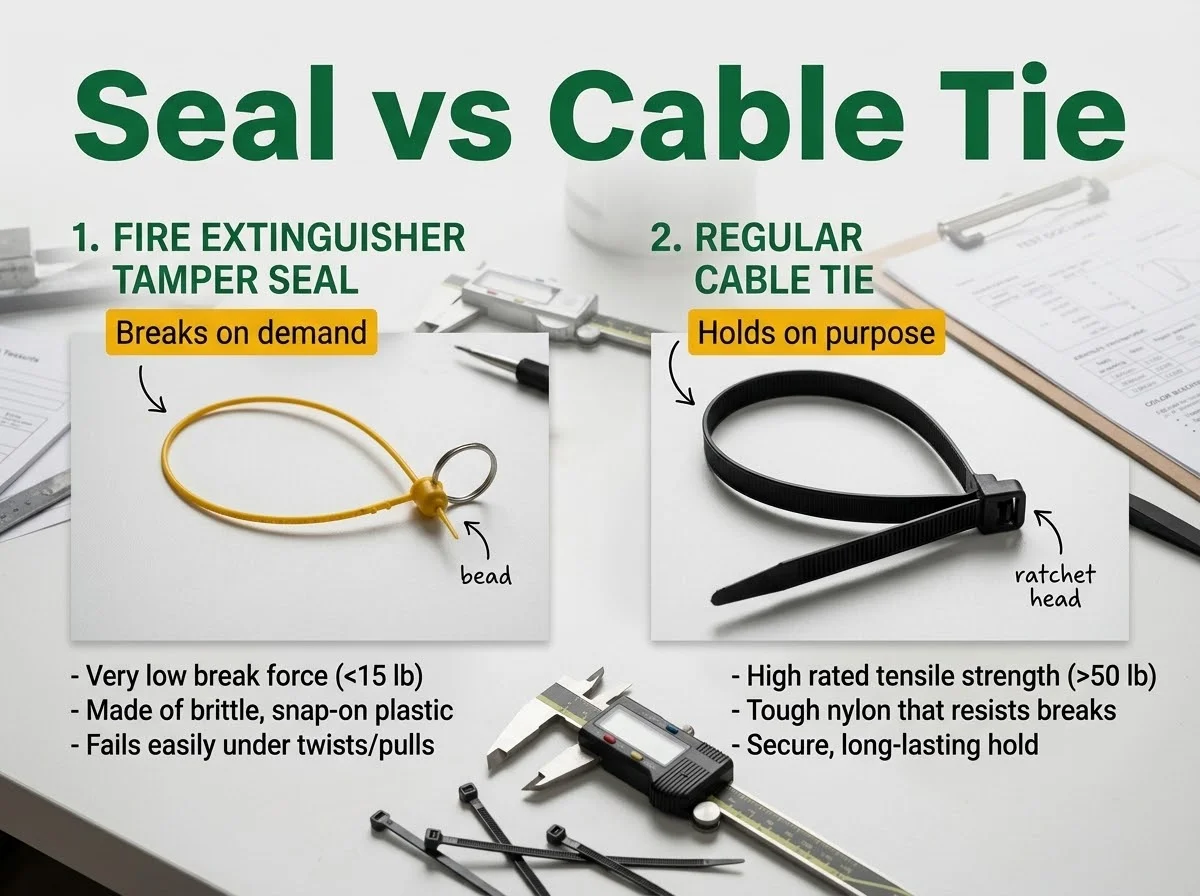
Most of the time, the zip tie attached to the extinguisher is called the breakaway seal. It means that it is made of a small brittle loop of plastic. It has a very simple shape and thus, it has very little strength – according to the Fire Code of Florida, the break pressure applied on that zip tie is no more than 15 pounds.

That Little Plastic Loop Has a Very Specific Job
On close inspection of a portable fire extinguisher, you can see a metal pin going through the handle of the extinguisher. This pin serves to avoid the possibility of accidentally squeezing the handle of the extinguisher. A piece of plastic usually in yellow, red, blue or green color passes through the circle of the pin and around the handle before forming a loop.
This piece of plastic does two functions only:
It keeps the pin in place. It is obvious that extinguishers do get hit, get dropped and shaken in vehicles. This seal will stop the pin from loosening accidentally.
It acts as a sign. An intact seal indicates that no one has pulled the pin since the last service. A broken or absent seal means that someone may have pulled the pin and since that the extinguisher might be in whole or in part empty.
What it does not do is keep something as cable ties do. Inspectors, fire service specialists and facility managers will be able to evaluate the state of the extinguisher every month.
Why Fire Extinguisher Zip Ties Are Built to Lose
Consider a stressful situation when you find a good tamper proof seal. The smoke is creeping through in the kitchen. An inexperienced user reaches the first extinguisher, removes the pin but nothing happens since the seal is tied with a nylon wire of 50 pounds. The person starts to panic and looks for scissors because seconds are ticking away.
Therefore real fire extinguisher seals need to be designed to fail easily. The seals are very thin and made from quite fragile hard plastic making them easy to break just at the moment of the pin turning. According to some manufacturers, it is difficult to pull the seal apart since it is designed to break easily at the moment of the pin turning; this principle is reflected in the instruction for using fire extinguishers.
Various fire codes specify that the limit for breakage is 15 pounds according to Florida’s law as for the portable fire extinguishers. Some authorities say nothing concrete, referring instead to manufacturer’s charts and NFPA 10 but everywhere the principle is the same – a seal should never be an obstacle for the extinguisher to work.
If the idea of a fastener designed to fail sounds odd, it is not unique to fire safety. We cover the wider family in our guide to breakaway cable ties, which are engineered to part at a set load for safety reasons.
Tamper Seals vs Regular Zip Ties
The two look similar in a photo. Side by side, they are built for opposite outcomes.
| Feature | Fire extinguisher tamper seal | Regular nylon cable tie |
|---|---|---|
| Goal | Show tampering, then break on demand | Hold a bundle tight and keep holding |
| Strength | Very low break force, often capped by code (15 lb in Florida) | Rated loop tensile from about 18 lb up to 175 lb or more |
| Material behavior | Hard, brittle plastic that snaps cleanly | Tough nylon 6/6 that stretches before it breaks |
| Locking style | Thin thread or bead locks into a small housing | Toothed strap through a ratchet head |
| Certification that matters | Listed as an extinguisher tamper seal component (UL category GBMS2) | Material flammability rating such as UL 94 V-2; ties may be UL listed as cable ties |
| Typical colors | Bright colors, often rotated by service year | Natural or black, with colors for identification |
he strength row truly tells the whole story. The guide on how much weight zip ties can hold lists the smallest common zip tie strength at around 18 lbs and the most popular 8″ size at strength of 50 lbs or more. Even the weakest zip ties today have more strength than seals in at least one state’s code will allow. Heavy duty ties are in completely different leagues.
Never pass standard cable ties in fire extinguisher pin. It may prevent the pin from coming out in case of emergency, and it disguises the evidence of tampering necessary for inspections.
Certification row is also worth the second look. The UL has classified the tamper seals on fire extinguishers as a product class, which is called GBMS2 in their guide. A UL 94 flammability rating for nylon material is about how the material burns, but nothing more. Never let anyone confuse these terms.
What the Rules Actually Say (and Who Says It)
A lot of online advice blends OSHA, NFPA and local fire codes into one blur. They are different documents with different jobs.
| Source | What it covers | About tamper seals |
|---|---|---|
| OSHA 29 CFR 1910.157 | US workplaces: extinguishers must be mounted, located and identified so they are readily accessible; visually inspected monthly; given an annual maintenance check; employees trained | The regulation text does not mention tamper seals by name. Inspection details come from NFPA 10 and the manufacturer. |
| NFPA 10 | The detailed standard for selecting, installing, inspecting and maintaining portable extinguishers, adopted by most local fire codes | Monthly inspections check that seals and tamper indicators are intact; a new seal goes on after maintenance or recharge |
| State and local fire codes | How NFPA 10 is adopted and enforced locally, plus extra rules | Some add specifics, such as Florida’s annual replacement and 15 lb break limit |
| UL | Product listing and certification | Lists extinguisher tamper seals as a separate component category |
The mounting height is an excellent illustration of this perplexity. You frequently see the phrase “top no higher than 5 feet” attributed to OSHA. The origin of such figure is NFPA 10. The only requirement from the OSHA’s standpoint is to provide ease of access to fire extinguishers. The authority having jurisdiction, your local fire marshal, will determine the applicable code and the latest its edition.
What the Colors Mean
If you go through a sizable structure, you will see yellow seals in one section and red seals in another section. There is no universal color code for the seal. The colors are a means utilized by service firms since some change the color of the seal from year to year, thereby making it possible for technicians to notice missing extinguishers from far. Other seals have a year printed on them together with a serial number corresponding with the inspection tag.
Thus, a seal color is an indication of the service done at the premises, but it is not an indication of the type of the extinguisher and does not provide any pass/fail score. The inspection tag should be consulted.
Found a Broken or Missing Seal? Here Is What to Do
A seal that is broken raises questions, not conclusions. An extinguisher could have been used or simply dropped off its bracket, and whatever the cause, it must be checked.
1.Check the pressure gauge to ensure that the needle is in the green section. If it is showing in the red, the extinguisher must be treated as used.
2.Check for signs of leakage, such as powder on the nozzle, damage to the hose, or a lighter body of the unit.
3.If something looks wrong, take the extinguisher out of service and replace it with a working one.
4.Contact a service company specialized in fire suppression systems to check the unit, make a refill if necessary and replace it with a new official seal.
5.Do not try to reseal the unit accidentally—using whatever you have at hand, it will only disguise the fact that the unit was used without actually fixing anything.
All workplaces in the US are required to perform that monthly visual inspection, so any broken seals should be revealed in time.
Zip Ties and Fire Extinguisher Mounting
Individuals searching for fire extinguisher zip ties typically aren’t inquiring about seals. Their intent is to find some manner to secure their extinguisher in automobiles, boats, UTVs and workshop walls, and they believe a bunch of heavy-duty zip ties may be a simple solution to this.
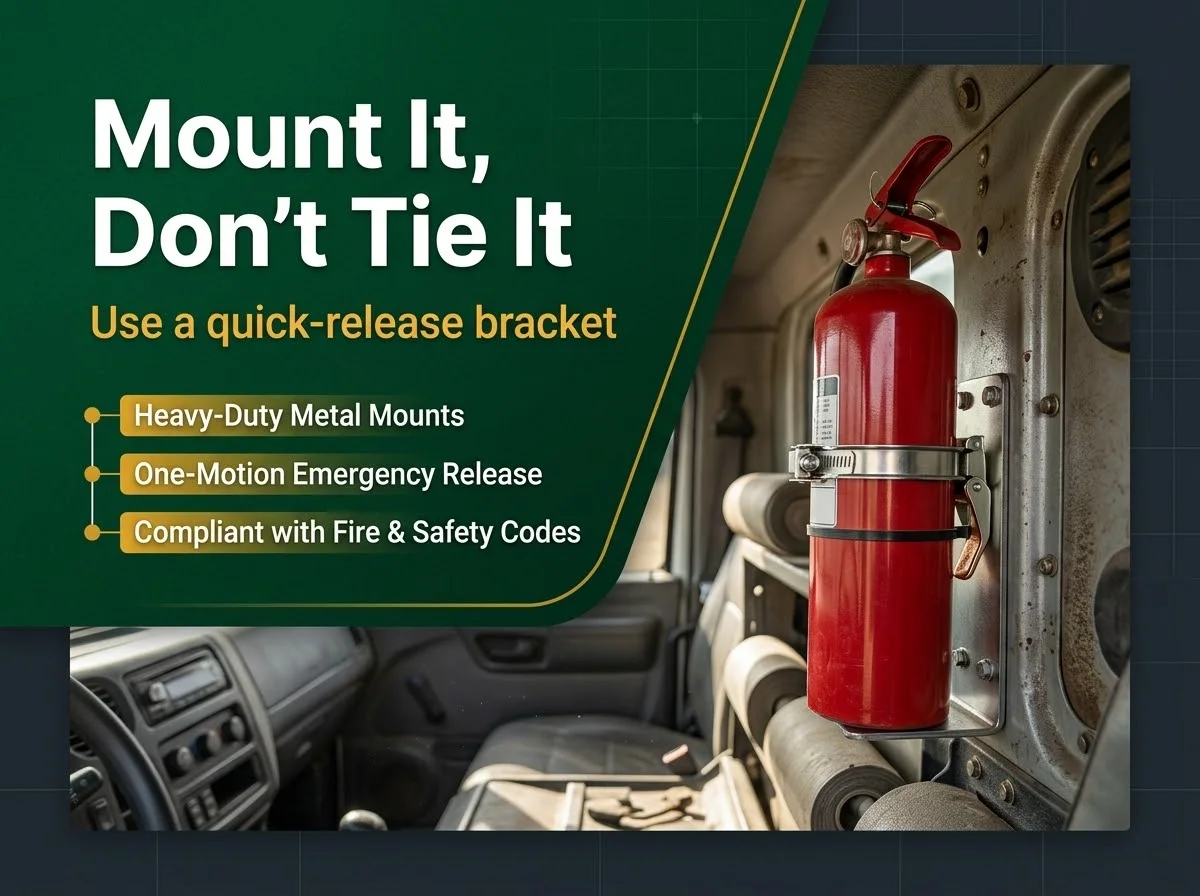
This is the wrong decision due to three reasons. First, cable ties don’t allow for a quick release, which means that, at the time of emergency, one is expected to look for a knife instead of taking the extinguisher. Second, nylon begins to soften long before it starts melting, and the fire is most likely to start right where the ties are located. Third, in the case of a car crash, an extinguisher tied up with plastic straps can become a projectile.
Never use plastic ties for securing a fire extinguisher on a bracket, roll bar or wall. Instead, either use the bracket supplied by a producer or metal quick-release mount which can be opened in one motion.
For stationary installations, NFPA 10 states the height of the installation: fire extinguishers that weigh up to 40 lb must be installed no higher than five feet above the floor, heavier equipment has to be mounted at a height of no higher than 3.5 feet from the floor, with no less than four inches of free space under the device. For vehicles and boats, make sure to bolt a metal holder to some solid construction and keep the fire extinguisher within a reach of the driver or helmsman.
Where Regular Cable Ties Do Belong Around Fire Equipment
None of this means cable ties have no place near fire safety gear. They are just the supporting cast, not the lead.
- Cabinet and box seals. Numbered plastic ties are widely used to seal extinguisher cabinets and hose boxes, so it is obvious if a door has been opened. Our guide to identification cable ties explains how numbered ties work as evidence without pretending to be locks.
- Signs and tags. Ties hold location signs, inspection tag holders and pictograms to racks and railings.
- Cable management near alarm and suppression panels. Here the material matters. Our flame retardant cable ties carry a UL 94 V-2 rating, and near heat sources our guide to high temperature tie wraps explains when standard nylon is no longer enough.
- Outdoor fire points. Anything strapped outside, such as signage at a fire point or hose reel cover, should use black UV-stabilized ties. See our UV resistant cable ties for exposed locations, and our answer on how long zip ties last outside for realistic replacement intervals.
The rule of thumb is simple. If the tie is holding something that must stay put, use a proper cable tie, such as our standard nylon cable ties. If it is holding something that must come apart in an emergency, it should not be a cable tie at all.
FAQ
At what temperature will a zip tie melt?
Cable ties made from standard nylon 6/6 melt at an approximate temperature of 260 °C (around 500 °F), but the really useful number is much lower: most cable ties are rated for continuous use at around 85 °C, while heat-stabilized varieties rated for around 105 to 125 °C. Beyond this point, the nylon begins to soften, lose strength and can give way much before melting. This is yet another reason to avoid securing an extinguisher with cable ties.
How do you secure a fire extinguisher?
Utilize the mounting bracket provided by the manufacturer of the extinguisher, or alternatively, use a quick-release metal mounting system which can be secured in place by use of a screw or bolt onto a firm structure. Particularly indoors, ensure that the established heights recommended by NFPA 10 are adhered to including not mount any fire extinguishers higher than 5 feet for sizes up to 40 pounds, 3.5 feet for heavier sizes and at least 4 inches above ground. In case of vehicles and boats, secure the fire extinguisher in a manner that will be accessible to the driver and avoid any movements during accidents.
What are the OSHA requirements for fire extinguishers?
Employers that supply portable fire extinguishers in accordance with 29 CFR 1910.157 are responsible for properly mounting, locating, and identifying them for easy access. They also need to carry out visual inspections on a monthly basis, have them maintained annually, conduct hydrostatic testing at designated periods, and ensure that employees know how to operate them correctly. One of the vital inspection points which must be considered is that seal is not broken as stated by both NFPA 10 and the manufacturer.
How much force does it take to break zip ties?
The strength depends on its size. Standard nylon cable ties are rated anywhere from around 18 lb for a small 2.5 mm cable tie, to about 40 to 50 lb for average-sized ties 3.6 to 4.8 mm, and even up to about 120 to 175 lb for the large ties of size 7.6 to 9 mm. A tamper seal for fire extinguishers is intentionally rated lower than any of these. For instance, in Florida, the break force is required to be a maximum of 15 lb.
References
- OSHA: 29 CFR 1910.157, Portable fire extinguishers
- NFPA 10: Standard for Portable Fire Extinguishers
- Florida Administrative Code 69A-21.249: tamper indicators and seals
- UL Solutions: fire extinguisher testing and certification (component category GBMS2)
Conclusion
The plastic tie on the fire extinguisher is the only case in which using the strongest zip tie is a bad option. It is a tampering seal that has to keep in place till the moment it is required. So when it comes to repairs of the seal, remember to use a listed seal installed by a qualified technician, use broken seals as a reason to check the fire extinguisher, and use proper brackets to mount extinguishers.
Use strong cable ties for the jobs that require such strength.