



How Much Weight Can Zip Ties Hold?
When an employee believed that using a few 18-pound zip ties would be enough to hang a cable bundle in the theatre, he did not consider that the movement caused by the air conditioner would significantly increase the stresses at the heads of the ties throughout the entire performance. Eventually, the constant flexing caused one of the zip ties to fail. Due to this situation, the bundle was able to sag downwards but was caught before it could drop to the floor. It has to be mentioned that there was nothing wrong with the ties, which were simply pushed to their limit for the first time and held in a way that created maximum stress on their weakest part.
What the Tensile Strength Rating Actually Means
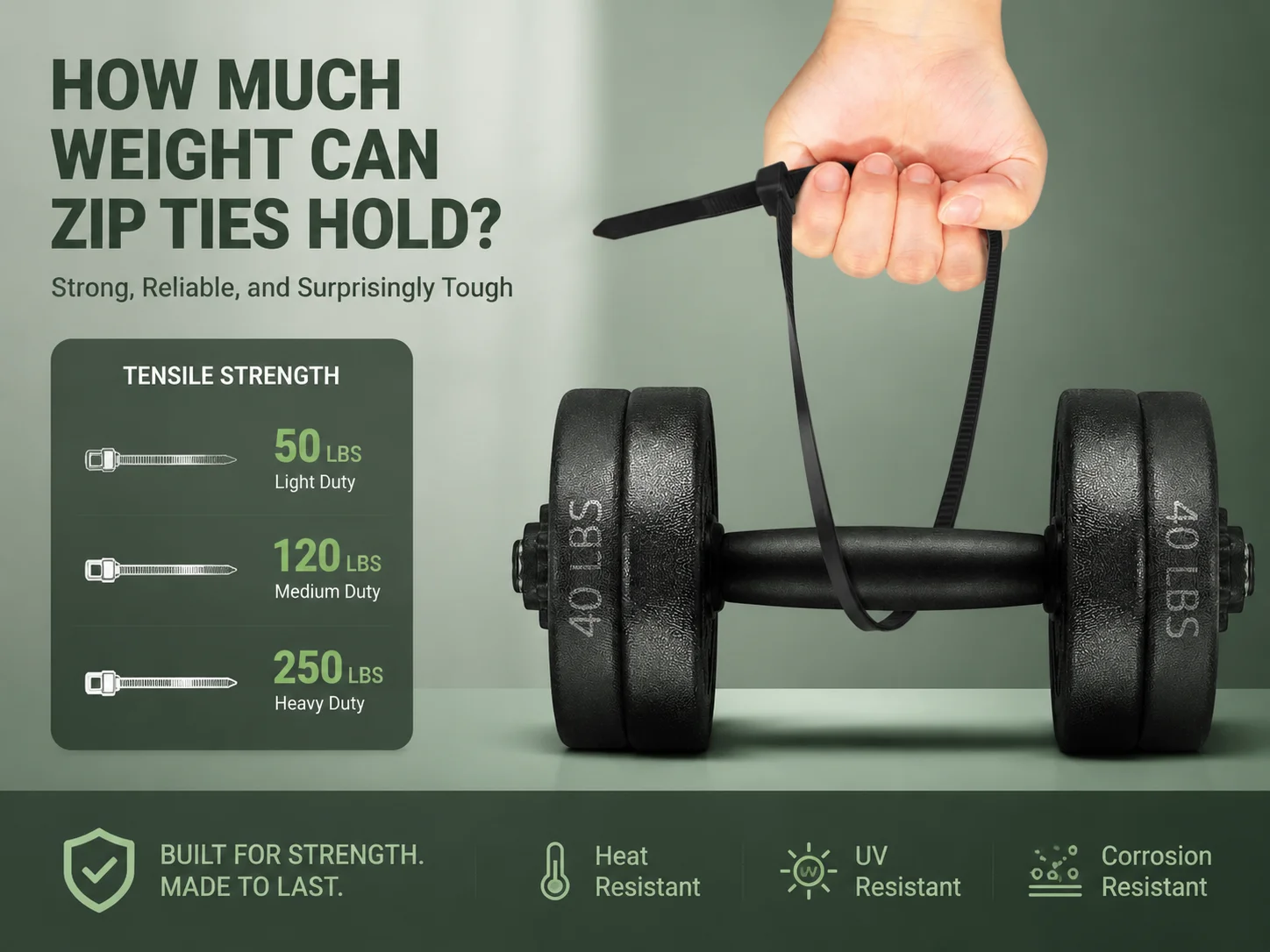
The minimum tensile loop strength is the weight carrying capacity of a zip tie and it is defined as the amount of force needed to break the zip tie when looped around a mandrel and pulled with constant force. The test is standardised by UL 62275 and MIL‑STD‑23190. A zip tie of 50 lbs rating will definitely not break at exactly 50 lbs. It just means it can hold a weight of more than or exactly 50 lbs but does not specify the actual weight it can hold for sure. The breaking strength may be 55 or even 60 lbs but the rating means the minimum weight it can hold. The tensile strength is not determined by the length of the zip tie but by the cross sectional area of the zipper, that is, width and thickness and the locking mechanism of the zip tie. For a detailed breakdown of how length and width interact to define a cable tie’s dimensions and strength class, our guide on cable tie sizes covers the full range from 4‑inch, 18‑pound ties to 48‑inch, 250‑pound heavy‑duty fasteners.
Tensile Strength by Cable Tie Type and Size
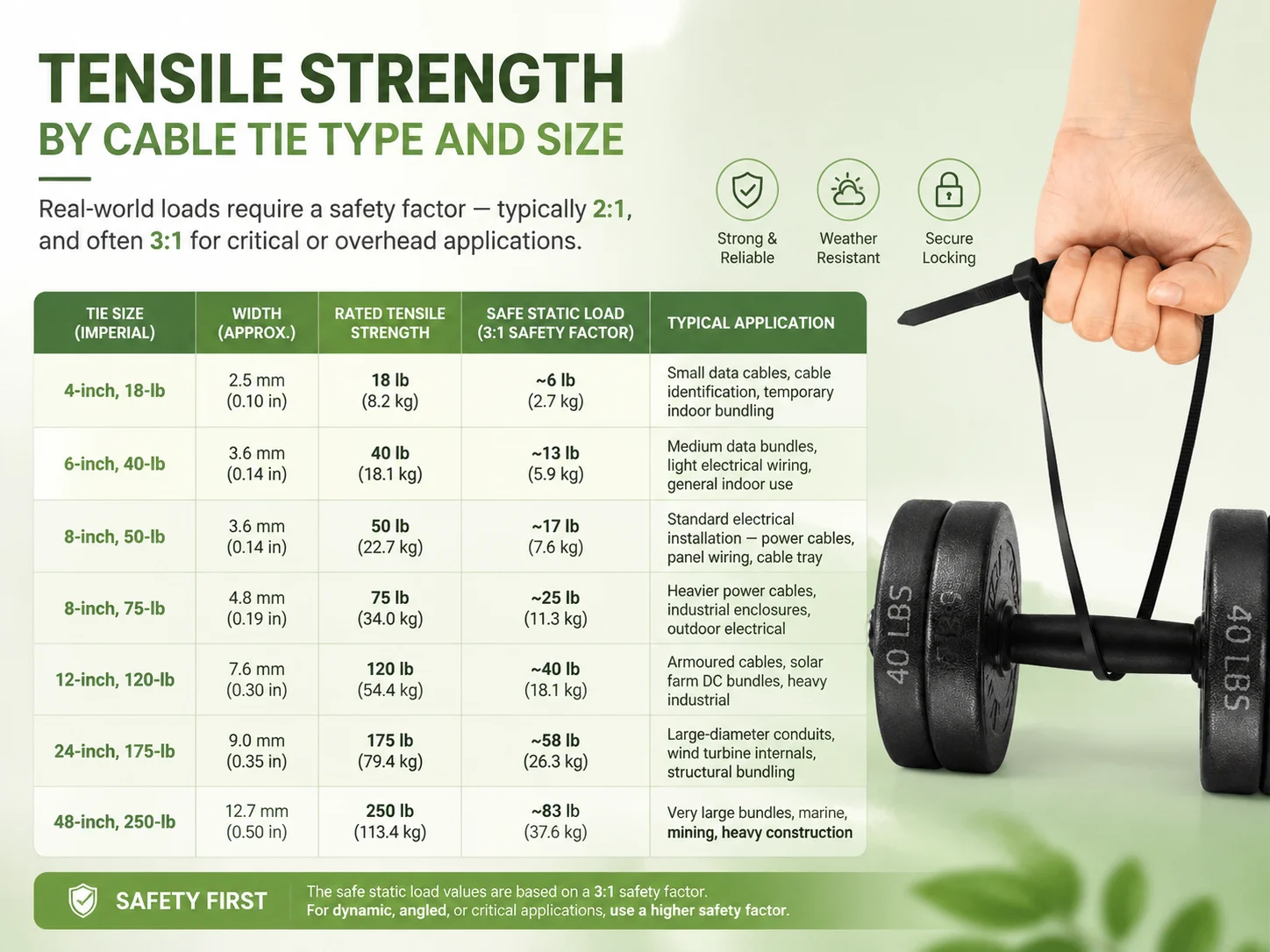
The table below provides a practical reference for the most common zip tie sizes, their rated tensile strengths, and the real‑world loads they can typically handle. The “safe static load” column assumes a straight, vertical pull with no dynamic or shock loading. Any installation that involves vibration, wind, temperature cycling, or an angled pull requires a safety factor — typically 2:1, and often 3:1 for critical or overhead applications where a failure would cause injury or damage.
| Tie Size (Imperial) | Width (Approx.) | Rated Tensile Strength | Safe Static Load (3:1 Safety Factor) | Typical Application |
|---|---|---|---|---|
| 4‑inch, 18‑lb | 2.5 mm (0.10 in) | 18 lb (8.2 kg) | ~6 lb (2.7 kg) | Small data cables, cable identification, temporary indoor bundling |
| 6‑inch, 40‑lb | 3.6 mm (0.14 in) | 40 lb (18.1 kg) | ~13 lb (5.9 kg) | Medium data bundles, light electrical wiring, general indoor use |
| 8‑inch, 50‑lb | 3.6 mm (0.14 in) | 50 lb (22.7 kg) | ~17 lb (7.6 kg) | Standard electrical installation — power cables, panel wiring, cable tray |
| 8‑inch, 75‑lb | 4.8 mm (0.19 in) | 75 lb (34.0 kg) | ~25 lb (11.3 kg) | Heavier power cables, industrial enclosures, outdoor electrical |
| 12‑inch, 120‑lb | 7.6 mm (0.30 in) | 120 lb (54.4 kg) | ~40 lb (18.1 kg) | Armoured cables, solar farm DC bundles, heavy industrial |
| 24‑inch, 175‑lb | 9.0 mm (0.35 in) | 175 lb (79.4 kg) | ~58 lb (26.3 kg) | Large‑diameter conduits, wind turbine internals, structural bundling |
| 48‑inch, 250‑lb | 12.7 mm (0.50 in) | 250 lb (113.4 kg) | ~83 lb (37.6 kg) | Very large bundles, marine, mining, heavy construction |
Beyond Nylon: Stainless Steel and High‑Strength Alternatives
When the necessary holding force is higher than that provided by a nylon cable tie — or if environmental conditions are too severe for nylon to withstand — stainless steel is the answer. A stainless steel cable tie, made from Type 304 or 316 stainless steel, is characterized by a tensile strength, which starts at 100 pounds for the smallest sizes and can reach more than 600 pounds for heavy-duty versions. Stainless steel is resistant to deformation under load, develops no defects in UV rays, and is resistant to softening under high temperatures. However, the drawbacks include its cost, weight, and the necessity to use an additional tool that tightens and cuts off the tail of the tie. For a complete comparison of plastic and metal fastening options, including their respective load ratings and best‑use scenarios, our guide on alternatives to cable ties covers stainless steel, hook‑and‑loop, and other fastening solutions.
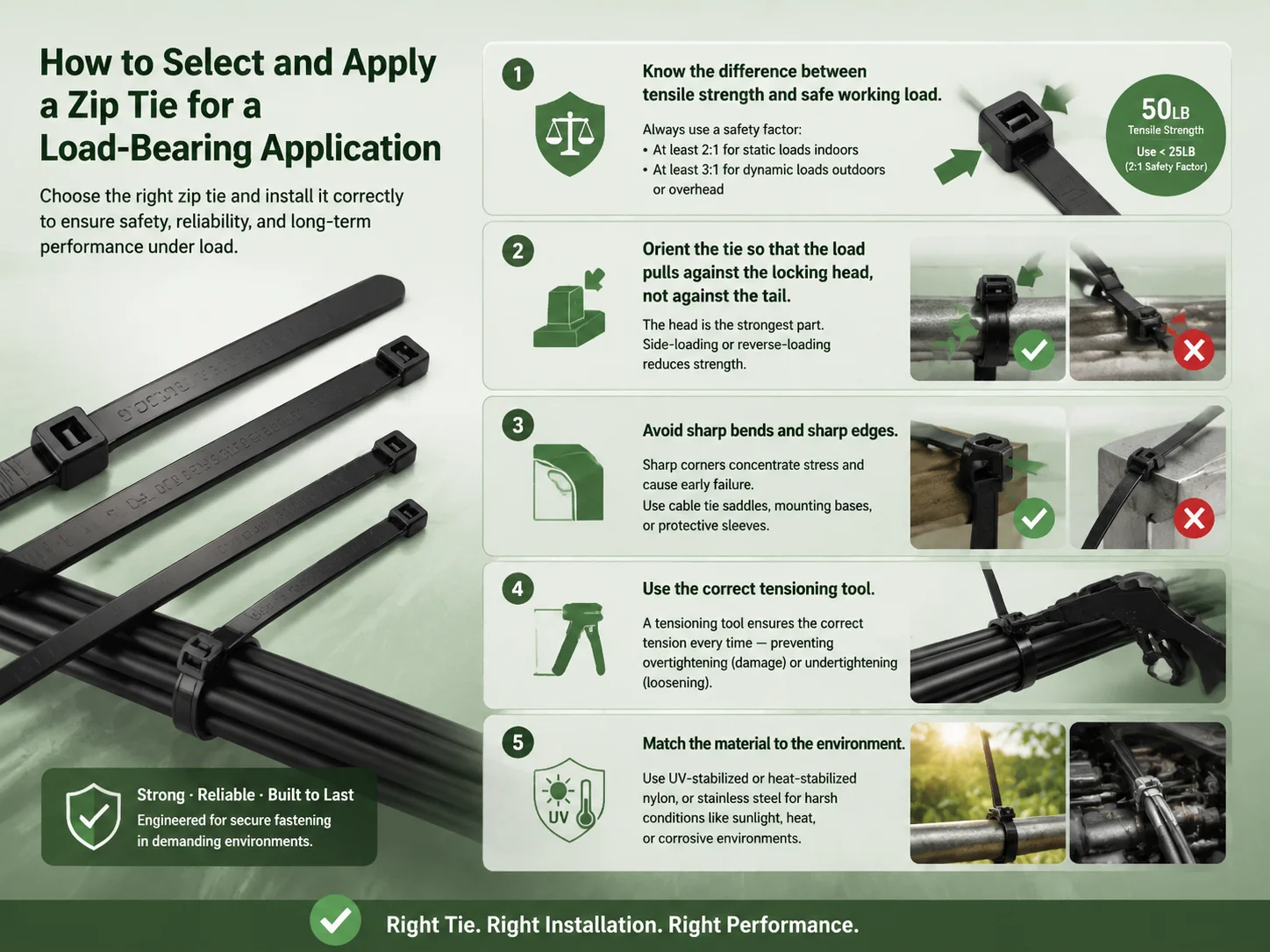
How to Select and Apply a Zip Tie for a Load‑Bearing Application
The process of selecting the right zip tie for any load-bearing application is about ensuring that the strength rating of the tie is appropriate for the actual load (including a safety factor) and that it is installed in a way that preserves the strength of the tie. The principles that follow can be applied to any type of cable tie that is used in a load-bearing capacity whether to hold a conduit in place on a tray or to hold cables together in an outdoor rack.
- Know the difference between tensile strength and safe working load. The 50-pound tie is capable of providing a straight pull of at least 50 pounds. However, it should not be expected to hold 50 pounds while in an angular position, under vibration, or while on a sharp corner. Safety factors of at least 2 to 1 for static loads indoors, and at least 3 to 1 for dynamic loads outdoors or pulling from an overhead position, should also be considered.
- Orient the tie so that the load pulls against the locking head, not against the tail. The strongest portion of the tie is the head. The tail is just a free end after passing through the head. In the case of a tie that is subjected to side-loading of the tie or is asked to support a load that is pulling the tie away from the head rather than towards it, the breaking load will be lower than the rated value.
- Avoid sharp bends and sharp edges. When a cable tie is secured tightly over a sharp metal corner, the corner of a cable tray for instance, or the edge of a punched hole in a bracket, it will no longer be able to withstand as much tension because of the angle. The nylon material causes the stress to be concentrated at the bend, causing the tie to break at a lower weight than its rated load. Use a cable tie saddle, mounting base, or a cable with a protective sleeve to avoid the corner.
- Use the correct tensioning tool. If a tie is tightened by hand one can never know if it is the correct tension. A tension tool adjusts with a pre-determined force ensuring each and every tie is tightened with the same tension every time. If one overtightens a tie, the tie distorts, the insulation of the cable is damaged and the tie becomes overstressed to the point that it possesses no more residual strength so that it can sustain any external load. Conversely, a tie that is not sufficiently tightened will remain loose and ineffective.
- Match the material to the environment. If a tie intended for use indoors will carry loads of up to 50 pounds for a period of twenty years, it is likely to only be able to carry 25 pounds of load after six months of exposure to sunlight if it is not UV-stabilized. For ties used in engine bays, where temperatures can reach 100 degrees Celsius or more, heat-stabilized nylon or stainless steel will be needed.Our guide on whether zip ties are heat resistant explains the temperature ratings for each material grade.
Frequently Asked Questions
How much weight will a zip tie hold?
The lightest 4-inch zip tie can carry up to 18 pounds (8 kg), while the heaviest 48-inch industrial zip tie can carry 250 pounds (113 kg) or more. Stainless steel cable ties may hold weights greater than 600 pounds. The rated tensile strength of zip ties can be found on their packaging, but a safety factor of at least 2:1 must be used in real-life applications.
How much strength does it take to break a zip tie?
Breaking a zip tie takes a force that is equal to its minimum tensile loop strength (18 lb, 40 lb, 50 lb, 75 lb, 120 lb, 175 lb, or 250 lb according to it size and width). The actual breaking force is in most cases higher than stated, but the stated minimum is guaranteed.
Are zip ties really strong?
It’s true that zip ties have high strength in relation to their dimensions and mass. A 50-pound tie, with a length of 8 inches and weighing only a few grams, would be able to fasten heavy cabling in a bundle. Meanwhile, a stronger 250-pound tie measuring 48 inches in length would easily be able to secure an industrial pipe of considerable size. The regular zip tie material, which is nylon 6/6, has a tensile strength rating of between 10,000 and 12,000 psi, which is determined depending on the loop dimensions.
What is stronger than a zip tie?
Compared to any nylon zip ties, stainless steel cable ties are definitely sturdier. There are heavy duty variations of some stainless steel cable ties that can take over 600 pounds of stress. Stainless steel is also UV resistant and resistant to heat and corrosion. However, in case you will need adjustability, you might want to choose using heavy duty hook and loop straps instead.
References
- Panduit — Cable Tie Tensile Strength and Material Specifications. Manufacturer technical data on nylon and stainless steel cable tie tensile strengths, including published breaking force data.
- HellermannTyton — Cable Tie Load Ratings and Application Guidance. Global manufacturer providing detailed tensile strength data and safe working load recommendations for cable ties.
- UL 62275 — Cable Management Systems. The standard defining the test method for cable tie tensile loop strength, used by all major manufacturers to rate and certify their products.
- MIL‑STD‑23190 — Military Specification for Cable Ties. The U.S. Department of Defense standard defining minimum strength and performance requirements for cable ties used in military applications.
The weight a zip tie can hold is printed on the bag — 18 pounds, 50 pounds, 120 pounds, 250 pounds — and that number is the guaranteed minimum tensile strength. However, the number provides a clear picture only when it is accompanied by a safety factor, proper orientation, and a material that is appropriate for the environment. For instance, a 50-pound tie that is angled, subjected to UV light, and tasked with handling a dynamic load is not as reliable as it seems. The technician who selects a tie that is appropriate for the load, the surroundings, and the application, and who utilizes a calibrated tool to provide the right tension, will never need to worry about their ties breaking.