




Nylon Cable Tie Price in Sri Lanka
When you purchase nylon cable ties from Sri Lanka you usually pay Rs. 1 or a little more for bulk purchase. When you order them from your supplier the price could be as much as four times greater but the actual product is exactly the same as what you’re ordering (at least that is what your supplier is telling you). Differences in price are very common and do not necessarily mean that either supplier is trying to cheat you; it’s merely a difference in mathematics. Several factors determine price: size, polymer, UV masterbatch, quantity of cable ties ordered, and wholesale supplier.
According to verified listings of common price ties from Sri Lanka, the wholesale price for the normal and regular 4” tie (100 packs) is LKR 120, whereas the wholesale price for the 6” tie is LKR 135 per 100 packs, meaning a price of LKR 1.20 per 4” tie and LKR 1.35 per 6” tie. The wholesale cost for 4.8mm UV-stabilised black ties (100 packs) is between LKR 250 and LKR 400. However, the expected wholesale cost for heavy duty (7.5mm) Releasable and Stainless Ties will range between LKR 600 and LKR 1,200. As an outlet for your factory to be established in the area of the factory, we will always provide you an outlet that offers the same price, or better, than what you will find in your local market.

The numbers you can actually check
You should refer to local listings that have already been published rather than relying on memory since “cheap cable ties” is not a price that clearly indicates what you are looking for.
According to Bulko, a B2B wholesaler based in Colombo, a pack of 100 4-inch (2.0 × 100 mm) white nylon cable ties is sold for LKR 120. The price for 6 inches is LKR 135, which comes down to LKR 1.2 and LKR 1.35 for each tie, respectively. Light-duty ties, such as these, possess a width of 2.0 mm, which means a tensile strength of approximately 8 kg/18 lb, sufficient for bundling cables in either a ceiling or a desk.
Prices for specialty cable ties made for the Sri Lankan market are significantly higher. An automotive cable tie features a built-in transferring clip and goes for LKR 200 per piece, or, EXW, before freight and duty.
When it comes to higher grades of cable ties, there aren’t any published prices, so what I’m about to tell you represents just the order of magnitude rather than a quotation: packs of 100 4.8 mm UV-stabilized black ties fall into the LKR 250–400 range, and 7.5 mmHD cable ties are on sale for LKR 600–1200, while wide delivery packaging ties with a width of 12.7 mm cost even more. Releasable ties and stainless steel ones can only be bought per piece and so don’t belong to the same price category as standard nylon ties.
Hence, the basis for pricing between international traders is always an FOB factory price, which is insignificant in our case. Indeed, basic PA66 nylon ties are shipped from China and India at USD 0.03–0.05 per piece at bulk quantity; it goes up to USD 0.10–0.50 depending on the duration of the delivery or whether the material is UV-stabilized, flame-retardant, low-temperature or custom-compounded. Everything above that goes to transportation, duty, VAT, holding in stock in the country, and compensation for distributors’ services. How that adds up in practice is covered in the breakdown of nylon and plastic tie pricing.
What moves the price
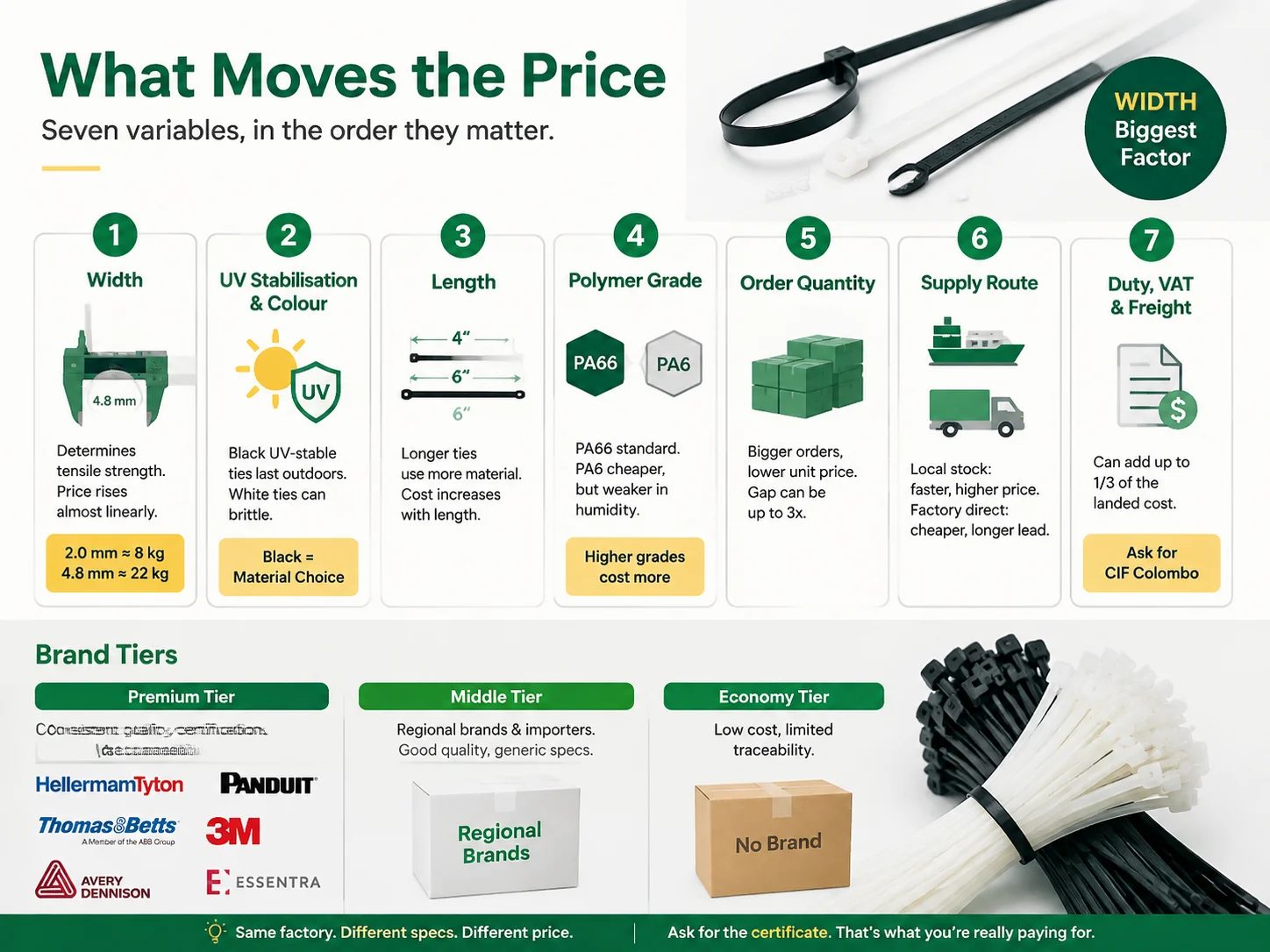
Seven elements, which should be in a specific order.
- Width, which is equivalent to the tensile strength. This is the most significant single factor and the most common mistake made by the purchasers. A 2.0 mm tie and a 4.8 mm tie look the same when placed on a table, but they actually differ threefold in terms of prices, because the second one has a load of about 22 kg, while the first one takes only 8 kg. Thus, the price depends on the width almost linearly. The full dimensional picture, including the 2.5 mm and 9 mm steps that sit in between, is in the guide to cable tie dimensions.
- UV stabilization and color. Natural white nylon offers negligible UV protection and Sri Lanka’s weather is tough on this material. Black carbon black-stabilized PA66 can remain outside for many years while white fades in a season or two at most. If a tie is to be used outside then color becomes a material choice, not just an artistic one. The difference in cost between black and white ties is low while costs incurred from a wrong decision are much higher.
- Length. At 2.0 mm a change from 4 inches to 6 inches is LKR 15 per hundred. On a 4.8 tie it is more expensive due to the increased use of material.
- Polymer grade. The normal polymer used is PA66, the cheaper alternative being PA6 which does absorb moisture leading to loss of strength in high humidity. At more than 85 °C or when using in a hot vehicle or tropical factory a more expensive grade such as PA46 or a copolymer is required.
- Order quantity. Buying ten thousand pieces is not the same as buying one hundred. Factories measure prices per piece when delivering large quantities and per carton when selling to final buyers. In many cases the difference is threefold. Asking for tie prices will not give correct information unless it is clear how many pieces are bought.
- Supply route. Buying ties locally in Colombo means paying the distributor and getting the ties within the same week. Purchasing them from the factory means getting them at lower price but waiting for four to six weeks. Both options can be followed but one should not expect to get the same price for both.
- Taxes and charges. These do not depend on the kind of the tie but rather on the delivery route.
What brand does to the price
The brands belonging to this category can be divided into three tiers. The gap among those tiers is much larger than what people think.
The first level is composed of brands like HellermannTyton, Panduit, Thomas & Betts, 3M, Avery Dennison, and Essentra. By using these brands, you are paying for the guaranteed tensile strength rating, a batch certificate, and a UL 62275 certificate.On a hospital, a datacentre or an export assembly line that certainty is worth paying for, and a published regional price comparison across this tier is in the branded tie price review.
The second level in the hierarchy consists of regional brand firms and importers that purchase from the same manufacturing companies and repackage products again. Prices on this tier are positioned between the factory-direct and premium levels. Additionally, specifications here are often standard, without certification.
At the lowest level you can find unknown manufacturing without the possibility of batch tracing. It is inexpensive and can do for any one-time bundling process performed in a workshop, but is not suitable for anything requiring confirmation in an audit.
One important thing is that one factory might produce goods for a range of companies in China, and the only difference comes from the composite they are using, testing of their batch and the documents accompanying their shipment away from factory. This is why a quote from the factory cannot match the retail price quoted by its distributor.
Where buying direct from a factory changes the arithmetic
As IGOTO produces its products and does not act as a distributor, the pricing structure is different. With no local inventory component, no agent commissions, and no relabeling, the quoted price is considerably below local distributor prices and even less in subsequent orders when the cost of tooling is absorbed.
The relevant category here depends on volume and specifications: contract electrical engineers, panel builders, OEMs, and distributors that offer private-label programs. The factory is looking for the yearly volume, technical specifications, and the delivery schedule. The manufacturing side of that is set out in how a nylon cable tie factory is set up.
What a fair price looks like
Much like decimal points, these three rules will remove almost all miscommunication.
- Compare in terms of actual width. If one quote states 2.0 mm and another refers to a requirement in terms of 4.8 mm, you aren’t negotiating the price. You are identifying a specification discrepancy, which is the most common problem with cable tie quotations.
- Make sure you are comparing landed prices and not quotes with ex-works pricing. The reason is that if you are quoting according to two different Incoterms, it makes no sense comparing them as different prices.
- Compare per 100 pieces with the specifications clearly stated. Simply stating nylon tie with 100 pcs is not sufficient. Proper specification should say something like PA66, width 4.8 mm, loop tensile strength of minimum 22 kg, black UV-stabilised nylon, length equal to 200 mm, pack size of 100 pcs.
Black versus white is where specifications go wrong most often in this market, and the cost of the mistake is set out in the black zip tie guide covering UV resistance, sizes, strength and cost. In case you discover a price that is more than about 50% lower than the actual price for the product with the same specifications, the cost advantage is not with respect to price. The saving is actually in the time of shipment, reliability of the next supply, or in the certificate you did not need.
FAQ
How much do nylon cable ties cost?
In the factory, a regular 4.8 mm PA66 fastener sold in bulk is around US$ 0.03 to US$ 0.05 per unit. For UV-stabilized, flame-retardant, low-temperature, or specialized types, a price of around US$ 0.10 to US$ 0.50 is expected. Anything beyond that is related to logistics, duties, and delivery.
How much do ties cost in Sri Lanka?
Authentic local wholesale prices indicate LKR 120 for a 100-pack of four-inch white nylon 2.0 mm ties and LKR 135 for the six-inch size which means prices are about LKR 1.20 and LKR 1.35 respectively. The price of heavier 4.8 mm black UV-resistant nylon is approximately two to three times greater than that while heavy-duty ones and stainless-steel ones are priced per unit.
How much do cable ties cost?
The width and grade of the tie affects its price. A light tie weighing 2.0 mm and a consignment tie of 7.5 mm can be priced very differently. Hence you can see that most of the differences can be accounted for by the material. First, you measure the width of the ties, and you will be able to compare their prices by other criteria.
What is the price of cable in Sri Lanka?
Normally, when the question above is raised, it refers to electric wire rather than cable ties, and the two says price different things. The price of copper wire will vary in line with the copper price for Sri Lanka, plus a local duty and VAT of 18 percent, as local manufacturing and import parity fluctuate, but nothing to do with nylon resin pricing. As for tie prices, the two prices mentioned above would be your best options.
References
- Bulko.lk — Sri Lankan B2B wholesaler, published cable tie pack pricing in LKR
- Rovenka — cable tie and cable management supplier quoting EXW prices in LKR
- HellermannTyton — PA66 tie materials, tensile grades and UV stabilisation data
- Panduit — cable tie specifications and installation tension guidance
- UL Solutions — UL 62275, the cable tie product standard for construction and performance
- UL Solutions — UL 62275 and the component recognition programme behind batch traceability
Conclusion
The wholesale prices of items in Sri Lanka are as follows. The bulk price of average nylon ties is between LKR 1.20 – 1.35. Once you go above that range, many variables begin to apply to the price of your items. For example, the width of the tie, UV stabilization, the volume of the order, and the number of people handling the ties before reaching the retailer are all factors affecting price. Therefore, the pricing of these items is based on specifications rather than brand names, which means you will want to include the polymer type, width, length, colour, tensile strength rating, and the number of units requested when asking for freight pricing for CIF-Colombo specifications based on actual historical data collected.


