





How to Choose and Install Air Duct Zip Ties on Flex Duct
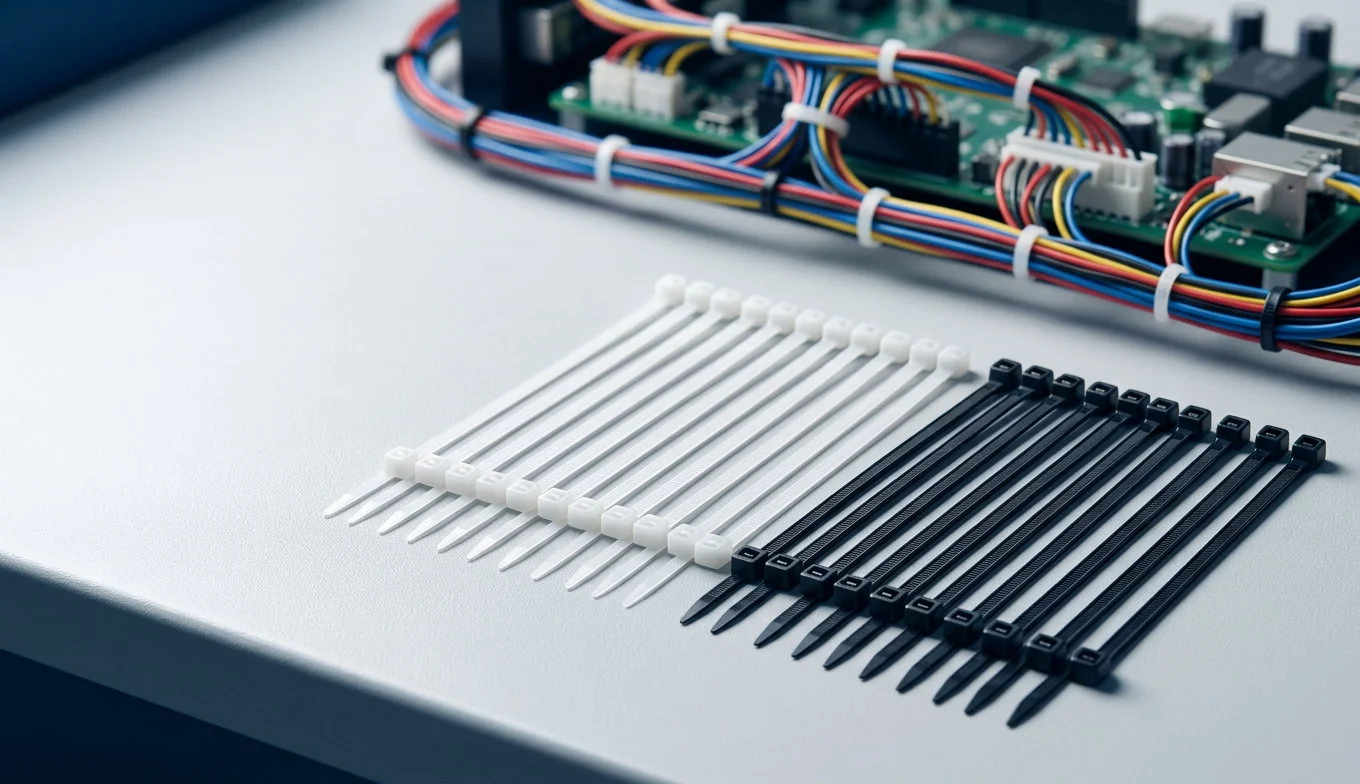
Flexible duct is a ducting material that can transport conditioned air from a trunk line to register but where the ducting connects on either end, the problem may lie. The warm air moves to the attic, crawl space, or ceiling cavity whenever the inner core comes loose on the metal collar and the room being served by the entire duct run never gets heated or cooled. Air duct zip ties serve this purpose; air duct zip ties are long nylon strips that wrap around the duct core and jacket to secure it to the collar, splice sleeve, or fitting. These ties look like large cable ties, but their form and function is different. This guide explains what they are, what their size should be, how to install zip ties, why they so often fail the inspection and how they compare to metal clamps.
Air duct zip ties, which are marketed as HVAC duct straps or duct tie wraps, are long non-metallic clamps, usually between 24 and 48 inches in length, so that maximum use is made of flexible ducts to keep warm or cool air moving efficiently. In the USA, the mechanical and building codes state that non-metallic fasteners are to be used on flexible ducts in order to comply with certification UL 181B. The work of air duct zip ties is to produce a mechanically tight joint. They are not used as hangers and they do not seal the joint by themselves and, therefore, normal nylon cable measure with only UL 94 code is insufficient.
What Is Air Duct Zip Tie?
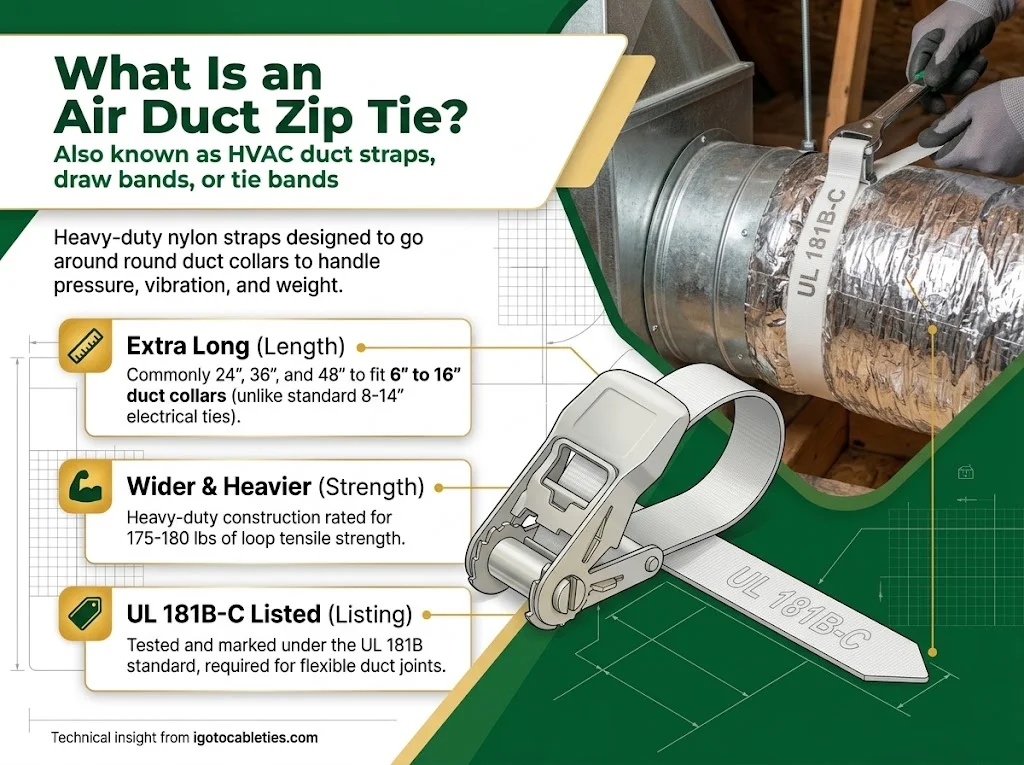
In the trade of HVAC there are few terminologies used for these products, which include duct strap, duct strap for HVAC, draw bands, tie bands, duct tie wraps etc. All of the terminologies mean the same i.e., a nylon strap of just one part and with one ratchet head which is long enough to go around a round duct collar and strong enough to hold the duct through pressure, vibration and weights of run.
In comparison to a common cable tie, a duct strap is different in three practical ways:
Length- Common lengths are 24 inches, 36 inches and 48 inches, since they have to go around a collar which ranges between 6 inches and 16 inches. Regular electrical tie ranges between 8 to 14 inches.
Strength and width- Duct straps are wider and heavier tie types. The 36 inch store brand duct strap is rated around 175-180 pounds loop.
Listing- The items that are sold for flex duct connections are tested under the UL 181B standard for closure systems and marked as 181B-C. Many have been tested for use in spaces of air handling.
Thus, when anybody searches for HVAC duct zip ties he/she most probably needs not just an ordinary long zip tie but a listed product that is acceptable by an inspector for flex duct joint.
Where Zip Ties Are Used on Flexible Air Ducts
Flexible insulated duct is composed of three components: thin internal core, a plastic film wound around a wire helix; a layer of insulation; and an outside vapor coat. The duct parts must be joined together at every connection, so the installer removes the vapor coat and insulation, binds the core together, and then brings back the coat and attaches it. As a result, the straps can be seen at three different places.
| Location | What the strap does | Typical requirement |
|---|---|---|
| Inner core to collar | Holds the core on a beaded collar so it cannot pull off | Core sealed with listed tape or mastic, then a 181B-C strap or metal clamp placed past the bead |
| Outer jacket to collar | Closes the vapor jacket over the insulation to stop condensation | Listed tape, a strap, or both, depending on the manufacturer’s instructions |
| Core-to-core splice | Joins two duct sections on a metal sleeve | Sleeve of at least 4 inches, cores taped, then a strap on each side past the beads |
| Hanging the duct | Not a strap job | Support material at least 1.5 inches wide, spaced per the manufacturer and local code |
The final knot is the one most frequently performed incorrectly. A thin tie looped around a flexible duct and suspended from a beam puts all weight on only one tiny spot, making it curb the contents and block the air flow. According to the flexible duct installation standards, it is necessary to use support straps which are at least 1.5 inches wide in order to make duct rest on an even surface.
What Size Zip Ties Are Required for Air Ducts?
The size of the duct is given according to the nominal inner size of the center, and the collar which makes the strap can be of the same nominal diameter. There is a difference in what the strap wraps, however, as it wraps the outside part of the core while it rests on the collar, and on the insulation it wraps the full jacket diameter, which can be larger than the nominal diameter of the duct. Here are the four parameters you have to pay attention to while choosing the right length:
The diameter of the duct in inches like 6, 8 or 10 inches.
The fastening circumference or the perimeter of the duct in the place where the strap actually sits.
The length of the strap or its entire length from the tip up to the head.
The maximum diameter of the bundle which is the maximum diameter of the round objects that the zip tie can fix.
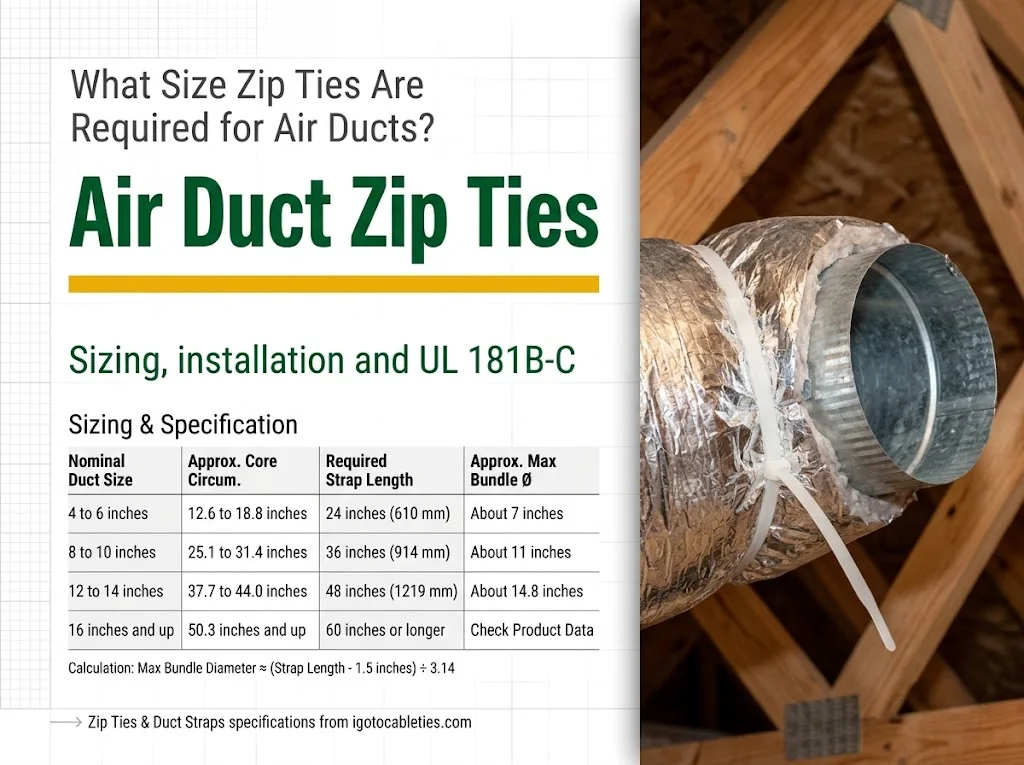
The most crucial measurement to consider is the maximum diameter of the bundle. For instance, one of the models of duct straps, which has got the length of 36 inches, has been said to have the maximum diameter of the bundle equal to about 11 inches. To get the estimate for any tie, you have to perform the following steps: subtract approximately 1.5 inches for the tail and the head of the tie from its length; and divide the result by 3.14. The thicker the strap, the more allowance you may need, though. Our tie wraps sizes guide explains the same circumference method for ordinary cable bundles.
| Nominal duct size | Approximate core circumference | Strap length for the core | Approximate maximum diameter of that strap |
|---|---|---|---|
| 4 to 6 inches | 12.6 to 18.8 inches | 24 inches | About 7 inches |
| 8 to 10 inches | 25.1 to 31.4 inches | 36 inches | About 11 inches |
| 12 to 14 inches | 37.7 to 44.0 inches | 48 inches | About 14.8 inches |
| 16 inches and up | 50.3 inches and up | 60 inches or longer | Check the product data |
These are the starting points for your central connection. Since most jacket connections need the next size larger, measure the insulated duct with a tape before ordering. Contractors usually carry 36-inch duct zip ties on hand as the common size for branch runs and keep 48-inch straps on their trucks for larger supply and return ducts. The longer the strap, however, does not render it automatically stronger. The strength derives from getting the cross-section of the strap and the material right. So compare the material strengths in terms of the tensile rating, rather than future length.
Steps for Installing Zip Ties on Flexible Ductwork
The following steps work with the connection instructions given by most manufacturers of flexible ducts. As these may vary for different makes of ducts, always consult the manufacturer’s instructions that come with the ducts first. Below is how to connect the flexible duct and collar fittings according to what most technicians do when they are asked how to install flexible ducts.
1. Use a pair of scissors to cut the duct straight. Cut through the insulating jacket, insulation, and the core and then clip the wire coils using the wire cutters. If not cut properly, there will be gaps at the joints.
2. Pull back the insulating jacket and foil to expose about 6 inches of the core.
3. Slide the core over the collar making it reach more than an inch beyond the bead. The bead is the bump in the ring preventing the strap from slipping out of place.
4. Seal the core to the collar by wrapping it at least two times with duct tape having UL 181B label, or using mastic having UL 181B label.
5. Place one strap over the core and the inner layer of tape on the other side of the bead and pull it tightly.
6. Pull the insulating jacket over the joint and then secure the jacket using either duct tape or the second strap or by both.
7. Pull the flexible duct until it stretches fully and fasten it in place before it bends for the first time.
The proper fastening of the joints is the key to effective installation. If you only pull the strap by hand, you may not get it tight enough, and the core may slip over the bead while the system is in operation. The NREL standards recommend the use of fastening tool for connecting the flexible duct and collar fittings. It pulls the strap to the set pressure and cuts off the free end of the strap. Our article on how to use a zip tie gun explains how tension and cut-off settings work.
It is important to position the strap behind the bead, so it does not lay on top of the bead or even ahead of it. This is due to the fact that if the strap is inappropriately placed on the bead side, the strap can slip off the collar at the first pull or pressurization of the system.
UL 181B-C vs Regular Nylon Zip Ties
This is the part of the topic that separates a passed inspection from a failed one. UL 181B covers three types of closure product for flexible air ducts and air connectors, and each carries its own mark.
| Mark | Product type | Used for |
|---|---|---|
| UL 181B-C | Nonmetallic mechanical fasteners (straps and clamps) | Holding flex duct cores and jackets on collars and sleeves |
| UL 181B-FX | Pressure-sensitive tape | Sealing flex duct joints |
| UL 181B-M | Mastic | Sealing flex duct joints |
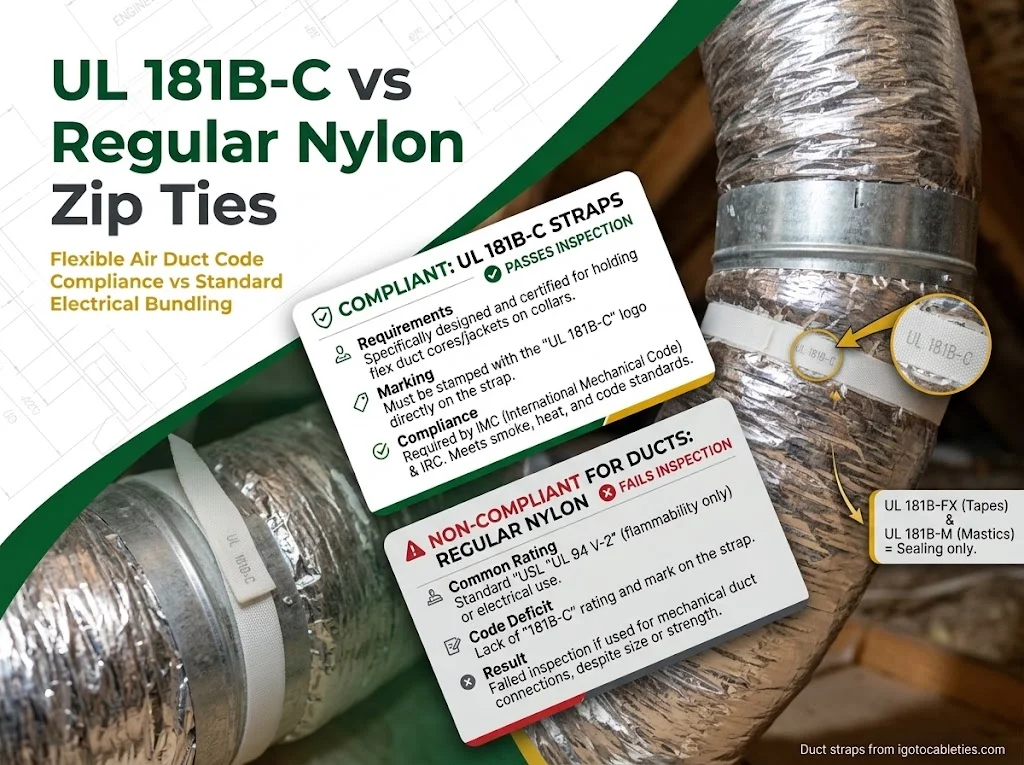
| UL 94 V-2 | Flammability rating of the plastic material | Describes how the resin burns. It is not a duct closure listing. |
The International Mechanical Code and the International Residential Code stipulate that mechanical fasteners that are utilized in conjunction with flexible nonmetallic air ducts must comply with UL 181B. They must also be marked 181B-C. Most cable ties made out of nylon (including a number of industrial-grade options) are UL listed for electrical bundling and have a UL 94 V-2 rating for flammability. This listing does not indicate compliance with respect to duct connections. Therefore when a contractor or a buyer looks for UL 181B-C cable ties, markings on the product are of foremost importance rather than the cable ties’ length or strength.
Additional restrictions arise from the manufacturers’ specifications. There are nonmetallic clamps that can hold duct runs only up to 6 water gauge inches of positive pressure and require the use of beaded sheet metal fittings when applied. This covers all major residential and light commercial supply runs, although it should be confirmed in cases of systems designed to operate at higher pressure.
Plenums are another matter. In case ducting runs through a return-air plenum, materials be exposed (that includes cable ties) have to comply with smoke and heat release requirements. he nature of the test applied is different from UL 181B, and the details can be found in our guide devoted to plenum rated cable ties .
Cable ties that are long and strong enough for duct connections do not meet code unless they are UL 181B listed and marked 181B-C.
Zip Ties vs Metal Clamps for HVAC Ducts
Most flex duct connections can be accomplished with either a non-metal strap or a metal band clamp. The flex duct instructions indicate there’s a choice of half-an-inch-wide aluminum, stainless steel, and galvanized clamps, and that collar beads are optional when using a worm gear metal clamp.
| Factor | Nylon duct strap | Metal worm-gear clamp |
|---|---|---|
| Speed | Very fast with a tensioning tool | Slower, must be screwed down |
| Cost per joint | Low | Higher |
| Bead needed on collar | Yes | Usually optional |
| Reusable | No, it is cut off | Yes |
| Pressure limit | Set by the listing, commonly 6 in. w.g. | Set by the duct manufacturer |
| Risk of damage | Low, smooth edges | Sharp band edges can cut the core if overtightened |
Typically, a typical nylon strap on a beaded collar is the quickest and most preferred option among a wide range of residential branch runs. If there are no beads on the collar, if a joint must be separated for maintenance, or if the specifications dictate, then metal clamps become the preferred option.
Reason Flexible Duct Loses its Collar
Normally when a duct comes loose from a collar, it is due to an installation error, not because of failure of the strap. Here are some common reasons of failure:
– The core of the duct is not pushed into the collar enough, and the strap is resting on the collar or on the front of the bell.
– The strap was tightened by hand and not pulled to its maximum tensile strength.
– The duct has been fitted too short, and under tension is constantly pulling away from the collar.
– Support is located too far from the collar and so the weight of the flex duct causes the core to come off the fitting. Some guidelines support additional support placed in between the collar and first bend.
– Strap is not designed for used and stretches or fractures under temperature and load.
– Clamp used has been tightened too much and damaged the core of the duct itself.
Our article on heat stabilized nylon zip ties explains how those ratings work. Rooftop units and exposed duct runs add UV, which is why exterior work calls for UV resistant cable ties rather than natural nylon.
Choosing Air Duct Zip Ties for HVAC Projects
The same checklist should be followed whether you buy in bulk for one job or for several jobs.
1. Listing. When installing flex duct connections in areas where the IRC or IMC codes are applicable, make sure that the connection is marked with a 181B-C code. In addition, if the duct passes through an air-handling area, ensure that it has a plenum label as well.
2. Length. Measure the maximum width of the bundle considering the insulation jacket.
3. Tensile strength. In the case of loop tensile tests, it is more important to compare the values than to measure the distance.
4. Environment. Use heat-stabilized materials for hot attics and UV-stabilized black materials for anything under the sun.
5. Tooling. Ensure that the tensioning tool selected is compatible with the strap width.
6. Local laws. Outside of the USA, nations from the Gulf region and the project specifications determine which code must be applicable, implying that it is important to verify with the job specification so that you do not assume that UL 181B is required.
Not every tie on an HVAC job goes on a duct, of course. Around air handlers and condensing units, ordinary nylon ties still bundle thermostat cable, secure condensate lines and tidy control wiring, and IGOTO’s medium size cable ties up to 20 inches cover most of that work. Distributors and HVAC suppliers looking for private-label flex duct zip ties in longer lengths can send the target length, width, tensile strength and required listings through our OEM cable tie service, and the team will confirm which specifications and certifications can be met before quoting.
Frequently Asked Questions
Can I use regular zip ties on air ducts?
A regular long tie can be used physically to tie the duct. However, for flex duct connections in the areas that have adopted IRC or IMC, the fastener must comply with UL 181B and is labeled as 181B-C. An unapproved tie might not be satisfactory in inspections despite looking good.
Can you hang ductwork with zip ties?
No. Flex duct supports must be at least 1.5 inches wide so they do not pinch the duct. A narrow tie used as a hanger compresses the core and restricts airflow.
What size zip tie do I need for 8 inch flex duct?
A 36-inch strap is the usual choice for the core of 8-inch duct. The insulated jacket may need a longer strap, so measure the outside of the duct first.
Do I need tape and a zip tie on a flex duct connection?
Typically yes. Manufacturer instructions call for sealing the core with listed tape or mastic and then mechanically fastening it with a strap or clamp. The tape seals the joint and the strap holds it.
How tight should a duct strap be?
Tight enough that the core cannot rotate or slide on the collar, which in practice means tightening it with a tensioning tool rather than by hand. Stop before the strap distorts the collar.
References
- NREL Standard Work Specifications, Mechanical Fastening
- NC Office of State Fire Marshal, Support of Flexible Factory-Made Air Duct
- Building America Solution Center, ADC Flexible Duct Performance and Installation Standards
- ACHR News, The Right Way to Install Flex Ducts
- UL 181B, Closure Systems for Use With Flexible Air Ducts and Air Connectors
- Wikipedia, Duct (flow)
Conclusion
To make good flex duct connections one needs four items: a beaded collar, a core that is pushed past the beaded collar and sealed with proper tape or mastic, a strap that is tightened with the proper tool, and a duct that is properly supported so it is not stretched. Air duct zip ties make this connection cheap and fast, but only when they have been selected so that they are long enough, have enough strength and are approved. Calculate the size from the largest bundle diameter and check for the 181B-C mark in case USA codes are required, this way ensures a proper hanging support of the duct and full compliance with the installation requirements as to the clamping method.