




Black Zip Ties: A Complete Guide to UV Resistance, Sizes, Strength and Cost
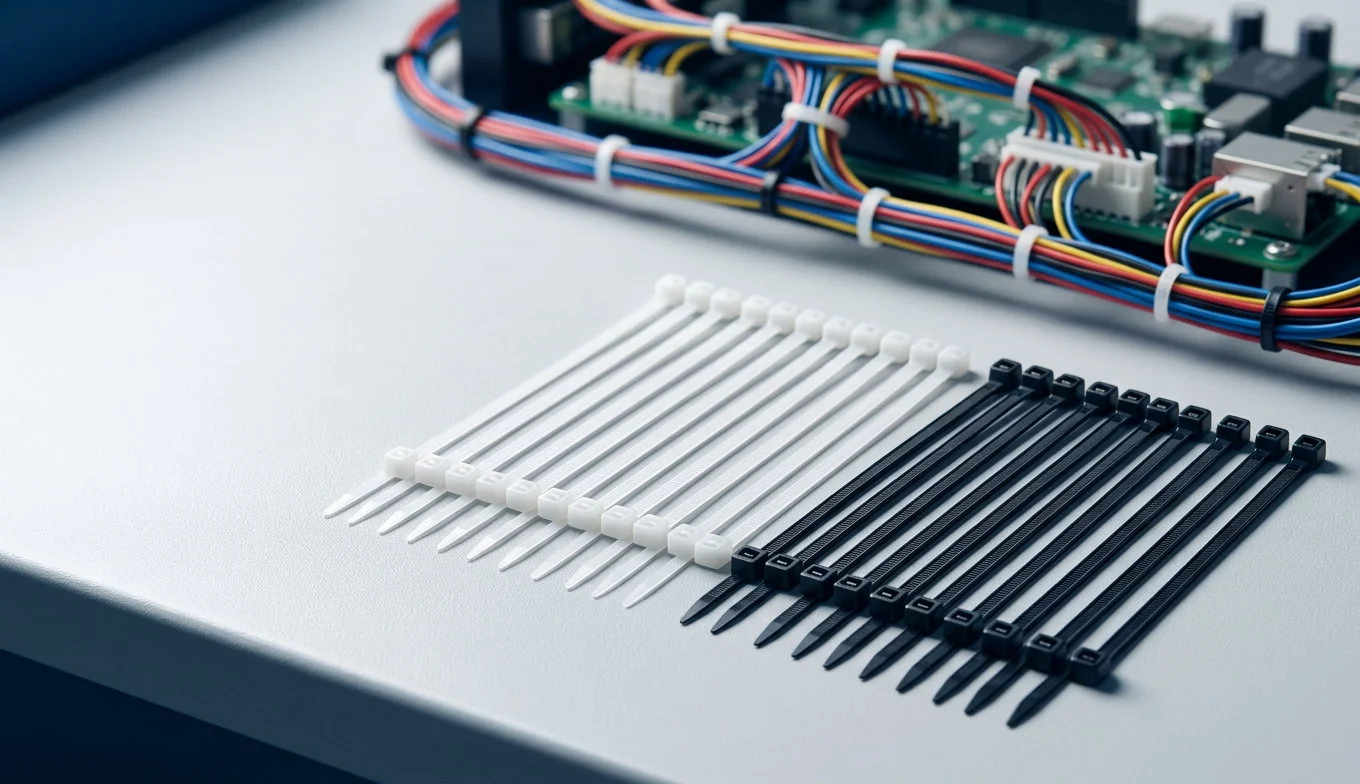
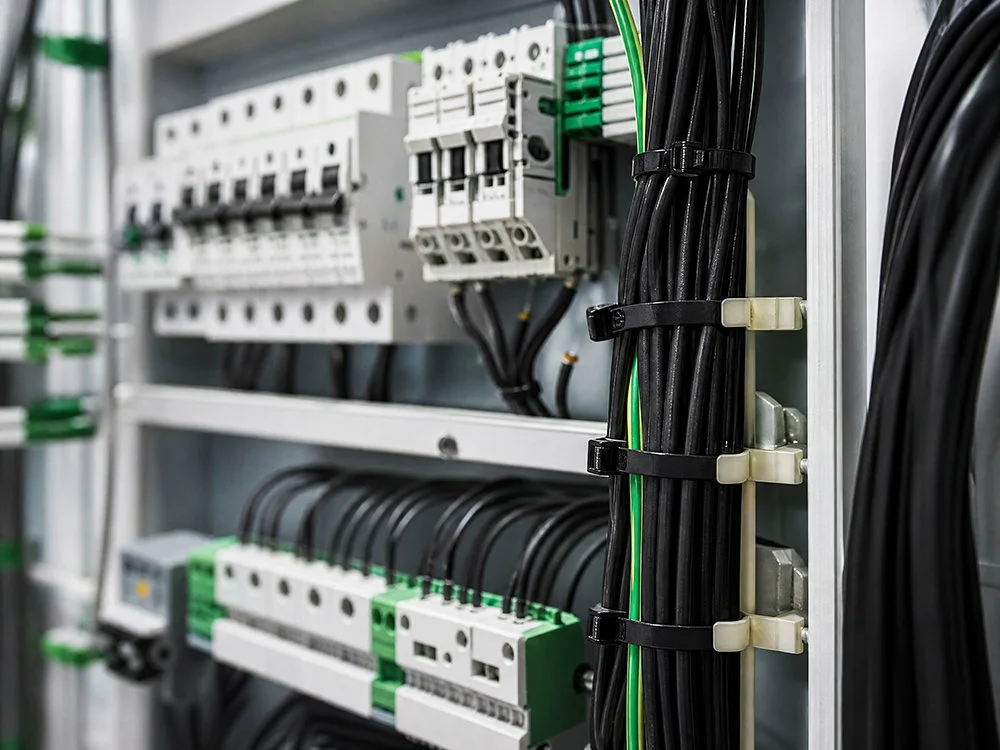
Black zip ties are the most common color used because black zip ties can be found anywhere. This trend can be seen in places like the shops nearby, on service cars of electricians or even buildings with solar panels. The explanation of why black is the favored color has nothing to do with its attractiveness. Black is the best color for nylon zip ties because most of the installations happen outdoors and in the presence of windows. The intention of this article is to make the reader aware of the peculiarities of black nylon zip ties and white nylon zip ties, their manufacturing process, size variety, maximum loads, and pricing, as well as names of manufacturers of nylon zip ties.
At the most basic level, all nylon black cable ties consist of nylon 6/6 (PA66) and carbon black pigment which makes-up almost 2% of its total weight from it. Carbon black is helpful as it makes nylon black from falling victim of UV light thanks to its property of absorbing UV rays. Normal nylon ties have a life span of about 3-24 months excluding any exposure to UV light. A regular black nylon tie with UL stabiliser can last more than 5 to 10 years when exposed to sunlight. The width of cables used applies to both black and white cable ties, usually from 2.5 mm to 12 mm. The strength of cable ties can vary from 18 lbs to 250 lbs but some cable types have even more strength. The temperature range of cable ties is from -40 C to 85 C, making them perfect for any weather condition. The prices of black cable ties are $5 for 100 cable ties to $25 for more than 100 cable ties depending on their specifications.

Why Black Became the Default Colour
Unlike decoration, color in cable ties works like a functional signal much like the use of colors in wires.
The common idea in this color coding system works generally as follows: black signifies science and engineering work such as outdoors work with UV and industrial applications, white indicates common indoor application, red, blue, green, and yellow are used for coding and identification in harnesses and panels, and clear or white is used where visibility of the tie is not required. There are some conventions introduced in some industries, such as the National Electrical Code in the USA, which makes the use of specific colors for branch circuits and conductors. Therefore, the assumption that if there is a color code for a conduit, it has to follow the same rule is absolutely wrong.
Black color has become a default for the outdoors mostly for practical reasons. Cable ties’ usage is mainly limited to applications where the usefulness is determined by the sustainability of the employed tie, especially because of the presence of sunlight which leads to failure of natural nylon due to the changes of its make.
There’s a full breakdown of what each colour typically signals in this piece on what the different cable tie colours mean in practice, including the ones that exist purely for identification rather than for performance. For now, the short version is that black is the only common colour that both performs outdoors and stays available at commodity prices.
Carbon Black: Why Black Zip Ties Resist UV
The mechanism clarifies why black isn’t necessarily the same as UV resistant.
Ultraviolet light has enough energy to disrupt carbon-carbon bonds in the polymer. In the case of nylon, this causes a whole series of events to take place: the polymer chains get broken, thus losing their tensile strength, becoming brittle, and failing under loads they used to support easily. This process is accelerated by sunlight, heat, moisture, and oxygen.
Carbon black attracts ultraviolet rays and radials. It traps UV radiation thus converting it to heat rather than allowing it to initiate destructive processes like photochemical reactions. Carbon black also traps free radicals which otherwise would be responsible for the continuation of the degrading process. It also has the important property of being opaque, thus it protects the material not only on the surface but also beneath it.
However, there is the problem of dosage and dispersion. A properly modified black cable tie contains approximately 2% carbon black in weight, widely dispersed throughout the polymer. On the other hand, a black tie that is black due to the presence of some dye won’t be protected at all. This is the main trap encountered by buyers who see two similar products on the shelf but which differ five times in their service life.
| Tie type | Typical outdoor life | What’s going on |
|---|---|---|
| Natural / white nylon (PA66) | Months to about 2 years | No UV stabilisation; surface chalking, then embrittlement |
| Coloured nylon (red, blue, green, yellow) | Similar to natural, sometimes slightly better | Pigment may offer limited protection; generally not UV grades |
| Black nylon, UV stabilised (PA66 + carbon black) | 5–10 years | Carbon black absorbs UV; the standard outdoor choice |
| Carbon black PA66, weathered-grade formulations | 10+ years in accelerated ageing tests | Higher stabiliser package, tighter dispersion control |
| Weather-resistant specialty grades (e.g. PA66W) | Up to about 20 years | Premium polymer and additive system; higher price |
| Stainless steel or coated stainless ties | Decades | No polymer to degrade; used for extreme exposure |
When requesting an outdoor installation, the question to ask is not “is it black?” But rather “what is the UV grade and does it hold up under testing?” This is simply because the lifespan difference between the decorated and the properly treated product is a life span of an installation of cabling of two years versus ten years. There’s more detail on how UV resistance is actually specified and tested in this article on whether zip ties are UV resistant and how to tell.
What Black Zip Ties Are Made Of
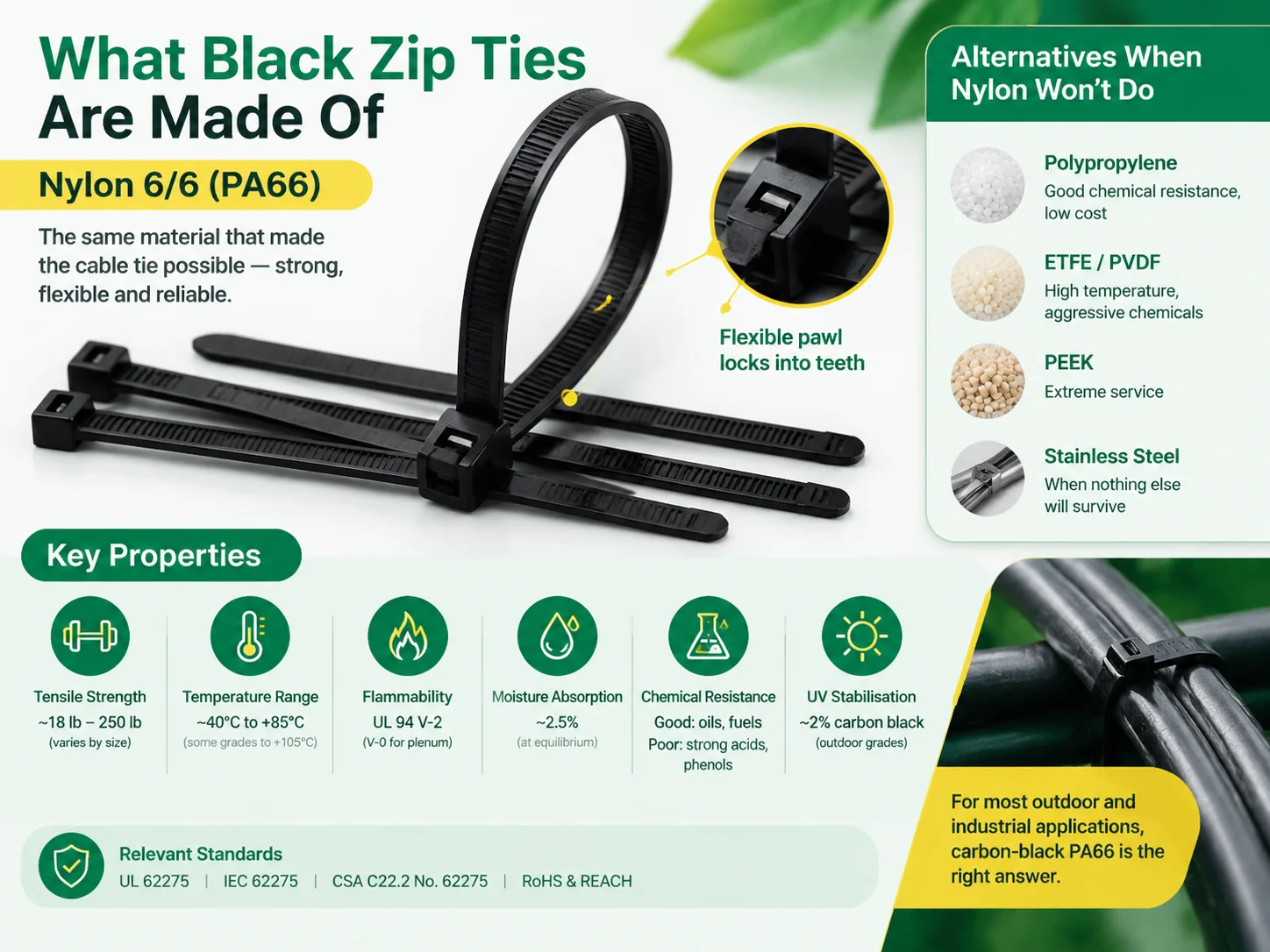
Nearly every black cable tie in use nowadays is made from nylon 6/6, abbreviated as PA66 or polyamide 66. This material is the basis for the cable-tie industry. It can be molded suitably with a flexible pawl, it is very strong and stiff, it handles heat quite well, and it does not creep much under load.
Here is what you should consider while comparing technical documents.
- Tensile strength. Ranges between 18 lb for small 2.5 mm cable ties and 250 lb for heavy-duty 12 mm cable ties. Stainless steel will be much stronger.
- Temperature range. From −40°C to +85°C for ordinary PA66. Some grades are able to withstand temperatures of +105°C; however, at temperatures below −40°C nylon becomes brittle and requires caution during installation.
- Flammability. Common system nylon cable ties can be classified as UL 94 V-2. As far as plenum areas and air-handling systems are concerned, there are special regulations that stipulate UL 94 V-0 classification or a separate plenum classification.
- Moisture absorption. Nylon absorbs up to 2.5% of water in chemical state and this allows increased flexibility and increased size of the product in humid weather. This property is quite normal and does not harm the cable tie.
- Chemical resistance. Good against moist and oils and, on the contrary, bad against harsh acids and phenol. Alkaline environments poison the nylon material.
- UV stabilization. Carbon black is used in the production of nylon ties designed for outdoor use.
- Relevant standards. UL 62275 is the UML type cable tie standard as well as IEC 62275 and CSA C22.2 No. 62275.
Of course, there are other materials that can replace nylon in some situations. For example, polypropylene has an inclination to be used in low-cost products that need chemical resistance; ETFE and PVDF are used for high-temperature and severe chemical environments; PEEK can withstand tough conditions; while stainless steel cables are used where nothing can survive. However, for 90% of outdoor and building applications carbon black is the answer to all the questions.
Sizes, and What They Actually Hold
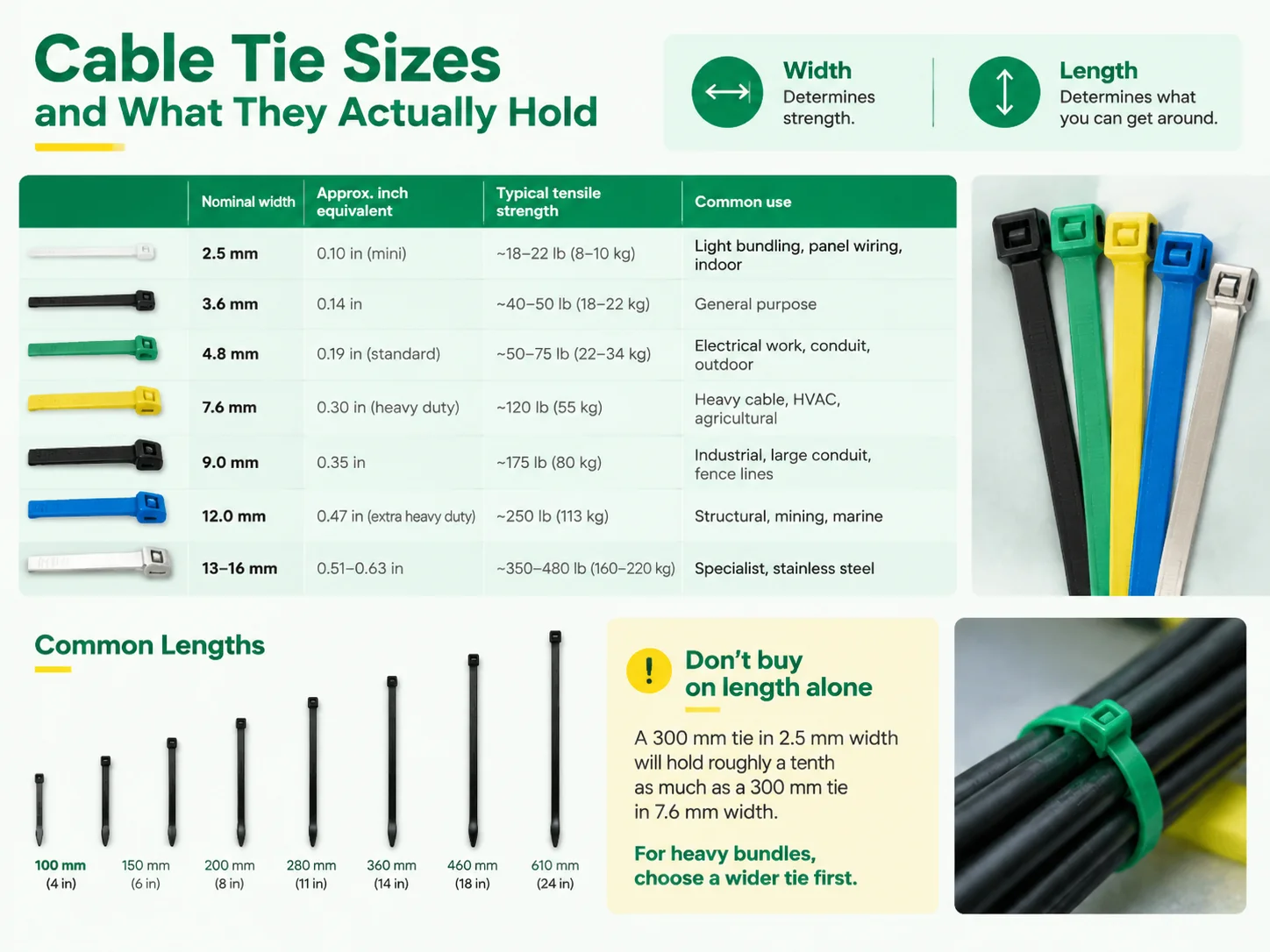
The sizing of cable ties takes into account two dimensions: width and length — both dimensions are important but for different reasons. Width is directly linked to strength. Length determines circumferences.
Most of the world expresses width in millimetres while North Americans use inches.
| Nominal width | Approx. inch equivalent | Typical tensile strength | Common use |
|---|---|---|---|
| 2.5 mm | 0.10 in (mini) | ~18–22 lb (8–10 kg) | Light cable bundling, panel wiring, indoor |
| 3.6 mm | 0.14 in | ~40–50 lb (18–22 kg) | General purpose, the most common size sold |
| 4.8 mm | 0.19 in (standard) | ~50–75 lb (22–34 kg) | Electrical work, conduit, general outdoor |
| 7.6 mm | 0.30 in (heavy duty) | ~120 lb (55 kg) | Heavy cable, HVAC, agricultural, structural light duty |
| 9.0 mm | 0.35 in | ~175 lb (80 kg) | Heavy industrial, large conduit, fence lines |
| 12.0 mm | 0.47 in (extra heavy duty) | ~250 lb (113 kg) | Structural, mining, marine, extreme duty |
| 13–16 mm | 0.51–0.63 in | ~350–480 lb (160–220 kg) | Specialist and stainless-steel formats |
Measurements are generally expressed in terms of either millimeters or inches and vary from roughly 80 mm to over 1,200 mm, but the practical range is 100 mm to 500 mm. Typical North American measurements are 4 in (100 mm), 6 in (150 mm), 8 in (200 mm), 11 in (280 mm), 14 in (360 mm), 18 in (460 mm), and 24 in (610 mm).
People go wrong in this area when they simply buy according to length. A 300 mm tie in 2.5 mm can wrap around the same bundle as a 300 mm tie in 7.6 mm, but it is going to have a little bit less than a tenth of its holding capacity and quickly serve as the weak link in the chain. If the bundle is on the heavy side, one should look for a greater width before increasing the length. There’s a fuller walkthrough of how to match the two dimensions to the job in this guide to cable tie sizes and how to choose the right dimensions.
How Strong Is a Black Zip Tie, Really?
Tensile strength is determined in the laboratory and can generally be regarded as the result obtained by testing a new tie in all conditions, namely a perfectly straight tie at a temperature of 20 degrees with a defined loop. In practice, however, tests are likely to be conducted under different conditions.
The loop strength of a cable tie is not influenced by its strap, but rather by the mechanism of the tie (the pawl and the first few teeth). In other words, the tension of the loop is stated separately from the tensile strength of the strap. Therefore, the tie fails at the head of the tie much more often than at the middle of the tie.
Environmental factors also have an effect. Those factors include heat, as the heat reduces strength, and nylon loses a considerable portion of its tensile strength as the limit of temperature approaches. The tie is subjected to creep over the months and years while holding in the constant pull of static load. Moreover, sharp edges of the loop cut through the strap. Sun and UV exposure influence the strength as well, as 120 lb tie can retain only 60 lb after 5 years of exposure to sun.
Therefore, it is advisable to apply to this full load only one fourth or one third of the rated tensile strength. This is related to the, first, known effect of UV, temperature, and creep, and second, that rated tensile strength is determined in dry conditions. The full treatment, including how strength is tested and where the numbers come from, is in this article on how strong nylon cable ties actually are.
When you frequently need larger nylon ties where stainless steel or coated steel ties will do. They hold much more, survive for years outdoors, and endure temperatures that would melt polymers. They are also much more expensive and could damage weaker wires in case they are over-tensioned; therefore, this option can be advantageous but not automatic.
What Black Zip Ties Cost
Price often times differs according to thickness, size, specification and amount. The table presented below can be used as a rough tool for planning when it comes to UV-proof black nylon purchase.
| Product | Typical retail (per 100) | Typical wholesale (per 1,000) |
|---|---|---|
| 4 in / 100 mm, 2.5 mm, black UV | $3–$8 | $8–$20 |
| 6 in / 150 mm, 3.6 mm, black UV | $4–$10 | $10–$25 |
| 8 in / 200 mm, 4.8 mm, black UV | $6–$15 | $15–$40 |
| 11 in / 280 mm, 7.6 mm, heavy duty black | $15–$35 | $35–$90 |
| 14–18 in, 9 mm, heavy duty black | $30–$70 | $70–$180 |
| 24 in, 12 mm, extra heavy duty black | $60–$150 | $150–$400 |
| Stainless steel or coated stainless, 12 mm | $60–$250 | $200–$900 |
Three factors which are most impactful for the price formation are the following. The first one is the amount, clearly, as when ordering a bag of 100 items instead of a box of 5,000, we can see a price variation by 2 to 3 times. Next, specification: a true UV-stable, UL-certified strap is more expansive in comparison to an ordinary black strap. Finally, packing: bulk loose-packaged straps cost less than strapped-up isolated bags therefore when arranging the equipment of service vans it is of importance not to forget about.
The most important piece of advice to consider is the fact that it is not a good idea to choose the purchase only based on the price.
Who Makes and Sells Black Zip Ties
Separation of the market into several groups is necessary for the end-user customers.
Global players. Panduit and HellermannTyton are the most well-known names in industry settings and OEM appliances. Another name is Thomas & Betts (an ABB Installation Products company) which is very strong in electrification sales. Gardner Bender and Southwire rule the retail market in North America, while 3M is engaged in industrial MRO. Essentra Components and Advanced Cable Ties operate with OEM accounts and distributors providing a big range of sizes.
Manufacturing. Injected molded parts are used for cable ties production, while a significant fraction of the total volume is made in China and Taiwan. This means that similar products can be produced in one location for different brands, but due to variations in resin specifications, additives, and quality control practices it is practically impossible to say which brand is better because of small effects of these variables.
Buying directly from the factory. In case a customer requires some special size and length or its own branding on the package, or the volumes that cannot be sold through catalogs, it makes sense to purchase from the manufacturer instead of the distributor.The relevant capability to look for is range coverage, UV grade consistency and third-party test reports — and the sort of facility that supplies OEM and own-brand programmes, like this heavy duty cable tie manufacturer, is set up for exactly that pattern of order.
Before making a purchase, ensure that you ask two questions. This concerns the amount of carbon black contained in the compound, as well as availability of the UV ageing test results. Suppliers who can provide correct answers to both questions are selling a true product, while suppliers who cannot answer them only sell a colour.
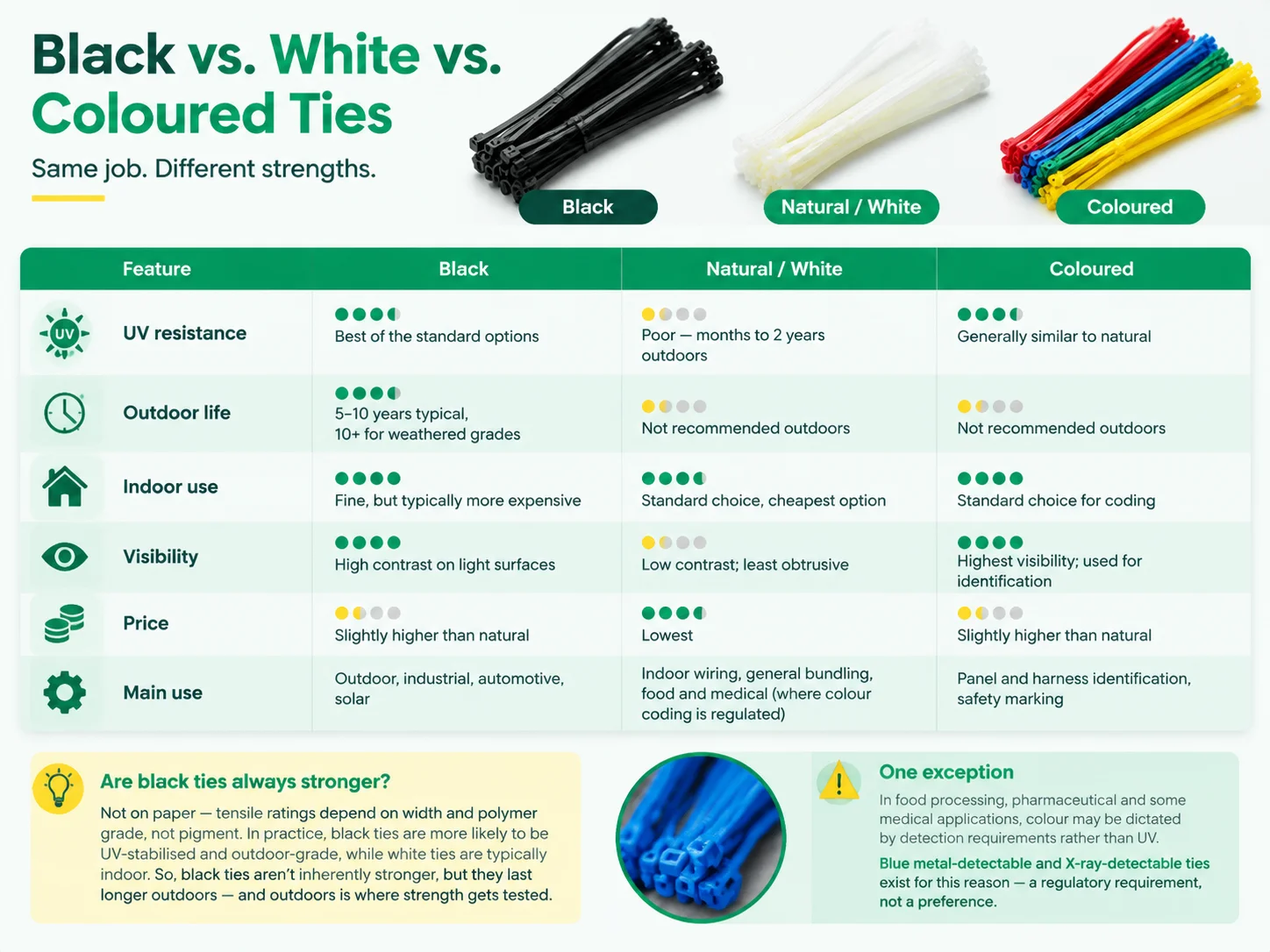
Black vs. White vs. Coloured Ties
Since it’s the question that started all of this, here’s the comparison in one place.
| Black | Natural / white | Coloured | |
|---|---|---|---|
| UV resistance | Best of the standard options | Poor — months to 2 years outdoors | Generally similar to natural |
| Outdoor life | 5–10 years typical, 10+ for weathered grades | Not recommended outdoors | Not recommended outdoors |
| Indoor use | Fine, but typically more expensive | Standard choice, cheapest option | Standard choice for coding |
| Visibility | High contrast on light surfaces | Low contrast; least obtrusive | Highest visibility; used for identification |
| Price | Slightly higher than natural | Lowest | Slightly higher than natural |
| Main use | Outdoor, industrial, automotive, solar | Indoor wiring, general bundling, food and medical where colour coding is regulated | Panel and harness identification, safety marking |
Is black always more durable than white, though? On paper, it isn’t — tensile ratings are dependent on the polymer grade and the width of the tie, not color. In practice, however, your black tie will more often be outdoor-grade and UV-resistant, while your white one will be an ordinary indoor tie. So the truthful answer would be that black ties are not always stronger, but they certainly last much longer when out in the open.
However, note that in the area of food and pharmaceutical processing in some medical applications, tie color choices can depend on detection technologies rather than UV use. Blue metal-detectable and X-ray-detectable ties are available for this reason, and the choice of a blue tie is right even indoors since it is regulated.
Choosing the Right Black Zip Tie
An abbreviated decision series that includes nearly every situation:
- Is it outside or is it exposed to sunlight? If yes, black UV resistant PA66 is the bare minimum. Avoid natural nylon altogether.
What’s the weight of the bundle and will the load be continuous? If yes or heavy, go with a larger width and reduce rated tensile strength down to around 25% at the minimum. - What’s the temperature exposure? Standard PA66 is good from −40C to +85C. Beyond that, high temp grade or stainless steel is needed.
Is there any chemical exposure? Oils and fuels are fine. Strong acids and alkalis, phenols or hot water for longer times are not acceptable — go with polypropylene, ETFE or PVDF. - Is there a fire rating for the area? Plenum or air handling space may require a V-0 instead of the regular V-2 rating.
- Is color used for identification? Make sure to know if there are colors required by your industry or local electrical safety codes before defaulting to black.
- Is it necessary to have certification? If it is electrical installation, check that the product is UL 62275 listed and that it covers the size and material and not only the brand name.
- How easy is access? If you will need scaffolding, a lift or walls opened for replacement, buy the longest lasting option. The tie is the inexpensive part.
FAQ
Are black zip ties better than white?
That would certainly be true if a product was going to be exposed to direct sunlight. Black nylon has carbon black in it, which absorbs UV rays and protects nylon, giving it a life expectancy of 5 to 10 years in the weather and longer for special versions. Raw or white nylon has no protectant in it and tends to break down into dust within just a few months to about 2 years when exposed to direct sunlight. However, inside a building, white works just fine and is usually much less expensive, so there would be no reason to spend money on the black version if there were no UV exposure. One thing black nylon is not is stronger, since its tensile strength is determined by the width of the product and its resin material rather than its color.
Is there a difference between cable ties and zip ties?
No – it is a case of the same item marketed under two different names. “Zip tie” is an American term which refers to the sound the strap produces when made to fit tightly. “Cable tie” is instead what you will find in standards documents, catalogues, and in most parts of the English-speaking world. Examples of regional use include the terms “wire tie”, “zip strip”, and “cable wrap”. If there is a specific specification given by the purchaser, one should use the term “cable tie”, as that is the term used in the standards documents which comply with guidelines.
How long do black zip ties last?
UV stabilised carbon black nylon ties can last between 5 to 10 years if exposed to weathering. The carbon black PA66 grade can withstand the elements for 10 years or more, providing that it is subjected to standard accelerated testing. Under optimal conditions, weather proof grades such as PA66W may last for 20 years. Of course, the actual life of the ties will depend on a number of factors, including their exposure to sun rays (the tie under a solar panel or in permanent shade may last longer than that on a south-facing rooftop) or the temperature fluctuations. A cheap black tie made from common nylon with very little carbon black in it may fail within two or three years no matter what the package says.
What is the strongest zip tie?
The most common tie made of nylon is the 12mm extra heavy-duty tie which has a maximum strength of around 250lb while the specialized ties of 13 to 16mm can reach up to 350lb to 480lb. Anything above this falls under the category of stainless steel ties. Coated stainless steel ties can easily exceed 1000lb and last for many years in the outdoor setting. However, strength doesn’t only depend on the tie used. The lever strength is restricted by the pawl and first few teeth while the atmosphere reduces that strength with time. A tie that has been excessively tightened already lost some strength, therefore for prolonged usage it is best to use about a quarter or a third of the maximum load provided by the manufacturer and to choose the width of the tie beforehand.
Do black zip ties work in cold weather?
Yes, but only to some extent. The regular PA66 tie can withstand temperatures down to -40 °C, however, nylon becomes more brittle at these temperatures, which makes it more prone to breaking at the place of installation. There are two pieces of advice regarding operating in extremely cold conditions: never tighten ties too much and use a tie one size larger if the ties need to bear any force. In conditions lower than -40 °C, or where there are temperature fluctuations, it is advisable to use special nylon or stainless steel clamps.
Can black zip ties be reused?
In a dependable manner. Certain releasable ties come with a lever or small tab allowing to use a pawl without having to cut the strap. Standard black ties are one-off: they have a pawl whose teeth are designed to lock one way only, and if a tie is unfastened, the teeth are damaged meaning that the tie will be very weak when used again. Once a tie has been cut, it can’t be used again at all. If cables have to be re-used repeatedly, opt in favor of releasable ties instead of the black ones.
References
- UL 62275 — Cable ties for electrical installations — the standard governing cable tie performance and type designation
- UL Solutions — certification and listing information for cable management products
- National Electrical Manufacturers Association (NEMA) — electrical equipment standards and industry reference material
- US Department of Energy — guidance on solar and electrical installations where outdoor-rated fasteners are specified
- US Environmental Protection Agency — reference point for material and environmental compliance requirements
Conclusion
The black nylon cable tie’s popularity stems from the fact that carbon black is instrumental in absorbing harmful ultraviolet radiation, thus preserving the polymer’s integrity. The difference between a cable tie that can last ten years and a cable tie that has a shelf life of only one and a half years boils down to approximately 2% carbon black, which is nearly imperceptible.
According to numbers calculated previously, if the black nylon cable ties have gone through this process, their service life outdoors will be from five to ten years, while the weathered cable ties are expected to last over ten years. The maximum operational period of the natural or white cable ties is limited to two years.
The required information may be obtained from the supplier provided that they answer two vital questions: the amount of carbon black in the composition and the results of UV aging tests.


