




What Do Different Color Zip Ties Mean?
Someone has informed you that the color of a zip tie has significance, and you are currently in front of a machinery room or electrical panel trying to determine whether the red tie you are holding is used for alerting someone or just because it is the last color in that box. This is a good question, and you will find that the answer is not as simple as it looks.
Indeed, zip tie color coding is something that exists in various forms. However, it should be noted here that it is rarely a formally documented standard. Hence, it is dependent on several factors, including industry, plant, and sometimes even a shift. In this article, I will show you the most popular conventions, explain which type of coloration truly alters the way a zip tie works rather than just its meaning, and resolve the white vs black strength issue that arises in all discussions of this type.
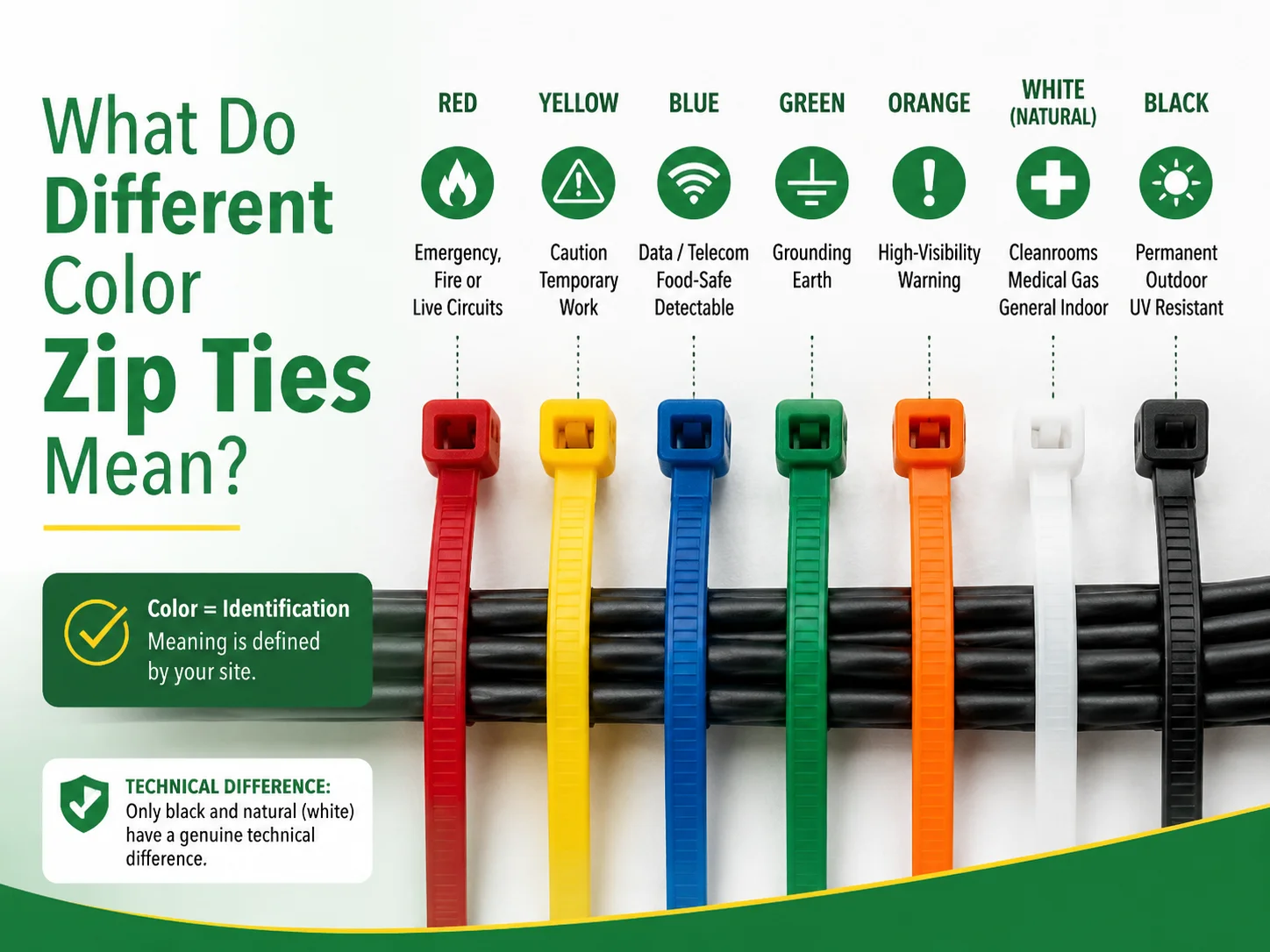
The short answer is that there is no standardistic code to assign color meanings to zip ties in the same way as the NEC does for wire colors. In reality, there are some traditional industry practices, such as, red for emergency, fire or live wires, yellow for caution or temporary work, blue for data and telecom runs, as well as for food-safe detectable purposes, green for grounding, orange for warnings, white for use in clean rooms, medical gases and general indoor use, and black for outdoor installation due to its UV resistance. It can be said that the only technically different colors are black and natural (white) as all others are the means of identification only, which have whatever meaning your job site assigns to them.
First, the Honest Part: No Universal Colour Standard Exists
It is crucial to state this matter carefully since there is a lot of information available on the topic suggesting otherwise. There are no IEC standards, UL standards or IEEE standards to support the argument that green cable ties signify ground. Instead, there are standards that govern the cable tie itself as UL 62275 and IEC 62275 discuss the cable ties for electrical installations in terms of their mechanical strength, temperature rating, flammability, and labeling but not a word is mentioned as to the use of color for identification.
Indeed, everything that pertains in standard specifications is that there is a color-coding of the wire insulation which is where the main confusion originates. According to Article 200.6 of the National Electric Code, a grounded conductor is supposed to be identified by a white or a gray finish, and Article 250.119 states that an equipment grounding conductor must be a green, green with a yellow stripe or bare. Such color coding is legal requirements while the color of a nylon tie is not discussed in any regulations.
Where does this custom of color coding originate from? Partly, it is because of the experience gained by the industry over the years, because of visual management systems that may differ in each plant and eventually because of the fact that cable ties are the most affordable means of labeling something permanently. It is also important to mention the fact that the nylon ties are colored during manufacturing by adding pigment at the mixing stage which is worth noting since the pigment rather than being a cover is used as a filler.If you want the material side of this explained properly, what zip ties are actually made of and how the nylon grades differ is the right background before you go any further.
The Working Colour Conventions by Trade
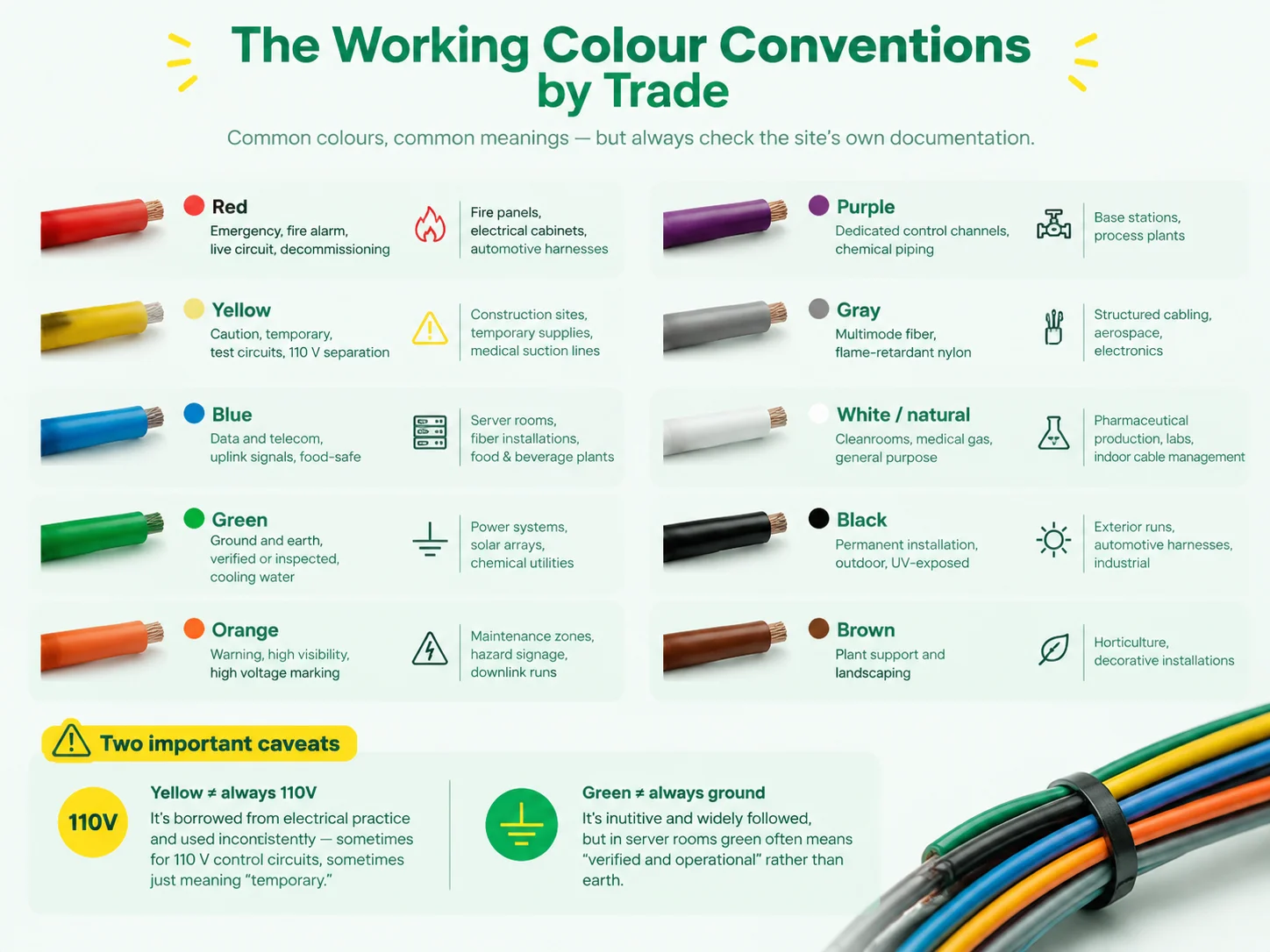
These are the kinds of practices you will be most likely to come across. You should look upon them as hypotheses and not specifications, and always refer back to the documentation for the particular site as you can never take anything for granted.
| Colour | Common Meaning | Where You See It |
|---|---|---|
| Red | Emergency, fire alarm, live circuit, decommissioning | Fire panels, electrical cabinets, automotive modified harnesses |
| Yellow | Caution, temporary, test circuits, 110 V separation | Construction sites, temporary supplies, medical suction lines |
| Blue | Data and telecom, uplink signals, food-safe detectable | Server rooms, fiber installations, food and beverage plants |
| Green | Ground and earth, verified or inspected, cooling water | Power systems, solar arrays, chemical plant utilities |
| Orange | Warning, high visibility, high voltage marking | Maintenance zones, hazard signage, downlink signal runs |
| Purple | Dedicated control channels, chemical piping | Telecom base stations, process plants |
| Gray | Multimode fiber, flame-retardant nylon | Structured cabling, aerospace and electronics |
| White / natural | Cleanrooms, medical gas, general purpose | Pharmaceutical production, labs, indoor cable management |
| Black | Permanent installation, outdoor, UV-exposed | Exterior runs, automotive production harnesses, industrial |
| Brown | Plant support and landscaping | Horticulture, decorative installations |
There are two of these that come with a warning. The yellow color code for 110 volts is borrowed from electrical installation, but it has not been applied successfully throughout. I have seen this color code being used to distinguish between a 110 volt control circuit and a 220 volt power circuit. I have also seen it used simply to mean temporary. The green color for ground is not as universally used in the data center environment. It makes sense, is precise, and is used frequently, but it is not used universally.
Green Zip Ties: Grounding, Earth and Sign-Off
Green is a hue that resonates in terms of meaning in various industries, but it is also one with a different meaning which may lead to confusion.
For example, in the area of electronics, green is a signaling color for equipment ground under NEC 250.119, so wrapping grounded and bonding conductors in green is a simple and efficient solution almost any plant applies. There are no costs, no training, and visual auditing is conducted on the spot. The same method is observed in the area of solar energy, where array ground and equipment bonding conductors should not be mistaken for anything else, as in cooling-water systems in power and processing stations, where green is used by tradition only.
The second meaning is drawn from lean production and visible management, as a color stands for the status system rather than the type one. In many plants and holding facilities, a green wrap signifies that the item has been examined and signed. The same concept is observed in disaster recovery methods and quality control, where a color lets one know that a particular piece of equipment has been checked. If you want the longer version of how green fits into electrical identification practice, the range of uses for green zip ties in electrical and inspection work goes through it properly.
White vs Black: The Only Colour Choice That Changes Performance
The technical part is here. Almost all color choices involved minimal differences of nylon material, tensile properties and endured temperature differences; black stands out thanks to a specific additive.
Carbon black is contained in black ties to act as both a pigment and a UV blocker. UV ray is what destroys nylon used outside: molecular chains start breaking at nylon’s surface and the material grows brittle whereas a tie that was holding fine previously breaks in 2 years. Carbon black absorbs this ray and so almost every outdoor tie is black in color. Regular nylon 6/6 black tie lasts long in outdoor conditions while a similar natural tie experiences failure in a season or two when exposed to sun lights.
Natural color or white is the base color and is considered the cheapest one – it is the easiest one to dye as well. Natural color is also the most suitable one to choose when there is a need to detect any contamination. In pharmacy silos or food production facilities white ties show any floating dust or substance whereas black ties camouflage any contamination, making the identification process much easier.
One clarification that surprises many: carbon black does not make black ties weaker: this is just a normal compounding additive so considering the same width and grade both natural and black ties have the same tensile strength. The only thing that differs is the lifetime in outdoor conditions. The failure mechanics and the actual test conditions are worth reading up on if you are buying for anything exposed, and how UV resistance works in cable ties and which grades actually deliver it covers the detail.
Colour and Strength: What Actually Changes the Rating
Before we get into technicalities, let’s clarify another point of confusion. Color does not determine strength of cable ties, but the width and grade of the material used do.
Loop pull strength really comes down to the cross-section of the strap and the type of nylon that was used for making it. The industry has different categories starting with miniature, which have rated strength just at about 18 lbs (8 kg), continuing to intermediate with a 40 lbs (18kg) rating, then standard with 50 lbs (22 kg), then light-heavy weighing 120 lbs (55 kg), heavy with its 175 lbs (80 kg), extra-heavy weighing 250 lbs (110 kg). You can find all of these products in black, and those in various other colors too. The 4 inch colored tie and the 4 inch black tie share identical ratings in the datasheet.
Now, what color is still able to affect is the additional benefits. Colored products tend to be less expensive when they are black or natural, which means that in case of a custom color there’s going to be a minimum quantity imposed. UV-stabilized black, for example, is definitely in stock. Heat stabilized samples providing a continuous service temperature of around 185°F (85°C) to 221°F (105°C) are delivered in black and natural colors. Mainly blue material is used for food-grade and detection rods. Thus, the required color leads to a specific material grade while the grade determines the measurement.
| Size | Typical Length | Common Tensile Range | Typical Use |
|---|---|---|---|
| Miniature | 4″ (100 mm) | 18 lb (8 kg) | Small cable bundles, panel wiring, labelling |
| Intermediate | 6″ (150 mm) | 40 lb (18 kg) | General indoor cable management |
| Standard | 8″ (200 mm) | 50 lb (22 kg) | Network and electrical bundles |
| Light-heavy | 11–14″ (280–360 mm) | 75–120 lb (34–55 kg) | Larger harnesses, conduit support |
| Heavy | 14–24″ (360–600 mm) | 120–175 lb (55–80 kg) | Outdoor runs, heavy cable support |
| Extra-heavy | 24–36″ (600–900 mm) | 175–250 lb (80–110 kg) | Industrial, structural bundling |
If you are choosing a size rather than a colour, the full dimensional reference is worth consulting before you order, and the standard cable tie sizes and what each one is actually for lays out the range in more depth than this table can. In simpler terms, the tendency of people is to under-specify length and over-specify strength. Most installations usually depend more on length than strength since a bundle requiring multiple ties to hold its shape indicates that it was purchased with the wrong length rather than the wrong tensile strength.
Special-Purpose Colours and the Materials Behind Them
There are some colors that directly correspond to types of material, which are the most valuable to know about because they influence a tie’s tolerability.
- The food and drink industries use blue for a particular reason; a very small number of food items naturally come in blue color, which makes it possible to detect a small blue plastic piece right away. Also, the blue metal-detectable ties are designed to be used in lines where detecting equipment is installed. Imagine that a tie accidentally ended up in the delivery – it will be blue.
- Gray and clear white are not the colors to be confused with other types of materials. These two colors indicate nylon that has been treated to meet UL 94 V-0 specifications, i.e., passing the vertical burn test, which means that while undergoing the test the material catches fire but does not drip. When you purchase a nylon tie for an aircraft wire harness, you buy its properties instead of caring about the color.There is more on where this matters in how flame-retardant cable ties are specified and where they are mandatory.
- Purple, brown, and metallic colors usually represent niche or custom colors. Purple is one of the former colors used in control rooms of chemical plants and telecoms. Brown and metallic colors are preferred where visible ties must be invisible against the parts being held. If you require a given color to conform to a brand standard or Pantone shade, it becomes a custom job with minimum order quantity, and the best approach is to provide a physical sample rather than a picture because the color displayed on the screen differs from that displayed on the actual product.
- Average production colors include black, natural, and the colors produced by masterbatch suppliers such as red, yellow, blue, green, orange, purple, gray, brown, and pink. Everything else is a special color.
Why Colour Coding Pays for Itself
One should ask the question about why it is worth bothering with color coding and discover the fact that the explanation is more rational than the desire to be tidy.
- The first measurable benefit refers to the time spent on fault tracing. If an engineer is tracing a fault on a tray carrying 200 circuits to 40 destinations, he/she would scan all wires involved. When he/she has color-coded ties on entry signs to that rack, he/she is able to narrow down the search and save time. This system takes just one occasion to pay for itself in terms of saving a fortune on the downtime.
- The second benefit comes with errors being avoided. When there is a new contractor that fails to spot the difference between the control circuit and power circuit, there will be problems if colors are not used.
- The third benefit of color is something that is usually neglected. The labels fall off, filling tape comes off, ink fades. Therefore, the only way people still use codes is a colored nylon tie, which is a permanent color marker holding the wires at the same time. Color codes still survive in so many industries.
- One of the major risks the codes faced was that they ended up being folklore. If the color coding system was introduced five years ago, and nobody wrote it down, the system is in place but does not mean anything. Make sure to write down your color code if you decide to introduce your own one.
Frequently Asked Questions
What do different tie colors symbolize?
In reality, there is nothing that is recognized by all parties involved as universal. The meaning of colors is not the same everywhere, although the most common meanings are red for emergency work, yellow for precautionary or temporary work, blue for data and telecommunications wiring (or for processing plants meant for safe food production), green for grounding or earth and “verified or inspected” in visual management system; orange for warnings and high visibility; purple for the channels specifically used for manufacturing processes and chemical tubing; white for clean areas, gas use in medical facilities and all general purposes; black for permanent and outdoor installations.
What does a green zip tie mean?
There are two meanings depending on the convention used on the site. In an electrical context, it refers to grounding and earthing. The meaning stems from NEC 250.119, which specifies that equipment grounding conductors must be colored either green, yellow and green striped, or be bare. The same convention applies to solar array bonding and cooling water systems. In manufacturing and data centre performance monitoring, green refers to the opposite concept: tested, verified, passed inspection, or cleared for use. This indicates that green is often used in quality control as a sign-off as well as in disaster response marking. Both of the meanings can be regarded as correct. They can easily co-exist as long as the site shows which meaning is used here. If the person sees a green tie on-site and does not know the exact meaning, he/she should ask. Making assumptions could lead to assuming the circuit to be grounded or thinking that the work has passed inspection.
Are white or black zip ties stronger?
The same applies to ties of the same width and material class. The tensile strength of a cable tie is created by the cross-section of the strap and the type of nylon used, and in the case of the same size the recorded values are the same for black, white or any other version. In this case, carbon black used to dye a tie black plays the role of a standard processing additive and does not affect the polymer strength parameters. The only notable aspect is that the carbon black acts as a UV stabilizer, which makes black ties resistant to sun rays, whereas natural ties usually become brittle and fail in a year or so. All considerations are of no relevance indoors where white or uncolored ties prove to be more useful because dirt and stains are visible on such light-colored ties.
References
- UL Solutions — UL 62275, Cable management systems: cable ties for electrical installations
- International Electrotechnical Commission — IEC 62275, cable ties for electrical installations
- NFPA — NFPA 70 National Electrical Code, Articles 200.6 and 250.119 on conductor identification
- UL Solutions — UL 94, Tests for flammability of plastic materials
- OSHA — electrical safety and identification requirements
- ISO — ISO 22324, safety colours and safety signs, guidance on colour use
Conclusion
The color of the zip tie is determined by the definition by the site in question and nothing else because no standard decides that. UL 62275 contains information about how strong and how fire-resistant the tie is, but does not tell us what blue means for a data run. The fact that black ties contain carbon black and resist sunlight, while natural and colored ties do not, is universal and is the only color-related decision to have technical implications.
This leads to two recommendations. If your facility already has a color code, document it and try to limit it to five or six colors, as it is a bad idea to have a code that exists only in someone’s head. Those who are looking to buy ties for outdoor use should stick to black ties no matter what color scheme they prefer, as natural nylon ties fail in eighteen months and cost more than what you save by buying them in the first place.
Everything else about color is all about making someone else’s job easier, which is a good enough reason as long as everyone knows what the colors mean.


