




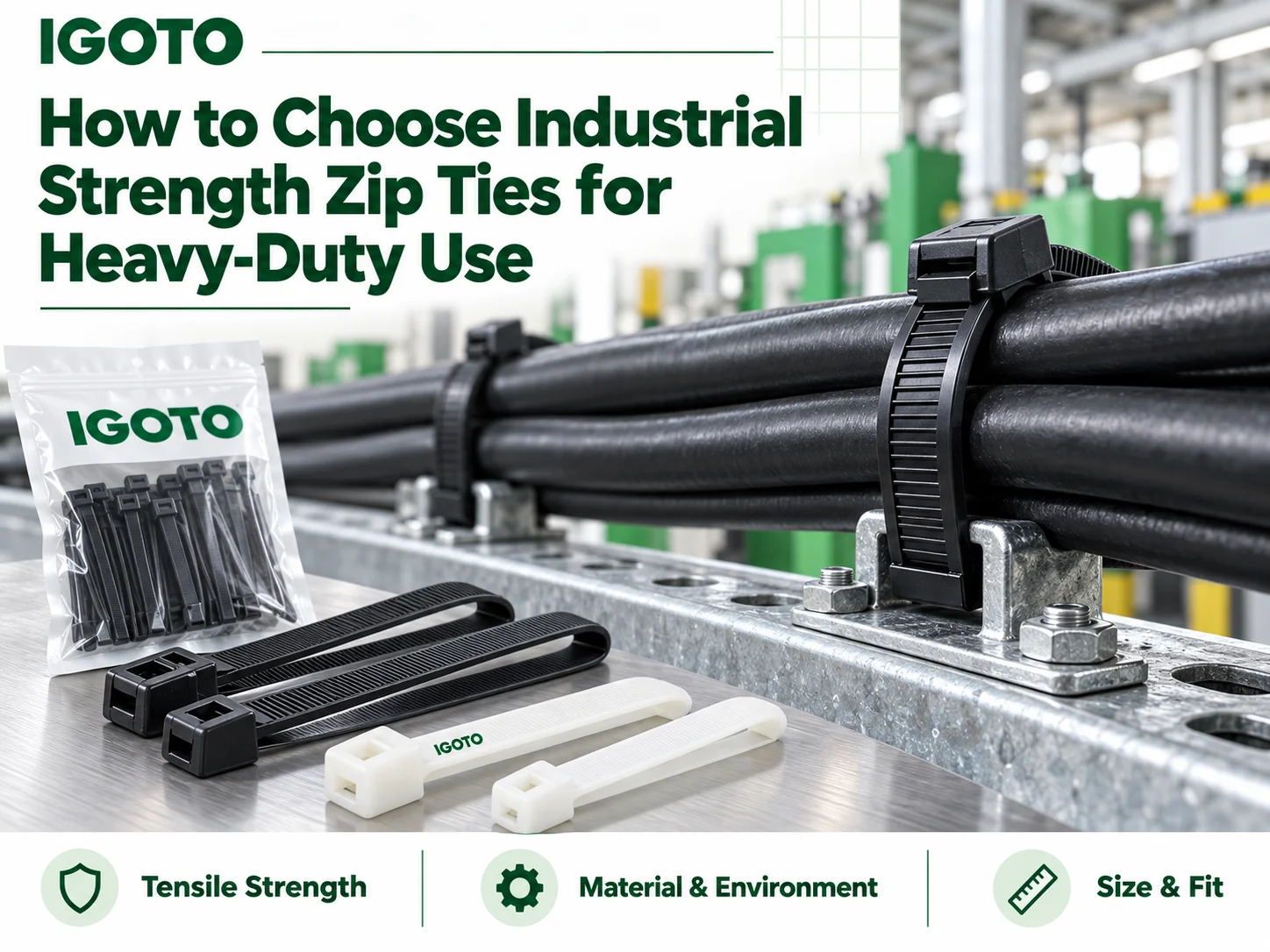
How to Choose Industrial Strength Zip Ties for Heavy-Duty Use
A regular zip tie that can keep electrical cable from beneath a desk organized forever can go bad in weeks on an industrial site. That is because the combination of heat softens the material, sun exposure makes it chalky, and constant shaking loosens the cable bundle to break it. Hence, there is a constant need for industrial zip ties that are designed to support heavier loads, performing in harsh environments for the long durations. In this context, “industrial” implies a heavy tensile class zip tie, the most common types being 120 lb, 175 lb and 250lb ones. However, besides strength, there are other factors that come into play here, these are the components used, the certification of the item and how it is applied. The purpose of this buyer’s guide is to make the reader familiar with different factors that they need to keep in mind when making a purchase.
Industrial zip ties are heavy-duty cable ties that can support a lot of weight. These ties are classified on the basis of minimum loop tensile strength, 120 lb (around 54 kg), 175 lb (around 79 kg), 250 lb (around 113 kg). The most used materials to make industrial zip ties are nylon 6/6 and stainless steel. An industrial zip tie has a given rating that is verified according to a standard like UL 62275 / IEC 62275, and it is suitable for string areas. The guide below tells you how to evaluate how strong industrial zip ties are, what materials are suitable for use, their common usage scenarios, and a checklist to use while shopping.
Reasons for the Failure of Common Zip Ties in Industries
There are three primary reasons behind any malfunction in an industry, solar system, or any work area, and none of these can be simply termed as “the tie was very thin”.
Overload and Shock Loading
A light duty wrap with an 18 lb. or 50 lb. limit can only be used to tie up wires but not hold on to objects as massive as a heavy hose, thick electric wire, or even a flag that moves due to the wind. When a load goes beyond the company’s stated limit or if any shock causes a sudden increase in the load, the tie expands, thus misaligning the lock or breaking the head of the tie.
UV and Weather Degradation
Unfinished (white) nylon has no defense against ultraviolet rays. When exposed to sunlight, its strength gradually deteriorates, making the material brittle and breaking it after some time due to a hit or just a cold morning. Our guide on how long zip ties last outside explains why black zip ties with UV protection are much better suited to outdoor use than the normal ones.
Vibration, Heat and Cold
The operation of machinery like pumps, compressors, conveyors, and vehicles requires pervasive vibrations. Over time, every vibration and jolt leads to abrasion of the tie against different sharp objects and repetitive loading of the locking mechanism. In addition, being near a heating source (the engine or the furnace) makes the nylon softer, while in very cold temperatures nylon becomes hard to use, especially when the material is dry.
How to Judge Strength: The Metrics That Actually Matter
Strength is the first number buyers look at, and the one most often misunderstood. Here is how to read the specification sheet like an engineer.
Loop Tensile Strength and the Common Industrial Classes
The most crucial factor regarding a cable tie is its minimum loop tensile strength, which refers to the force required to break the tie or unlock it while it is already tied. This value increases approximately proportionally to the width and thickness of the cable tie. The next table displays the classes of cable ties you are likely to come across the most.
| Duty class | Typical minimum loop tensile strength | Typical strap width | Typical use |
|---|---|---|---|
| Miniature | 18 lb (8 kg) | about 2.5 mm | Electronics, light wiring |
| Standard | 40 to 50 lb (18 to 22 kg) | about 3.6 to 4.8 mm | General electrical and panel wiring |
| Heavy duty | 120 lb (54 kg) | about 7.6 mm | Heavy bundles, hoses, outdoor runs |
| Extra heavy duty | 175 lb (79 kg) | about 8.9 mm | Large trunks, construction, fencing |
| Extreme duty | 250 lb (113 kg) | about 12.7 mm | Very large bundles, pipe and structural fixing |
Widths and ratings vary slightly between manufacturers, so always check the data sheet. For a closer look at the strongest options on the market, see our article on the toughest zip ties available.
Rated Strength Is Not Working Load
Loop tensile ratings indicate the breaking point of ties when cut subjected to a specific test in the lab. UL Solutions explains that this is more properly termed a bundling capacity than a load-bearing capacity. Real installations will involve dynamic loads, environmental and aging factors, and therefore, practitioners will build in a large safety factor, which requires never exceeding one third to one half of the rated value of the cable tie.
Thus, when a cable tie is rated for 250 lb, it does not mean the tie can hold 250 lb safely. Instead, it is a measure of breaking force obtained in the laboratory environment and you must never use cable ties in ways that would injure people in case of failure.
Certified Performance: What UL 62275 Types Tell You
The UL 62275 standard, which conforms to the IEC 62275 standard, governs electrical installations. This standard classifies ties according to the extent to which they maintain their declared strength after conditioning.
Type 1 ties are required to hold 100 percent of their declared loop tensile strength upon receipt, while only 50 percent of the strength needs to be maintained after heat aging and UV exposure, if applicable.
In contrast, Type 2 ties must retain 100 percent of their declared strength even after undergoing heat aging, temperature cycling, and UV exposure, if applicable.
Types 11 and 21 are similar to Types 1 and 2, respectively; however, the types differ in the materials used, where polymer materials are used instead.
On the other hand, Types 2S and 21S are used for primary support of conduits, tubing, and cables and feature a higher minimum loop tensile strength than 50 lb.
With regards to industrial buyers, the key question becomes whether the tie keeps its rating after aging or when it is new.
A Type 2 or 21 rating will confirm the answer, as it provides third-party confirmation of the product features.
Other Specifications Worth Checking
- Operating temperature range. Nylon 6/6 ties are typically rated for temperatures ranging from about -40 °C to +85 °C. Heat-resistant types can handle more heat than that.
Flammability. Most nylon 6/6 materials have a flammability rating of UL 94 V-2; applications such as control panels or transit jobs may require more flammable ratings and halogen-free materials.
Locking mechanism. Along with other versions of this type of tie, nylon pawls are standard; some applications involving the heaviest ties may use stainless steel barbs as a locking mechanism.
Military specifications. Self-locking plastic fasteners used in the harness of their products are part of the certification process for military applications. 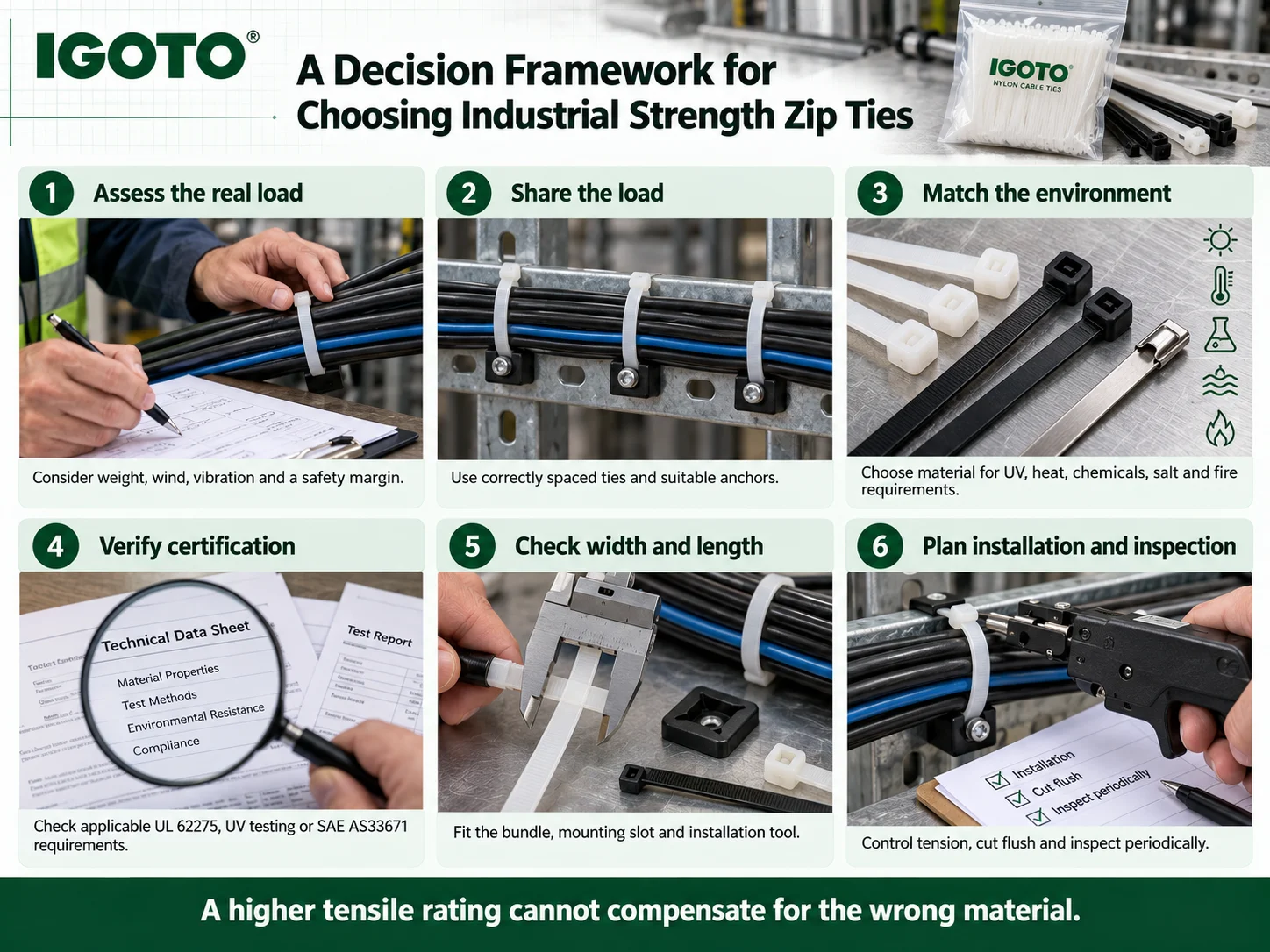
Material Selection for Industrial Strength Zip Ties
The right material is often more important than a higher tensile class. A 120 lb tie in the wrong material can fail sooner than a correctly chosen 50 lb tie.
Nylon 6/6: The Industrial Default
Nylon 6/6 (PA66) combines strength, flexibility, electrical insulation, and affordability; thus, it is widely used for industrial cable ties. Various grades of nylon exist, created either by producers’ virgin resin or the mix of virgin resin and regrind. Additionally, nylon absorbs water from the atmosphere. For the more dried ties after a hot warehouse, flexibility decreases, and the chance they will crack during the installation increases.
UV-Stabilized Black Nylon
Carbon black absorbs UV radiation and shields the polymer, which is why black ties are a typical option for outdoor applications, solar arrays, and telecom equipment. See our range of UV-stabilized black heavy-duty cable ties for a typical outdoor specification.
Heat-Stabilized and Flame-Retardant Grades
Heat-stabilized nylon resists long-term thermal aging near motors, lighting and engine bays. Our guide to high-temperature tie wraps covers these grades in detail. Where fire safety codes apply, choose flame-retardant ties with a documented UL 94 rating.
Stainless Steel for Extreme Environments
In the case of applications such as fire-resistant paths, offshore oil rigs and refineries or wherever the temperatures exceed those tolerable by any nylon, the solution lies in the use of stainless steel ties, which are usually made with either grade 304 or 316 stainless steel. Although they entail higher costs and require the use of tensioning tools, their use is preferred in applications where there are no other alternatives.
Real Industrial Applications and What They Demand
Each environment has its own specific stresses on a tie. Check out the examples provided below and decide for yourself which features are most important.
Solar Farms and Outdoor Energy
Solar cables experience stresses in the racking for many years of sun, rain and wind exposure. The key requirements are UV stabilization, weather-safe materials and the right distance so the wind’s load is distributed among many ties. Explore our solar energy system cable tie solutions.
Construction and Infrastructure
In the construction industry, ties help to secure some temporary electricity, rebar markers and edge of safety nets and signage. Loads are irregular and impacts are frequent, therefore, the heavier classes and outdoor-grade materials are advantageous. See our construction and infrastructure solutions.
Industrial Equipment and Machinery
In the machines and along conveyers, vibration, oil, heat, and diligent maintenance are all possible challenges. Thus, reliable anchoring, consistent locking and heat resistance matter more than the highest tensile class. Our industrial equipment cable tie solutions cover typical machine builder requirements.
Transport, marine and heavy vehicles.
Trucks, railway cars and boats present a variety of stresses: from vibration and temperature cycles to salt spray and fire safety regulations. Customers usually demand compliance with UL 62275 Type 21 or any of higher defense and aerospace standards and use stainless steel elements when corrosion or burning are an issues.
A Decision Framework for Choosing Industrial Strength Zip Ties
Follow through and answer the questions below one by one. By doing this you will have a clear specification that can be presented to suppliers.
①.What is the load? Calculate the weight of the bundle as well as the forces acting on it such as wind and vibration to see whether the load is static or dynamic. Do not forget to add safety margin and choose the tensile classification.
②.Is the load distributable? A few properly spaced straps fixed to the mounting points are normally more effective than a single heavy strap and help to distribute the stress throughout the bundle.
③.What type of environment is there? Indoor or outdoor environment, temperature, chemicals, salt spray and fire requirements will determine whether to choose natural, UV black, heat-stabilized, fire-retardant, or stainless steel.
④.What is the certification needed? Electrical works normally require UL 62275 certification, outdoor straps should be subjected to UV testing, and aerospace and defense tasks must have SAE AS33671 certification.
⑤.What are the dimensions of the tie? Make sure to leave adequate length of tail to allow for threading and tightening and make sure that the tie width fits the mounting base or tooling.
⑥.How to mount and inspect the tie? The use of tensioning tool will ensure that the strap is tightened properly and cut flush, and you need to schedule inspection of the mounting from time to time, especially for outdoor and high vibration installations.
Do not use the heavier class of strap instead of choosing the right material. Even though high strength nylon strap will withstand sunshine, it will still break, while nylon will not withstand the conditions that require the use of stainless steel strap.
Buyer’s Checklist Before You Order
- Minimum tensile strength specifications communicated in lb and kg or N
The actual width of the straps, length and the maximum size of bundles
The material used in the straps as well as its grade, preferable virgin nylon 6/6 from the known manufacturer
UV protection for outdoor use
Temperature and flammability specifications
Indication of UL 62275 regulations, or any other necessary requirements
The consistency of the batch: tensile tests or sampling
Packaging ensuring moisture retention, i.e. packet
Stability in supply schedule and possibility of supplying the customized products
Where IGOTO High Strength Cable Ties Fit
We believe that it is important to answer directly, thus here is our answer. IGOTO’s High Strength cable tie series is built around a 4.8 mm-wide strap that provides at least 22 kgs (around 50 lbs) of minimum tensile strength and that is made of pure nylon 6/6 (Ascend Vydyne 21SPC resin from the USA), UL-certified under the file number E357639, rated UL 94 V-2 and able to work from -35 °C to +85 °C with UV-stabilized black variations suitable for outdoor use. Taken together, this means that it belongs to the class of standard-duty cable ties instead of being among the cables with 120 lbs and higher tensile strength.
It is worth mentioning that in actuality, this cable tie represents a considerable part of cable management in industrial sectors, including control panels, cable trays, machine harnesses, solar string wiring, and equipment bundles where the loads are distributed among many cable ties instead of relying on a single strap. If your project really requires 120 lbs, 175 lbs, or 250 lbs cable ties for a single point load, the above-mentioned criteria will still work, and we will be glad to answer your questions and discuss your needs and alternatives in detail.
Frequently Asked Questions
What counts as industrial strength zip ties?
Heavy-duty cable ties of 120 lb, 175 lb, or 250 lb rating are commonly referred to by suppliers using the name. Although the name is not an official standard, it is important to verify the actual tensile strength, material and certification.
How much weight can a 250 lb zip tie hold?
In a short lab test, its rated breaking strength is around 250 lb (113 kg), but the safe working load is significantly lower. In fact, many installers take a third to a half of the rating into account due to the vibration, aging, temperature and impact loads, moreover cable ties should never be used for lifting and life-safety restraint.
Are black zip ties stronger than white ones?
Initially, black and natural neutral nylon ties would have similar tensile strength. The major difference was the outdoor durability as black ties would be made with carbon black, which provides a form of UV protection against degenerating.
Can I use two lighter ties instead of one heavy-duty tie?
Distributing the weight across multiple ties is the best way to go, especially if the ties are allotted in the line and connected to the mounts. However, there is no way of knowing exactly how much weight will be distributed evenly. Therefore, do not think that two ties weighing 50 lbs equal one tie weighing 100 lbs. For single-point loads, make sure that you are using a tie which is suitable for the particular application.
Should I choose nylon or stainless steel for industrial use?
Nylon 6/6 is the right choice for most electrical and industrial bundling thanks to its insulation, flexibility and cost. Choose stainless steel for fire-rated routes, very high temperatures, aggressive chemicals, offshore or other extreme environments.
References
- UL 62275, Cable Management Systems: Cable Ties for Electrical Installations, UL Standards Catalog
- Cable Ties for Cable Management: testing and certification, UL Solutions
- UL 62275 Cable Tie Types Simplified, NEMA
- IEC 62275 Cable Tie Loop Tensile Testing, TestResources
- SAE AS33671, Strap, Tiedown, Electrical Components, Adjustable, Self-Clinching, Plastic, SAE International
Conclusion
Choosing industrial strength zip ties comes down to five decisions: size the tensile class to the real load with a safety margin, share loads across properly spaced ties, match the material to the environment, demand certified performance such as UL 62275 Type 2 or 21, and install with the right tools. Get those right and your ties will outlast the equipment they secure. If you need a stable supply of high-tensile nylon 6/6 cable ties for panels, machinery, solar or construction projects, explore our High Strength series or contact IGOTO for samples, pricing or custom packaging.


