


How Long Do Zip Ties Last Outside?
If you place a white nylon zip-tie on a fence and pull on it after one year of installation, the expectation is that it would be broken. However, when utilizing the correct zip tie (black) on your fence, that zip tie should outlast even your posts. This isn’t purely due to the brand or luck; rather, it is due to the colour and material composition of the zip tie as well as pressure it has endured in its environment over time.
The article also provides details with numbers to show how long zip-ties can survive in outdoor conditions, how they are influenced by the environment, and how to select zip-ties which will have an expected lifespan of at least 10 years.
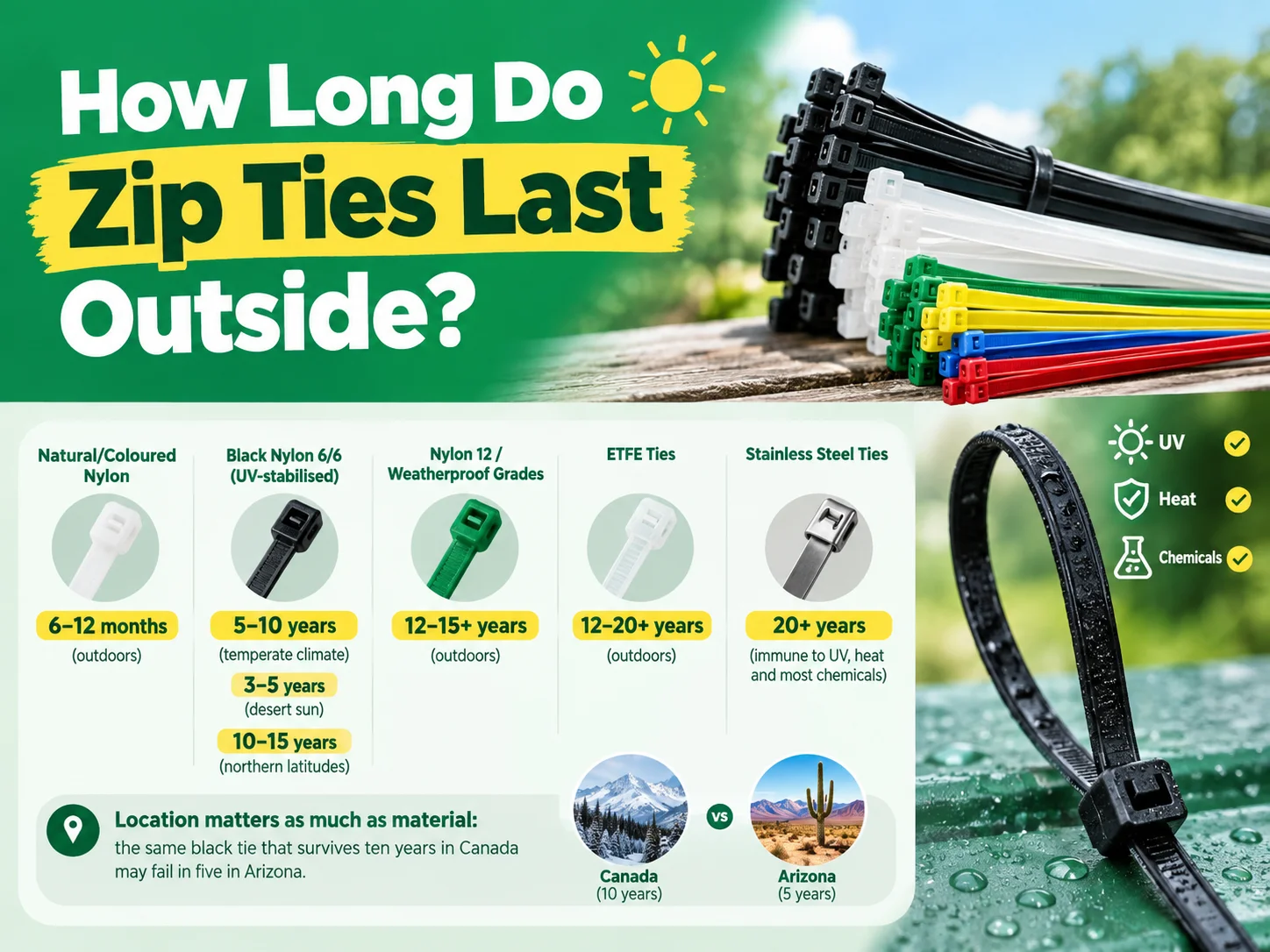
A standard nylon zip tie that is produced using standard materials has a service life of approximately 6 to 12-months while it is exposed to the elements; however, a black, UV treated, nylon 6/6 zip tie can be expected to have a longer service life; depending on geography, the estimated duration of use could range anywhere from 5 to 10-year (southern), 3 to5 year (desert), up to 10 to15 year (northern) in duration. In terms of environmental exposure, a weather-stabilized nylon zip tie, such as one made out of nylon 12, usually has an estimated service life of 12 or so years. Other materials, such as ETFE, have estimated lifetimes exceeding 15 years, and stainless steel zip ties will typically have a lifetime of over 20 years due to the materials being protected from UV radiation and elevated temperatures.
The short answer: how long outdoor zip ties last
The most helpful number to remember is actually two orders of magnitude. A typical unprotected nylon tie will last you for months while the right type can last for years. The difference between them is a colour and additive choice. There are differences in the information reported by various manufacturers. This is due to the fact that this info is obtained in different ways (some researchers perform accelerated weathering tests according to ASTM G154 or ISO4892, others rely on field returns) and not all manufacturers arrive at the same results. Those tests in the field tend to be more favourable for the stabilised ties operating in cold climates and more negative for regions characterised by hot conditions, which is why it is better to give a range rather than a single figure.
As for the results, all sources agree that UV stabilised nylon is superior to regular nylon by almost ten times more. Stainless steel wins against any plastic material in terms of longevity and temperature but it costs much more and it is heavier and requires tensioning.
What actually kills a tie outdoors
It is not accurate to say that sunshine “causes wear” on plastic; what happens is that polymer chains which provide nylon with strength are broken. Photo-oxidation mechanism is responsible for that with three observable phases: the tie changes colour, then becomes less flexible, and finally has fine cracks, emerging usually first in the area of the lock, where there is less material and much stress. Once the tie loses its ability to bend, it has already failed in its function even though it appears to be fine.
Two additional processes worsen the situation. The first one is moisture cycling: nylon absorbs a certain level of water from the atmosphere and then loses that moisture when exposed to the sun, which leads to the permanent condition of dryness and rigidity. The second process is thermal cycling when the strap encircling the cable expands and contracts daily, forming micro-cracks in the radii of the bends. If the tie is on a hot roof or on a sunny desert, then the heat speeds all these processes up, sometimes twice or thrice comparing to being in a cooler shade.
The result of degradation is not a process of gradual deterioration that can be observed. No, when the tie is used, it can retain its shape while losing up to 80% of its tensile strength and then break from the sudden increase of load that was never applied to it before, like a gust of wind or a person leaning on it.
Outdoor lifespan by material
This is a table to keep in mind. It shows the lengths of time materials take to degrade when they have been in one outdoor spot for a relatively constant amount of time. Note, though, that the way in which each material fails is different. For instance, plastics degrade but steel fails through rusty patches or from being cut from whatever it was holding onto.
| Material | Outdoor lifespan | Best for | Trade-offs |
|---|---|---|---|
| Standard nylon 6/6 (natural, white, colours) | 6-12 months | Indoor only | Yellows, embrittles and snaps; not an outdoor product at any price |
| UV-stabilised nylon 6/6 (black) | 5-10 years temperate; 3-5 years desert; 10-15 years far north | The general-purpose outdoor tie: cables, fencing, signage, garden structures | Still degrades in sustained heat above 85°C and in aggressive chemicals; creeps under continuous load |
| Nylon 12 / weatherproof grades | 12-15+ years | Coastal, saline, wet and hot zones | Higher cost; less widely stocked in retail sizes |
| ETFE (Tefzel-type) | 15-20+ years | Chemical plants, nuclear, radiation and aggressive environments | Premium pricing, limited availability |
| Stainless steel 304 / 316 | 20+ years | Marine, industrial, high heat, anything intended to be permanent | Not reusable, sharper edges, needs a tensioning tool, higher cost per tie |
Selecting the material also determines the tie’s chemical properties. The workhorse polymer of almost every tie is nylon 6/6, which gives an excellent compromise between tensile strength, flexibility, and electrical characteristics, but nylon 6/6 is hygroscopic and is not sunlight resistant on its own.The rest of the picture — what zip ties are made of, and which additives change their behaviour — is decided at the resin stage, which is why two black ties of identical dimensions can differ by years in service.
Why black lasts longer than white
Upon entering any professional installation, one can see that basically all outdoor fasteners are black. This is not a matter of aesthetic choice. The UV stabilized black fastener includes the carbon black pigment that prevents any detrimental effects of ultraviolet radiation by absorbing it and converting the energy to heat before the ultraviolet radiation starts destroying the polymer chains. The method is inexpensive, efficient, and — what is very important — three-dimensional: in case if the properly produced fastener is applied, the stabilizer would be distributed throughout the whole material, so an activation by the scrapes or scratches will not uncover the unprotected core, as would happen with more traditional surface coatings.
In contrast, white, ivory, red, blue, yellow and green fasteners do not have any similar protections unless additional UV stabilizer additives are used by the producer, which rarely occurs with the budget production line. Therefore, the true test of outdoor fasteners is based on the information provided on the package, rather than on the color: “UV resistance”, “outdoor rated”, or the publication of the weathering datasheet. Whether a tie is genuinely UV resistant is settled by that claim and the standard it was tested to, which is the question UV-resistant cable ties have to answer on paper before they answer it on a pole — and a black tie with no UV claim on the label is the most common mistake in outdoor installations, because the colour looks right and so nobody checks.
When it comes to the color green, the only noteworthy exception is UV-stabilized green nylon as an authentic outdoor product that is ideal for plant ties where blending into the greenery is key. The only downside is that it falls on the low end of the spectrum, lasting only about 3-5 seasons compared to 5-10 seasons for a black variant of the same grade.
Outdoor lifespan by scenario
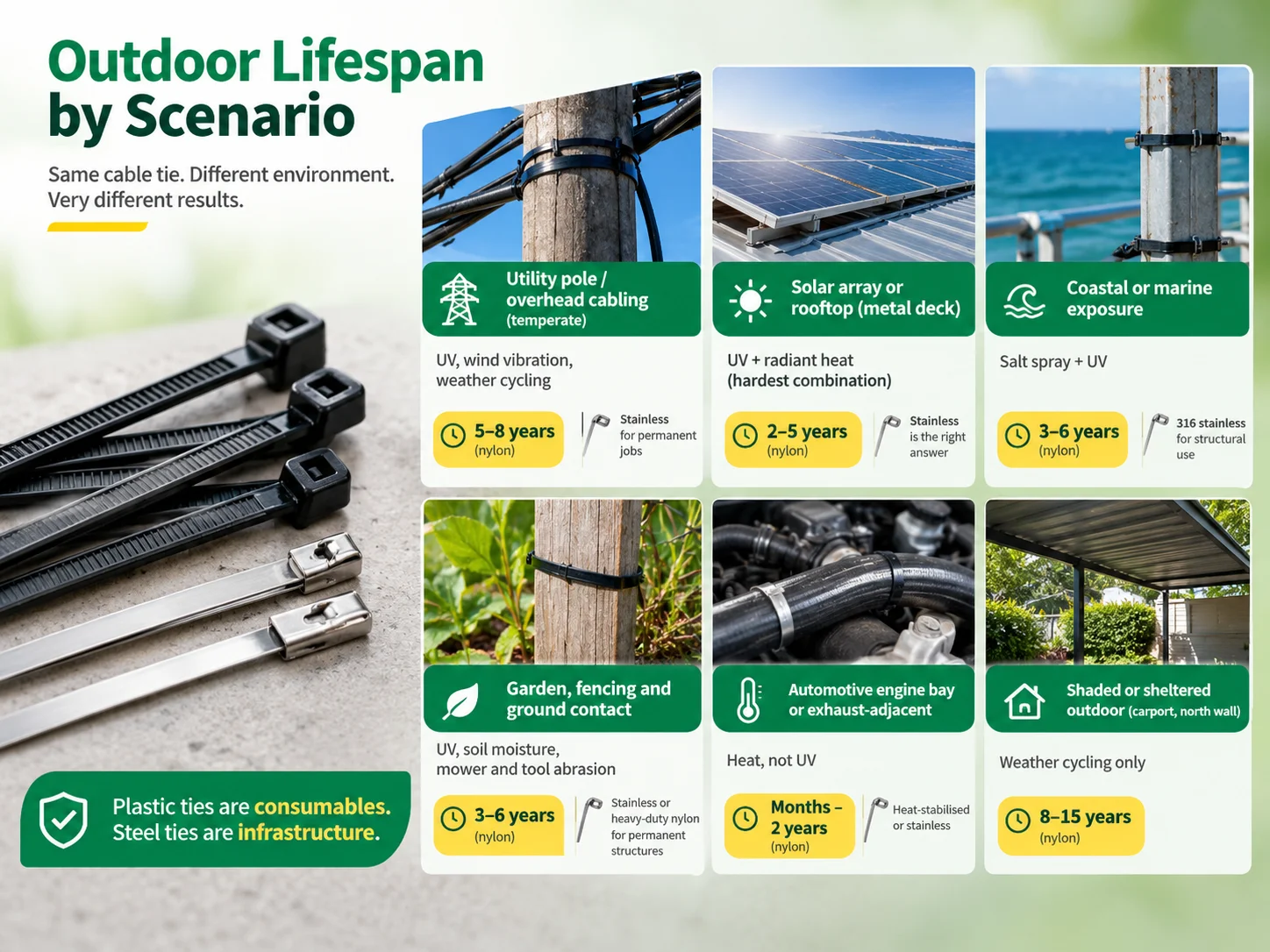
Generic numbers become useful once you match them to the installation. The main stressor shifts from site to site, and it is generally not just UV.
| Installation | Dominant stressor | Realistic lifespan (UV black nylon 6/6) |
|---|---|---|
| Utility pole / overhead cabling, temperate | UV, wind vibration, weather cycling | 5-8 years; step up to stainless for permanent jobs |
| Solar array or rooftop on a metal deck | UV plus radiant heat — the hardest combination | 2-5 years; stainless steel is the correct answer |
| Coastal or marine exposure | Salt spray plus UV | 3-6 years for nylon; 316 stainless for anything structural |
| Garden, fencing and ground contact | UV, soil moisture, mower and tool abrasion | 3-6 years; stainless or heavy-duty nylon for permanent structures |
| Automotive engine bay or exhaust-adjacent | Heat, not UV | Months to two years for standard nylon; use heat-stabilised or stainless |
| Shaded or sheltered outdoor (carport, north wall) | Weather cycling only | 8-15 years where UV never reaches the tie directly |
Just pay attention to how many times the real answer for a permanent installation is stainless steel. Plastic ties can be called consumables in any long-term outdoor application. In contrast, steel ties can be qualified as infrastructure.The comparison between stainless steel zip ties and nylon cable ties turns on exactly that line — one is designed to be cut and replaced, the other to be forgotten about — and it is a more useful distinction in procurement than the lifespan numbers themselves, because it sets the maintenance schedule before the first tie is fitted.
Does the brand make a difference?
There is, however, less here than is material, and much less than the bulk of selling conversations imply. What is different among manufacturers is the polymer grade and the additive package, the difference between compounding the stabiliser into the resin or applying a surface treatment. A good supplier indicates the material grade (nylon 6/6 or PA66), the UV guarantee, the tensile rating in both pounds and kilograms, and often the results of accelerated weathering, where a product listing only has a picture and a price. The specification sheet, rather than the logo, shows what is likely the field life of the joints.
Price reflects that fact accurately. Certified-grade black UV ties from reputable manufacturers are more expensive, and companies such as igoto provide the same levels of nylon 6/6 at a much reduced price, as long as the buyer checks the material grade and UV guarantee; very often, it is only the distribution and application of stainless that gets paid for by the gap existing for installers working with lots of ties.
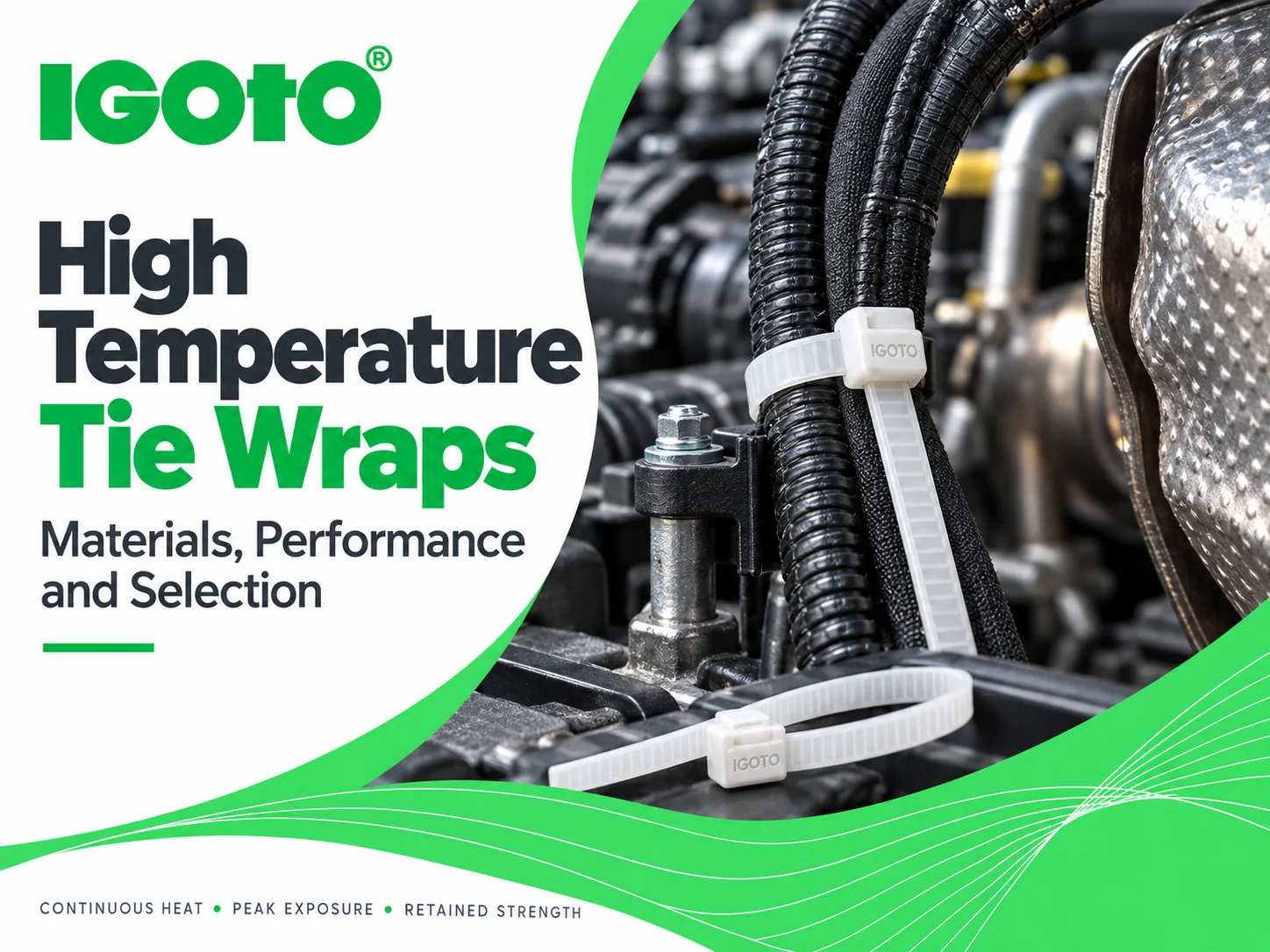
Temperature limits and the heat factor
While UV is the main concern outdoors, heat limits how high the temperature can go, since no amount of stabilisers will help. Standard nylon 6/6 has a continuous service temperature of approximately 85°C (185°F), it softens long before it melts and melts at an approximate temperature of 250-260°C (480-500°F). Heat-stabilised nylon lifts this limit to about 125°C (257°F), while stainless steel has an operating temperature of 538°C (1,000°F) and is fireproof.Where a tie stops being heat resistant in practice is a separate question from where it melts, and the continuous rating rather than the melting point is the number to check against the actual service environment.
Failures of real-life nature occur in the zone between melting point and functioning temperature. A cable tie in deployment will deform and creep long before it has the chance to melt, whether it is around the exhaust manifold or on a hot process line or wherever it is in direct sunlight. Cold causes the opposite effect. Nylons are usable at temperatures down to about -40C, but this material is less resistant to shocks. Therefore, a cable tie that has had its strength already weakened by UV degradation will snap far more easily when exposed to low temperature of -10C compared to high temperature of +20C.
Warning signs that your ties are failing
Recognizing outdoor tie malfunction can be easy if you know what signs to keep an eye on for and a five-minute inspection is preferable to a call-out in January. Here are four main signs that should be watched for, listed in order of importance.
- Chalking. Touch the strap surface with your finger. If you see a white powdery deposit, it indicates that carbon black food is wearing off and the nylon part is being exposed. It is the first sign that can be trusted.
- Colour fade. If your black one is turning gray or your colored one is turning yellow, it means that oxidation has started. The tie will soon break although it may still feel solid.
- Surface cracks. Observe bend points and the area around a locking head for cracks. If hairline fractures develop in these areas, the tie has lost its structural integrity.
- Sagging and creep. Cables that have sagged or ties that have stretched without breaking are a sign of overheating and excess load. In other words, installation has lost its grip, and re-tensioning won’t solve the issue.
It is possible to use one vital operational rule: age of the element is the same across the whole installation, so should one tie show chalking that means every other tie from the same batch has also aged. Thus, you should replace them in batches.
How to get more years out of an outdoor installation
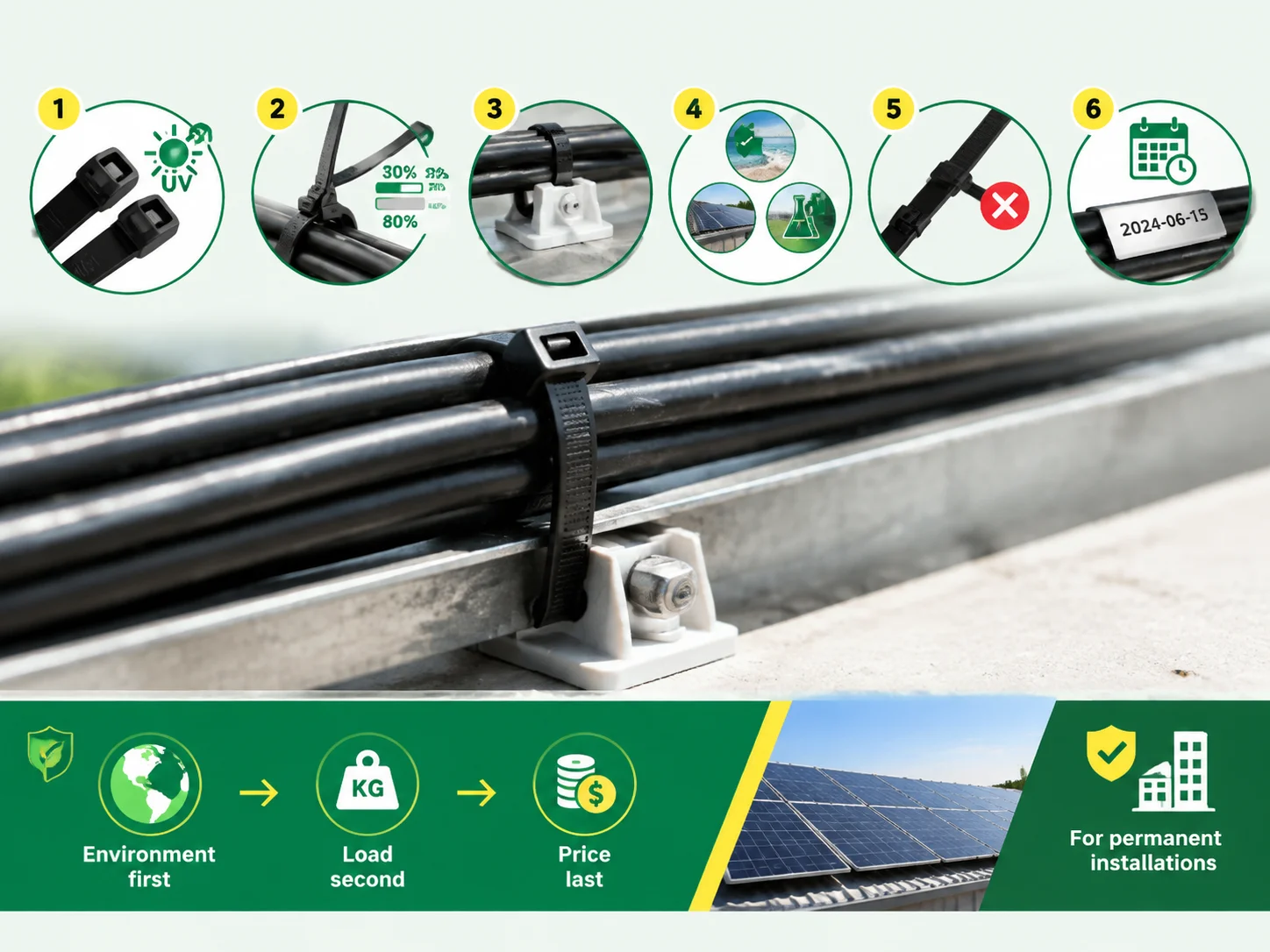
Only six choices make the bulk of the changes happen, and all these choices occur prior to the start of construction and not afterward.
- Opt for black and UV-proof materials, along with the proof that comes with the package. The appearance of the material alone does not mean it is of high quality.
- Make the size of the tie larger than what is required. When a tie performs at 30% of its actual strength instead of 80%, longevity is much greater because of the reason that creeps ruin the outstanding tie over the years.
- Use support bases or standoff. A tie attached directly to a hot place or some sharp edges breaks early while being mounted correctly prevents both overheating and abrasiveness.
- Use the right material for the right environment. Improved quality pays off, hence there should be not looking for it.
- Do not reuse ties. After being tensioned and cut, it is already damaged even without being detected.
- It is essential to put down the date of installation. Since failure happens to the batch, the replacement can be planned instead of being an unexpected one.
Where the installation is permanent by design — a rooftop array, a marine fitting, a piece of signage intended to last as long as the building — the simplest way to make the whole question of lifespan irrelevant is to stop specifying plastic. For everything else, the six decisions above map onto the ordinary cable tie selection process almost without modification: environment first, load second, price last. Get that order right and the material decision, not the maintenance schedule, is what determines whether anyone visits the installation again next year.
FAQ
How long do zip ties last in the sun?
The operational life of black nylon cable lies between five and 10 years under average temperature (temperate) conditions. This reduces to less than three years in arid/altitude climate condition. Therefore, the lifespan of typical colored/natural ties that do not have UV-stabilized properties (such as jute) will often only lie between six and 12 months as these materials get dried out (get brittle). In contrast to this, stainless steel ties do not get affected by sunlight and, hence are expected to last for more than 20 years.
How do I know if zip ties are UV resistant?
The packaging marked as “UV resistant” or “outdoor rated” is indicated along with the grade of nylon 6/6 or P66; black cable ties are made with compounded black materials with the addition of carbon black and thus have some degree of UV resistance. This should not be the case for a low-priced black cable tie, though. A low grade black cable tie can simply be a white cable tie dyed black where the core material is not treated with any UV protection. Well-known distributors stock both UV resistance info and data from accelerated weathering tests based on ASTM G154 and ISO 4892-3 standards.
How long do zip ties typically last?
Generally, a self-mountable textile strap will have a long period of service life in the house and it may last for the whole service life of the mounted device. But the average period of service for a non-stabilized strap outdoors, on the other hand, will vary from six months to one year depending on environmental conditions. A black stabilized strap can have an average of 12-15 years and even more than 20 years lifetime in moderate or extreme climatic conditions. However, the actual lifetime of the strap can be significantly shortened due to loading, excessive heat, and abrasion.
At what temperature will a zip tie melt?
Standard nylon 6/6 has a melting point that ranges from 250 to 260 degrees Celsius (480 to 500 degrees Fahrenheit) but its usability is limited until the temperature gets to a range of 85 degrees Celsius (185 degrees Fahrenheit) where it begins the process of softening and creeping which occurs before its melting point. Heat-stabilized nylon can be made use of when operated at an approximate temperature of 125°C (257°F). ETFE has a usable temperature range of about 180°C (356°F) and PEEK can operate at temperatures of around 260°C (500°F) while the temperatures that stainless steels can operate at may go as high as temperatures of around 538°C (1000°F) owing to their nature of being fire resistant.
References
- ASTM International — ASTM G154: Standard Practice for Operating Fluorescent Ultraviolet (UV) Lamp Apparatus for Exposure of Materials
- ISO — ISO 4892-3: Plastics — Methods of Exposure to Laboratory Light Sources (Fluorescent UV lamps)
- UL Solutions — UL 746C: Polymeric Materials — Use in Electrical Equipment Evaluations
- HellermannTyton — Cable Tie Technical Data and Outdoor Ratings
- Panduit — Outdoor Cable Ties and Weathering Performance Data
Conclusion
There are four factors that affect the amount of time that zip ties remain functional when they are used outside: the type of zip tie, the manner in which the zip tie is manufactured to be UV resistant, climate and the load being supported by the zip tie. Unstabilized nylon will last only a few months compared to black UV stabilized nylon, which has a performance life of five to ten years in temperate climates. Nylon 12, ETFE and stainless steel zip ties have the potential to last longer than twelve years; however, steel zip ties are the only material that provides a guarantee for permanent outdoor installation. Therefore, when selecting UV resistant materials for outdoor use, it is important to consider that a broken tie still appears to be intact and can still support as much as 80% of its load. Therefore, it is important for users to be educated on how to recognising signs of deterioration and how to perform batch replacements when necessary.