



Cable Ties: How to Choose the Right Size, Strength & Material
Cable ties are the kind of tool that is inconspicuous yet crucial: they appear frequently in our daily lives, yet few people give much thought to how to select the right one. Often, we simply grab a few from a drawer to get the job done—which suffices for most everyday applications. However, when it comes to specialized tasks, the choice of cable tie becomes critical, as it directly determines whether the fastening will hold for years or fail after just a few weeks.
If a cable tie lacks sufficient strength, it is prone to snapping under tension; using an indoor-rated tie outdoors causes it to lose rigidity due to UV exposure; and selecting a size far exceeding actual requirements results in unnecessary waste. Learning how to choose the right cable tie is not complicated, but it does reward a few minutes of thought.
If you aren’t very familiar with cable ties, this article is worth a read. It will help you solve a practical problem: which type of cable tie to choose for a given situation.
Why Choosing the Right Cable Tie Matters
Most people view various types of zip ties as generic tools that all serve the same purpose. Indeed, most zip ties look alike, are inexpensive, and function by wrapping around a bundle of wires and locking with an audible “click.” However, this superficial resemblance masks substantial differences—differences that often come to light at the very moment you least want a problem to occur.
As the name implies, a cable tie is a strap used for binding goods; its performance depends primarily on the interplay of four factors: dimensions, tensile strength, material, and the compatibility of these characteristics with the actual operating environment. When these four elements are properly aligned, the cable tie can function effectively for years; conversely, a failure in even one aspect can lead to the tie’s malfunction—precisely the type of failure it is designed to prevent.
In a typical household storage room, a failed cable tie is merely a minor nuisance. However, inside a power distribution box, a broken or aged tie can cause cables to sag and come into contact with moving parts or heat sources; similarly, if ties not designed for solar exposure are used on rooftop solar arrays, they may degrade and shatter under prolonged, intense sunlight. In these contexts, cable ties—despite their small size—serve as critical load-bearing components within larger systems and warrant serious attention. Let us now examine these four key dimensions one by one.
Understanding Cable Tie Sizes
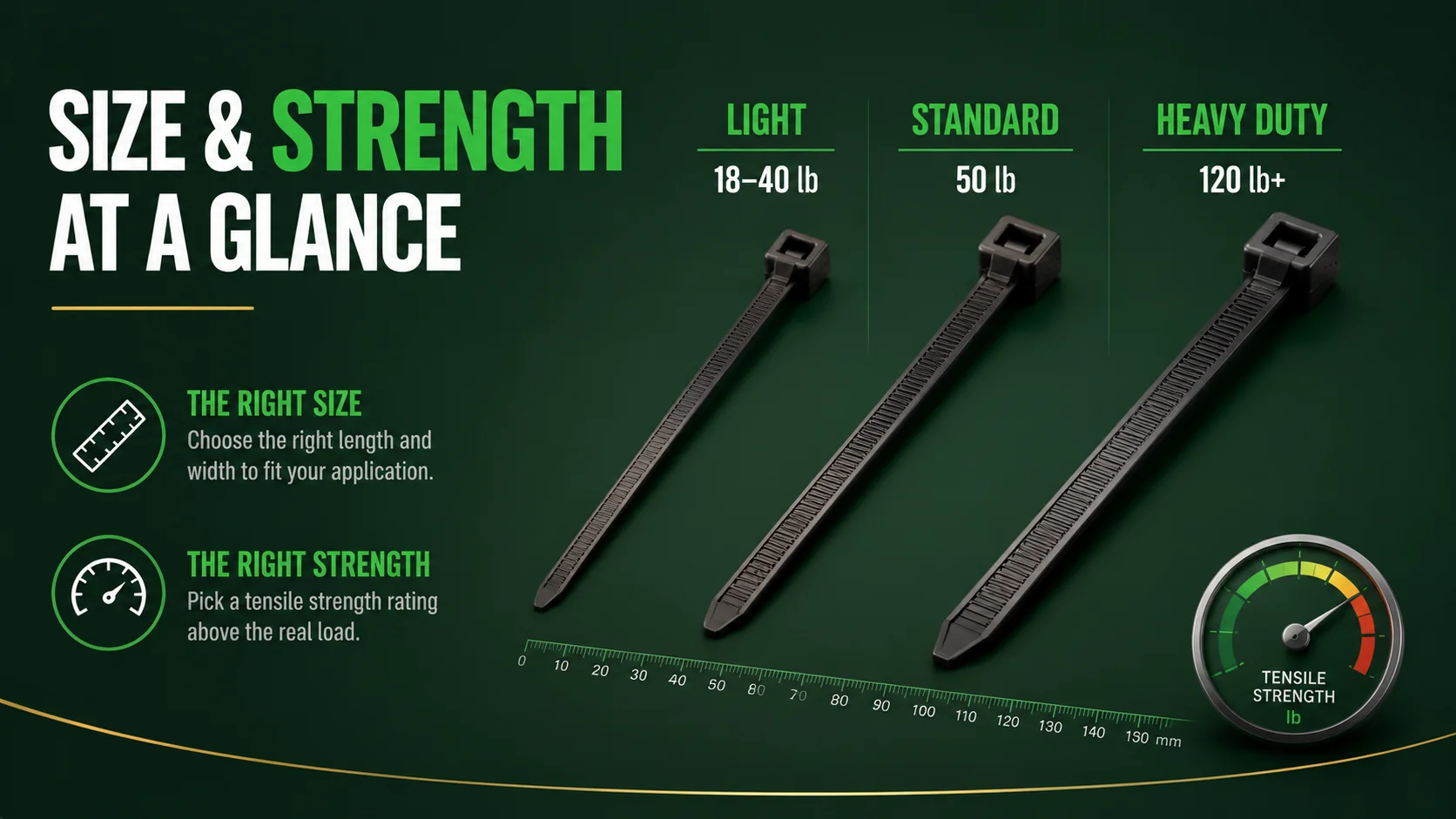
Size is the first thing to get right, and the one most people guess at. A cable tie’s size is described by a few key measurements, and understanding each one keeps you from over-buying or under-buying.
Length is the total usable length of the strap, usually in inches or millimeters, and it is the number printed most prominently on the bag. Common lengths run from tiny four-inch ties up to giant forty-inch straps. Length matters because it sets the largest bundle a single tie can wrap around.
Bundle diameter is the practical number that flows from length. Every tie has a maximum bundle diameter it can close around and, just as importantly, a comfortable minimum. A good rule of thumb is to pick a tie whose length gives you a little slack past the bundle so the tail feeds cleanly into the head. A tie that only barely reaches around a bundle is frustrating to work with and leaves almost no tail to grip.
Width quietly does a lot. Wider straps distribute load over more surface area, resist stretching, and generally carry higher tensile ratings. Narrow ties are neater and more flexible for delicate bundles; wider ties are the workhorses for heavy loads. When two ties share the same length but different widths, the wider one is almost always the stronger one. Thickness, though rarely printed, adds to that strength and stiffness.
A simple way to shop: measure the diameter of the largest bundle you will tie, add a bit of margin, and choose a length comfortably above that. Then let the width follow from how much load the bundle places on the tie. It is far better to have a couple of inches of spare tail than to fight a tie that is fractionally too short.
Cable Tie Tensile Strength Explained
If size answers “will it fit?”, strength answers “will it hold?” Cable tie tensile strength is the force a tie can withstand before it breaks, expressed in pounds (lbs) or newtons. You will see it printed as a number like 18 lb, 50 lb, 120 lb, or 175 lb, and it is arguably the single most important spec for any load-bearing job.
People often misunderstand the concept of nominal ratings, confusing the breaking limit with the recommended working load. Cable ties should not be used near their breaking point. Professionals typically incorporate a safety margin—accounting for factors such as material fatigue, temperature fluctuations, and load shifting—by selecting ties with a rated strength significantly higher than the actual load they will bear. A common practice is to limit the actual working load to between one-third and one-half of the nominal rating, thereby providing ample headroom for the stresses the tie will endure during long-term use. Furthermore, it is important to consider that a cable tie’s effective strength decreases as temperatures rise; a tie that easily handles a load in a cool indoor environment might be pushed to its limit if exposed to the heat of an attic or an engine compartment.
Roughly speaking, light ties in the 18-to-40-pound range handle everyday bundling of small cables, cords, and household tasks. Standard ties around 50 pounds cover the vast majority of general-purpose work. Heavy-duty cable ties from 120 pounds upward are for thick cable trunks, pipe, signage, and construction jobs where a failure would be costly. For the most demanding loads, stainless steel cable ties push into the several-hundred-pound range. When in doubt, size up — the cost difference between a 50-pound tie and a 120-pound tie is trivial; the cost of a failure is not.
A Guide to Cable Tie Materials
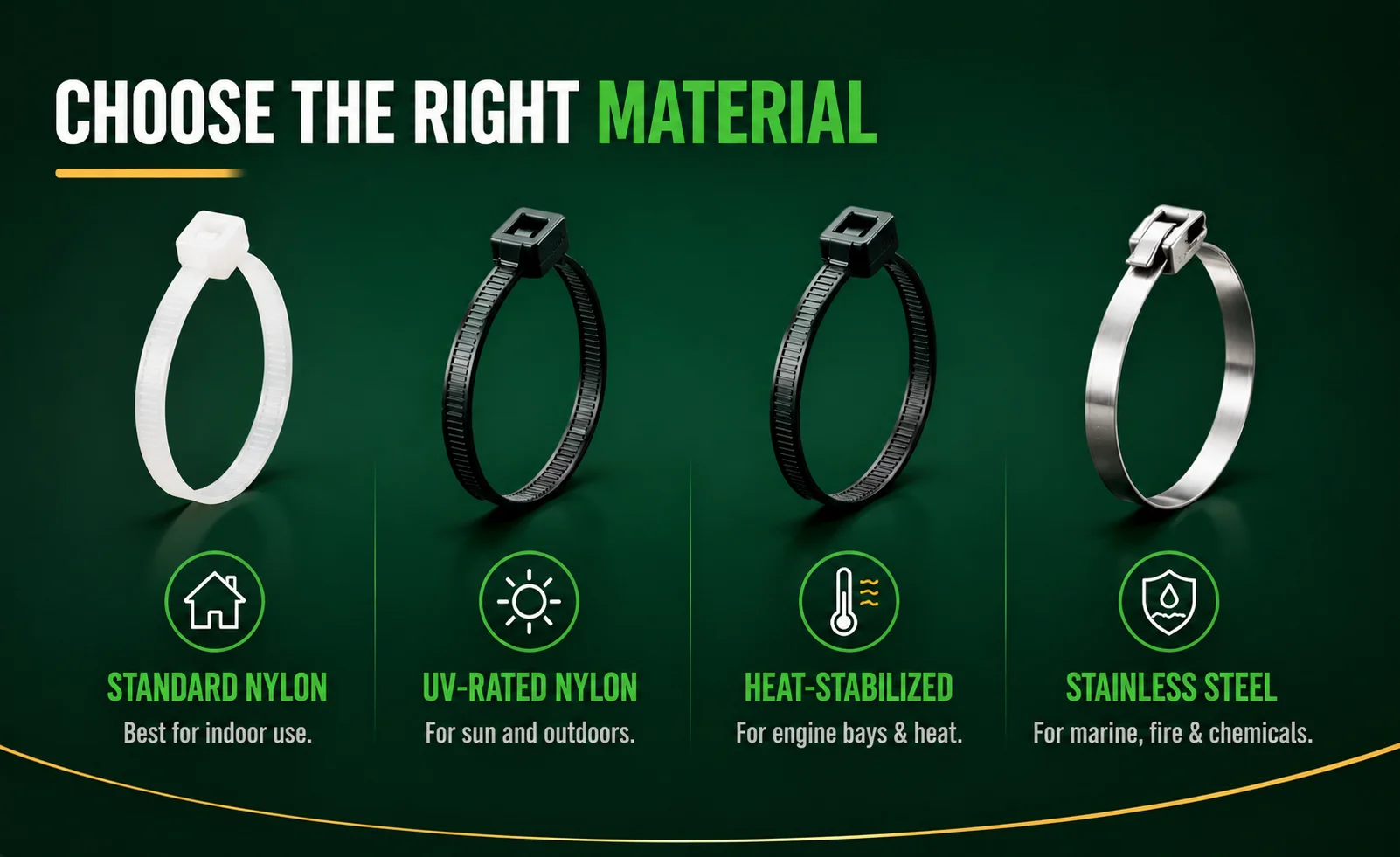
Material is where cable ties quietly diverge into very different products that happen to share a shape. The strap’s cable tie material determines how it behaves under heat, sunlight, chemicals, and time.
Nylon 6/6 is the default and, for good reason, the most common material by far. It is strong, flexible, abrasion-resistant, and inexpensive, and it performs well across a wide temperature range — typically from around minus forty degrees Fahrenheit up to about one hundred eighty-five degrees Fahrenheit. Standard nylon cable ties are naturally a translucent off-white and are intended for indoor use.
UV-resistant cable ties use the same base material with carbon black and UV stabilizers added, which is why weather-rated ties are almost always black. This is the single most common mistake people make: using a standard off-white indoor tie outdoors, where ultraviolet light attacks the polymer and makes it brittle until it cracks. If a tie will ever see sun, choose a black, UV-rated one, and check the packaging rather than assuming color alone guarantees protection.
Heat-stabilized nylon is formulated for high-temperature environments like engine bays and industrial equipment, holding its integrity where a standard tie would soften.
Stainless steel cable ties are a different animal entirely. Made from grades such as 304 or 316 stainless, they shrug off extreme heat, fire, corrosion, and chemicals, and carry enormous tensile ratings. They are the go-to for marine environments, refineries, tunnels, and anywhere fire safety or corrosion resistance is non-negotiable. They cost more and need a tensioning tool to install cleanly, but nothing else matches them for durability.
Specialty materials round out the field: weather-resistant polypropylene resists many chemicals, fluoropolymer ties handle aggressive chemical environments, and detectable ties loaded with metal or blue pigment are made for food and pharmaceutical plants so a broken piece can be caught before it contaminates a product.
Matching the Tie to the Environment
Once you know the material families, matching a tie to its environment becomes mostly common sense. Ask a few quick questions before you buy.
Indoor or outdoor? Indoors, standard nylon is fine. Outdoors, you need outdoor cable ties with UV resistance — full stop. How hot or cold? Standard nylon covers ordinary ranges; genuinely hot or freezing environments call for heat-stabilized nylon or stainless steel. Wet, salty, or chemical exposure? For constant saltwater, harsh chemicals, or wash-down areas, step up to stainless steel or a chemical-resistant specialty tie. Fire safety? Many quality nylon ties carry a UL 94 V-2 flammability rating, meaning they self-extinguish rather than feeding a flame; where that matters, look for it on the packaging or move to steel.
The theme running through all of this is simple: the environment, not the price tag, should drive the material choice. A cheap tie in the right material beats an expensive tie in the wrong one every time.
Head Styles and Special Features
Beyond size, strength, and material, cable ties come in a surprising variety of head designs that make specific jobs easier.
- Standard ties use a one-piece nylon head with an internal pawl that ratchets over the strap’s teeth and locks. They are permanent — install once and cut off to remove. Simple, cheap, and reliable.
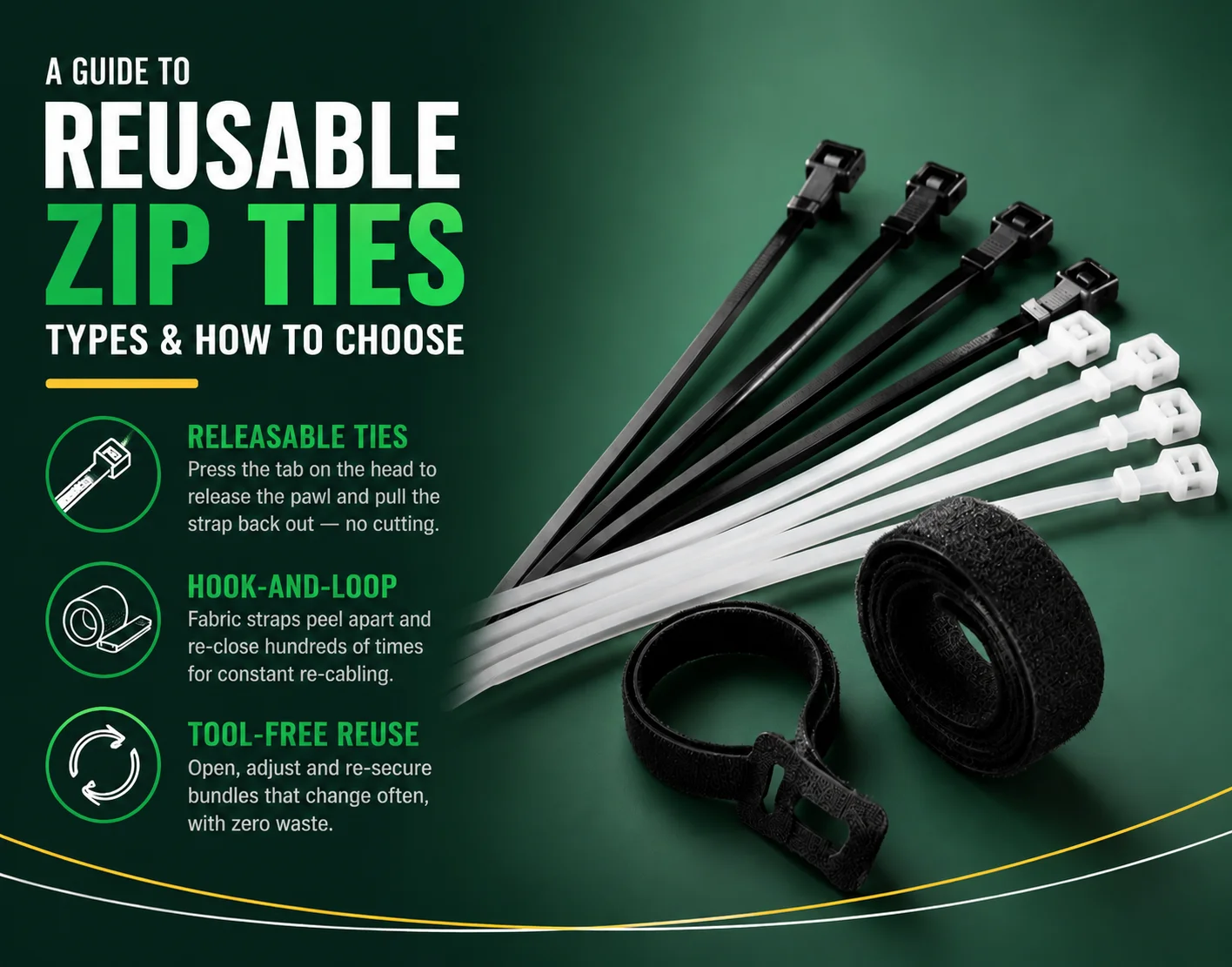
- Releasable cable ties have a small lever on the head that releases the pawl so you can open and reposition the tie without cutting it. These reusable cable ties are ideal wherever you expect to add or remove cables later.
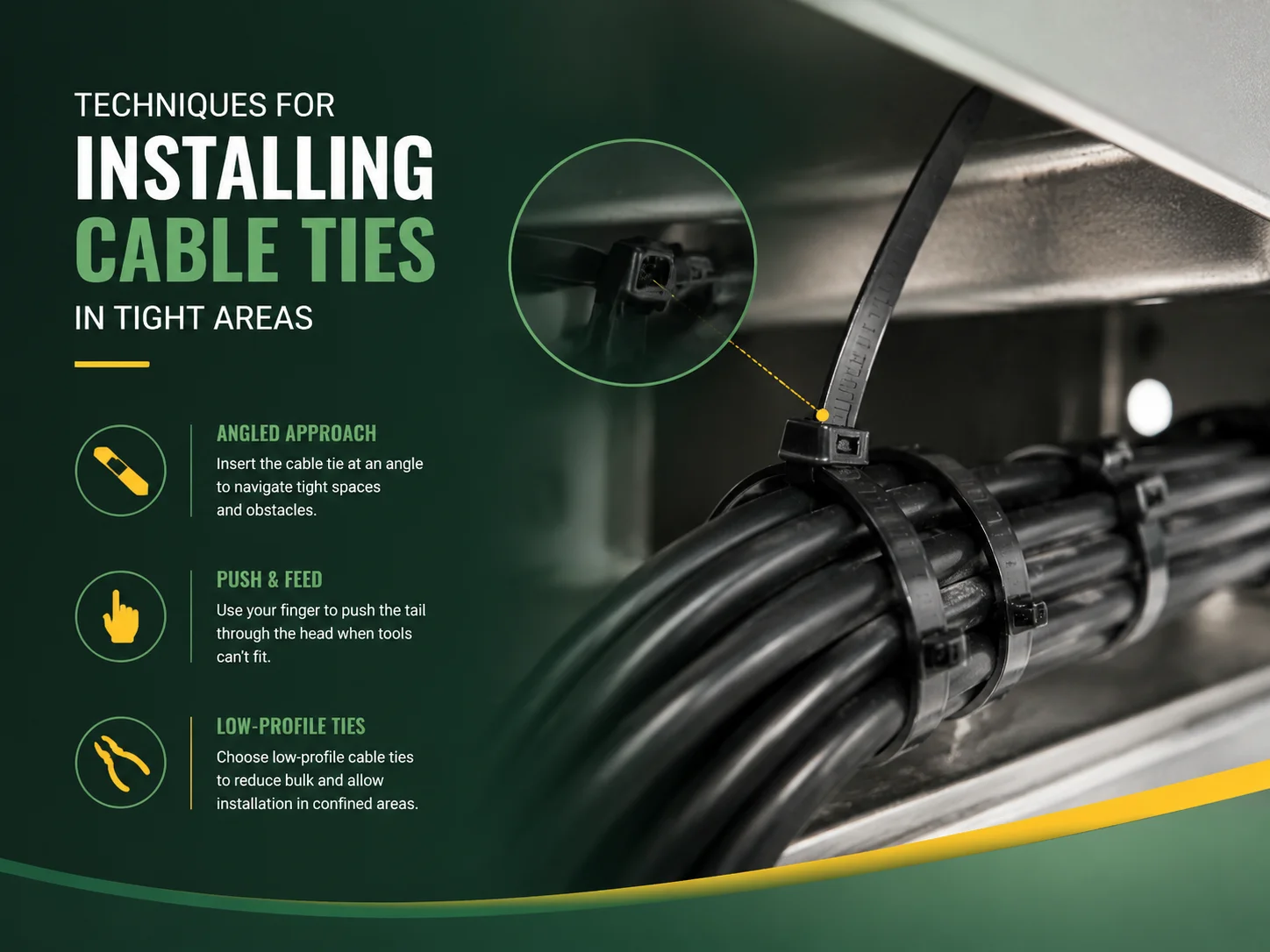
- Low-profile ties have a slimmer, flatter head that sits flush in tight enclosures where a bulky head will not.
- Mounting-hole ties include a molded eyelet so you can screw the tie directly to a wall, panel, or beam, turning a simple bundle into an anchored one.
- Marker ties feature a flat blank tab where you can write a label — invaluable for identifying individual cables in a crowded panel or server rack.
Head style will not change whether a tie holds, but it can dramatically change how clean and fast the installation is — and tidy installations are easier to maintain and inspect.
Cable Ties by Application
Sometimes the fastest way to choose is to start from the job rather than the spec sheet.
- Electrical and networking: standard nylon around 50 pounds covers most bundling, with marker ties for labeling and releasable ties where cables get swapped. Look for a UL 94 V-2 rating near electrical enclosures.
- Automotive and machinery: heat-stabilized nylon under the hood, standard nylon for interior runs, and mounting-hole ties to anchor harnesses against constant vibration.
- Outdoor, landscaping, and solar: everything comes back to UV. Black, UV-rated nylon is the baseline, and on rooftops and solar arrays it is not optional.
- Marine and corrosive settings: stainless steel ties, ideally grade 316 for the harshest salt exposure.
- Food and pharmaceutical: detectable ties let broken fragments be found before they contaminate a product.
- Home and DIY: an assortment of standard nylon in a couple of sizes, plus a pack of releasable ties for things you will adjust later.
Color, Quality, and Common Mistakes
Color can carry real meaning beyond the black-equals-UV convention. Electricians and network installers assign colors to circuits, phases, or cable types so a run can be identified at a glance months later. On anything with many parallel runs, a simple color code pays off every time someone traces a cable.
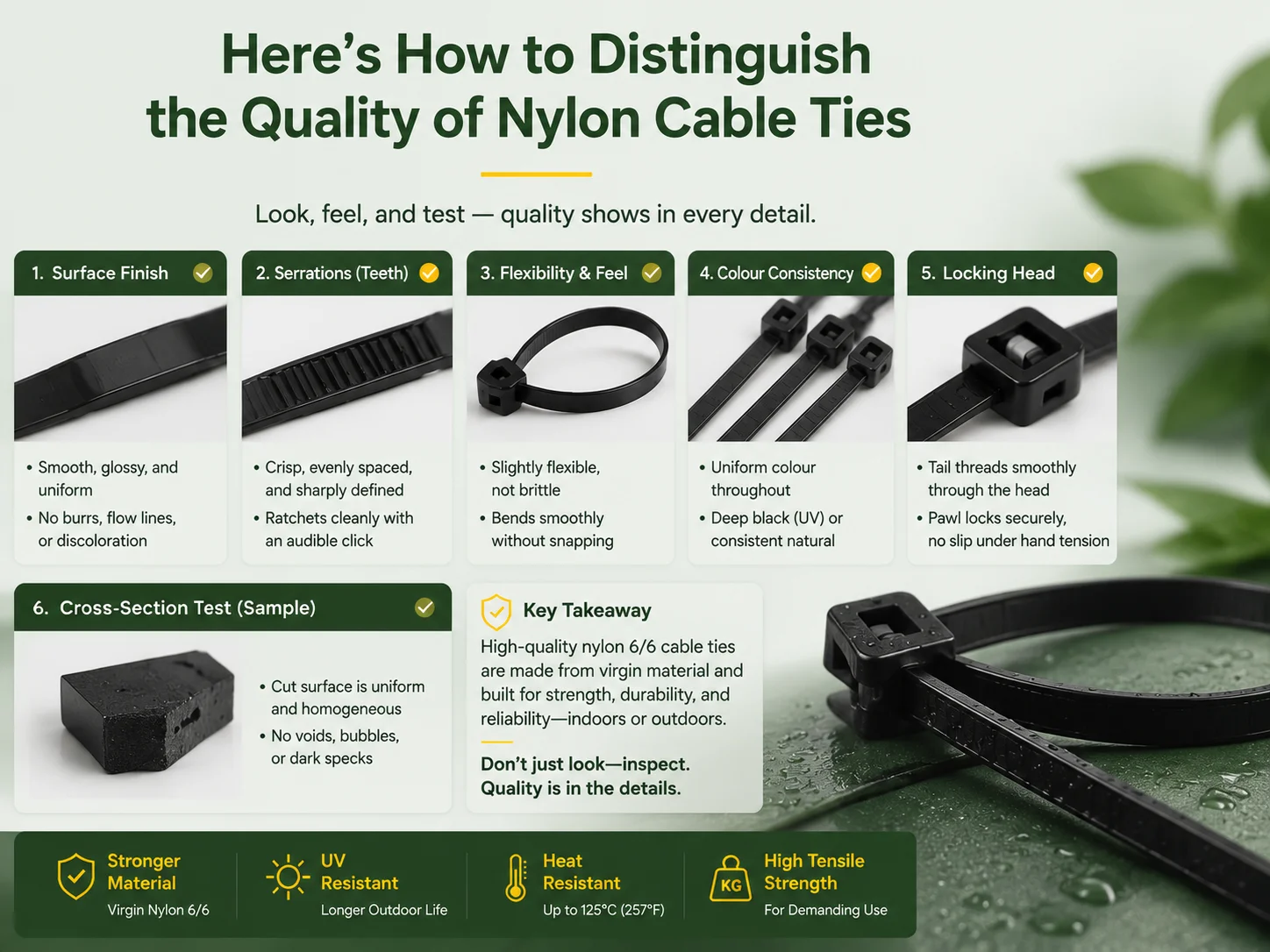
Quality also varies even when the printed specs match. Premium nylon cable ties are molded from virgin nylon 6/6, which gives consistent strength, clean flexing, and reliable UV and heat performance. Cheaper ties made from reprocessed or regrind material feel dry or chalky, show flow lines or discoloration, and either snap when bent or fail to reach their advertised rating. A good tie has a smooth, glossy surface, crisp evenly spaced teeth, and a pawl that clicks cleanly and holds firmly without slipping when you pull the tail. When cut through, a quality tie shows a clean, uniform cross-section rather than a grainy or flecked one. These small signs separate a tie that truly meets its rating from one that merely claims to, and they are worth a quick check before you commit to a large batch for a demanding job.
Finally, a handful of mistakes cause most failures, and all are easy to avoid: using indoor ties outdoors, choosing a tie too close to its breaking strength, over-tightening until the tie bites into cable insulation, cutting the tail into a sharp stub, and prying open a permanent tie to reuse it. Sidestep those five and your installations will look professional and last.
A Quick Selection Checklist
When you are standing in front of a wall of cable ties, run through these questions and you will land on the right product almost every time:
- How big is the bundle? Choose a length that wraps it with a little tail to spare, and let width follow from the load.
- How much load will it carry? Pick a tensile rating comfortably above the real force, never right at the limit.
- Where will it live? Indoors, standard nylon; outdoors or in sun, black UV-rated nylon; extreme heat, cold, salt, or chemicals, heat-stabilized nylon or stainless steel.
- Will you need to reopen it? If yes, choose releasable ties; if no, standard permanent ties are cheaper and stronger.
- Do you need extras? Mounting holes, label tabs, low-profile heads, or color coding can each save time on the right job.
Choosing With Confidence
Cable ties reward a little forethought out of all proportion to their cost. The difference between the right tie and the wrong one is a few cents and a few seconds of thinking, yet it determines whether a bundle holds for a decade or fails within a season. Get the size right so it fits, the strength right so it holds, the material right so it survives its surroundings, and the style right so the job goes smoothly — and the humble cable tie will do exactly what it has done reliably for over half a century: hold things together and quietly disappear.