



What Are the Toughest Zip Ties Available?
Some fastening jobs do not tolerate failure: bundling heavy cable trays, securing a load in transit, holding a spring under tension, or locking down equipment on a truck or machine. When it comes to these jobs, just having ordinary zip ties will not help — you would require the strongest cable ties available in the market. This guide explains what exactly does “strong” mean in terms of a cable tie, what the strongest types of cable ties are, when each one can be used, which companies manufacture them, and how much they cost.
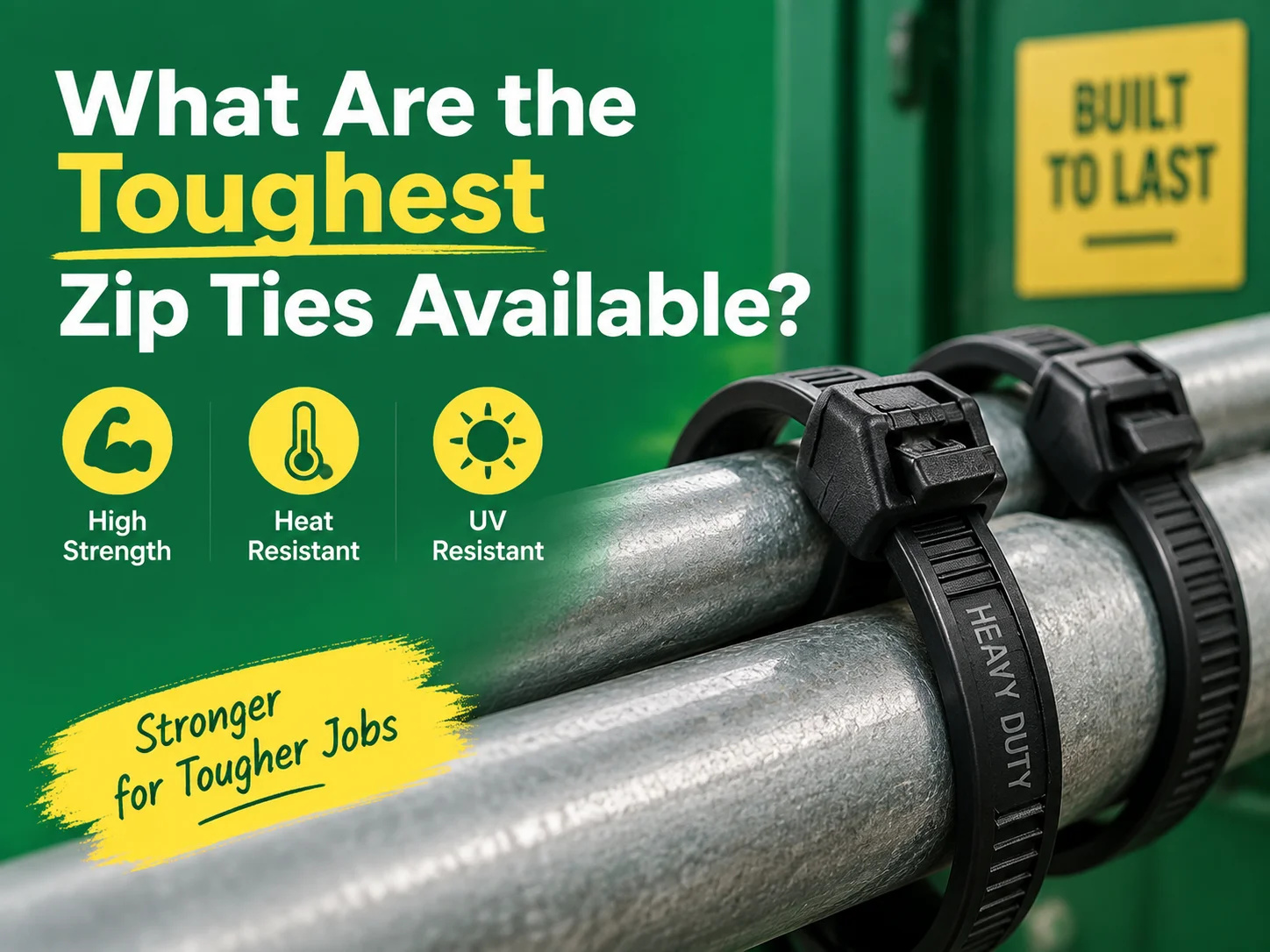
The best zip ties can be classified into three types. The synthetic nylon 6/6 zip ties are the toughest plastic variety,since the largest variety can withstand up to 250 lbs (about 113 kg) tensile, and various outdoors and high-temperature varieties are UV-light and heat-stable. Stainless steel zip ties are even more durable, being able to withstand 250-600 lbs of tensile strength, and UV-light and heat (up to 1000 F or 540C). For the exotic variety, there are ETFE (Tefzel) zip ties made of radiation-resistant and chemically stable material which are mainly used in nuclear plants, being considered the most durable zip ties ever.
What “Tough” Means in a Cable Tie
The phrase “toughest zip tie” can usually refer to just one or more of four properties, hence it makes sense to discuss them separately since there is no zip tie that features the maximum in all four properties.
- Tensile strength — the maximum load for straight pull until breakage, this is the number indicated on every zip tie package (50 lb, 120 lb, 250 lb, 600 lb).
- Environmental resistance — durability against UV rays, heat, chemicals, and salt. Stainless steel zip ties are resistant to all of these factors; nylon zip ties require special stabilization.
- Cut and abrasion resistance — the ability to resist cutting edges and chafing, which is where steel ties are unbeatable.
- Clamping and holding force — the ability of the head to lock tightly and hold tight under shaking, and good design plays almost as important role here as the choice of materials.
The key is to combine the right toughness with the right environment — because the strongest nylon tie in the world will fail in a couple of months when exposed to the sun if it is not UV-protective, while the steel tie will survive even the strongest building but is too much when it comes to temporary needs.The material comparison that frames this decision — nylon versus stainless across every axis — is covered in the stainless vs nylon cable ties guide.
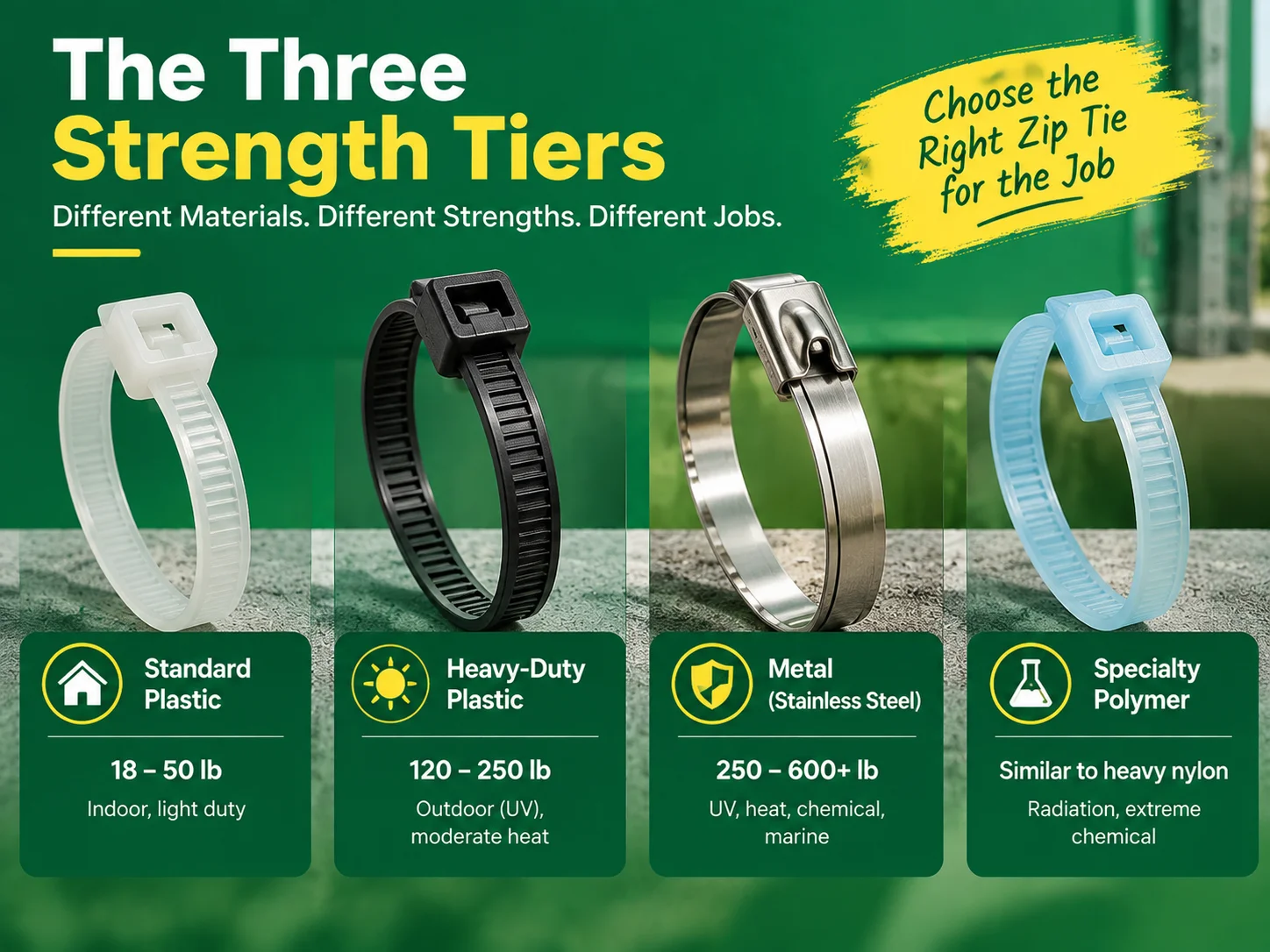
The Three Strength Tiers
| Tier | Type | Tensile Strength | Environment Limit |
|---|---|---|---|
| Standard plastic | Nylon 6/6, 18-50 lb | 18-50 lb | Indoor, light duty |
| Heavy-duty plastic | Nylon 6/6, UV/heat-stabilized | 120-250 lb | Outdoor (UV), moderate heat |
| Metal | Stainless steel 304/316 | 250-600+ lb | UV, heat, chemical, marine |
| Specialty polymer | ETFE (Tefzel-type) | Similar to heavy nylon | Radiation, extreme chemical |
A critical observation regarding the term “strongest”: the absolute strength of engineered stainless banding systems (meaning BAND-IT style steel band and buckle) and ball-lock steel ties are higher than even standard stainless steel ties, which is why they are preferred by municipal, marine, and industrial specifiers in maximum load situations. However, for 99% of people, the choice comes down to heavy-duty nylon ties, and standard stainless ties are about equal in terms of strength.
Heavy-Duty Nylon 6/6: The Strongest Plastic
Heavy-duty nylon 6/6 ties are the workhorses of industrial bundling. In the largest sizes (typically 300 to 600 mm long, 7.6 to 12.7 mm wide), they exhibit tensile ratings in the range of 120 to 250 lb, and quality versions add the benefit of UV stabilization (black) or heat stabilization for specific usages. Their advantages are their price (a fraction of steel up to date), flexibility (they conform around bundles and cushion), non-conductivity and non-marring (they do not scratch the cable jackets), and ease of installation (hand or tool tensioning). Their downsides include degradation with prolonged exposure to UV without stabilization, melting at above approximately 85-120°C continuous, and cutting from sharp edges, resulting in the necessity of having steel there.The heavy-duty size and rating questions — what a 250 lb rating really holds and how the numbers map to jobs — are answered in the heavy-duty zip ties guide.
Stainless Steel: The Ultimate Tie
Stainless steel cable ties serve as a solution in harsh surroundings or conditions. There are two popular specifications: 304 stainless steel for general usage in industry and outdoor settings; and 316 stainless steel for marine and chemical use; there are also coated versions available (vinyl or nylon coated) where there is contact with dissimilar metals or cable sleeves. Depending on the size, these ties can withstand 250-600 lbs; moreover, they can operate at both extreme temperatures (either cryogenic temperatures or 1000F+, which is 540C+) and are not affected by UV radiation; further, they are very secure and do not burn; that’s why they are used in fire safety and marine or nuclear or infrastructure areas.
The trade-offs are: the price of stainless ties is bigger, they require a tightening device for good clamping (hand-tightened steel ties require bigger tensioning), they can cut when you cut them and can’t be reused.The installation technique that keeps steel ties at their rated strength — proper tensioning and flush cutting — matters more than the brand, and the UV and outdoor context for choosing between nylon and steel is in the UV resistance guide.
ETFE and Specialty Ties
ETFE (ethylene tetrafluoroethylene, marketed under DuPont’s Tefzel brand) is one fluoropolymer tie that possesses extraordinary properties of resistance to various types of radiation and chemicals and temperature. It is the only correct tie in nuclear power plants, chemical industries, and other similar environments, whereas nylon material fails as well as stainless material corrode, or where there is the necessity of using non-metallic ties. In fact, the best polymer ties ever produced, and their costs are high, being several times more than the cost of stainless products on the market. Only in 1% of cases does the use of ETFE tie become essential, yet in nuclear plants it is mandatory. If you face the need for the use of standard materials in your industry, we recommend using this type of tie.
Brands and Prices (Including igoto)
The tough tie market consists of high-end items fabricated by industrial manufacturers and cheaper products coming from value suppliers.
| Brand | Strength | Typical Price |
|---|---|---|
| Panduit | Industrial benchmark, published ratings | Heavy nylon $15-40/100; stainless $0.60-3/tie |
| HellermannTyton | Global #2, tools and systems | Heavy nylon $12-35/100; stainless $0.50-3/tie |
| Thomas & Betts (Ty-Rap®) | Heritage brand, utility-grade | Heavy nylon $12-30/100; stainless similar range |
| igoto | Factory-direct heavy-duty and stainless, full range | Heavy nylon $6-20/100; stainless $0.30-1.50/tie |
As far as igoto is concerned, this is a manufacturers from China that provides heavy-duty nylon 6/6 and stainless steel belts, in the full range of sizes and at factory prices lower than those of competitors by 30-50%. igoto is renowned not for well-known brands but rather for affordability, variety, and extensive supply options. If you are told to choose a brand based on its brand name only, doing so shall be fine; however, if you are free to select a product based on its specifications, you shall find it reasonable to opt for igoto.The size and rating reference that applies across brands is the standard cable tie sizes guide.
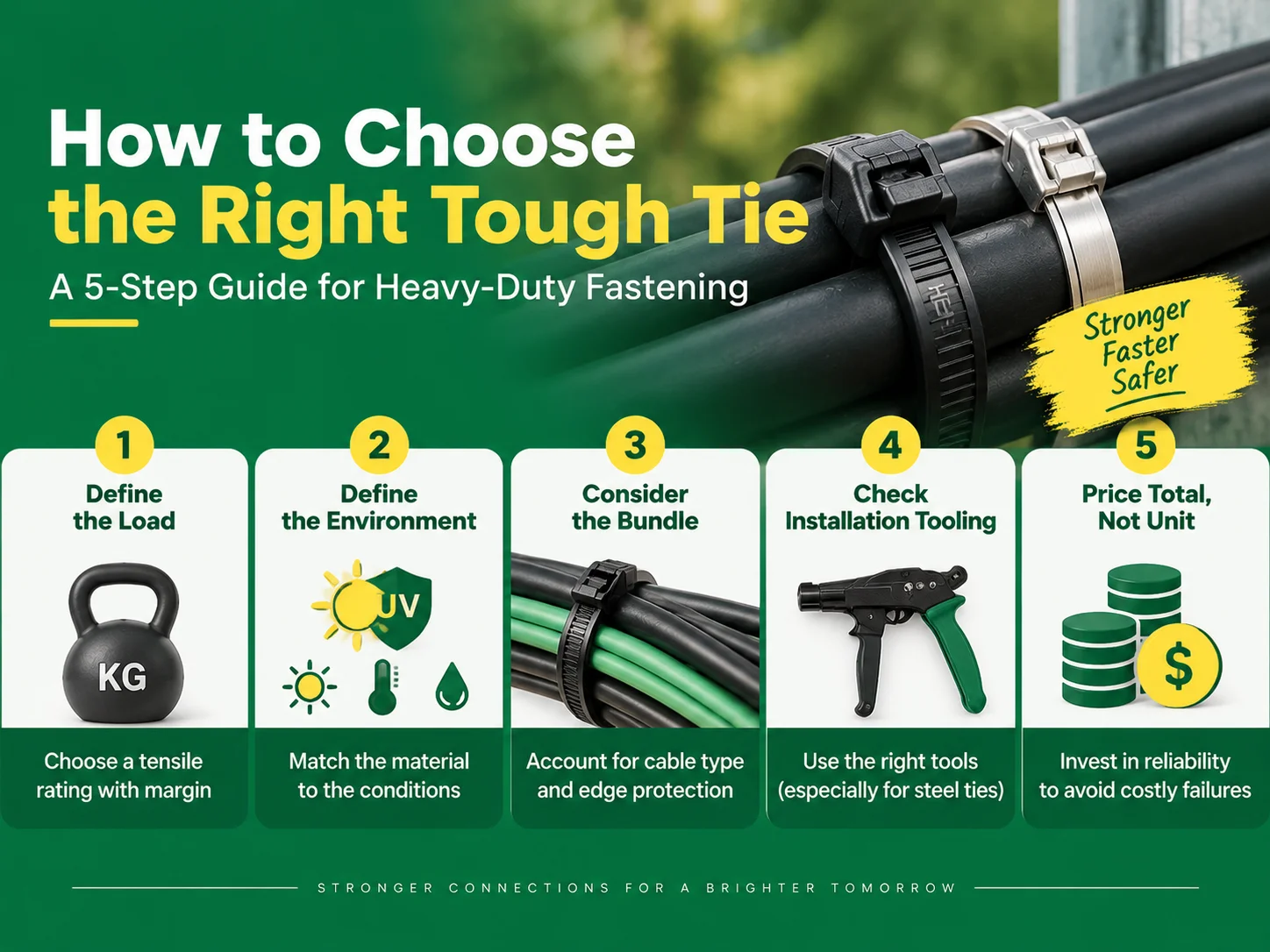
How to Choose the Right Tough Tie
Five steps to follow during any heavy load fastening:
- Identify the load. What is the weight that the fastener will be subjected to? For example, if the load is 100 lbs, a fastener with a tensile strength rating of 250 lbs is safe. However, a fastener rated at 50 lbs will not hold.
- Identify the conditions of use. If the application is outside; sun is exposed, plastic with UV protection or stainless steel ties are needed. If the application is extremely hot, heat-resistant plastics or stainless steel can be used. If your application is in a salt and chemical environment, 316 stainless steel is preferable.
- Take into account the type of bundle. If your cables are flexible, plastic ties are compatible with them. If you have wires or heavy loads, then heavy-duty metal fasteners should be applied.
- Make sure you have all the required tools. If you are using steel ties, you would need a tensioning and cutting tool for fastening. If you are using nylon straps, you can use any conventional tension tools available.
- Calculate the final price instead of the unit price. If you are buying fastening items for difficult applications, the difference in price between the most professional products and regular ones does not really matter compared to the cost if something goes wrong during operation.
FAQ
Which zip ties are the strongest?
When it comes to tensile strength, stainless steel cable ties are the strongest ties available — with a tensile strength of 250-600 lbs or more, depending on their size and with the 316 and coated grades for extreme conditions. With regard to plastic ties, heavy-duty nylon 6/6 is considered the strongest with its capacity to withstand loads up to 250 lbs. When it comes to actual loads, engineered stainless steel banding solutions beat any cable ties.
What are the world’s strongest zip ties?
The strongest cable ties that can be found are heavy-duty stainless steel cable ties and steel banding systems (e.g. BAND-IT band and buckle), perfect for civil engineering, marine and civil infrastructure, boasting tensile strength of over 600 lbs, which works even in UV, heat, and corrosion. The strongest polymer ties happen to be ETFE (Tefzel) polymer ties purpose-made for nuclear and chemical applications.
Where can I buy heavy duty zip ties?
Heavy-duty zip ties can be purchased with the help of industrial distributors (such as Grainger, McMaster-Carr, RS Components), electrical wholesalers, and on the Internet. The brands to look out for are Panduit, HellermannTyton, and Thomas & Betts (Ty-Rap), while users can also take advantage of budget-friendly suppliers such as igoto which sell top-quality heavy-duty nylon and stainless steel cable ties at factory prices.
Is there something stronger than zip ties?
Yes — in addition to heavy-duty ties, engineered stainless banding systems (band and buckle, BAND-IT style) and band clamps exist and offer increased clamping strength capable of handling any loads. For permanent heavy-duty fastening, mechanical fastening becomes the following logical step.
References
- Data Insights Market — Steel Cable Ties Market (Company Shares)
- Panduit — Heavy-Duty and Stainless Cable Tie Ratings
- HellermannTyton — Stainless Steel Cable Tie Range
- ABB / Thomas & Betts — Ty-Rap® Cable Ties
- ASTM G154 — UV Exposure Standard
Conclusion
The strongest zip ties available come in a simple hierarchy: heavy-duty nylon 6/6 up to 250 lb for the heaviest plastic option that is affordable, stainless steel at 250-600 lb for the waterproof option that outlasts the building job itself, ETFE for the nuclear-grade job of shielding from chemicals and radiation, and engineered steel strap for the ultimate in toughness. Toughness is made up of four qualities — tensile strength, resistance to environmental conditions, ability to resist cuts and clamping force — and the right zip tie will maximize the qualities needed for a particular task. Best brands (Panduit, HellermannTyton, Ty-Rap) set the standard for zip ties while the value brands like igoto provide the same heavy-duty nylon and stainless steel products at 30-50 lower prices for people who know what they need and choose the right product. Specify the load, define the environment, plan for the tensioning equipment and select from the suppliers using the guidelines provided in our guide on how to choose cable ties and be assured that the cable tie you chose will hold the load you have specified.