



Flame Retardant Cable Ties: Essential Fire Safety for Electrical and Industrial Wiring
Release Time: 2026-09-04
In electrical installations, mechanical control panels, data centers, and transportation systems, fire safety must be taken seriously. Any short-circuit or overheating incident may produce sufficient heat to ignite normal plastics. Standard nylon cable ties are great for most common use; however, these ties can melt and drip, and burn even once ignited. This means that when a fire starts, nylon ties pose a fire hazard because they can allow fire to go along the cable runs and on to the adjacent equipment. Flame retardant cable ties solve this problem by design. Manufactured from specially formulated nylon 6/6 (PA66) with flame-retardant additives, these ties self-extinguish quickly when the ignition source is removed, limiting fire spread and helping installations meet critical safety codes.
In this guide, readers will learn more about flame resistant cable ties, how the UL 94 rating system works, where flame-resistant ties are needed, how they differ from conventional products, and how to choose the right specification for the project.
What Are Flame Retardant Cable Ties?
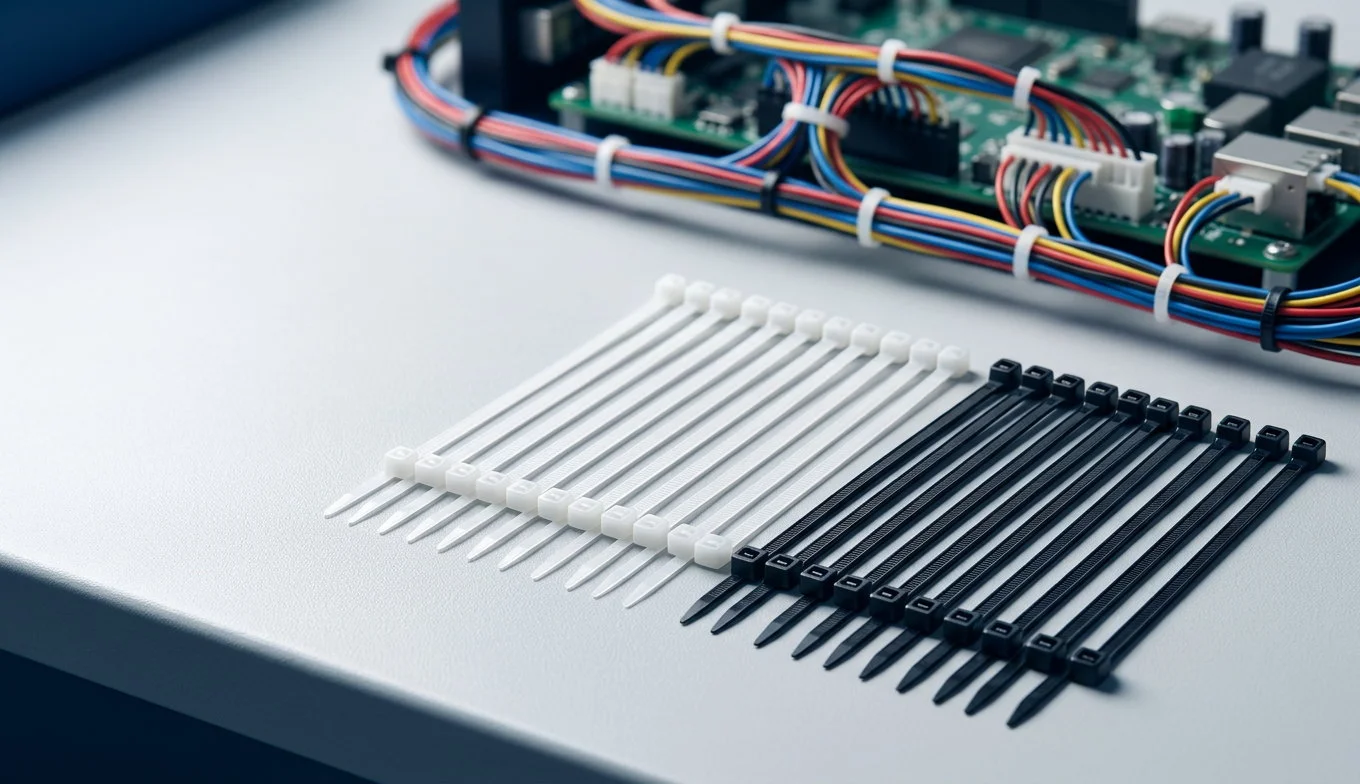
Flame retardant cable ties are nylon cable ties engineered to resist ignition and stop burning within defined time limits after exposure to an open flame. The same base polymer, pure nylon 6/6 (PA66), which is used in high-quality standard ties, is also used as the base polymer, supplemented with many flame-retardant additives during compounding. These additives provide different means of preventing fires from bursting out: they could liberate water or inert gases that cool the materials and dilute combustible gases, create a char that will protect the polymer from both heat and oxygen, and neutralize any free radicals that exist in the gas form.
As a result, we get self-extinguishing fasteners. That is, when the flame is turned on and then off, a good quality flame retardant cable tie will stop burning after a few seconds instead of burning and dripping molten fire. This is a crucial feature for electrical cabinets, switchgear, server cabinets, and other limited spaces where even a small fire has to stay small.
Flame retardant cable ties are used in a different way than common natural or black nylon ties, as they must undergo tests and be certified according to established flammability standards, most often that being the vertical burning test UL 94. This certification serves as a proof for inspectors, engineers, and insurance companies that the manufacturer tells the truth.
Understanding the UL 94 Flammability Rating
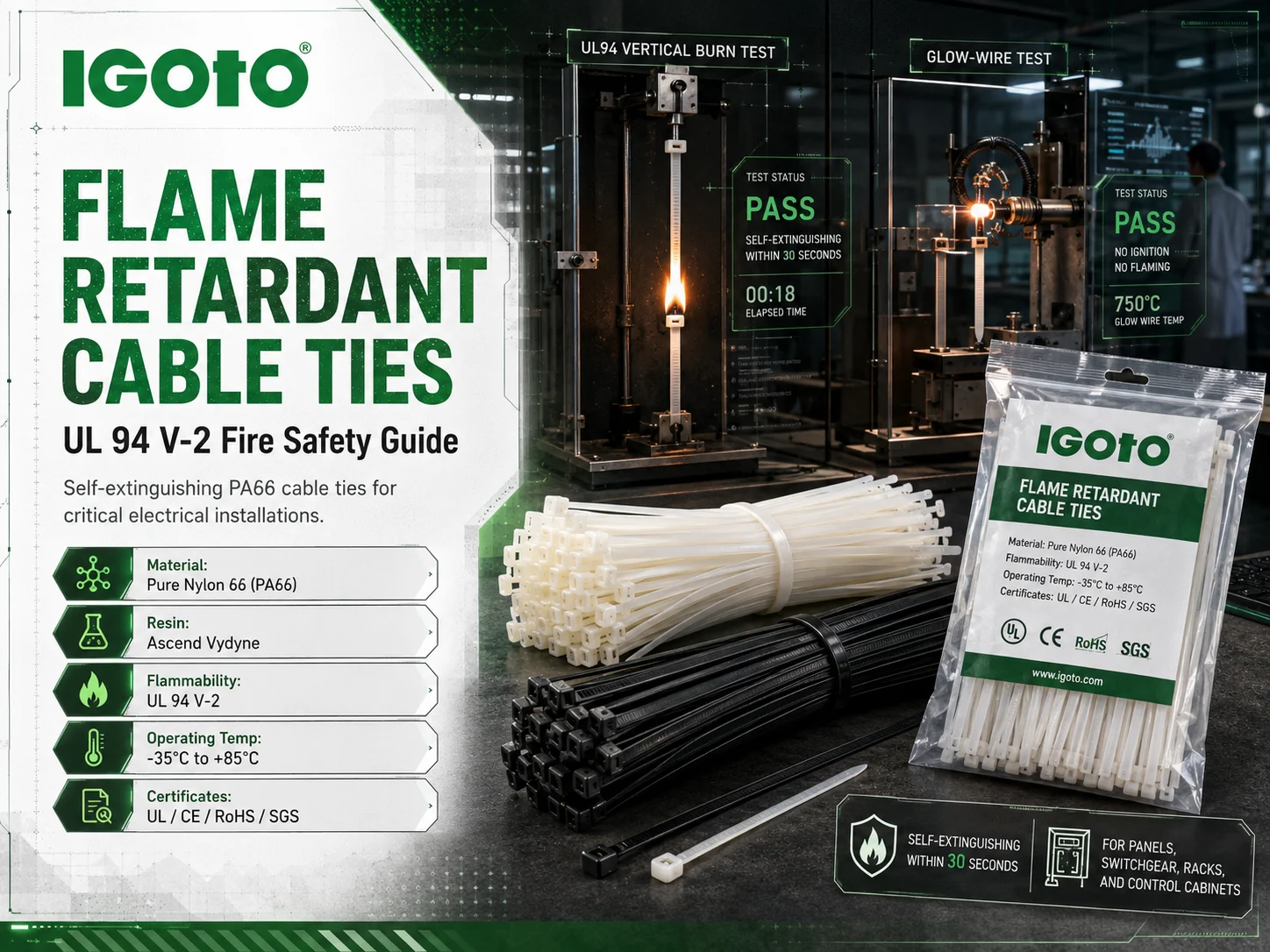
The UL 94 standard is the most widely used protocol for assessing plastic material flammability in electronics and electrical engineering, making it relevant for cable ties in terms of vertical burning designations, such as V-0, V-1, and V-2. The flame is applied to the vertical sample at certain intervals of time and the duration for which the sample continues to burn after the fire is put off is recorded along with the occurrence of flaming drips; this is how the ratings are arrived at.
①.UL 94 V-2: The cable tie material self-extinguishes within half a minute and flaming drips are possible. This is the commonest of all the ratings issued in connection with industrial flame retardant ties.
②.UL 94 V-1: The cable tie self-extinguishes in less than half a minute and no flaming drips occur. It lies between V-2 and V-0 in terms of requirements and rigor.
③.UL 94 V-0: The cable tie self-extinguishes in less than 10 seconds and has no flaming drips. This is the most stringent of the ordinary standards in this regard.
IGOTO flame retardant cable ties meet UL 94 V-2 specifications. It self-extinguishes within 30 seconds and can be used in electrical panels, control boxes, and data center racks. In cases when V-0 criteria are necessary, it may be needed to use special fluoropolymer cable ties like ETFE or ECTFE, but in the overwhelming majority of cases a high-quality UL 94 V-2 nylon cable tie does the job.
It is worth noting that the material flammability rating (UL 94) is not the same as the component rating. If a cable tie has both UL 94 rating and a UL component recognition/listing it means that it is evaluated not only for the material it is made of but also for its suitability as a fastening device for electric purposes. Always check for both if installation has to meet some code or customer requirements.
Key Product Specifications of Quality Flame Retardant Cable Ties
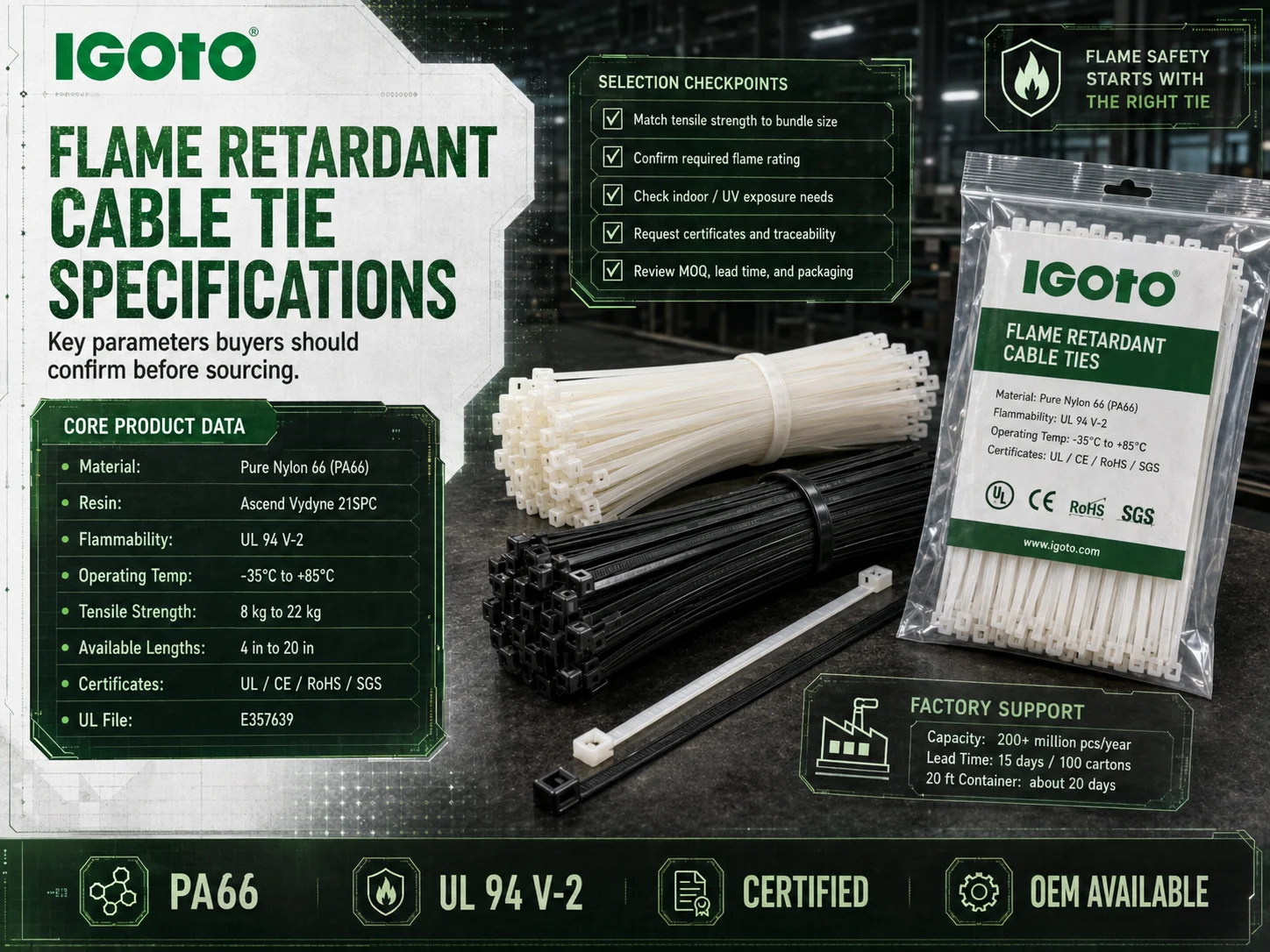
High-performance flame retardant cable ties are able to combine characteristics related to fire resistance with the characteristics related to the mechanical properties of the industrial fasteners. Reliable flame retardant cable ties should have the following specifications:
Material: pure nylon 6/6 (PA66), preferably from a good supplier of resins like Ascend Vydyne. Flame retardant additives are mixed with the base polymer to get the necessary UL 94 rating without losing tensile strength and durability.
Flammability: UL 94 V-2 (self extinguishing in no more than thirty seconds).
Operating temperature: constant service temperature of -35 °C to +85 °C. This operating temperature helps to use the cable ties in indoor electrical environments or industrial areas.
Tensile strength: available from eight kg to 22 kg (approximately from 18 lb to 50 lb and more) thus correspond to the required grades of cable ties so that the designer can choose the cable ties which meet the mechanical specifications and have fire resistance properties.
Length: normally from 4 inches to 20 inches (approximately from 100 mm to 500 mm), allowing covering every bundle size from small and medium cable installations to huge power cables and multi cable installations.
Certifications: UL, CE, RoHS, and SGS certificates. Traceability of materials, starting from resin lot and up to finished goods guarantees quality audits.
The specifications of these products allow the use of flame retardant cable ties in the designs where standard nylon ties were widely used, having just the fire rating as a new requirement.
Where Flame Retardant Cable Ties Are Required
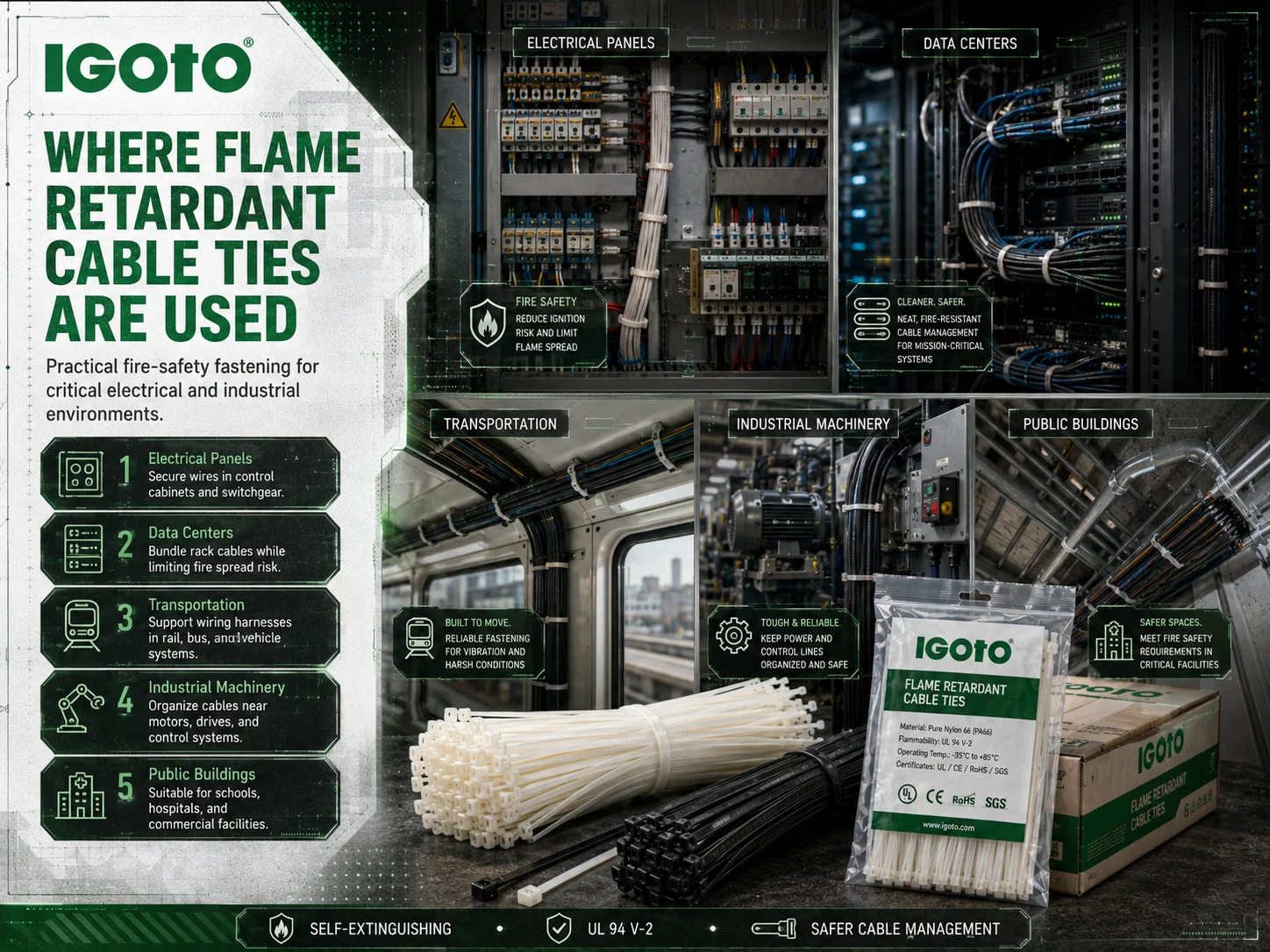
Not every installation needs flame-rated fasteners. In a residential garage or temporary construction site, standard nylon ties are often acceptable. In regulated or high-risk environments, however, using non-rated ties can fail inspection, void warranties, or create unacceptable fire-propagation paths. The following applications commonly require or strongly benefit from flame retardant cable ties:
Electrical Panels, Switchgear, and Control Cabinets
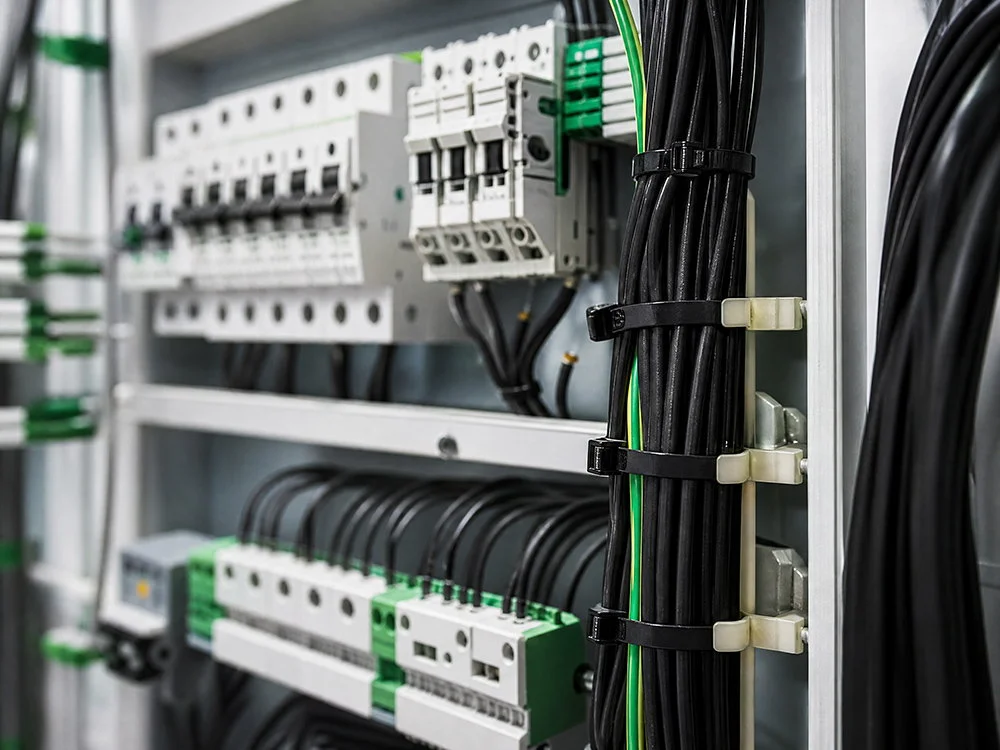
Inside metal or plastic enclosures, cables are tightly packed and heat can build up. A short circuit or loose connection can produce an arc that ignites nearby plastics. Flame retardant cable ties prevent the tie itself from becoming a continuing fuel source. Many panel builders and OEMs specify UL 94 V-2 or better ties as standard practice to maintain the fire integrity of the finished assembly.
Data Centers and Telecommunications
Server racks, overhead cable trays, and under-floor pathways contain dense concentrations of power and data cables. Fire events in these spaces can be catastrophic. Industry specifications such as Telcordia GR-63-CORE and many data-center design standards call for materials with defined flame performance. Flame retardant cable ties meeting UL 94 V-2 (and in some cases V-0 or low-smoke requirements) are routinely used to secure bundles while limiting fire spread.
Transportation – Rail, Aviation, and Automotive
The rail cars, airplanes and buses must adhere to flame, smoke and toxicity (FST) regulations. The materials used in passenger compartments and key components are regulated by standards such as EN 45545 in Europe or NFPA 130 in North America. Although the highest FST requirements may necessitate advanced polymer materials, there are also many situations in which companies rely on flame retardant cable ties made of nylon 6/6 with the necessary additives.
Public Buildings, Hospitals, and Schools
Often in assembly places, hospitals and schools, building codes and fire engineer analyses necessitate the use of fire-resilient cable management. Using fire-proof cable tying in electrical spaces, risers and equipment demonstrates due diligence and can facilitate the inspection process.
Industrial Machinery and Process Equipment
Machines that contain motors, drives, heaters, or high-current circuits benefit from self-extinguishing fasteners. In the event of an electrical fault, the ties help contain the incident rather than contribute to it.
In every case, the cable tie is only one element of a complete fire-safety strategy that also includes proper circuit protection, enclosure design, cable selection, and installation practice. Nevertheless, replacing ordinary nylon ties with flame retardant cable ties removes a known propagation path at minimal cost and complexity.
How Flame Retardant Cable Ties Differ from Standard Nylon Ties
The differences in physical appearance and installation of flame retardant cable ties and normal nylon 6/6 cable ties are negligible. The main distinction can be found in the formulation of the materials used in manufacturing, which gives rise to the respective fire behavior:
Ignition resistance and self-extinguishing characteristics: Normal PA66 ignites with ease and continues to burn with dripping. Flame retardant formulation is more resistant to ignition and stops burning when the flame is no longer there.
Dripping: According to UL 94 V-2 tests, limited flaming drips are acceptable; however, the overall contribution to spreading fire is less than in case of non-certified material.
Certification: Flame retardant cable ties have the potential to provide UL 94 ratings and in most cases UL component recognition. Normal cable ties cannot do that.
Changes in mechanical characteristics: Admixtures allow for some slight adjustment of the tensile strength or stretching. Renowned manufacturers retest this parameter and publish the results of their testing for engineers to understand the adequate strength class.
Color and appearance: Some flame-retardant additives give different natural colors, but there are still black and other colors available.
Price: The price of flame retardant cable ties is higher than that of normal NATURAL or UV-stabilized black cable ties, due to special resin and certification processes that are usually involved. However, the price to safety ratio is small enough to be justified for regulated application.
For the outdoor and high-UV conditions, it should be mentioned that the two properties do not depend on each other. In case both characteristics are needed, then the black UV yellow flame retardant cable tie can be selected. Otherwise, the indoor type of flame retardant cable ties can suffice.
Selecting the Right Flame Retardant Cable Tie
Choosing the right product calls for the matching of four important parameters with the use:
Flammability: Confirm UL 94 V-2 (or V-0 if the specification requires it). Get the UL file number and material test report from the manufacturer in case the project is subject to a countercheck.
Mechanical strength and length:– Follow exactly the same procedure in selecting the tensile strength and the length of the product as you would for a usual cable tie. Most frequently used industrial sizes lie in the range of 100 mm / 8 kg to 500 mm / 22 kg and even larger. It is not wise to overstate the tensile strength, while underestimating it can lead to the possibility of mechanical failure.
Temperature condition: The conventional range of –35 °C to +85 °C matches most of the indoor electrical applications. As for the applications with continuous temperature above 85 °C, heat stable flame resistant grades or different kinds of polymers should be considered.
Colour, packing, and documentation: Choose black or natural color for the common use or a custom color to distinguish the product. The packing should provide lot traceability and it is advisable that the records contain compliance certificates.
When purchasing in large volumes, the best solution is to deal with a manufacturer who provides consistency of materials across the batches, is able to accept low minimum order quantities for custom orders, and offers technical support in regard to specification inquiries. Manufacturers who conduct compounding and testing in-house usually achieve better consistency than trading companies.
Manufacturing Quality and Supply Considerations
The performance of flame retardant cable ties depends heavily on the quality of the base resin and the precision of the additive package. Premium manufacturers use 100% virgin PA66 from reputable suppliers like Ascend Vydyne and take care of the compounding process allowing for proper flame properties, tensile strength, and moisture levels. Automated production lines as well as hot-runner molding and comprehensive in-process tests (pull force, moisture level, temperature cycling, and flammability sampling) ensure documentation of goods’ compliance with respective specifications.
Production capacity, lead time, and packaging flexibility are the factors to consider when planning the project. For instance, if a manufacturer can produce hundreds of millions pieces annually, smaller OEM orders as well as large containers will be manufactured without quality loss. Average lead times for standard sizes are weeks, while custom dimensions, hues, and proprietary packing can be ordered within reasonable minimums.
Documents confirming UL, CE, RoHS, and SGS standards along with full traceability of materials provide buyers with certificates needed for export, regulations, and audits of customers.
Installation Best Practices
Installing flame retardant cable ties follows the same good practices used with any nylon cable tie:
- Choose a size that gives extra material to the locking head; excess material after tightening should be removed completely.
Tighten properly but avoid overtightening, which may damage the insulation of the cable and reduce the effective strength of the strap.
Position the head in such a way that it does not form a sharp edge against other cables or walls of the enclosure.
For areas with high vibrations, use the additional support or wider and stronger straps.
Store the straps in a cool, dry place away from sunlight to keep the properties of the material intact until they are needed.
Given that the flame-retardant composition does not change the design and locking mechanism, the tools, and methods used in the installation process remain the same.
Frequently Asked Questions
What does UL 94 V-2 mean for cable ties?
UL 94 V-2 means that a vertical test specimen of the material stops burning within 30 seconds after the test flame is removed and may produce flaming drips. It is the standard flammability classification for most industrial flame retardant cable ties used in electrical panels and general commercial applications.
Are flame retardant cable ties the same as plenum-rated ties?
No. Plenum-rated ties must meet stricter requirements, typically UL 94 V-0 and often low-smoke tests such as UL 2043, because they are installed in air-handling spaces. Flame retardant cable ties rated V-2 are suitable for many electrical and industrial uses but are not automatically approved for plenum applications.
Can I use flame retardant cable ties outdoors?
Standard indoor-rated flame retardant cable ties are formulated for fire performance, not UV resistance. For outdoor exposure, specify a black UV-stabilized flame-retardant grade if both properties are required. Otherwise, use conventional UV-stabilized black nylon ties for pure outdoor mechanical fastening.
Do flame retardant additives reduce strength?
There can be a small effect on tensile strength or elongation. Reputable manufacturers re-test the finished product and publish the actual mechanical ratings, so the published strength can be used with confidence.
What temperature range do they cover?
Typical continuous operating range is –35 °C to +85 °C. This is sufficient for the majority of indoor electrical and industrial environments. Higher continuous temperatures require heat-stabilized or alternative polymer formulations.
How do I verify that a cable tie is truly flame retardant?
Look for the UL mark, the specific UL 94 rating (V-2 or V-0), and the manufacturer’s UL file number on the packaging or data sheet. Request a certificate of compliance or material test report for critical projects.
Conclusion
Flame retardant cable ties are a simple, cost-effective upgrade that significantly improves the fire safety of electrical and industrial installations. By self-extinguishing within seconds and limiting the production of flaming drips, they remove a common path for fire propagation inside panels, racks, and equipment. When manufactured from pure PA66 with properly engineered additives, tested to UL 94 V-2, and supplied with full certification and traceability, these ties deliver reliable performance without sacrificing the mechanical strength and ease of use that installers expect.
For electrical OEMs, panel builders, data-center contractors, and industrial end users, specifying flame retardant cable ties is a straightforward way to align cable-management practices with modern fire-safety expectations. Choose products that carry verifiable ratings, match the mechanical requirements of the application, and come from a manufacturer capable of consistent quality and responsive supply. In environments where fire risk cannot be ignored, the right cable tie is not merely a fastener—it is a small but essential component of passive fire protection.