



Detailed introduction and usage instructions for Breakaway Cable Ties
Almost every other cable tie is made for one task only: to cling on tight. Breakaway cable ties are the one notable exception. These ties are made to release — separating easily at the correct point rather than holding on tightly. This reversal is also what makes this tie one of the most misunderstood fastener that can be bought. When used properly, a tie made for breaking will be able to protect fences, machinery, and people while used improperly might either break too soon or resist breaking when needed.
This guide will help you to learn what breakaway cable ties actually are, the two totally different mechanisms that can go by that name, when breakaway ties are needed, and how to order them so they break at exactly the right force. The main change in mindset is the following: in case of regular ties you have to check tensile strength, but in case of breakaway ties you are interested in the force it takes to break them.
What Are Breakaway Cable Ties?
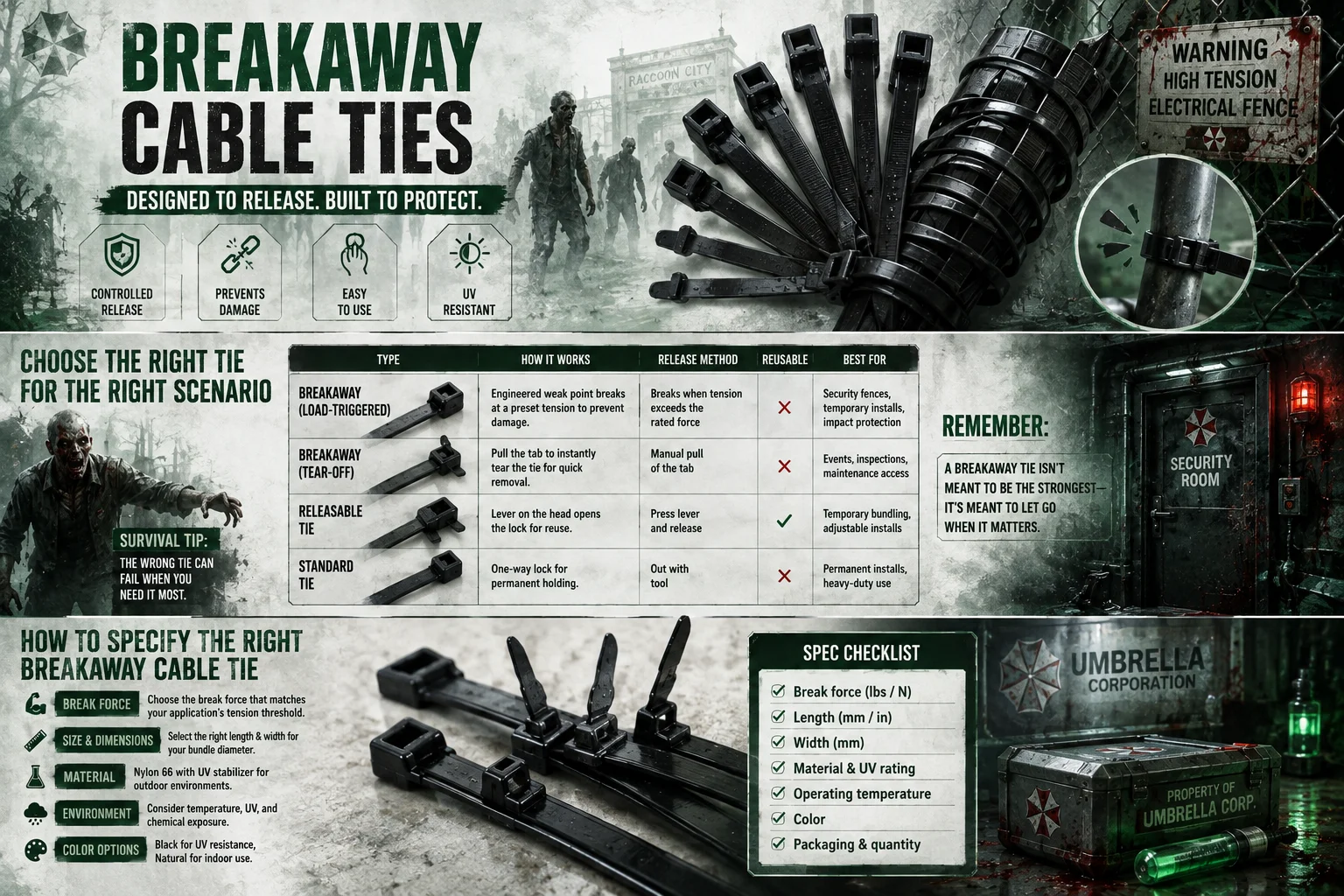
Breakaway cable ties refer to ties that are manufactured to part ways intentionally. This happens either because a predetermined load has been attained or because a person pulls or pushes the cable tie thus bringing about its release. The phrase can be utilized in relation to two distinctive categories of products that follow the same principle of the intentional separation and knowledge of which one is required being the most vital factor for making a decision.
The first group includes breakaway ties, also called load activated ties, which are designed to hold a package under normal conditions but are constructed with a low predetermined breaking point so that if the load exceeds the required level, the cable will break away and let the package release instead of passing the load to the object to which it has been attached. The second group is made of manually activated ties which are provided with a small pull-tab at the end; to break away the tie it is sufficient to pull the tab down without any need to use cutting devices. Although both cable ties are called breakaway ties, the first one reacts to a force and the second one reacts to touch.
Nevertheless, what makes the two groups alike and distinguishes them from the regular ties is the purpose behind the use of breakaway cable ties. While a common nylon cable tie defines separation as a failure, breakaway cable ties realize it as a purpose.
How a Breakaway Cable Tie Works
To comprehend the differences in how these ties function, one must first take into account the basic structure of a normal tie. Regular nylon ties can be said to consist of a rigid strap, which has teeth running down its entirety. There is a small pawl in the head of the tie through which the end of the strap is passed. When the strap is pulled and the pawl engages the teeth, the tie becomes one-way, hence offering an efficient means of locking.
What distinguishes a load-activated breakaway tie is that it makes use of the same locking mechanism but incorporates changes in the body of the tie. Manufacturers usually use thinner strap materials so that the tensile breaking point of the tie is considerably lower than that of the material. Accordingly, the tie stays secured under normal use; however, once it has reached its breaking point, it will come apart easily. In this case, the basic advantage of this type of tie is that it is low cost and offers reliable performance.
Tear-off ties work similarly to the first type of ties. However, unlike load-activated breakaway ties, they are not made to work in the same way through tension. Rather than relying on the pawls that are cut, these ties rely on an arm of some sort, which must be pulled in order for the tie to break free of its lock. If you want to see how the standard one-way lock is defeated by hand on ordinary ties, our guide on how to remove cable ties safely walks through the mechanism in detail.
The base substance for both variants is typically the same Nylon 6/6 that is selected for the whole range of cable ties due to its strength, flexibility, and predictable properties. The only difference is the shape of the material and additive used in case of outdoor application. Break force is generally adjusted by means of the neck and strap design, since a thinner part is broken at lower and more precise forces, and then the resin grade is selected according to the conditions of its use — standard nylon for indoor applications and UV resistant for outdoor ones. Because the break point is engineered rather than incidental, a quality breakaway cable tie gives a far tighter, more repeatable release than any standard tie forced to fail, which is exactly what makes it trustworthy in a safety role.
Breakaway vs. Releasable vs. Standard Ties
Three categories of tie are easy to confuse because all three deal with getting a tie off again, yet each behaves in a fundamentally different way. Choosing the wrong one is the most common mistake buyers make.
A standard permanent tie is built to stay put until it is deliberately cut off with flush cutters, which is why our overview of how to cut cable ties cleanly matters for those installations. A releasable tie adds a small lever to the head so it can be opened by a fingertip and reused many times, ideal wherever a bundle grows or changes; the full range of reusable options is covered in our guide to assorted zip ties and how they work. A breakaway cable tie sits apart from both: it is not meant to be reopened and reused like a releasable tie, and it is not meant to resist removal like a permanent one. It is meant to separate — once — either under a specific load or with a single deliberate pull.
This distinction drives the buying decision. If you need to reopen a bundle repeatedly, you want a releasable tie. If you need maximum holding power, you want a heavy-duty permanent tie. You only want breakaway ties when controlled separation is itself the goal — when something must be allowed to pull free rather than hold fast.
Where Breakaway Cable Ties Are Used
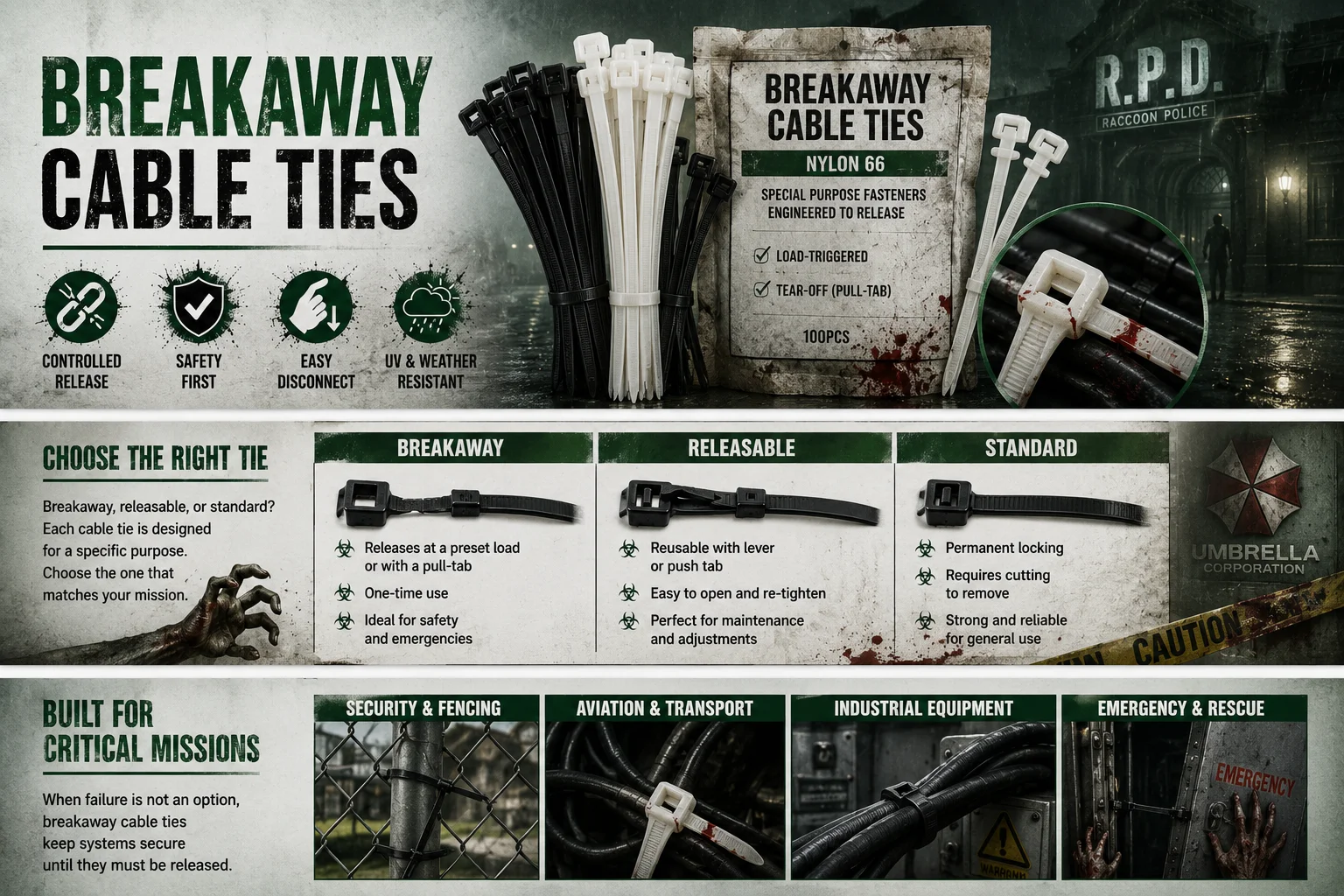
The applications for breakaway cable ties all share one theme: a situation where a fastener holding too well would cause more damage than a fastener that lets go. A handful of common uses shows how broad that theme is.
Security and perimeter fencing is a prime example. When the windscreen or privacy mesh is added to the chain-link fence, a powerful blast of wind can cause a great deal of stress on it; if the ties of the windscreen are stronger than the fence, the wind may tear the grommets, and even uproot the posts. Intentional ignorance of this fact is what allows for a weak connection to be the savior — it will break first instead of damaging the fence or the windscreen, thus allowing for saving the windscreen without losing a cheap tie. Sports netting, banners, and outdoor signage are made according to the same principle, i.e., allowing them to be free rather than tearing through the mechanisms.
Crowd control and temporary barriers is another example of an application of this principle. Event fencing, queuing lines, and stage barricades use ties that can hold the whole configuration in one place under normal conditions but can easily be torn apart in case of a rush, thus minimizing the risk of a traffic jam and enabling the barrier to collapse under control. The same is true for things such as people and machinery. A cable secured with a breakaway tie can come free under pressure instead of dragging a person or an item, being a ‘small’ version of the breakaway connections used in industrial safety.
Agriculture and gardening employ light breakaway and tearable ties for lifting the plants, which allows them to release rather than compromising the dead stem or breaking apart a branch. Business and industries prefer using tearable ties for removal without any tools since the workers have to free something quickly and without wasting time looking for cutting machines.
Temporary and seasonal fixing is the last item in this list. Holiday lighting and decoration, festival rigging, and trade shows benefit from ties that safely hold cables and then easily come apart, allowing teams to take everything down quickly, without any lasting damage to the equipment.
This “designed to let go” philosophy is the same safety principle formalized in aviation, where structures near runways must be frangible — built to break, yield, or distort on impact to minimize hazard. Airfield frangibility is achieved with engineered couplings rather than nylon ties, but the logic that a controlled break is safer than rigid resistance is exactly what a breakaway tie brings to smaller, everyday fastening jobs.
Choosing the Right Breakaway Tie
Because a breakaway tie inverts the usual priorities, specifying one well means focusing on different numbers than you would for a standard tie. Four factors decide whether the tie does its job.
The break force, or release tension, comes first. This is the load at which a load-triggered breakaway cable tie is designed to part, and it must be matched to what you are protecting: low enough that the tie fails before the fence, screen, or structure does, but high enough that it survives normal handling and everyday wind. Getting this number right is the whole exercise, which is why it should come from a manufacturer specification rather than a guess.
Consistency comes second and is easy to overlook. A break force is only useful if it is repeatable across thousands of ties; a tie that breaks at widely varying loads is worse than useless, because you cannot predict when it will let go. Reputable production controls the geometry and material tightly so every tie in the batch behaves the same way.
Environment comes third. Many breakaway applications — fencing, signage, agriculture — live outdoors in full sun, and ordinary nylon degrades and grows brittle under ultraviolet light, which would change its break behavior over time. For any outdoor use, a UV-stabilized black nylon grade is the right base material, a point our guide on whether zip ties are UV resistant explains in full. Size and width come fourth: the strap dimensions still have to suit the bundle, and our references on standard cable tie sizes and choosing the right size, strength, and material map those dimensions to the job.
Do not try to fake a breakaway tie by buying a cheap, undersized standard tie and hoping it snaps at the right moment. A standard tie’s failure point is neither low enough nor consistent enough to trust, and it may hold long past the point where damage is done. Controlled separation requires a purpose-made breakaway tie.
Installation Tips for Breakaway Ties
A breakaway tie only works properly only if it is installed with its effectiveness in mind; keeping a few things in mind allows you to keep it that way. Don’t tighten the load-activated tie too much: tightening it to the maximum means the strap has been pre-stressed and has moved breaks force further from the rated capacity.
Route the tie so that the force acting on it will come as intended by the design rather than at an angle that will lead to misalignment. Whenever a tie is used in place where it might rub against a sharp edge, do take care of the strap, as abrasion can cause the tie to break before reaching its intended point. In outdoor and long-term applications, make a habit of periodic inspections: replace ties that become hard, rough or damaged and always replace the breakaway ties after they have done their job; unlike releasable ties that can be reused, this type of tie is intended for one use. Finally, store breakaway ties together with each other rather than with standard or heavy-duty ties; a breakaway tie installed incorrectly on a load-bearing product is a disaster waiting to happen, just like using a standard tie in a situation where a breakaway one is needed leads to a loss of safety.
Frequently Asked Questions
Are breakaway cable ties recyclable?
No, a breakaway cable tie is not designed to be used more than once. After its first use, it is either broken due to the weight placed on it or it is pulled apart by the pull-tab, rendering it useless. If you are looking for a tie that can be used frequently, you should be searching for a releasable cable tie, which utilizes a lever mechanism to unfasten the tie and lock it again without breaking it.
At what weight will a breakaway cable tie break?
The answer will vary depending on the type of cable tie. Generally speaking, a breakaway cable tie is meant to break at a lower weight limit than what is stated in the specifications provided by the manufacturer. To be sure, look for the weight limit indicated on the tie and make sure that it matches with its purpose.
Can breakaway cable ties be used in outdoor conditions?
Yes, as long as they are made from a UV grading material. Breakaway cable ties are often used for the construction of external objects that require strength, and very often include commercially available black-colored nylon material, which can be UV-resistant. Normal cable ties made for indoor use tend to deteriorate under the sunlight, thus decreasing their reliability.
What is the difference between a breakaway tie and a releasable tie?
A releasable tie is designed to be opened and reused repeatedly by pressing a lever; nothing breaks. A breakaway tie is designed to separate once — either under a set load or with a single tear-off pull — and is then discarded. Releasable is about convenient reuse; breakaway is about controlled, deliberate failure.
Choosing With Confidence
A tie that is built to let go sounds like a contradiction until you meet the job it was made for: the fence that must survive the storm, the barrier that must yield to a crowd, the cord that must pull free of a hazard. In every one of those cases, the fastener that holds too well is the fastener that causes the damage, and a well-specified breakaway cable tie is the small, inexpensive safeguard that prevents it. Specify the break force for the load you need to protect, insist on batch-to-batch consistency, and choose a UV grade for anything that sees the sun.
IGOTO manufactures nylon cable ties across the full size and strength range, including UV-stabilized and specialty grades, backed by 25+ years of production experience and UL, CE, and RoHS compliance. You can explore the complete cable tie product range and request samples or a quotation with your exact size, material, break-force, and quantity requirements, so the tie that is meant to let go does so at precisely the right moment.