



Cold Weather Cable Ties: A Complete Buying and Installation Guide
If you have ever been outside on a winter day trying to secure cable ties, only to find that your tie has broken, you are already familiar with the problem discussed in this article: nylon ties become brittle when exposed to low temperatures. The science behind the phenomenon is straightforward: when temperatures drop, nylon polymer molecules gain rigidity until they are rendered glass-like. Unfortunately, cold temperatures create problems: a broken tie leaves a loose bunch of cables and entails further installation in freezing temperatures. Choosing the right type of cable ties for works in cold conditions in telecom, cold-chain logistics and cold storage facilities is no triviality, it is of utmost importance.
This article will inform you about everything that buyers will need to know to avoid this problem, such as what really happens to nylon in cold, which plastics are suitable for work in cold conditions, what is the difference between nylon and stainless steel, why the “temperature rating” of some ties can mislead customers, how to install and store the ties correctly in order to avoid breaking them, and how to pick the right brand of ties.
In brief: Simple zip ties do tend to snap in low temperatures, and this temperature range is based on what they’re made of. Standard nylon 6 starts to lose its effectiveness at about -10°C while nylon 6.6 has about a -20°C failure point, and only specially engineered low-temperature nylon 6.6 or nylon 12 work down to about -40°C; the only way to get anything that can work in a full-blown winter is to get stainless steel ties that work to about -80° or lower. The “-40°C to +85°C” marking associated with the majority of nylon ties is a static one that does not indicate that the tie will still be able to be twisted and pulled on at -40°C — what matters is dynamic cold resistance.
Why Cable Ties Break in Cold Weather: The Science
Cable ties are made out of semi-crystalline polymers, primarily nylon, and the behavior of the materials depends on the temperature. When warm, the long molecular chains slide past one another and the material is able to bend. However, when the temperature drops to the glass transition temperature of the polymer, molecular movement slows down significantly: the chains get locked in the position, the free volume disappears and the material changes from ductile, rubbery state into rigid, glassy state. Thus, there is a sudden and catastrophic failure of the product: at 20°C, one can easily bend the cable tie, while at -20°C it can break even under a small tension.
There are two reasons why nylon performs worse than other plastics at low temperatures. First of all, nylon is hygroscopic: it absorbs water from the atmosphere, and because of the low humidity in cold conditions its moisture is released and the properties of the material worsen. Second, the failure is related to the strain rate: the cable tie can survive a slow pull, while fast pulling or impact will cause it to break down. Thus, the cable tie can spend the whole winter on a cold wire, but still break down after being pulled hard.
Material Comparison: Which Cable Ties Handle Low Temperatures?
All cable ties do not work the same in cold conditions, and the manufacturers and test houses have published the level of different materials:
| Material | Dynamic Cold Limit | Characteristics |
|---|---|---|
| Nylon 6 (PA6) | about -10°C | Cheapest, common in budget ties; becomes seriously brittle below -10°C |
| Nylon 6.6 (PA66), standard | about -20°C | Industry standard; tighter molecular structure, better cold resistance than PA6 |
| Low-temperature modified nylon 6.6 | about -40°C | Impact modifiers added; stays flexible to -40°C, ideal for cold-weather duty |
| Nylon 12 (PA12) | about -40°C | Excellent inherent cold toughness, very low moisture absorption; premium price |
| Polypropylene | about -29°C | Light and chemical-resistant but stiffens fast; less common for cold duty |
| Stainless steel (304/316) | -80°C and below | No brittleness issue at all; corrosion-resistant; the extreme-cold answer |
| Tefzel® (ETFE) | about -80°C | Aerospace-grade; wide range (-80°C to +170°C) but high cost |
What is the conclusion for the buyers? If the application is in conditions lower than around -20oC, standard nylon is unsuitable. For -40oC, low-temperature nylon 6.6 or 12 is recommended, while for any copper, offshore, or prolonged outdoor application, the best choice is stainless steel.The material chemistry behind these ratings is covered in depth in our guide to what zip ties are made of.
Nylon vs Stainless Steel for Cold Environments
When temperatures plunge into the -40°C region or lower, the issue boils down to the nylon vs stainless steel dilemma. Both materials have their special properties:
- Cold resistant nylon (modified PA66/PA12): it is flexible, easy to install, it has good insulation properties, UV stabilizable, and it is significantly cheaper. It is best for cable bundles, wire harnesses, and general fastening up to -40°C where flexibility and speed are important.
- Stainless steel: it is not prone to brittleness, rated to act at -80°C and beyond, resistant to corrosion in salt air and chemical compounds, and has to be used for critical and load-bearing equipment that vibrates at very low temperatures. Nevertheless, there are some drawbacks: it is not flexible, sharp edges can damage surfaces and wiring, and it costs several times more than nylon. Our stainless vs nylon cable tie comparison walks through the full trade-off table for both temperature and corrosion duty.
A rule of thumb is to use low-temperature nylon down to about -40°C for general applications and then switch to stainless steel below that temperature or when the bundle must bear a load, be exposed to chemicals/salt, or cannot be inspected for a long time.
The Truth About “Temperature Rating” Labels
Here is where most buyers get stuck—a standard nylon tie has the label “operating range: -40°C to +85°C,” suggesting it is rated for use in cold temperatures. Actually, in this case, it refers to what is called “static operating range”, which doesn’t mean that you can bend or stress the tie without breaking it. Static operating temperature indicates temperature conditions where the tie can exist without making it unusable, but it doesn’t say anything about ability to bend it at the stated temperature. In order to find the information you actually need about the cold-weather performance, you need to compare the specifications of dynamic cold rating — the temperature where the tie can be flexed and tensioned without breaking. In our case, according to the table above, this rating amount to -10°C for nylon 6, -20°C for standard nylon 6.6, and -40°C only for low-temperature modified grades of the material.
Installation and Storage Tips for Cold Weather
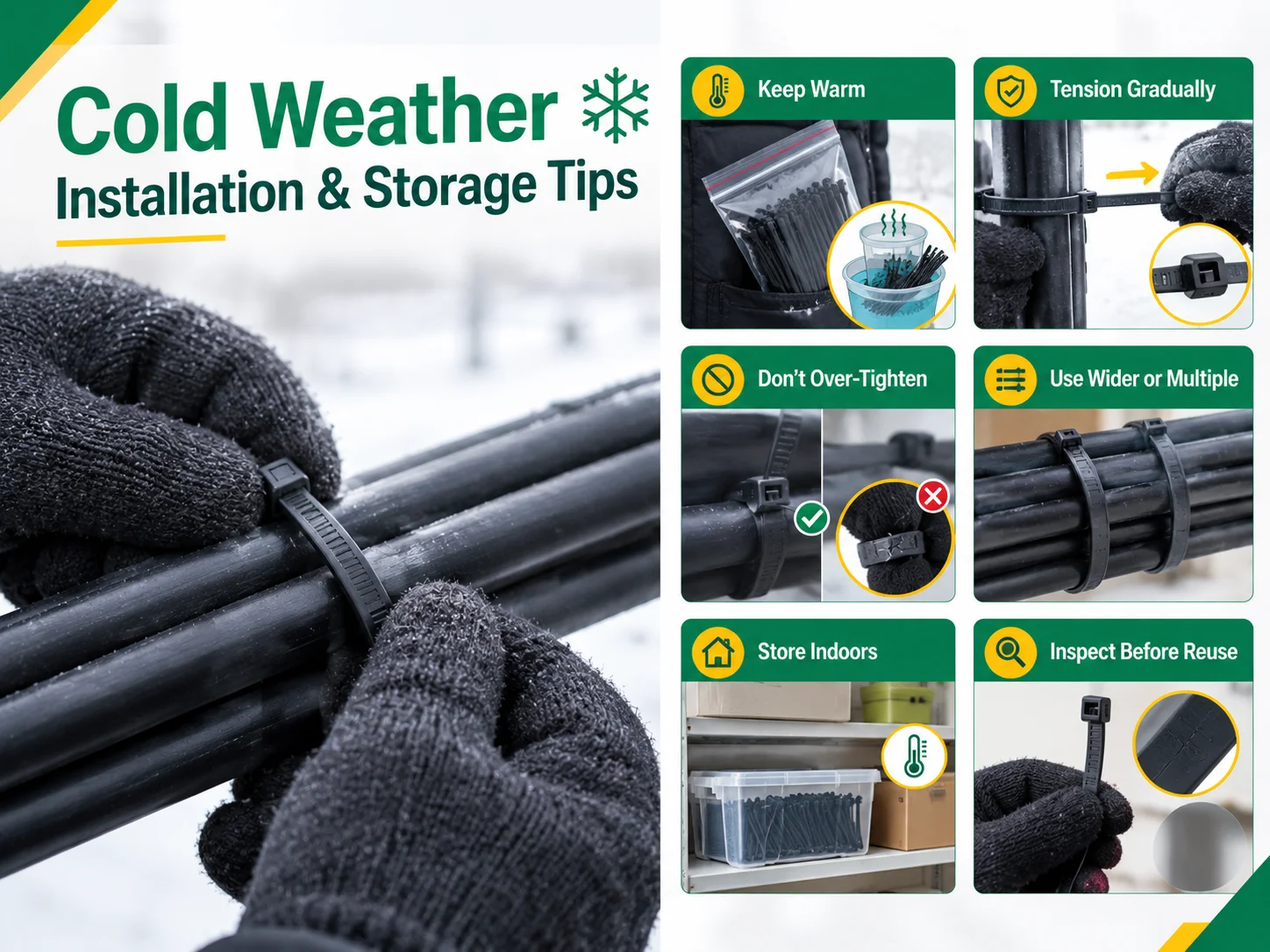
Any properly rated tie will not work if installed improperly. The rules for cold-weather installers based on manufacturer recommendations and actual experiences are:
- Keep ties warm prior to use. Either carry them in a coat pocket or simply dip them in warm water a little before installation to regain flexibility.
- Tension tie gradually, never jerk. Pull the strap steadily and have a look at possible cracks near its head; rapid and strong pulling technique is the best way to break the cold tie.
- Do not overtension. Under cold conditions, overtensioning causes strong localized stress at the head where the pawl bites.
- Even when using several ties for vibrating application, the load should be distributed properly, so that instead of using one point of failure it is possible to avoid any failures.
- Before reusing a tie that was used during winter it is necessary to check it for microscopic cracks and discoloration first. Our guide to distinguishing nylon cable tie quality lists the visual and physical checks that separate sound ties from failed ones.
Applications That Demand Cold-Weather Ties
Here are the cases where a typical nylon tie will be ineffective, and only one made of cold weather nylon works:
- Cold storage and freezer facilities — the temperatures in food and industrial freezers are usually below -30C; standard nylon 6/6 ties will not work in such conditions
- Cold-chain logistics — in the case of the failure of a tie, a reefer or temperature-controlled truck may deliver the wrong load
- Outdoor telecom and utility installation work — aerial and pedestal cabling done outside at temperatures below zero
- Offshore and polar operations — that includes platforms, research stations, and equipment that works in extreme temperatures
- Fire safety systems used outdoors — hoses and equipment which has to work on the coldest night of the year
- Medical cold-chain logistics — cold-chain vaccine and biopharmaceutical packages; in case of the tie break, there might be a quality issue
Recommended Brands and What to Look For
The market for low-temperature cable ties is made up of international specialists and focused manufacturers. The names that come up most often in this case are Panduit and HellermannTyton (both supply special lines of nylon for cold weather and low temperature with dynamic ratings’ values published), Thomas&Betts (ABB) for the heritage line of Ty-Rap and 3M, Essentra, and Avery Dennison for the general industrial product lines with cold weather grades. Chinese manufacturing companies like igoto have made cold-weather suitable products cheap and affordable while still achieving the same performance at -40°C as others have. In case you are evaluating one or another brand, make sure to check the following three values in the datasheet: the dynamic low temperature rating, the grade of the material (low temperature modified PA66 or PA12 suitable for cold duty) and the certification/test evidence (peers like igoto provide chamber tests for the low-temperature products where they say that the normal ties have failed 100 percent while cold-weather ties did not). Keep in mind that price is not a good indicator — there are renowned and expensive cold-weather cable ties that actually do worse than cheap versions of the equipment for all cold weather applications.
Igoto Cold-Weather Cable Ties: An Introduction
Igoto Cable Ties produces cable ties and, therefore, has a cold-weather product that meets these requirements. Igoto produces low-temperature modified nylon 6.6 ties with a rating of -40°C, the same temperature rating as the leading global brands. Igoto manufactures ties in a range of the standard lengths and tensile strengths, which cater to a regular installer’s needs (from low 100 mm ties for light bundling to ties of a heavy-duty size of 200-370 mm). In an average situation, Igoto Cable Ties would charge 30 to 50 percent less than global brands for analogous -40°C cold-weather products. It should be noted that the stainless steel range can withstand extreme cold weather and marine applications.For buyers comparing sizes and strengths across the range, our standard cable tie sizes reference lists the dimensions and tensile ratings that map to each job.
How to Choose the Right Cold-Weather Tie
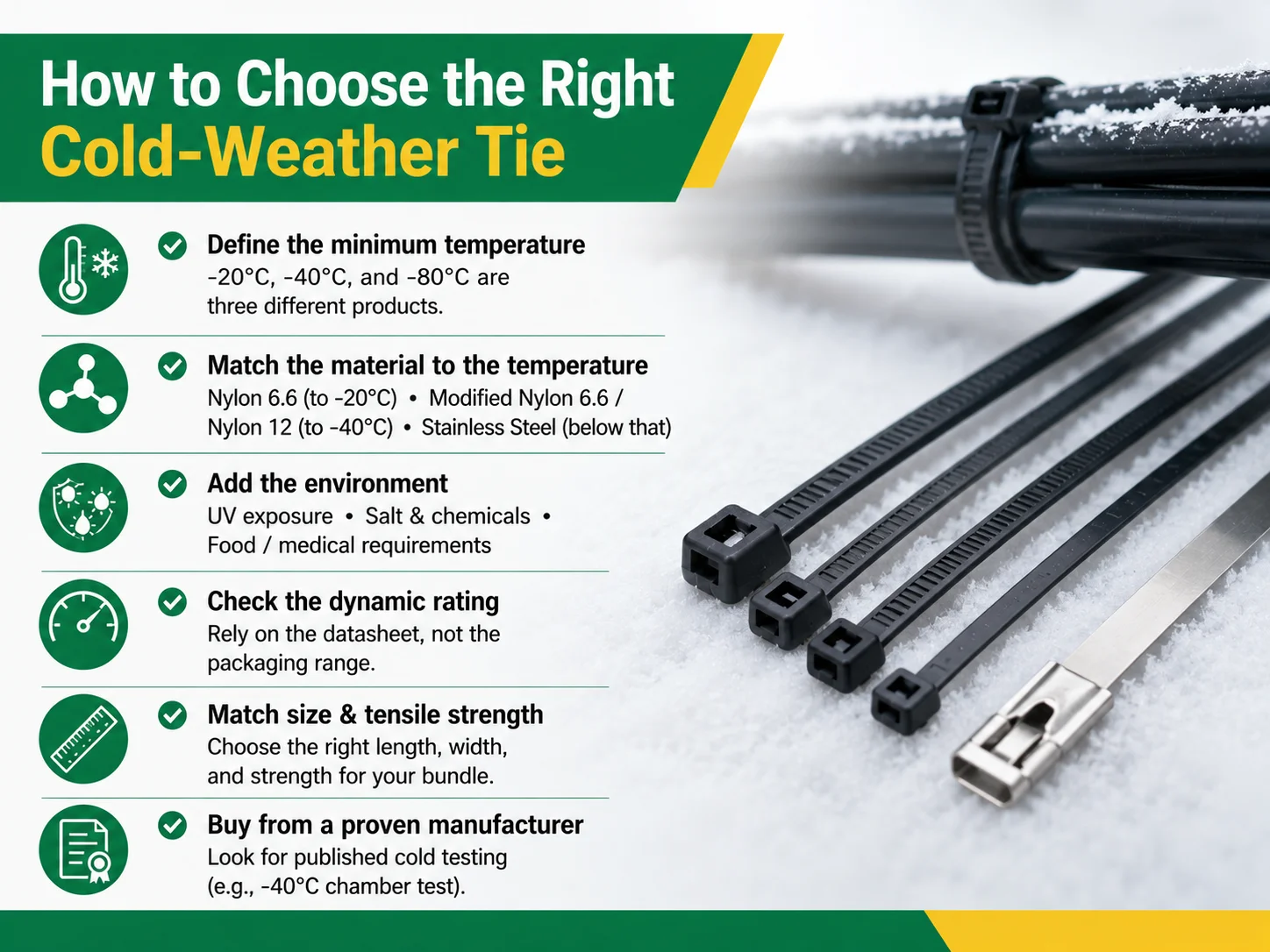
Before making a purchase, make sure to go through this checklist:
- Identify the minimum temperature – the minimum temperature at which the tie will be installed or at which it will be operating; this minimum temperature could differ from the average for -20°C, -40°C, and -80°C products.
- Choose the material according to the temperature: standard nylon is suitable for temperatures down to about -20°C; low-temperature modified nylon or nylon 12 can be purchased for -40°C; and any stainless steel is applicable for temperatures below that as well as for crucial loads.
- Specify the environment: UV exposure requires UV-stabilized materials (generally brown); salt air and chemicals require stainless steel; and food and medical cold chain requires certified materials.
- Check the dynamic load on the datasheet rather than the temperature on the packaging.
- Choose the sizes and tensile strength according to the bundle specification, as can be seen in our cable tie selection guide.
- Purchase ties from a producer who performs cold testing, as in industry cold weather proof testing; for example, the -40°C chamber test.
Frequently Asked Questions
Will zip ties break in cold weather?
Ordinary zip ties do not withstand freezing temperatures, being made from a material that becomes brittle when temperature drops. Pure nylon 6 will crack at around -10 degrees Celsius, nylon 6.6 will endure until the temperature drops to -20 degrees Celsius, while only nylon 6.6 and nylon 12 made of special cold-proof material can stay strong at up to about -40 degrees Celsius. Beyond that point, it will be necessary to switch to use of stainless steel ties. The -40 degree Celsius mentioned on regular ties means that it is a constant measure, but in this case it needs to be understood that what is really important is the measure related to their application in conditions under strain caused by bending and pulling.
At what temperature will a zip tie melt?
Zip ties made from standard nylon 6.6 start to melt already at the temperature greater than 255-265 degrees Celsius, but before actually melting the nylon ties stop working due to losing grip and strength even at lower temperatures – at temperatures above 85-105°C the regular nylon ties lose their grip, while heat-stabilized ones operate properly even at 125 degrees Celsius constantly or at 150 degrees Celsius for short time intervals. In comparison, stainless steel ties can withstand temperatures of approximately 538 degrees Celsius without melting. As for engines, stoves and industrial heat, if one uses heat-stabilized nylon or stainless steel, the standard nylon needs to be avoided.
What temperature can cable ties withstand?
It highly depends on the material used for making the ties. Regular nylon 6.6 works properly till some minus 40 degrees Celsius; however, it should be remembered that it operates properly for cold temperatures only to about -20°C during its dynamic use. Speaking about heat-treated nylon, such material operates as expected even at above 125°C. Tefzel, in turn, can endure temperature up to -80°C and among similar materials seem even more reliable than stainless steel ties made from -80°C to about 538°C.
Are cable ties weatherproof?
Not necessarily. The thing is that through the time standard nylon can be harmed due to some UV sunshine, moisture cycling and temperature variations. However, being exposed to UV radiation the nylon metrial becomes weak and brittle. Thus, for protective purposes one needs to have special nylon ties, preferably black or welded from stainless steel.
References
- Wandu Cable Ties — Do zip ties break in cold weather? (material cold limits and installation tips)
- Wandu — Cold weather cable ties product page (-40°C test data)
- Difvan — Cable tie temperature ratings by material
- Cable Ties Unlimited — The science of temperature ratings in cable ties
- CHS Cable Tie — Temperature range for self-locking cable ties (nylon, polypropylene, stainless)
Conclusion
Low temperatures turn a regular item into a specialized tool. Ordinary nylon zip ties — available in every toolbox — get brittle and ineffective at around -20°C. The poor performance at even -40°C stated on the package cannot save an installer from a broken tie in hand on the snow-covered rooftop. Approach to the solution is based on the material: low-temperature nylon 6.6 or 12 is capable of working until -40°C, stainless steel or something more serious is suitable for super-low situations; installation method plays role too, warming ties, stretching them in gradual way, and avoiding excessive tension are required in any operation. Make sure the supplier shares the information regarding cold temperature usage of the zip ties and measures in the cold chamber; remember that prices don’t matter since it is formulation that is really important. Whether you need the high-performance zip tie to prevent the telecom bundle from ugliness during the January storm or to help to fix the cable tray on the oil platform on the shelf, the key is to pay attention to the manufacturer’s guarantee about doing such kind of work.