


Here’s How to Distinguish the Quality of Nylon Cable Ties
Upon inspecting the cable bundles of a solar farm operating in Queensland after only 18 months of operation, the operator encountered an infuriating situation. While half of the nylon cable ties would snap easily, the other half of the same batch withstood harsh environmental forces and were still functional. They looked unmistakably identical to the naked eye, being the same color, length, and width. However, the two batches were manufactured from completely different materials, one being poor-quality nylon with no UV stabilizers and the other genuine nylon 6/6 with superior mechanical properties. Identifying the quality is not simply conducting a visual inspection of the bags; it involves knowledge of the material, way of production, features of the product, certifications, and various tests with physical equipment to guarantee the durability and quality of the ties you buy. This tutorial will provide all the information related to nylon cable ties.
Summary: The standard of a nylon cable tie is based mainly on the purity and quality of the nylon 6/6 resin, the effectiveness of any UV and temperature stabilizers, the accuracy of the moulding process, and the correctness of the reported tensile strength. The top-class cable tie is made of virgin nylon 6/6 (not regrind or blended material), has a known certification (a UL listing, for example), and provides material tests and any relevant performance documents on demand. The cheap tie might appear to be the same but can break much earlier, becoming brittle, losing its tensile strength, or breaking. The easiest way to check it is visually or by touch: the quality tie has a uniform and smooth surface, a sharp protruded edge, a consistent color, and allows for slight bending when the temperature is normal. The guarantee of the manufacturer’s quality is in the paperwork — specification, tensile strength check, and environmental test results.
The Material Foundation: Virgin Nylon 6/6 vs. Recycled and Blended Resins
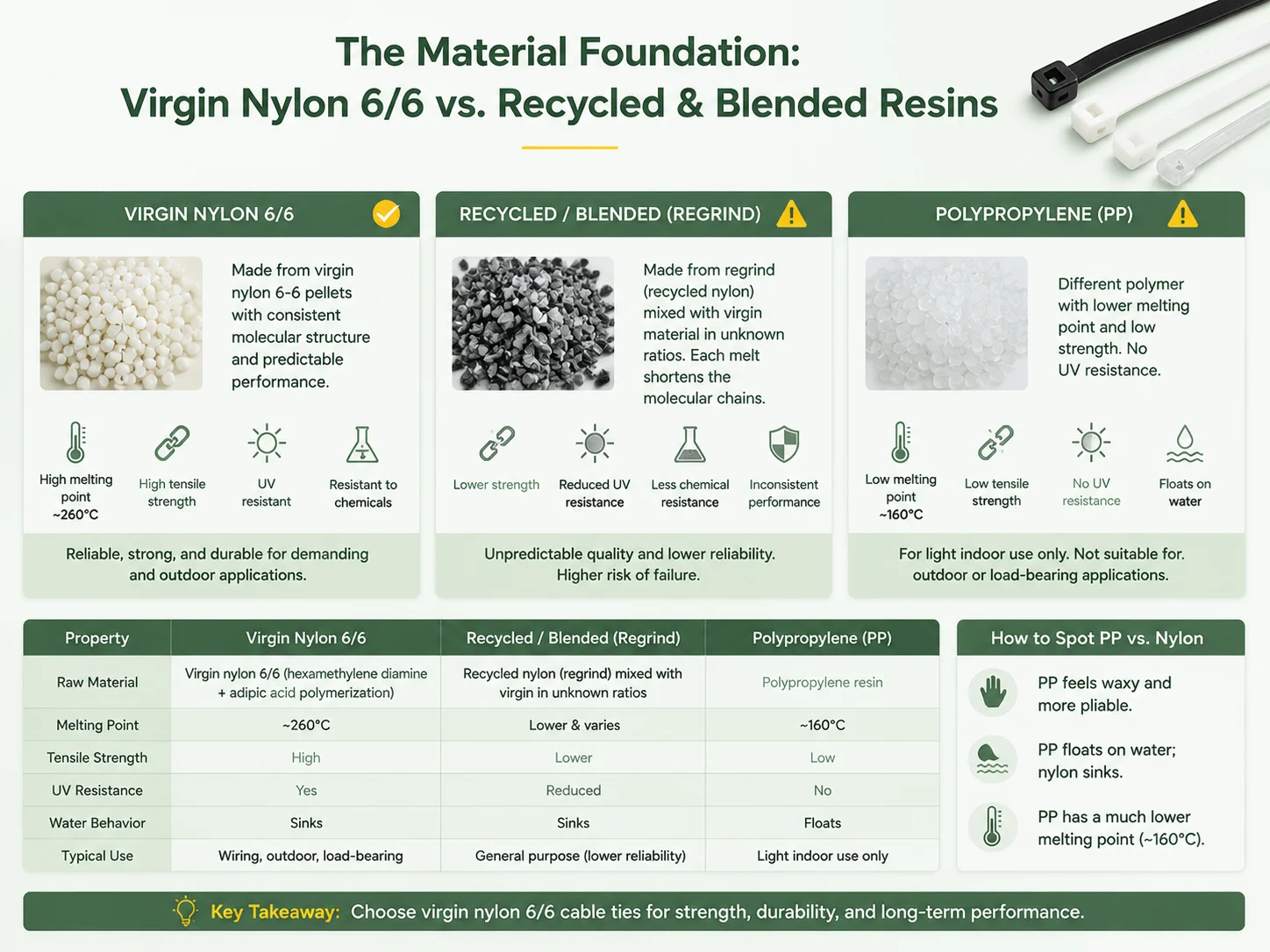
The quality of a nylon cable tie is determined primarily by the nylon that the tie is made from. High-quality nylon cable ties are made using virgin nylon made of nylon 6-6, which is a semi crystalline thermoplastic and possesses properties like constant molecular weight, predictable physical properties, and known reaction with heat, ultraviolet rays and chemicals. Virgin nylon 6-6 plastic is produced by polymerizing hexamethylene diamine and adipic acid under stable conditions, producing pellets with highly similar properties for every batch. On the contrary, the manufacturing process of low-quality nylon ties involves using recycled nylon (regrinds), which is the outcome of grinding, remelting, and molding previously used nylon and combining with virgin material in an uncontrolled ratio. Each time nylon is melted the molecular structure shrinks do it losing its important characteristics. Even though you might think that the tie is of high quality just by looking at it, the ties made from regrind materials will fail to perform like those made of virgin nylon because of the fact that the keys of the former one are shorter and less strong.
There is another category of ties composed of polypropylene (PP) as opposed to nylon. Polypropylene is a different type of polymer that has a lower melting temperature of around 160°C versus 260°C for nylon 6/6, low tensile strength, and no UV resistance. Polypropylene ties are less expensive compared to nylon and can sometimes be seen on cheap cables found at discount outlets and online marketplaces. A polypropylene cable tie gives a waxy feel, is more pliable than nylon, and can float on water (nylon sinks). It can be used for light indoor work such as tying extension cords and organizing a table but should not be used instead of nylon ties for wiring work, usage outdoors, or for load-bearing. For a full description of cable tie materials and how to distinguish them, our article alluded to above looks Into various materials used in making ties including nylon, polypropylene, ETFE, and stainless steel as well as the tests for their identification.
Tensile Strength: The Number on the Bag Must Be Real
Tensile strength refers to a nylon cable tie’s capacity to support weight before it snaps. It is expressed as minimum tensile loop strength, a measurement performed under testing procedure provided by UL 62275, and is given in pounds or newtons. A cable tie marked with a tensile strength of 50 pounds means that its capacity to hold weight has to comply with this indication during straight line stress and at all conditions, referring to all cable ties from the package. A good-quality cable tie that is produced with the use of virgin nylon 6/6 and made uniformly will demonstrate tensile strength equal or slightly exceeding stated in the product description, and this, in its turn, is confirmed with certificates – the UL listing of a testing report. A poor-quality cable tie may have a certificate of 50 pounds attached but can fail at 30 or 35 pounds, due to the fact that the resin has gone bad or the molding is not resistant enough.
How can an individual evaluate tensile strength without going to a laboratory? The most straightforward method in the field is the comparative pull test. To do this, take one of each of the suspect ties, one tie from the known-good batch with the same rating of strength, wrap them both around a heavy metal bar or pipe, and pull on them with a fish scale or a spring balance. The known-good tie should break at or near its rated strength, and the suspect tie should break at about the same value. If the suspect tie breaks significantly sooner than expected, or if it slips at the head instead of breaking in the strap, the tensile strength is not what it is supposed to be. This is not a calibrated lab test but is a quick and practical test. For a deeper understanding of how tensile strength relates to safe working loads, our guide on how much weight zip ties can hold explains the safety factors and the installation practices that turn a rated strength into a reliable fastening.
Physical Inspection: What a Quality Nylon Cable Tie Looks and Feels Like
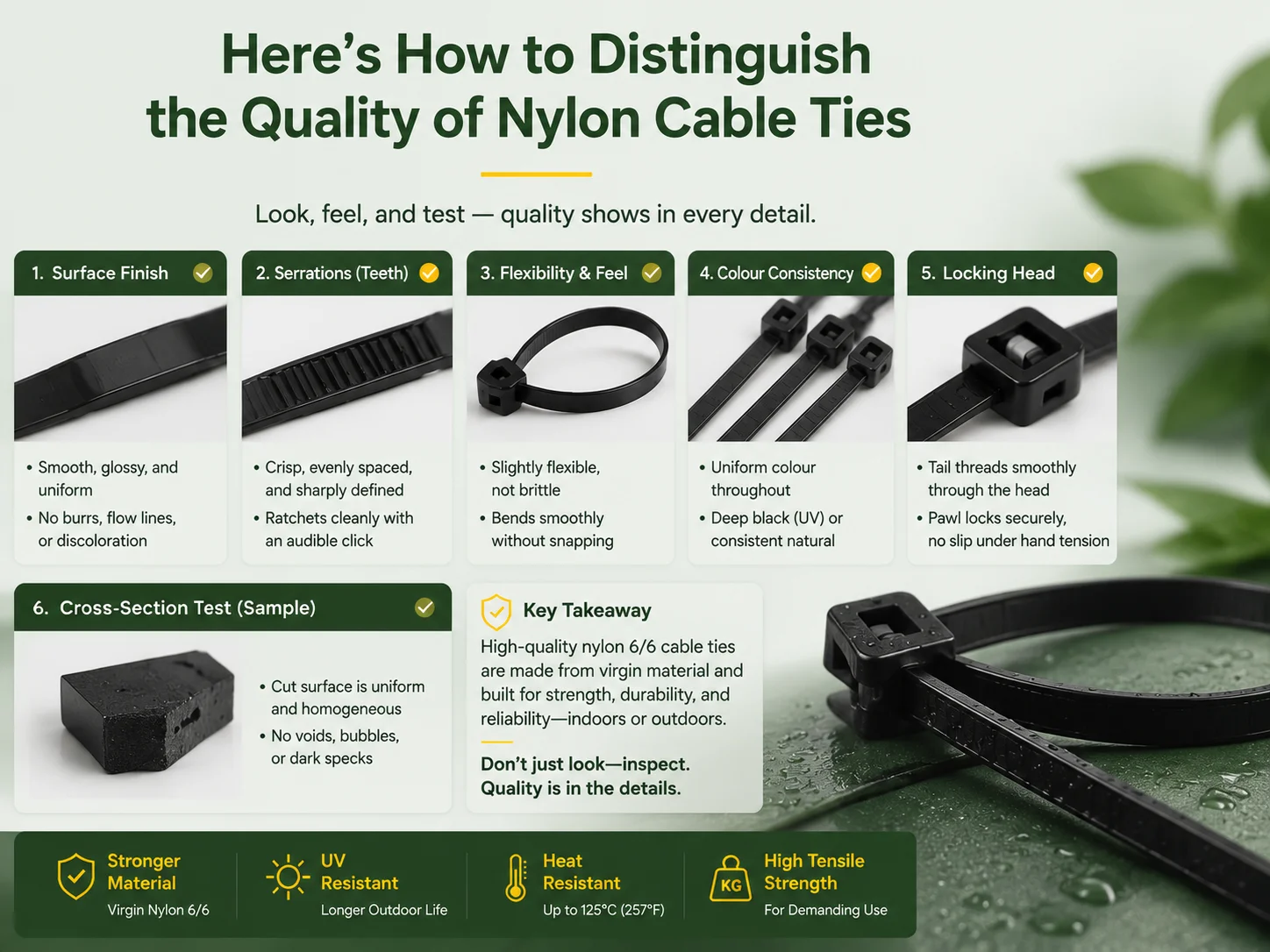
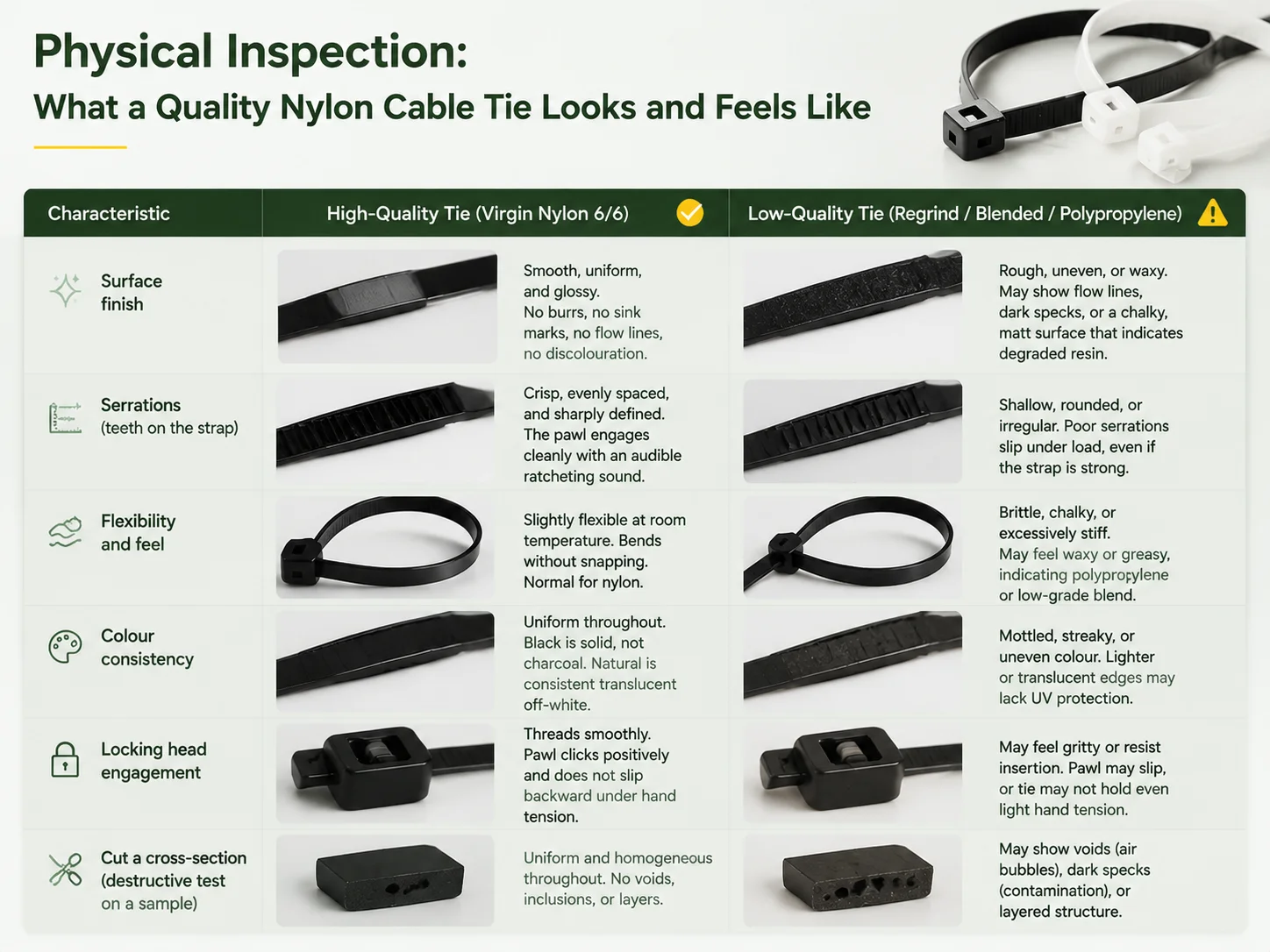
Before any mechanical test, a careful visual and tactile inspection of a nylon cable tie reveals more about its quality than most buyers realise. The table below summarises the physical characteristics that distinguish a high‑quality tie from a substandard one.
| Characteristic | High‑Quality Tie (Virgin Nylon 6/6) | Low‑Quality Tie (Regrind / Blended / Polypropylene) |
|---|---|---|
| Surface finish | Smooth, uniform, and glossy without being greasy. No burrs, no sink marks, no flow lines, no discolouration. | Rough, uneven, or waxy. May show visible flow lines, dark specks (contamination), or a chalky, matt surface that indicates degraded resin. |
| Serrations (teeth on the strap) | Crisp, evenly spaced, and sharply defined. The pawl engages cleanly with an audible ratcheting sound. | Shallow, rounded, or irregular. Worn mould tooling produces poor serrations that slip under load, even if the strap itself is strong. |
| Flexibility and feel | Slightly flexible at room temperature. Nylon 6/6 in its conditioned state (at ambient humidity, approximately 2.5% moisture content) feels alive — it bends without snapping. If the tie has been stored in a very dry environment, it may feel slightly stiffer; this is normal for nylon and does not indicate a defect. | Brittle, chalky, or excessively stiff straight out of the bag — indicates overdried or degraded resin. Alternatively, may feel waxy or greasy, indicating polypropylene or a low‑grade blend. |
| Colour consistency | Uniform throughout. A black UV‑stabilised tie should be solidly black, not charcoal grey or translucent black. A natural tie should be a consistent translucent off‑white. | Mottled, streaky, or uneven colour. A black tie that is lighter in colour or translucent at the edges may lack the carbon‑black loading that provides UV protection. |
| Locking head engagement | The tail threads smoothly through the head. The pawl clicks positively and does not slip backward under moderate hand tension before the tie is tightened. | The tail may feel gritty or resist insertion. The pawl may slip, or the tie may not hold even light hand tension before the tool is applied. |
| Cut a cross‑section (destructive test on a sample) | The cut surface is uniform and homogeneous, with a consistent colour through the entire cross‑section. There are no visible voids, inclusions, or layered structures. | The cut surface may show voids (air bubbles from improper moulding), dark specks (unmelted contaminants), or a layered appearance indicating incompatible blended materials. |
Certifications and Documentation: The Proof Behind the Product
To ascertain the quality of a nylon cable tie, one must check the certifications and papers that come along with the tie itself. A tie produced by an established manufacturer must carry a UL certification mark (to UL 62275) or other authentic certification. In case the packaging of the cable tie involves a certification mark, it indicates that the tie has been tested by a third party. The manufacturer must be able to provide the material test report (MTR) upon request which states the grade of resin, the tensile strength document confirming the minimum loop strength, and the accelerated weathering information of UV resistance (if applicable) for outside rated ties. A cable tie that doesn’t carry any identification information, doesn’t provide a data sheet, doesn’t carry a certification mark, and doesn’t carry contact details of manufacturer is a product with unknown quality — and an unknown quality product cannot be used in any case of failure. Confirmation of the link existing between certification indications and mechanical properties has been provided by companies like Panduit and HellermannTyton.
Nylon Cable Ties vs. Polypropylene Cable Ties: The Material Difference
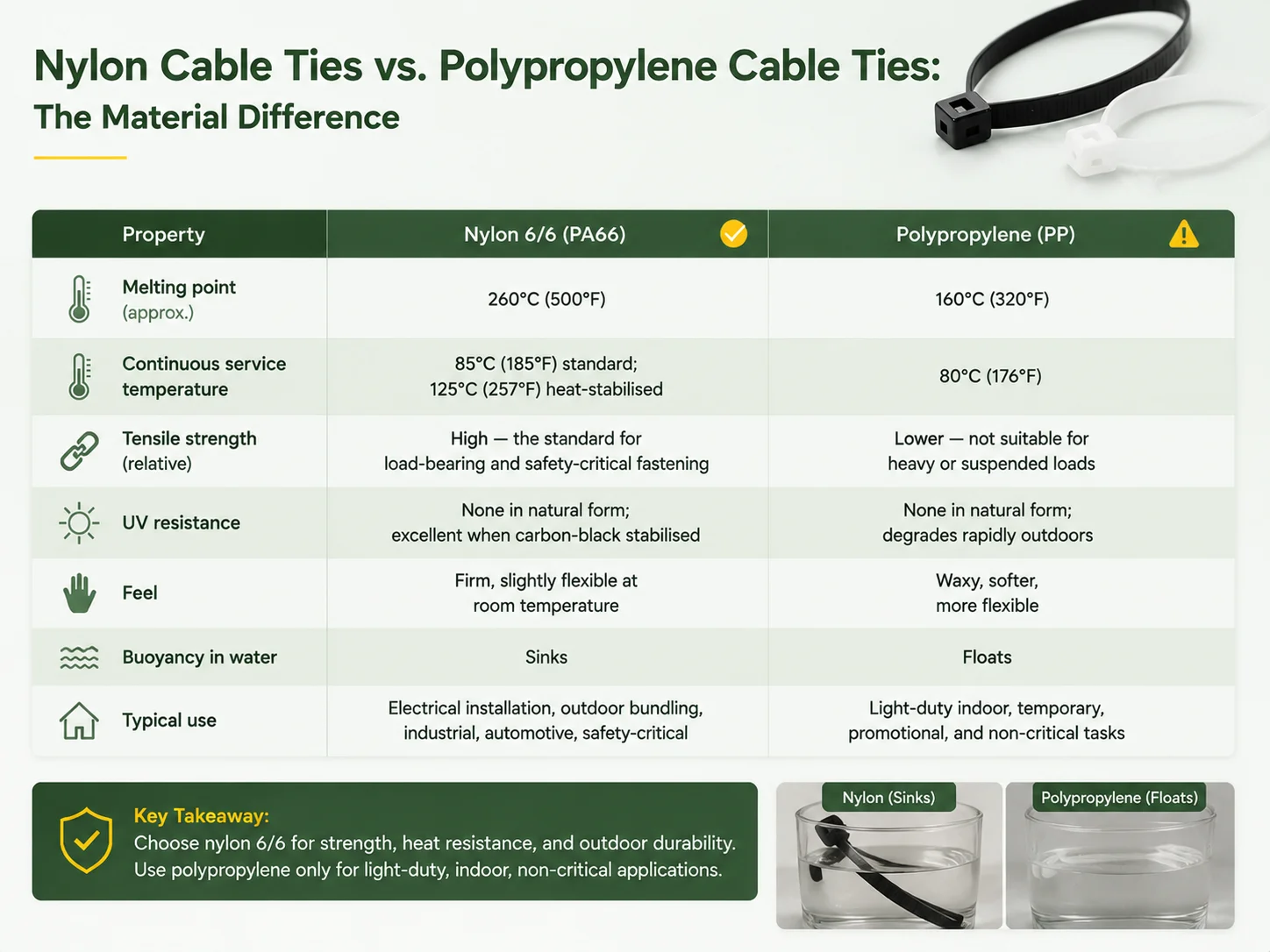
In cable ties, one of the most frequent confusions is found between the two polymer materials known as nylon 6/6 and polypropylene (PP). While the two materials differ in both chemical and mechanical sense, a tie made of polypropylene cannot be considered an equivalent alternative to a nylon device for any applications that require a great deal of strength, resistance to temperature, or outdoor durability. The table below illustrates the distinguishing features of both polymer materials.
| Property | Nylon 6/6 (PA66) | Polypropylene (PP) |
|---|---|---|
| Melting point (approx.) | 260°C (500°F) | 160°C (320°F) |
| Continuous service temperature | 85°C (185°F) standard; 125°C (257°F) heat‑stabilised | 80°C (176°F) |
| Tensile strength (relative) | High — the standard for load‑bearing and safety‑critical fastening | Lower — not suitable for heavy or suspended loads |
| UV resistance | None in natural form; excellent when carbon‑black stabilised | None in natural form; degrades rapidly outdoors |
| Feel | Firm, slightly flexible at room temperature | Waxy, softer, more flexible |
| Buoyancy in water | Sinks | Floats |
| Typical use | Electrical installation, outdoor bundling, industrial, automotive, safety‑critical | Light‑duty indoor, temporary, promotional, and non‑critical tasks |
How to Choose the Right Nylon Cable Tie for Your Application
Choosing a good nylon cable tie involves finding the right combination of material, tensile strength, environmental resistance, and certification to match the specific job requirements. The selection process is straightforward and applies to any installation. Step one involves verifying the material—making sure that the label reads “nylon 6/6” or “polyamide 66,” not “polypropylene” or just “plastic.” The second step is to match the tensile strength with the load, maintaining a minimum safety factor of 2:1 for static, indoor applications and 3:1 or higher for dynamic, outdoor, or overhead situations. For example, a bundle of 20 pounds should be fastened using a tie rated for at least 50 pounds. The final step is matching the material to the environment. Outdoors, select a black UV‑stabilised tie — the carbon‑black stabiliser provides the outdoor life, as detailed in our guide on whether zip ties are UV resistant. A heat-stabilized tie with a working temperature of 125°C has to be chosen for the hot environment. When searching for a heat resistant tie for an installation where fire safety is essential, a tie should be selected based on its flame retardancy (for example, UL 94 V-0) rating. Finally, ask for documentation—good suppliers will readily provide material test certifications, tensile strength tests, and environmental testing. A supplier that is unwilling or unable to provide the above certificates should be avoided as it is of no use for critical applications. Thanks to igoto, all the contractors, panel builders, and OEMs get nylon ties complying with these requirements along with all the certificates and discounts.
Frequently Asked Questions
What are nylon cable ties used for?
Nylon cable ties are mostly used for securing cables and wires in electrical and industrial environments, but they can also be used for identification and coding, tamper evidence, temporary fastening and other purposes. They come in materials and sizes suitable for all environments, indoor and outdoor, and high-temperature application such as those of engine bays.
Are nylon cable ties the same as zip ties?
Indeed. Nylon cable ties and zip ties are two words for the same item. The word “zip tie” is actually just a generic name for a self-locking cable tie, and nearly all zip ties available today are made using nylon 6/6. Basically, the terms zip ties and nylon ties refer to the same product even in the other usage contexts like electrical, industrial, and consumer ones. In other cases, the zip tie made of a material different from nylon should be indicated on the zip tie package.
What are the best ties for cables?
Choosing the right type of cable ties varies based on the different environments of application. The best and the most economical choice for indoor electrical installations is natural nylon 6/6. For outdoor applications, black nylon 6/6 cable ties with UV stabilization are the standard choice. When used in a high-temperature environment, heat-stabilized nylon or stainless steel cable ties must be employed. For extreme outdoor, marine, or corrosive environments, 316 stainless steel cable ties are required, providing durability in those cases. The best tie is one that suits all the requirements concerning its material, tensile strength, and certification, for particular conditions of usage.
What is another name for a nylon cable tie?
Nylon cable ties Also referred to as zip ties, these fasteners are known also as wire ties, hose ties, Ty-Raps (the original brand name), and tie wraps. In UK and the Commonwealth countries, cable ties are the most commonly used term. In electrical and industrial supply catalogs, cable ties get listed as “cable ties,” with the material usually mentioned as nylon 6/6 or PA66.
References
- Panduit — Cable Tie Quality, Material Specifications, and Certification. Manufacturer of premium nylon and stainless steel cable ties with published tensile strength data, material test reports, and accelerated weathering results.
- HellermannTyton — Cable Tie Material Properties and Quality Standards. Global manufacturer providing detailed material performance data for nylon 6/6, polypropylene, and specialty cable tie materials.
- UL 62275 — Cable Management Systems. The defining standard for cable tie testing, rating, and listing, including the tensile loop strength test method and the environmental conditioning requirements.
- ASTM G154 — Standard Practice for Operating Fluorescent Ultraviolet (UV) Lamp Apparatus for Exposure of Materials. The test standard used to evaluate the UV resistance of nylon and other plastics, and to validate the claims of UV‑stabilised cable ties.
Distinguishing the quality of nylon cable ties is a skill that combines material knowledge, physical inspection, and documentation verification. The tie that appears similar on the shelf as the lower-cost one could have been manufactured using nylon pellets, which will not last very long, or the tie can be made from a type of polypropylene, which will melt at temperature of efficient nylon tie. The key is in the material – virgin nylon 6/6 and not recycled material. It is also in the quality of moulding, which means sharp serrations, polished surface and uniform color. It is in the certification, including UL approval, material test report, and weathering data. Finally, the tie is made by the manufacturer that provides the necessary warranty and assistance. Igoto is the supplier of nylon ties fully complying with required quality levels, because the tie that keeps together the wires at the solar farm, electrical panel, or industrial machine must be reliable and trusted.