




How to Remove Cable Ties: Safe Methods for Every Type of Tie
In the datacenter, after putting the fiber patch cable into forty others together with the ties each secured every twelve inches, the network technician needs to remove the cable ties. The other professional that is affected is the maintenance electrician who is in the control system and wants to fix a damaged capacitor and needs to know how to go about it carefully. The third individual is the solar installer who wants to re-configure the DC string cables while ensuring that the cables get removed with new ones since the current tie has been in the sun for a long time causing it to lose its efficiency. In each of these cases, there is need to ensure that the cable tie removal is done properly without any damages.
The Basic Principle: Cut the Locking Head, Not the Strap
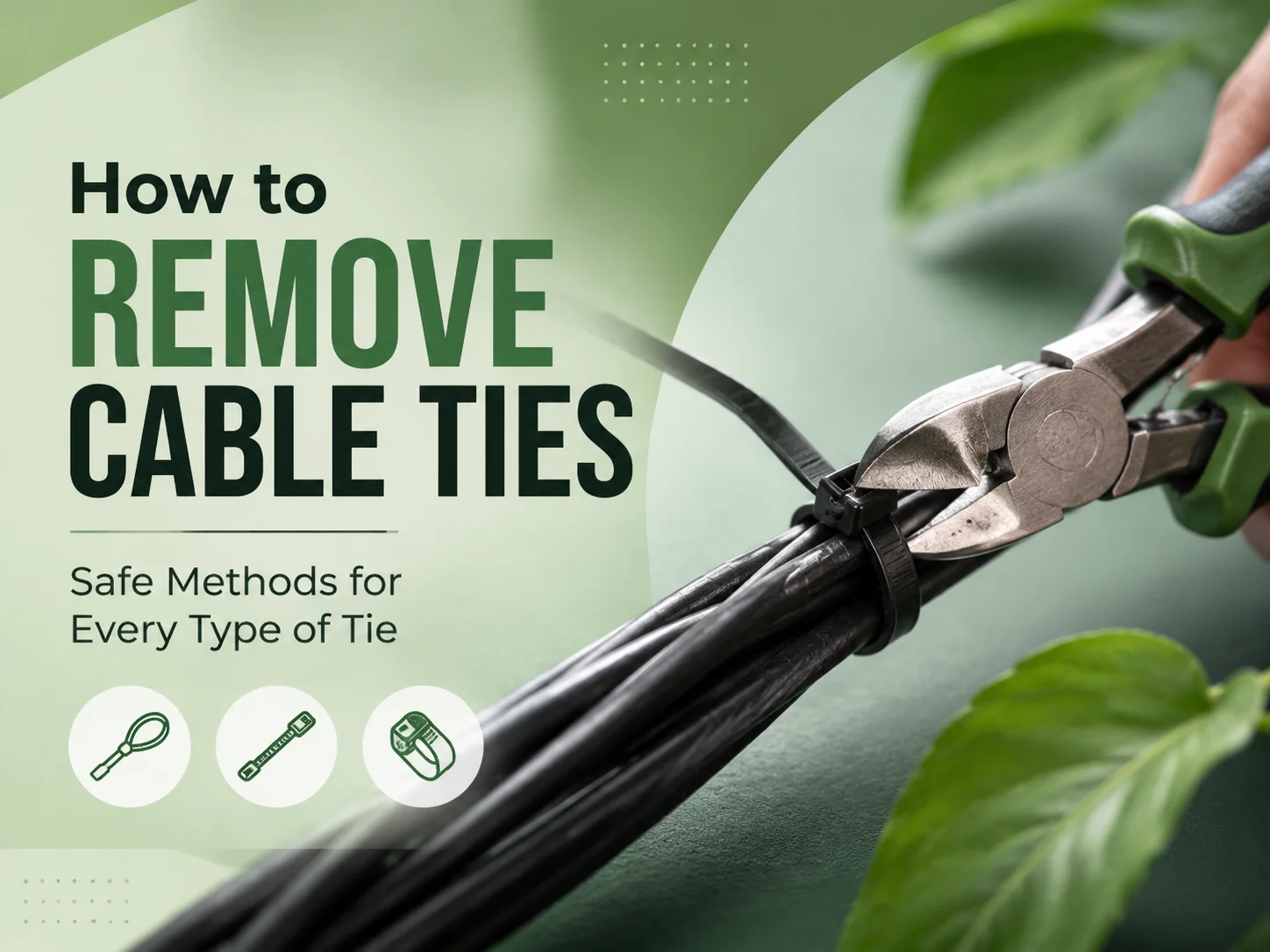
Every nylon cable tie operates based on the same principle. The strap has teeth-like serrations on one part and goes through a pawl located on its head. The pawl catches the serrations when the strap is pulled, and that gives a locking effect. The tie can be released by either pulling the pawl away from the serration or cutting the strap before the needed serrations. It is best to cut the tie at its head, particularly the part where the strap is inserted into the head. At this point, cutting does not leave sharp edges and removes the tie out completely.
Tools for Removing Cable Ties
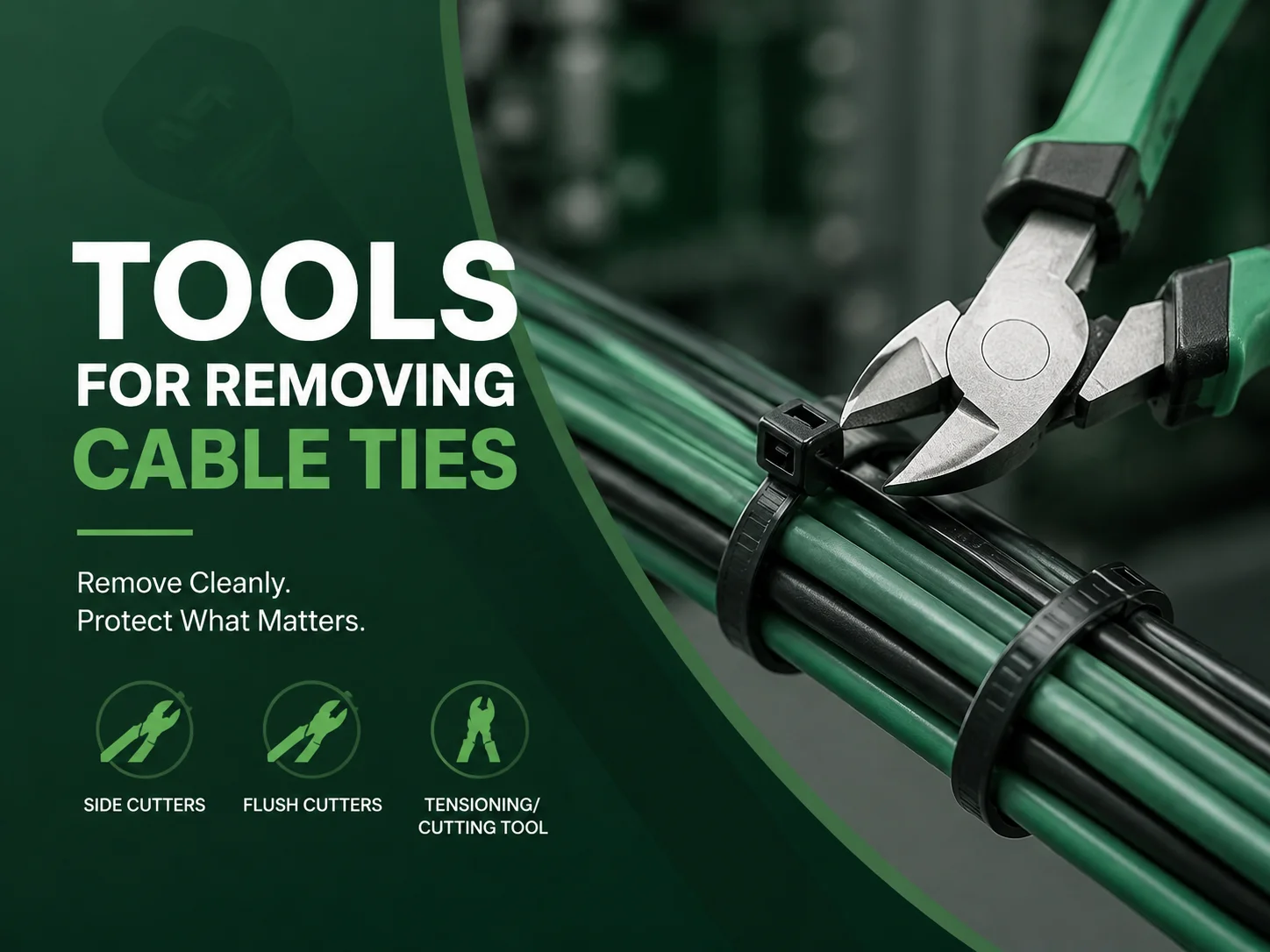
The right tool makes the difference between a clean removal and a nicked conductor. The table below summarises the most common tools and where each is appropriate.
| Tool | Best For | Precautions |
|---|---|---|
| Side cutters (diagonal pliers) | General‑purpose tie removal in open, accessible areas | Cut at the head, not mid‑strap. Keep the blades perpendicular to the tie to avoid pinching adjacent cables. |
| Flush cutters (electronics cutters) | Delicate work — control panels, data cabling, tight bundles | The flat side of the cutter should face the cables to leave a flush cut. Ideal for cutting the tail close to the head. |
| Cable tie removal tool (tensioning/cutting tool) | Production environments, high‑volume tie installation and removal | Many tensioning tools include a cutter that trims the tail flush. For removal, the cutter can be used on the head. Follow the tool manufacturer’s instructions. |
| Small flathead screwdriver | Releasing a releasable tie or gently lifting the pawl on a standard tie to slide the strap back | Only works on releasable ties with confidence. On standard ties, prying the pawl can damage the locking mechanism and leave a weakened tie in place. |
| Utility knife | Last resort, when no other tool is available | Extremely high risk of cutting the cables or your hand. Always cut away from the body and away from the cables. Not recommended for work near live conductors or delicate cables. |
For the vast majority of installations, a pair of small flush cutters or side cutters is the right tool. They are inexpensive, widely available, and when used correctly — cutting the head, not the strap — they remove the tie cleanly without damaging the bundle. Leading electrical tool manufacturers such as Klein Tools and Fluke produce cutters designed specifically for this kind of precision work in electrical enclosures and data racks.
Step‑by‑Step: How to Remove a Standard Nylon Cable Tie
- Locate the locking head. The head is the rectangular component which receives the strap. It is usually situated on the outer side of the package and positioned by the installer in order to gain easy access to it.
- Grip the tie gently with one hand. If the bundle is under tension, hold the tie to prevent it from snapping away when cut.
- Position the cutters at the head. Against the head, position the flat surface on the cutter jaw with the cutting edge right behind the pawl mechanism for severing it. The cut should happen at the narrowest part across the head and not the broader section.
- Squeeze firmly. One big, clean cut works better than many small ones that create jagged edges. Separation of the head part will take place and the tying will come undone.
- Remove the loose tie from the bundle. Discard it all. Never leave cut cables inside electrical enclosures, data racks, or machines, because they can migrate into moving parts or connect live circuits.
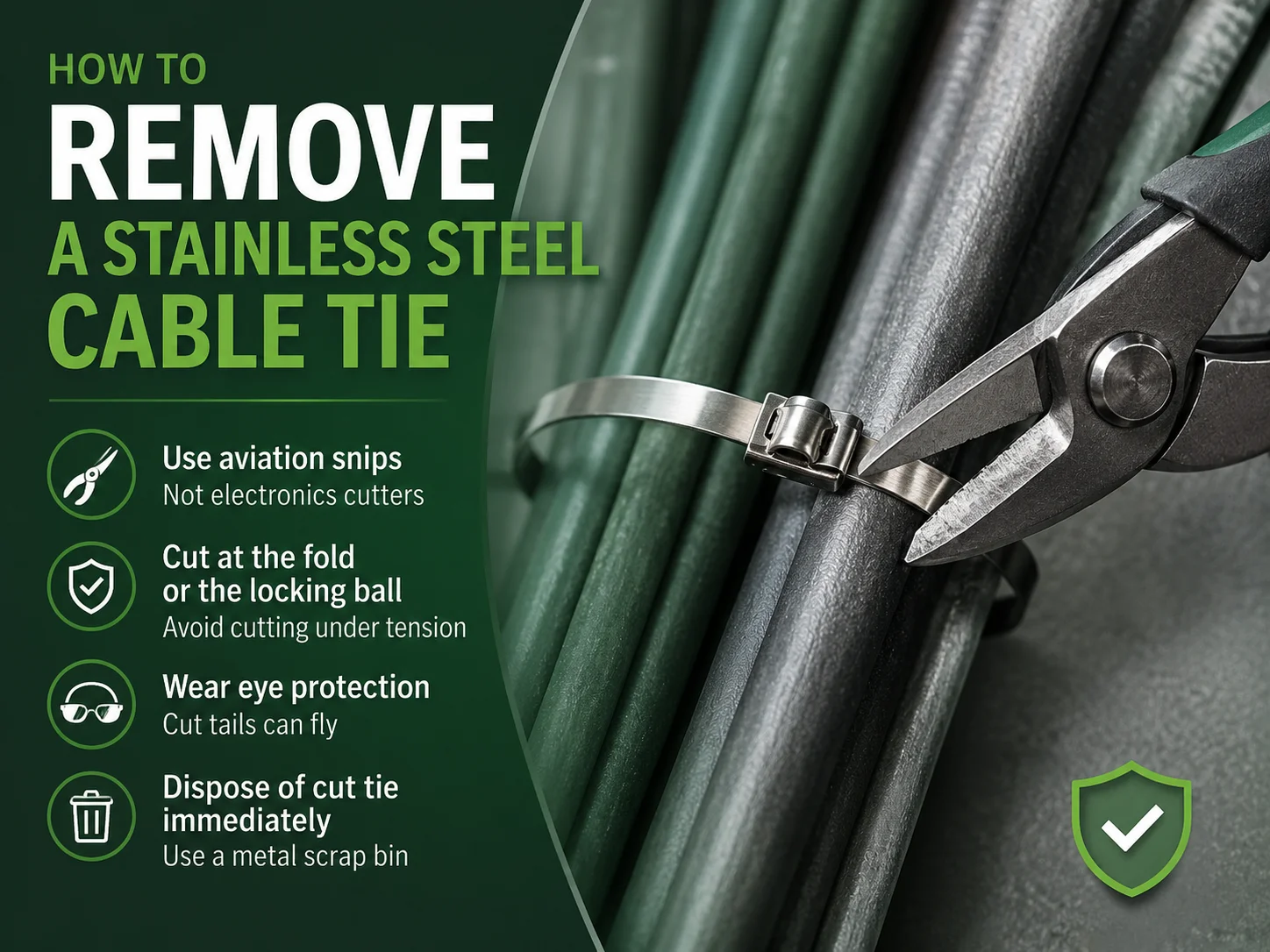
How to Remove a Stainless Steel Cable Tie
A stainless-steel cable tie will require different tools and more care. The metal is tougher than nylon, the edges of the cut are sharper, and the tension in the tie is probably greater than with nylon ties. The best way to do it is:
- Use aviation snips or tin snips, not electronics cutters. Stainless steel will blunt the hardened cutting edge of flush cutters, while a mini pair of pliers will not provide sufficient cutting force. Compound-leverage snips are required here.
- Cut at the fold or the locking ball, not at the strap under tension. A steel cable under load has a potential for energy storage. If the strap is cut through the rope, it may snap back and emit potential for harm. If you decide to cut it, do it through the locking piece.
- Wear eye protection. A cut stainless steel tail can fly. Safety glasses are mandatory.
- Dispose of the cut tie immediately in a metal scrap bin. A stainless steel tail on the floor is a puncture hazard.
Is There a Way to Remove a Zip Tie Without Cutting?
The mechanism of ratchet of a nylon tie is made so that release cannot be achieved easily. A pawl is a small, springy piece of plastic which follows the ratchet mechanism and locks with it to avoid release of the tie. It is possible to achieve release theoretically by inserting a thin, stiff edged tool — a jeweller’s screwdriver, a pin or any other similar instrument. However, this can be difficult in practical life because of tightening of the nylon zip tie.
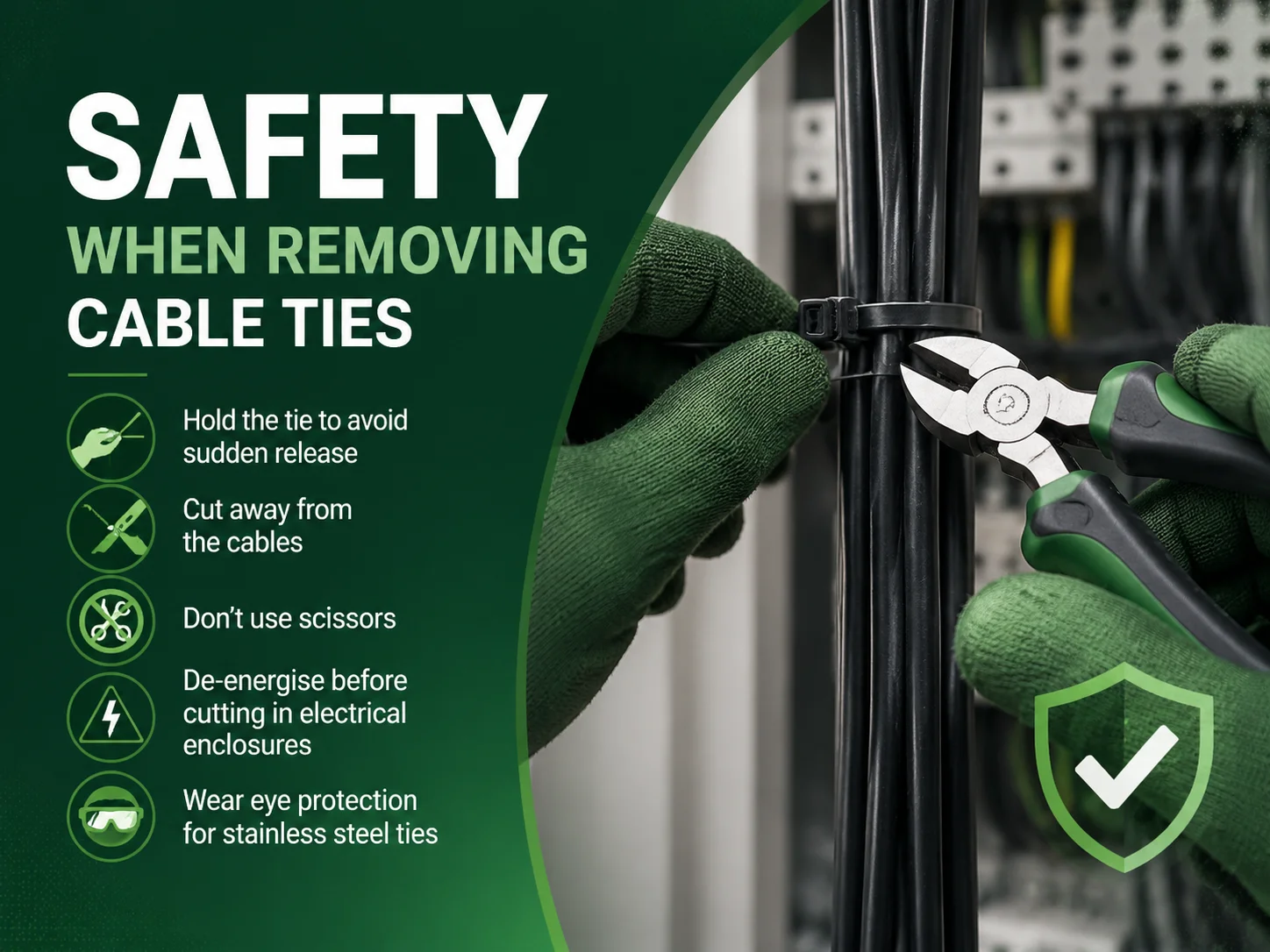
Safety When Removing Cable Ties
Removing a cable tie is a quick task, but it carries a few specific risks that are easily managed:
- Never cut a tie under tension without holding it. Any bundle that is tied tightly will create tension when cut and release that tension with a force that may injure the face or hand. It is therefore recommended that one hand grips the tie while cutting it with the other hand.
- Always cut away from the cables. Set the cutters such that the blade is pointed outward from the multitude. In the event that the cutters and slipsare accident, it will not touch any conductors.
- Do not use scissors. The action of cutting a nylon strap will not succeed with scissors, as it lacks leverage that can provide a clean cut, more often than not slipping and causing harm to the wires.
- In an electrical enclosure, confirm the circuit is de‑energised before cutting any tie. To short circuit, there may be a possibility of contact between a live terminal and a pair of cutters while cutting through a tie. In this regard, a tie should be treated like a conductor.
- Wear eye protection when cutting stainless steel ties. The risk of a flying metal tail is real.
Frequently Asked Questions
How to get cable ties off?
To perform the task of removing cable ties in the safest and most efficient manner, it is advisable to cut off the locking head of the ties using either side cutters or flush cutters. This will cut the cable tie off cleanly without the risk of injuring yourself with the sharp end of the tie. In case of stainless steel ties, make sure to use kitchen scissors and put on protective eyewear.
Is there a way to remove zip ties without cutting?
With a releasable cable tie, it is easy to release it by pressing the tab and removing the strap. On a normal nylon tie, using a narrow tool, it is possible to raise the pawl within the locking head, but it is more difficult when the tie is tight. In this case, cutting off the end of the tie is the common practice.
Why can’t you undo zip ties?
On a regular zip tie, it is impossible to undo it because there is a one-way ratchet mechanism inside the locking head. The strap becomes locked into the pawl after it has traversed the pawl and hence the movement opposite to the direction of the strap is blocked.
Is there a tool to undo zip ties?
Sure. A cable tie un-installing device or a pressure tool that has an in-built cord trimmer is the standard equipment for production. When it comes to rare usage of cable ties, the best means of uninstallation is through using flush-cutting pliers.
References
- Klein Tools — Precision Cutters and Pliers — Manufacturer of side cutters, flush cutters, and specialty electrical hand tools.
- Fluke — Electrical Test and Measurement Tools — Non‑contact voltage testers and safety guidance for working in and around electrical enclosures.
- Panduit — Cable Tie Installation and Removal Tools — Manufacturer of tensioning tools with integrated cutters for nylon and stainless steel cable ties.
- HellermannTyton — Cable Management Tools — Supplier of cable tie tensioning and cutting tools for production and field use.
Removing a cable tie is a simple task that rewards the right tool and the right technique. Cut at the head, not the strap. Use flush cutters for nylon ties and aviation snips for stainless steel. Hold the tie while you cut, and keep the cutters moving away from the cables. A clean removal takes seconds and leaves the bundle ready for the next tie — or for a different fastening solution altogether. igoto supplies the full range of cable ties — standard, releasable, UV‑stabilised, and stainless steel — because the tie that goes on quickly must sometimes come off just as cleanly.