




Is it Legal to Zip Tie license plate in Texas?
To put it plainly: it is illegal. According to Texas Transportation Code § 504.943 and regulations from the Texas Department of Motor Vehicles (TxDMV), a license plate must be “securely fastened” in a designated location on the vehicle’s exterior. However, in many rural parts of Texas, “beat-up” trucks and modified off-road vehicles frequently traverse muddy terrain, ranches, and brush. Factory-installed plastic license plate mounts are highly prone to breaking when they strike tree branches, earthen embankments, or winch cables. Rather than purchasing replacement factory mounts, local owners often simply grab a few heavy-duty zip ties from their toolboxes and secure the plate directly to the bumper or a “bull bar.” If a tie breaks, they just snip it off and attach a new one—it’s an inexpensive and rugged solution. In these rural areas, local sheriffs or small-town police officers—who are often well-acquainted with the local residents—are unlikely to pull you over for using zip ties, provided the license plate remains clearly visible and there is no evidence of intentional concealment or an attempt to evade toll charges.
In major metropolitan areas like Dallas or Houston—and their surrounding suburbs—law enforcement officers have greater discretion in determining whether a license plate is “securely fastened.” If the zip ties used are too flimsy or have become brittle due to age, you could still be pulled over or issued a citation. It is important to understand the specific legal requirements and to use high-strength zip ties capable of withstanding both the intense Texas sun and the stresses of high-speed driving to ensure your vehicle remains in compliance with the law.
Key Takeaway: While Texas law does not explicitly mention “zip ties” by name, Texas Administrative Code Title 43, § 217.27 requires every license plate to be “securely fastened at the exterior front and rear of the vehicle in an upright horizontal position of not less than 12 inches from the ground.” In urban and suburban areas, officers frequently interpret flimsy or loose cable ties as failing the “securely fastened” standard—meaning a zip-tied plate can still lead to a traffic stop or a fine of up to $200.

What Texas Law Really Says About Mounting License Plates
Texas law is more concerned about how a license plate is displayed and secured rather than the exact hardware needed. The mounting of license plates across the State is governed by two main regulations:
Texas Transportation Code Section 504.945 (Wrong, Fictitious, Altered, or Obscured License Plate): It shall be unlawful to attach or display any license plate in such a manner as to conceal any letters, numbers, name of the state, or otherwise alter its legibility.
Texas Administrative Code, Title 43, Section 217.27 (Vehicle Registration Insignia): Each license plate shall be firmly attached to the outside of the vehicle in an upright and horizontal position at a height not less than 12 inches from the ground, shall be kept from swinging, and shall not be obstructed from view except to identify the number required in this subdivision.
If your zip ties hold the plate flat against the bumper or mounting bracket-without wobbling, twisting, booting, or covering any part of the registration characters or validation text-you’re answering on them for meeting the minimum display requirements.
When Using Zip Ties to Attach a License Plate May Result in a Traffic Stop
In spite of cable ties not being illegal, their incorrect use results in different violations causing police to pull the vehicle over:
Swinging plates: If there are only two zip ties holding the license plate at the top, the lower section of the plate is free to swing which is a violation against swinging plates.
Obscured text or name of the state: The cops can stop you for having the oversized ties placed diagonally on the corners or on the word ‘Texas’ to block it.
Broken or drooping ties: With a lot of UV rays and heat, standard indoor nylon ties become very weak and unexpectedly break leaving the plate hanging at an angle.
Missing front plate: The state of Texas requires two plates for all vehicles; thus, the zip tie on the back plate will not help the driver who has no front license plate.
Quick Compliance Checklist: Legal vs. Illegal Setup
| Mounting Factor | Compliant Setup | Non-Compliant Setup |
|---|---|---|
| Number of Fasteners | 4 zip ties (all four corners secured) | 1 or 2 zip ties (bottom swings in the wind) |
| Plate Orientation | Upright, horizontal, and flush with bumper | Tilted, crooked, or hanging vertically |
| Visibility | All letters, numbers, and “Texas” 100% visible | Straps crossing over numbers, letters, or stickers |
| Material Grade | UV-resistant nylon 6/6 or stainless steel ties | Thin indoor craft ties or brittle, sun-bleached plastic |
| Ground Clearance | At least 12 inches above the roadway | Mounted lower than 12 inches on a front splitter |
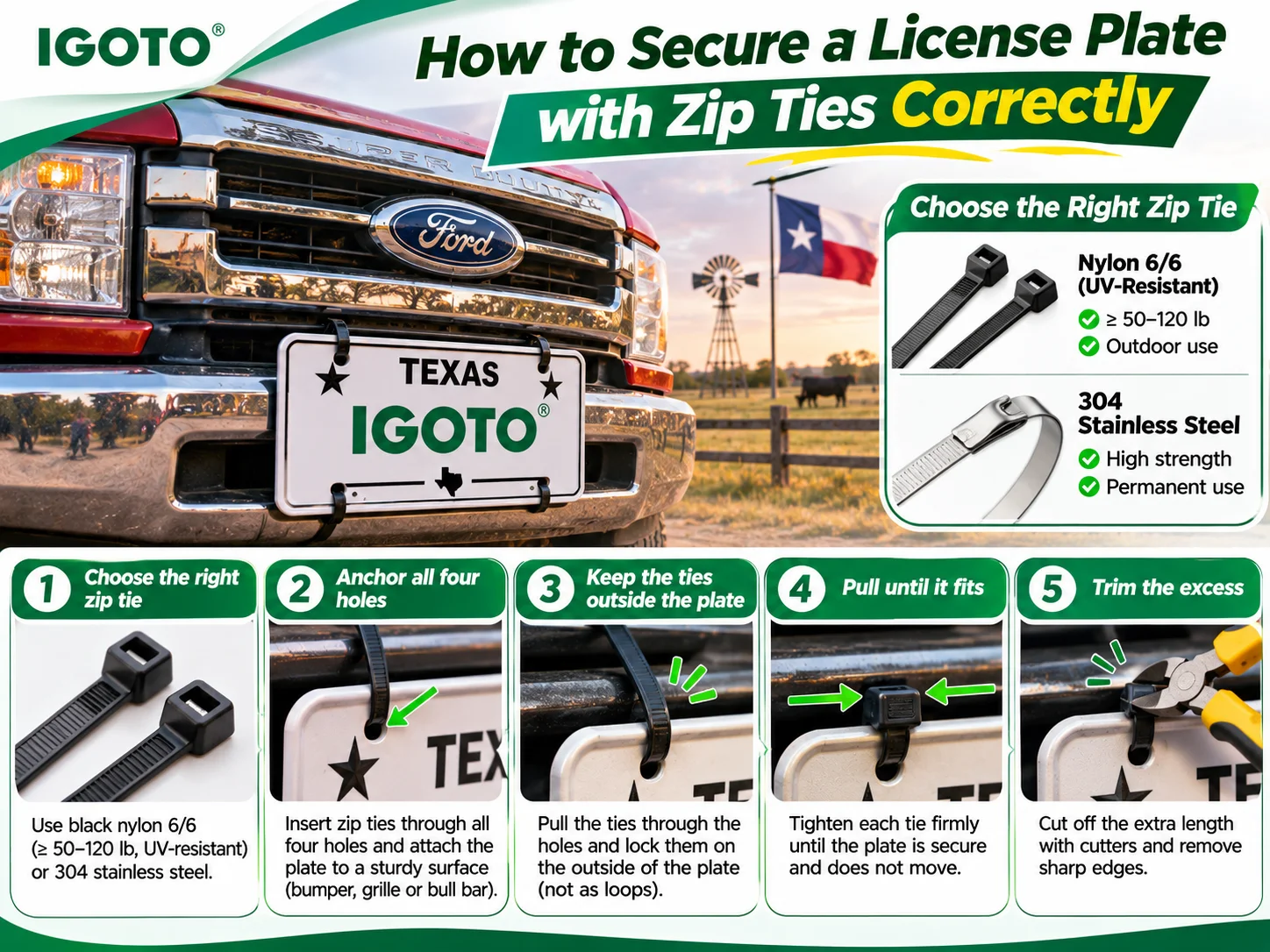
How to Secure a License Plate with Zip Ties Correctly
If damage to the bumper, sway in the auto body, a ruined bracket, or the holes in the license plate are stripped, here are the steps to use zip ties for fastening the license plate safely and legally:
1. Choose the right specifications of the zip tie. Either decide on a high strength cable tie that has a strength of at least 50–120 pounds and is resistant to UV light or use 304 stainless steel cable ties for permanent usage outdoors.
2. Anchor all four holes of the license plate: insert zip ties from each hole of the license plate and attach it to a sturdy surface that holds the license plate.
3. Make sure that the zip ties are outside the license plate: pull zip ties tightly through the holes instead of using them as loops.
4. Pull it tightly until it fits: every tie should be pulled until flat.
5. Trim off parts of the zip tie that stick out from the plate: use cutters to cut the zip ties hiding the sharp edges.
Best Zip Ties for License Plates in Texas Heat
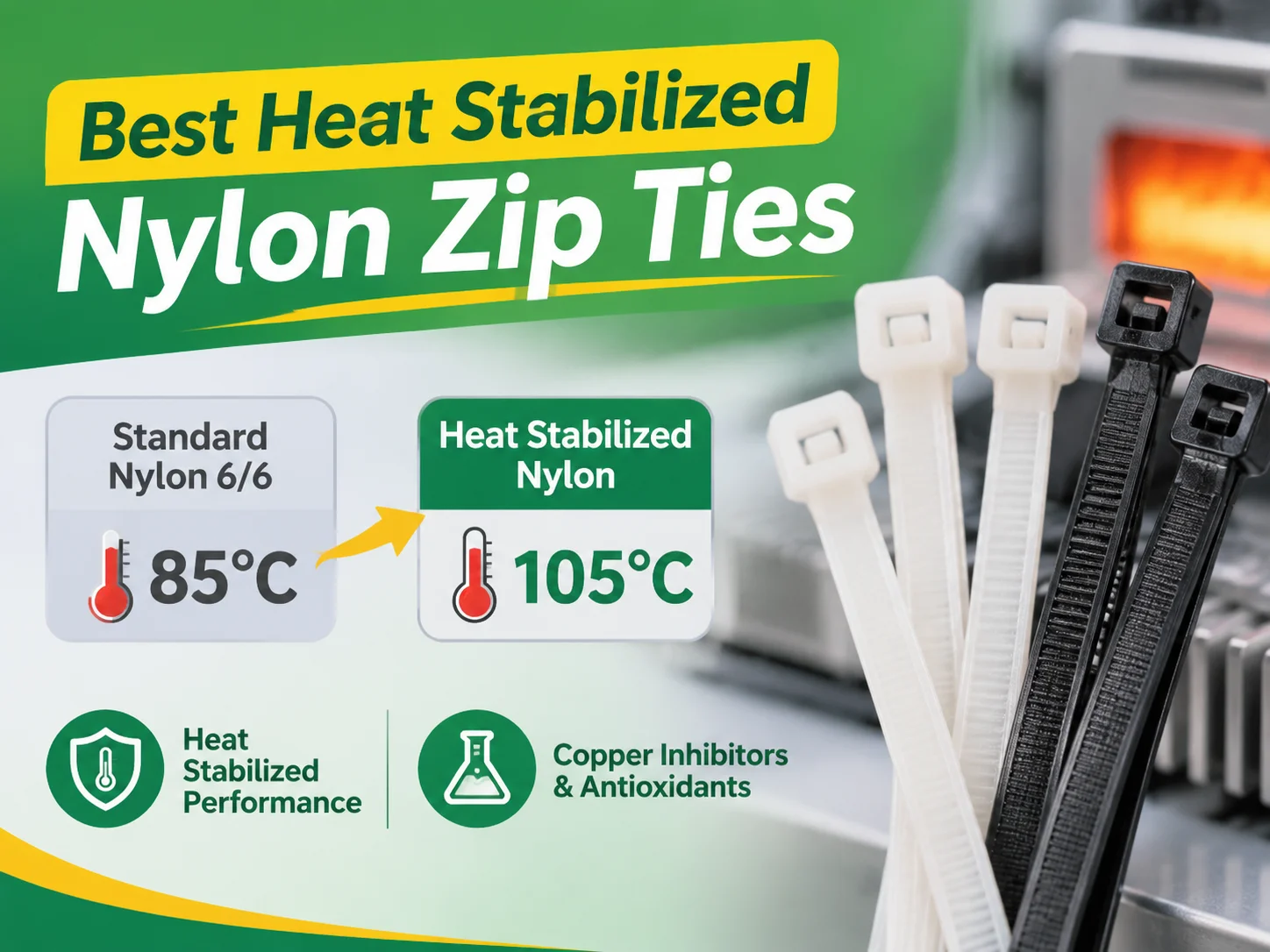
Standard zip ties made of nylon, whether white or natural, are not meant to withstand outdoor use. Therefore, they can lose up to half of their tensile strength and be rendered useless within a matter of time when exposed to the sun and heat of the engine. To safely mount your automotive assembly, you should only work with the weather-resistant materials. The materials is the following:
UV-resistant black nylon 6/6 (50 lb – 120 lb): Synthetic polymer with carbon black additives, which provides enough protection from the sun and works well in temperatures of up to 185 °F (85 °C).
316 stainless steel: Completely resistant to the elements, such as UV rays, road salt, engine heat, or vibrations. It provides a strong and permanent bonding between different materials thanks to a reliable metallic connection.
Heavy-duty mounting hole tie: This tie has an eyelet near the lock that allows you to rivet or bolt it to the bumper frame.
Frequently Asked Questions
Can I zip tie my front license plate to my grille in Texas?
Yes, provided the plate is mounted upright, horizontally, at least 12 inches off the ground, and secured at all four corners so it cannot swing or block airflow sensors. Make sure no part of the zip tie covers the registration numbers or the state name.
Is zip-tying a license plate considered a temporary fix only?
While Texas law sets no time limit on how long cable ties may be used, they are best treated as a temporary measure until you can install proper machine screws, nylon bumper inserts, or a replacement mounting bracket—unless you use high-tensile stainless steel ties.
Will a zip-tied license plate pass a Texas vehicle inspection?
Texas eliminated mandatory safety inspections for most non-commercial vehicles starting in 2025, though emissions testing still applies in designated counties. Regardless of inspection rules, traffic officers can still issue a citation at any time if a zip-tied plate is loose, swinging, or obscured.
Sources
- Texas Transportation Code § 504.943 — Operation of Vehicle Without License Plate
- Texas Transportation Code § 504.945 — Wrong, Fictitious, Altered, or Obscured License Plate
- Texas Administrative Code Title 43, § 217.27 — Vehicle Registration Insignia (TxDMV Mounting Rules)
- Texas Department of Motor Vehicles (TxDMV) — Vehicle Registration & License Plate Display Guidelines