


UV-Resistant Cable Ties: Which Supplier to Choose
There are many manufacturers stating that their product has UV resistance. Among them, only a few can explain what specific test was done, for how long, and what the product’s tensile was before and after the test. This is where purchasing problems come in, mostly due to the fact that one cheap cable tie can last only eighteen months, while a good product can be used for about ten years.
It is important to know how to interpret these claims and which manufacturers can provide reliable information regarding UV-resistant products. Additionally, we’ll list five questions that can tell the difference between a manufacturer and a reseller.
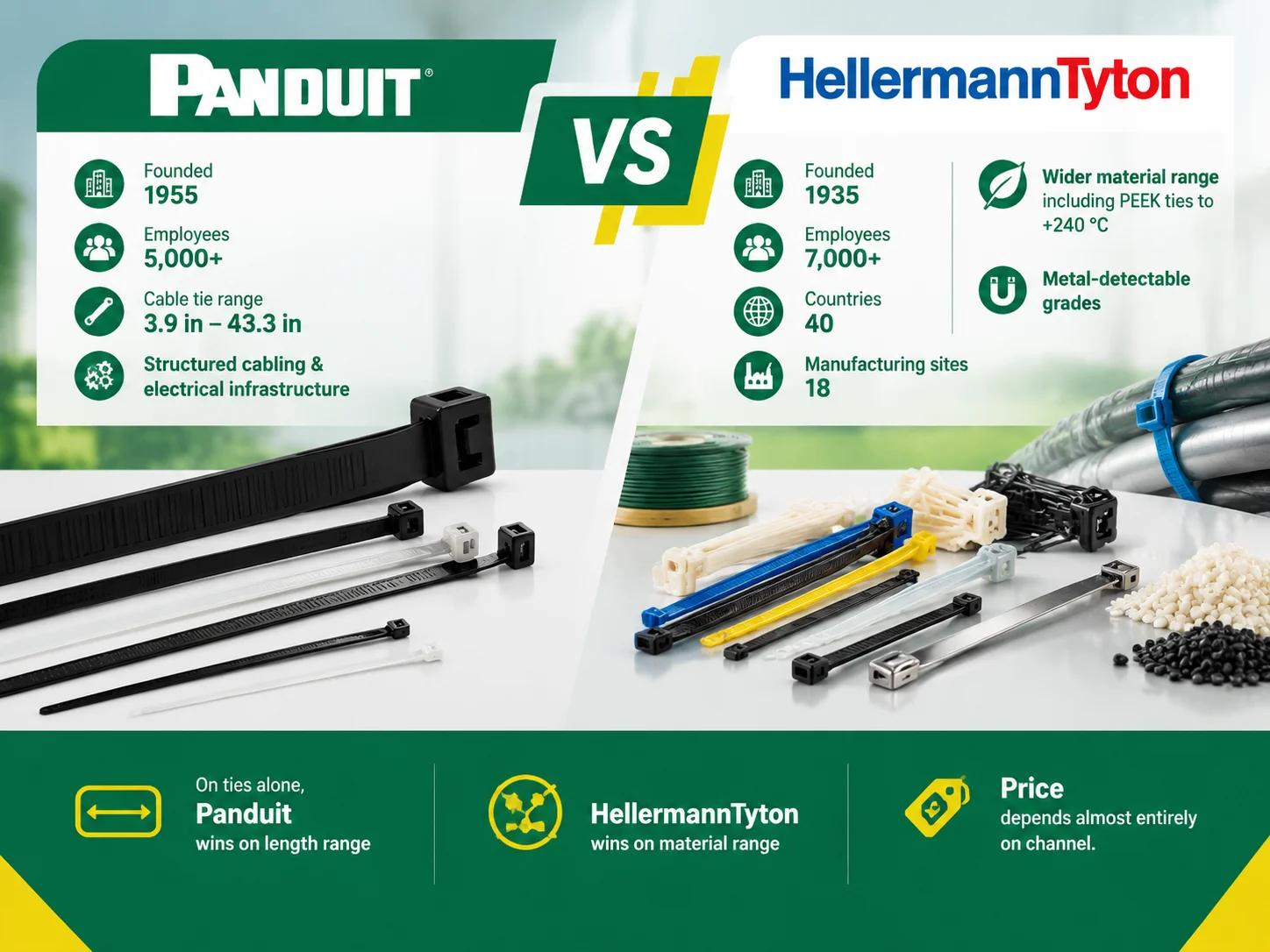
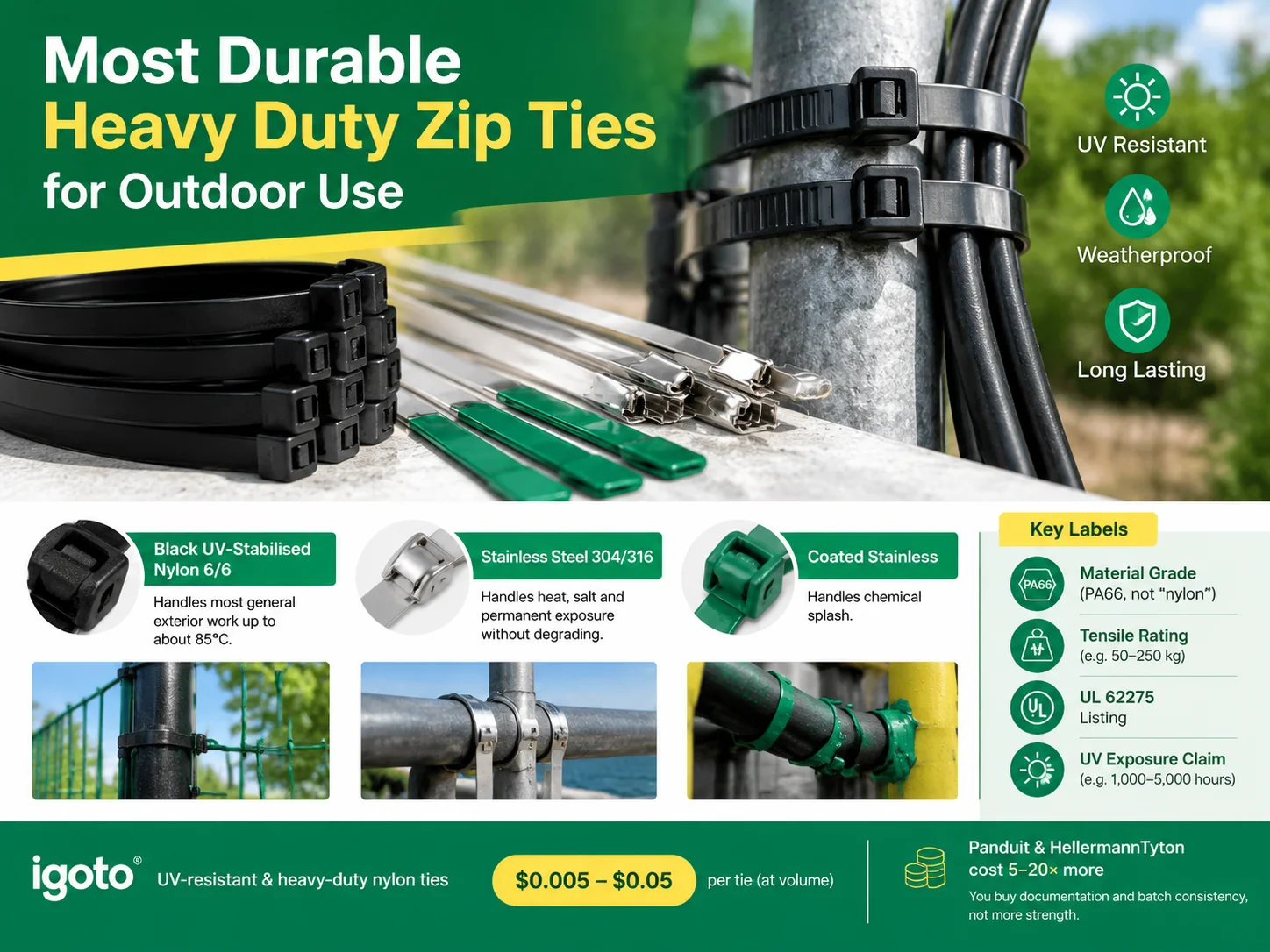
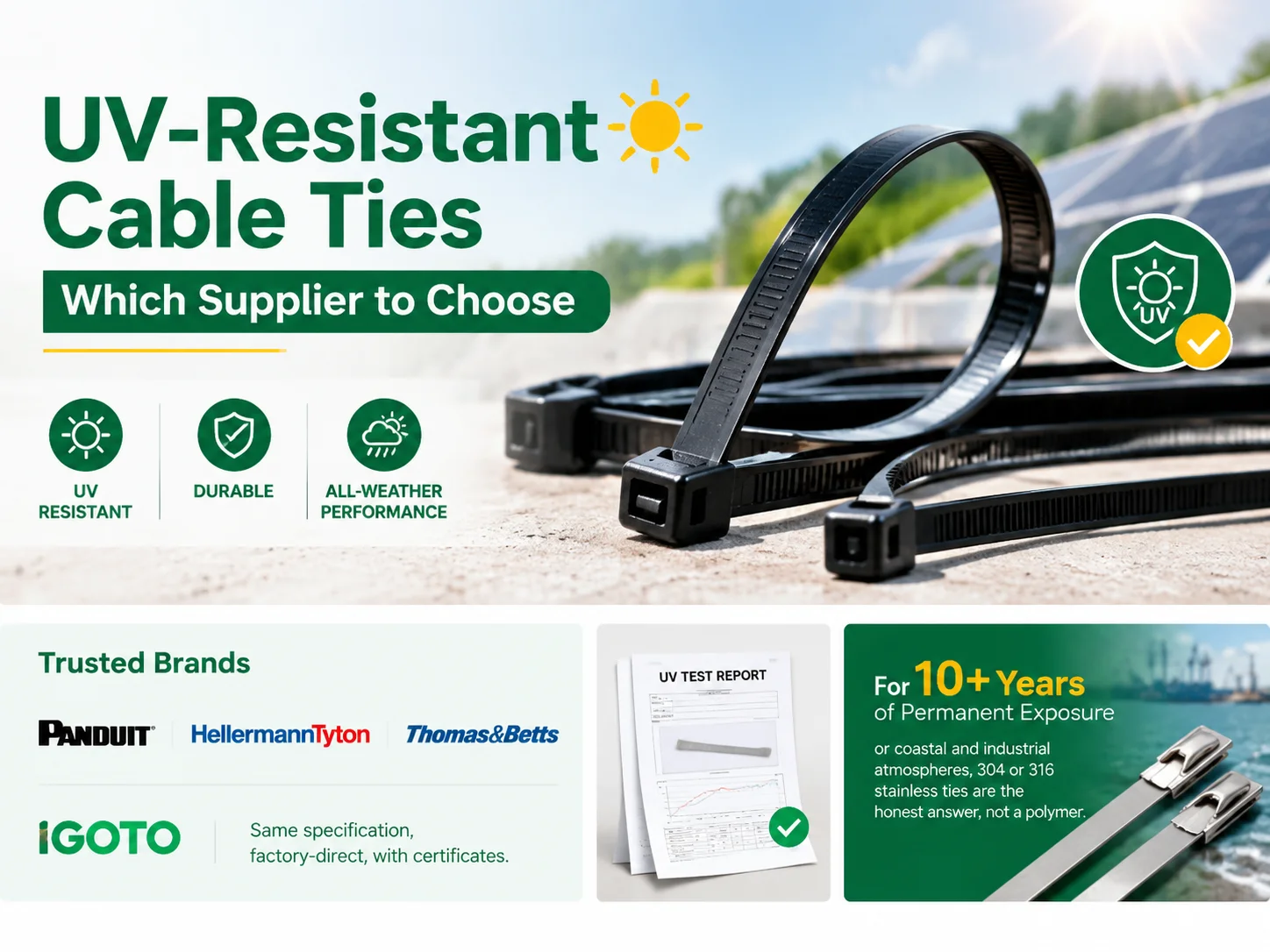
Short answer: Go for a black PA66 tie (that is UV-stabilised) which is manufactured using process that provides an end product, and not just resin that was UV tested before manufacturing. The recommended brands in this case will include: Panduit, HellermannTyton and Thomas & Betts; IGOTO will supply the same quality products directly from the factory. If you need a tie that will withstand the test of time (10 years of continuous exposure), or if you are in a coastal or industrial environment, you should stay away from polymers and instead choose 304 or 316 stainless steel ties.
What “UV-Resistant” Actually Means
Sunlight destroys polymer chains. For instance, in polyamide 6.6 signs of damage are chalking, followed by brittleness, and lastly a tie that breaks.Three key factors reduce this process:
- Carbon black: Approximately 2% of dispersed carbon black absorbs UV before it comes in contact with polymer.That explains why outdoor ties are black, while natural or white ties should not be used outdoors.
- Stabilizing packages: Hindered amine light stabilizer stops the decomposition chemistry process.While stabilized substance is not to be confused with colored ones, it is evident in the period between three and five years.
- Thickness: A thicker strap means more material will go away till the failure occurs.This explains why heavy-duty ties will outlast thin ties after exposition to the environment, regardless of the material they are made of.
The claim itself should be testable. UL 62275 implies that the cable tie must be provided with the UV treatment, and suppliers state that they use it for a certain number of hours, this number is often 720. Make sure you ask for the report as well as for the information about the type of the test conducted – was it on the cable tie or the resin plate. Only the cable tie results are valid because molding and design influence the final result.
The measurement conventions behind the claim, including how tensile is specified and tested, are set out in this guide to standard cable tie sizes.
The Shortlist
| Supplier | UV range | Where it wins | Price signal |
|---|---|---|---|
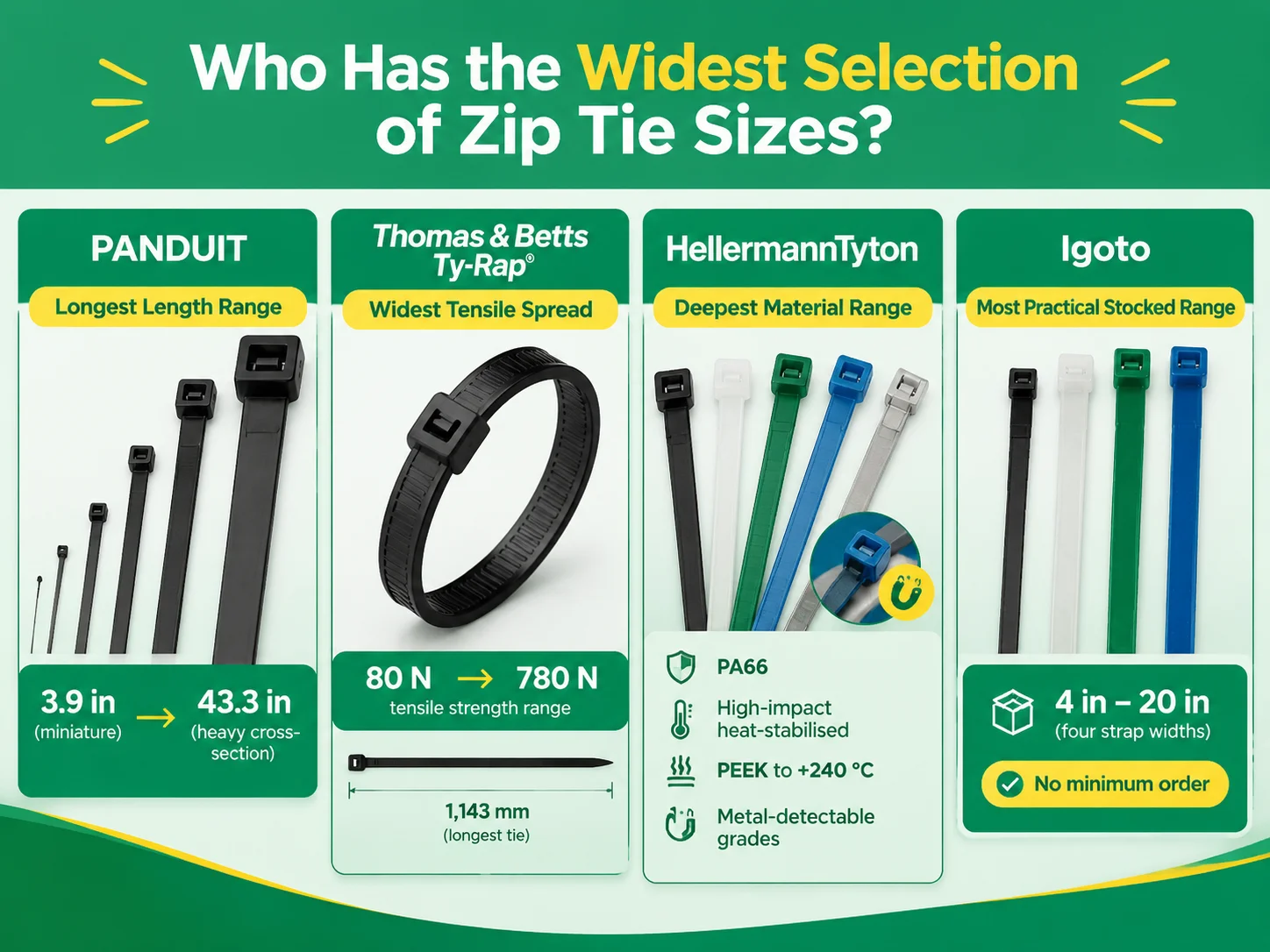
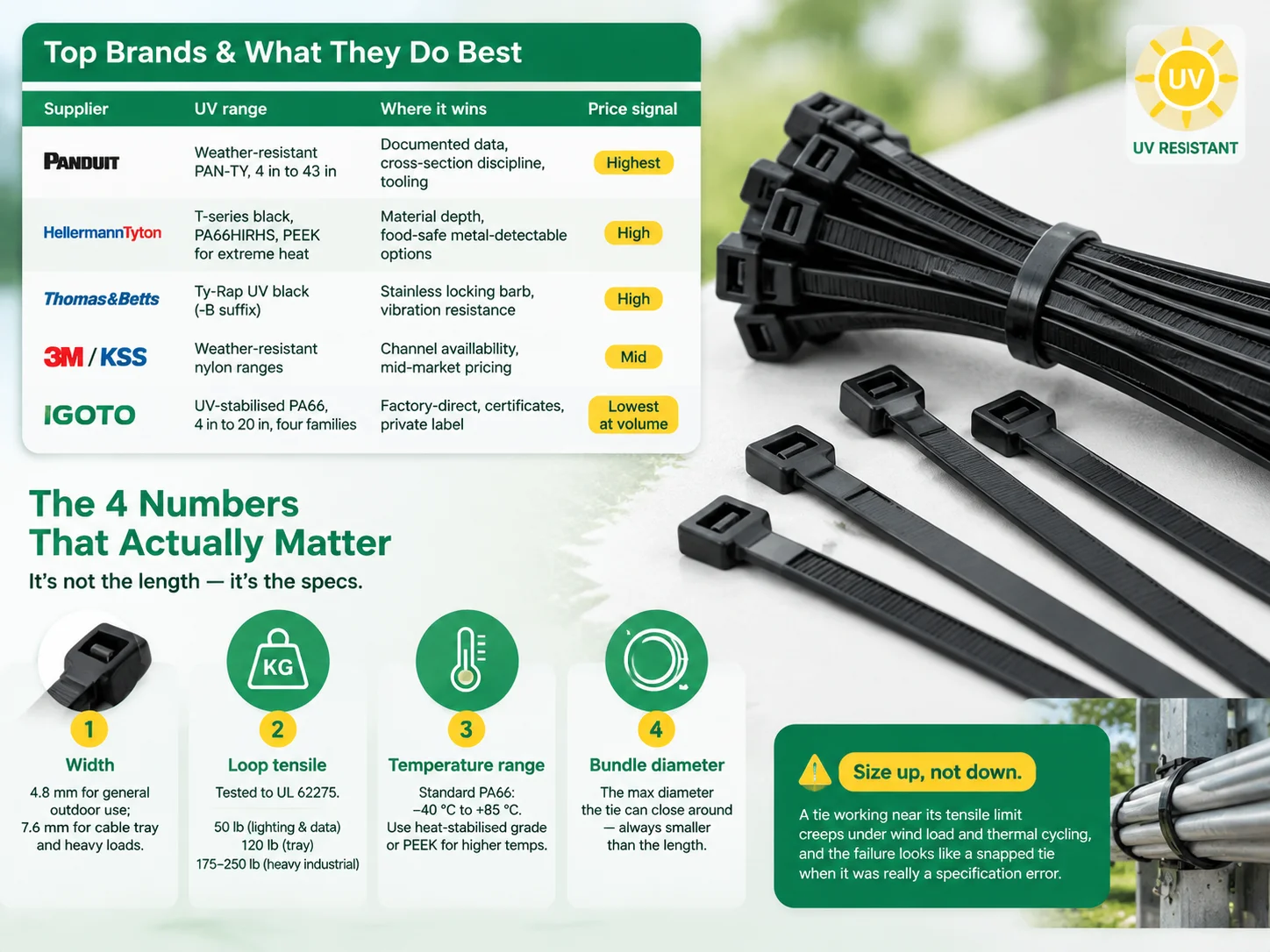
| Panduit | Weather-resistant PAN-TY, 4 in to 43 in | Documented data, cross-section discipline, tooling | Highest |
| HellermannTyton | T-series black, PA66HIRHS, PEEK for extreme heat | Material depth, food-safe metal-detectable options | High |
| Thomas & Betts | Ty-Rap UV black (-B suffix) | Stainless locking barb, vibration resistance | High |
| 3M / KSS | Weather-resistant nylon ranges | Channel availability, mid-market pricing | Mid |
| IGOTO | UV-stabilised PA66, 4 in to 20 in, four families | Factory-direct, certificates, private label | Lowest at volume |
Brands sitting at the top of this table are not better due to their names. The reason behind their superiority can be found in completeness of the data: tensile value, UV exposure, temperature range and confirmation of certification verification are provided. Meanwhile below those brands, quality is dependent on the factory rather than the brand so this is why the information provided in the previous section is more important than logos.
Sizes and Specifications That Actually Matter
Four factors determine if a tie outdoor has the right size. Furthermore, length is not one of them!
- Width. 4.8 mm provides basic outdoor size, while cable tray applications require 7.6 mm width. In this respects, width increases the strength of the loop more than length.
- Loop tensile strength. This is measured in either pounds or newtons. Essentially, this is the maximum weight the tie can carry as tested with UL 62275. For instance, a 50 lb tie serves as a cable lay and a lighting tie, while 120 lb tie is capable of carrying a tray.
- Temperature range. Standard PA66 can function at temperatures ranging from −40 °C to +85 °C. In case of higher temperatures, a heat-stabilized material is required, such as PEEK for high-end temperature applications.
- Bundle size. This is maximum size for a bundle diameter that can be held through the closing tie – and normally it is smaller than expected.
When using ties outside use larger sizes rather than smaller ones. Using the smaller ones can lead to problems caused by the tie which has been used near its loading limits.The width-to-strength relationship is covered in this note on zip tie width.
Certifications Worth Asking For
Three documents distinguish a bona fide supplier from a trading company.
- UL 62275 reference number. Can be verified in minutes, and it proves that tensile strength has been tested and not calculated from a sample in a laboratory.
- UV exposure test report. Xenon arc or equivalent with the number of hours and the kept tensile strength. A supplier who claims “UV resistant” without a number is talking only about color.
- RoHS and REACH declarations. More and more demanded by European customers and any project with material declarations, and cheap to produce if the mixture is controlled.
Add ISO 9001 if the buyer’s own quality system needs it. Our certification library exists because the same three documents are requested on every export order, and a factory that cannot produce them quickly is a factory that has not done the work.
Where IGOTO Fits
We produce four different types of UV-stabilised nylon ties ranging from 4 to 20 inches in lengths, with a width of 3.0, 4.0, 4.8 and 5.0 mm, standard colour being black, while clients can request colour variations for identification purposes. The polymer used is UV-stabilised PA66, while the category also comprises varieties made of flame-retardant and high-strength nylon fabric, all of which are manufactured at the same plant.
It is important to be honest with the clients when it comes to our position in the market: we are not the go-to supplier for clients who have a Panduit die for their product. We are also bad suppliers for clients who need nylon ties of 43 inches in length. We should focus on the middle of the market where, for example, a client needs 200,000 black nylon ties of 200 mm length with a product certificate and branded packaging.
That range is described on our UV-resistant cable tie manufacturing page, including the size ladder and the certifications we hold.
Price, and How to Compare Quotes Honestly
The cost of standard black UV-stabilised nylon ties per volume is measured in cents. In terms of variation, suppliers tend to vary more than brands due to four main factors.
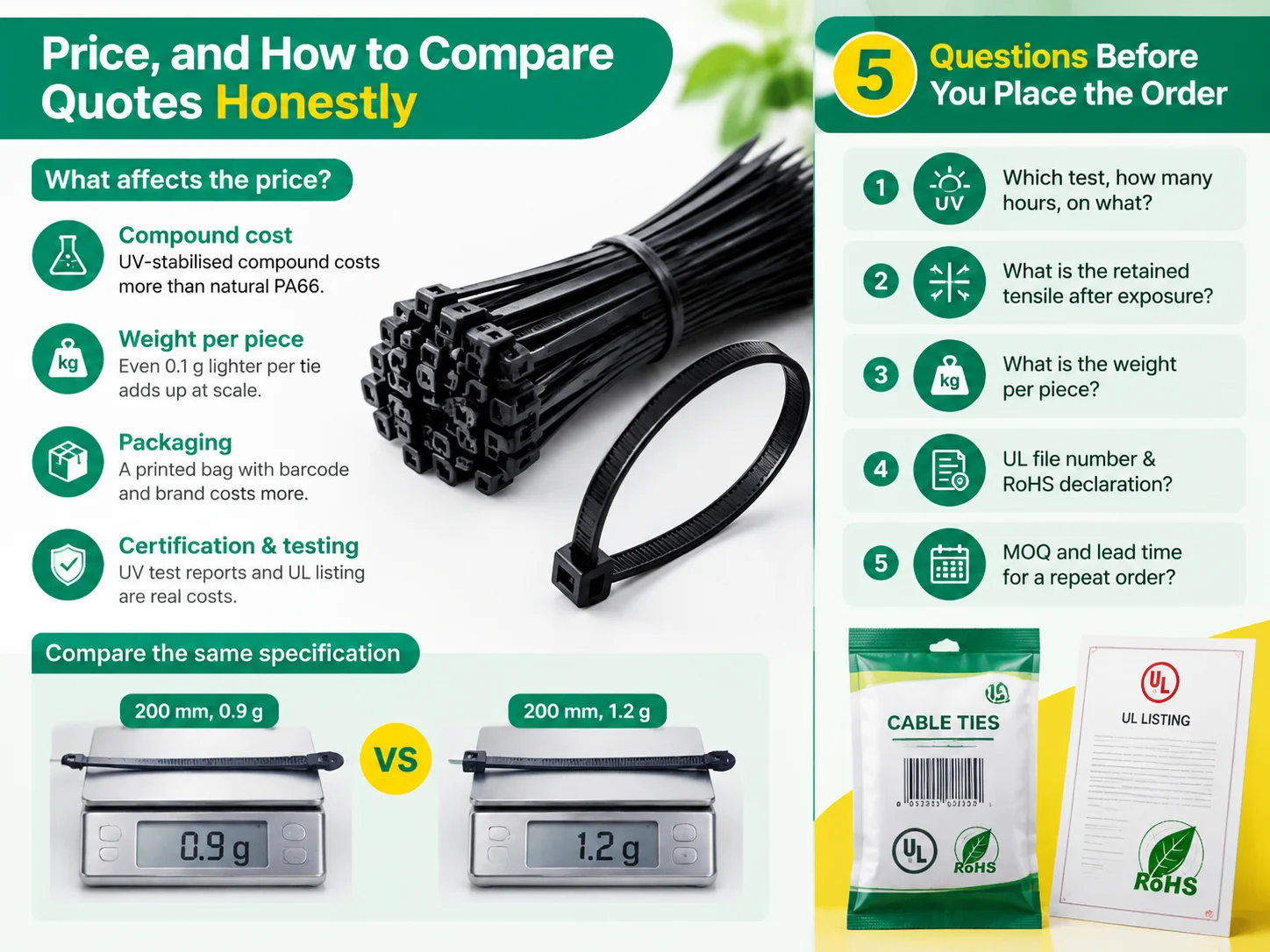
- Compound cost. There is a difference in the price of a stabilisation black compound with respect to a natural PA66 compound; thus, when a supplier gives a low price offer, they could be providing a natural or a less pigmented tie.
- Weight per unit. Although ties are sold in terms of the number of units, tying units using the same material doesn’t mean that unit weight doesn’t matter. For instance, a tie can be heavier by 0.1 grams, which means that 100 thousand pieces will account for 10 kg of the material savings.
- Packaging. It costs more to have a printed bag that has a brand and a barcode than simply have a plain bag; thus, at a big scale, packaging will cost more than the tie itself.
- Testing. Some costs which are generally ignored by cheap suppliers are related to certification such as UV test reports and UL listing.
The best way to assess the actual prices is by quoting the same specification to three suppliers and getting samples. Thus, a ‘200 mm tie that weighs 0.9 grams is not the same as that with a weight of 1.2 grams as per catalogue. The heavy-duty end of the range is where this matters most, and it is covered in this look at heavy-duty cable tie production.
Five Questions Before You Place the Order
- What type of test has been performed, how much time did it take, and what is its purpose? A UV testing claim which doesn’t have the time element is not a valid claim.
- What are the retained tensile forces after conducting the test? The value that can be used to forecast year 5 as opposed to week 1.
- What is the weight of one piece? Instead of saying “standard thickness”, say grams.
- Can I have the UL file number and the RoHS declaration through email today? The speed of response indicates how often someone is required to deal with this issue.
- What is the MOQ? What is the lead-time for a repeated order? It is during the second order that a weak supplier fails.
Anyone can easily answer questions one and two by referring to a brochure. For questions 3-5, it is important to have a factory that understands its production process.
FAQ
Are black cable ties UV resistant?
The color black is appropriate because it has carbon black which absorbs UV, however specification is not only about color. Even black ties made from unstabilised material are prone to break. Always inquire for UV hours and remaining tensile strength.
How long do UV cable ties last outdoors?
For a moderately climate PA66 fastener installation, it can be counted on to retain enough strength for five to ten years. In environments that have high UV exposure, high temperatures, or coastal conditions, it will typically hold for five or six years, so it may be worthwhile to choose stainless steel in applications that need to endure for decades.
Should I use stainless steel instead?
Yes, both outdoor usage, shore stations, and the requirement for support of any weight exceeding 50 lbs. require the use of 304 in most circumstances, and 316 when your environment has chlorides. Although stainless steel material ends up more expensive for every piece, it needs a special tensioning tool and edges protection.
What is the difference between UV-resistant and weather-resistant?
Weather resistance is usually regarded as a combination of UV and moisture and the cycling of temperature. Actually, these two terms are taken as synonymous, and therefore, the report is much more relevant than the writing on the box.
References
- Panduit — Weather-Resistant PAN-TY Cable Ties
- HellermannTyton — UV-Resistant and High-Temperature Cable Ties
- UL Solutions — UL 62275 Cable Management Systems
- Cable Ties Unlimited — Distributor Size and Material Listings
- Heyco — Nylon Cable Ties and UV Performance
Conclusion
The certification of UV resistance is no mere word found on the packaging. It is a piece of information one must obtain by asking questions. This information includes the number of exposure hours, as well as the retained tensile strength and file number so as to calculate the weight for each item from three suppliers.
Provide us with the specifications, tensile strength and exposure conditions of your application, and we will supply you with the relevant stabilised ties, complete with certificates.