




Suporte para Fita de Cabo: Como Escolher Montagens e as Fitas de Cabo Certas
Suporte para cabo é um pequeno dispositivo que é usado para ancorar laços de cabo em paredes, painéis, mesas ou caixas, de modo que o grupo de fios mantenha sua posição e não deslize, caia ou se curve. O suporte faz a ancoragem e o laço de cabo faz a retenção. Se a largura ou a espessura do laço de cabo for escolhida incorretamente, o melhor suporte pode não ser capaz de suportar os cabos. Este guia descreve os tipos mais comuns de suportes, como combinar cada tipo com o laço de cabo certo, como instalá-los e as marcas que você deve considerar ao comprá-los.
Um suporte fixo para laço de cabo (que também pode ser referido como um suporte para laço de cabo, base de laço, âncora de laço ou almofada de montagem) é simplesmente um pedaço de nylon, ABS ou componente metálico projetado com uma ou mais fendas que permitem a passagem do laço de cabo. Para instalá-lo, ele deve ser colado ou fixado usando parafusos, rebites ou âncoras de pressão na superfície. Um suporte adesivo funciona bem com feixes mais leves em superfícies lisas e uniformes, mas para cabos mais pesados usamos parafusos, rebites ou sistemas de pressão. É importante garantir que tanto o suporte quanto o laço de cabo estejam em conformidade com o mesmo padrão ambiental (exposição UV, temperatura, classificação de chama).
O que é um Suporte Fixo para Laço de Cabo e Por Que Isso Importa?
Sozinhos, os laços de cabo podem apenas manter juntos feixes de cabos. Assim que esse feixe de cabos precisa seguir ao longo de uma parede, uma porta de aparelho ou a estrutura de uma máquina, uma âncora deve ser empregada. Essa âncora é conhecida como suporte. Catálogos de fabricantes se referem a ele por vários nomes, incluindo base de laço, suporte para laço de cabo, suporte para laço zip, suporte de sela ou suporte de pressão. Em conversas do dia a dia, as pessoas normalmente se referem ao suporte como suporte para laço de cabo ou suporte fixo para laço de cabo.
Aplicar um bom suporte para cabo é importante, não apenas por questões estéticas. Cabos dispostos corretamente são menos propensos a se desgastar contra bordas afiadas, ficar presos em terminais, afetar o fluxo de ar dentro de um gabinete elétrico ou serem tropeçados por pessoas. Em carros e máquinas, os suportes especialmente espaçados manterão os feixes de cabos livres de vibrações. Em um escritório ou em casa, apenas alguns pads adesivos sob uma mesa ajudarão a organizar a confusão de fios de carregamento em um percurso de cabo ordenado e seguro.
Este é o ponto mais importante que os guias de compra não mencionam: um suporte é tão bom quanto o laço de cabo que passa por ele. O laço de cabo suporta toda a carga do cabo, resiste ao calor e à luz solar e mantém o laço no lugar por muitos anos. Esta é exatamente a razão pela qual o restante do artigo será dedicado aos laços de cabo.
As Principais Classes de Dispositivos de Suporte para Laços de Cabo
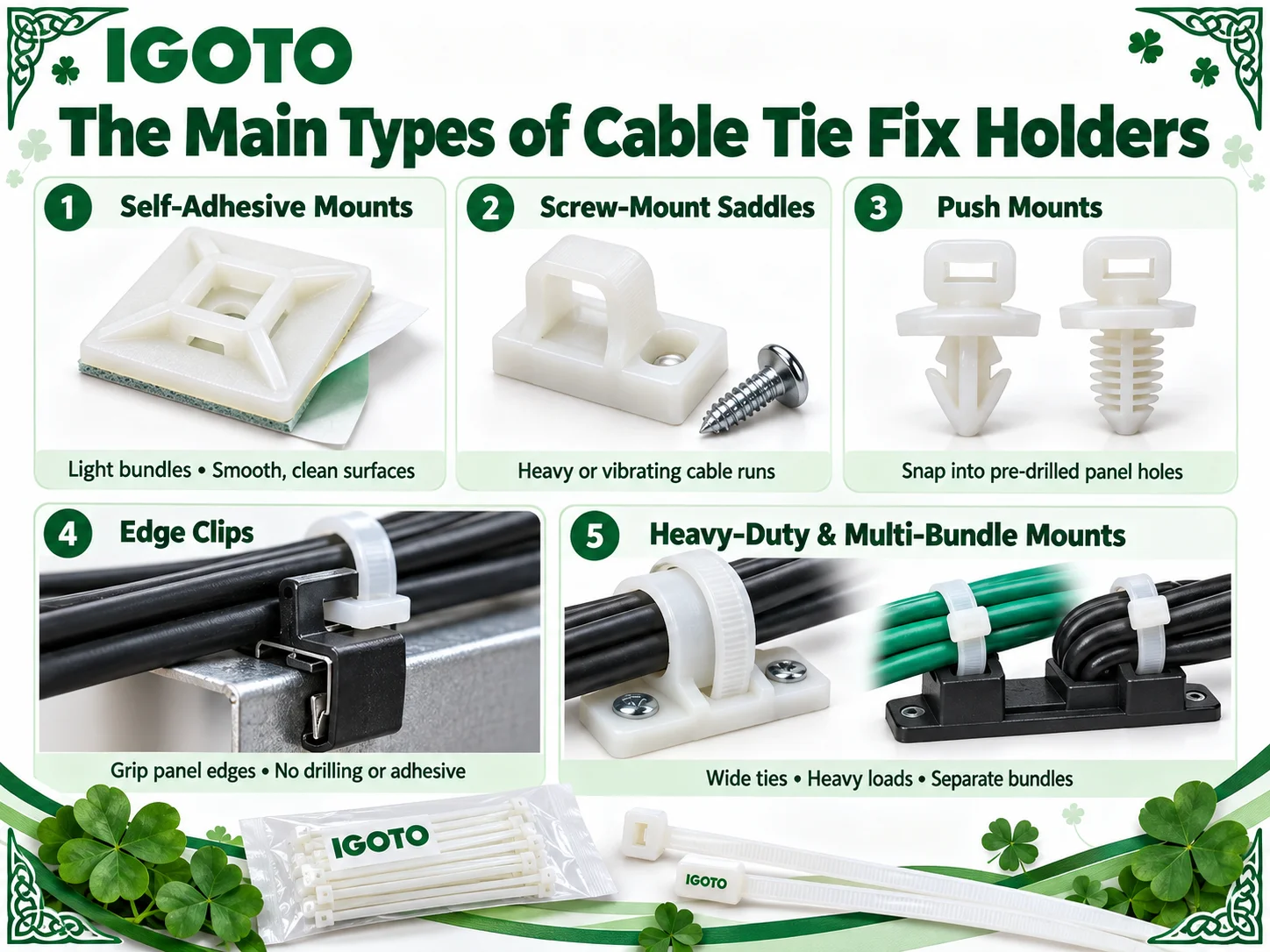
A maioria dos dispositivos pode ser agrupada em cinco categorias. Eles cobrem diferentes situações em termos de tipo de superfície e capacidade de carga.
Suportes Autoadesivos
Os suportes adesivos são um tipo de almofadas quadradas feitas de nylon ou plástico ABS, fornecidas com fita de espuma na superfície traseira e um canal de dois ou quatro lados na parte superior para o cabo. O processo de montagem é muito simples: você apenas remove a camada de proteção, fixa a almofada em uma superfície lisa e instala a amarração usando a fenda fornecida. Você não precisa usar nenhum equipamento de perfuração, assim, os suportes adesivos são muito populares para mesas, paredes de TV, móveis, racks de servidores e interiores de carros. A principal desvantagem desses suportes são os tipos de superfície em que podem ser usados, bem como limitações de temperatura e peso: superfícies ásperas, empoeiradas, oleosas ou frias podem estragar o adesivo, e cargas pesadas podem fazer com que os suportes se soltem.
Tipos de Suportes de Montagem por Parafuso
Os suportes de montagem por parafuso, também conhecidos como suportes de sela ou bases de amarração, são caracterizados por um molde no suporte que permite o uso de um parafuso ou rebite, o que é a razão pela qual o processo de instalação é mais longo do que no caso anterior, já que a perfuração é obrigatória. Esses suportes são extremamente confiáveis e permitem a instalação de cargas pesadas, longas ou vibratórias dentro de painéis de controle, estruturas de equipamentos, paredes e caixas externas. Quanto aos furos nesses suportes, deve-se notar que o tamanho de um furo pode variar e se adequar a parafusos de #4 a #10 ou seus equivalentes métricos, dependendo do tamanho do suporte.
Suportes de Pressão
Os suportes de pressão também são bastante populares, pois permitem que o engenheiro encaixe o suporte nos furos pré-perfurados em metais ou plásticos; uma vez instalado, a forma do suporte se assemelha à de uma seta ou um pinheiro. Mais uma vez, existem vários tipos de suportes de pressão, e eles diferem dependendo de haver ou não uma asa presente. O processo de instalação não requer nenhum equipamento especial, exceto ter um furo pré-perfurado. Vale dizer que certos laços de cabo possuem um suporte de pressão embutido, mas muitos profissionais qualificados optam por usar um laço de cabo padrão juntamente com o suporte separado.
Suportes de Borda e Suportes de Painel
Os suportes de borda são um tipo de suportes que podem simplesmente agarrar a borda de um painel metálico ou flange. Casos de uso padrão incluem situações em que a perfuração ou colagem é impossível.
Suportes de Alta Resistência
Os suportes de alta resistência são maiores e mais grossos, projetados para laços grandes e cargas pesadas.
Como Combinar um Suporte de Fixação de Laço com o Laço de Cabo Certo
É aqui que a maioria das instalações tem sucesso ou falha. Uma ficha de especificação do suporte sempre listará uma largura máxima do laço e, frequentemente, uma resistência máxima do laço. Seu laço deve se encaixar confortavelmente nessa fenda e corresponder ao ambiente para o qual o suporte é classificado.
Regra 1: Combine a Largura do Laço com a Fenda
A tabela abaixo mostra emparelhamentos típicos. Sempre confirme com a própria ficha de dados do suporte, pois os tamanhos das fendas variam de acordo com a marca.
| Tamanho típico do suporte | Largura comum do laço que aceita | Faixa típica de comprimento do laço | Uso típico |
|---|---|---|---|
| Almofada mini de 13 mm (1/2 in) | até cerca de 2,5 a 3,6 mm | 100 a 150 mm | Carregadores, fitas LED, pequenos eletrônicos |
| 19 a 20 mm (3/4 in) | até cerca de 3,6 a 4,8 mm | 150 a 200 mm | Mesas, paredes de TV, cabos de rede |
| 25 a 28 mm (1 a 1-1/8 pol) | até cerca de 4,8 a 5 mm | 200 a 300 mm | Armários, veículos, fiação geral |
| 38 mm (1-1/2 pol) e bases de parafuso de alta resistência | 7,6 mm e mais largas | 300 mm e mais longas | Pacotes pesados, máquinas, instalações externas |
Se você não entender como as larguras, comprimentos e diâmetros dos pacotes de laços estão relacionados, nosso guia de tamanhos de laços fornece o gráfico completo. É melhor medir o laço em vez de confiar em seu nome. Um laço de “classe 5 mm” pode ser 4,8 mm e caber em um furo de 4,8 mm, enquanto um laço mais largo não conseguiria passar.
Não use força excessiva tentando empurrar um laço mais largo através de uma fenda de retenção estreita ou cortá-lo para que se encaixe melhor. Um laço que está esticado ou arranhado perde uma parte significativa de sua resistência à tração e pode quebrar facilmente.
Regra 2: Combine a Força do Laço com a Classificação do Suporte
Embora um dispositivo de fixação tenha a capacidade de suportar cargas de até cinquenta libras (aproximadamente vinte e dois quilogramas), ainda é inadequado carregar um pacote pesado simplesmente porque é possível obter um dispositivo de fixação mais forte. Em vez disso, a parte mais fraca se torna o suporte do dispositivo de fixação ou seu agente de ligação. Por outro lado, suportes de parafuso de alta resistência são inúteis se usados em conjunto com dispositivos de fixação leves e finos. É importante selecionar um laço de nylon de alta resistência e suportes de parafuso classificados para a mesma categoria de carga.
Regra 3: Combine o Ambiente
Most holders are made out of nylon 6/6 which is the same material as regular plastic cable ties. White nylon is good for interior use but got damaged by sunlight. For outside installations, both the holder and the cable tie must be UV resistant that usually implies having black color. Make sure to use UV-resistant cable tie when securing outdoor equipment and plan on conducting inspections since UV resistant nylon ages faster when exposed to intense heat, sun and salt air.
Heat is the next factor. In close proximity to engines, light fixtures or engines, both cable ties and holders have to tolerate the heat. Standard nylon 6/6 is commonly rated to around 85 °C continuous. Beyond that, look at heat-stabilized ties, covered in our high-temperature tie wraps guide. When fire proofing is important regulation wise (for example, in some control panels, rail or building services) make sure to use a flame-retardant cable tie with a holder that has the same profile.
Rule 4: Think About Head Height
In tight spaces, such as behind a panel or under a drawer, the tie head can stick out and catch on things. Low-profile holders paired with low-profile wire ties keep the whole fixing flat against the surface.
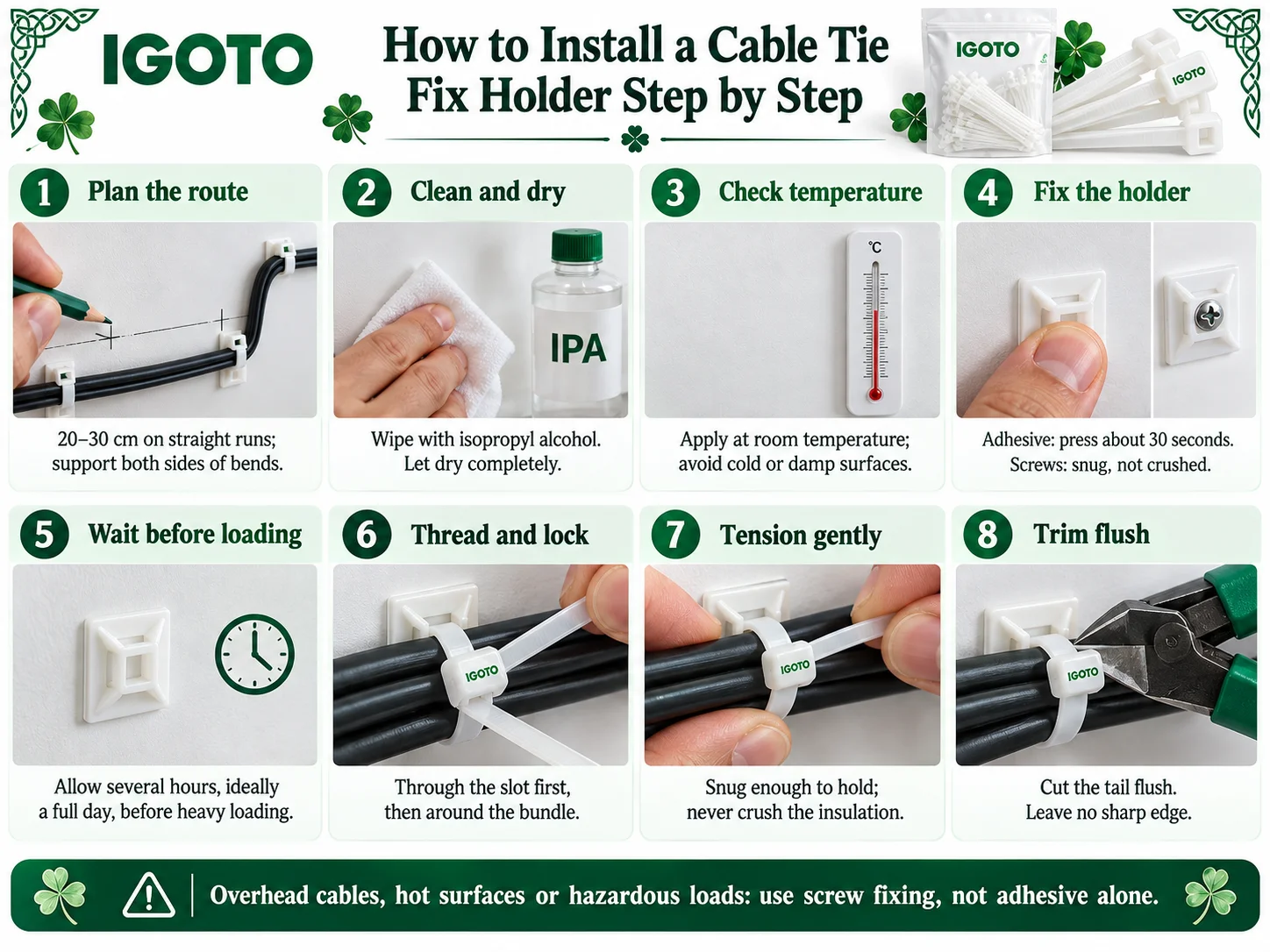
How to Install a Cable Tie Fix Holder Step by Step
The below procedure is suitable for nearly all adhesive mounts and screw mounts. However, push mounts and edge clips are devoid of the details of surface preparation but follow the same routing pattern.
①.Plan the route of the cables ahead of time. Keep the cords loose along the intended path and mark where the holders are to be placed. In straight lines, keep a distance of approximately 20 to 30 cm between the holders. Install holders on both sides of the bends in the cable path.
②.Prepare the surface of the spot before installing adhesive pads. For this, use isopropyl alcohol to clean the surface and make sure it is dried well. The most widely spread reasons for failure of the stick pads are dirt, grease, and silicone leftovers.
③.Check whether the place where adhesive pads will be applied is at room temperature, as the adhesive bond is strongest at this temperature. Do not apply pads onto cold metal or in cold rainy conditions if possible.
④.Install the holder, pressing the adhesive pads properly and firmly for about 30 seconds. For screw mounts, drill a pilot hole before putting in the screw of the required size as specified by the mount and tighten it up until it is snug.
⑤.Do not use the mounts immediately after they have been installed. Let the pressure-sensitive adhesives set first by allowing the mount to rest for a few hours if possible.
⑥.Thread the tie through the slot of the holder, wrap it around the bundle, and lock the tie in place.
⑦.Make the tie tight enough to prevent any sliding, but do not overtighten. The insulation of the cables also should not be damaged.
Cut off the tail of the tie near the head with the help of a flush cutter or tensioning tool.
When working with overhead cables, always bear in mind that there can be unsafe substances present on the surface of his cables.
Popular Cable Tie Fix Holder Brands and How to Pair Them With IGOTO Cable Ties
IGOTO’s expertise lies in producing nylon cable ties and cable glands, but not cable mountings. This gives you the liberty of selecting your preferred cable holder brand and mounting it with IGOTO cable ties. The cable holder brands mentioned below are commonly stocked by distributors in North America, Europe, and Asia for reference.
3M Cable Tie Mounting Bases
3M makes a range of cable tie mounting bases in adhesive and screw-mount versions. While the black version can be used outdoors and indoors, the natural and beige types are intended for indoor installations only. The foam adhesive backing is widely used for mounting of panels and enclosures. Customer service in USA: 800-245-3573.
Pairing advice: if you are using a 1 inch x 1 inch 3M base outdoors, you could use a black UV-stabilized tie from class 4 to 4.8mm, with length exceeding 200 mm, as it will provide enough length to thread the base and wrap the bundle.
Essentra Components
Essentra offers one of the widest catalogs of screw-mount cable tie mounts, along with adhesive, edge, hook-and-loop and multi-bundle styles. The manufacturer explains that adhesive mounts maintain effective bonding for one year, provided they are stored unopened at room temperature away from sunlight. Call +1 800 847 0486, or email sales@essentracomponents.com if you are interested or need more information about Essentra’s services and products.
Advice: Heavy-duty screw mounts from Essentra can be used with wide cable ties designed for heavy duty applications. You are advised to choose heat-stabilized or flame-retardant cable ties for use inside electric panels.
ABB (Thomas & Betts) Ty-Rap Mounting Bases
Thomas & Betts, now part of ABB Installation Products, invented the cable tie and still sells Ty-Rap mounting bases in self-adhesive, glue-on and screw versions, including aluminum bases for high-temperature areas. The full range is listed in ABB’s Ty-Rap fastening accessories catalog. U.S. product and service line: 1-888-862-3290. For background on the brand, see our article on cabos de amarração Ty-Rap.
Pairing tip: many Ty-Rap bases accept ties up to about 4.8 mm wide, so a 4 mm or 4.8 mm class nylon tie is the natural match.
Other Well-Known Holder Makers
Two other companies, Panduit, located Tinley Park in Illinois with the customer service number 800-777-3300 and HellermannTyton with the customer service number 800-537-1512 produce a large variety of mounts, push mounts, and saddles. Both brands are commonly used in industrial panel construction and automotive wiring. For do-it-yourself projects, generic adhesive pads of 3/4 inch and 1 inch sizes available in hardware stores are effective for light indoor use, provided that the surface is clean and the tie fits into the slot.
Why Pair a Branded Holder With IGOTO Ties?
Mountings are uncomplicated molded products, and virtually all manufacturers use comparable slot dimensions. The cable tie is the expendable item: it is bought in large quantities, does the job, and is the first to break down when exposed to sunlight, heat or cold. IGOTO ties are molded from nylon 6/6 in natural and UV-stabilized black, in widths from about 3 mm to 5 mm and lengths from 100 mm to 500 mm, plus flame-retardant and high-strength versions. For most cabinets, vehicles and outdoor runs, a practical all-rounder is the 8 inch black UV heavy-duty cable tie pack: 200 mm long, 4.8 mm wide, 22 kg (50 lb) tensile strength, carbon-black UV stabilized and rated from -35 °C to +85 °C. That 4.8 mm width threads the 1 in and 1-1/8 in holders from all the brands above. For small 3/4 in or 1/2 in pads, step down to IGOTO’s 3 mm or 4 mm ties. Need a mixed order, custom length or private-label packaging to match your holder supplier? Contact the IGOTO team for a quote.
Common Mistakes When Using Cable Tie Holders
- Combining indoors ties with outdoor mounts. A black UV mount coupled with a natural nylon tie does not work when the tie disintegrates in the sun.
Putting the holder too far apart. The longer unsupported span causes it to bend and pull the adhesive off.
Not cleaning the surface before applying the tape. Dust, oil, and silicone cause most problems, not weak tape.
Over-tightening of data cables. It prevents the proper signal transmission of an Ethernet or fiber cable.
Using a tie that is too short. The tie must come through the holder and around the bundle with enough tail left to be able to tighten it.
Leaving sharp tails. A tail cut obliquely can scratch skin and cable insulation.
Perguntas Frequentes
How to fix a cable tie?
When discussing joining a cable tie with a surface, you can use a holder; either you can attach an adhesive pad or attach the base to the surface with screws. You have to insert the tie through the slit, wrap the cable and tighten the knot. One note about repairing a cable tie that you locked in mistake is that regular ties aren’t made to be unlocked, and damaged cables shouldn’t be reused but cut off and thrown away. For careful release techniques on ties you want to reposition, see our guide on how to desfazer abraçadeiras sem cortar, and replace any tie whose pawl or teeth show damage.
What is the best way to store zip ties?
It is advised to keep zip ties in an airtight container or sealed bag, away from direct sunlight and heat sources, preferably under moderate humidity and temperature conditions. Moisture from the atmosphere is taken up by Nylon 6/6 materials resulting in these zip ties becoming more brittle once they completely dry out in hot or dry environments. Place zip ties in their respective original bags sorted by the sizes and use the ones that are older first. Adhesive holders must also be kept correctly as their adhesive will last only when in unopened packing.
What are the best stick pads for cable ties?
The stick pads that are the best are made from foam-backed adhesive that is sensitive to pressure, molded from nylon or ABS plastic, and comes with a backup screw hole. When using pads outdoors, make sure they are black and UV-stabilized, and also look for natural pads to use indoors. Choose pads with a four-way slot so that the tie can be threaded in either direction, and ensure that the pads can accept the width of the tie being used. Typically, pads that are approximately 20 mm will be appropriate for the smaller ties, while those with widths of 25 to 28 mm will work for the general wiring. Clean the surface of the object with isopropyl alcohol before applying the pad for an optimum adhesion.
What are some good clips to hold cords?
When it comes to securing cables on desks and walls, using adhesive ties with small clips can be be an inexpensive, tidy and flexible solution. When working with heavier cables or outside installations, screw-type saddles are great. Push mounts can be used to attach cables with a panel pre-drilled with holes in it and edge clips can be used when you cannot drill or glue. Regardless of the clip you use, it is the tie that does the actual holding, so remember to select the right tie size and tie material according to the environment and clip.
Referências
- Braçadeira, Wikipedia
- Guide to cable tie mounts, Essentra Components
- 3M Cable Tie Mounting Bases, 3M United States
- Thomas & Betts heritage brand, ABB
Conclusão
A cable tie fix holder transforms an unorganized bunch into an organized and professional cable system. However, the holder is not enough. Pick the appropriate mounting for the type of surface and the load to be carried. Use the adhesive mounting only when the cable application is made indoors; while using screw mount in an environment that is either heavy, hot and vibrating or one that is located outdoors. Choose the right cable tie to fit the holder, bear the load and survive in the environment. Any known holder brand can be used with IGOTO nylon cable ties with the appropriate length, width and quality.
Índice
Recomendação
-
 Arte e Artesanato com Fitas de Fecho: Artistas, Exposições e Ideias de DIY2026-09-26
 -
 Ty-Rap Laços de Cabo Explicados: Por Que os Rovers da NASA os Usam2026-09-24
 -
 A História das Algemas de Zip Tie e Por Que a Polícia Ainda as Usa2026-09-23
 -
 Soluções de Fixação Reutilizáveis para Montagens Temporárias2026-09-22