



Cable Tie Holder: How to Choose Mounts and the Right Cable Ties
Cable tie holder is a small device that is used for anchoring cable ties on walls, panels, desks or cases so that the group of wires holds its position and does not slide, drop or sag. The holder does the anchoring and the cable tie does the holding. If the width or the thickness of cable tie is chosen incorrectly, the best holder might not be able to support cables. This guide describes the most common types of holders, how to match each type with the right cable tie, how to install them and the brands you should consider when buying them.
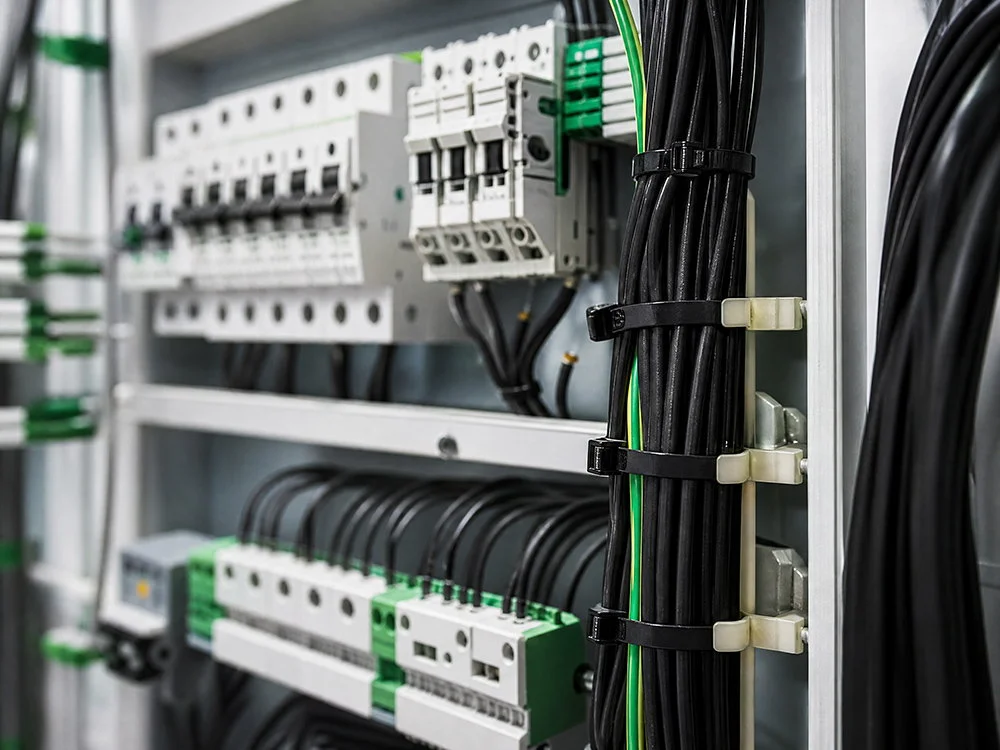
A cable tie fix holder (which can also be referred to as a cable tie mount, tie base, zip tie anchor or mounting pad), is simply a piece of nylon, ABS or metal-based component designed with one or more slots that allow the passage of cable tie. To install it, it has to be glued down or fixed using screws, rivets, or push-in anchor onto the surface. An adhesive holder works well with lighter bundles on smooth and even surfaces but for heavier cables we use screws, rivets or push systems. It is important to make sure that both holder and the cable tie conform to the same environmental standard (UV exposure, temperature, flame rating).
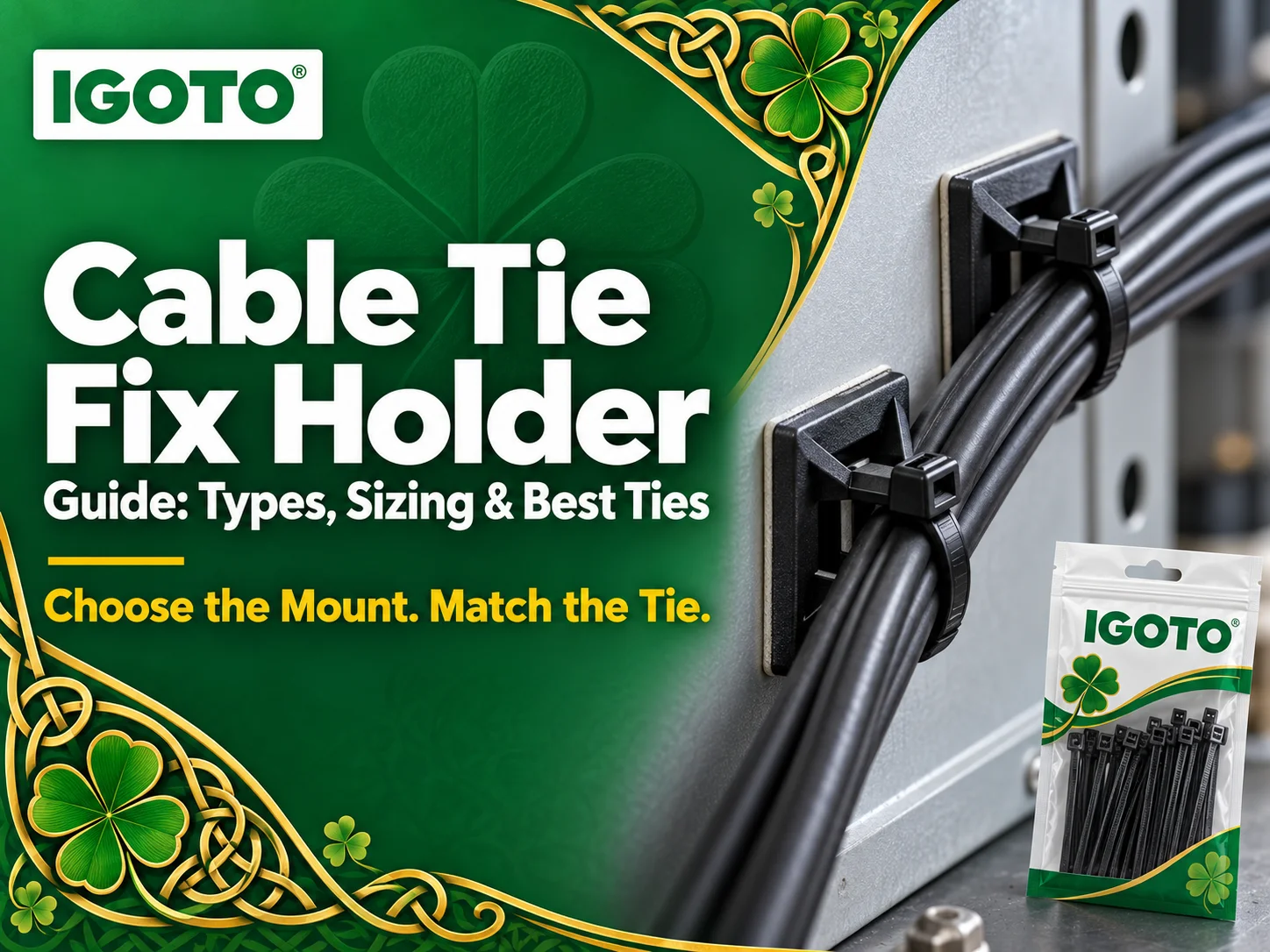
What Is a Cable Tie Fix Holder and Why Does It Matter?
By themselves, cable ties can only hold together cable bundles. As soon as this cable bundle needs to follow along a wall, an appliance door, or the frame of a machine, an anchor must be employed. This anchor is known as a holder. Manufacturer catalogs refer to it by multiple names, including tie base, cable tie mount, zip tie mount, saddle mount or push mount. In everyday conversations, people typically refer to the holder as cable tie holder or cable tie fix holder.
Applying a good cable holder is important, not only for aesthetics. Correctly laid cables are less prone to abrading against sharp edges, getting hung up on terminals, affecting air flow inside an electric cabinet or getting tripped over by people. In cars and machines, the specially spaced holders will keep cable looms from vibrating loose. In an office or home, just a few adhesive pads under a table will help organize charging wire hodge-podge into an ordered and safe cable run.
This is the most important point that buying guides don’t mention: a holder is only as good as the cable tie that goes through it. The cable tie supports the entire cable load, withstands heat and sunlight and holds the tie in place for many years. This is exactly the reason why the rest of the article will be given to cable ties.
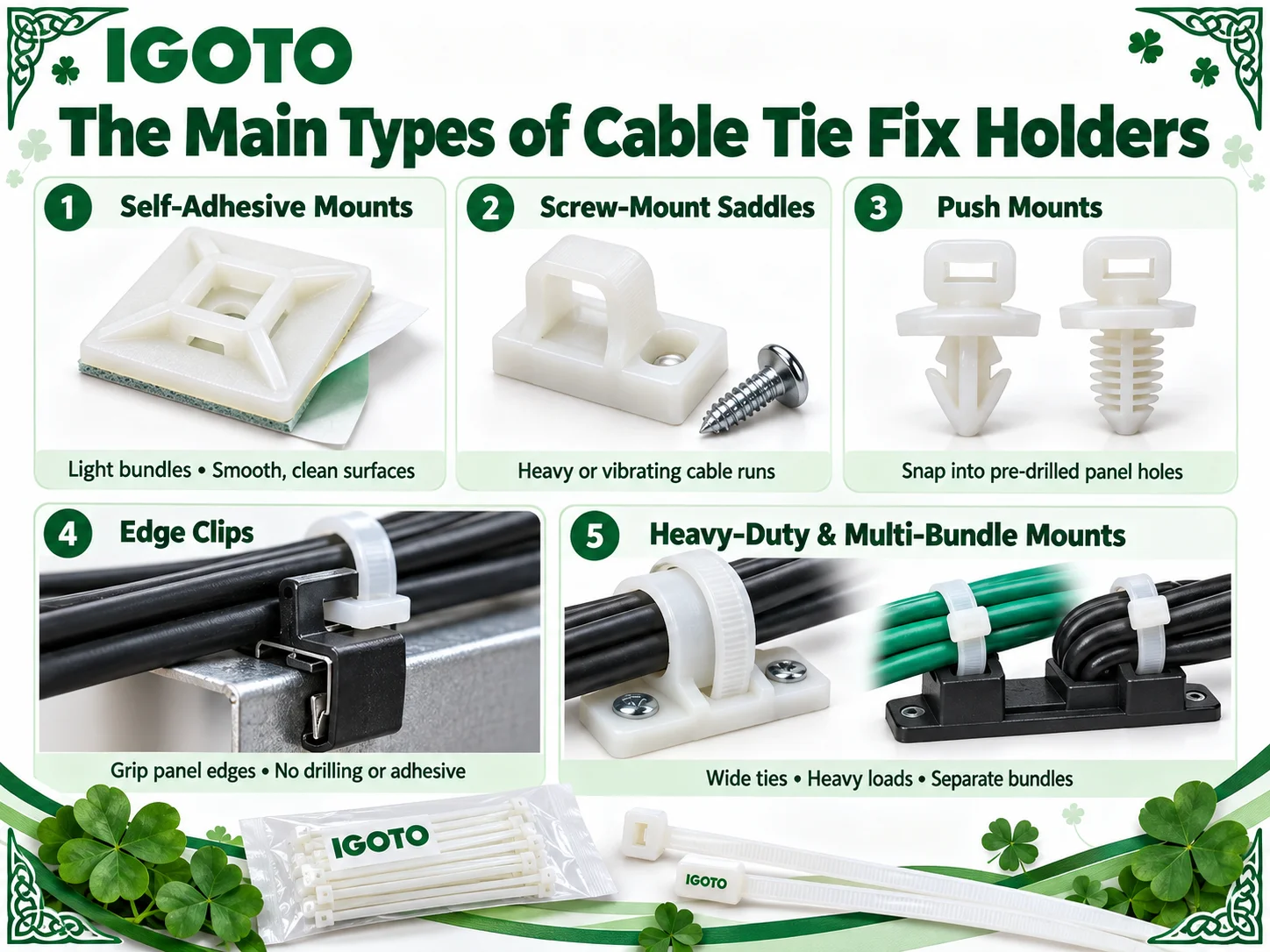
The Major Classes of Cable Tie Holding Devices
Most devices can be grouped into five categories. They cover different situations in terms of surface type and carrying capacity.
Self-Adhesive Holders
Adhesive holders are a kind of square pads made from nylon or ABS plastic provided with foam tape on the rear surface and a two- or four-way channel on the upper side for the cable. The mounting process is very simple: you just remove the layer of protection, attach the pad to a smooth surface, and install the tie using the provided slot. You do not need to use any drilling equipment, thus adhesive holders are very popular for desks, TV walls, furniture, server racks, and car interiors. The main disadvantage of these holders is the types of surface they can be used on as well as temperature and weight limitations: rough, dusty, greasy, or cold surfaces can spoil the adhesive, and heavy loads can cause the holders to fall off.
Screw-Mount Holder Types
Screw-mount holders, otherwise referred to as saddle mounts or tie bases, are characterized by a mold on the holder that allows for the use of a screw or rivet which is the reason for the fact that the installation process is longer than in the previous case, as drilling is a must. Such holders are extremely reliable and allow for the installation of heavy, lengthy, or vibrating loads inside control panels, equipment frames, walls, and outdoor boxes. As for the holes in such holders, one should note that the size of a hole can vary and fit #4 to #10 screws or their metric counterparts depending on the size of the holder.
Push Holders
Push holders are also quite popular as they allow the engineer to hook the holder into the pre-drilled holes in sheet metals or plastics; once installed, the holder’s shape resembles that of an arrow or a fir-tree. Once again, several types of push holders exist, and they differ depending on whether a wing is or is not present. The installation process does not require any special equipment except for having a pre-drilled hole. It is worth saying that certain cable ties possess a built-in push holder, but many skilled professionals choose to use a standard cable tie along with the separate holder.
Edge Holders and Panel Holders
Edge holders are a kind of holders which can simply grip the edge of a metallic panel or flange. Standard use cases include situations when drilling or gluing is impossible.
Heavy-Duty Holders
Heavy-duty holders are larger and thicker screw holders designed for large ties and heavy loads.
How to Match a Cable Tie Fix Holder With the Right Cable Tie
This is where most installations succeed or fail. A holder specification sheet will always list a maximum tie width and, often, a maximum tie strength. Your tie has to fit that slot comfortably and match the environment the holder is rated for.
Rule 1: Match the Tie Width to the Slot
The table below shows typical pairings. Always confirm against the mount’s own data sheet, because slot sizes vary by brand.
| Typical holder size | Common tie width it accepts | Typical tie length range | Typical use |
|---|---|---|---|
| 13 mm (1/2 in) mini pad | up to about 2.5 to 3.6 mm | 100 to 150 mm | Chargers, LED strips, small electronics |
| 19 to 20 mm (3/4 in) | up to about 3.6 to 4.8 mm | 150 to 200 mm | Desks, TV walls, network cables |
| 25 to 28 mm (1 to 1-1/8 in) | up to about 4.8 to 5 mm | 200 to 300 mm | Cabinets, vehicles, general wiring |
| 38 mm (1-1/2 in) and heavy-duty screw bases | 7.6 mm and wider | 300 mm and longer | Heavy bundles, machinery, outdoor runs |
If you don’t understand how tie widths, lengths and bundle diameters are related, our tie wrap sizes guide provides the complete chart. It is better to measure the tie instead of trusting its name. A tie of “5-mm class” might be 4.8 mm and fit a 4.8-mm hole while a wider tie couldn’t get through.
Don’t use excessive force trying to push a wider tie through a narrow holding slot or cut it to make it fit better. A tie that is stretched or scratched loses a significant part of its tensile strength and may easily break.
Rule 2: Match the Tie Strength to the Holder Rating
Although a fastening device has the capability to handle loads of up to fifty pounds (approximately twenty-two kilograms), it is still improper to load a heavy bundle simply because it is possible to obtain a stronger fastening device. Rather, the weakest part becomes the fastening device holder or its bonding agent. On the other hand, heavy-duty screw holders are useless if they are used in conjunction with light and thin fastening devices. It is important to select a high-strength nylon cable tie and a screw holders rated for the same load category.
Rule 3: Match the Environment
Most holders are made out of nylon 6/6 which is the same material as regular plastic cable ties. White nylon is good for interior use but got damaged by sunlight. For outside installations, both the holder and the cable tie must be UV resistant that usually implies having black color. Make sure to use UV-resistant cable tie when securing outdoor equipment and plan on conducting inspections since UV resistant nylon ages faster when exposed to intense heat, sun and salt air.
Heat is the next factor. In close proximity to engines, light fixtures or engines, both cable ties and holders have to tolerate the heat. Standard nylon 6/6 is commonly rated to around 85 °C continuous. Beyond that, look at heat-stabilized ties, covered in our high-temperature tie wraps guide. When fire proofing is important regulation wise (for example, in some control panels, rail or building services) make sure to use a flame-retardant cable tie with a holder that has the same profile.
Rule 4: Think About Head Height
In tight spaces, such as behind a panel or under a drawer, the tie head can stick out and catch on things. Low-profile holders paired with low-profile wire ties keep the whole fixing flat against the surface.
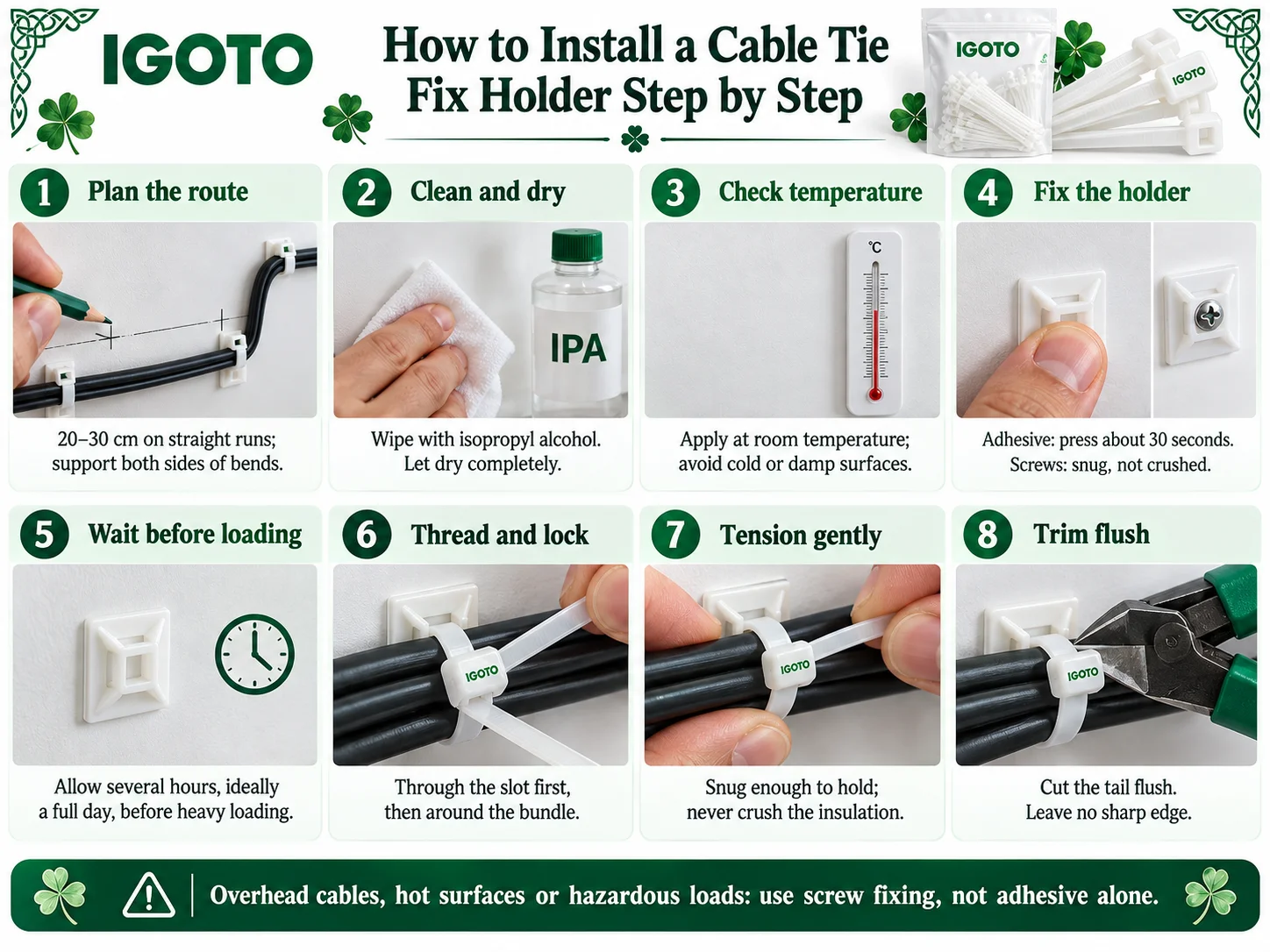
How to Install a Cable Tie Fix Holder Step by Step
The below procedure is suitable for nearly all adhesive mounts and screw mounts. However, push mounts and edge clips are devoid of the details of surface preparation but follow the same routing pattern.
①.Plan the route of the cables ahead of time. Keep the cords loose along the intended path and mark where the holders are to be placed. In straight lines, keep a distance of approximately 20 to 30 cm between the holders. Install holders on both sides of the bends in the cable path.
②.Prepare the surface of the spot before installing adhesive pads. For this, use isopropyl alcohol to clean the surface and make sure it is dried well. The most widely spread reasons for failure of the stick pads are dirt, grease, and silicone leftovers.
③.Check whether the place where adhesive pads will be applied is at room temperature, as the adhesive bond is strongest at this temperature. Do not apply pads onto cold metal or in cold rainy conditions if possible.
④.Install the holder, pressing the adhesive pads properly and firmly for about 30 seconds. For screw mounts, drill a pilot hole before putting in the screw of the required size as specified by the mount and tighten it up until it is snug.
⑤.Do not use the mounts immediately after they have been installed. Let the pressure-sensitive adhesives set first by allowing the mount to rest for a few hours if possible.
⑥.Thread the tie through the slot of the holder, wrap it around the bundle, and lock the tie in place.
⑦.Make the tie tight enough to prevent any sliding, but do not overtighten. The insulation of the cables also should not be damaged.
Cut off the tail of the tie near the head with the help of a flush cutter or tensioning tool.
When working with overhead cables, always bear in mind that there can be unsafe substances present on the surface of his cables.
Popular Cable Tie Fix Holder Brands and How to Pair Them With IGOTO Cable Ties
IGOTO’s expertise lies in producing nylon cable ties and cable glands, but not cable mountings. This gives you the liberty of selecting your preferred cable holder brand and mounting it with IGOTO cable ties. The cable holder brands mentioned below are commonly stocked by distributors in North America, Europe, and Asia for reference.
3M Cable Tie Mounting Bases
3M makes a range of cable tie mounting bases in adhesive and screw-mount versions. While the black version can be used outdoors and indoors, the natural and beige types are intended for indoor installations only. The foam adhesive backing is widely used for mounting of panels and enclosures. Customer service in USA: 800-245-3573.
Pairing advice: if you are using a 1 inch x 1 inch 3M base outdoors, you could use a black UV-stabilized tie from class 4 to 4.8mm, with length exceeding 200 mm, as it will provide enough length to thread the base and wrap the bundle.
Essentra Components
Essentra offers one of the widest catalogs of screw-mount cable tie mounts, along with adhesive, edge, hook-and-loop and multi-bundle styles. The manufacturer explains that adhesive mounts maintain effective bonding for one year, provided they are stored unopened at room temperature away from sunlight. Call +1 800 847 0486, or email sales@essentracomponents.com if you are interested or need more information about Essentra’s services and products.
Advice: Heavy-duty screw mounts from Essentra can be used with wide cable ties designed for heavy duty applications. You are advised to choose heat-stabilized or flame-retardant cable ties for use inside electric panels.
ABB (Thomas & Betts) Ty-Rap Mounting Bases
Thomas & Betts, now part of ABB Installation Products, invented the cable tie and still sells Ty-Rap mounting bases in self-adhesive, glue-on and screw versions, including aluminum bases for high-temperature areas. The full range is listed in ABB’s Ty-Rap fastening accessories catalog. U.S. product and service line: 1-888-862-3290. For background on the brand, see our article on Ty-Rap cable ties.
Pairing tip: many Ty-Rap bases accept ties up to about 4.8 mm wide, so a 4 mm or 4.8 mm class nylon tie is the natural match.
Other Well-Known Holder Makers
Two other companies, Panduit, located Tinley Park in Illinois with the customer service number 800-777-3300 and HellermannTyton with the customer service number 800-537-1512 produce a large variety of mounts, push mounts, and saddles. Both brands are commonly used in industrial panel construction and automotive wiring. For do-it-yourself projects, generic adhesive pads of 3/4 inch and 1 inch sizes available in hardware stores are effective for light indoor use, provided that the surface is clean and the tie fits into the slot.
Why Pair a Branded Holder With IGOTO Ties?
Mountings are uncomplicated molded products, and virtually all manufacturers use comparable slot dimensions. The cable tie is the expendable item: it is bought in large quantities, does the job, and is the first to break down when exposed to sunlight, heat or cold. IGOTO ties are molded from nylon 6/6 in natural and UV-stabilized black, in widths from about 3 mm to 5 mm and lengths from 100 mm to 500 mm, plus flame-retardant and high-strength versions. For most cabinets, vehicles and outdoor runs, a practical all-rounder is the 8 inch black UV heavy-duty cable tie pack: 200 mm long, 4.8 mm wide, 22 kg (50 lb) tensile strength, carbon-black UV stabilized and rated from -35 °C to +85 °C. That 4.8 mm width threads the 1 in and 1-1/8 in holders from all the brands above. For small 3/4 in or 1/2 in pads, step down to IGOTO’s 3 mm or 4 mm ties. Need a mixed order, custom length or private-label packaging to match your holder supplier? Contact the IGOTO team for a quote.
Common Mistakes When Using Cable Tie Holders
- Combining indoors ties with outdoor mounts. A black UV mount coupled with a natural nylon tie does not work when the tie disintegrates in the sun.
Putting the holder too far apart. The longer unsupported span causes it to bend and pull the adhesive off.
Not cleaning the surface before applying the tape. Dust, oil, and silicone cause most problems, not weak tape.
Over-tightening of data cables. It prevents the proper signal transmission of an Ethernet or fiber cable.
Using a tie that is too short. The tie must come through the holder and around the bundle with enough tail left to be able to tighten it.
Leaving sharp tails. A tail cut obliquely can scratch skin and cable insulation.
Frequently Asked Questions
How to fix a cable tie?
When discussing joining a cable tie with a surface, you can use a holder; either you can attach an adhesive pad or attach the base to the surface with screws. You have to insert the tie through the slit, wrap the cable and tighten the knot. One note about repairing a cable tie that you locked in mistake is that regular ties aren’t made to be unlocked, and damaged cables shouldn’t be reused but cut off and thrown away. For careful release techniques on ties you want to reposition, see our guide on how to undo zip ties without cutting, and replace any tie whose pawl or teeth show damage.
What is the best way to store zip ties?
It is advised to keep zip ties in an airtight container or sealed bag, away from direct sunlight and heat sources, preferably under moderate humidity and temperature conditions. Moisture from the atmosphere is taken up by Nylon 6/6 materials resulting in these zip ties becoming more brittle once they completely dry out in hot or dry environments. Place zip ties in their respective original bags sorted by the sizes and use the ones that are older first. Adhesive holders must also be kept correctly as their adhesive will last only when in unopened packing.
What are the best stick pads for cable ties?
The stick pads that are the best are made from foam-backed adhesive that is sensitive to pressure, molded from nylon or ABS plastic, and comes with a backup screw hole. When using pads outdoors, make sure they are black and UV-stabilized, and also look for natural pads to use indoors. Choose pads with a four-way slot so that the tie can be threaded in either direction, and ensure that the pads can accept the width of the tie being used. Typically, pads that are approximately 20 mm will be appropriate for the smaller ties, while those with widths of 25 to 28 mm will work for the general wiring. Clean the surface of the object with isopropyl alcohol before applying the pad for an optimum adhesion.
What are some good clips to hold cords?
When it comes to securing cables on desks and walls, using adhesive ties with small clips can be be an inexpensive, tidy and flexible solution. When working with heavier cables or outside installations, screw-type saddles are great. Push mounts can be used to attach cables with a panel pre-drilled with holes in it and edge clips can be used when you cannot drill or glue. Regardless of the clip you use, it is the tie that does the actual holding, so remember to select the right tie size and tie material according to the environment and clip.
References
- Cable tie, Wikipedia
- Guide to cable tie mounts, Essentra Components
- 3M Cable Tie Mounting Bases, 3M United States
- Thomas & Betts heritage brand, ABB
Conclusion
A cable tie fix holder transforms an unorganized bunch into an organized and professional cable system. However, the holder is not enough. Pick the appropriate mounting for the type of surface and the load to be carried. Use the adhesive mounting only when the cable application is made indoors; while using screw mount in an environment that is either heavy, hot and vibrating or one that is located outdoors. Choose the right cable tie to fit the holder, bear the load and survive in the environment. Any known holder brand can be used with IGOTO nylon cable ties with the appropriate length, width and quality.