




Ty-Rap Cable Ties Explained: Why NASA Rovers Use Them
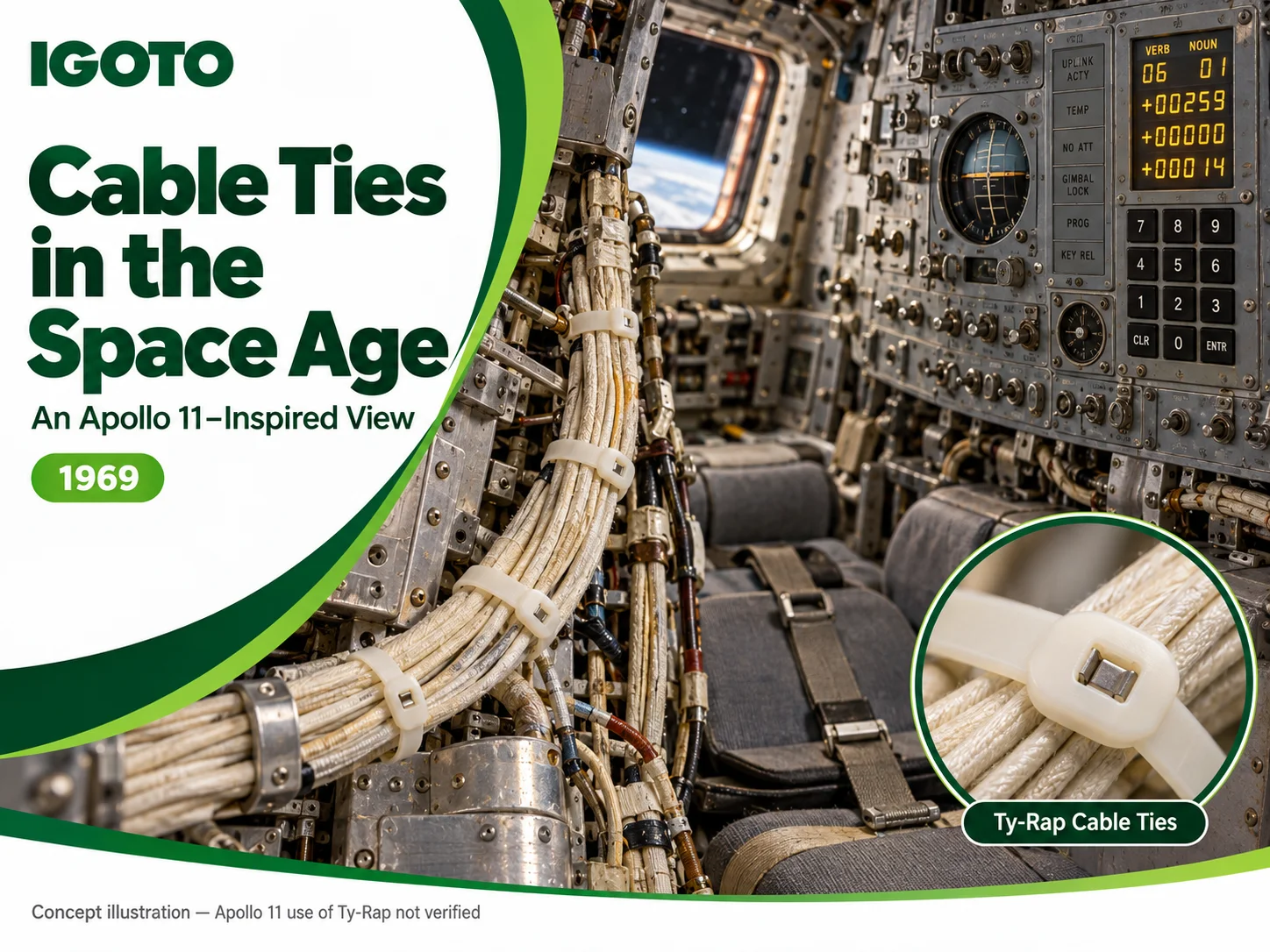
Shortly after the invention of the cable tie, it was put into space, which proved the device to be incredibly smart. The Ty-Rap cable ties is the original self-locking cable tie that was patented in 1958. The patent was developed so that airline employees will not hurt their fingers while using wax cord for tying. Since then, this design was sent to Mars with four NASA rovers. The article outlines the way the cable tie was designed, what the steel barb does, how the cable ties can withstand vacuum and radiation, and how to choose a good supplier for those cable ties.
Ty-Rap is a brand of high-quality locking cable ties originated by Thomas and Betts, which is now part of ABB and often considered as the first commercial cable tie. Its special feature is a locking barb made of stainless steel placed inside the molded plastic head, which is called Grip of Steel, due to the fact that it bites into the strap. This metallic barb allows obtaining a higher and more stable tensile strength of the loop, preventing its loosening in case of vibrations and temperature fluctuations, while keeping a good grip even after aging of the nylon. In addition to standard versions made of nylon 6/6, the range of products includes weatherproof, flameproof, heat-resistant, as well as fluoropolymer grades used in aerospace, railway, oil and gas, and spaceflight equipment.
From Hamburger Hands to a Patent
The tale begins on a production site and not in a laboratory. In 1956, an engineer named Maurus C. Logan, who worked for the company Thomas and Betts, visited an aerospace manufacturing site owned by the company Boeing and watched how employees of the factory were making wire harnesses in the traditional way, which implies that thousands of feet of electric cable are being put on 50-feet wooden tables and secured together with braided nylon threads with wax coating. A worker needed to tighten all made knots by grabbing the cord with a finger. It happened so often that the workers obtained such physical injuries as cuts and calloused fingers called hamburger hands.
The engineer spent the following two years engaged in testing tools and materials, and on June 24, 1958, a patent was registered for the tie called Ty-Rap. The concept behind the tie was really simple and could be explained in only one sentence. The product was made from a flexible nylon strap, on one side of which there were ridges molded into it. The other part of the strap had a head with a locking mechanism, which allowed moving the strap only one way but keeping it secured in the opposite direction without any knots or tools or any special skills. The patent was registered in 1962, and the creator received a place in the Hall of Fame of Inventors.
What made the invention popular was not the innovation of attaching wires but rather the efficiency of the method that allowed fastening multiple wires in a shorter time than hand wiring does and can be performed with gloves on. The same aviation heritage shaped the whole product category, which we covered in detail in our guide to aviation zip ties.
What Makes Ty-Rap Cable Ties Different
Almost every cable tie sold today works on the same one-way principle, explained step by step in our breakdown of how a self-locking cable tie works. The difference sits inside the head.
A conventional nylon tie features a molded nylon pawl, which is a small flexible tongue that fits into the strap’s ridges. It works in a good way, it molds easily, and it is homogeneous. However, the main downside of this type of pawl is that it is as strong and stiff as the nylon filament surrounding it. Nylon 6/6 is porous, pliable at elevated temperatures, and hardens in the drying process, which means that its state changes at every stage of the pawl operation.
Ty-Rap cable ties design is different due to the fact that it replaces this tongue with a stainless steel barb created through pressing of the head of the tie. The barb is harder than the strap, which implies that it digs into the ridges, instead of resting against them.
As a result of using the barb design, it is possible to achieve some remarkable results.
First of all, there is some kind of reliability when it comes to the grip. Unlike the nylon pawl that can get softened or brittle, the steel barb keeps the grip force close to the expected value anyway.
Second, tightening becomes smoother and results in less damage to the strap. A steel barb does provide smoother tightening and allows to draw it down in fine increments without causing any discomfort as with a nylon pawl.
Third, the resistance to vibration loosening has increased. A nylon pawl can loosen the grip over time due to continuing vibration while the barb becomes practically immune to this.
It is this design solution that made Ty-Rap the most widely used tie in various spheres like aerospace, railroad, utilities, and oil and gas industry.
However, at the same time the presence of the metal barb causes some limitations of using this kind of ties.
From Aircraft to Spacecraft
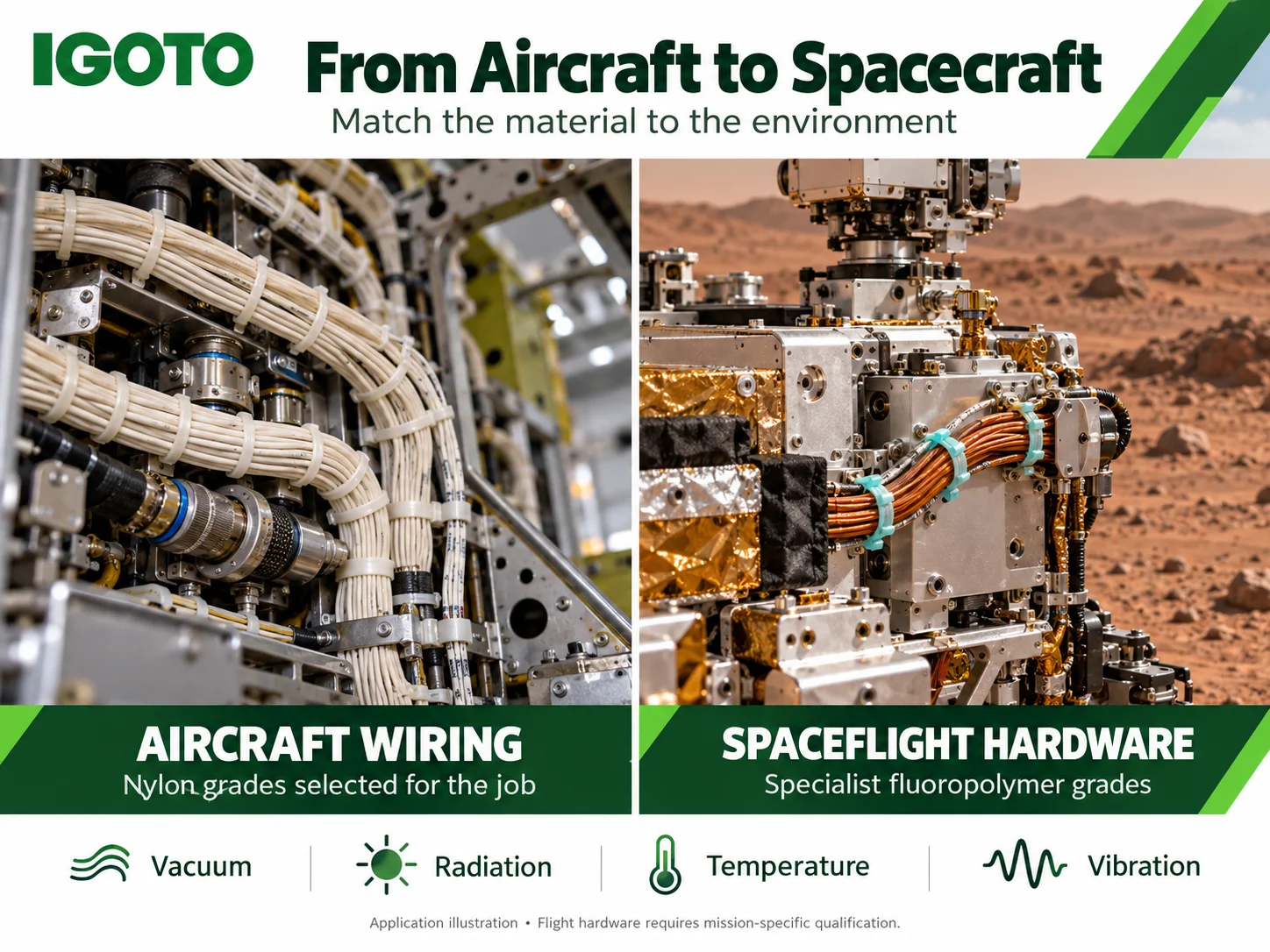
The transition from wire harness to spacecraft is less significant than it appears to be. Both are really the same engineering problem in the sense that there is a lot of wiring that has to stay in place while the structure around it vibrates, heats, cools, and flexes. The difference in space is the severity of the consequences resulting from the failure of fasteners because nobody is going to open the compartment and fix it.
Why ordinary nylon struggles in orbit
A standard nylon 6/6 tie is a very good product in terms of industrial applications but a bad one for spaceflight because of several factors:
Outgassing: Polymers release absorbed moisture along with other volatiles in the vacuum. The vapour condenses to the coldest surface around such as optical sensors, lenses, or radiators in spaceflight vehicles. The standards provided by ASTM E595 testing for total mass loss (not more than 1.0 percent) and volatiles collected during testing (not more than 0.10 percent) can be considered as valid in this case.
Radiation: Outside of the atmosphere and magnetosphere, polymers are attacked by radiation destroying their molecular chains. Consequently, nylon becomes fragile which means that a nylon tie can break under very small load.
Temperature extremes and cycling: Hardware changes temperature from really cold when in shadow to really hot when in sunlight many times. Nylon 6/6 is good at temperatures about between minus 40 and 85 degrees Celsius, which makes the range of temperature not very wide.
Moisture dependency: Nylon needs to absorb a little moisture in order to remain flexible and reach its strength. When in vacuum, moisture is removed from nylon and it becomes brittle.
The fluoropolymer answer
The answer to the problem was maintaining the same geometry while adjusting the type of plastic. While nylon was previously used for the non-space models, the company’s products intended for space missions are made of fluoropolymer, namely ETFE, or what is known as Tefzel. Fluoropolymers have properties that make them extremely resistant to chemicals and radiation compared to nylon and offer superior performance in different environments, no matter what the humidity conditions are. The manufacturer claims that ETFE ties may endure about two thousand times radiation that nylon can tolerate.
It is worth noting that this brand of ties has a record of successful journey in NASA missions, including Spirit and Opportunity rovers. The company has been awarded contracts for space missions since 1973.
Fluoropolymer ties do not just exist in a better form. They cost more than nylon and have lower tensile strength for the same strap size. Their use is limited to special applications, where vacuum, radiation, and chemical exposure conditions allow the use of nylon.
Where ties sit next to lacing cord
While it is impressive to claim that cable ties simply replaced knots in aviation, this is not true. Cable lacing, or Logan’s solution, is still a standardized NASA production method used for some of the elements of spacecraft including Curiosity. The advantages of lacing are conformity to irregular bundles, possibility of adjustment, distribution of pressure without damage to insulation, and absence of metallic components in electronic sections.
Cable ties, however, improved the economics of the entire process. In cases where a bundle is regular, speed-important, and the assembly occurs outside the sensitive optical or electronic bay, a cable tie does the work for two seconds instead of using lacing which takes two minutes. Nowadays, both methods coexist in modern spacecraft, selected independently in each case.
Sizes and Strength Classes
The range is set up in a way that resembles many other industrial tie ranges, that is, with diligence in creating classes of loops according to their tensile strength instead of just their length. These classes include, but are not limited to, lightweight (approximately 18 pounds), intermediate with tensile strength of around 40 pounds as well as heavier classes such as standard class (about 50 pounds), heavy duty at 120 pounds and others with even heavier loops at 175 to 250 pounds. Lengths vary between 4 inches for the smallest ties and anywhere from 36 inches and above for ties used for tying grown conduit.
The selection process depends on two numbers that are not related to each other. One of them is the length of the tie that will determine the possible maximum diameter of the bundle that can be tied up using the loop, and the second is the tensile class which defines how much weight a closed loop can withstand. In other words, a long tie does not guarantee the strength of it. We walk through that selection logic, with the diameter arithmetic, in our guide to tie wrap sizes, and compare the top of the strength range in the toughest zip ties available.
Specifying an Equivalent High-Performance Tie
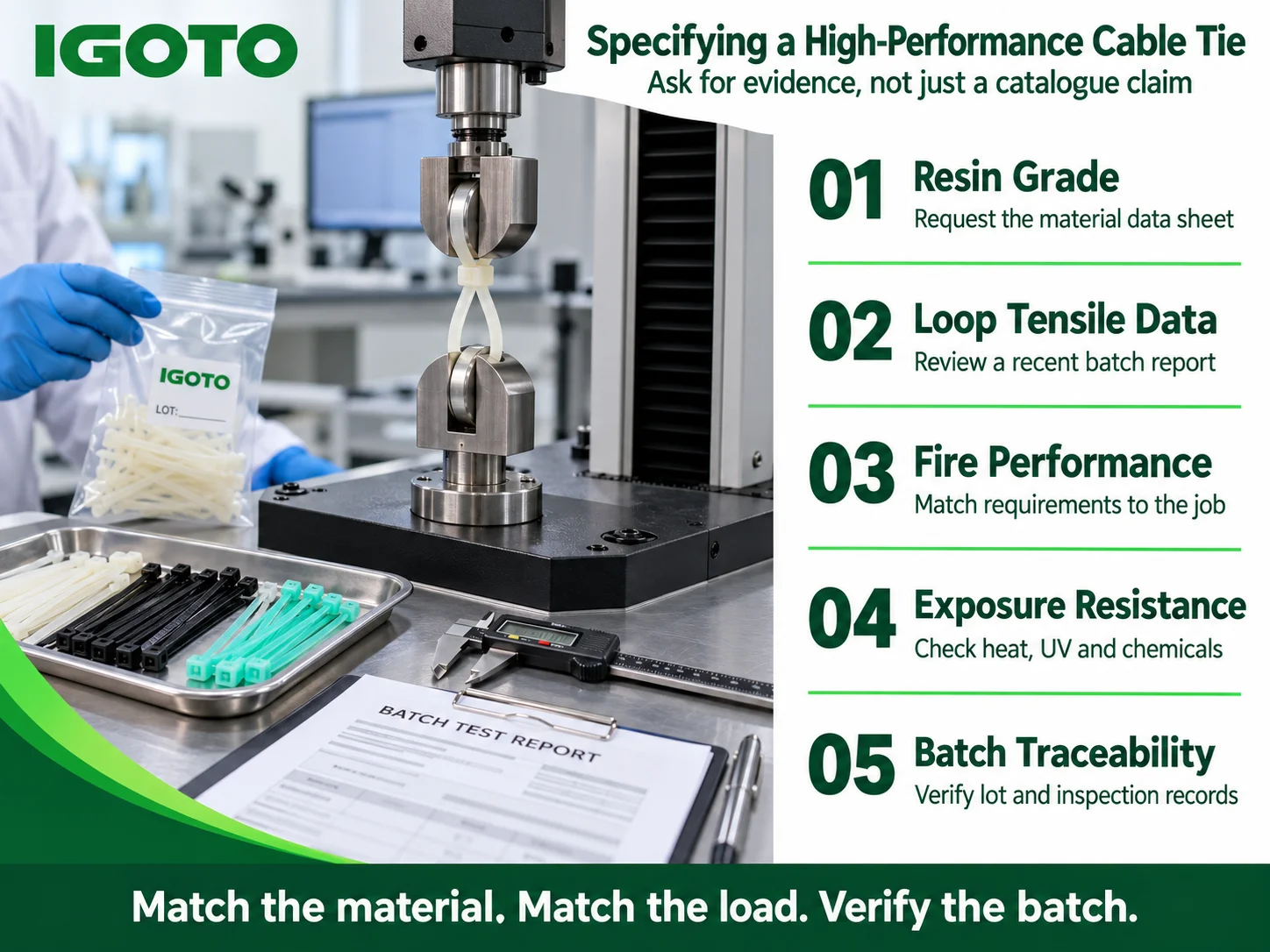
The majority of consumers looking for this specific kind of product aren’t actually looking for any particular brand. They want to know that the product can provide reliable results every time. Manufacturers have to give them that assurance and there are specific questions to ask.
Ask for the resin grade: When inquiring with manufacturers, don’t merely ask for nylon: find out which specific type of nylon 6/6 or fluoropolymer has been used in production, and request for the material data sheet as well.
Loop tensile test information rather than catalogue: Ask for reports from real batches tested in a verified manner, and not in-house only.
- Flammability and approvals that match the job: UL 94 V-2 as a baseline for nylon 6/6, with dedicated grades where fire performance is part of the spec, as covered in flame retardant cable ties.
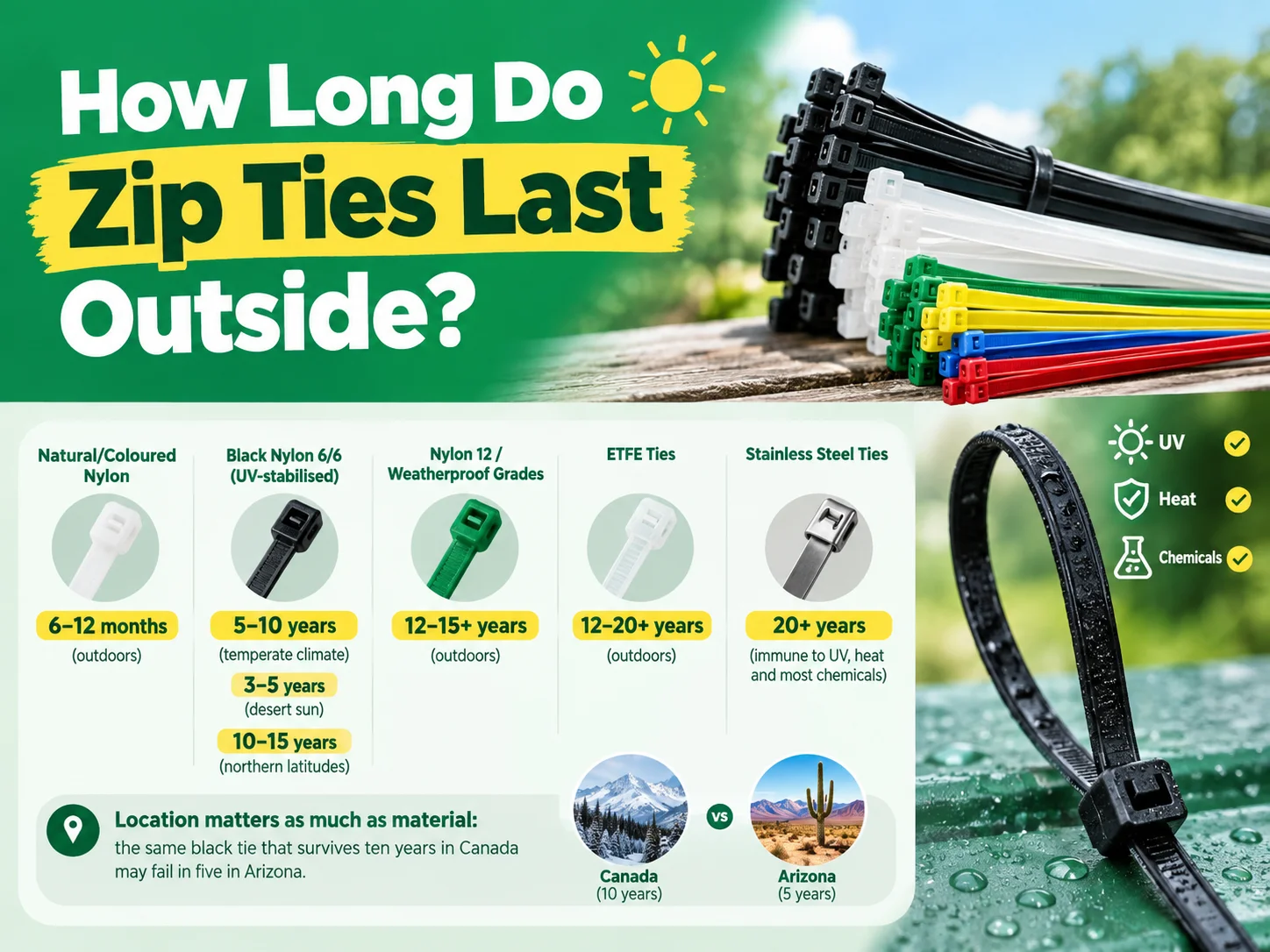
- Environmental grade matched to exposure: UV-stabilised black for sun, weather-resistant formulations for outdoor runs, and high-temperature grades for engine bays and hot process areas, discussed in high temperature tie wraps.
- Batch traceability: Lot numbers on the bag, retained samples, and an inspection record. This is the difference between a quality claim and a quality system, and it is what our own quality control process is built around.
For projects that need a specific colour, marking, strap geometry, or packaging format, a manufacturer that runs its own tooling can produce it as a dedicated line rather than a relabelled stock item. That is the purpose of our OEM and ODM programme.
Frequently Asked Questions
What sizes are available for Ty-Rap cable ties?
The sizes of the products are generally between 4 inches and 36 inches in length, divided into classes of tensile strength: the mini class line, which is approximately 18 pounds. The intermediate class has a strength of 40 pounds, the standard class has 50 pounds, the heavy-duty line consists of products with 120 pounds strength, the extra heavy-duty type has a strength of 175 to 250 pounds. Besides these, there is a unique line which has temperature resistant, weatherproof, flame-proved, and fluoropolymer categories with similar measures. As the product line may be altered by the manufacturer, please check both product number and product strength in the catalogue before placing a technical drawing order.
Who makes the best quality zip ties?
We cannot put forward one solution as the quality of a cable tie can be measured and is not based on its reputation. Benchmark was set by the initial patent owner, and many experienced manufacturers work in accordance with it. Instead of relying on the general reputation of various providers, one should pay attention to 4 aspects: the name of the resin they use, the independent tensile test results, certifications that meet your requirements (UL 94 flammability standard and RoHS), and if the manufacturer has the possibility to ensure a lot traceability. The manufacturer performing testing report for the batch will offer more information than any name of the brand could do.
What are the strongest cable ties available?
When it comes to plastic zip ties, heavy-duty nylon zip ties come in at about 175-250 lbs of loop tensile strength; otherwise, the material will change instead of the design itself. Anything beyond that is stainless steel zip ties (both ball-lock and coated versions) which have a capacity of several hundred pounds and are commonly used in heavy conduit, marine, and high-temperature work. In industrial applications, the effective ceiling in practice is heavy-duty nylon since it is normally either the cable bundle or the mounting point that limits their use, not the zip ties themselves.
Is there a difference between cable ties and zip ties?
No. The two names are of the same object. The differences are only in regional and historical terms, not terminology. Cable tie is the formal and universal term, whereas zip tie is a popular American term. The brand name Ty-Rap is also used the same way. Moreover, one can also come across terms tie wrap, hose tie, and wire tie. Always make sure that while comparing quotations, you skip the terms and check the parameters of the items: grade of material, size, and specification.
References
- Maurus Logan, National Inventors Hall of Fame
- Cable tie, Wikipedia
- Cable lacing, Wikipedia
- Cable ties, components and critical space exploration, SHEQ Management
- Knots on Mars, The Planetary Society
- Outgassing Database, NASA Goddard Space Flight Center
- Meet NASA Low Outgassing Standards, IEEE Spectrum
- The Ty-Rap cable tie celebrates 60 years and 28 billion units, Electrical Business
Conclusion
The arc from a Boeing plywood harness board in 1956 to a rover on Mars is a good reminder of what a cable tie actually is: a fastener judged entirely by whether it still holds years after anyone thought about it. Ty-Rap cable ties earned their place by changing one small part, swapping a nylon pawl for a steel barb, and by changing the resin when the environment demanded it. The lesson for anyone specifying ties is the same at any scale. Match the material to the environment, match the tensile class to the load, and buy from a manufacturer who can prove both with data. If that is what you need for your next project, talk to our engineering team through the contact page.