



How Does a Self-Locking Cable Tie Work? The Ratchet Explained
The simplest part of the strap process is to take the tail around and through the head part of the strap. After pulling it through, you hear a sharp click and the strap won’t collapse. At this point, you have just observed a brilliant piece of mechanics. The cable tie self locking design is a one-way locking system made of a strap made of nylon. It has been designed so that any trying force to open the loop only helps the closing of it. This guide will tell you about the working principle of the cable tie.
A self-locking cable tie is a type of fastener made from a single piece of material that features a row of teeth on its strap and allows the strap to only tighten, as it is designed to engage a claw in the fastener’s head. By pulling on the tail of the fastener, the claw or pawl moves on top of each tooth, and pulling back on it causes the claw’s tip to move deeper and deeper into the fastener. Self-locking cable ties are usually made from nylon (PA66), which is rated for temperatures ranging from minus 40C to 85C, whereas outdoor ties are made of black UV-resistant nylon. There are also stainless steel cable ties that utilize a rolling ball instead of a pawl, making them more expensive but much more resistant to heat, corrosion, and fire. The quality of the cable ties is verified by means of loop tensile testing mentioned in IEC 62275 and UL 62275, and common failures of cable ties such as loosening or snapping occur due to the use of recycled material or faulty pawl design.
What Makes a Cable Tie Self Locking?
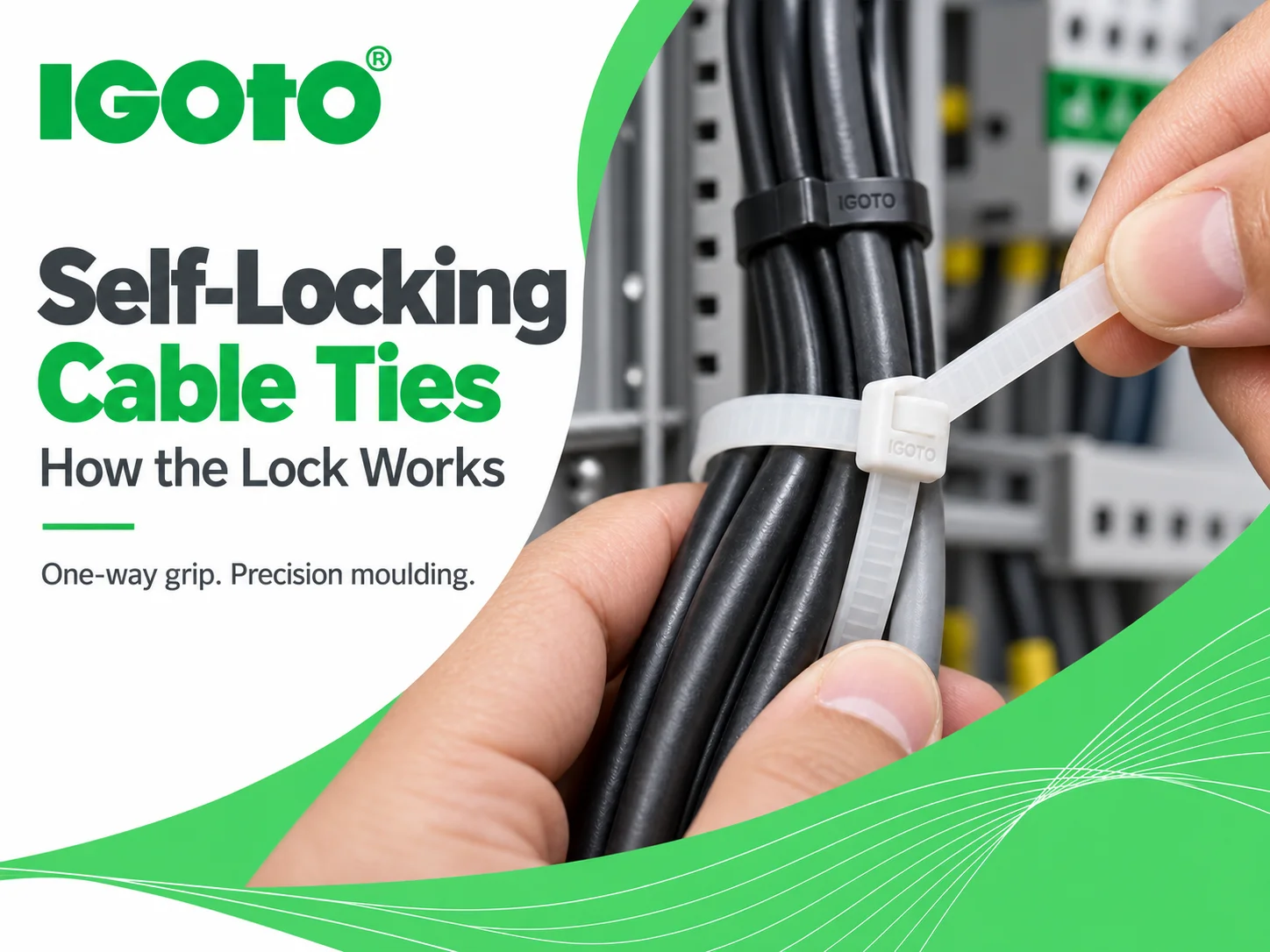
Self locking zip ties do not require any tools, knots, or any separate locking device. Self locking zip ties come equipped with everything necessary to close the loop. There are four parts in an ordinary nylon zip tie:
- The tail: this is a tapered pointed end which passes through the head. Its design is thin enough to allow it to pass easily and in some cases may be curved.
The strap: it is the long body of the zip tie. One surface has a row of small angled teeth and this feature is called a linear gear rack by engineers.
The head: it is the square block on the other end which has a rectangular opening that is wide enough for the strap to get through.
The pawl: a small flexible tongue made in the head channel; its end is positioned just above the teeth so that it can lock the mechanism.
The idea is not new. Electrical engineer Maurus Logan developed the first cable tie in the 1950s after watching aircraft workers tie wiring harnesses with waxed cord, and his design was recognised by the National Inventors Hall of Fame in 2026. The original used a small metal tooth in the head; the all-nylon version with a moulded pawl came later and is what almost every tie on the market uses today. For a broader look at the product’s background and naming, the cable tie entry on Wikipedia is a useful starting point.
Why It Grips Tighter the Harder You Pull
Often, people say that a zip tie gets “stretched out the more a person pulls it”. This is true in one way, but what is even more interesting that this is also true in the other way, although with a different meaning. The explanation lies in the fact that teeth and a pawl have asymmetrical shapes. Each of them has a soft surface on one side and a steep one on the other side.
Going In: The Pawl Rides Up the Ramps
By pulling the tail of the tie through the opening, the strap of the tie slides in the direction of the knot. The inclined edges of the grooves in the teeth exert pressure against the tip of the pawl, which forces the pawl out of the path of the strap. When a tooth moves past the pawl, it springs back down into the next available slot. You hear the resulting sound of zipping as the pawl moves back and forth. Since the ramps are at such a shallow angle, there is not much resistance to the pushing of the strap, which is why you are able to pull on the tie using your hands.
Pulling Back: The Pawl Digs In
At this point, let us visualize the bundle being forced outwards or someone pulling on the loop to have it open. The strap tries to slip back. In this case, again the steep surface of the tooth meets the steep face of the pawl. Since it cannot have a ramp to climb onto, the pawl is forced to remain straight and inclined in such a way that the force pushing back moves its point deeper into the tooth. Therefore, the more load the loop experiences, the harder the pawl gets stuck in the rack.
Engineers refer to this effect as self-energizing, in which the force trying to open the coupling turns into the force trying to keep it closed. This is similar to a doorstop that grips tighter when you push the door.
A good self-locking strap is never going to fail by “letting go” as the pawl stays locked until it either breaks, shear tips of the pawl or the head cracks. If a strap slips back from tooth to tooth without the load increasing, it is not normal behaviour but a material or design issue.
Why the Tooth Angle and Pitch Matter
The mechanics of this matter is rather complicated. On one hand, there is a need for balance between the angles of the tooth ramp and robustness of the connection – otherwise, there will be difficulties with fastening the connection and working of the pawl during its minute. On the other hand, if the angles of the bands are insufficiently steep then even a little force on the connection will make the pawl skip. The distance between the teeth, called pitch, determines the closeness of adjustment of the connection because the finer the pitch, the better the connection, as the teeth will be smaller in size and carry less load. This accounts for the use of bigger tooths in heavy duty straps during the design process while ensuring that very accurate moulding is implemented for small tooths.
Some manufacturers also make pawls in a way that they reach several teeth at the same time and distribute the pressure over other tooths. Others use the so-called “curved” or inclined track which creates a constant pressure on the strap due to its tightening process. Although the design may be different, the principle of operation remains the same as for any other ratchet.
Nylon vs Stainless Steel: Two Different Locking Systems
The two main materials used for self-locking ties do not just differ in strength. They lock in fundamentally different ways, and that affects where each one belongs.
Nylon PA66: The Moulded Pawl and Rack
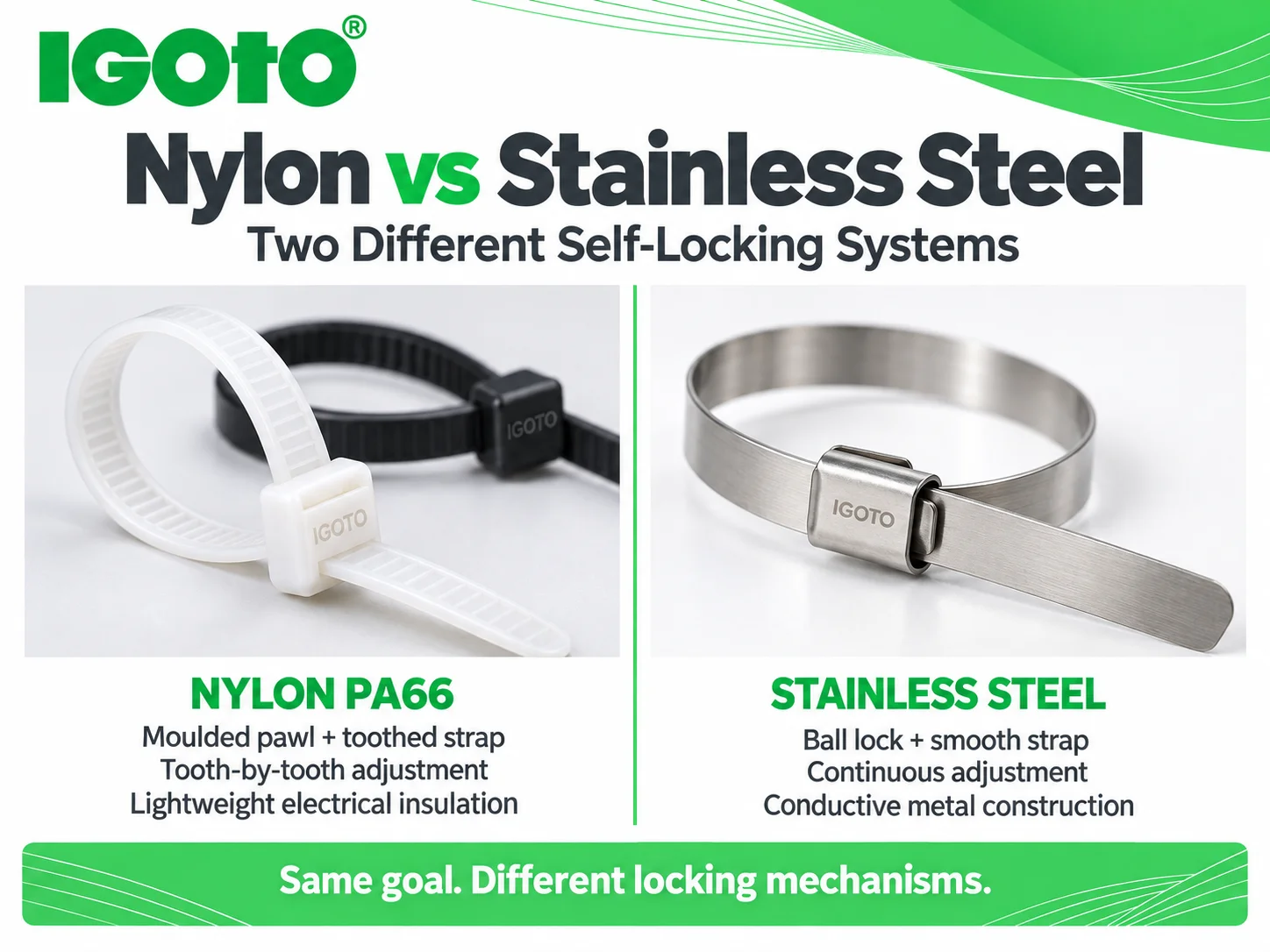
Most ties are usually produced using injection molding process and made as one piece from nylon 66 otherwise known as PA66. The reason for using nylon is its toughness which makes it strong thus the inability for it to break. It is flexible enough for the pawl to work repeatedly. The capability to endure loads while producing ties is essential. A standard car tie made from nylon PA66 can perform well under the conditions of continuous use in the temperature range of from -40°C to -85°C. It is also a very good electrical insulator and weight safe materials.
Its weak points are sunlight, chemicals and heat. Ordinary natural nylon degrades under UV, which is why outdoor ties use carbon-black stabilised compounds such as our UV resistant cable ties. Nylon also absorbs some moisture from the air. That moisture actually keeps it flexible; very dry nylon, for example in cold, dry winter air, is noticeably more brittle, which is why cold-climate installation needs extra care, as covered in our cold weather cable ties guide.
Stainless Steel: The Ball Lock
Unlike a nylon pawl, a metal strap cannot bend, so the preferred method of fastening stainless steel ties is the ball lock rather than the brief lock. The head of the strap has a tiny steel ball that is inside a taper. The strap works by drawing the ball to the wider end of the taper to allow the strap to slide. When the time comes for the strap to retract, the ball moves itself to the narrower end of the taper to lock the strap. The ball locks itself in the narrow part so that the strap cannot move at all. It is the same self-locking principle as in the case of a nylon pawl, but here the mechanism is a rolling wedge.
The advantage of a ball-lock strap is that it can be tightened in virtually any position as opposed to the limited movement of a tooth. Stainless steel ties made from 304 or 316 types can easily withstand ultraviolet rays, salt spray, a large number of chemicals, and very high temperatures. What is more, the ties can be expected to survive without burning. The only trade-off is in terms of their price, weight, the sharper edges of the strap, and the need for a special tool to tighten or cut the strap.We compare the two materials in more depth in stainless steel zip ties vs nylon cable ties.
| Feature | Nylon PA66 tie | Stainless steel tie |
|---|---|---|
| Locking method | Flexible moulded pawl engaging a toothed strap | Steel ball wedging in a tapered head against a smooth strap |
| Adjustment | Steps of one tooth pitch | Continuous, any length |
| Typical temperature range | About -40°C to 85°C for standard grades | Far wider, including very high heat |
| UV and corrosion | Needs UV-stabilised black grade outdoors | Excellent, especially 316 grade |
| Electrical | Insulator | Conductive unless coated |
| Installation | By hand, tool optional | Tensioning tool recommended |
| Cost | Low | Several times higher |
For most tasks related to electricity, industry, automobiles, and homes, a good nylon tie is preferable. Stainless steel has its place in marine construction, refineries, tunnels, installations with resistance to fire, and outside hardware when a plastic tie is no longer helpful.
How a Self-Locking Mechanism Is Tested
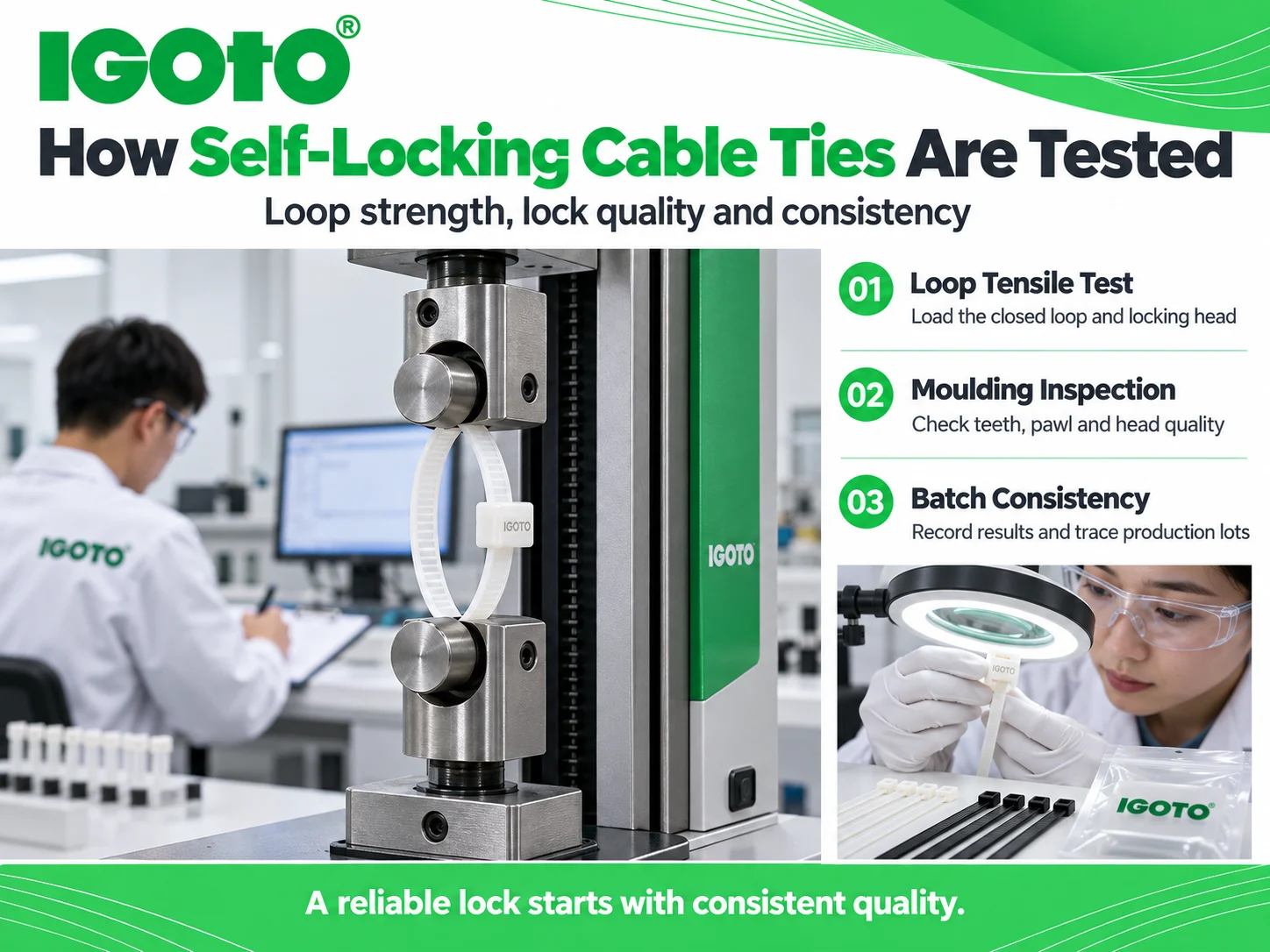
As the lock is central to the product, the international standard for electric cable ties is made according to it. IEC 62275, approved in North America as UL 62275, defines ties according to their loop tensile strength. The tie is looped around test specimens and pulled out from the inside till it fails. The locking mechanism is firmly tested this way, as it is the most important thing.
The standard also examines cable ties for the ability to retain their strength after the processes of heat ageing and temperature cycling, as opposed to just performing when brand new. There are different types of ties according to the ability to retain the claimed strength. For example, Type 1 ensures that at least half of the claimed strength is retained after conditioning. Type 2 ensures that all of the claimed strength is retained and no slippage through the head occurs. The trade association NEMA publishes a clear summary of the UL 62275 type designations if you want the detail.
The other examinations include low-temperature installation, minimum operating temperature, flammability, and UV resistance, if applicable. A cable tie that possesses a certificate for compliance with this standard means that its locking mechanism has been tested under repeatable conditions, which is much more important than the strength figure printed on the package.
Why Some Cheap Ties “Back Off” or Snap
If this principle works so well, why do some ties fail on vibratory shaping machines or break during the first frosting of the season? More often than not, the problem is not in the principle but the quality of the material and the processes used to mould it.
Recycled or mixed materials. Grinding nylon, or nylon mixed with cheaper polymers and fillers, makes it weak. The result is that pawls made of this nylon fail due to being too flexible and cracking under pressure.
Pawls moulded poorly. The pawl is a very small part, and if the mould is old or cycled too fast, it may end up defective in terms of length, roundness, thickness etc. Even a slightly tiny error of a millimetre can result in the strap passing instead of biting.
Pawls are dry and brittle. Ties that were sent very dry, or stored in hot and dry warehouses, are most likely to break while tightening the strap, especially in cold weather.
A combination of temperature changes and vibrations. Frequent heating and cooling events, along with constant shaking, work a poor lock loose. A good tie will withstand any changes, while a mediocre one will loosen up a bit with every use.
Wrong product used. A natural tie on direct sun will become brittle soon, irrespective of the quality of the mould.
Often, it is possible to identify a problem even before using cable ties. Our guide on how to distinguish the quality of nylon cable ties walks through simple bend, pull and visual checks, such as looking for any flash around the head of the tie, irregularities in color and the pawl of the tie that does not bounce back properly.
If you order cable ties in bulk, make sure to ask the supplier two questions, for example: Is it made from 100% virgin PA66? Is it certified to IEC 62275 or UL 62275 and can I get copy of the certificate if required?
At IGOTO, every tie is moulded from virgin PA66 and checked through our in-house quality control process, including loop tensile testing of production batches, because the lock is only as dependable as the least consistent tie in the carton.
How to Install a Self-Locking Tie So It Stays Locked
Even an excellent tie can be applied improperly. These good practices lead to a properly working lock:
1.Feed the tail the right way. The teeth must touch the pawl. In most cases, the toothed section sits on the inner part of the loop. If it is wrongly put on, the tail will simply pass through without any clicking noise and won’t lock at all.
2.Tighten by hand first. Close the tie until it is able to keep the bundle only, then apply final tension with steady force or a tensioning device.
3.Never over-tighten soft cables. The lock holds more than the data or fibre- optic cable can bear, so tighten the tie until the bundle can no longer slide but not until it begins to peel.
4.Trim flush. The tail has to be trimmed flush to the head without twisting or pulling it while cutting. Flush cutters or tensioning devices with the built-in tag will give you the best result.
5.Use the appropriate tie for the particular location. Black UV-stabilised ties must be used outside, heat-resistant ones near engines and heaters, and stainless steel ties must be chosen if there is a risk of corrosion.
If you ever need to open a tie again, a standard self-locking design can usually be released by lifting the pawl with a thin pick, although the strap may be weakened afterwards. We explain safe methods in how to undo zip ties without cutting. For bundles that change often, a purpose-made releasable tie is the better option.
Frequently Asked Questions
What is a self-locking cable tie?
The fastener is typically made from nylon, forming a loop that closes without requiring any separate buckle or other tool. The strap has a series of angled teeth that connect with a flexible pawl that can be inside the head of the buckle. The strap can be pulled as tight as needed but cannot come undone as backward forces drive the pawl deeper into the teeth of the strap.
How do you get a zip tie to lock?
Reel the strap around the bunched-up end and push its pointed end inside a slotted part, allowing the notched side to face what would be the inside of the loop. As you pull the tail through, you may hear some clicks as the pawl passes through each notch of the strap. If it moves along with no sound or resistance, the strap is incorrectly placed and should be turned upside down. Once it is in place, pull on the strap until it is tight, and cut off the extra tail.
What are the different types of cable ties?
Apart from the regular nylon ties, there are lots of other ties available as well such as high-resistant nylon ties with broad strap and a great tensile load rating, UV-proof ties in black color meant for outdoor applications, heat-resistant ties used in application subjected to high temperature, flame-proof ties, removable or reusable ties with release tab, fastening ties having provision for screws or adhesive fixing, push-on ties and identification ties with a flag, slim ties with flat heads and stainless-steel ties with ball locks in them. Our overview of assorted zip ties types covers when to use each.
Is there a difference between cable ties and zip ties?
No. They are two names for the same product. “Cable tie” is the term used in electrical standards and industry, while “zip tie” comes from the zipping sound the strap makes as it passes the pawl. You will also see tie wraps, wire ties and zap straps. What actually differs from one tie to the next is size, material and quality, not the name. We break down the terminology further in are nylon cable ties the same as zip ties.
The Small Mechanism That Holds Everything Together
The concept behind the self-locking cable tie is simple, but it is effectively put into action: angled teeth and a pawl stop the strap going back. You can use this self-locking principle as long as the raw material used to manufacture ties is of high quality, the mould used is accurate and whether the most appropriate type of tie is used in any certain situation. If you want to purchase self-locking cable ties of any standard, UV-resistant or custom specifications, contact the IGOTO team for samples and technical data.
References
- National Inventors Hall of Fame — Maurus Logan and the Invention of the Cable Tie
- NEMA — UL 62275 Cable Tie Type Designations Simplified
- IEC — IEC 62275 Cable Management Systems: Cable Ties for Electrical Installations
- Google Patents — US6668427 Ball Lock Cable Tie Design
- Wikipedia — Cable Tie Design, History and Use
Conclusion
There is a self-locking cable tie that offers a solution to an instance of what appears to be a simple problem of keeping a loop fastened without any tow, buckle or equipment. It employs one concept that performs beautifully. The hook-shaped edges on the band and the movable pin in its head enable movement of the band in one direction while changing any effort aimed at loosening the loop into a tightening push. The stainless steel ties achieve a similar purpose with the help of a rolled ball in conical heads and thereby cope with temperatures, humidity and fire, while the nylon cables fail under such conditions. The difference between a tie that remains tight for decades and a tie that loosens after only one season is not in the design of the product, but rather in the way it is made: PA66 of the best quality is preferable to recycled raw materials, the locks should be produced with utmost precision and approved regarding IEC 62275 or UL 62275 standards. If you need ties with a lock you can rely on, in standard, UV-resistant or custom specifications, contact the IGOTO team for samples and technical data.