



What Are Low Profile Wire Ties?
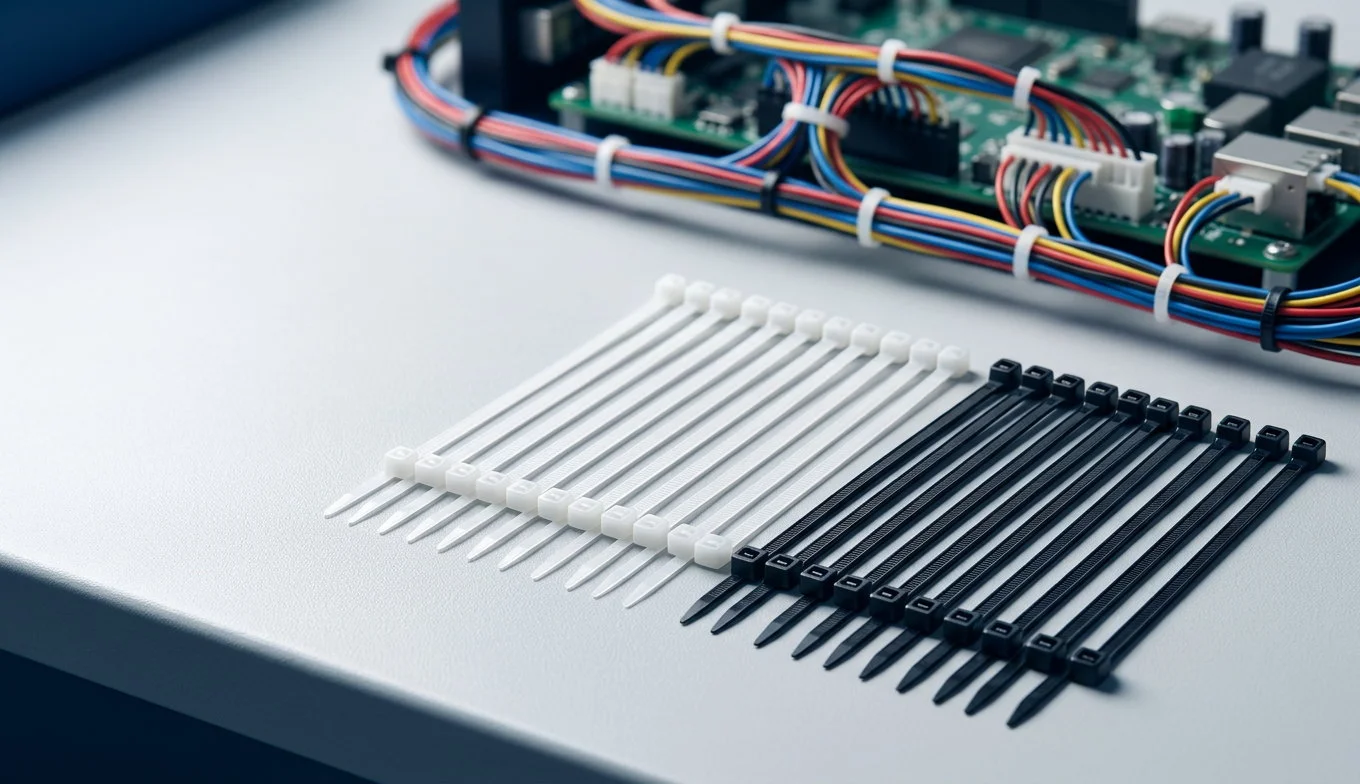
There are no design differences between a low-profile cable tie and a regular cable tie when viewed side-by-side. However, a low-profile cable tie has a flat, small head that fits snugly against the surface where it will be used compared to the large round head of a regular cable tie. While this difference may seem small in a typical use case such as hanging a fence, as in an aircraft wiring harness, or a cable tray installation, it can become critical to achieving a properly installed product. This article will examine the details of low-profile cable ties, compare them to standard cable ties, explain the meaning of the specifications, and describe their intended uses.
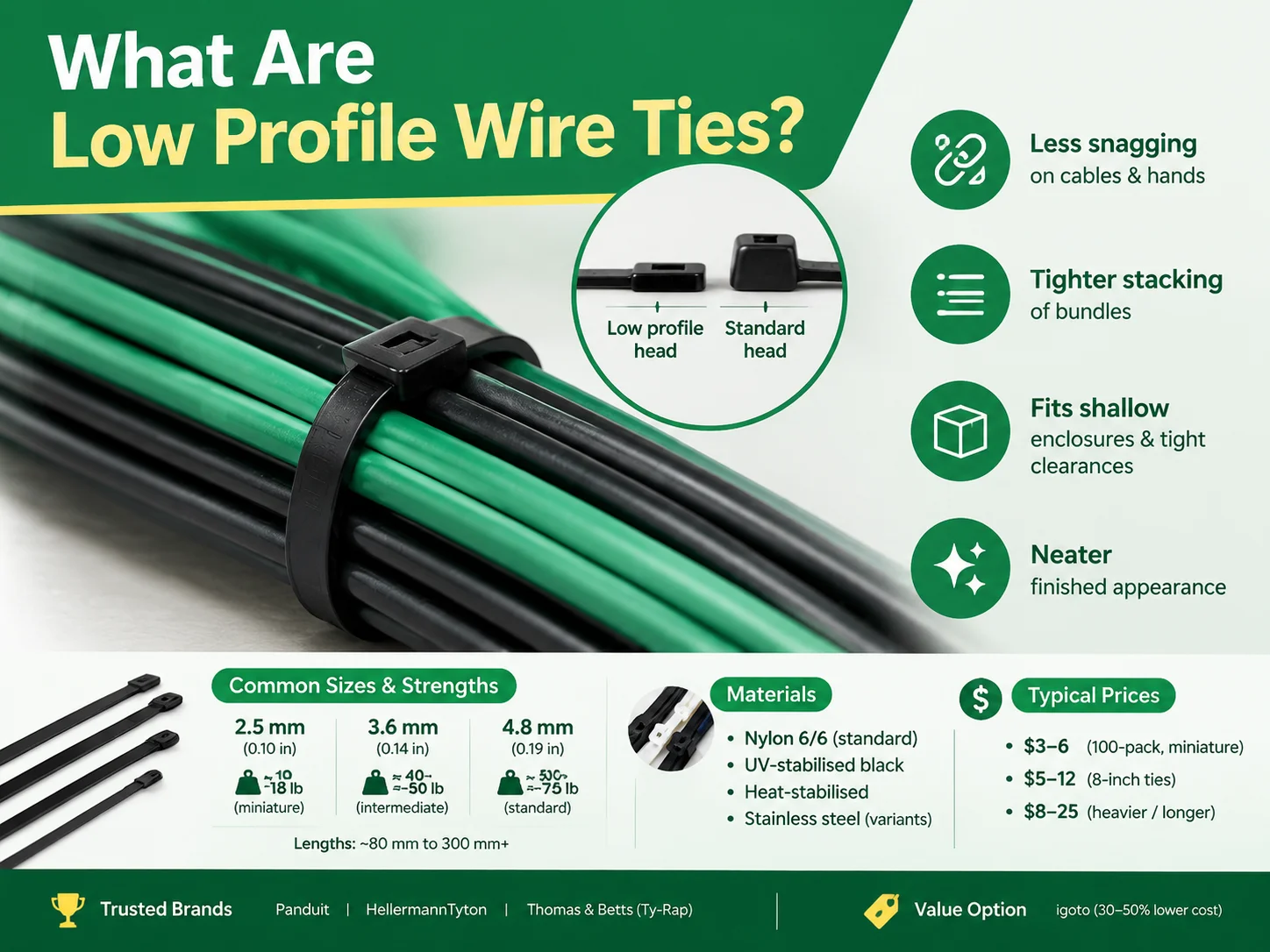
Low-profile wire ties are a type of cable tie that features a head that is flat rather than rounded, allowing for a more compact design than a standard cable tie, locking the mechanism closer to the cable bundle so that it is less noticeable. Additionally, the low-profile design of the cable tie reduces the chance of them becoming tangled with other wire ties and your bare hands and allows for better tightening of the cable bundles and fitting into shallow devices and to appear more aesthetically pleasing. The materials used to create the low-profile wire ties are the same as regular ties, and most of the wire pathways used to create a low-profile tie is made from nylon 6/6 with UV reducing special black and other compounds. The smallest low-profile wire tie typically has a width of 2.5 mm and is rated to hold approximately 18 lbs of pull, followed by a 3.6 mm low-profile wire tie with an approximate pull strength of 40-50 lbs, and then there are standard industry ties at 4.8 mm, which are rated to hold approximately 50-75 lbs of pull, depending on the required length of wire, which is often either 80 or 300 mm long.
What a Low Profile Wire Tie Is
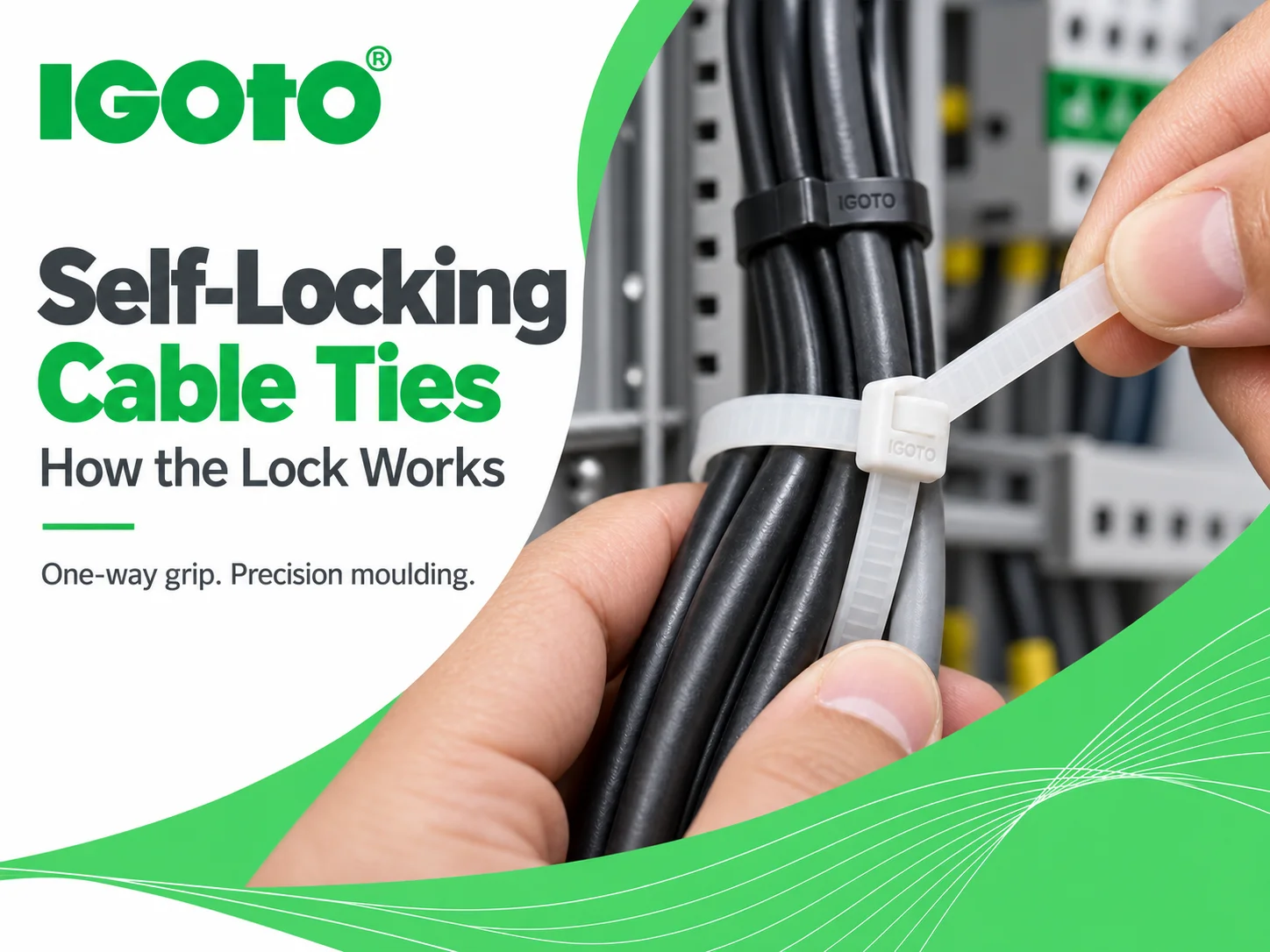
Cable ties are a type of nylon strap with a head that has a ratcheting mechanism. The strap is threaded through the head of the tie and tightened; once it has been pulled taut, a mechanism in the head locks the strap in place using teeth along its length. The design itself has not changed since its patenting in the 1950s; its simplicity and cheapness are what make it work.
The head is the part of the design that is different between product types. The distinguishing feature of low profile ties is that they have a lower profile than the regular curved head tie. Although the mechanism itself is the same, the housing design is modified. Since the head is the biggest part of the tie when it has been placed, the only way to lower the whole assembly’s position on the bundle is to lower the head’s height.
Another type that is closely related to the low profile cable tie is low-profile or flat-head cable tie with integrated mounting feature.Those are a separate sub-family covered in our article on mountable cable ties.
Low Profile vs Standard Head
| Standard cable tie | Low profile wire tie | |
|---|---|---|
| Head shape | Curved, rounded, taller profile | Flat and low; sits closer to the bundle |
| Head height above the bundle | Greater — typically the most protruding part of the installation | Reduced, sometimes by half |
| Tensile range available | 18 lb to 250 lb and above | Generally up to the mid-range; fewer very heavy options |
| Snagging risk | Higher — heads catch on adjacent cables and on hands | Lower — the point of the design |
| Stacking bundles | Heads interfere when bundles are layered tightly | Layers sit closer; neater trays and ducts |
| Clearance required | Needs more room above the bundle | Suits shallow enclosures and tight clearances |
| Installation with a tensioning tool | Standard tooling | Standard tooling; some ranges need a matching tool for the flatter head |
| Cost | Lowest per unit — the volume product | Slightly higher per unit, sometimes negligible in volume |
| Best application | General bundling where protrusion does not matter | Panels, looms, trays, and anywhere space or snagging is a problem |
The trade off should be stated clearly. Low profile ties are not stronger than regular ties of similar width and there are fewer options with very high tensile ratings. When you have to hold a heavy object, standard heavy duty tie or a stainless tie will be the best way to go. Low profile ties solve the problems of space and snag, not strength.
Names and Terminology
Different names are used for this type of product. Knowing what to search for lightens the burden of obtaining it.
- Low profile cable tie — the most common of the generic terms.
- Flat head cable tie — highlights head geometry rather than the height.
- Wire tie — in North America, often referring to wire tie, especially with regards to smaller sized ties in use on wiring. By itself, the term does not state whether or not the head is low, which makes it important for the consumer to specify.
- Zip tie — the everyday name for such products, derived from the sound made while installing it and the brand name of the original producers.
- Micro/mini/miniature ties — again, it describes sizes, rather than head specification, but often used along with low profile since the smallest of ties come in low head version.The terminology overlap is covered in our guide to standard cable tie sizes.
- Loom tie is also known as harness tie and is applied in wired harnessing and loom systems. They have low-profile heads.
When ordering a loom tie or any other product, it is advisable not to use a single word description but instead to give specifications on such things like width, length, tensile strength, material, and design of head. The term “low profile” can have several meanings, and hence numbers must be supplied with this specification.
Specifications and Sizes
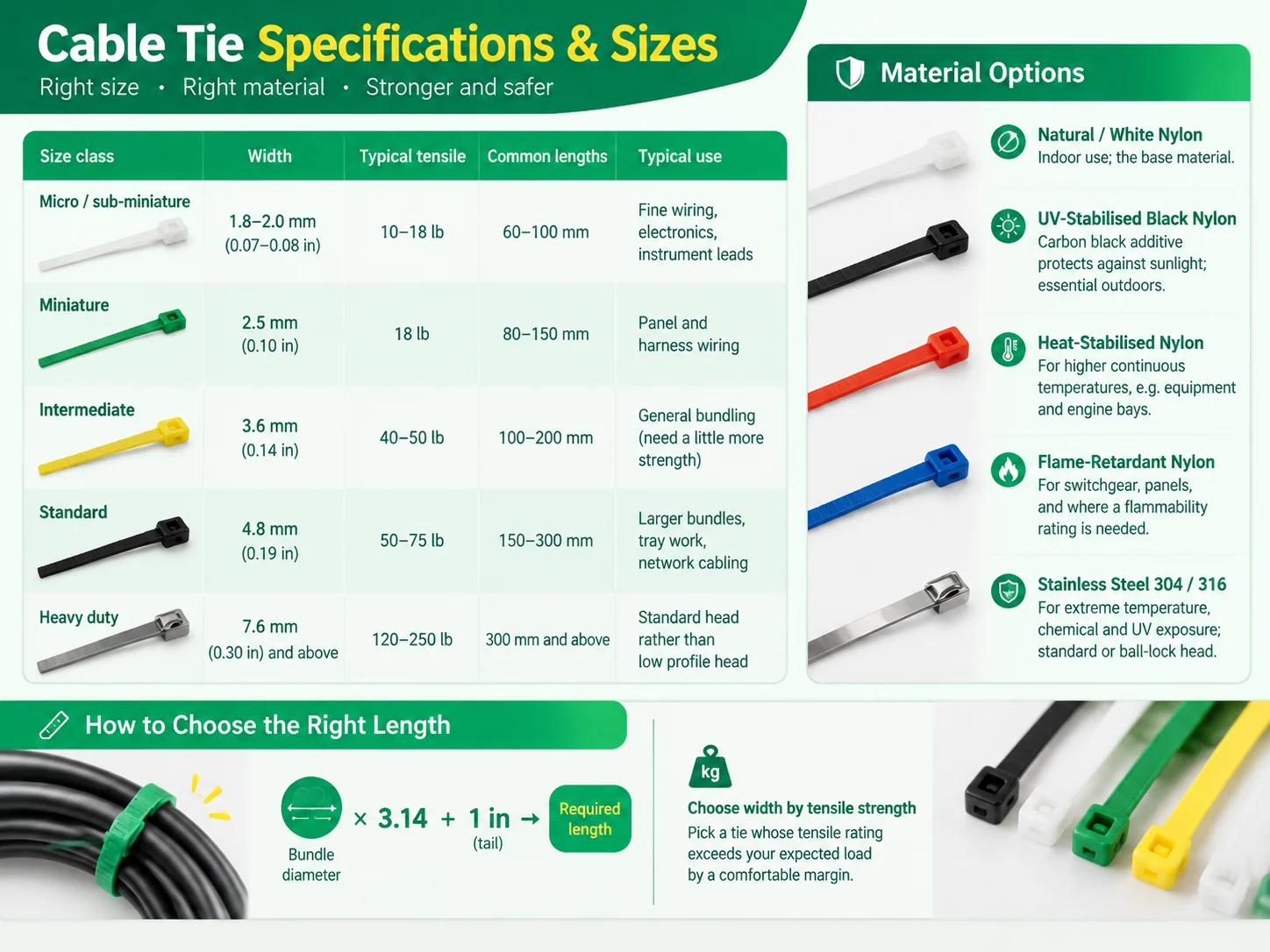
The dimensions follow the accepted conventions, which means that the width is a measure for strength, the length is a measure for the bundle’s maximum diameter and the type of material used decides the nature of the environment.
| Size class | Width | Typical tensile | Common lengths | Typical use |
|---|---|---|---|---|
| Micro / sub-miniature | 1.8-2.0 mm (0.07-0.08 in) | 10-18 lb | 60-100 mm | Fine wiring, electronics, instrument leads |
| Miniature | 2.5 mm (0.10 in) | 18 lb | 80-150 mm | The most common low profile size; panel and harness wiring |
| Intermediate | 3.6 mm (0.14 in) | 40-50 lb | 100-200 mm | General cable bundling where a little more strength is needed |
| Standard | 4.8 mm (0.19 in) | 50-75 lb | 150-300 mm | Larger bundles, tray work, network cabling |
| Heavy duty | 7.6 mm (0.30 in) and above | 120-250 lb | 300 mm and above | Usually standard head rather than low profile |
The materials used for making cable ties are equally important as their dimensions. Standard models are made of nylon 6/6, being tough, water resistant and self lubricating.
- Natural or white nylon is for indoor purpose and is the starting point of base material.
- UV-stabilized black nylon is for outdoor usage and well has addition of carbon black which protect the material against the sunlight.
- Heat-stabilized nylon is for higher temperatures, designed for constant use in the equipment and engine compartments.
- Flame-retardant nylon can be used in switchgear or panels and anywhere that requires flammability rating.
- Stainless steel 304 or 316 for higher temperatures, chemicals and UV.
Two measurements decide the right length. For a round bundle, multiply the bundle diameter by roughly 3.14 and add about an inch for the tail. For width, choose a tie whose tensile rating exceeds the load you expect by a comfortable margin, and remember that width is the variable that carries the strength — the relationship is set out in our guide to zip tie width and tensile rating.
Where They Are Used
Low-profile ties find their application in places where executing work with a normal tie would be impossible. This practically covers many aspects of work, where the use of standard ties is cumbersome or even prohibited.
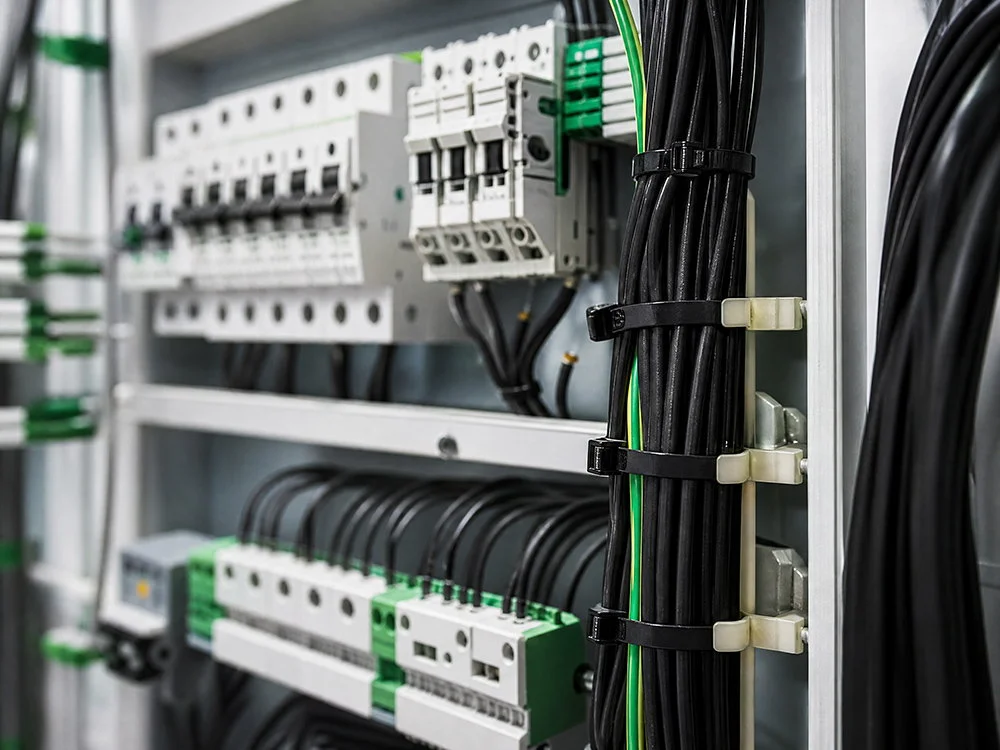
- Control panels and switchgear. This is the case when the channel is shallow, the bundles cannot touch the door or the elements situated behind the door, and when fireproof material must be used.
- Wire harnesses and looms. Low-profile ties make it possible to create a series of flush-mounted ties along the harness when it is guided through a narrow passage or against a sharp edge.
- Cable trays and ladder racks. When the structure is layered, installation becomes simpler, as installers will not scrape themselves on the way.
- Electronics and instrumentation. This means that equipment cabinets of the sort where the head can contact a board.
- Aerospace and defence. It is often required that the head of the tie be specified in the drawing because of the way something like chafing happens with adjacent wires, which is thus a reason for failure.
- Automotive and motorsport. This is the case with spaces below the dashboard and in the compartments with engines.
- Data centers and network cabinets. High-density patching, with many ties in a small volume.
- Renewable energy installation. Solar fields and storage batteries, which requires that radiation-resistant materials be used.
All cases presented above unite the fact that a protruding head is something harmful and that the way it looks does not matter in this instance.In confined installations the technique of installing ties at all becomes a skill in itself, and the approaches are covered in our article on techniques for installing cable ties in tight areas.
What They Cost
The low profile ties are priced slightly higher compared to standard ties of the same size, but in most applications, the price is not the determining factor.
| Product | Indicative price | Notes |
|---|---|---|
| Miniature low profile, 100 pack | $3-6 | 2.5 mm width, 80-100 mm; the volume size |
| Intermediate low profile, 100 pack | $5-12 | 3.6 mm, 100-200 mm |
| Standard low profile, 100 pack | $8-25 | 4.8 mm, longer lengths; price rises with length |
| Heat-stabilised or flame-retardant grades | Add 30-80% | Material cost rather than manufacturing cost |
| Stainless steel ties | $15-60 per 100 | Different head design; cost driven by the metal |
| Wholesale, 1,000+ | Cents per tie | Unit cost falls steeply with volume and drops the price question entirely |
In wholesale quantities, the cost difference between low profile ties and standard ties of the same size disappears. Therefore, the question of selection is usually based on fit and clearance, not price. The solution is usually a mixed stock of two or three sizes, which is sufficient for most jobs.
Brands and Quality
The sector tends to categorize itself into premium engineering firms and budget manufacturers. Nevertheless, the distinguishing factor is documentation instead of materials employed.
Panduit, as well as HellermannTyton and Thomas & Betts’ Ty-Rap can be used as examples. All products are accompanied by published tensile capacities, temperature degrees, flammability ratings, and UL certifications, if it applies to cases. Therefore, for any project which contains a brand specified in the technical request or audit of materials that is required to be verified according to standard specifications, these brands will be the most suitable for the client.
igoto produces low profile ties using the same types of materials — nylon 6/6 with UV and heat survivability — from the smallest to the largest sizes, for surprisingly lower prices usually by 30-50% compared to the premium brands. Its only flaw is a lack of brand image and its own engineering experience history, which is very important for cases when customers have a brand named in the technical request. Still, igoto is strong at price, model availability, and potential quantity of orders. The general selection logic that applies across all suppliers is set out in our guide to choosing the right cable ties, and it holds regardless of which brand is on the bag.
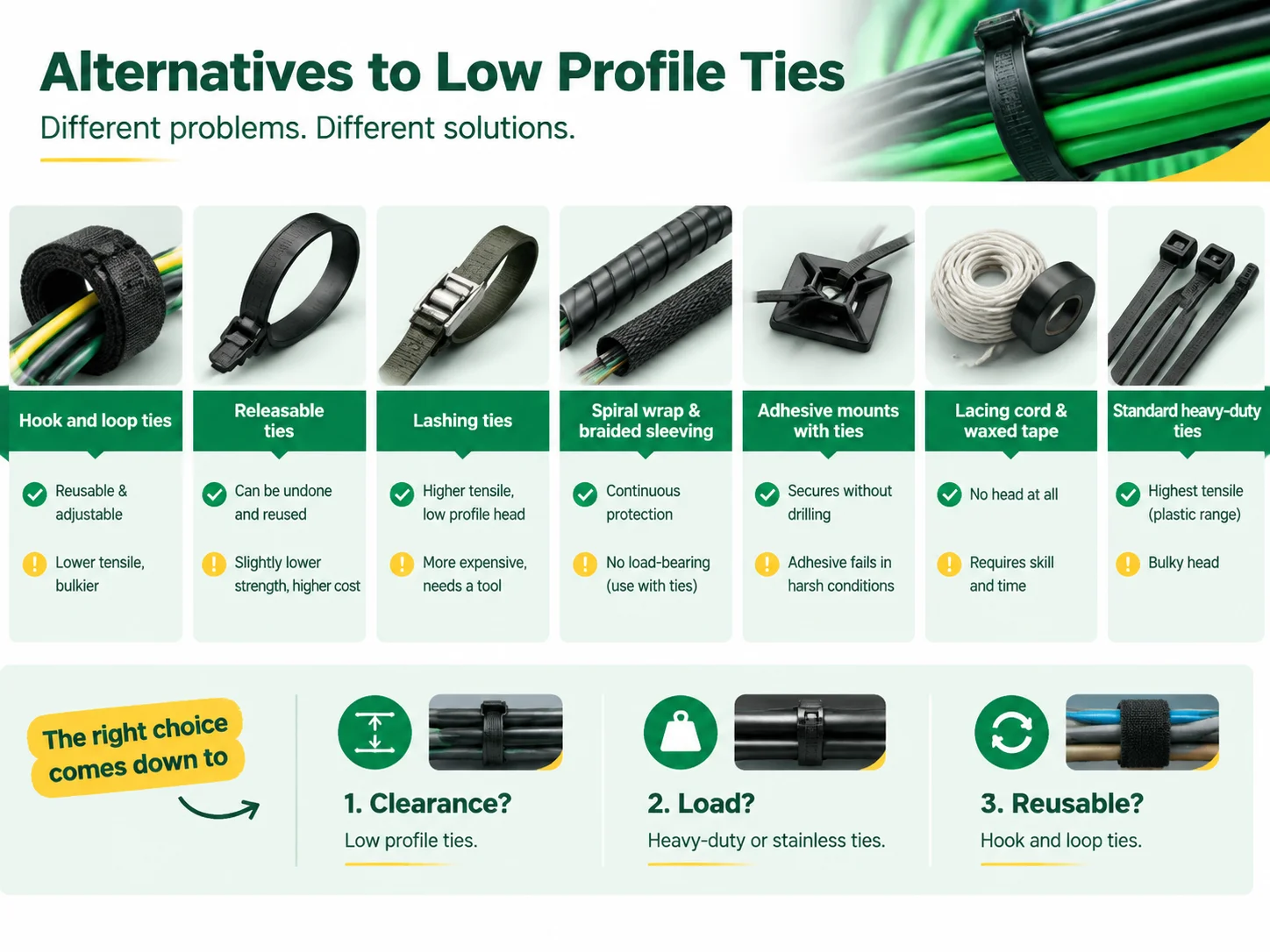
Alternatives
Low profile ties are not the only solutions and there are various alternatives which cover related requirements.
| Alternative | Advantage | Trade-off |
|---|---|---|
| Hook and loop ties | Reusable, adjustable, soft on delicate cables; no head at all | Lower tensile, higher cost, bulkier for the same strength |
| Releasable cable ties | Can be undone and reused without cutting | Slightly lower holding strength; the release mechanism adds cost |
| Lashing ties | Higher tensile with a low profile head, designed for heavy bundles | More expensive; needs a tensioning tool to install properly |
| Spiral wrap and braided sleeving | Continuous protection along a run rather than point securing | No load-bearing capability; used with ties, not instead of them |
| Adhesive-backed mounts with ties | Secures to a surface without drilling | Adhesive fails in heat, cold, and vibration; surface preparation critical |
| Lacing cord and waxed tape | No head at all; traditional in aerospace and telecoms | Requires skill and time; hard to tension consistently |
| Standard heavy-duty ties | Highest tensile in the plastic range | Bulky head; the problem low profile ties exist to solve |
Choosing the most suitable solution comes down to answering three questions: what clearance is available, how heavy the load is, and whether the tie has to be removed in the future. The low profile ties help to solve the clearance problem, while the heavy-duty and stainless steel ties are for the load problem. Finally, the hook and loop ties deal with the reusability problem.
How to Choose
When deciding on the fastening method for wire bundles, five choices must be made.
- Decide if a low profile head is required. If there is nothing within a few mm from the bundle to snag, a standard tie would do. The low profile option should be used where there are clearance limits for bundles stacked on one another or adjacent cables may rub.
- Determine the tie size according to bundle diameter and load. Knowing the length required for a tie, it is necessary to find out a size rating that is more than enough to hold the load.
- Choose the material depending on the conditions it will be used under: nylon that is resistant to UV and rain for outside use, heat resistant material when it is too hot, flame retardant materials for use on panels and switchboards, stainless steel for places that plastic cannot handle.
- Think whether the fastening method should be removed in future. If modifications are expected, using releasable zip ties or hook and loop prevents having to cut and replace the ties in the future.
- Ensure that specifications are confirmed rather than descriptions. It is necessary to obtain a copy of tensile strength of the tie before making a purchase.
FAQ
What are the thinnest cable ties available?
The micro or sub-miniature tie is currently the slimmest commercially available tie; it has a width of approximately 1.8-2.0 mm (0.07-0.08 in) and a tensile strength of around 10-18 lb. Manufacturing lengths of these ties are around 60-100 mm, and their wider version is the miniature tie, which is 2.5 mm (0.10 in), which is the smallest size usually kept by manufacturers in stock.Anything smaller exists only as a special item available to selected industries, and prices are likely to get prohibitive.
What are the different types of wire ties?
They classify using three factors, which are i) head type ii) material and iii) mounting type. Looking at head type, there are standard curve head, low profile or flat head, releasable, bead type, marker and identification, lashing and mounting ties with a plate or with a push mount. When it comes to material, there are natural nylon 6/6, black nylon with UV protection, heat-resistant nylon, flame retardant nylon, stainless steel type 304, specialist polymers such as ETFE. Finally, by size, there are micro, miniature, medium, standard, and heavy duty ties. Most errors in specification occur because people use how to speak about kind instead of using numbers.
What are the smallest cable ties?
From a practical standpoint, the smallest ties that are available in supply are the 2.5 mm wide ties that are 80 mm long and are rated at 18 lbs, as well as the micro ties that are in the 1.8-2.0 mm range. These ties are used for fine wiring and instrument leads where bigger ties do not work well because they are too rigid to shape into a tiny loop or will strain the thin conductors without need. When you are looking for the tiniest of ties, do check for minimum bundle diameter and width as very thin tie could still be too rigid to close around a small bundle without damaging the wire.
What is a type 21 cable tie?
There is no universal designation “Type 21” recognized in the wiring industry and the use of this term will depend on the manufacturer’s catalogue adopted. The naming of cable ties is based on different systems. For instance, HellermannTyton has introduced a T-series where the number indicates the minimum loop tensile strength in pounds (for example T18, T30, T50, or T120). Panduit uses the PLT series (size code) while Thomas & Betts employs the Ty-Raps system but there is also the system based on internal part numbers only. Military and aerospace harness manufacturing may suggest the use of Military Specifications. If one comes across such designation in a drawing or list of suppliers, it is better to verify what catalogue is adopted and which specifications correspond to the one in the document.
Are low profile ties as strong as standard ties?
Given the same width and material, it is correct that head geometry does not change the tensile strength of the strap; a 4.8 mm low profile tie is rated the same as a 4.8 mm standard tie. What is different is the tensile strength category available; very high tensile strength ratings (greater than about 120-250 lb) tend to be offered only in standard or lashing head configurations, because low head designs are more complex due to the pawl forces. If you have a significant amount of weight to hold, you should choose a heavy-duty or lashing tie and forego a low-profile tie.
References
- Panduit — Cable Tie Product Specifications and Low Profile Ranges
- HellermannTyton — Cable Tie Range and Material Data
- ABB / Thomas & Betts — Ty-Rap Cable Ties
- UL Solutions — Polymer Material Flammability and Component Recognition
- SAE International — Aerospace Wiring Harness and Bundling Practices
Conclusion
Low profile ties address a very specific problem, as the thickness of a standard tie head is usually the largest part of an installation. Because of this thickness, standard ties can snag, chafe, and cause clearance issues in environments such as control panels, wiring looms, stacked cable trays, and shallow boxes. A low-profile tie head does not change the way that low-profile ties are utilized, but by eliminating the snagging, cracking, and clearance problem caused by the thickness of standard tie heads, the design has quickly become a common practice for installing wiring professionally and is not considered a niche product. When selecting low-profile ties, you should ensure that clearance or snagging is the actual limiting factor in your installation, select the size according to the diameter and load or weight of the bundle you are using them to secure, and use the same guidelines for selecting material as you would for any other type of tie: Use UV-stabilised for outdoor use; Heat-stabilised for use close to heat sources; Flame-retardant for use in panels and cabling used near high heat; and stainless steel where plastic would not normally survive. Additionally, you should specify the width, length, tensile strength, and, material of the low-profile ties by using numbers instead of adjectives. If you require strength but not clearance, you should purchase a heavy-duty or stainless steel tie, and while the tie will have a taller head, you can view the low-profile tie as a solution for clearance, rather than a solution for strength.