




The Story of Zip Tie Handcuffs and Why Police Still Use Them
On May 3, 1971, police authorities in Washington, D.C. apprehended more than 7,000 individuals by day’s end. There was no police force that had 7,000 pairs of steel handcuffs, and one officer usually had only a few pairs on him. The means to address that needs was the nylon strap used in the aircraft cable industry. This is the story of zip tie handcuffs: how a protest era created the need, why nylon won, and how the restraint is correctly used and applied today.
Zip tie handcuffs, also called flex cuffs, plasticuffs, riot cuffs, or disposable restraints, are one-time-use hand restraints made of nylon and based on the concept of self-locking cable ties, invented back in 1958. Special types of zip ties include two broad and thick loops of nylon with a locking mechanism that tightens the zip in one side only. This type of handcuffs became a mandatory accessory worn by police officers and army units starting from the mid-twentieth century because the portable zip ties allow carrying a plethora of cuffs without adding any additional weight.
 A Decade of Crowds: America in the 1960s
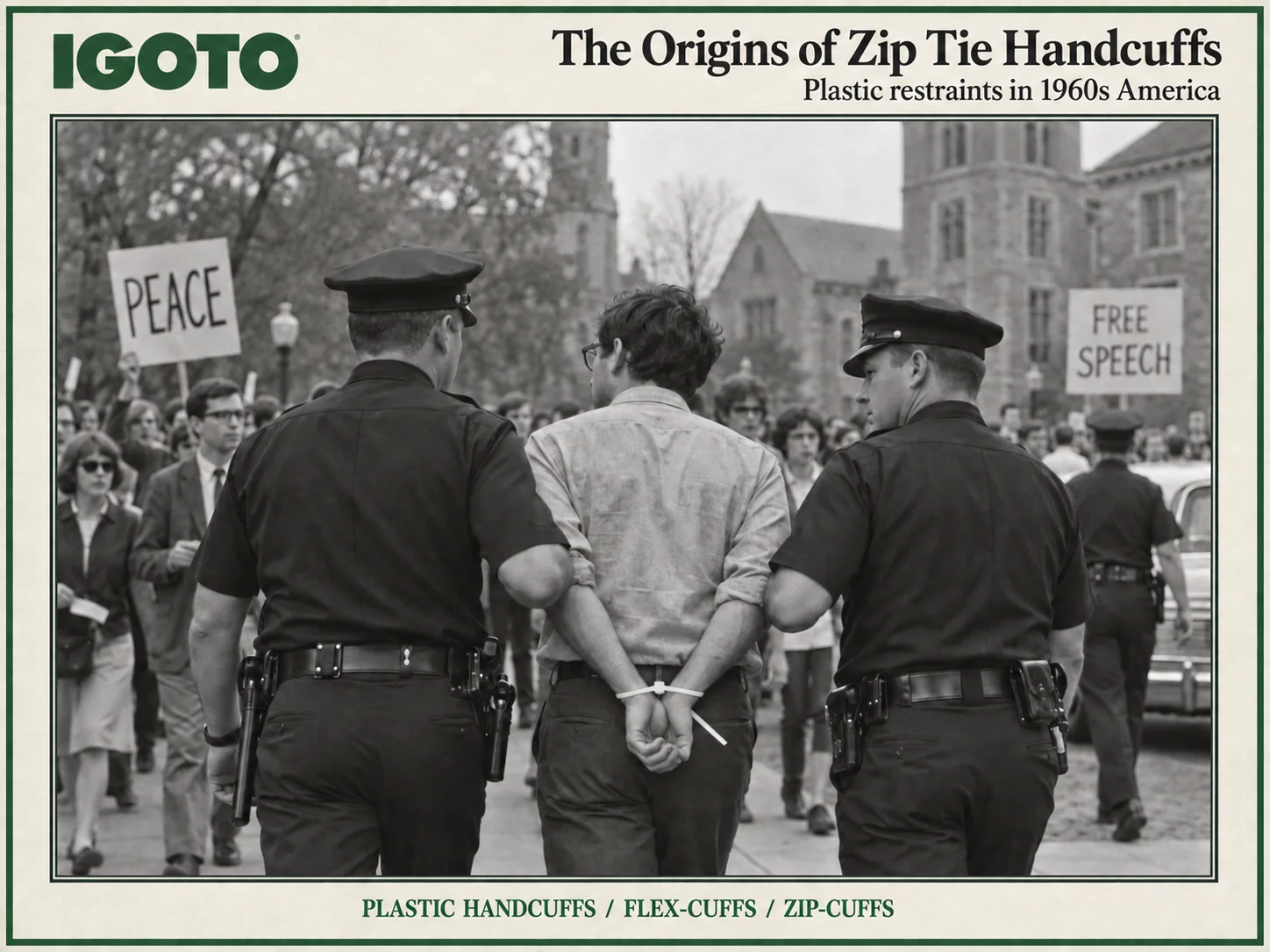
To understand how a plastic strap managed to find its way onto a police belt, one must first take a look at the United States in the second half of the 1960s. The children born during the post-war baby boom had grown up by now and were arriving at various colleges in numbers that were unprecedented in the history of the country. At this point in time, the young generation was facing several pressures at once.
The civil rights movement opened the door to discussions of racial inequality.
The Vietnam War was escalating, and the military draft meant that any young man could be sent to serve.
The Cold War created the subliminal fear of nuclear war due to the constant reminder of missile threats comparable to what is today’s alarm about terrorist attacks.
The traditional values were fading away, and young people became much bolder in expressing their disagreement with the authorities.
This resulted in the anti-war marches that had tens of thousands, instead of hundreds as it used to be before, of people participating.
The Day Steel Handcuffs Ran Out
The clearest example came in the spring of 1971. Anti-war organizers announced that if the government would not stop the war, they would stop the government, and they planned to block the bridges and streets of the capital during the Monday morning commute. The response was the largest police sweep the country had ever seen. Over three days, roughly 12,000 to 13,000 people were detained, with about 7,000 of them picked up on May 3 alone. Holding space ran out so completely that a fenced football practice field was turned into an open-air jail.
Think about what that meant for equipment. Traditional police restraints had a hard ceiling built into them, and the ceiling was far below what a mass arrest demanded.
Not enough metal handcuffs: Steel handcuffs were expensive, precision-made items. An officer typically carried one pair, perhaps two or three at most. When hundreds of people are being arrested on a single street corner, two pairs per officer simply do not go around.
Too much weight and noise: Carrying dozens of steel cuffs was never realistic. They are heavy, they take up belt space, and a bag of them clanks with every step, which destroys any chance of moving quietly during a tactical operation.
Police in the late 1960s needed a restraint that was cheap enough to buy by the thousand, light enough to carry by the dozen, and fast enough to apply in seconds. The answer was already sitting in the parts bins of electrical contractors.
From Aircraft Wiring to the Police Belt
The invention of cable ties can be traced to an aircraft manufacturer. In 1956, an engineer named Maurus C. Logan, working for the company Thomas and Betts, made a tour of a Boeing factory, where he noticed thousands of feet of cables were tied together using wax-coated nylon lines. Logan spent two years creating a new tool, and he received a patent in 1958 for a nylon strap that had a toothed head and a ribbed end. The tail provides one-direction lock without you needing anything and any physical connections. You can read more about that aircraft heritage in our guide to aviation zip ties.
It took only a little while for someone to realize that a strap that locks in one direction and cannot be undone by hand is, in effect, a type of restraint. NIK Public Safety is usually credited with producing the first commercially-made disposable restraint called the Flex-Cuf in 1965. It was basically a modification of the ratchet concept used in industrial straps where it is made bigger, thicker, and longer and it was equipped with a locking mechanism that was specially designed so that any detained person could not loosen the strap.The mechanism is the same one described in our breakdown of how a self-locking cable tie works, just scaled up for a very different job.
A product invented to protect aircraft workers’ hands from cord cuts became, within a decade, one of the most widely stocked pieces of equipment in American law enforcement.
The benefits became apparent to the officers. A collection of zip tie handcuffs could be worn on a belt like a roll of rope and weighed less than a pair of steel handcuffs. All the police departments could have thousands of them for the price of several metal pairs. By the time of the great protests of the early 1970s, the usage of nylon handcuffs was a common practice whenever an expected number of arrests was on the horizon.
Why Nylon Beat Steel for Mass Arrests
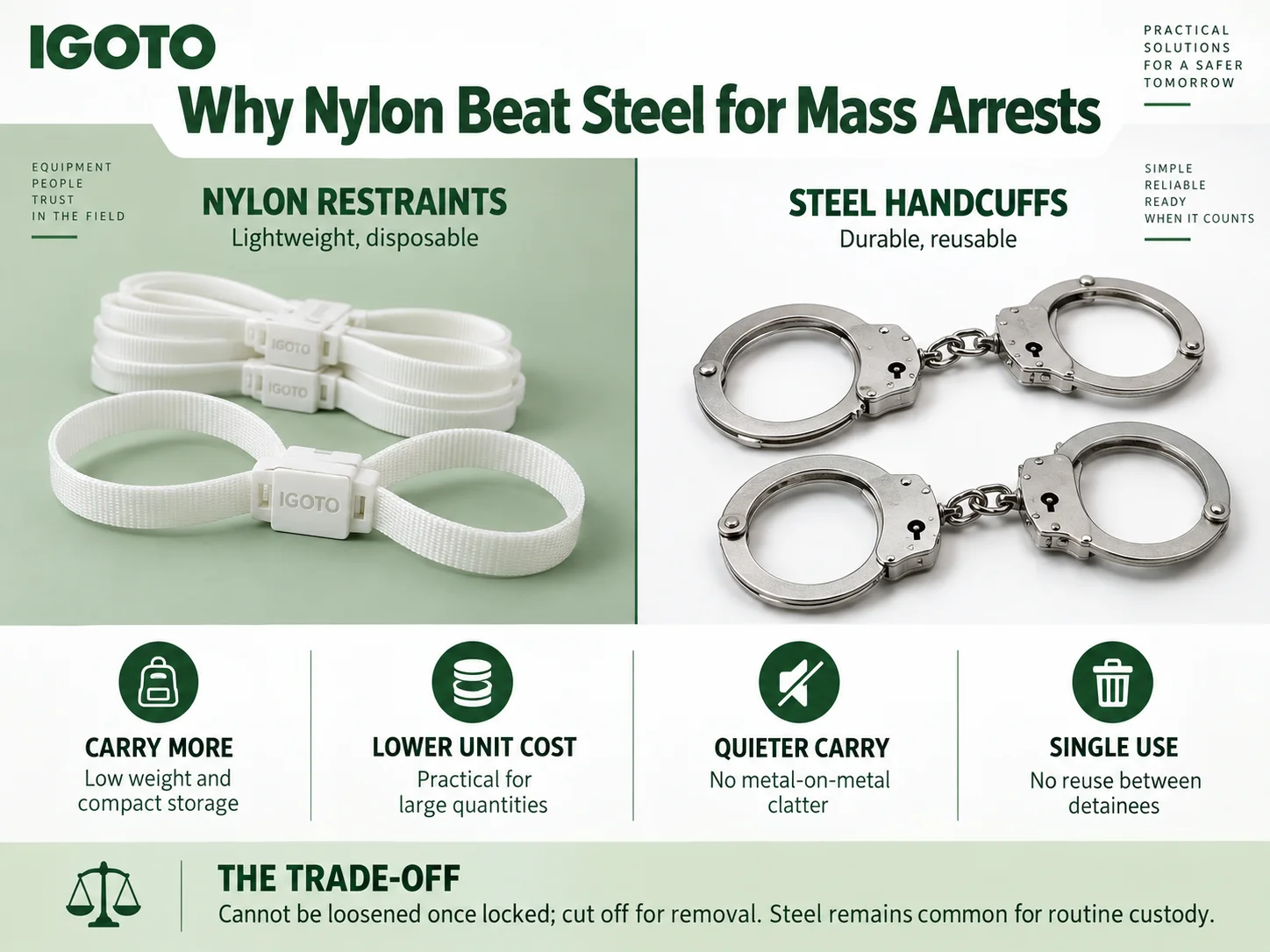
Everyday police handcuffs made from steel have not been replaced by nylon. Instead, nylon has been developed to address certain problems that steel has not been able to solve.
For instance, the carrying capacity of a nylon restraint is higher than that of a metal cuff; while an officer may be able to carry just one or two metal cuffs, they can carry 10, 20, or more nylon restraints.
Also, nylon restraints are much cheaper than steel handcuffs, and thus losing one in a chaotic situation is not a problem.
Another advantage of nylon restraints is the fact that they do not make any sound, which is important for police and military operations.
In addition, unlike handcuffs, nylon restraints do not require a key to unlock, which makes their use much quicker.
The one disadvantage of the nylon handcuffs is their permanently fixed size, which means that if they are fastened too tight, they have to be cut, and one more possible drawback is that each nylon cuff is used only once, which addto the cost of the cuffs.
What Are Zip Tie Handcuffs Called?
The same gadget is referred to by many different terms according to the region, institution, and producer involved. Here are some of the commonly used names.
Flex cuffs or flexcuffs: this is the term used mostly by military and police agencies in the USA.
Plasticuffs or plastic handcuffs
Riot cuffs: the name comes from a situation where the device is used for controlling crowds
Disposable restraints or disposable handcuffs
Wrist ties, zip cuffs, zip strips, or zap straps
Tri-fold cuffs: a special kind of cuffs that can be folded to be flat
Whichever name is used, all these cuffs are part of the same family with ordinary cable ties found in cafes.
How Zip Tie Handcuffs Are Built
At first glance, a purpose-built restraint resembles a regular tie but there are alterations in almost all aspects that help to understand why the usual hardware tie is not the best option.
Double-loop design: In most cases, the model is made in such a way that it includes two wrist loops which serve as the means to keep hands at certain distance from each other.
Wide, thick strap: The band is much wider than any usual electricity tie. The increased width allows distributing pressure on a larger surface area and provides more strength to the strap.
Reinforced locking head: Made of either metal or reinforced barbs, police-grade heads are manufactured to withstand picking and prying. Such a feature cannot be found in a standard tie.
Smooth inner side and rounded edges: The side of a band that contacts a skin must be smooth whereas the edges must not have sharp endings.
Top-quality nylon: The band must be made of high-quality nylon that has been chosen due to its flexibility and resistance to hindering under pressure.
Material choice matters just as much for industrial ties. If you are curious how strength ratings scale with width and length, our overviews of the toughest zip ties available and tie wrap sizes explain the same principles from the fastening side.
How to Use Zip Tie Handcuffs Correctly
Restraining someone can lead to serious legal and medical repercussions, which means only qualified and trained personnel such as police officers, military personnel, and airline staff should conduct it in compliance with their rules and regulations. The following principles are intended to show professionals how to use zip tie handcuffs in a safe way, and should not replace the training.
1. Follow your agency’s positioning protocol
Approximately from the mid-1960s, the modern police standards in the US have implied arresting a person with his/her hands stilled to his/her back instead of in front of the body, as this prevents him/her from hitting and getting to any objects. A lot of training programs specify the palm and wrists position. Use the method recommended by your organization instead of coming up with one by yourself.
2. Tighten for security, not for pain
The band should fit snugly enough that the hand won’t slip through but never so tight that it digs into the skin. A typical field test is to check if a finger can slide in between the band and the wrist. Since nylon restraints can’t be loosened once applied, it is better to tighten them in small increments.
3. Check circulation and sensation, then check again
Check for symptoms like swelling and changes in skin color, as well as any reported sensations of localized numbness and pins-and-needles. These things can be signs of compression of blood vessels or nerves caused by the restraint and need to be checked regularly, particularly during prolonged periods of use.
Excessively tight wrist restraints may cause injury to the radial superficial nerve. Medical research on handcuff injuries has shown that many cases can lead to numbness for a long time—sometimes even for months or even years. The longer one remains in them, the higher the risk is.
4. Never leave a restrained person unmonitored
A restrained individual who falls onto a flat surface is unable to use their hands to break the fall and might experience problems breathing when lying on their stomach. Once it is safe and observed, a restrained person should be placed into a sitting position or lying on their side.
5. Remove them with a proper cutter
Due to the one-way movement of the ratchet, one must cut the nylon straps in order to detach them. People generally utilize specific cutting devices or heavy scissors that can go under the strap and above the skin as opposed to the standard pocket knife. The hands must be in a position that is steady first, before a sudden turn leads to injury.
6. Document the time
A number of agencies mandate that officers note down the times restraints were used and taken off. In wrist injuries, duration of restraint is one of the important aspects, hence the need for knowing how long a person has been restrained.
Where Zip Tie Handcuffs Are Used Today
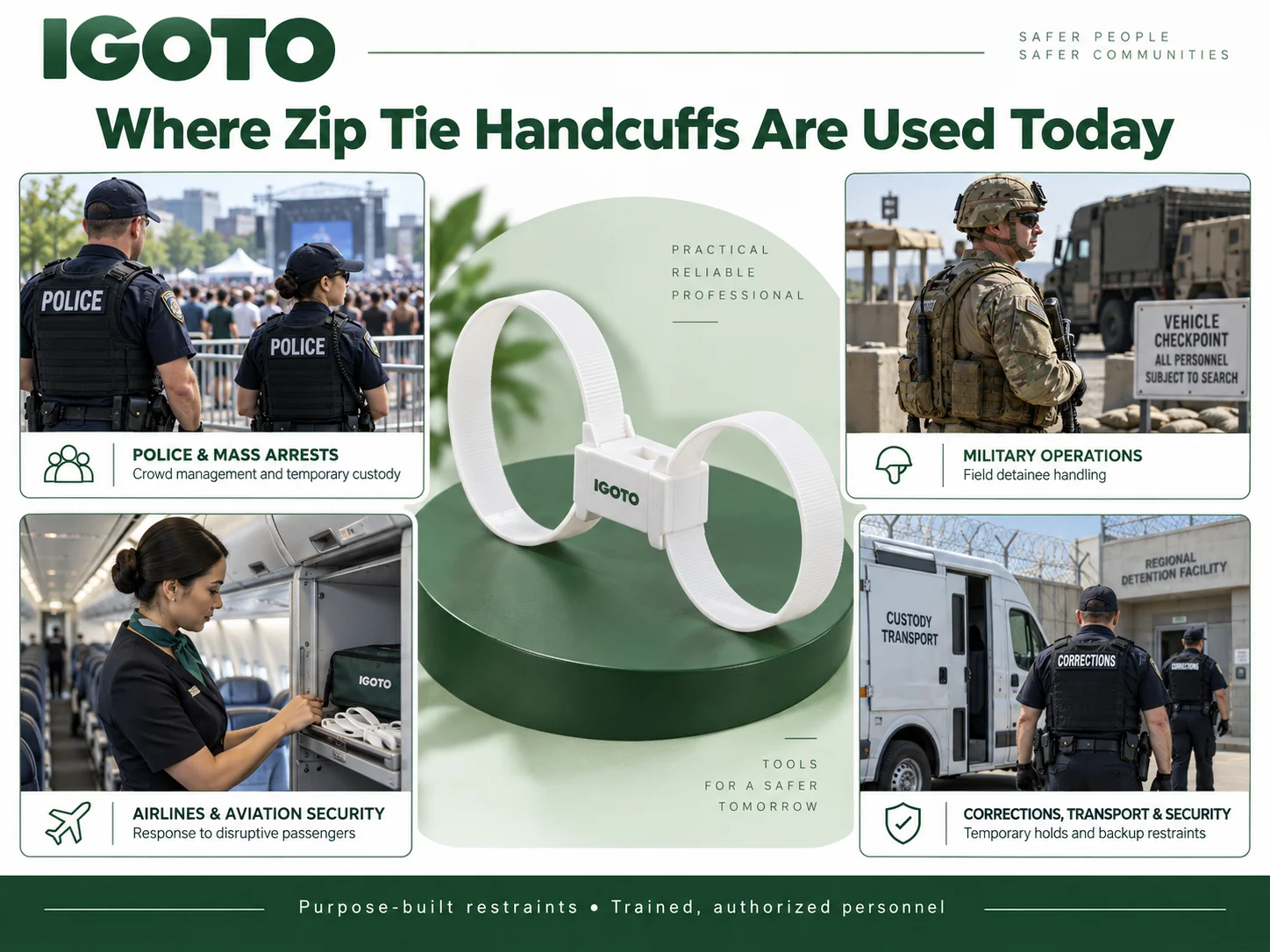
More than half a century after the protest sweeps that made them famous, nylon restraints are still a fixture in several professions.
Police and mass arrests
Crowd control remains the classic use case. When a city expects large demonstrations or major public events, departments stock up. In 2003, for example, San Francisco police placed an order for 30,000 nylon restraints ahead of anti-war protests, an echo of the same pressures that shaped the 1960s.
Military operations
Soldiers carry flex cuffs because weight and bulk matter on every mission. Handling detainees in the field calls for a restraint that is light, silent, and plentiful, which is exactly what nylon provides.
Airlines and aviation security
Commercial airlines now carry plastic restraints on board for dealing with violent or disruptive passengers. It is a neat full circle for a product whose ancestor was invented to tidy up aircraft wiring.
Corrections, transport, and security teams
Jails, transport units, and private security teams at large venues use disposable restraints as backups or for temporary holds, taking advantage of their low cost and single-use hygiene.
Can Ordinary Cable Ties Be Used as Handcuffs?
In terms of their physical nature, a cable tie attached to two wrists can keep them together, and that is what certain officers did back in the day. However, using a standard tie is the last thing you want, for a number of reasons.
First off, a regular electrical tie is very narrow, so when it comes to creating pressure, it has a potential to dig into the skin and pinch the nerves much easier than a wider restraint band.
Second, the locking mechanism of the cable tie was developed to hold wires, not for picking or prying.
Thirdly, the majority of universal ties lack a smooth and curved surface for the skin.
What is more, restraining someone without a lawful justification is a crime in many parts of the world regardless of the type of device used to achieve this.
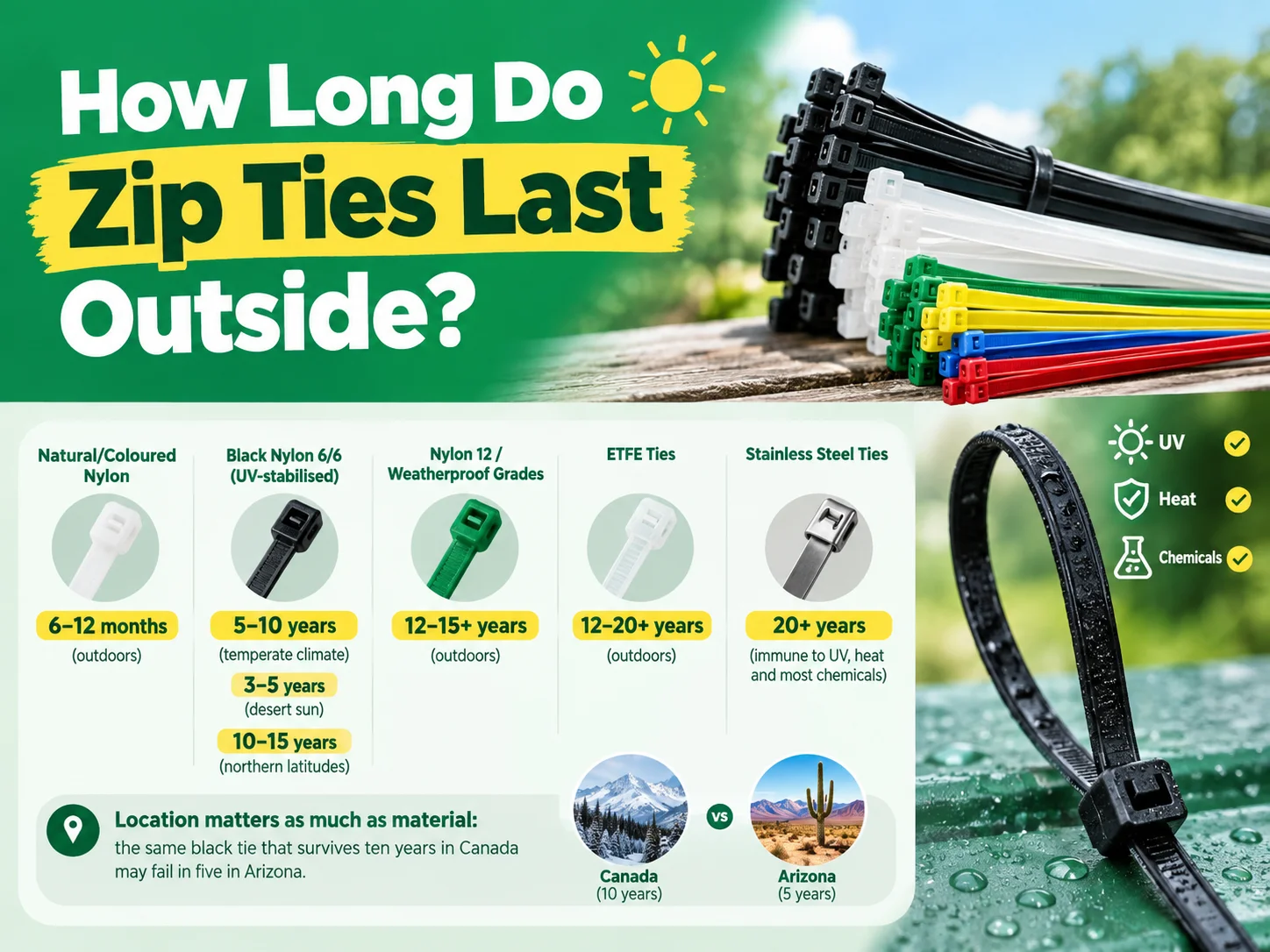
Cable ties are engineered to hold wires, hoses, and hardware, and that is where they perform best. If you are choosing ties for real fastening work, start with our guide to the best zip ties to buy. For jobs where the tie will sit in sun and rain, see how long zip ties last outside. For labeling circuits, identification cable ties are the better fit, and when you need something you can open and close again, look at reusable fastening solutions.
Frequently Asked Questions
Are zip tie handcuffs illegal?
In most regions of the world, including most states in the United States, the possession of nylon restraints is lawful (though certain sellers may limit the purchase of specific police nylon restraints to professionals) but it is illegal for one to apply them on someone else without the required authorization or consent as it would be classified as unlawful restraint, false imprisonment, or kidnapping.
Since laws differ from country to state, one is advised to check the laws in their jurisdictions for specific information rather than relying on someone’s claims.
Why do police use zip ties instead of handcuffs?
Primarily for efficiency and practicality. Steel handcuffs are costly and somewhat heavy which means that the officer can only use them on one or two persons at a time. On the other hand, Nylon restraints are economical and light and therefore can be carried in large quantities thereby becoming a necessity when mass arrests occur, like on protest and demonstration scenes where a number of criminals must be arrested at the same time.
What are zip tie handcuffs called?
The most widely known terms are flex cuffs, plastic handcuffs, plastic cuffs, riot cuffs, and single-use restraints. Depending on the model and area, you may may also encounter terms such as wrist ties, zip cuffs, zip strips, zap straps, or tri-fold cuffs.
Can cable ties be used as handcuffs?
A standard cable tie can tie up wrists although it was not intended for that. Common ties are narrow, increasing the chances of having cut and nerve-damaged wrists, while their heads are not built for protection against interference. Specially designed restraints are broader, heavier, and have smooth edges. Moreover, outside the framework of the law, restraining someone with any devices is a crime.
References
- 1971 May Day protests against the Vietnam War, Wikipedia
- The Most Influential Protest You’ve Never Heard Of: May Day, 1971, Georgetown University Library
- How the ACLU Won the Largest Mass Acquittal in American History, ACLU
- Maurus Logan, National Inventors Hall of Fame
- Cable tie, Wikipedia
- Handcuffs, Wikipedia
- Sales of disposable cuffs booming; S.F. Police Dept. orders 30,000 nylon restraints, SFGate
- A prospective study of handcuff neuropathies, Muscle and Nerve, via PubMed
Conclusion
The story of zip tie handcuffs is really a story about a mismatch between old equipment and a new kind of crowd. When the protest era of the 1960s and early 1970s pushed arrests into the thousands, steel cuffs hit their limits on cost, weight, and noise, and a nylon strap first designed for aircraft wiring stepped in. Today the same one-way locking idea serves police, soldiers, airline crews, and security teams, always in trained hands and always with care for the person being restrained. For everyone else, the cable tie remains what Maurus Logan meant it to be: a fast, strong, dependable way to hold things together. When you need that strength for wiring, hoses, or hardware, explore the full range of nylon cable ties at IGOTO.