



Reusable Fastening Solutions for Temporary Setups
Just because something is temporary doesn’t mean it has to be thrown out. Trade show booths, movie sets, tents, scaffolding, decorations for the holidays, different types of equipment — they all need something that gets the job done in a reliable manner but can also be easily removed without marking the surface or leaving behind a mess. An engineer could design a fix for a permanent solution, but these specific products are made for temporary situations. Here are the five products used for a job like that, as well as how they behave and how much they cost.
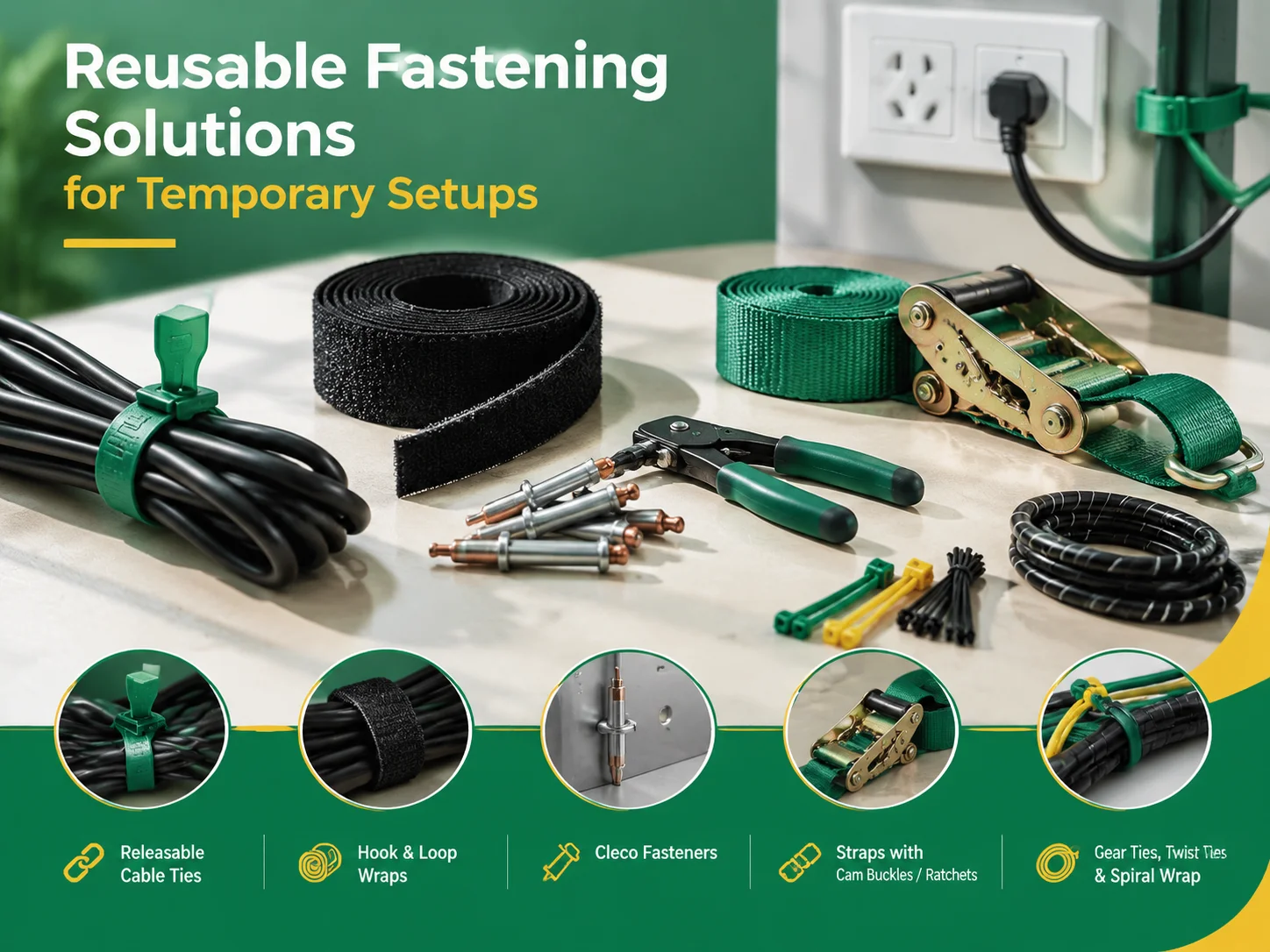
Briefly: During the process of temporary assembly, there are five alternatives that cover almost all cases. Detachable ties (the ties with a release tab) give the highest strength-to-price ratio with a price of $6-15 per 100 that last through many openings and closures. Hook and loop wraps (the ones that are sold in rolls of $8-25 each) are the simplest to apply and the least harmful to cable jackets. Cleco fasteners, temporary rivets used in aviation and sheet metal, are the only method that allows one to clamp materials together by means of a drilled hole at a price of $3-8 (plus the price of special pliers). Cam buckle straps or ratcheting straps are the most efficient means of supporting heavy loads at $5-30 per strap. Lastly, gear ties, twist ties, spiral wraps are methods for completing small everyday tasks at very low prices.
The short answer: five options that actually come apart again
The determining factor for differentiating between a temporary fastening method and a permanent fastening method does not lie in how powerful the fastening method is. Rather, it relies on what happens to the fastener after it is undone for the second, tenth and fiftieth time. A common cable tie is one of the most efficient fastening devices known to man, but it fails the test since once it is cut, it vanishes completely. The following paragraphs discuss how to achieve the same strength of fastening as provided by a cable tie but still keeping the release function intact after the fastener is used for the fiftieth time.
The requirement on reusability excludes many well-known devices from the list. Sticky tape might lose its adhesive properties, and the surface it has been attached to. A split rivet or a blind rivet causes some permanent deformation during installation. Screws are effective, but one needs a screwdriver, a hole and the right material to attach them and they can loosen up due to vibration. This leaves only a brief list of the fastening devices providing tension-based fastening, clamping or cheese fastening with each solution being used when appropriate.
Reusable cable ties
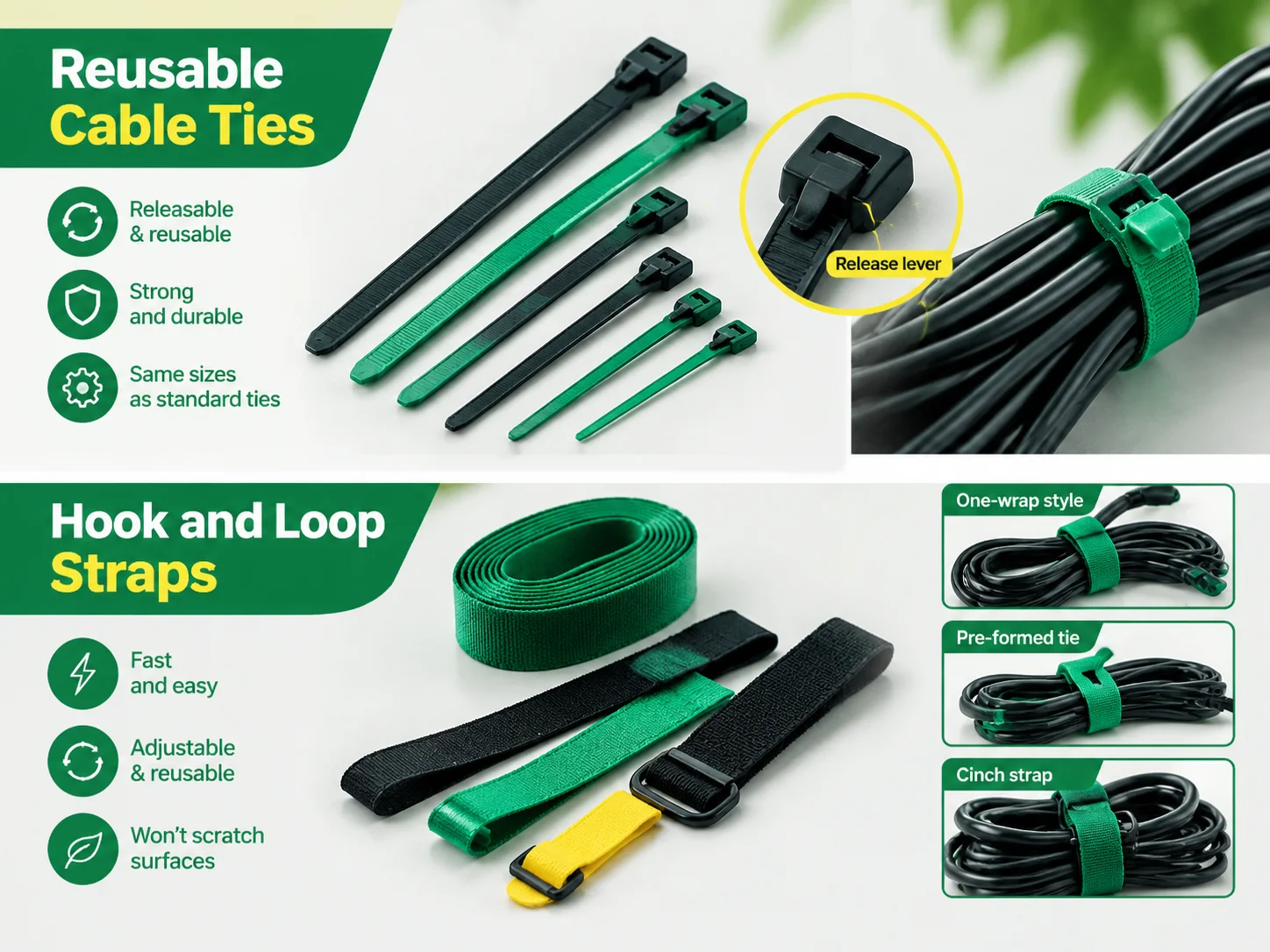
Also referred to as quick-release cable ties or reusable zip ties, these are the clear answer to the major drawback of a standard cable tie. A small lever inside the head releases the lock as it pulls away from the teeth, allowing you to pull the cable tie apart so that it can be reused. This is the main difference, and it also completely changes the way temporary fastening is done.
These quick-release cable ties are made of the same materials and sizes as standard cable ties — they are made of nylon 6/6, and are available in the same lengths (from 100 mm to 760 mm) and widths (2.5 mm to 12 mm) and tensile strength (from 18 lbs to 250 lbs). There are variations of these cable ties that are weather-resistant for outdoor use and heat-resistant for warm weather. Hence, these quick-release cable ties are not suitable for places where there are sharp objects, but if they are to be used for managing cables, these cable ties are the best choice.
The number of reuses that you can get depends on the quality of the locking system and how carefully you release it. They cannot be called infinite because the pawl of the locking system wears out; however, they can be reused several times before they begin to lose grip.And the practical skill that makes them last is removing them properly — prying at a tie with a screwdriver is how the release lever gets broken, and how to remove a cable tie without damaging it is worth five minutes if you’re planning to reuse the same ties all season.
It is worth noting that ball-lock ties and beaded ties are different types of reusable mechanism, in which a bead or ball rolls in a groove and maintains itself by friction. They are not as strong as the releasable cable tie but are inexpensive and can serve well in case of securing soft items light-weight items where flexible adjustment is preferred instead.
Hook and loop wraps and straps
The hook-and-loop fastener (Velcro and even the imitators) is by the far the quickest way to fasten something temporarily. You simply wrap it around the bundle, push it together and that’s it. To release it, just pull it apart, adjust it as necessary, and use it many times, if kept clean. There is no other fastening process that could match its speed in operation.
However, as the saying goes, there are downsides. The fastening strength of hook-and-loop is much lower than the one of the plastic tie—that relies on hook adhesion, which is measured in terms of pounds, rather than dozens of pounds, and greatly decreases when contaminated with various substances. Everything from dust and dirt to adhesive residues and even pet hair can obstruct the hooks, making them useless. And because it can’t be pulled tight (unlike the plastic tie), it can’t be used in any applications where it needs to be taut.
In fact, there are three main versions of hook-and-loop fastening that are the most widely used. One-wrap roll style is the simplest, as it can be cut to necessary length and wrapped around the cable. The advantages are that it is good for binding cables and light rigging. Pre-formed ties consist of the loop and slot, which lets you simply insert one end onto that of the other, thus making the process quick and efficient. The cinch strap has a buckle or D-ring that makes it possible to take advantage of mechanical force, being able to multiply the possible fastening effect three times larger than usual. Hook-and-loop fastening is perfect for everything that requires multiple openings and closures, and being non-scratching is also a big plus.
Cleco fasteners: the temporary rivets
If you have been struggling to recall what temporary rivets are called, the answer is Cleco fasteners, also known as skin pins or sheet holder clamps. This name is a generic trademark of the Cleveland Pneumatic Tool Company, and the spelling of the name varies from Cleco to cleko, depending on who sells it.
Cleco fasteners provide a solution that other options cannot — fastening two or more pieces of material through a hole in an aligned position before welding them permanently. This fastening system is made of a steel cylindrical body, a spring-loaded plunger, and two locking jaws. When using special pliers, the operator presses the plunger, closing the jaws and sliding them through the hole. Once released, the jaws spread and secure the material together. Due to their design, these fasteners can be used in difficult places, and, therefore, they are common for aircraft assembly.
| Type | How it’s operated | Clamping force and use |
|---|---|---|
| Plier-operated (spring) | Special pliers compress the spring | Light clamping, up to about 25 lb — the standard fast, high-volume option |
| Wing-nut | Hand-tightened | Wider grip force range; good for thicker material and low production volumes |
| Hex-nut | Pneumatic or powered tool | High, consistent clamping for production settings |
| Cylindrical body | Power tool, double-lead thread | Removes fastener orientation problems; fast install and removal |
| Side-grip | Pliers, gripping from the sides | For edges and joins where there’s no hole to use |
Sizes are color-coded, which is extremely helpful while in a shop: silver for 3/32 in (2.4 mm), copper for 1/8 in (3.2 mm), black for 5/32 in (4.0 mm), and gold or brass for 3/16 in (4.8 mm). They can be used again and again — that’s the idea behind them as a permanent rivet is lost upon installation and clecos stay as a tool in your workshop or garage. It should be understood that clecos are not sealing fasteners and they cannot serve as final fasteners either. They are for temporary use and when the time comes for the holes where clecos were used to be welded or glued, the technology will be different.
Straps, cam buckles and bungee
When a load is really heavy — tying down a stack of staging, securing a reel of cable on a cart, fastening a light truss to a vehicle — tension becomes the solution, and webbing straps are the mechanical means of applying the same.
Cam buckle straps are a great compromise: quick to apply and quick to release, though with no useful mechanical advantage, they are reliable for loads of several hundred kilograms. With ratchet straps, one will achieve real mechanical advantage, being able to handle much larger loads, but the use will slow down greatly. Rapid overstretching is the way to crush an air duct, bend a panel, or cut through a delicate object. Bungee cords fall into the lowest category: rubber, fast, cheap, but demanding respect, since a streghtened bungee can store energy, and faulty hooks do not gurnatee a predictable release of this energy, A bungee left in the open air during the whole season is guaranteed to break accidentally.
It is advisable to know about a hybrid solution: a rubber-covered wire tie sometimes referred to as a gear tie. Thick metal core covered with rubber allows to shape the wire however needed and use it multiple times.
What the load ratings actually mean
It is misleading to evaluate products based on strength alone as the number mentioned on the packaging is the result of a test. A cable tie that holds up to 50 lb can keep holding that weight only under optimal conditions – it should be brand new, used at the right temperature, wrapped around a suitable bundle, and stretched properly. However, if you consider factors such as UV exposure or a bundle of a small diameter or if the tie is under the constant load for weeks, the same cable tie will not be able to hold 50 lb.
Furthermore, another important distinction is between tensile strength and holding. With cable ties, the method of holding mechanism is mechanical interlocking, and the failure method is clean break — the tie stops holding completely and releases the bundle. At the same time, the hook and loop method relies on friction and peeling, and the failure method for this technology is gradual creep, which means that it starts loosening out instead of releasing all at once. So, if you are doing an installation on heights, you have to consider the difference between the two approaches since it is a safety issue. And for anything where the tie will carry weight rather than simply bundle, it’s worth understanding how the weight ratings on zip ties are actually derived before you choose between a 50 lb and a 120 lb tie.
Temporary setups that live outdoors
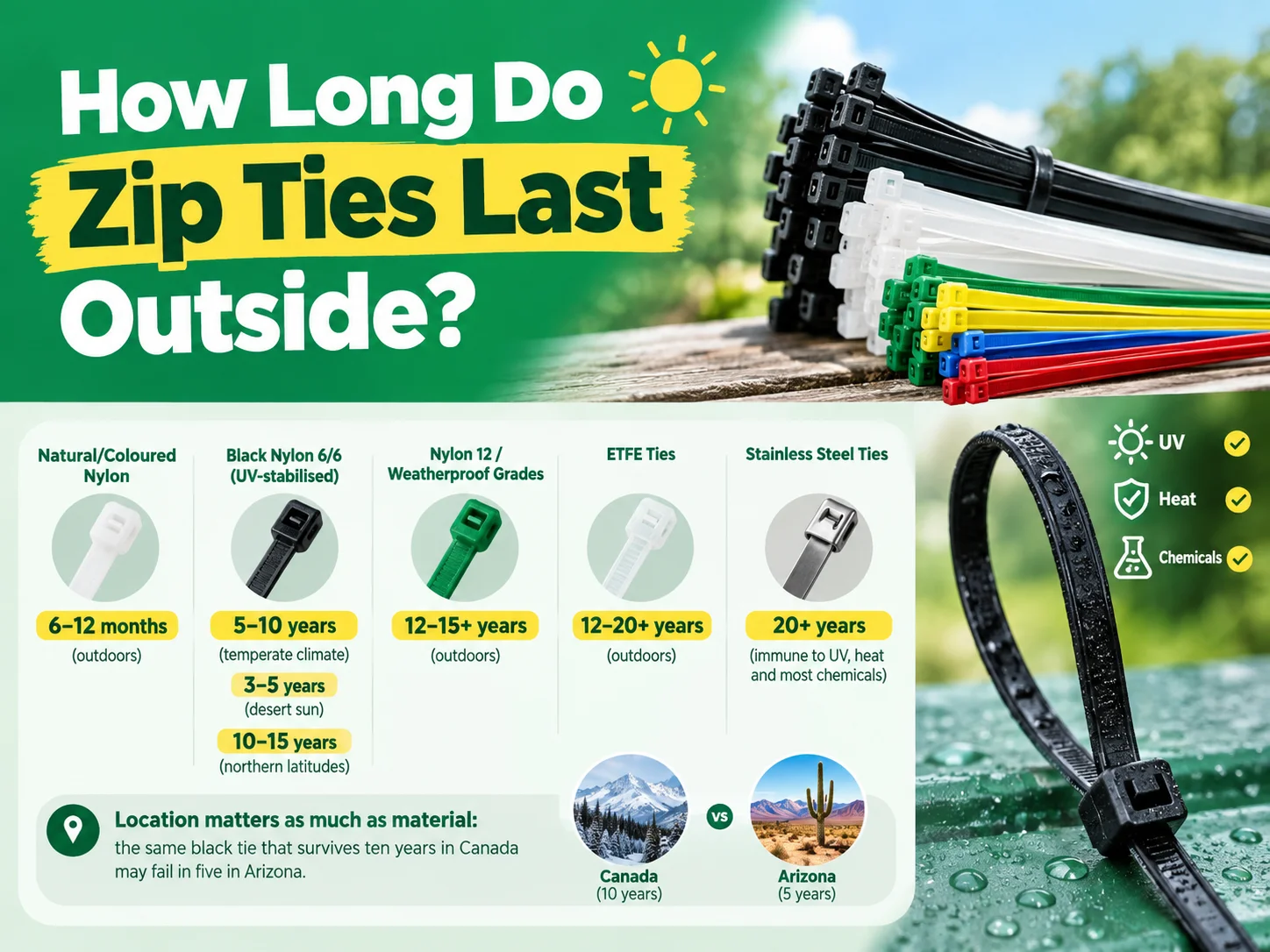
The usage of the term “temporary” can give the impression that it is “for a season,” changing the picture altogether. For example, a black UV-stabilised nylon tie will sustain its strength during a summer of direct sunlight. In contrast, a natural coloured one will become brittle and break after just several months of use. The hook-and-loop material will eventually experience similar degradation, as UV light degrades the fibers and both moisture and dust destroy its functionality. Thus, hook and loop is for one season only, regardless of the price.
Unfortunately, bungee cords and cheap polypropylene straps are some of the worst offenders, as both suffer from visible degradation under UV light and lose strength well before any visible signs appear.If it is required that a temporary installation survive British winters or Australian summers, the choices narrow to UV-stabilized nylon ties, stainless steel ties where permanence is needed, and galvanized or stainless steel hardware on the straps.How long a plastic tie really lasts in the sun is a more nuanced question than the packaging suggests, and the honest ranges by material and climate are set out in whether zip ties are UV resistant.
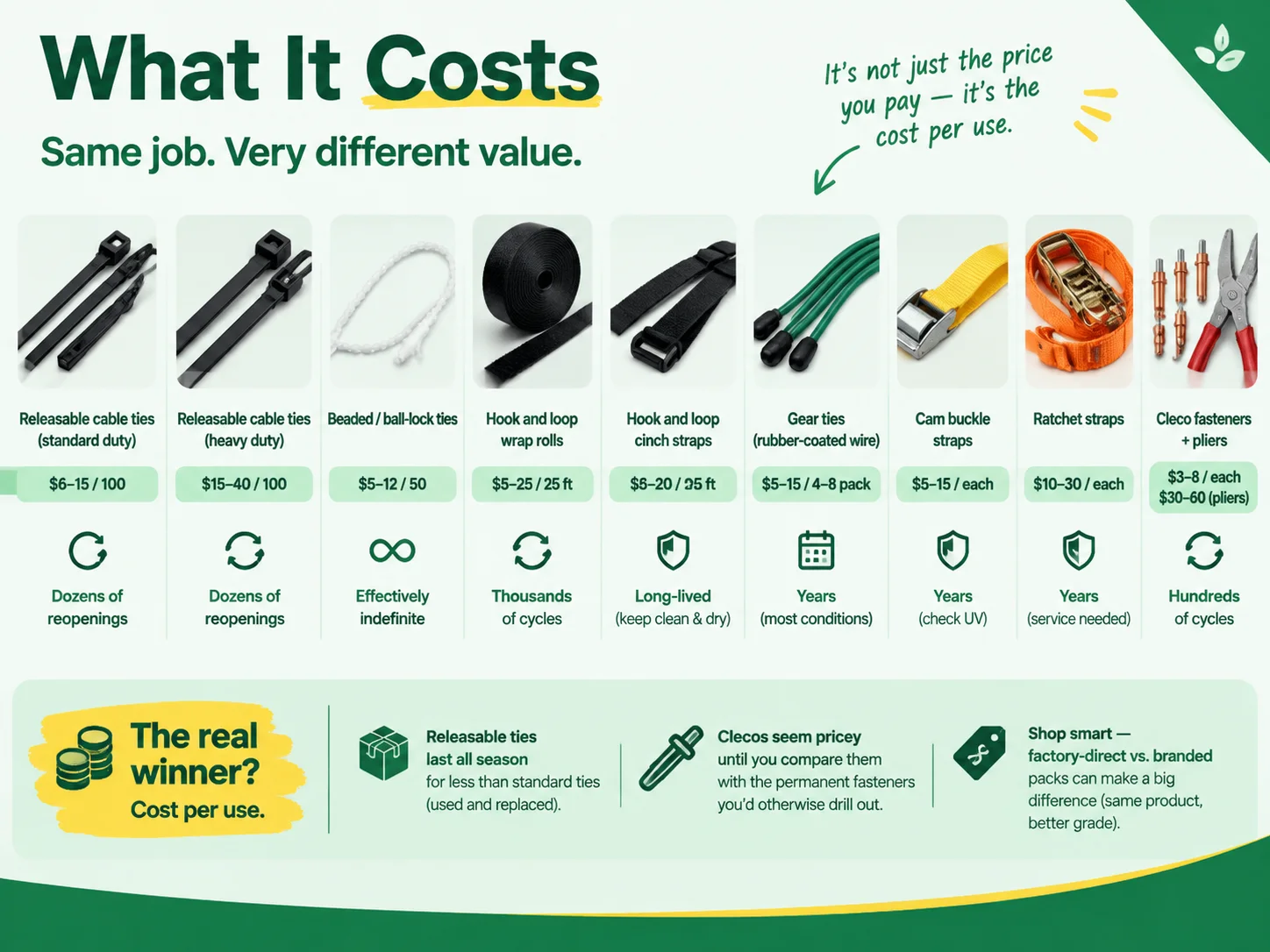
What it costs
The report shares typical prices in US dollars, as this marketing segmentation has a bearing on the presentation as well as the distribution.
| Solution | Typical cost | Reuse profile |
|---|---|---|
| Releasable cable ties, standard duty | $6-15 per 100 | Dozens of reopenings before the pawl slips |
| Releasable cable ties, heavy duty | $15-40 per 100 | Same, with thicker strap and head |
| Beaded or ball-lock ties | $5-12 per 50 | Effectively indefinite; low holding force |
| Hook and loop wrap rolls | $8-25 per 25 ft roll | Thousands of cycles indoors; one season outdoors |
| Hook and loop cinch straps | $5-20 each | Long-lived if kept clean and dry |
| Gear ties (rubber-coated wire) | $5-15 for a pack of 4-8 | Years, in most conditions |
| Cam buckle straps | $5-15 each | Years; check webbing for UV damage |
| Ratchet straps | $10-30 each | Years; mechanism needs occasional servicing |
| Cleco fasteners | $3-8 each; pliers $30-60 | Hundreds of cycles — the tool, not the consumable |
Price per usage turns out to be the key figure here, making a difference in the assessment of the products. An example that demonstrates this is a box of releasable ties, which will cost less than regular ties, which must be cut and changed three times during the season. A set of clecos is going to look expensive until we compare their price with that of permanent fasteners we would prefer over clecos! And as with any fastening product, the price spread between a factory-direct supplier and a branded retail pack is wide enough to fund the upgrade to a better grade of the same product — which is the same arithmetic that shows up in the price of nylon plastic ties across the size range.
How to choose the right solution
- Count the number of cycles: one-time use or with repeated use. A simple tie works better for a one-time need, while ties that can be opened once a week is definitely a job for releasable configurations, whether it be some type of tape or hook and loop depending on the load.
- Determine if you need tensioning or contacting tie. Tensioning (e.g., cable ties, straps) means binding stuff together using force. Contacting, (i.e., hook and loop) is meant for the soft, adjustable bonding with no or low weight.
- Check the surface. Hook and loop require a flat working surface and is capable of gripping almost anything including paint, while straps usually require a point, and clecos a hole.
- Match the material to the environment and not to your budget. Outdoor environment for at least one season means UV-proof or metallic ties and nothing else.
- What about failure mode? Will it matter for you? If tie is overhead, over a people, or any costly objects, you might want to choose the method that will let go completely instead of loosening gradually, which could cause certain damages.
- Keep using two or three sizes. The best benefit of a temporary arrangement comes not from product itself, but from not having to search for the right length while having flashlight in your hands, and it could happen at 11p.m.Sizing is systematic once you know the conventions, and choosing the right cable tie for a given bundle is a two-minute calculation rather than a guess.
A further note about reliability since that is the issue that truly matters to people. Thus, the most trustworthy solution does not necessarily mean that the strongest one; in fact, the most suitable solution is the one that matches the frequency of its opening, the environment of operation, and the user. For instance, if you have a bulky strap that takes you four minutes and a special tool to open it, then after the third attempt you would probably cut it off. The economy of reusability is evident in cases when the mode of release is faster than the alternative mode of release, which is why a reliable release-tab cable tie is so commonly used. Popular producers produce UV-stabilized releases and sizes for manufacturing purposes, thereby providing the customers with top-quality producing materials at a lower price.
FAQ
What are the different types of temporary fasteners?
In a general sense, there are five types of families to keep in mind. Releasable (or reusable) cable ties work with a locking pawl that uses a release tab for closure. Beaded and ball-lock ties work by means of friction allowing an inner core to lock in place through a channel. Hook and loop wraps and straps use surface interaction for locking in place. Cleco fasteners are spring or thread-clamped temporary rivets employed in sheet metal and composite assembly. Tension straps are bungee, cam buckle or ratchet-based devices. Most temporary works depend on one of the listed types, sometimes in conjunction with each other.
What are the best reusable zip ties?
The detachable ones featuring a suitable release lever instead of a tab you have to pry open with an instrument. Search for nylon 6/6 as opposed to nylon 6, a stated tensile strength as opposed to a marketing term, and UV stabilization if it is going to be outside for longer than a few weeks. A black UV-stabilized releasable tie with a weight capacity of 50-120 lb can cater for most applications. Heavy-duty tasks require the 250 lb version, whereas exposure to chemicals and high temperatures necessitates the use of stainless steel instead of plastics.
What are temporary rivets called?
Cleco fasteners, spelled as cleko and also referred to as skin pins or sheet holder clamps, are temporary blind fasteners that expand behind the workpiece and secure the material stacks by means of a pre-drilled hole before making the permanent joints with riveting, welding, or bonding. Some types of cleco fasteners are better suited for specific tasks; there are spring types operated with pliers suitable for speed and light clamping, wing-and hex-nut types for firm gripping, and side-gripping fasteners for edges without holes.
What can be used for fastening?
For temporary uses: releasable ties in the form of cable ties, as well as hook and loop wraps, beaded ties, gear ties, bungees, and webbing straps. If there are any panels or any hard components in use, then either clecos or clamps. In case of permanent use, the list changes completely and consists of standard ties, stainless steel ties, screws, bolts, rivets, adhesives, and welding. The mistake that one must avoid is using a permanent fix to do a temporary job, as the costs associated with dismounting effort would usually surpass the costs of a reusable product in the first place.
References
- ASTM International — ASTM D6775: Standard Test Method for Breaking Strength and Elongation of Textile Webbing
- ASTM International — ASTM G154: Standard Practice for Operating Fluorescent Ultraviolet Lamp Apparatus for Exposure of Materials
- ISO — ISO 4892-3: Plastics — Methods of Exposure to Laboratory Light Sources
- OSHA — 29 CFR 1910 Subpart N: Materials Handling and Storage (Load Securing)
- Omega Technologies — Cleco Temporary Fastener Types and Specifications
Conclusion
Temporary fastening has emerged as a distinct field of its own, and all solutions that work efficiently share a characteristic: the ease of opening and closing of the same fastening device repeatedly with the same efficiency on each occasion. Among the existing solutions, releasable cable ties tend to offer the best value for strength and are widely used for fastening wires and bundles. Hook and loop is an ideal fastening solution in terms of speed and gentleness in situations where the load is light, but the equipment costly. Clecos provide the only viable solution when panels have to be aligned and clamped through a hole. Straps are used to fasten heavy loads, while relatively cheap fastening devices such as gear ties, twist ties, and spiral wrap can be used to do minor fixing and save you a lot of trouble. Choose the fastening mechanism based on the type of load and surrounding conditions, choose the right material considering climatic conditions, and standardize the sizes to prevent people from searching through boxes in the middle of the night.