



Cable Tie 300mm Price: A Buyer’s Guide to Cost and Value
When one of the procurement managers for an electrical wholesale chain asks for the price quote of 100,000 cable ties that are made of black UV stabilised material and are 300mm in length, the price to be charged per piece is not simply one figure. The figure is not the same for all as it depends on the raw materials, tensile strength, number of glue sticks to be purchased and also the supplier involved. The cost of retailing a packet of 100 nylon ties is just a few dollars. On the other hand, the cost of purchasing 100,000 rubber ties through a B2B supply channel is priced differently. The manager of procurement who has knowledge of the factors affecting the price and how much an item of that nature costs from each material and quality is equipped to follow a straightforward approach while undertaking the procurement decision.
What Does a 300mm Cable Tie Cost?
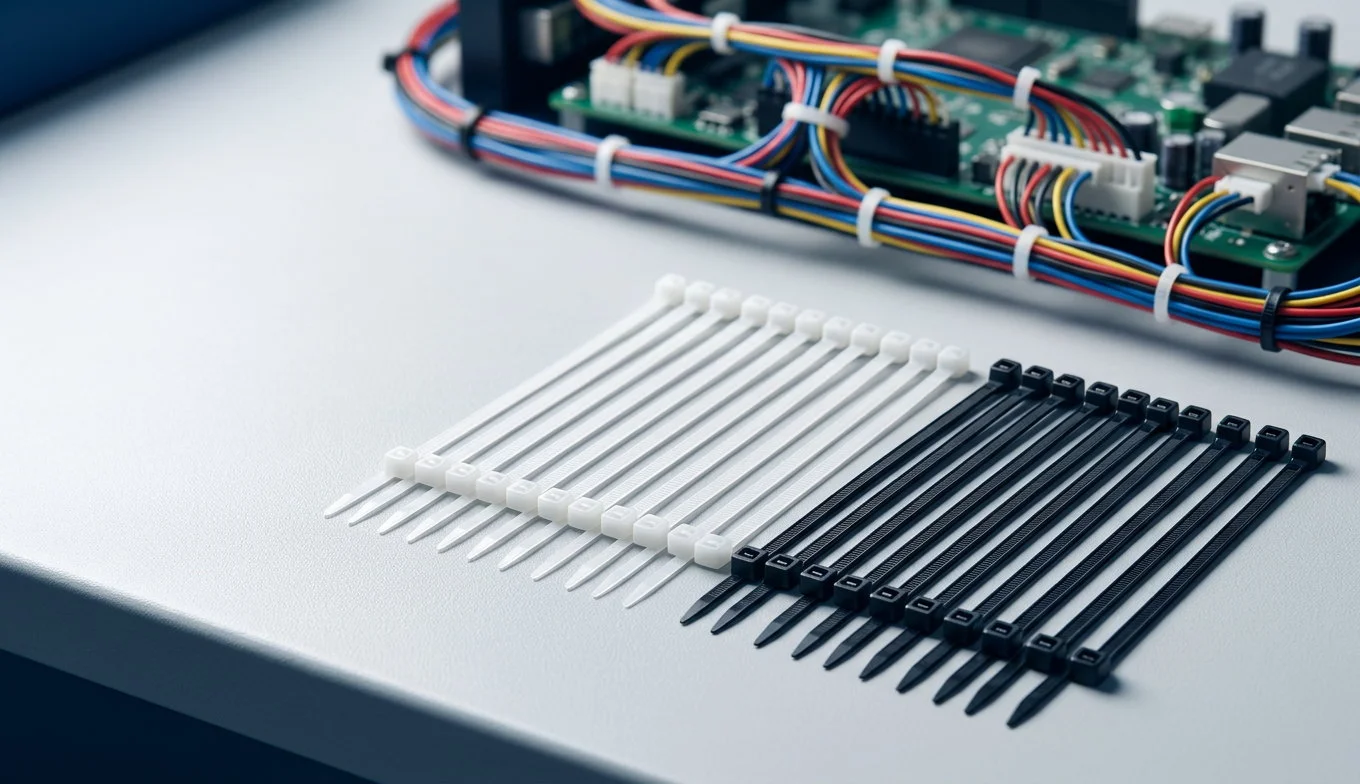
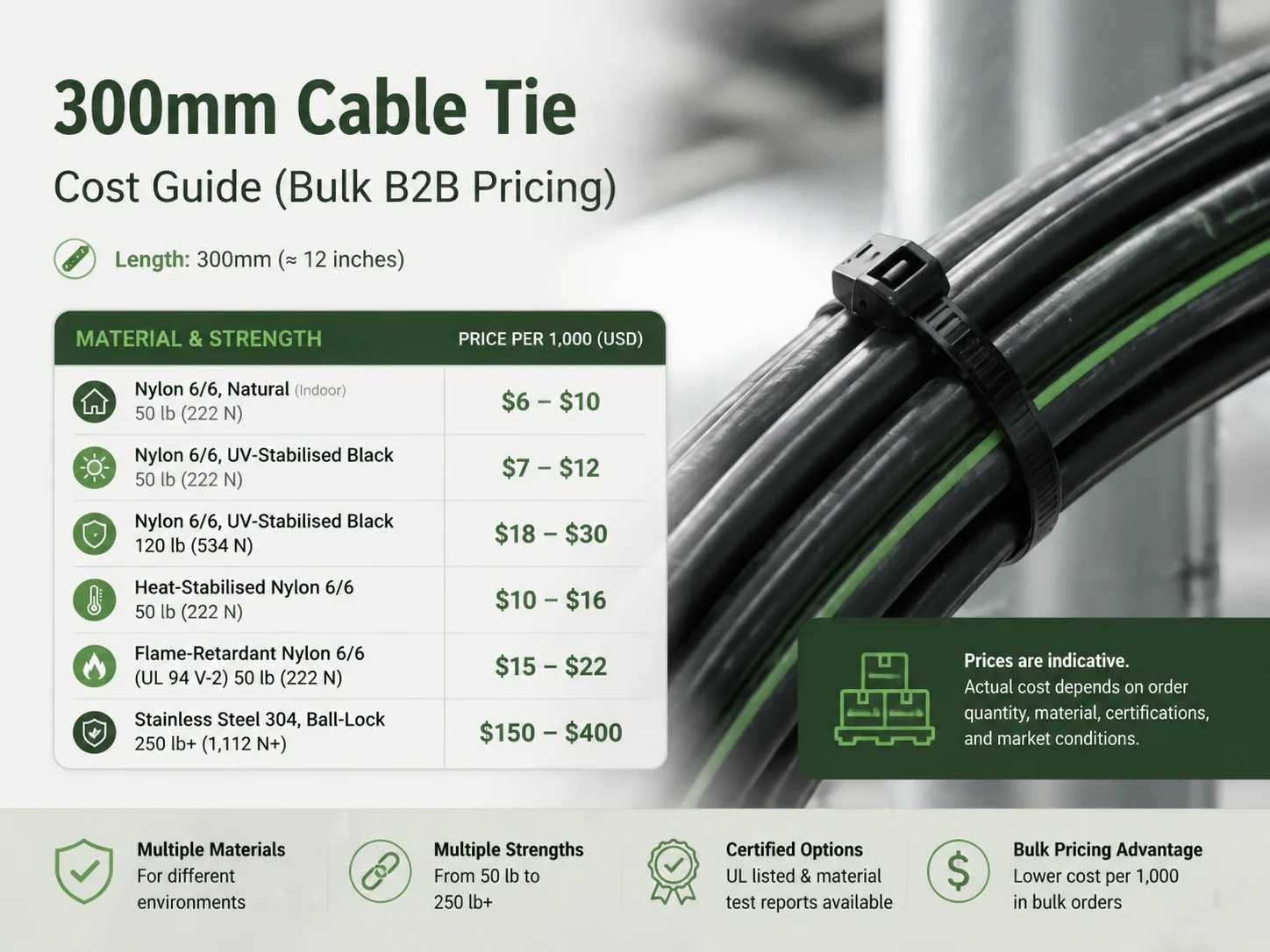
Among various lengths, the 300mm cable tie is one of the most popular ones in the fields of industrial and electrical installation. This length is long enough to cover multiple armoured cables, conduits, or pipes of large diameters. Moreover, there are a variety of materials and tensile strengths available for this type of product. The pricing for 300mm cable ties has been presented in the table provided below, including categories such as strength and material type. For context on how length relates to strength and application, our guide on cable tie sizes explains the full dimensional range.
| Material | Tensile Strength | Width (Approx.) | Price per 1,000 (Bulk B2B, USD) | Price per 100 (Retail, USD) |
|---|---|---|---|---|
| Nylon 6/6, Natural (Indoor) | 50 lb (222 N) | 3.6 mm | $6 – $10 | $3 – $6 |
| Nylon 6/6, UV‑Stabilised Black | 50 lb (222 N) | 3.6 mm | $7 – $12 | $4 – $7 |
| Nylon 6/6, UV‑Stabilised Black | 120 lb (534 N) | 7.6 mm | $18 – $30 | $8 – $14 |
| Heat‑Stabilised Nylon 6/6 | 50 lb (222 N) | 3.6 mm | $10 – $16 | $5 – $9 |
| Flame‑Retardant Nylon 6/6 (UL 94 V‑2) | 50 lb (222 N) | 3.6 mm | $15 – $22 | $8 – $12 |
| Stainless Steel 304, Ball‑Lock | 250 lb+ (1,112 N+) | 4.6–7.9 mm | $150 – $400 | $20 – $50 per 100 |
These are indicative ranges. The actual price depends on the order quantity, the supplier’s manufacturing location, the raw material cost at the time of order (nylon resin prices fluctuate with petrochemical markets), and the level of certification required. A tie that carries a UL listing and a full material test report will cost more than one that does not, and the price difference reflects the cost of that independent verification. For the outdoor and UV‑resistant options specifically, our article on why UV‑protected cable ties matter outdoors explains the material costs and performance trade‑offs.
Price by Brand and Supplier Type
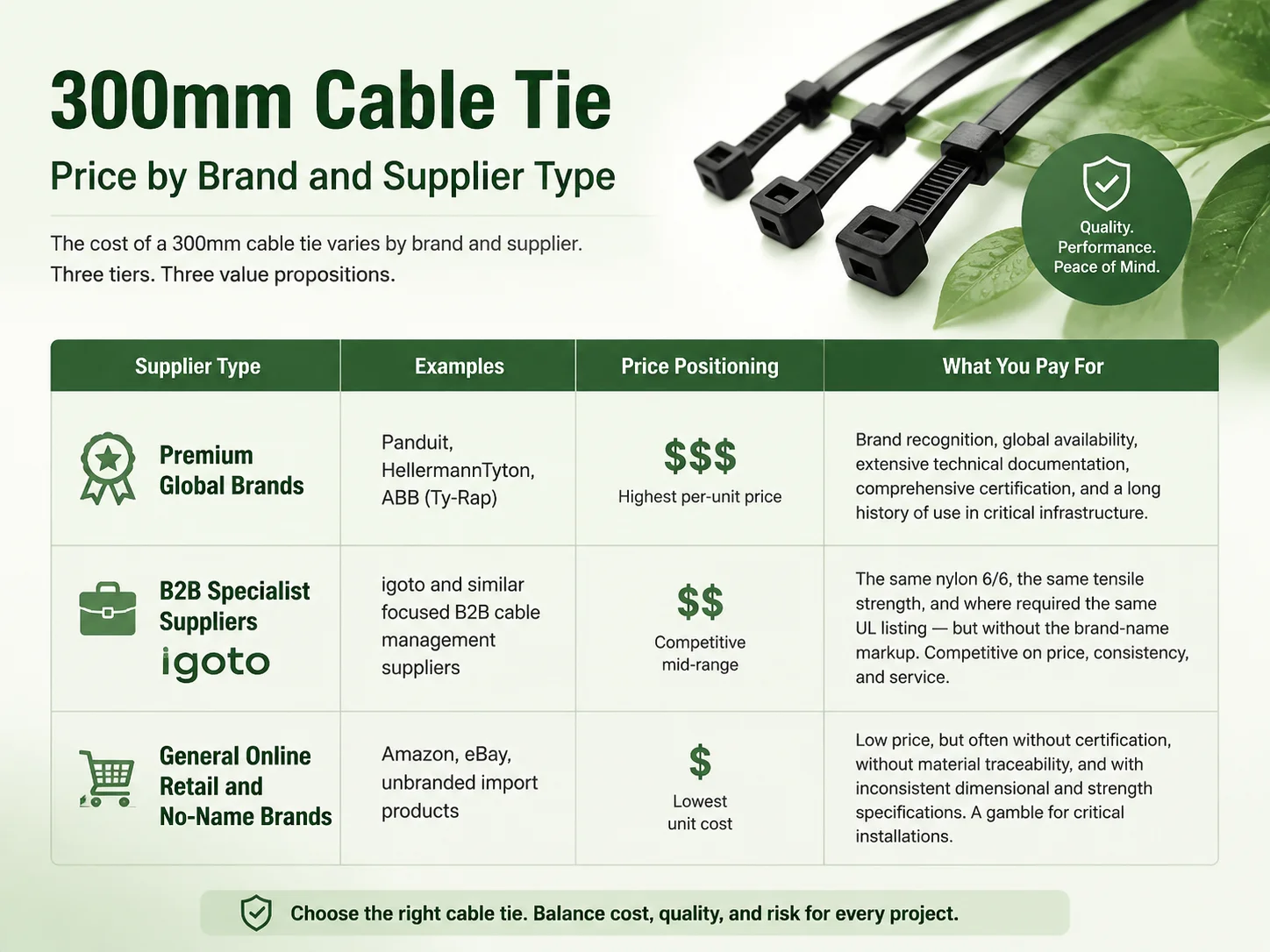
The cost of a 300mm cable tie also varies by who is selling it and under what brand. The market divides broadly into three tiers, and the price reflects the value proposition of each.
| Supplier Type | Examples | Price Positioning | What You Pay For |
|---|---|---|---|
| Premium Global Brands | Panduit, HellermannTyton, ABB (Ty‑Rap) | Highest per‑unit price | Brand recognition, global availability, extensive technical documentation, comprehensive certification, and a long history of use in critical infrastructure. A Panduit 300mm, 50‑lb UV tie may cost 30–50% more than an equivalent from a generic manufacturer, but it comes with the assurance of a name that an inspector or a specifier will recognise. |
| B2B Specialist Suppliers | igoto and similar focused B2B cable management suppliers | Competitive mid‑range | The same nylon 6/6, the same tensile strength, and where required the same UL listing — but without the brand‑name markup. A focused supplier competes on price, consistency, and service, not on a brand premium. For a buyer ordering 50,000 ties for a solar farm or an OEM production line, the cost difference between a premium brand and a B2B supplier like igoto can be significant over the life of the project. |
| General Online Retail and No‑Name Brands | Amazon, eBay, unbranded import products | Lowest unit cost | Low price, but often without certification, without material traceability, and with inconsistent dimensional and strength specifications. A tie that is labelled “50‑pound” may break at 30. A tie that looks black may have no UV stabiliser. For a critical installation, this tier is a gamble. For a non‑critical, temporary, or light‑duty task, it may be sufficient. |
How Price Scales with Quantity
The cost of the cable ties decreased significantly with the level of purchase because buying them in bulk lowers the price per item. When buying them in a retail store, a person pays more because the bag does not only cover the price of the ties but also the cost of logistics. The cost of purchasing the same ties from a business to business supplier on a carton of 1,000 ties is a lot cheaper than purchasing in retail. The price goes down further from a pallet of 100,000 ties, which costs less than one cent for Nylon cable ties.
Frequently Asked Questions
What is the cost of cable tie 300mm?
A 300mm cable tie can be priced scrap different buying volumes. Various producers manufacture different cable tie costs too. 300mm black UV-stabilised nylon cable ties are priced at $0.006 to $0.02 each if bought in bulk. Prices may go as high as $0.30 to $0.80 per piece for 300mm stainless steel tie in wholesale volumes. Buying 300mm cable ties per piece in retail packs makes rates unnecessarily much higher per item.
How much do cable ties cost?
Cable ties The costs can vary between less than half a dollar per unit for bulk 4-inch natural nylon ties, and several dollars for bulk purchases of large-format high-strength stainless steel materials. The prices may be affected by factors like the type of material, the manufacturer’s specifications on money spent per unit, and the degree of certification required.
What is the price of 500 mm cable tie?
A standard black UV-stabilized nylon, 500mm cable tie having a tensile strength of 50 lbs would cost between $10 to $18 per one thousand pieces when bought in bulk. In comparison, the price for a heavy duty version with a tensile strength of 120 lbs would be around $25 to $45 per one thousand pieces. Stainless steel cable ties having the same length, meanwhile, cost much more, in the range of $0.50 to $1.50 each in wholesale purchase.
What is the price of 450 mm cable tie?
The length of a cable tie measuring 450mm (18 inches) is between the length of 300mm and 500mm long. In the case of standard black UV stabilised nylon, the cost used is simultaneous to the prices of bulk cable ties in the country. Three elements affect the price of even cable ties with a tensile strength of 50-lb and this is not an exception. The factors that affect pricing include tensile strength, material, quantity of cable ties purchased and logistics involved in getting them from suppliers.
How to Get the Best Price on Cable Ties
When it comes to professional buyers, obtaining the ideal cable tie at the most suitable price translates to ensuring that the specification fits the required purpose as well as the order volume matches that of the supplier.
- Buy the material the job requires, not the cheapest option. An all-natural nylon tie will most likely fail within a year in outdoor use. The least costly tie of a complete tie set will become costly upon breakage.
- Buy in bulk where storage and cash flow permit. Purchasing 300 mm black UV ties for an entire year in one transaction offers a more attractive pricing option than making twelve transactions over the course of the year to receive smaller amounts of the product.
- Request a quote from a B2B supplier, not just a retail store. In general, igoto and similar suppliers’ pricing model reflects any volume discounts that may affect contractor prices since pricing is based on suppliers’ cost structure.
- Verify the certification before comparing price. A UL-listed tie with a Material Test Report is different from a non-UL listed tie. It is vital that the quotation you compare have the same specifications.
References
- Panduit — Cable Tie Product Range and Pricing — Global manufacturer of premium nylon and stainless steel cable ties.
- HellermannTyton — Cable Management Products — International supplier of cable ties, tools, and identification solutions.
- ABB (Thomas & Betts) — Ty‑Rap Cable Ties — Manufacturer of the original Ty‑Rap cable tie and a full range of fastening solutions.
- Thomasnet — Cable Tie Suppliers and Pricing — Industrial sourcing platform with supplier listings and specification data for commercial and industrial buyers.
The cost of a 300mm cable tie is in cents, but the cost of mistakes with it — a faulty tie, a drooping installation or outdoor use that would be affected by UV light — comes in the form of work that had to be redone, downtime and security problems caused by whatever equipment it failed to secure. In other words, for the electrician, solar contractor and buyer, the best choice of a tie is the product that complies with strict specifications and is able to maintain its integrity throughout the project.