


Green Zip Ties for Sapling Support and Reforestation
In the northern deserts and windswept plains of China, a forest that could be considered small for a country is still on its way to being built. The Great Green Wall, also known as the Three-North Shelterbelt Project, has planted approximately 66 billion tress since it began in 1978 and aims to finish its commitment by 2050. All the trees have one thing in common: they all start their lives as a fragile little sapling – and the first year is crucial for its survival. This first year is called the establishment phase of a young tree’s life because this is where the little tree becomes anchored in the ground or dies. It is during this phase that lowly materials such as green zip ties come into play. The aim of this article is to find out how temporary fasteners help saplings during the establishment process, to use the example of the Three-North Shelterbelt, as well as other significant afforestation projects, and tell how to choose and use green zip ties for planting trees without harming them.
The Great Green Wall Begins One Sapling at a Time
The Three-North Shelterbelt Program stands as the planet’s longest continuous reforestation project. Covering about 42 percent of the territory of the country, it is implemented across 13 provinces and autonomous regions in the northeast, northwest, and north-central parts of China. One of the planned functions of the project is to stop the movement of the Gobi and Taklamakan deserts. For more than forty years of its existence, the forest cover in the area of the program has grown from five percent in 1977 to almost 14 percent currently, which also means that significant areas of previously degraded grasslands have all been brought back under control.
All these figures, naturally, do not give the whole picture. It is evident that the strength of a shelterbelt depends on the strength of individual trees planted in the area. In the case of semi-arid and arid lands the newly planted tree has to cope with the sandy soil, strong winds, high temperature, and lack of rainfall. A large number of young tree die before they mature. The most important juncture in the development of a tree or shrub during its life period called establishment is the getting through its first year of growth. Temporary solutions and sustainment are different forms of providing the young tree with the necessary support during its growth process.
Why the Establishment Phase Decides Everything
Both arborists and university extension services agree on an unexpected fact: most newly planted trees thrive when they are allowed to sway. A gentle wind moving a young trunk makes the cambium and root hairs thicken and spread, allowing the tree to achieve an improved trunk shape and a better root system. A seedling that is firmly held by a stake cannot sway and thus has a frail and thin trunk, which might snap as soon as the support is removed.
So, when using temporary supports, we don’t aim at immobilizing the tree. The purpose is to prevent the roots from getting loose while letting the trunk sway. This technique becomes useful, and sometimes even necessary, in a few situations that represent the planting conditions in the Three-North region quite well. These are as follows:
The root system is very small compared to the trunk and crown.
The trunk bends excessively or fails to become upright after planting.
The location is wind-prone and trees would easily be uprooted before getting established.
The soil is loose or sandy and does not grip the root ball too well.
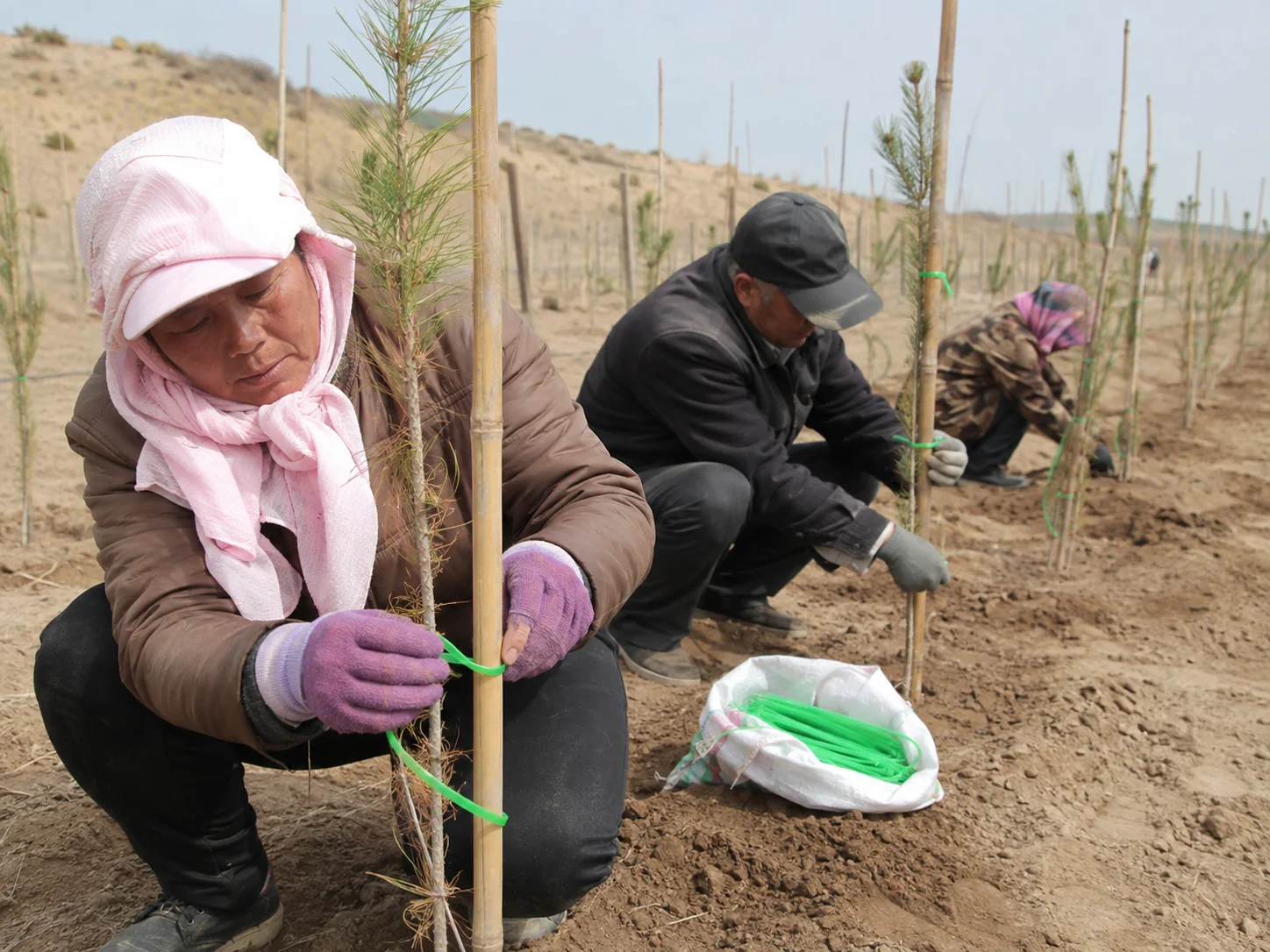
The method used here follows the “let it sway” principle. Stakes are put into the ground outside the root ball, and a soft tie is placed low on the trunk. The tie should be crossed in a loose figure-eight way to allow the trunk to sway within an inch or two. The tie should not be put too high or too tight since both approaches defeat the purpose of the method.
Where Green Zip Ties Fit in the New-Forest Construction Phase
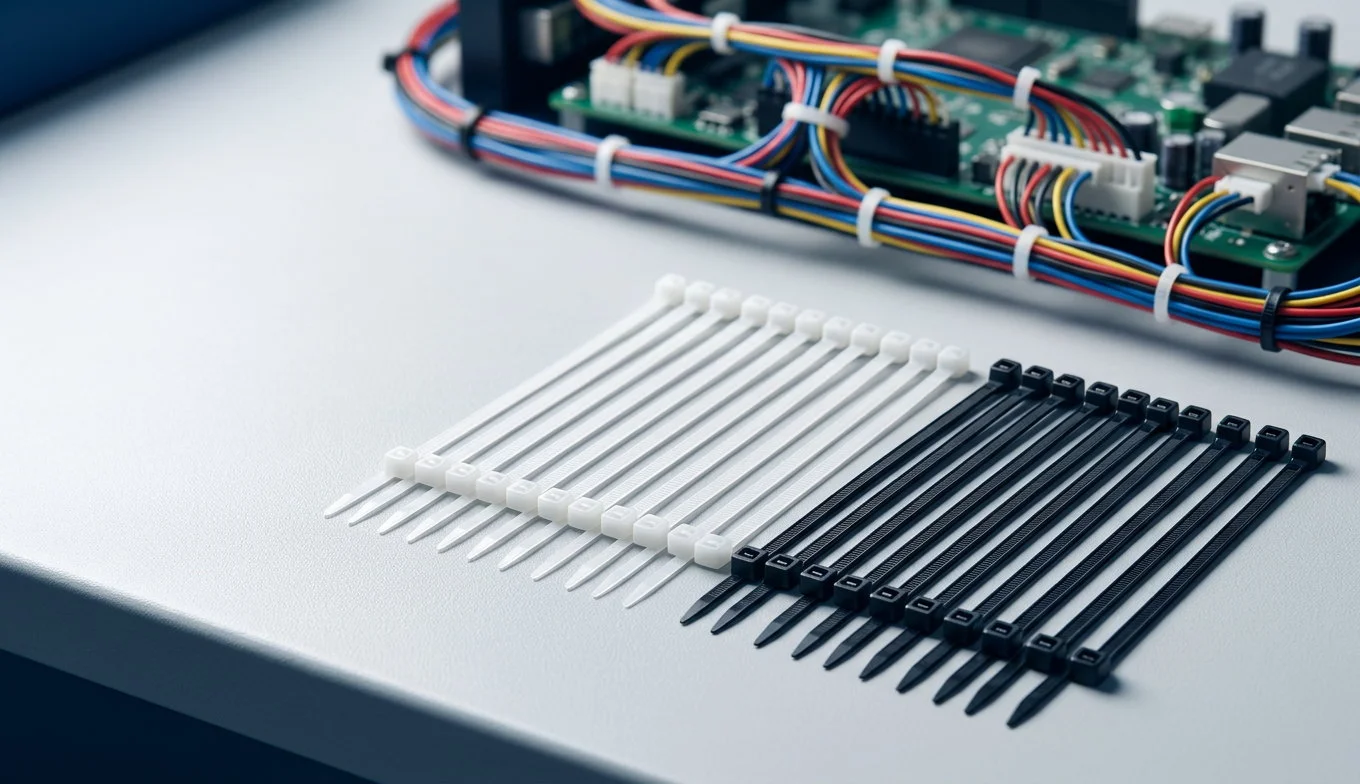
A cable tie is not an uncommon product in the horticultural world, yet its functionality, fastening speed, and low cost prove to be extremely useful when working on a large plant planting site. When several thousand trees are planted each day, anything which can be put to use in seconds single-handedly acquires real worth. The green option has one other quality that is useful in forests and surroundings: color. The green strap looks much better against the trees than the bright white or fluorescent counterparts making the process of planting appear seamless and clean. The blending feature explains the popularity of green zip ties in horticulture, landscaping, and camouflage.
At the stage of planting a new forest, temporary fixtures are employed for a number of tasks:
– Securing a sapling to a stake or bamboo stick. A loose tie allows for fastening the small trunk without the need to tie a knot of twine manually.
– Attaching tree shelters, mesh guards, and spiral protectors. Weather-resistant ties ensure that the plastic guards or shelters are kept in their place with the help of stakes, protecting the sapling from wind, animals and pesticide sprays.
– Grouping drip lines and irrigation pipes. In dry planting areas, temporary irrigation can be run along the row of saplings leaving nothing on the ground.
– Securing shade nets and windbreak fabric. Light nets protect fragile new leaves from sun and sand for the first time.
– Marking colors and signifying batches. A green tie can become a flag informing about the type of species, the particular date of planting, or the particular nursery batch.
Releasable and non-releasable versions each have a role. A non-releasable tie is fine for a shelter that will stay put for a season, while a releasable green zip tie is better for anything you expect to loosen, reposition, or remove — which, on a trunk, is almost always. For a fuller look at where this color earns its keep, our guide to green zip ties and their uses walks through horticultural, decorative, and concealment applications in more detail.
Deciding to put a cable tie around growing bark and then forgetting about it is a mistake, as it can restrict the growth of a tree. If a tie is going to be in contact with the tree trunk for more than one growing season, use a tie that can be released as the tree grows or make sure the tie is removed before it starts to damage the tree. Never assume the tie is permanent once done.
Temporary Means Temporary: The Removal Rule
The biggest mistake in supporting trees is not selecting the wrong type of fastening method but rather keeping it for too long. According to the growing period, characterized by six to twelve months period, most young trees will anchor themselves sufficiently. Otherwise, the tree will become dependent on the various stake support systems used and the trunk will remain weak. As a result, any fastening element connected to the trunk will begin working against it. In particular, a rigid fastening strap which used to fit loosenly, in the process of the trunk growing, will begin girdling and strangling the tree which would lead to its death long after it seems to be grown enough.
This is the reason disciplined projects treat the whole process of fastening and removing supports as two parts of the same procedure. Fastenings are checked every month, loosened every time trunk grows, and removed as soon as young sapling is able to survive on its own. In such a way, all people working at the project and making a program like Three-North Shelterbelt can distinguish between a normal windbreak and strangled tree trunks. The photo below shows the second part of the process started above: after the roots of the young sapling have been established properly, the workers come back to the site and remove fastening devices from the trunk of the tree.
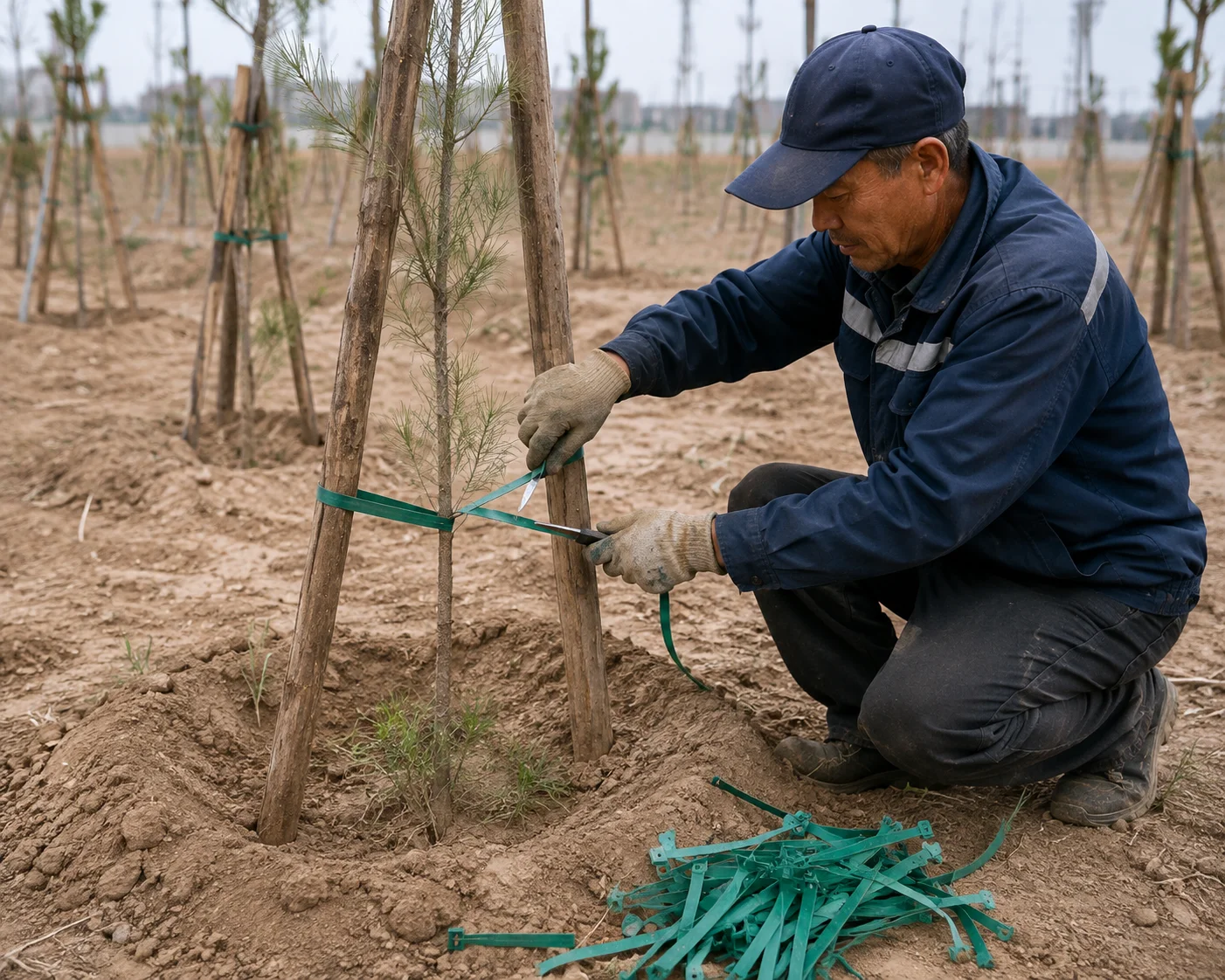
As removability is an important factor in best practices, releasable green zip ties are worth mentioning when it comes to tree work. These ties allow the crew to loosen the straps during their monthly inspections rather than needing to cut them off and replace them. This provides multiple benefits by saving materials and time, as well as eliminating the accidental cuts on the tree bark due to the blade. If the planting plan calls for some sort of support that will require a change over time, the releasable ties are the right option.
UV Resistance: The Spec That Decides How Long a Tie Lasts
Most outdoor planting projects make a mistake here. People usually think that ties designed for use in gardens would be suitable for outdoor use, however, the color reveals nothing about the strength of the ties when exposed to the sun. Green nylon ties are dyed for aesthetic reasons, and not for reliability in terms of blocking UV light. Direct sunlight makes the unprotected nylon tie become brittle and break in a matter of months. The only pigment that shines through when it comes to durability is carbon black, which explains the popularity of black outdoor ties equipped for long life in outdoor conditions.
For temporary sapling support that will be removed within a single season, a standard green zip tie is often perfectly adequate — it only has to survive a few months, and its job ends when the tie comes off. But if a tie must hold a shelter or guard through more than one year of sun, you need a genuinely UV resistant green zip tie made from UV-stabilized nylon, or you should switch to a black UV-rated tie for that part of the job. Matching the tie’s lifespan to the task is a small decision that prevents a lot of failed fixings. If you want to understand exactly how weathering works, our explainer on whether zip ties are UV resistant and the companion piece on whether white zip ties are UV resistant cover the physical tests and specification checks that separate a true outdoor tie from an indoor one.
It is now clear that green color does not provide any protection from UV rays. If your temporary support is expected to be in a continuous sunshine for more than one season – be it a tree shelter, a windbreaker or an irrigation run – you need to use either a green nylon tie that has been stabilized from UV rays or choose a tie in black that is resistant to UV rays. A green tie that is colored usually becomes more brittle if subjected to full sun during one season.
Learning from Other Successful Green Projects Around the World
The Three-North Shelterbelt is by no means the only project that hinges on the care of saplings during their first year of life. Lessons can be learned from other successful projects around the world.
Africa’s Great Green Wall launched in 2007 under the African Union, completed two or three projects by ensuring that a strip of land of 8 thousand kilometers recovering about 100 million hectares. For Africa, the hardest lesson learnt is survival. In the Sahel, the survival rate of the trees planted is about 20 percent, which means that it is not enough to plant a tree for it to survive. In the dry conditions of the Sahel, protection from animals as well as choosing the right species for the right location is vital and continuous monitoring is a prerequisite for a sapling to grow into a strong tree. It has been observed that where saplings are carefully fenced off from animals, they flourish; where they don’t, they simply die.
History of these countries shows the same thing. The US Great Plains Shelterbelt was started in the 1930s to cope with Dust Bowl, while the Soviet Union started its Great Plan for the Transformation of Nature and failure teaches us that trees will unlikely survive without proper care and planning. China seems to be outlasting these projects partially because it has been combining tree planting projects with continuous maintenance which means that plants are not being treated as purely saplings from the moment of planting.
Tree supports are one of the devastating elements of the larger picture; they are arguably as significant as the trees themselves in this regard. For each tree planted, every tree stake received or watering line established – each successful operation is a step towards success and durability.
How to Choose Green Zip Ties for Sapling Support
Choosing the proper ties for planting comes down to a few aspects:
Length and width. Depending on the task, ties come in 200 mm or 300 mm long pieces, having a 4.8 mm width which is suitable for most canes, stakes, and shelters. Wider ties provide for better load distribution and thus are less damaging to any tree species in comparison to narrow ties.
Load-bearing capacity. For lighter materials like whips and small nets, lighter nylon ties weighing around 18 lb (8 kg) can be used, while heavier materials like shrubs, large shelters, or areas with high winds require heavier ties weighing around 40 lb (18 kg).
Realizability. If anything comes in contact with trunks, green realizable cable ties should be used which allows loosening without cutting the ties.
UV protection. Choose the ties according to their use. If ties are meant for only one season, ordinary ties can be used, while multiple season ties should be UV protected.
Tree protection. If the tie is contacting with the bark, use some kind of soft tube or cloth collar to allow the load not to affect the tree.
When used properly, nylon cable ties provide individuals with a fast, hassle-free, inexpensive way to help the sapling survive at the very beginning after planting.
Frequently Asked Questions
Are green zip ties safe to use on young trees?
Yes, when they are used correctly. Fasten the tie loosely so the trunk can still flex, place it low on the stem, and never let a strap bear directly on bark for long periods. Use a soft sleeve or collar at the contact point and remove the tie within one growing season, and a green zip tie is a safe, practical support fixing.
How long should a zip tie stay on a sapling?
Generally no longer than one growing season, or six to twelve months. Most saplings anchor themselves within that time. Leaving a tie on longer risks girdling the trunk as it thickens and can leave the tree weak and stake-dependent. Check ties monthly and remove them as soon as the tree stands on its own.
Are green zip ties UV resistant?
Not automatically. Green color comes from pigment, which offers no ultraviolet protection. A standard green tie may become brittle within months in direct sun. For multi-season outdoor use, choose a UV-resistant green zip tie made from UV-stabilized nylon, or use a black UV-rated tie.
What size green zip ties are best for tree staking?
For most saplings, a 200–300 mm length in a 4.8 mm width works well. Choose lighter ties for young whips and light netting, and stronger ties for larger shelters or windy, exposed sites. Wider straps are gentler on bark than narrow ones.
Can a zip tie damage a tree?
It can, if it is left on too long or fastened too tightly. As a trunk grows, a rigid strap digs in and girdles the bark, cutting off water and nutrient flow. This is entirely preventable: tie loosely, pad the contact point, check monthly, and remove on schedule.
At IGOTO Group, we manufacture nylon cable ties in a full range of colors, sizes, and UV-stabilized grades — including green zip ties suited to horticulture, landscaping, and large-scale afforestation work. Whether you need releasable ties for gentle sapling support or black UV-rated ties for multi-season outdoor fixings, our factory-direct pricing and custom options help planting projects of every size fasten smarter. Contact IGOTO Group to source the right tie for your next greening project.
References
- University of Minnesota Extension — Staking and Guying Trees
- University of California ANR, Master Gardeners — Supporting Your Young Tree
- University of Hawaiʻi CTAHR — Staking and Guying Newly Planted Trees (PDF)
- Food and Agriculture Organization of the United Nations — Afforestation Techniques in the Three-North Region
- National Geographic Education — The Great Green Wall