




How to Choose Mountable Cable Ties
In situations when certain wires require being firmly held in position, the ordinary zip tie comes in handy only in part. Its ability to hold wires together does not solve the problem of keeping the bundle against a wall, a panel, or a machine case. This is when mountable cable ties perform their task. Being a combination of a fastening loop and a mounting device, one mountable tie can perform two functions of tying cables and keeping them in place on the surface.
This article explains how mountable cable ties operate, their types and materials, and how to choose the right tie for you. If you are interested in the definition of a mountable cable tie, please refer to the article devoted to it before reading more about selection.
What separates a mountable tie from a standard zip tie
A typical zip tie comprises a loop with a fastening system. It can help bundle cables together but allows them to fall off, glide, or swing about. This might be useful for short-term purposes but leads to problems when there is a need for organizing cables and limiting their movements.
In contrast, a mountable cable tie is provided with an additional part and thus is more than just a tool for bundling wires – it is a cable tie with a broken point, which may be formed or attached to the head of the cable tie. The presence of a broken point gives the possibility of locking the cable to a stationary surface and therefore receiving the bundle that is secured for use. In practical terms, this means that instead of going through the cable routing stage each time, one can fix the cable in one definite spot after that. Those who install cables in cabinets, machines, and on walls appreciate the difference between the normal bundle and a secured one.
The main types of mountable cable ties
The category includes different mounting techniques or mechanisms, which apply to various surfaces and loads, and whether you want to remove your tie later or not.
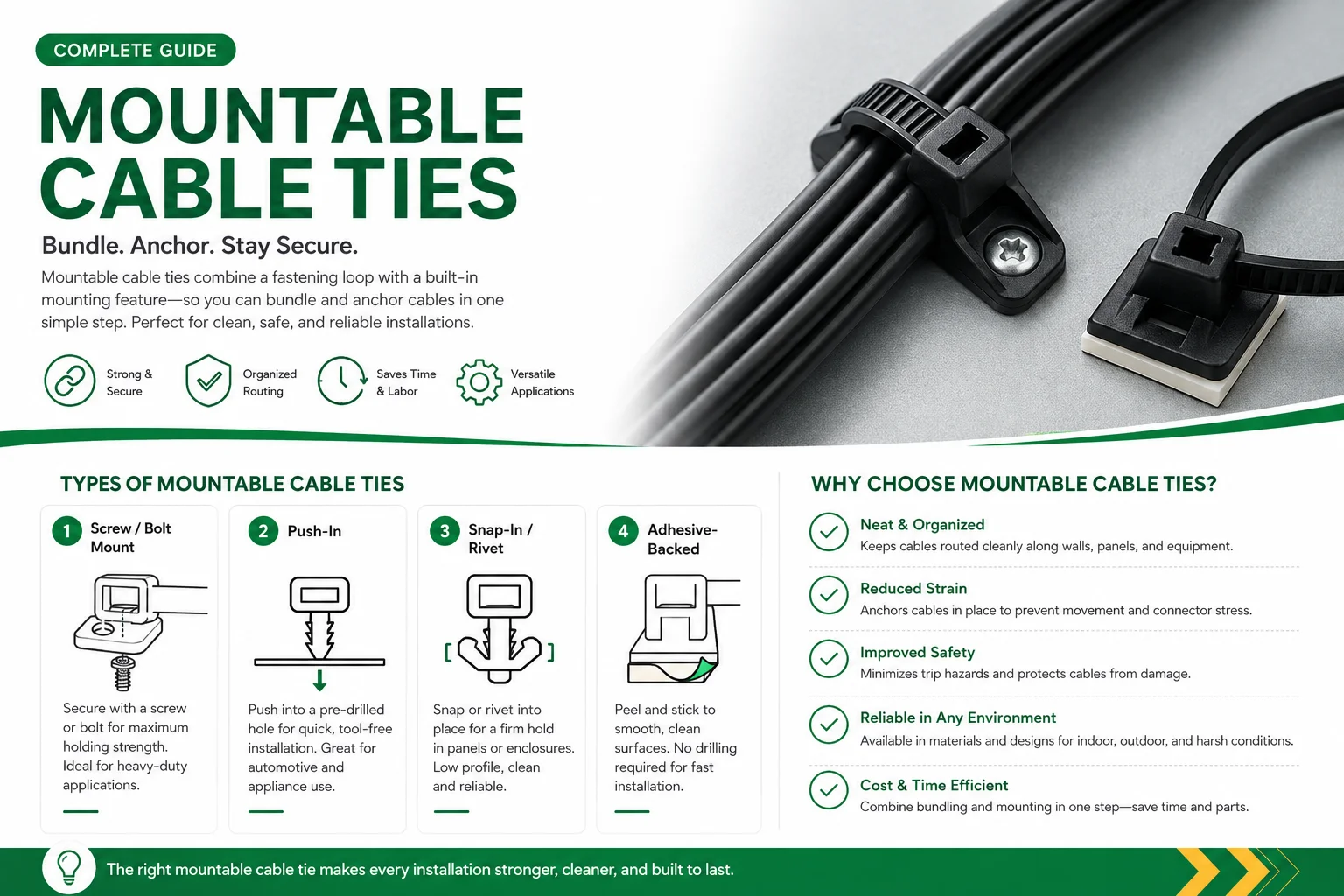
Screw mount and bolt mount ties
The most recognizable feature of this type of anchor is its round shape with a hole in the top. The screw or bolt then goes through this hole and into the mounting surface, followed by the cable tie being put around the bundle and tightened. The mechanical nature of the anchor makes it a reliable and enduring option that can endure a lot of loads. This type of anchor is used for mounting various elements from the panel and rack to the machine and outdoor setups that require working equipment.
Push-in (fir-tree) mount ties
A head includes a pointy shape or a fir-tree-shaped pin. In addition, it is pushed into a pre-drilled hole made in either a plastic or sheet metal material. The barbs will grip the inside of the hole and thus will keep the tie in its place without needing any additional fastener. The push-in connectors are very quick in terms of installation processes and thus are widely used at many auto wiring assembly plants and in all appliance manufacturing lines. Many types of push-in connectors can also be removed and reused.
Snap-in and rivet mount ties
Snap-in mounts are inserted into a receiver, and rivet mounts are installed using a rivet made of expanding plastic that is placed into a place that is hard to reach. These mounts are similar as they provide a secure non-removable connection that does not need any tools for installation.
Adhesive-backed mount ties
This option has a durable self-sticking base. As soon as you take the backing off and press it onto the clean surface, it sticks with no need for drilling. These mounts are ideal for flat surfaces indoors where drilling is to be avoided — desk surfaces, cupboards, finished walls etc. However, adhesive mounts do not work well if they are not installed at the right temperature and in oil-free conditions.
One-piece versus two-piece systems
Decisions need to be made not only on what type of zip tie to use but also on the type of mechanism. For instance, using one-piece mountable zip ties, in which both the mount and the tie piece are created out of one piece of molded plastic, allows for easy use and fewer number of constituent parts.
In the two-piece mechanism, the mounting piece has to be put in place first. First comes the attachment of the mount to the surface using adhesive or the clutch screw. After that, once the mount is secured, the zip tie can be pushed into it and adjusted in length and distance between the mounts.
Materials and ratings that actually matter
The majority of mountable cable ties are made from nylon 6/6 (PA66), which is the same synthetic polymer used throughout the entire manufacturing process of these cable ties, owing to its excellent characteristics in terms of resistance to strain and flexibility properties. A few factors determine how long useful a specific cable tie will last in its respective use.
Ultraviolet radiation is one of the critical factors outdoors. Ordinary nylon is sensitive to decomposition under open sunlight, therefore for any application taking place outdoors, on rooftops, or being solar-based you want to have black colored UV stabilized nylon, which is the standard benchmark of weather resistance in the industry.Our overview of whether white zip ties are UV resistant explains why color and additives, not the plastic alone, decide outdoor life.
The range of temperature is important next. Typical nylon 6/6 ties are rated between -40°F and 185°F (or -40°C to 85 °C). However, heat-stabilized types are also available for applications in more extreme conditions. To determine how close to electrical enclosures a tie can be used, you should check its flammability rating. The UL 94 V-2 rating means the tie is self-extinguishing. In cases when plastic cannot be used because of corrosion, salinity or extreme temperature, stainless steel ties or mounts should be chosen (grade 316 should be used in marine and coastal applications).
Quality of materials should not be treated as a mere specification. Ties made of virgin nylon 6/6 can have a loop strength equal or slightly higher than required. But cheap reground nylon ties may look the same but have poor quality. If you are going to make a bulk order, it is a good idea to read our guide on how to recognize good quality nylon ties.
How to choose the right mountable cable tie
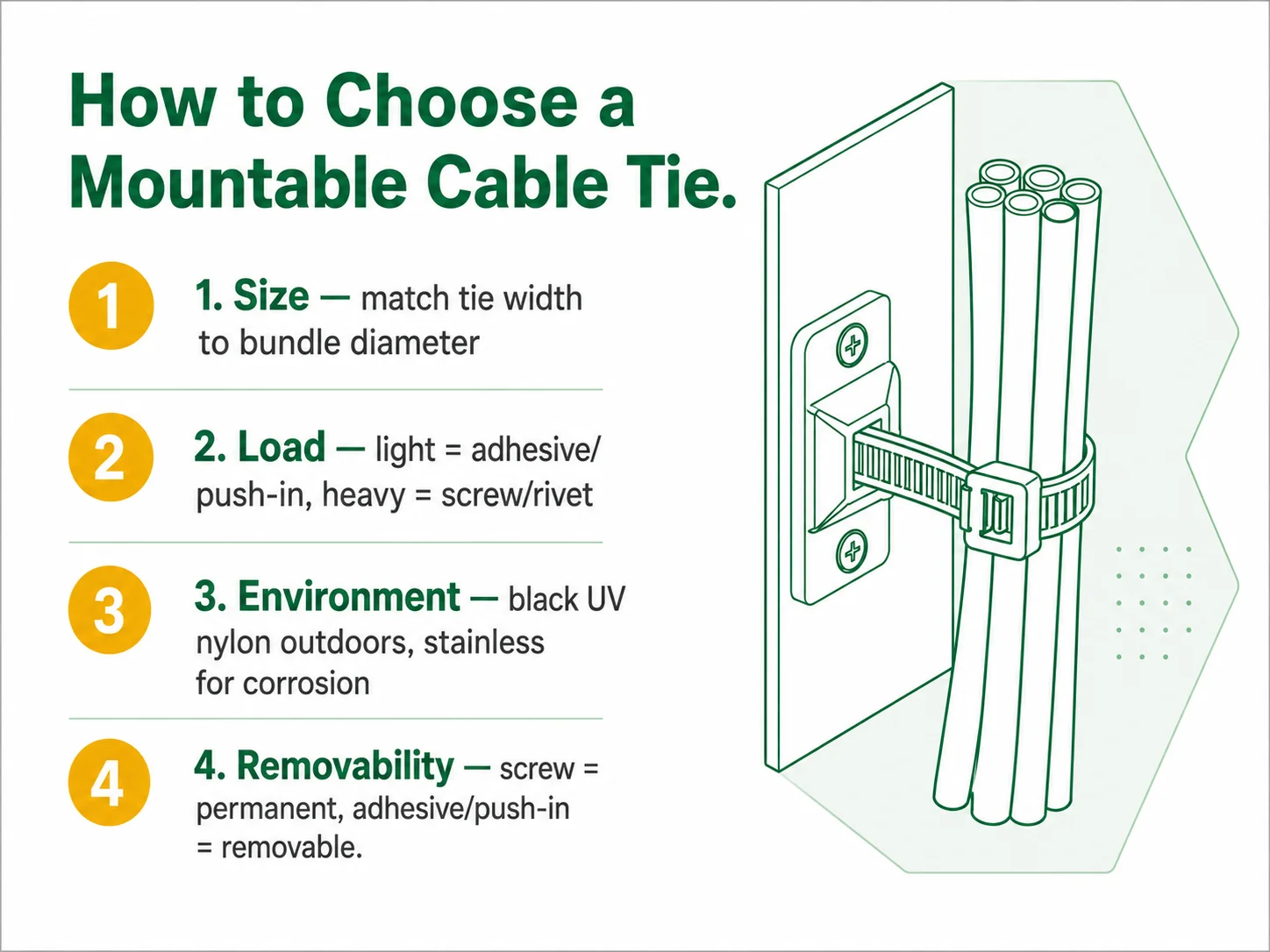
The process of selection has four steps: establishing the size of the bundle, knowing the type of load should be supported, knowing the type of environment where the load has to be placed, and establishing whether there is a need for deinstallation later.
First thing to be taken into account is matching the size of the tie to the size of the bundle. Since IGOTO ties vary in size from 2.5mm to 9mm, the tie range can accommodate several applications, from thin signal wires to thick multi-core ones. It’s important to check the maximum size of the bundle to ensure that it does not exceed the limits of the selected type of the tie. When it comes to a structured approach to the selection, you can use our cable tie selection guide to address certain lengths, widths, materials, and strengths.
The second stage is to determine the weight of the bundle. Lightweight indoor bundles can easily be attached either with adhesive mounts or using the push-in mode of installation. For the heavy bundles, mechanical anchors are required, thus screw mount cable ties and heavy-duty ties are to be used. Our heavy duty zip ties can provide the numbers for the case.
The next thing to take into consideration is whether the mount will be used outside, i.e. be exposed to sunlight or any boiling stuff. In that case it should not be adhesive. Use a mount made of UV stabilized nylon with the application of either rivet or screw fastening and select a mount made of stainless steel instead when it comes to marine applications.
As a final point, it is worth mentioning the possibility of deinstallation of cable mounts. Even though screw and rivet mounted solutions are more applicable for permanent application of the mounts, adhesive and push-in installations make it feasible to deinstall or relocate it. In case you would like the zip tie itself to be installed and uninstalled, use a removable mount and the reusable zip tie.
Where mountable cable ties are used
Mountable ties have become known in many areas of our life due to their ability to handle the global problem of maintaining cable bundles in a fixed position. For example, in the electrical and networking industries, they deal with security of the cables on walls, cabinets, and server racks instead of letting them lie on the floor. In the automotive and machinery industries, ties help to secure those cables to be vibrated while push-in mounts and screw mounts are applied during the assembly phase and installation phase respectively. In the same way, black UV-mountable ties are utilized in the solar installation wiring outside.
Installation tips for a hold that lasts
The mount’s quality largely relies on how it is installed. A few key aspects set apart the mount that works for few years and the mount that will break down sooner than you expect.
For screw mounts, you need to verify that the screw is appropriate for the surface you work with. Make sure you drill pilot holes for the screws and that they are flush with the surface so that the screw does not lift the plastic. When installing pin or rivet mounts, a hole has to be the exact size of the stud you are using. If the hole is oversized, the barbs will not latch; if the hole is smaller, the mount will fail to fit properly. In the case of adhesive mounts, the surface must be dry and clean initially and pressed firmly for a while, after which the adhesive can start to dry. Do not attempt to install adhesive mounts in case of oily, dirty, and wrinkly surfaces.
Remember not to over-tighten tie fastening mounts since otherwise you be easy to break them. If the bundle cannot be held even after tightening the tie, this means the mount is weak rather than there is a need to pull the tie device harder. It is better to switch to mechanical anchoring than tightening the loop too much which may end in damaging the electrical tape.
When installing the mounts, do not forget to place them evenly apart so that the weight is distributed evenly and to place extra mounts in areas where the bundle bends.
Sourcing mountable cable ties from IGOTO
IGOTO (Zhejiang IGOTO Electric Co., Ltd.) has been producing nylon cable ties for more than 25 years. The company solely manufactures its products using the high-quality virgin PA66 raw material, plus they have 18 fully automated production lines in the factory. All their products meet the UL, CE, RoHS, and ISO 9001 quality standards. The various types of nylon cable ties manufactured include small, medium, standard, strengthened, UV-protected, and flame-retardant.
The benefits of working with IGOTO can only be appreciated by the buyers themselves. Among all the advantages, there are the excellent tensile characteristics during the production of all nylon cable tie batches made, as well as information on UV and flame resistance.You can explore the full cable tie product range and request samples or a quotation with your size, material, and quantity requirements.
Frequently asked questions
Are mountable cable ties reusable?
That depends on what kind of mounts you have and whether the ties are of the releasable variety. An adhesive or push-in mount can be used over and over again – and if used with a releasable tie effectively removed and reassembled. On the other hand, screws and rivets will firmly hold, meaning there is no option to get rid of them and use them again in the same way.
Can mountable cable ties be used outdoors?
If the right material is used. Black UV-stabilized nylon is the least acceptable material for sunlight and weather exposure, while stainless steel mounts and connections are preferable in marine and corrosive conditions. Natural nylon and adhesive mounts are limited to indoor use.
What size mountable cable tie do I need?
When it comes to tie widths, they must match bundles’ diameters as per IGOTO. The range of widths is between 2.5mm and 9mm. If the bundle in question is sagging or heavy, it might be wiser to use mechanical screws and/or rivets placed on the top of a larger diameter adhesive pad.
Do I need to drill holes to install them?
However, this does not always apply; mechanical mounts such as screw mounts, push-in mounts, and rivet mounts require drilling a hole, whereas adhesive mounts stick directly to a smooth surface and do not require such process. If you cannot create the holes, use adhesive mounts. However, if the application requires a stronger connection, you may use mechanical mounts.
What is the difference between a one-piece and a two-piece mountable tie?
A single strap connects the hill with the ring in one quick, low count process. In contrast, the two-part configuration fastens a different base to the surface, then passes the common strap through, giving the user flexible tie distances and lengths.
Bottom line
The mountable cable ties serve their purpose if keeping a group not only tied together but fixed as well. Select the appropriate mounting device according to the load and characteristics of the surface on which the cable tie is going to be installed, choose stainless steel or black polyethylene materials according to the corrosive nature of the environment, find out the optimal size, and fix the mount properly.