



Most Durable Heavy Duty Zip Ties for Outdoor Use
Both black ties are from the same warehouse and both are rated 50 lb. One of the ties is still used for carrying conduit these past six summers on roofs in Arizona. While the other tie broke after fourteen months because of its age and brittleness.The only difference in these ties is not their static load but rather the type of nylon used in the tie, the type of stabilizer used, and the fact whether the manufacturer tested the tie for durability in lab or simply printed “UV.”
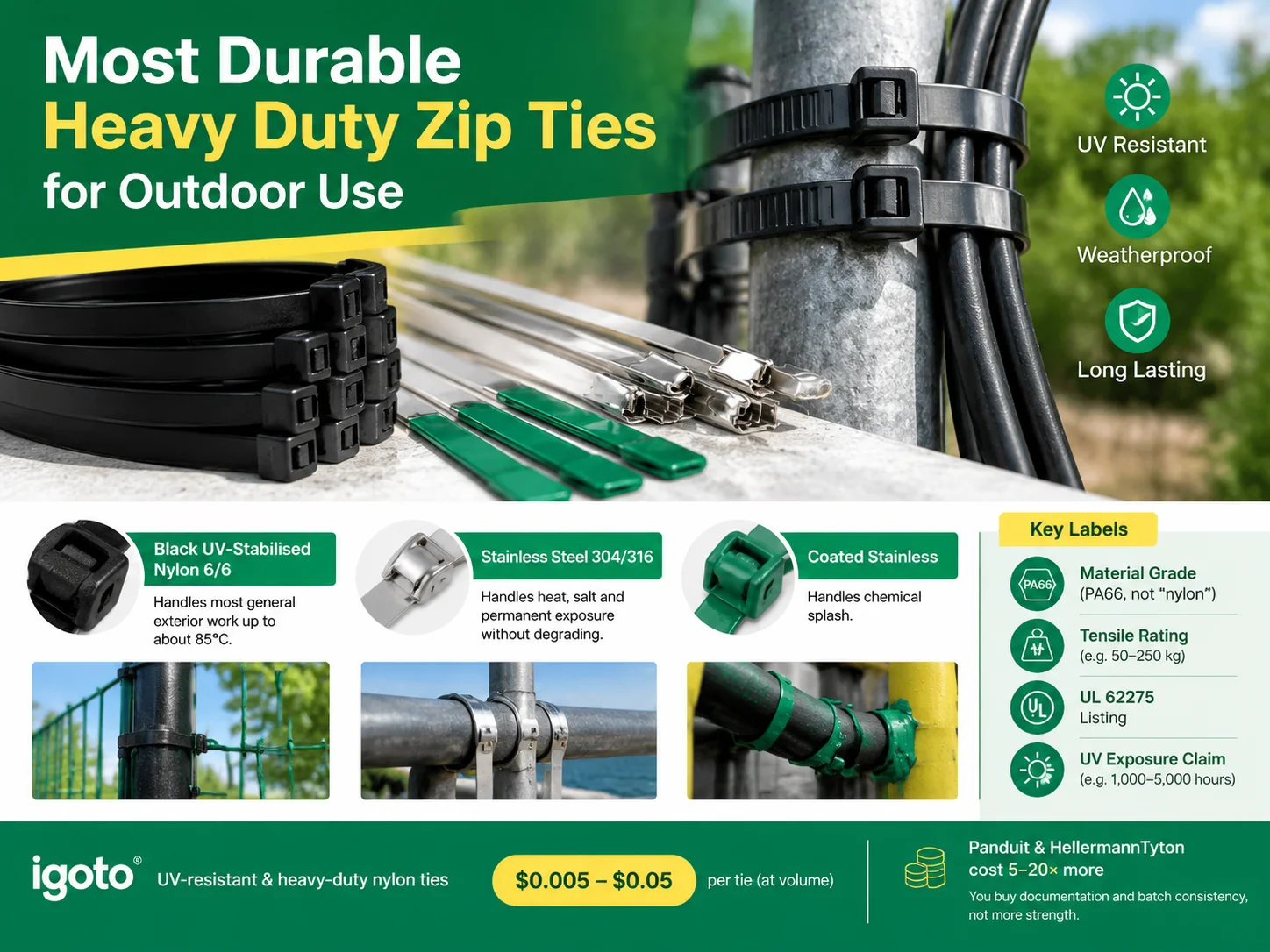
To put it in simpler terms, it is advisable to select black UV-affected nylon material of type 6/6 if you need product that is to be applied outside. It is reliable in terms of weather safety (up to 85 Degrees Celsius) as well as for exposure to other adverse conditions. Stainless steel of the grades 304 and 316 performs better than the nylon in terms of nature temperatures, salt or grounding. In addition, there is also coated steel product that can handle chemical spills. There are a few performance indicators that we have to take into consideration: the type of material (it is supposed to be PA66, not nylon), tensile strength, UL 62275 cable type and the total UV exposure time of the cables. The prices offered by igoto for nylon ties vary from $0.005 to $0.05 each according to the quantity ordered. Alternative products can be found at Panduit and HellermannTyton, but they are more expensive by five to twenty times.
What “Durable” Actually Means Outdoors
Outdoor failure is not due to a single mechanism. There are five distinct types of failures that occur to a cable tie and they each require different materials to address them.
- Ultraviolet degradation. The sunlight breaks the polymer bonds at the surface of the nylon tie, causing the tie to lose its ductility before it loses its tensile strength. So a tie that feels ok but snaps all of a sudden loses its ductility. This is the most significant outdoor failure and the one related to the material grade.
- Thermal cycling. The surface temperature of a roof changes from -10°C in February to 70°C in July, and the tie expands and contracts in action with an object that does not. Repeated movements put stress on the locking claw.
- Cold brittleness. Regular nylon 6/6 becomes brittle below -20°C. If a hammer falls on a tie at about -30°C, the tie shatters instead of bending. For the cold use, there is a need for a nylon with a lower brittleness or for stainless steel ties.
- Chemical and salt attack. The salt in the coastal air settles on the surface of the tie, and even though nylon is resistant, the stainless steel claws used in high-end ties do not stand a chance against such attack. De-icing salt, fertilizers and pool chemicals are more damaging for metals than for plastics.
- Mechanical fatigue. A cable tie used on a pole in strong winds goes through millions of very minor load shocks, which helps the sharp edge of the tie to cut through the strap at the contact point.
The Material Ladder
| Material | Temperature range | UV behaviour | Best outdoor duty |
|---|---|---|---|
| Natural nylon 6/6 | −40 to +85°C | Poor; yellows and embrittles in months | Indoors only |
| Black UV-stabilised PA66 | −40 to +85°C | Good; carbon black absorbs UV | General exterior, cable trays, signage |
| Heat-stabilised PA66 | −40 to +105°C | Good | Near engines, plant rooms, solar racking |
| PA12 | −50 to +90°C | Good | Cold climates, humid and wet service |
| Coated stainless (PA12 or ETFE jacket) | −50 to +150°C | Excellent | Chemical plants, marine, abrasive contact |
| Stainless steel 304 | −80 to +150°C | Excellent | Roof plant, masts, permanent outdoor |
| Stainless steel 316 | −80 to +150°C | Excellent | Coastal, de-icing salt, chloride exposure |
The decision between 304 and 316 follows the same rules as every stainless piece: 316 has molybdenum in it, while 304 does not and therefore has no resistance to chloride pitting. In the case of a roof in a landlocked part of the country, 304 makes sense, whereas 316 represents a costly overkill. However, at a distance of only a few hundred meters from salt water bodies, or on a road bridge sprayed with salt each winter, it is evident that 316 is the only option.The mechanical difference between the two tie types is set out in this comparison of stainless steel and nylon cable ties, including where nylon still wins on cost and cable protection.
A key material trap is “nylon,” which could refer to nylon 6, nylon 6/6, or a mixture of nylon with regrind. Nylon 6 has a higher moisture uptake with a decreased strength loss when wet. If the tie is going to be used outdoors in humid conditions, PA66 should be the specified material in place of “nylon.”

The Numbers on the Label and What They Leave Out
A cable tie bag contains five important values plus one irrelevant one.
The tensile strength defines the force to break a new tie if pulled in a straight line and is usually given in pounds or newtons. Light-duty ties are rated to around 18 lbs (8 kg), general-purpose ties to around 40-50 lb (18-22 kg), heavy-duty 120-175 lb (54-79 kg), and extra-heavy 250 lb (113 kg) and above. As for stainless ties, their tensile strength ranges from around 100 lb to more than 600 lb.
The weatherability is almost always given in the manufacturer’s range of materials but not the performance of the tie itself. The numbers refer to the polymer but don’t really refer to the physical performance of the joint.
The width of the tie is much more important than the length because the same material in a tie 7.6 mm (0.30″) across has almost twice the strength of a 4.8 mm (0.19″) one.
The listing number covers cable ties in electrical applications according to the UL 62275 standard. If a cable tie is not listed but has a UL logo printed on the bag, that tie is a fake.
The flammability standard is given as UL94 V-2 or V-0 if the tie is supposed to be used in plenums or enclosed spaces as opposed to outside installations.
The number of hours spent exploring a product in the weathering test is typically omitted on the label, making it hard to tell how the product performs over time based only the description “UV resistant.”
Heat performance is also omitted. A tie used near the air conditioning unit, where the ambient temperature reading is not applicable, will perform much lower than its rating indicates. How nylon ties behave at sustained elevated temperature, and where the practical ceiling sits before the material creeps, is covered in this look at whether zip ties are heat resistant.
Matching the Tie to the Environment
| Environment | Tie to use | Why | Mistake to avoid |
|---|---|---|---|
| Solar racking and roof conduit | Black UV PA66, or 304 stainless on the rail | Constant sun plus 70°C surface temperatures | White or natural ties, which fail in one season |
| Coastal and marine | 316 stainless | Chloride pitting destroys 304 and eventually the barb | Nylon, which survives but the metal pawl does not |
| Cold store exterior, northern latitudes | PA12 or stainless | Standard PA66 embrittles below −20°C | Tightening at low temperature, which pre-stresses the tie |
| Near compressors and engines | Heat-stabilised PA66 or coated stainless | Radiant heat plus oil mist | Judging by ambient temperature only |
| Chemical plant and pool plant room | Coated stainless | Chlorine and acid attack the polymer jacket slowly | Bare stainless in contact with dissimilar metal |
| Underground or buried | Stainless | Soil chemistry and abrasion | Nylon, which hydrolyses in wet alkaline soil |
| High-wind masts and poles | Stainless, wider strap | Fatigue at the head, not peak load | Overtightening, which starts a crack at the pawl |
Any product that is marked for permanent outdoor application in a structure needs to be black as well. Carbon black is the least expensive way and most efficient UV absorber; furthermore, concerns about color are greater than most buyers think, which is why products with UV imperfections use black color more often and not colors used for dry indoor identification.
Brands and What Each Is Actually Good At
When it comes to serious outdoor work, four companies rule the roost, and while they are very colorful in terms of their marketing, there are not many differences between them when it comes to the actual functionality of their products.
- Panduit is the company that does its homework properly. The company publishes data sheets, weathering reports, UL certificates, etc. This is important when you are providing a commercial project. The Pan TY line of ties made out of black UV-stabilized nylon has become a standard in telecoms and data market and its rounded straps allow for better protection of cable jackets. The company offers its products for prices ranging from $0.30 to $1.00.
- HellermannTyton has more sizes than anyone in Europe and has the most advanced European approvals. The T series of ties that meet the T series is differentiated according to temperature, strength, and UV resistance. If there are any requirements coming from Europe, this is the best option for a contractor. The price range is $0.30-$0.80.
- Thomas & Betts is the brand that is popular with contractors. It is the stainless steel pawl that allows for more precise gripping of equipment. The metal clip does not allow for a cable to slide once it has been attached. The prices vary from $0.20 to $0.60.
- 3M is the company in the middle of the price list between high and low-end brands. Practically any retailer can find the company’s products at the price range from $0.08 to $0.30.
Igoto is the factory-direct manufacturer whose price is significantly lower than anything from the brands above. They manufacture nylon 6/6 along with other materials available in abundant from their production. The heavy-duty cable tie manufacturing range covers the sizes that outdoor work actually uses.

What to Test Before You Commit to 100,000 Units
Using brand claims and data sheets as references, only three simple and straightforward procedures are necessary to check if the ties have been made with the correct PA66 material.
- Cold Bend Test. First, ten tie straps are placed in the freezer overnight and then bent one by one. Cold rated ties bend properly while standard PA66 ties break. In fact, the compound is identified using this test in just minutes.
- Boil and Pull Test. Next, ten straps are boiled in water for thirty minutes and then pulled until they fail. The results are compared to published tensile information. Any strength loss of more than 20% shows that the polymer is not what it is said to be or the moulding process is defective.
- Cut Test. Finally, one of the straps is cut to see the cross-section. A good product will have a uniform, solid, and bubble-free cross section. Anything else will start to break at the head of the tie.
If the manufacturer cannot supply the hundred pieces of ties coupled with a material certificate indicating PA66 and a UL file number, the conversation is useless.
Installation Details That Decide Service Life
Installation failures occur even when the components are of good quality. There are four points which are much more important than the specification of the tie.
- Tension. The biggest problem with hand-tensioning is that the tie itself does not have a specific tension and tensioning too much will cause the strap to be pre-loaded at the pawl which is where a crack will develop after about eighteen months.The only effective way to tension is to use a tensioning tool set to the tension of the tie.A flush cut is also essential for ensuring safety and avoiding stress concentrations at the point of the cut.
- Edge protection. If a tie is pulled over a sharp edge of a bracket, it will cancel before the end of the season no matter what material is used to make the tie.Make sure to use a protective sleeve or go around the edge, or use a coated tie made of stainless steel if going around is impossible.
- Orientation. The head of the tie should be on the side of the horizontal run where there is less exposure to water and ultraviolet radiation. This detail is insignificant but prolongs the service life of the tie on the roof.
- Temperature of installation. When using a nylon tie in the frost higher than minus fifteen degrees Celsius, it will be extremely fragile.
If you cannot avoid installation in winter, try to keep the tie warm in your pocket before using it or install a steel tie instead.
Cold-weather installation is its own discipline, covering the tension procedure, the tools and the material choices for sub-zero work, and it is set out in this guide to cold weather cable ties.
Cost per Year, Not Cost per Tie
The only comparison that really matters is the annual cost of owning a given fastening solution, and this is very rarely in favour of the cheapest one.
A nylon fastening solution that costs only $0.02 lasts for only 14 months. Thus, the annual cost of using such a fastening solution is $0.017 plus the cost of the labour involved in replacing it with a new fastening solution. A UV-stabilised fastening solution, which costs $0.05 and works for 5 years, gives an annual cost of $0.01 together with one-off labour costs for installation.
The most extravagant fastening solution seems to turn the calculations upside down. A steel fastening solution may cost around 0.40 but may survive in any condition and does not require an exchange. Hence, the answer to the question of whether to invest in the highest-quality fastening solution lies in case the fastening problem occurs in a hard-to-reach area.
For volume buyers the practical starting point is a properly specified black UV tie in the size the job needs, and a 100-pack of 8-inch black UV heavy-duty ties is the format most contractors test first, because 200 mm covers more outdoor bundling than any other single length.
FAQ
Are black zip ties better for outdoor use than white ones?
Certainly, to a great extent. The black pigment that is found in black ties absorbs ultraviolet rays before they reach the polymer which means that a UV-stabilized black tie commonly lasts much longer than an ordinary black tie or the white tie made of a similar compound in the outdoor conditions for multiple years. White and colored ties can be applied indoors, as ultraviolet rays do not play important role there.
How long do heavy duty zip ties last outdoors?
In temperate regions, the black UV-stabilised nylon ties can last approximately three to five years when they are exposed to sunlight directly, and even longer when they are used in covered places. The stainless steel ties can last for decades instead. The nylon ties usually have short life span due sunflower and heat together as a nylon tie in hot climates is exposed to stiffer conditions than that which is put under a covered structure and this makes a great difference in their duration of use.
Can I use nylon zip ties in freezing weather?
Be careful. Regular nylon 6/6 becomes weak at around −20°C, and fitting a tie at that point might break it. The preferred options for very low-temperature work are PA12 ties and stainless. For occasional jobs involving freezing temperatures the optimal method would be to keep the ties warm until they are installed.
What is the strongest type of cable tie?
Without a doubt, stainless steel is at the top of the heap. A heavy-duty stainless steel tie has load-bearing capacity of 200 pounds or more, and premium ladder-style ties capable of carrying over 600 pounds; none of them deteriorates even under prolonged UV exposure. With nylon ties, the effective limit is the 250-pound range for wide straps, after which the weak point will be the attachment point rather than the tie itself.
References
- Panduit — Pan-Ty Cable Ties and Weathering Data
- HellermannTyton — T-Series Cable Ties by Temperature and UV Class
- Thomas & Betts — Ty-Rap Stainless Pawl Cable Ties
- UL Solutions — UL 62275 Cable Ties for Electrical Installations
- 3M — UV-Resistant Cable Tie Range
Conclusion
Outdoor durability depends on materials ahead of strength. Black UV-stabilized PA66 works for normal outdoor purposes, PA12 is ideal for very low temperatures, 316 stainless steel is great for applications involving salt and chlorine, while coated stainless steel is perfect for extreme chemistry environments.
Then, order 100 bags, conduct tests with 10 bags and throw the rest of them in the freezer after the boiling test. Remember that the most sophisticated engineering does not always guarantee that the bags work well in real-life conditions as testing bags will cost you much less than sending your servicemen to the rooftop.