




Cable Gland: The Complete Guide to Types, Sizing & Sealing
Every fixed electrical construction has the problem of how to place a wire on the case wall in a way that allows neither dust, nor moisture to pass through. There is a device used for that purpose known as a cable gland, which is a thread connection, which holds the cable cover tightly and seals entry points. By selecting a wrong type, one compromises the ingress protection of the entire system; however, a properly picked up one would guarantee a high level of connections protection for years.
A cable gland is a perfect solution whether you are connecting a control panel at the factory, addressing a junction case of a solar energy generating station, or saving a wire of any outdoor equipment from damage. This article gives an overview of what a cable gland is meant for, what thread types it is equipped with, a comparison between plastic and metal protective channels, explains the principles of Table of Ingress Protection Ratings.
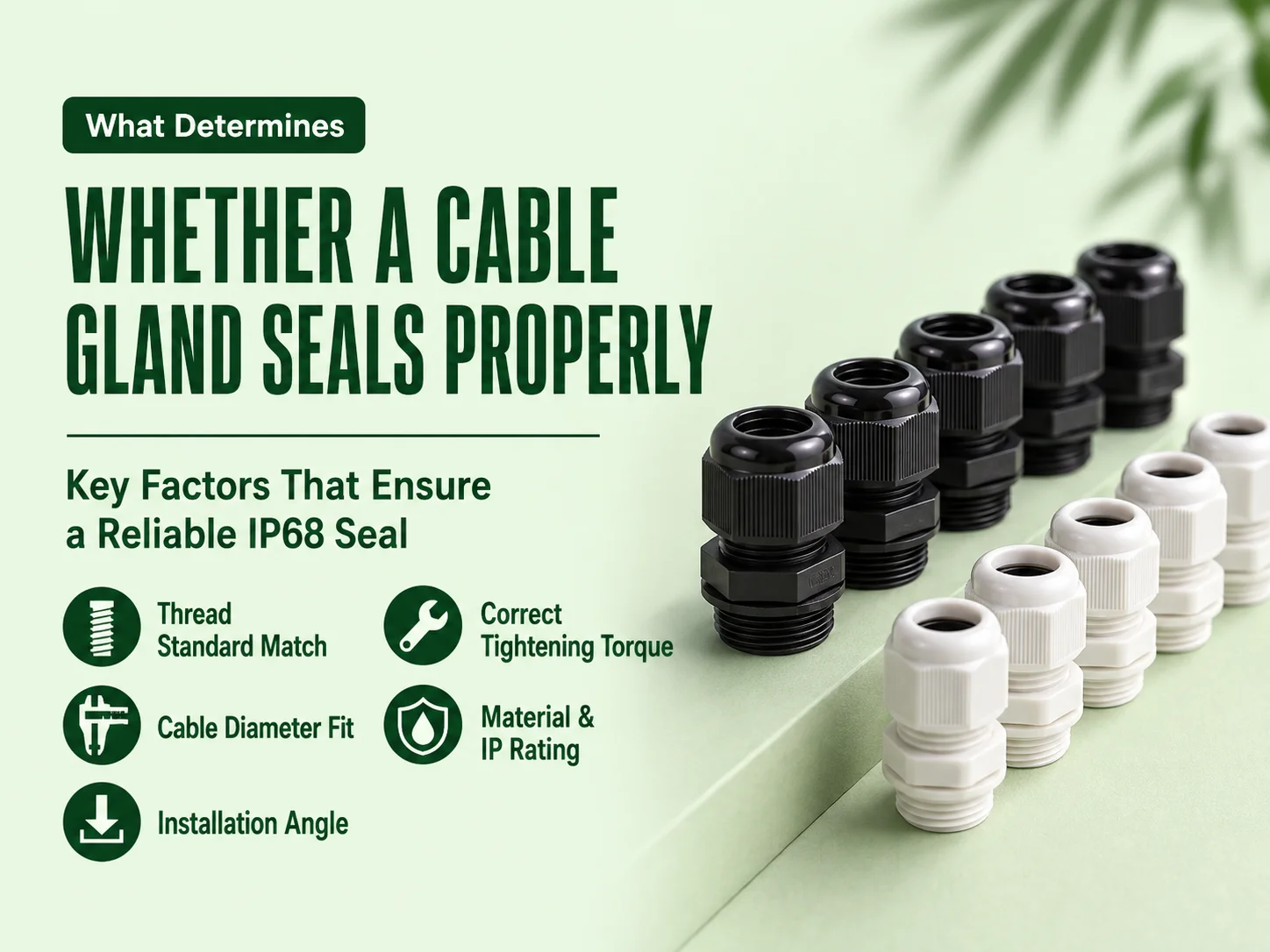
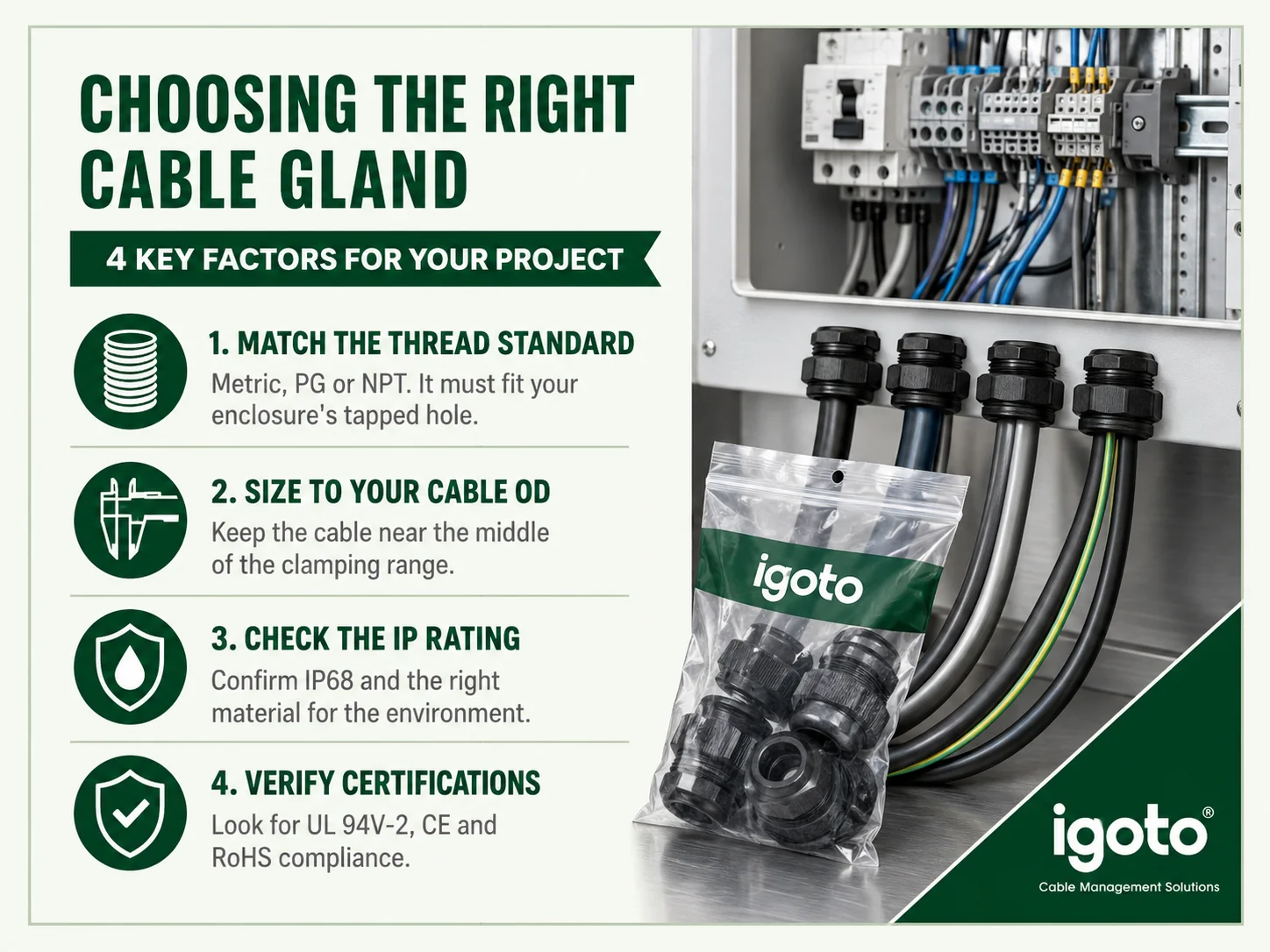
A cable gland is used to protect and secure a cable inside an enclosure by providing strain relief and environmental protection close to the point where the cable is passing though into it. When choosing a cable gland, one needs to consider four things: thread standard (metric, PG, or NPT), material (nylon or metal), ingress protection level, and most importantly, the ability of the gland to match its clamping range to the actual cable size.
What a cable gland actually does
Also referred to as a cord grip, cable connector, or strain-relief fitting in North America, a cable gland serves three functions simultaneously. The first function is mechanical fastening, which involves holding the outer jacket so that pulls, vibrations, and weight do not affect the terminals within the enclosure. Secondly, it seals the entry from moisture and dust making sure that the ingress protection rating of the enclosure stays intact. Also, in case of the metal types of the cable gland used for some installation types, the earth bonding or electrical continuity can be provided thanks to the body of the device.
The principle behind its operation is simple and effective. The construction of the cable gland allows the cable to pass through it; while the dome nut is tightened, the elastomer or rubber sealing ring exerts pressure on the jacket. Thus, compression allows gripping the wire and blocking it off from external environment outside.
Where cable glands are used
The reason that cable gland are used in virtually every industry that requires cables to be run into an enclosure is that they address a common problem. In industrial control, they prevent any cable from entering a cabinet or distribution board and in machinery and automation, they provide strain relief at the point where cables enter motors, drives, and sensors that will be on all the time, thereby ensuring that the connection made does not fail shortly after installation.
Even outdoor projects and infrastructure rely heavily on these products, as objects such as junction boxes for solar panels, telecommunication cabinets and equipment mounted near roads would need sealed entries in order to keep working amid rain, dust, and temperature fluctuations. For a closer look at these settings, see IGOTO’s guidance on electrical wiring and cable management and on industrial equipment, where sealed cable entry is a routine requirement rather than an afterthought.
Thread standards: metric, PG, and NPT
The interface between the gland and the enclosure is the thread, which strongly influences sealing ability and compatibility. Three standards take precedence in the market, and these are not interchangeable.
Metric threads refer to the standard ISO and DIN threads, and they are now governed by the IEC standards 62444. The metric thread designations start from the size M12 and have different pitch sizes; for example, an M20 thread size has a pitch of 1.5 mm. A perfect straight-threading helps the locknut and O-ring to press down evenly on the panel, which means that the metric threads can achieve IP68 easily. IGOTO’s metric thread cable gland range covers M12×1.5 to M63×1.5, handling cables from 3 to 44 mm.
PG (Panzergewinde) threads are an older German standard with a rounded profile and an 80-degree flank angle. Once dominant across European cable management, PG is gradually being replaced by metric but remains common on legacy equipment, sensors, and existing installations. If you are servicing older machinery, a PG thread cable gland is often the correct replacement part.
NPT (National Pipe Thread) is a type of thread that is based on inches, and it has a tapered shape. In NPT, it is the very taper that seals the pipe as it will tighten the threads, usually using PTFE tape or thread sealant. This makes NPT quite common in oil and gas, petroleum, and marine industries. A metric thread uses a 60-degree angle while a PG thread has an angle of 80 degrees, thus mixing them up will cause the threads to be stripped and the water resistant feature to be lost.
The table below summarizes how the three standards compare at a glance.
| Thread | Profile | Flank angle | Sealing method | Typical region / use |
|---|---|---|---|---|
| Metric (M) | Straight ISO | 60° | Locknut and O-ring | Global default, IEC markets |
| PG | Straight, rounded | 80° | Locknut and seal | Legacy European equipment |
| NPT | Tapered | 60° | Thread taper and sealant | North America, oil and gas |
Decision point: if the measurement on your enclosure appears in fractions, for example, either 1/2” or 3/4”, chances are that you are working with NPT/BSP and not metric. If the standard is not obvious to you, it is advisable to double-check your measurement using a thread pitch gauge before placing any orders. Filling out that two-minute check will save you from any leaks.
Plastic cable gland or metal: choosing the material
There are three basic types from which cable gland are made: nylon (plastic), nickel-plated brass, and stainless steel types. In most cases, it makes good sense to choose plastic cable gland, as they are the most convenient option for electrical and industrial systems.
Nylon cable gland are made from nylon 66, which carries a UL 94V-2 rating for flame resistance, meaning that this material is self-extinguishing. The key benefits of nylon are its impressive mechanical capabilities, chemical resistance, light weight, electrical insulation and operational temperatures ranging from −40℃ to +100℃. Additionally, nylon is naturally resistant to corrosion and much less expensive than metal; this is why it is able to successfully perform various functions in control panels, distributing stations, machinery and junction boxes for outdoor usage.
Metal cable gland have certain application areas where they are irreplaceable. Nickel-plated brass can be used in the applications requiring EMC protection or grounding through armored cable, while stainless steel (usually 316L) types of cable glands can be applied in environments with chemical corrosion or extreme temperatures. Finally, flameproof brass cable glands according to IEC 60079 are used in hazardous areas such as oil refineries and petrochemical plants.
Waterproof cable glands and how IP ratings really work
Generally, the term “waterproof” refers to an IP68 rating. However, one must understand what that acronym means. The IEC 60529 defines ingress protection in two-digits- the first one shows the protection level against solids and the second one about the protection level against fluids. A waterproof cable gland rated IP68 — such as IGOTO’s nylon range — is dust-tight and protected against prolonged immersion in water under conditions defined by the manufacturer.
The hitch is what catches countless installations: the rating is valid only when the gland is accurately installed. An IP68 rated waterproof cable gland fails in moisture testing just as easily when threaded into a wrong hole, over-torqued, or attached to a cable that is barely within its clamping limits. It is not unusual for a field failure to be related to the forced fit, remedied with a generous application of PTFE tape, rather than to the gland itself. The integrity of the seal path depends on a good fit of threads, torque, and cable diameter.
How to size a cable gland correctly
When it comes to sizing, there’s just one key measurement to consider — the outer diameter (OD) of the cable. The next step is measuring this against gland size’s clamp range and the corresponding enclosure thread size. The biggest, no-brainer rule is, pick the size so that the cable OD lands somewhere in the mid-point of the range. Picking a gland that is too big won’t help you as it won’t compress the seal. Similarly, picking a gland that is too small won’t work either because it won’t close properly. Whatever the case, your effective IP rating drops.
| Metric size | Cable range (mm) | Spanner size (mm) | Typical application |
|---|---|---|---|
| M12×1.5 | 3 – 6.5 | 16 | Sensors, thin signal cables |
| M16×1.5 | 5 – 10 | 22 | Control wiring |
| M20×1.5 | 6 – 12 | 24 | General-purpose power cable |
| M25×1.5 | 13 – 18 | 33 | Larger power cable |
| M32×1.5 | 12 – 21 | 36/37 | Multi-core cable |
| M40×1.5 | 22 – 32 | 52/53 | Heavy power cable |
| M63×1.5 | 37 – 44 | 67 | Largest standard entries |
When choosing between two sizes that cover your cable outer diameter, select the one that places the cable closer to the center of the band. Keep it in mind that the standards for the threads are not interchangeable, which means that an M20 will need a hole about 20.2 mm in diameter while a PG11 covering the same range will need an aperture of about 18.6 mm. This means that while changing standards with added equipment, the panel will have to be redrilled.
A few actions will preserve the integrity of the seal once you arrive on site. First, strip the cable jacket in a clean way so that the sealing ring is sitting on the undamaged round surface. The dome nut should be tightened until the insert perfectly fits around the cable, but it should not crush the jacket. Use a locknut or O-ring on the inner side if you are threading into a basic clearance hole instead of a threaded one. Lastly, for the outdoor installations, the gland should be aimed downwards, which will let water drain away from the seal instead of accumulating. All of the actions listed above take little time and have a big impact on the seal’s installation.
Can you 3D print a cable gland?
When you search for cable gland 3D print file, you will come across numerous STL models available for free on various maker sites. Whether you need parametric designs, printed nuts in various materials such as ABS, PETG, or ASA, or the split-body type, the options are endless. If you have a hobby project in mind, printing your own 3D cable gland can make for a beneficial and cheap option.
But while this is a good option, it still has its flaws. Printed cable glands do not provide a reliable IP68 seal since their layer lines create pathways for leaks. The threads lack the precision of the threads of the injection-molded part, and consumer-grade plastics do not come with a UL 94V-2 certification for fire safety. The compression fingers that hold the wires in place could also crack under pressure. And what is more, all of that information is not certified.
So while printing a cable gland for some hobby builds is fine, specifying a cable gland for something serious is not acceptable. Always go for UL 94V-2 nylon or a certified metal cable gland whenever you need to use a cable gland in a safety-critical environment.
Frequently asked questions
What is a cable gland used for?
It attaches a cable at the point of its entry into an enclosures’ electrical compartment and provides strain relief, thus preventing mechanical forces from reaching the terminals and sealing the entry against dust and water and maintaining its ingress protection rating.
What is the difference between M16, M20, and M25 cable glands?
Nominal is the metric approximate diameter of the thread. The M16 connector normally uses cables measuring from 5 to 10 millimeters, the M20 from 6 to 12 millimeters, and the M25 from 13 to 18 millimeters. You should make your selection taking into account the cable’s outer diameter.
Are plastic glands as good as metal ones?
For the majority of electrical installations and industrial systems, yes, as a high-quality nylon gland achieves IP68 performance, UL 94V-2 fire-resistance and a temperature range of -40C to +100C at a price point and weight lower than that of metal. Metal is only used for electromagnetic compatibility grounding, corrosive and washdown areas, and other hazardous environments.
What does IP68 mean on a cable gland?
According to IEC 60529, the first digit (6) represents completely dust-proof, and the second digit (8) specifies safeguards from extended contact with water. The rating is valid if the correct threading, torque and sizing of the gland have been done.
Can I use a 3D printed cable gland outdoors?
Nothing that requires a good waterproof seal or compliance with fire safety regulations should use printed glands. Printed glands not guarantee either IP68 ratings nor flame retardant certification and should only be used for indoor hobbies and prototyping.
References
- Cable gland — overview and terminology (Wikipedia)
- IP Code / IEC 60529 — degrees of ingress protection (Wikipedia)
- UL 94 — flammability of plastic materials (Wikipedia)
At IGOTO we have manufactured nylon cable-management components for more than 25 years, and our UL 94V-2 glands are molded from 100% virgin Nylon 66, IP68 rated, and offered from M12×1.5 to M63×1.5 for cable ranges of 3 to 44 mm. Explore the full metric thread cable gland range, browse our complete thread cable gland category, or request a quote — with low MOQ, custom sizes and colors, and fast delivery direct from a manufacturer trusted by clients worldwide.