



Versatile Uses of Colored Nylon Cable Ties
When you visit a data centre, a factory, or a structured cable installation, the first thing to take note of are the coloured ties and fixing devices. Many structured cabling sites have Blue ties on the trunking for Cat6a, Red ties to identify an emergency circuit, Green ties on grounding conductors, and White ties for temporary rigging that will be removed before final inspection. Coloured cable ties do not just keep cable bundles together. The knowledgeable installer can use them as an identification system that costs far less than using labels and last as long as the installation itself. Recognizing how to purposefully utilise colour and where different colours should be used will change a commoditised fastening device into an effective tool for ensuring safety, compliance with applicable codes, and speeding up maintenance activities.
Why Colour Matters in Cable Management
A black nylon cable tie and a white nylon cable tie have the same construction, the same tensile strength and the same locking mechanism. The only difference between them is how they look, but that visual difference has an impact with regard to their use as well as their application within your industry as well as across other industries where colour coding plays an important role. When a technician sees a red tie in an electrical panel, they will immediately know that the cable attached to the red tie is part of the fire-alarm or emergency circuit. Similarly, if a technician sees a blue tie in a data centre, they will know that the blue tie is for fibre trunks and that yellow ties represent the copper cabling. In a pharmaceutical plant, green ties are used to indicate a CIP (clean-in-place) system, while white ties are typically reserved for use with temporary rigging that must be removed within a shift. Colour coding has become a standard practice in many industries due to the strict safety regulations and audit requirements imposed on these industries. Organisations such as the National Fire Protection Association (NFPA) and the American National Standards Institute (ANSI) have long recognised colour as a safety communication tool in electrical and industrial environments, and major cable management manufacturers, including Panduit and HellermannTyton, produce colour‑coded cable ties specifically to support these identification systems.
Common Colours and Their Practical Applications
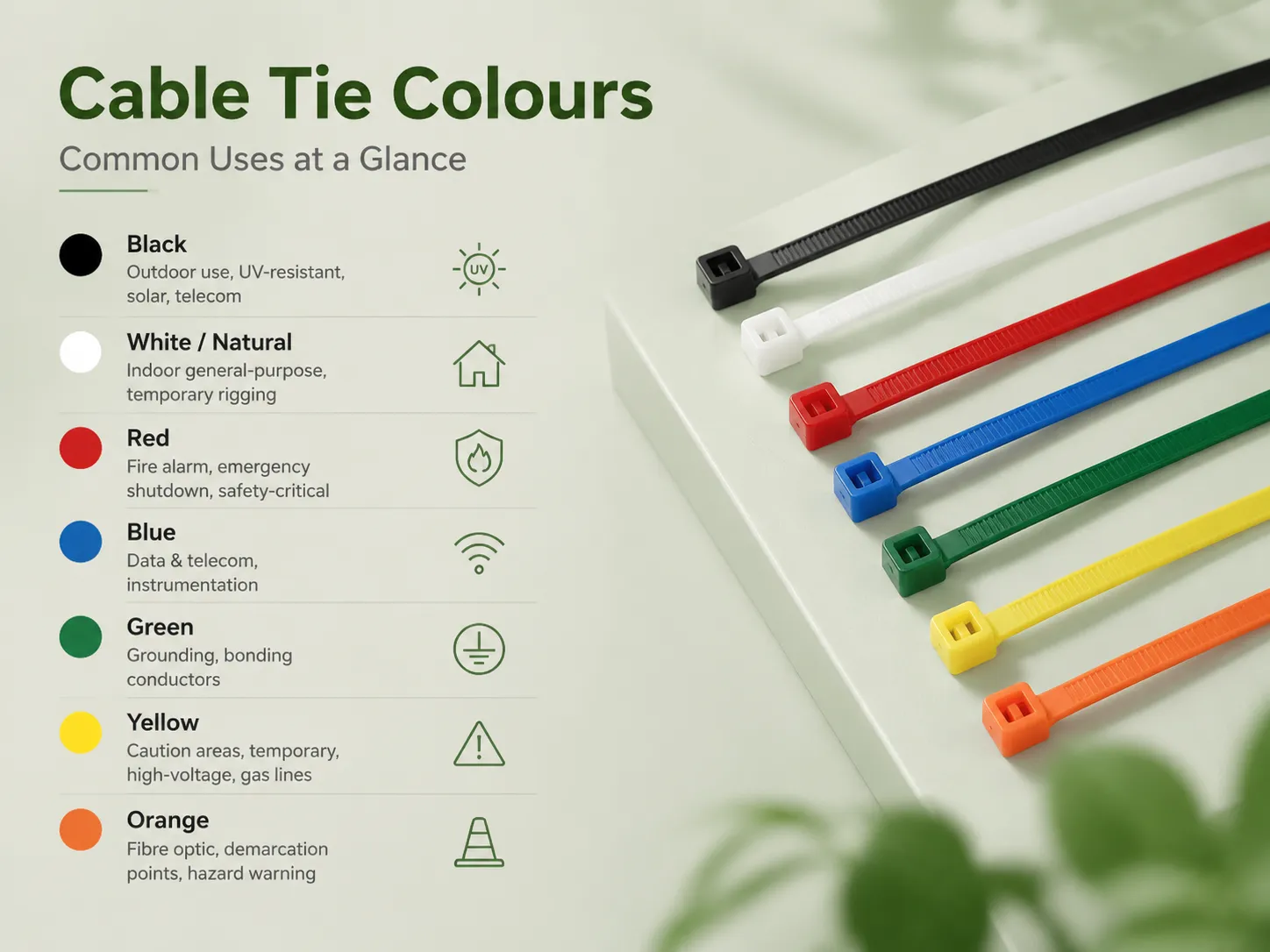
There is no single universal standard for cable tie colour coding — different industries and companies adopt their own schemes — but several conventions have emerged from decades of practice. The table below summarises the most widely used colours and where you are likely to see them.
| Colour | Common Applications | Why That Colour? |
|---|---|---|
| Black | General outdoor use; UV‑resistant; solar farms; outdoor telecommunications | Carbon‑black pigment provides UV stabilisation, making black the default for any tie exposed to sunlight. |
| White / Natural | Indoor general‑purpose; temporary rigging; cable harness mock‑ups | Natural nylon colour; no pigment added. Easily marked with a pen. Not for outdoor use. |
| Red | Fire alarm circuits; emergency shutdown wiring; safety‑critical systems | Universally associated with danger, fire, and stop functions. Stands out immediately. |
| Blue | Data and telecommunications; instrumentation loops; control circuit wiring | Distinct from electrical power colours; widely adopted by IT and telecom industries. |
| Green | Grounding and bonding conductors; environmentally sensitive circuits | ANSI/NFPA colour code for ground and safety; associated with “go” and environmental status. |
| Yellow | Caution areas; temporary installations; high‑voltage warning; gas and fuel lines | High‑visibility warning colour; stands out in low‑light and cluttered environments. |
| Orange | Fibre optic cables; demarcation points; warning of confined space or hazard | ANSI safety colour for warning; used to highlight a specific part of an installation. |
Strength and Material: Does Colour Affect Performance?
The strongest colored cable tie is usually the black cable tie. The reason for this is because the black color is created by adding a pigment called carbon-black pigment and the carbon-black pigment acts as a stabilizer against UV (ultraviolet) light; therefore, the cable tie (made from nylon 6/6) does not degrade under sunlight when exposed to the elements outdoors. In an indoor environment, a natural colored nylon 6/6 cable tie has the same tensile strength as the black cable tie of equal dimensions as long as it is in a climate controlled environment. However, in an outside environment the natural color will start to lose tensile strength after a couple of months but the black will still be able to hold its rated strength after a number of years. Many of the other colored cable ties such as red, blue, green, yellow and orange use other types of non-stabilizing pigment to produce the various colors and so have the same indoor tensile strength as natural colored cable ties; however, they are not UV stabilized and therefore should not be used outdoors unless there is a label indicating that they are UV-stabilized. If you want the maximum amount of strength from the colored cable tie that you are using then you should choose the one that is listed with the same tensile strength specifications as what will be required for your application. The color of the cable tie gives information about identifying it; the technical data provides information about the strength.
Which Colour Is Best for Outdoor Use?
Black cable ties are the most common type of cable tie for outdoor use. The ingredient that makes them black (carbon-black pigment) also makes them resistant to ultra violet rays. Black cable ties can be made from either standard nylon material or from premium materials such as ethylene tetrafluoroethylene (ETFE/Tefzel) and are approximately 60% stronger than standard nylon. Other coloured cable ties (red, blue) will not provide the same amount of UV protection due to the lack of carbon-black pigment, and therefore will fade and become brittle much sooner than black cable ties. When using colour-coded cable ties outdoors, it is best to use a black cable tie to hold the cable together mechanically and then use a coloured identification tag or label on it, or to purchase specifically manufactured UV-stabilised coloured cable ties that are labelled as being UV-resistant. Do not assume that a coloured cable tie will have the same outdoor life expectancy as a black cable tie unless the manufacturer has stated so. Our guide on why UV‑protected cable ties matter outdoors covers this in detail.
Electrical Code and Industry Standards for Colour Coding
Color-coded cable ties should always be used in regulated industries for the identification of electrical conductors; however, colour coding is not specifically required in the NEC, BS7671, ISA, or IEC. Regardless, red cable ties on fire alarm systems and green cable ties on ground conductors are very common forms of supplemental identification, as are blue cable ties on low voltage conductors. Therefore, using coloured cable ties will assist a contractor in going beyond the minimum codes established by these organizations and, as such, inspectors, maintenance personnel, and/or auditors will appreciate this additional identification technique.
Selecting and Purchasing Coloured Cable Ties for Your Project
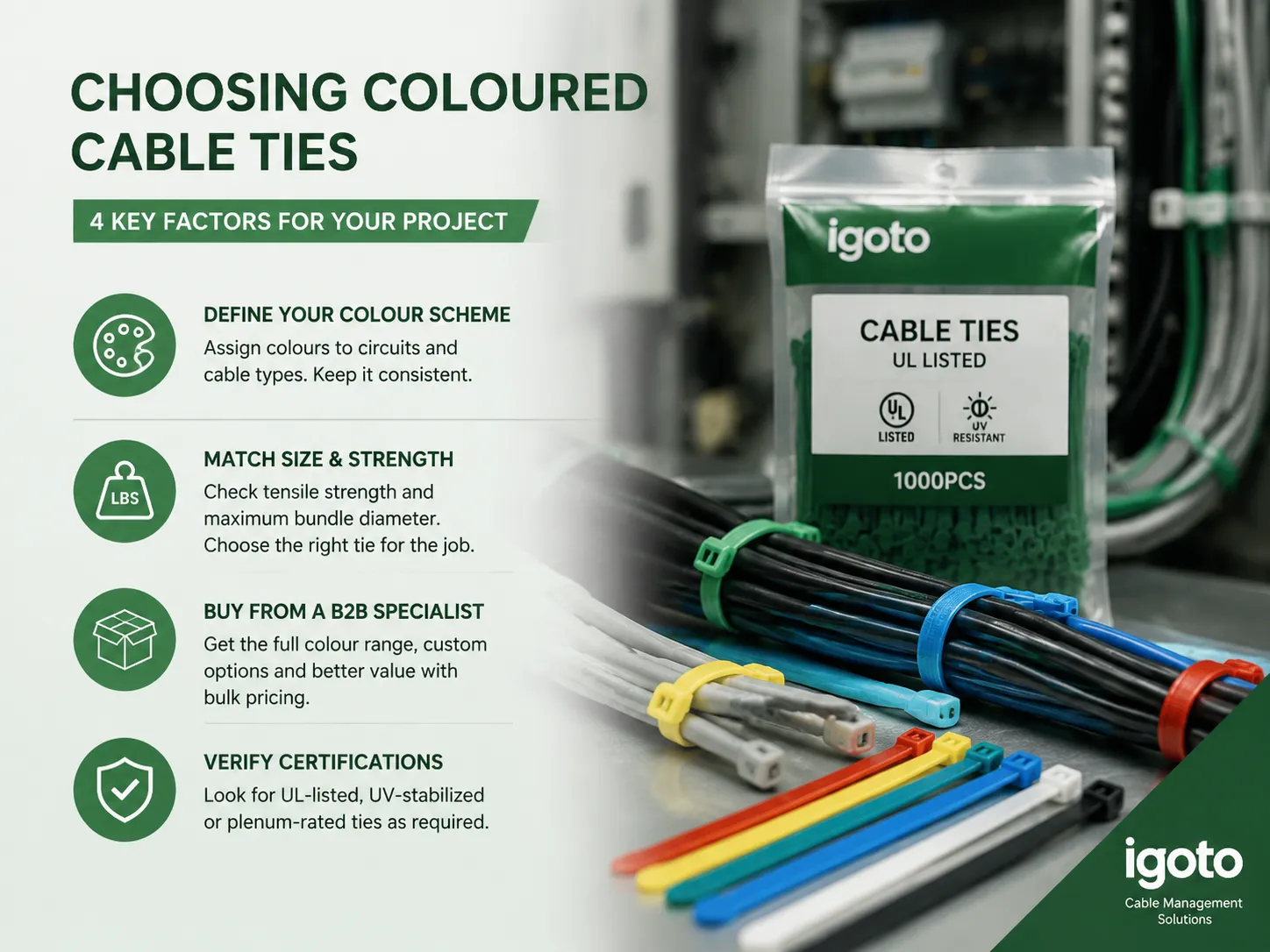
When an electrical contractor, facility manager, or OEM specifies cable ties in color, there are a few factors that will guide their decision:
- Define your colour scheme before ordering. Make a decision on which colour will relate to the circuit and cable type, record this and purchase cable ties of the required colours and amounts at the beginning of the project. The value of applying a single scheme across all areas of an installation far exceeds that of running mixed schemes.
- Match the tie size and strength to the bundle. If a tie breaks, it doesn’t matter what colour it is. To ensure there are good functioning ties, check for the tensile strength (pound load) and maximum bundle diameter for each size of tie and pick accordingly. To tie together a few Cat6 cables, an 18 pound tie may work, but to tie a heavier armoured cable would require a 50 or 120 pound tie.
- Buy from a B2B supplier that offers the full colour range. It’s important to note that not all suppliers offer every size or colour of product, therefore a supplier like igoto would be more suited for commercial or industrial buyers than retailers since they specialise only in supplying cable management products while also providing a complete colour palette, custom length and volume cost structure. In addition, purchasing from igoto by purchasing in bulk (for example buying a 1,000 piece bag rather than 100 piece bags) will significantly lower the unit costs associated with larger installations.
- Verify the relevant certifications. If you’re going to use these ties for an electrical enclosure, make sure they’re UL-listed. If they’ll be outside, make sure they’re UV-stabilized. If they will be in a plenum or air handling space, you may need to use plenum-rated materials. Certification will be listed on both the packaging and in the supplier’s documentation.
Frequently Asked Questions
What are the different colors of cable ties for?
Different colours of cable ties Use the following colors to visually identify electrical wires: black is for outdoor use and normal wiring, red is for fire alarm or emergency circuits, blue is for data/telecommunication, green is for ground wires, yellow is for caution or caution, and orange is for fibre optics/warnings. White is used for indoor use and for temporary wiring.
What color zip ties are the strongest?
Black zip ties Outdoor outdoor nylon 6-6 is usually most durable considering the carbon black pigment offers UV protection as well, which will help prevent sun exposure from degrading the Nylon in these situations. However, in regards to tensile strength; all colors of the same type and size (based on nylon 6:6) are equal when used indoors.
Are zip ties color coded?
There is frequently use of colour coding in zip ties by electricians, datatechincs, and industrial maintenance to specify circuits, voltage levels, and types of cables. There are numerous,and varied, standards for the colour codes used. However, most are internally established within their industry.
What color cable ties are best for outdoors?
Black cable ties are best for outdoors The reason manufacturers add UV stabilizers to ties is to prevent the deterioration of nylon through exposure to sunlight (UV light). All colored ties can be worn outdoors provided they clearly state “UV resistant” on their label or packaging.
Can coloured cable ties be used in electrical panels?
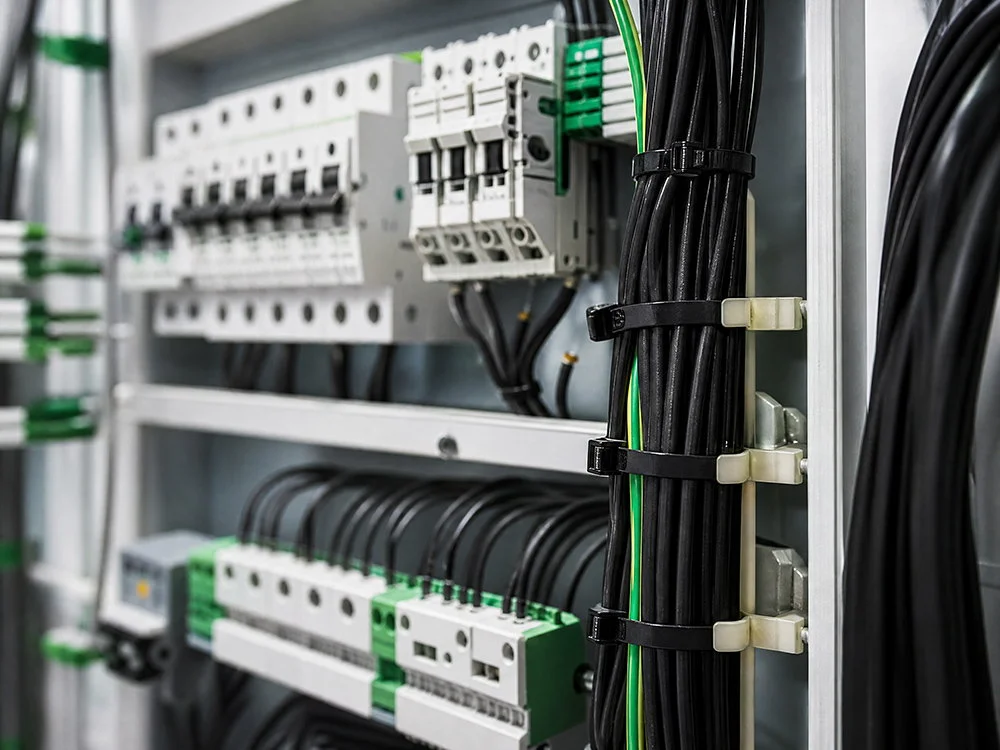
Yes. Coloured cable ties are used extensively in electrical panel enclosures as a means of bundling conductors and identifying them, as long as the cable ties are UL approved for use with these applications and the rated operating temperature inside the enclosure is within the requirement of the ties. The added benefits of using colours in wire bundle identification provide quick visual reference for maintenance personnel to more quickly troubleshoot and repair problems within the enclosure.
References
- National Fire Protection Association (NFPA) — Safety Colour Codes — Guidance on the use of colour in safety and hazard communication.
- American National Standards Institute (ANSI) — Safety Colours — ANSI Z535 colour code for safety signs, labels, and identification.
- Panduit — Coloured Cable Ties and Identification Solutions — Manufacturer of colour‑coded cable ties for electrical and data applications.
- HellermannTyton — Cable Management and Identification Products — Global supplier of coloured cable ties and identification systems.
- International Society of Automation (ISA) — Control Panel Wiring Standards — Guidance on colour coding and identification in industrial control panels.
Colored nylon cable ties are a simple tool with an outsized impact. A few cents’ worth of nylon, in the right colour, tells an electrician which circuit is live, a fire marshal which cables serve the alarm, and a maintenance technician which bundle to trace first. Applying colour coding consistently across an installation — and buying the right ties from a supplier who offers the full palette — turns cable management from an afterthought into a system that keeps paying back, every time someone opens the panel. igoto supplies the full range of coloured, UV‑stabilised, and UL‑listed cable ties to support that system, in the quantities and the specifications that commercial and industrial buyers need.