


How Do You Buy Good Zip Ties in India?
Getting zip ties in India is a simple task; getting good quality zip ties is the tricky part. Almost all electrical stores, hardware stores, wholesale markets, and online shops sell zip ties. Zip ties may be called by different names like cable ties, nylon cable ties, self-locking ties or केबल टाई. One may search for zip ties India online and find numerous results. The price of a packet of zip ties starts from ₹10 and can go up to several hundreds of rupees depending on various factors.
This article is meant to help anyone who is looking to buy cable ties, including electricians, solar and telecom installation teams, procurement teams, etc. It explains the local terminology used for the cable zip ties, the types of materials used, the climatic conditions affecting the cables, the applicable standards in relation to cable ties, and a list of things to be kept in mind while ordering zip ties in bulk.
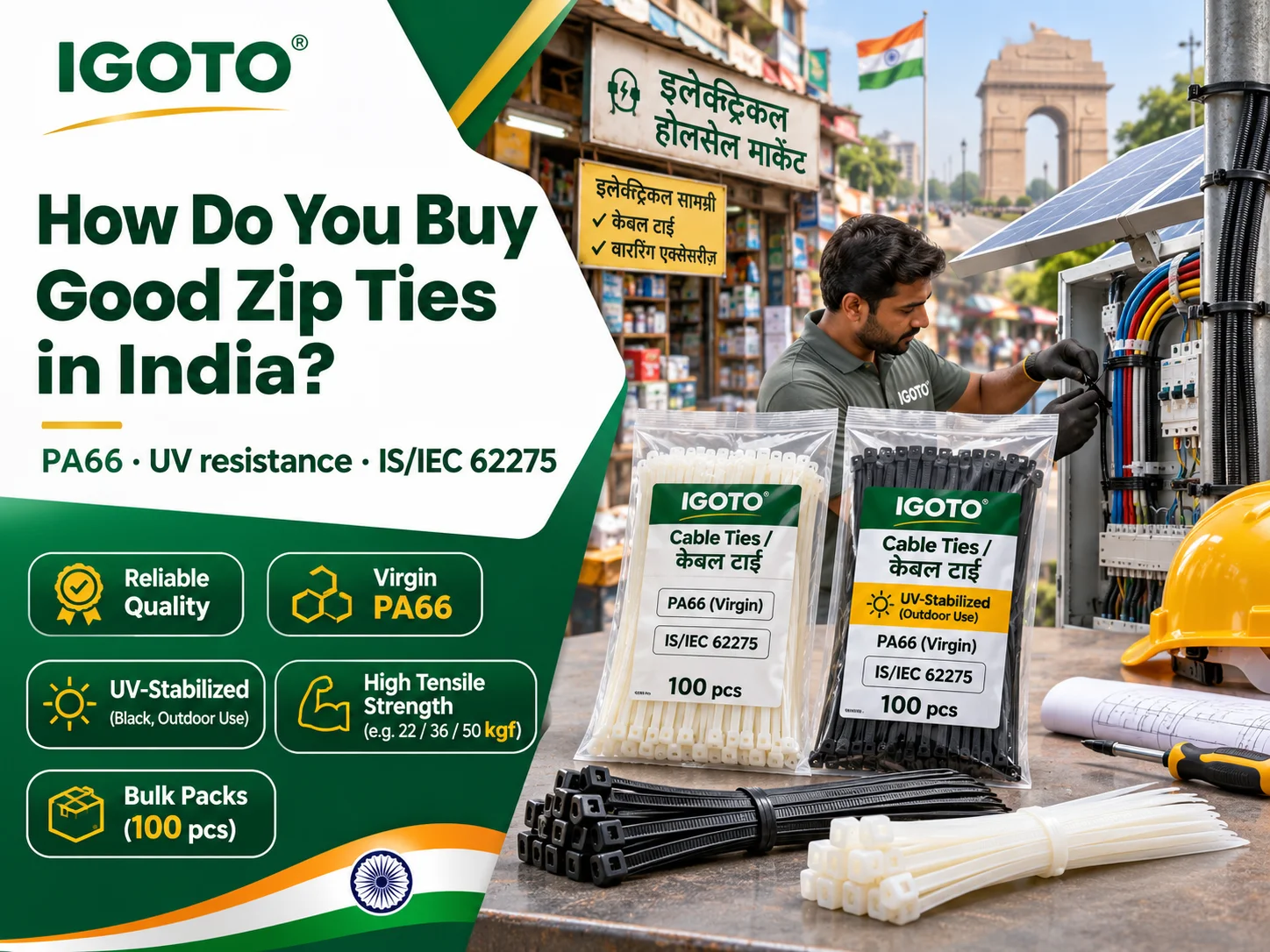
In India, zip ties are often referred to as cable ties or nylon cable ties and come packaged in lots of 100 according to the length in mm or inches, and with strength given in kgf. The quality of ties varies a lot between them, because they are formed from virgin nylon 6/6 (PA66), a cheaper nylon 6 (PA6) or mixtures including recycled materials. For reliable use in Indian conditions, especially outdoor solar, telecom and electrical work in hot weather exceeding 40 °C and intense UV radiation, it is better to use virgin PA66, UV stabilized and black when exposed to the sun, and choose ties with the tensile strength corresponding to the load. In India, the standard IS/IEC 62275:2018 officially adopted the IEC 62275 standard concerning the use of cable ties in electrical installations.
What Zip Ties Are Called in India
The terms related to cable ties are used frequently by Indian buyers and sellers. The following is a list of such terms:
due to the interchangeability of these terms.
Cable tie or nylon cable tie: Popular term in trade.
Zip tie: Term used by youngsters and in e-commerce.
Tie wrap or self-locking cable tie: More common in catalogs.
केबल टाई: This is the Hindi spelling of the term cable tie.
UV cable tie or black UV tie: For outdoor applications.
SS cable tie: Stainless steel ties made from grades such as 304 and 201.
The sizes are provided in both metric and imperial systems, e.g. 100 mm (4 inch), 150 mm (6 inch), 200 mm (8 inch), 250 mm (10 inch), and 300 mm (12 inch). The strength of these ties is often provided in kgf instead of pounds or newtons, e.g. 8 kgf for mini ties, 18 kgf for regular ties, and 55 kgf for heavy-duty ties. If you need a quick conversion between widths, lengths and strength classes, our cable tie sizes guide lays them out in both systems.
Where Zip Ties Are Bought in India
The venue determines the quality and price of zip ties, hence it is vital to understand how it works.
Local Electrical and Hardware Shops
The quickest option for small quantities. These stores typically stock standard black or white nylon in some of the most commonly used sizes. Quality depends entirely on the supplier of the shop and packages seldom mention material grade.
Wholesale Electrical Markets
In larger cities, you can find electrical goods wholesale markets where contractors come to buy goods in bulk. There are cheaper prices, bigger variety, and those who know the right questions can get good product. Those who don’t can easily fall into the trap of purchasing the cheapest grade.
B2B Marketplaces
Online B2B directories list thousands of manufacturers and traders, such as companies from established industry clusters (for example, companies from Ahmedabad). There are ways to compare the companies, but specifications and information on material, tensile strength and pack size is often missing from the listing, hence it is advisable to ask for a data sheet.
E-commerce
Retail sites sell mixed-pack and standard packages to households, hobbyists and home workshops. Though it is convenient for home renovations, it doesn’t suit projects where every batch should be the same.
Direct From Manufacturers and Importers
Panel manufacturers, solar installations, telecommunications installation companies and distributors usually buy directly either from India molders or import. The phase where specifications, test results and other qualities can be requested is now achievable.
The Real Quality Question: PA66, PA6 or Recycled
Two packets can look identical and perform completely differently. The reason is almost always the resin.
| Material | What it means | How it behaves |
|---|---|---|
| Virgin nylon 6/6 (PA66) | The industry-standard cable tie resin | Strong, flexible, good heat resistance, consistent locking |
| Nylon 6 (PA6) | A cheaper polyamide with a lower melting point | Usable indoors but softens sooner in heat and tends to lose grip faster |
| Recycled or blended nylon | Regrind mixed into new resin, often unlabeled | Variable strength, brittle batches, heads that crack or teeth that slip |
| UV-stabilized PA66 (black) | PA66 with carbon black or UV stabilizers | The outdoor grade for solar, telecom and rooftop work |
Why Indian Conditions Are Hard on Cable Ties
Heat
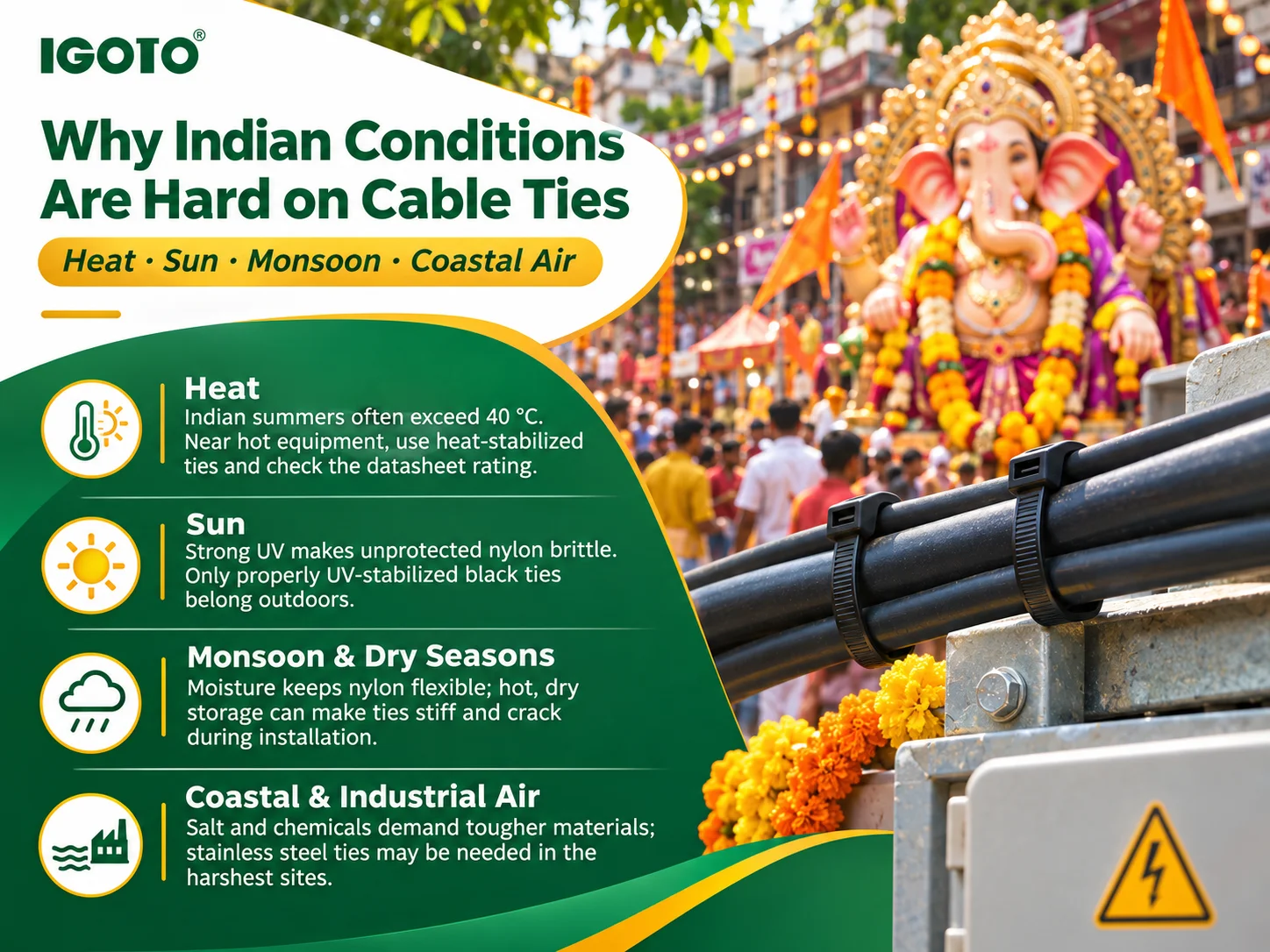
According to the India Meteorological Department, a heatwave is defined for plains as when the temperature reaches 40°C, which is a common occurrence in various parts of north and central India every summer. The temperature reaches higher limits in certain metal surfaces such as roofing, electrical enclosures and solar module frame. Normally, standard nylon 6/6 has a maximum temperature rating of around 85°C, but nylon 6 loses its stiffness before that temperature is attained. It is advisable to choose heat-stabilized nylon in the close proximity of hot machines.
Sun
Only properly UV-stabilized ties belong outdoors. Our UV resistant black cable ties are made for this kind of exposure, and our guide to the best zip ties for outdoor use explains when to step up to stainless steel.
Monsoon and Dry Seasons
Moisture of the atmosphere is absorbed by nylon, which makes it remain flexible. Except for fresh conditions when humid monsoon rains act in favor of it, the stored ties in godowns in the hot dry weather of northern India become stiff and crack after being used. Proper treatment and storage of nylon strips will help to prolong their service life.
Coastal and Industrial Air
This paragraph talks about ports, refineries, fertilizer plants and coastal solar power generation facilities which cause salt and chemicals to become a part of the environment. While nylon is able to withstand the elements, any metal components and steel-pawl ties must be made of specially treated materials that can withstand the adverse conditions experienced in these types of environments.
Where Cable Ties Are Used Across India
- The sector of solar power is expanding and India’s renewable energy capacity is reaching over 288 GW by the middle of 2026, according to the news from the Ministry of New and Renewable Energy. Approximately twenty-five percent of this capacity is accounted for by solar energy. In the first semester of the year the country is developing solar installations at a historically high level. All solar parks and rooftop installations require a great number of cable ties (thousands) to connect cable trays, solar panels, and wiring installations.
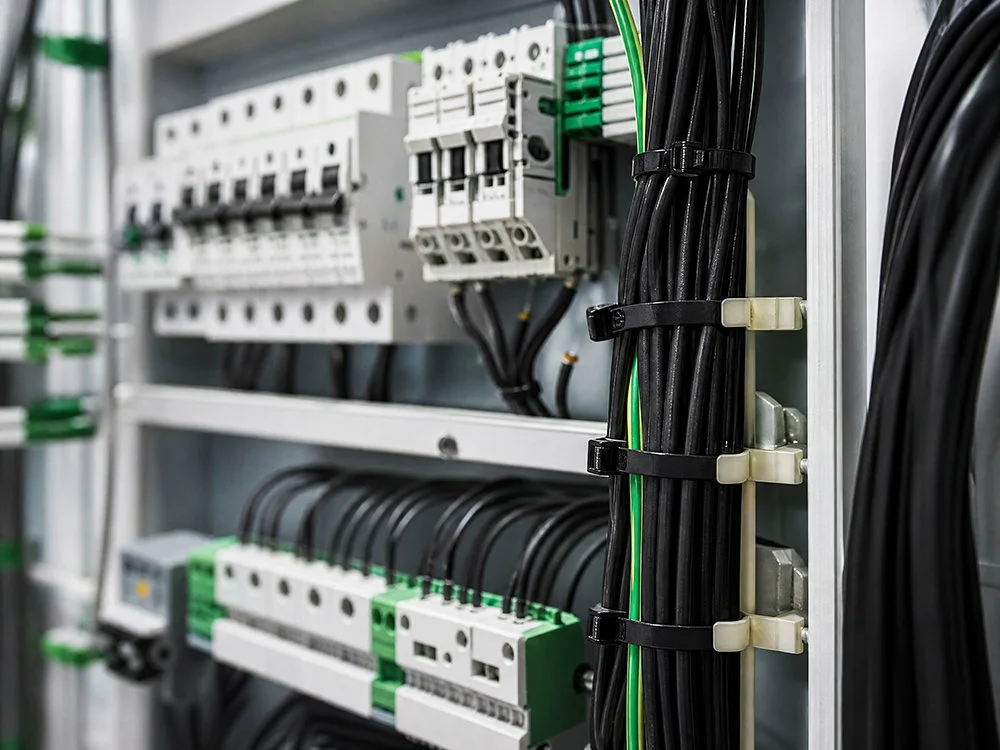
- Electrical panels and switchgear. Panel builders and OEMs use natural PA66 ties for internal wiring harnesses, often with adhesive or screw mounts; see our guide to mountable cable ties for those options.
-
Cable ties are also being used in electrical panels and switchgear.Ties are also being used widely in cars and motorcycles.Agriculture utilizes cable ties for drip irrigation systems.A big number of cable ties can be found on construction sites as well as at various events.Lastly, homes and offices also use cable ties for various purposes starting from the installation of electric appliances and ending up with some fixes at households.
Common Sizes and What They Are Used For
| Size (width x length) | Approx. inches | Typical strength | Common uses |
|---|---|---|---|
| 2.5 x 100 mm | 4 in | 8 kgf (18 lb) | Electronics, small wire bundles, labels |
| 3.6 x 150 mm | 6 in | 18 kgf (40 lb) | Panel wiring, computer cables |
| 4.8 x 200 mm | 8 in | 22 kgf (50 lb) | General electrical, solar string wiring |
| 4.8 x 300 mm | 12 in | 22 kgf (50 lb) | Cable trays, conduit, outdoor runs |
| 7.6 x 370 mm and wider | 14.5 in+ | 54 kgf (120 lb) and up | Heavy cables, pipes, fencing, industrial use |
Strength figures vary by manufacturer, so treat the table as a guide and confirm the rating on the datasheet. For most electrical and solar work, a 4.8 mm tie in the 22 kg class, such as our high strength cable tie, is the workhorse size.
The Indian Standard for Cable Ties
The Bureau of Indian Standards has approved the international cable tie standard as IS/IEC 62275:2018, which is called Cable management systems – Cable ties for electrical installations. This is the same as IEC 62275, replacing the previous version dated 2013. The standard contains issues like classification, marking, as well as tests like loop tensile strength, temperature performance, and for UV resistant ties weathering.
In recent years, India has been issuing Directives on Quality Control for many types of cables and electrical goods, and the list is continuously expanding. Be sure to check the latest Bureau of Indian Standards QCO list when importing or selling cable ties for a regulated application. For the United States projects, UL 62275 is equivalent to the standard in question, while many buyers are concerned about UL 94 flammability rating, as well.
Sourcing Zip Ties for Indian Projects
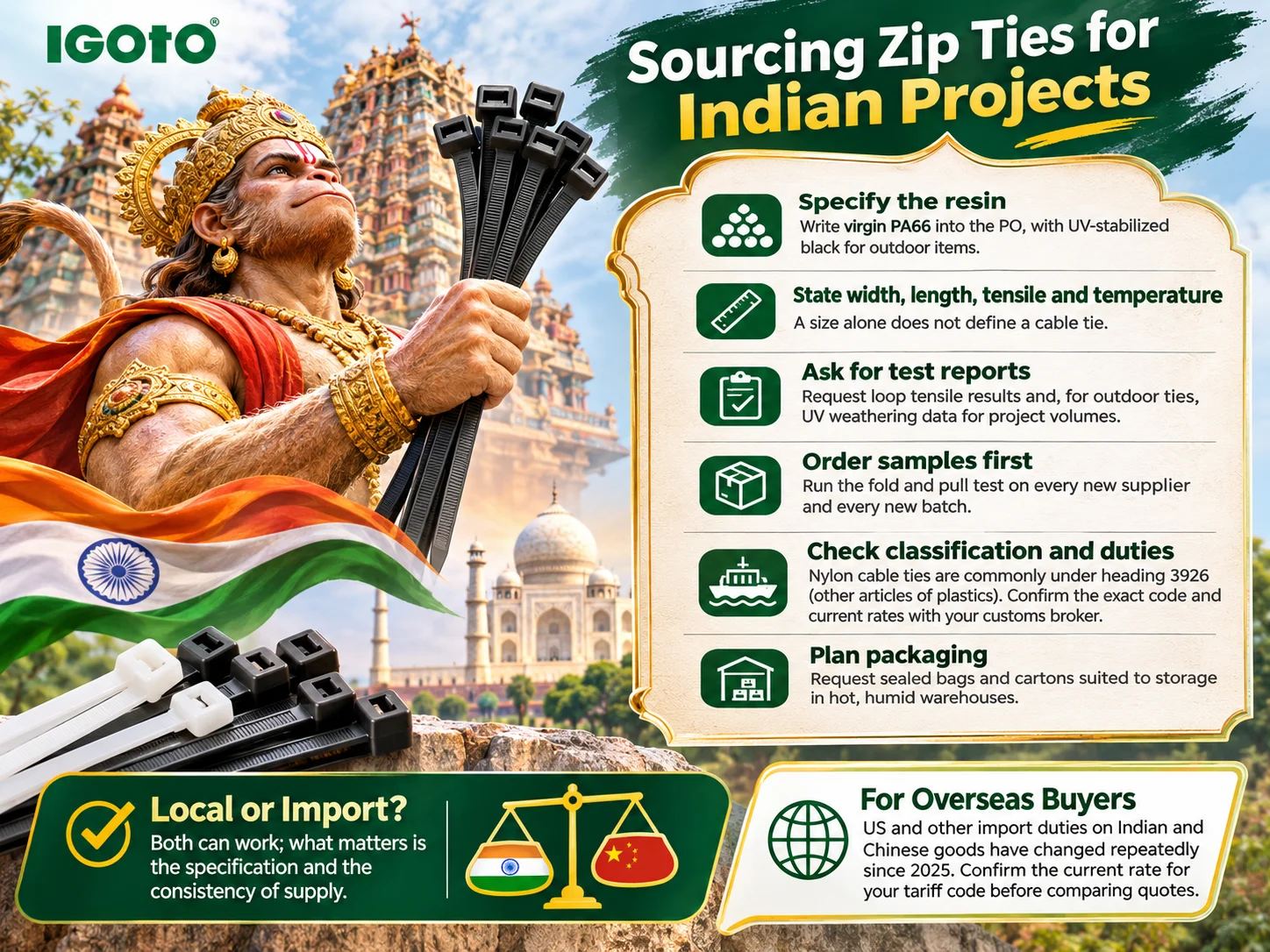
Installation Tips for Indian Job Sites
- Use a tensioning tool on large jobs. Consistent tension stops ties from cutting into cable insulation on solar strings and panel harnesses. Our guide on how to use a zip tie gun covers setting it correctly.
- Cut tails flush. Sharp tails on rooftops and in panels cause cuts during maintenance. The methods in our guide on how to cut cable ties leave a smooth edge.
- Never mix white and black ties outdoors. A single indoor-grade tie in an outdoor run becomes the first failure.
- Remove failed ties completely. When a tie has snapped or slipped, cut it off cleanly rather than adding a new tie beside it; our guide on how to remove cable ties shows how to do it without nicking the insulation.
- Leave room for expansion. On long outdoor cable runs, do not cinch ties so tightly that cables cannot move as they heat and cool through the day.
Frequently Asked Questions
What are zip ties called in India?
Most people say cable ties or nylon cable ties. Zip tie, tie wrap and self-locking tie are also common, and the Hindi spelling is केबल टाई.
Why are some cable ties in India so cheap?
Very low prices usually mean nylon 6 or recycled material instead of virgin nylon 6/6, thinner sections, or fewer ties per packet. They may be fine for light indoor use but tend to fail early outdoors or in heat.
Which cable ties are best for solar installations in India?
UV-stabilized black PA66 ties with a temperature rating suited to rooftop conditions, or stainless steel ties for the harshest locations. White or natural ties should not be used in sunlight.
Is there an Indian standard for cable ties?
Yes. IS/IEC 62275:2018 is identical to the international IEC 62275 standard for cable ties used in electrical installations.
How are cable tie sizes written in India?
Usually width by length in millimeters, such as 4.8 x 300 mm, often with the inch length alongside. Strength is commonly shown in kgf.
References
- IS/IEC 62275:2018, Bureau of Indian Standards
- India adds record 29 GW solar, wind in first half of 2026, Down To Earth
- Heat wave information explainer, Citizen Matters
- Cable tie, Wikipedia
Conclusion
The challenging part while obtaining zip ties in India is not in the procurement but in assurance of the best choice. Prefer paying for virgin PA66 rather than the cheapest pack, use UV-stabilized black ones for everything outdoors, make sure that the width and class are suitable for the load in question and check samples every time before ordering. This way, one will end up with a rub of only ₹50, which can last through Indian weather extremes.