


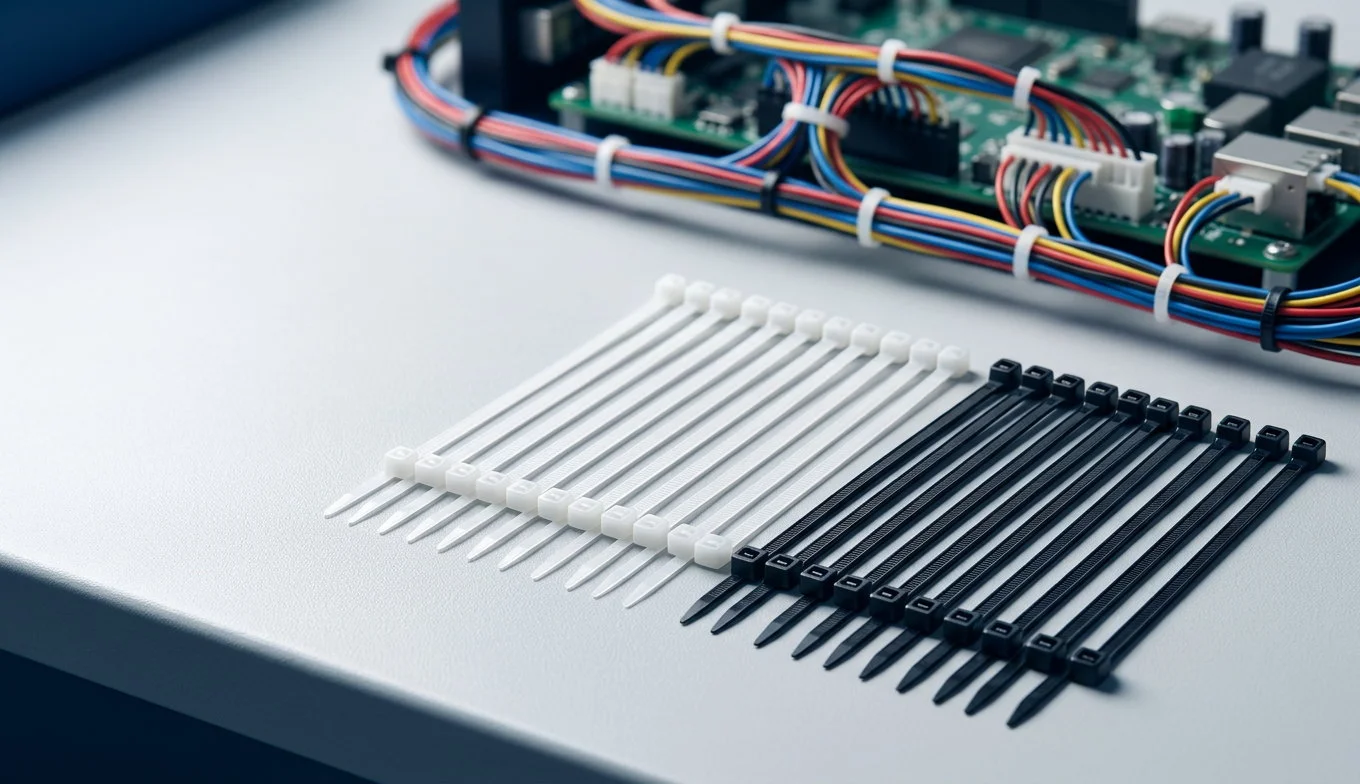



Cable Tie Sizes: A Complete Guide to Choosing the Right Dimensions
When an electrician finds himself in the aisle of a supply shop and catches himself in the middle of a wall of cable ties, he can see the colours and different brands but mostly thinks about the numbers: 4’’ inch, 8’’ inch, 14’’ inch; 18 lbs., 50 lbs., 120 lbs.; The size of a cable tie (in length, width, tensile strength, etc.) is critical in distinguishing between whether it will secure light Cat6 patch leads or heavy armoured cable assembly. Choosing the wrong size of a cable tie has been the most frequent mistake in the context of cable ties, and it is a common mistake which does not actually require one making a complex decision process.
How Cable Tie Sizes Are Defined
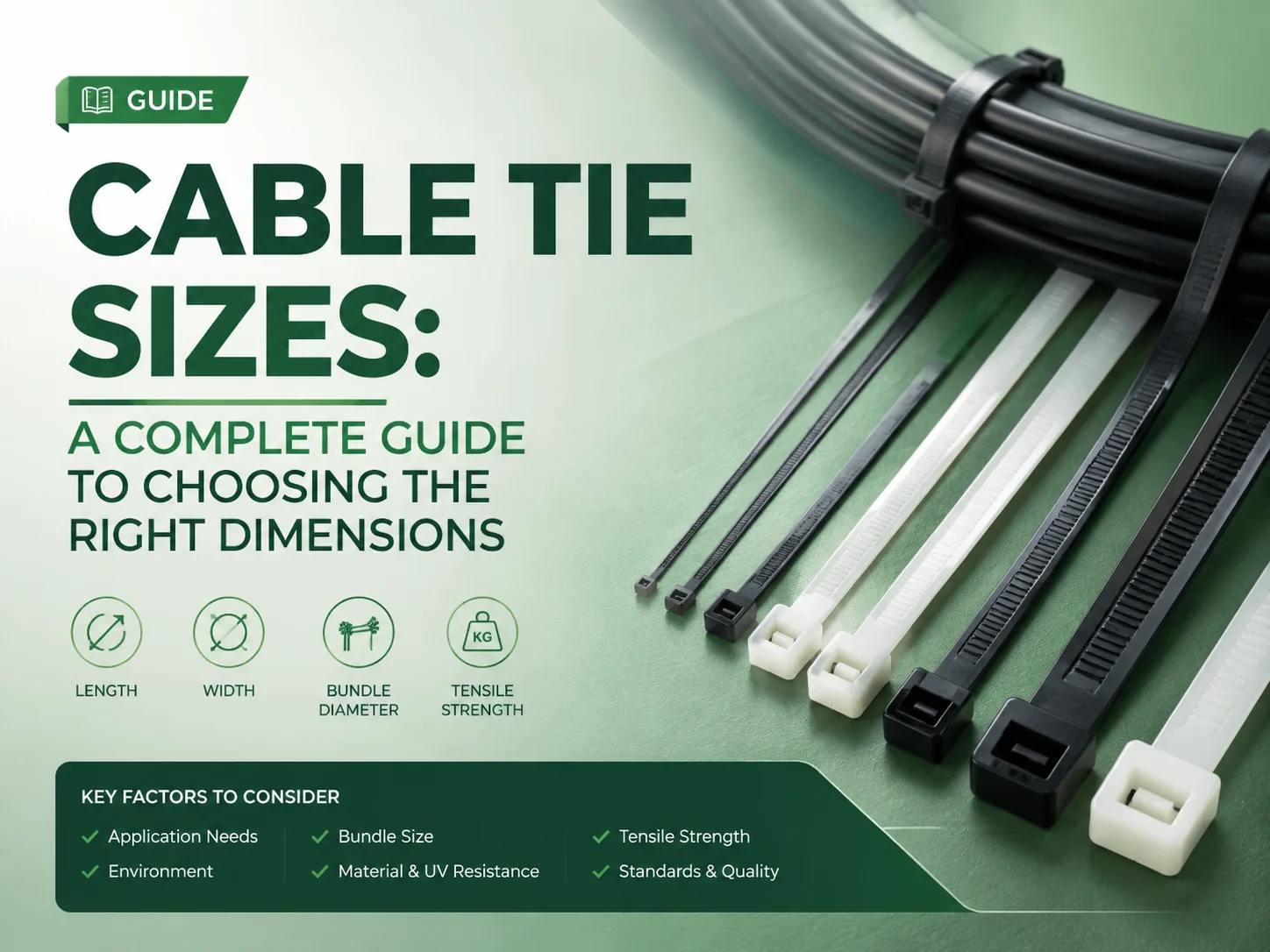
You can describe each type of cable tie using two main parameters — its length and width measurements — as well as its performance rating according to its minimum tensile strength. The length indicates the size limit for the cable tie and the maximum diameter that can be secured. Measured together with the thickness of the material of the cable tie, the width will provide you with information about the strength of the product — the amount of force it can face before getting broken. All these measurements are accepted in the industry, and consequently you will find an 8-inch cable tie of 50 pounds’ strength produced by one reputable brand with the same features as a cable tie produced by another company engaged in the manufacturing of cable ties.
The length is determined by the distance from the end of the tail to the rear of the locking head. The width is determined by how wide the strap is. The tensile strength indicates the amount of weight, in pounds or newtons, that a tie can withstand in a ‘pull-test’ — usually performed according to UL 62275 or MIL-STD-23190. This figure is shown on the package and it is the one to which the installer must compare the weight and tension of the bundle. If one wants to learn more about how this strength is built into the nylon, they can refer to the guide on nylon cable ties.
Metric vs. Inch: The Two Measurement Systems
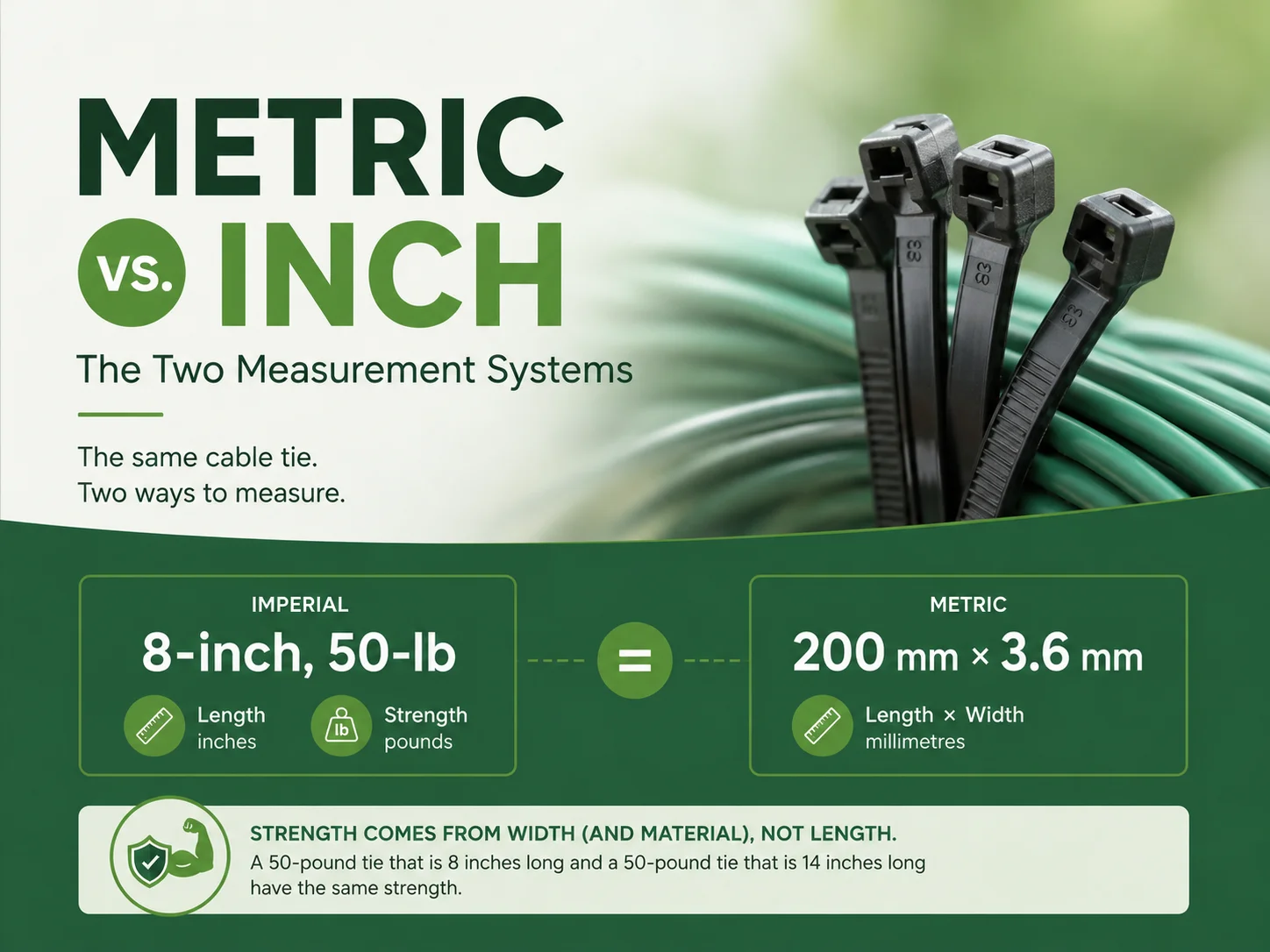
Cable tie sizes specification can be in terms of both metric (millimeters) and imperial more particularly in inches while the labeling format varies from one producer to another and according to the region of sale. For instance, a tie offered for sale in Europe will typically be labeled as “200 mm × 3.6 mm” — length first before width while in North America it will be sold as “8‑inch, 50‑lb” — the length in inches and the tensile strength in pounds. The table below provides a simple cross‑reference between the two systems of measurement for common tie sizes.
| Imperial Label | Metric Equivalent (L × W) | Tensile Strength (lb / N) |
|---|---|---|
| 4‑inch, 18‑lb | 100 mm × 2.5 mm | 18 lb / 80 N |
| 6‑inch, 40‑lb | 150 mm × 3.6 mm | 40 lb / 178 N |
| 8‑inch, 50‑lb | 200 mm × 3.6 mm | 50 lb / 222 N |
| 8‑inch, 75‑lb | 200 mm × 4.8 mm | 75 lb / 334 N |
| 12‑inch, 50‑lb | 300 mm × 3.6 mm | 50 lb / 222 N |
| 12‑inch, 120‑lb | 300 mm × 7.6 mm | 120 lb / 534 N |
| 14‑inch, 50‑lb | 360 mm × 3.6 mm | 50 lb / 222 N |
| 14‑inch, 120‑lb | 360 mm × 7.6 mm | 120 lb / 534 N |
| 24‑inch, 120‑lb | 610 mm × 7.6 mm | 120 lb / 534 N |
| 48‑inch, 250‑lb | 1,220 mm × 12.7 mm | 250 lb / 1,112 N |
Note that tensile strength is a function of the strap’s cross‑sectional area — its width and thickness — not its length. A 50‑pound tie that is 8 inches long and a 50‑pound tie that is 14 inches long have the same strength; the extra length simply accommodates a larger bundle diameter. This is a common point of confusion: a longer tie is not a stronger tie. The strength comes from the width and the material, not from the length.
Standard Cable Tie Sizes and Their Applications
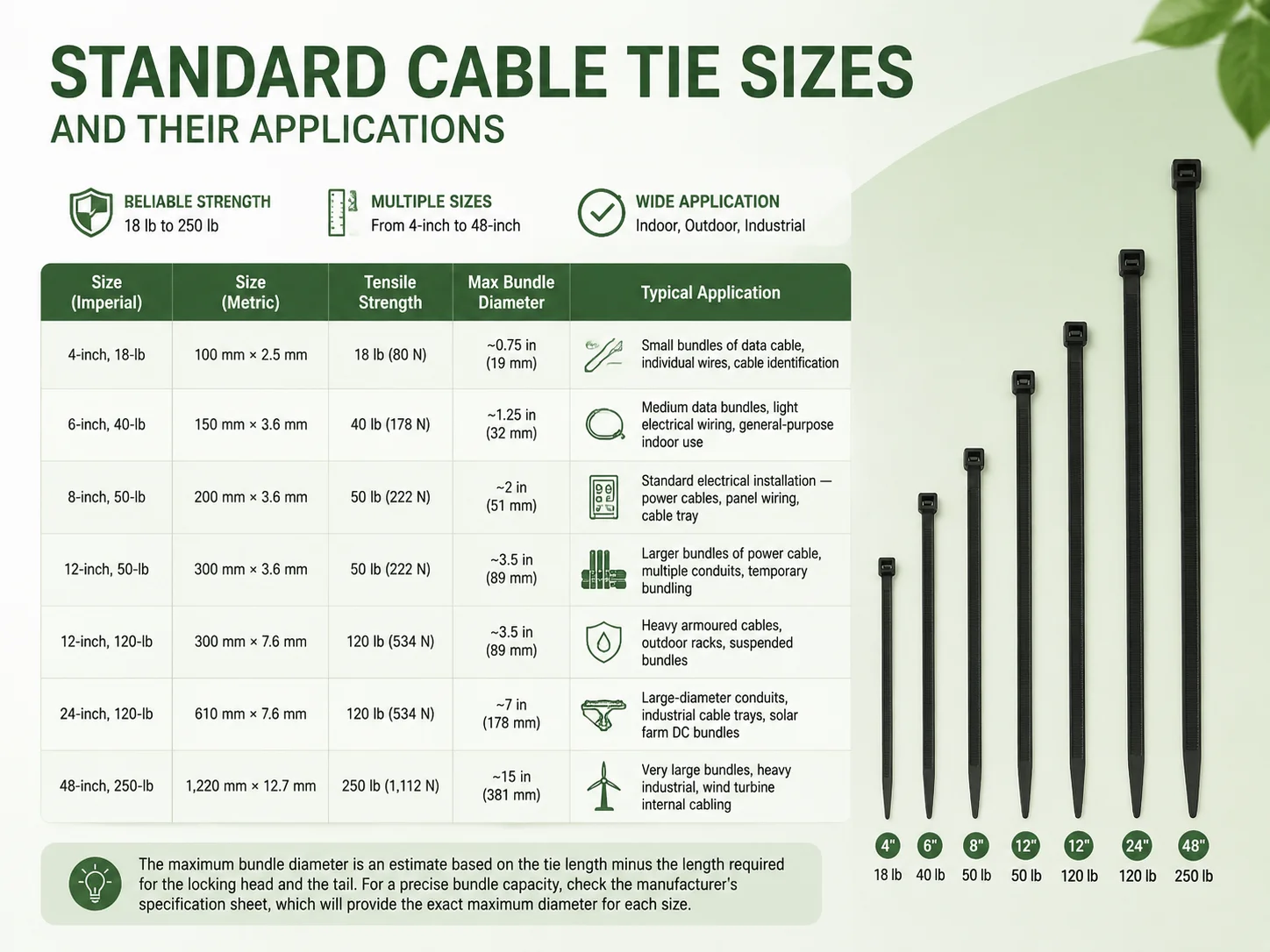
Most electrical supply stores, industrial suppliers, and online merchants sell the 4-inch, 8-inch, and 12-inch cable ties in the 18-pound, 50-pound, and 120-pound classes. With these, practically all cable tie needs can be satisfied. The table below shows the relationship between the most common cable tie sizes and their typical uses.
| Size (Imperial) | Size (Metric) | Tensile Strength | Max Bundle Diameter | Typical Application |
|---|---|---|---|---|
| 4‑inch, 18‑lb | 100 mm × 2.5 mm | 18 lb (80 N) | ~0.75 in (19 mm) | Small bundles of data cable, individual wires, cable identification |
| 6‑inch, 40‑lb | 150 mm × 3.6 mm | 40 lb (178 N) | ~1.25 in (32 mm) | Medium data bundles, light electrical wiring, general‑purpose indoor use |
| 8‑inch, 50‑lb | 200 mm × 3.6 mm | 50 lb (222 N) | ~2 in (51 mm) | Standard electrical installation — power cables, panel wiring, cable tray |
| 12‑inch, 50‑lb | 300 mm × 3.6 mm | 50 lb (222 N) | ~3.5 in (89 mm) | Larger bundles of power cable, multiple conduits, temporary bundling |
| 12‑inch, 120‑lb | 300 mm × 7.6 mm | 120 lb (534 N) | ~3.5 in (89 mm) | Heavy armoured cables, outdoor racks, suspended bundles |
| 24‑inch, 120‑lb | 610 mm × 7.6 mm | 120 lb (534 N) | ~7 in (178 mm) | Large‑diameter conduits, industrial cable trays, solar farm DC bundles |
| 48‑inch, 250‑lb | 1,220 mm × 12.7 mm | 250 lb (1,112 N) | ~15 in (381 mm) | Very large bundles, heavy industrial, wind turbine internal cabling |
The maximum bundle diameter is an estimate based on the tie length minus the length required for the locking head and the tail. For a precise bundle capacity, check the manufacturer’s specification sheet, which will provide the exact maximum diameter for each size. Leading manufacturers such as Panduit and HellermannTyton publish detailed dimensional data for every tie in their catalogues.
How to Measure Cable Tie Size
To determine the size of an unmarked cable tie, you need a ruler and a set of calipers. Measure from the end of the tail to the locking head in order to get the length. Measure width of the strap to calculate its size. Compare your measurements to the first table to find a size that fits best. In order to find tensile strength, you have to know the width and the material. A 3.6 mm nylon 6/6 cable tie will be equal to a fifty-pound pull. A 7.6 mm nylon 6/6 cable tie will belong to the category of one-hundred twenty-pound ties.
What Are Type 2S and Type 21S Cable Ties?
Type 2S and Type 21S are military standards regarding the different cable ties as per MIL‑STD‑23190 and MIL‑S‑23190. The types outline a set of requirements that are more stringent than the requirements for conventional commercial cable ties. The Type 2S cable tie is a miniature to intermediate tie, whereas the Type 21S cable has a larger grip strength due to its design. The types are used in different settings, including environments that are subject to vibration, temperature extremes, and other challenges in the field of aerospace and defense. The cables ties are also manufactured from nylon that has been heat stabilized or is flame retardant to ensure quality.
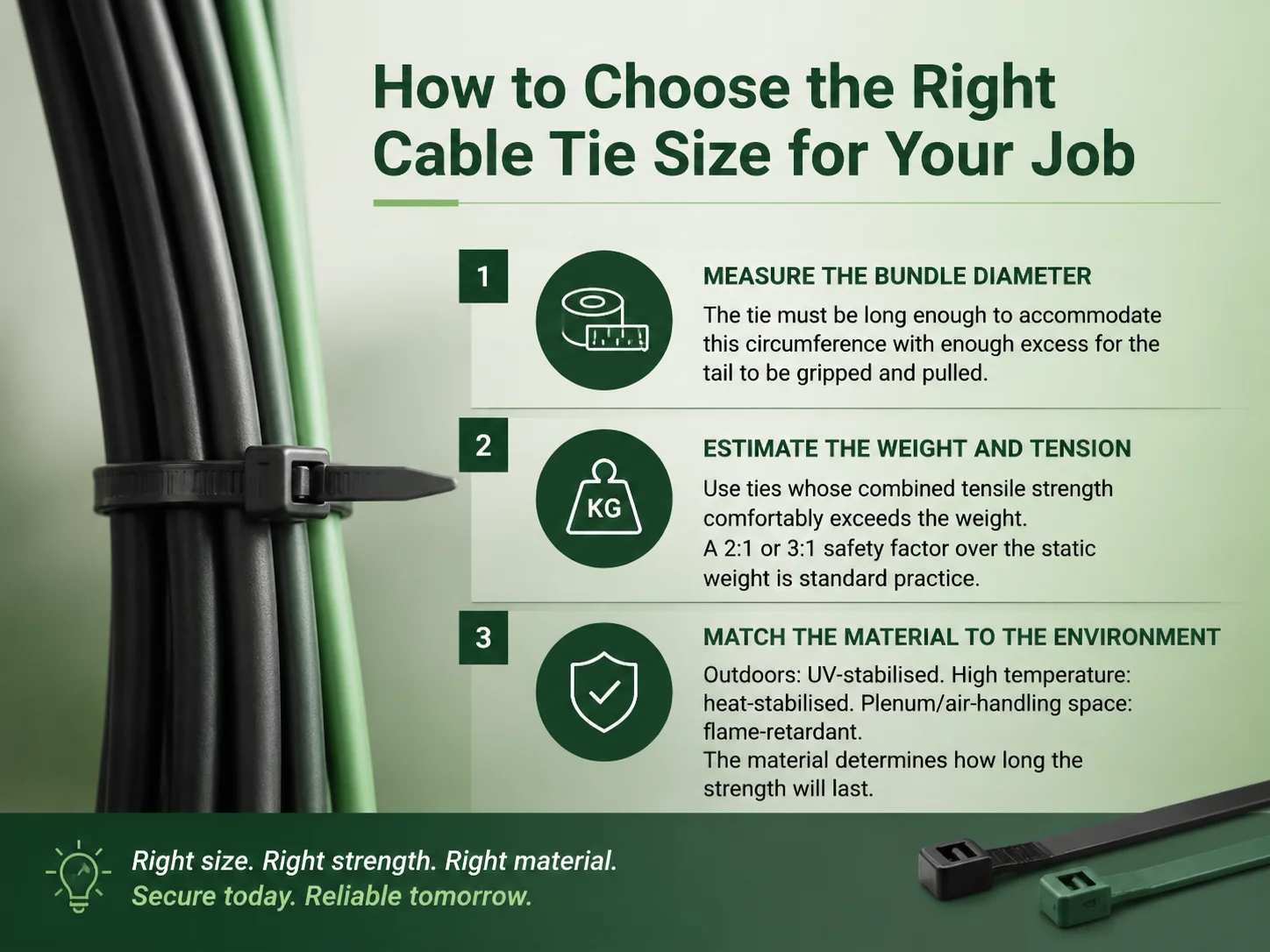
How to Choose the Right Cable Tie Size for Your Job
Selecting the correct cable tie size is a three‑step process:
- Measure the bundle diameter. Wrap a piece of string or a flexible tape around the bundle, then measure the length. The tie must be long enough to accommodate this circumference with enough excess for the tail to be gripped and pulled. A tie that is too short will not reach around the bundle; one that is far too long leaves an excessive tail that must be trimmed.
- Estimate the weight and tension the tie will carry. A vertical bundle supported only by cable ties must be secured with ties whose combined tensile strength comfortably exceeds the weight. A bundle that will be pulled, vibrated, or exposed to wind needs an additional safety margin. A 2:1 or 3:1 safety factor over the static weight is standard practice.
- Match the material to the environment. Outdoors, select a black UV‑stabilised tie. In a high‑temperature enclosure, select a heat‑stabilised tie. In a plenum or air‑handling space, select a flame‑retardant tie. The size and strength are only part of the equation; the material determines how long that strength will last.
Frequently Asked Questions
What size are standard cable ties?
The most popular type of cable tie is the 8-inch, 50-pound one (200 mm × 3.6 mm). This size is enough for doing the major part of electrical installations like bundling up power cables together, securing cables to the tray and wiring in general. Light duty bundling is done using the 4-inch, 18-pound tie while heavy-duty tasks are accomplished with the help of the 12-inch, 120-pound cable tie.
How to measure cable tie size?
To determine the length of a cable tie, measure it from the end of the tail to the edge of the locking head. In terms of the width, measure across the cable tie at its widest point. Compare these lengths to a manufacturer’s size chart to determine the respective standard size of the tie. The tensile strength of the cable tie can be determined either from the width measurement or from the manufacturer’s specification.
What is the size of a standard tie?
The standard electrical tie is an 8-inch (200 mm) tie that can handle 50 pounds (222 N) of tensile strength and is about 3.6 mm (0.14 inch) wide. This type of tie is usually employed for most types of bundling and securing purposes.
What is Type 2S and Type 21S cable ties?
Type 2S Type 2S and Type 21S are the designations by MIL-SPEC for cable ties, which are used in military and aerospace applications. Type 2S is a standard profile tie while Type 21S is heavy‐duty or high‐strength tie. MIL-SPEC ties are manufactured using stricter tolerances and full lot traceability compared to standard commercial ties.
References
- Panduit — Cable Tie Sizes and Specifications — Manufacturer of a full range of cable ties with published dimensional and strength data for every size.
- HellermannTyton — Cable Tie Product Data — Technical specifications for standard, heavy‑duty, and specialty cable ties in metric and imperial sizes.
- UL 62275 — Cable Management Systems — The standard that defines testing and rating requirements for cable ties, including tensile strength measurement.
- MIL‑STD‑23190 — Military Specification for Cable Ties — The U.S. Department of Defense standard defining dimensional and performance requirements for military‑grade cable ties.
Cable tie sizes are a language of their own — 4‑inch, 18‑pound; 8‑inch, 50‑pound; 12‑inch, 120‑pound — but the translation is simple. Length determines how much the tie can wrap. Width, combined with material, determines how much it can hold. Matching the two to the bundle in your hand takes seconds and prevents the two most common failures: a tie that is too short to close, and a tie that is too weak to hold. igoto supplies the full range of sizes, from 100 mm to over a metre, in the materials and colours that every indoor, outdoor, and industrial installation demands — because the right tie, in the right size, is the one that does its job and is never thought about again.