

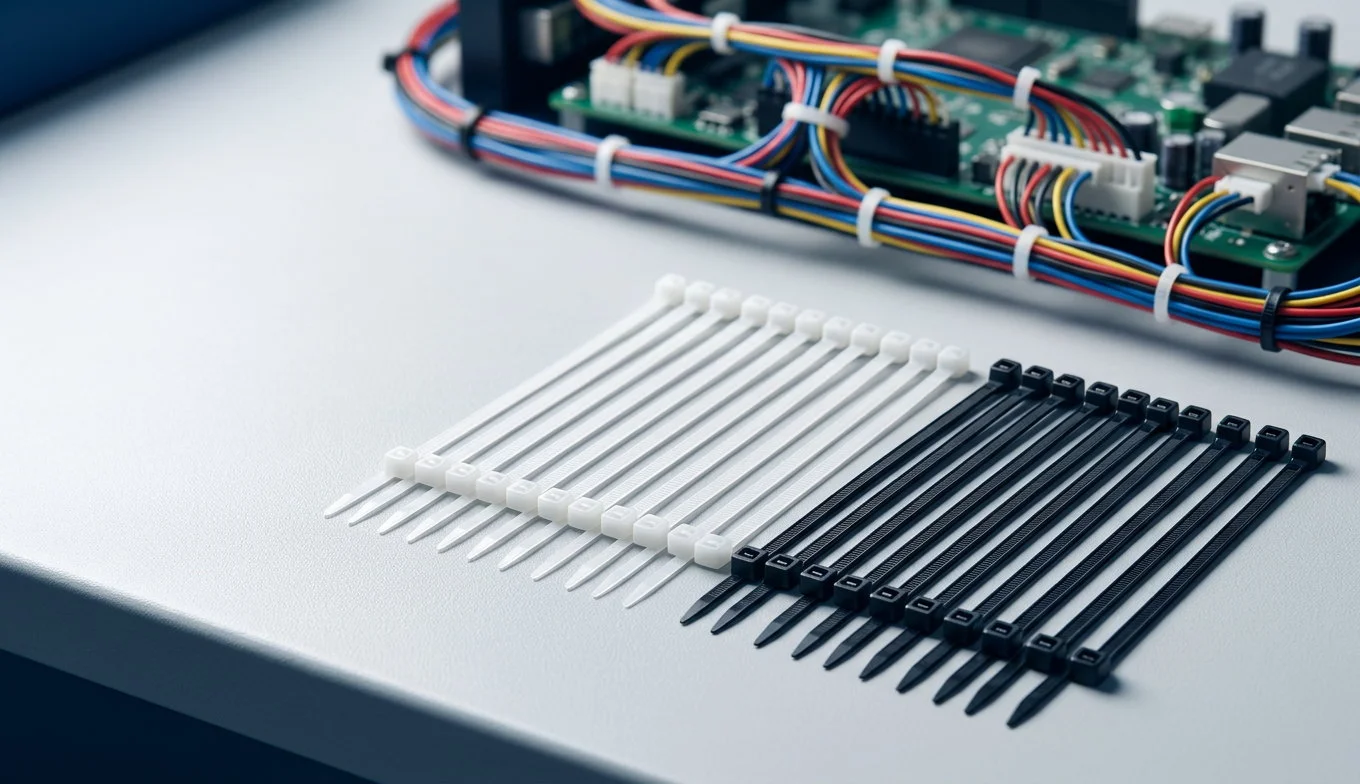

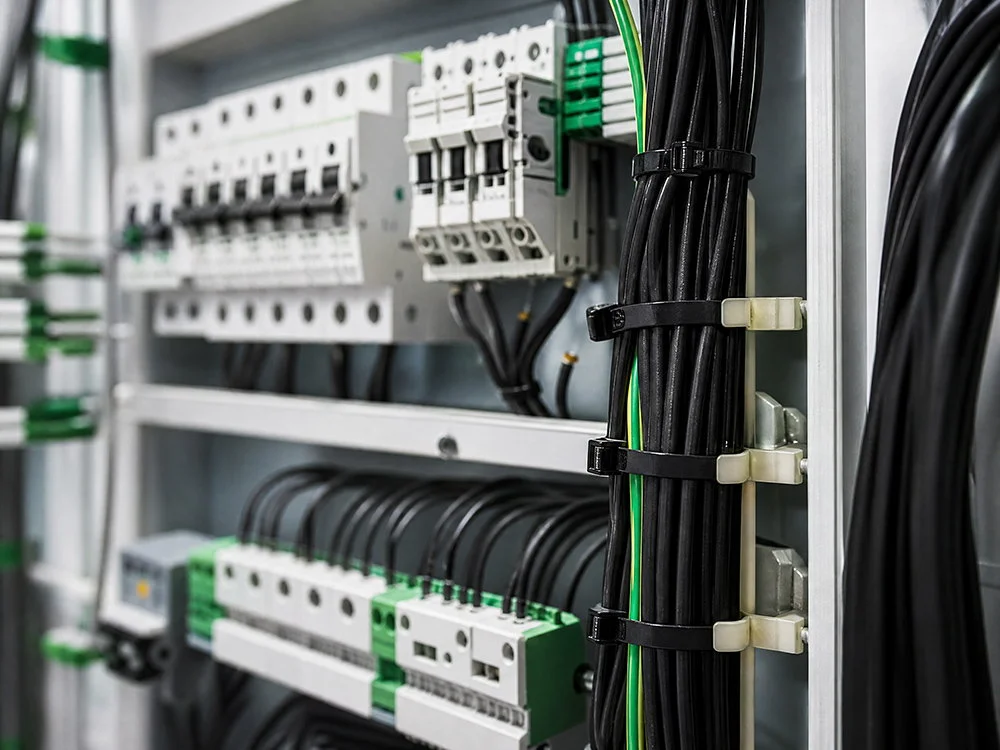

Industrial Cable Ties for Typhoon Storm Safety
The southeastern part of Asia is confronted with super typhoons annually from July to September. When the typhoons make first contact with the land, it becomes critical to give temporary support to outdoor structures and equipment, which is done using industrial cable ties.Policymakers and employees must know how to use industrial cable ties properly. These ties are not only used for securing electrical wires but are also in malls, stores, and factories for securing containers of goods stacked on top of each other during the storms.
When it comes to typhoons, industrial cable ties are typically made of black nylon 6/6 that is UV-resistant. In places near the sea or that might be exposed to a lot of wind, stainless steel of 316 grade is preferred. The choice of tie is dependent on the local conditions. The size of the tie is made bigger than required to avoid sudden breakage in case of sudden winds and shocks. Metal ties should never come in contact with live wires, however.
Why a Typhoon Is a Stress Test for Cable Management
There is a need to keep a calm day close to the memory as it usually provides chances of observing bad fastening decisions. It is worth realizing that everything should be checked during a typhoon. This is due to the existence of three forces that work together during a violent storm and an ideal fastening system should be able to face all of them.
The first one is a dynamic wind load. Static pressure is different as it is non-continuous pressure and at times it can perform hundreds of actions within an hour, making it quite hard to do the fatigue test. This is why even a good fastening system as it succeeded in calm weather may fail during the typhoon due to improper design. The second one is moisture – rain or salty spray that influence everything. The third one is temperature difference, which makes the cable hot and cold at the same time.Thus, the essence of storm-proof cable management is material selection.Our guide on how to choose the right cable ties walks through that selection logic in general terms; here we apply it specifically to typhoon and high-voltage work.
Where Industrial Cable Ties Earn Their Keep in a Typhoon
During hurricane conditions, industrial cable ties play three different roles, each role having different requirements for cable ties.
- Securing the materials. In advance of the hurricane, workers have 24 to 48 hours before the hurricane strikes, during which they must go to substations, lines on poles, units on the roofs, and outdoor cabinets and secure the materials. Loose conduits are tied to the trays, as well as the loops of service cables, and signs are also immobilized to stay where they are during the hurricane. The top priority is to secure those things that can be blown away by the wind and can eventually become dangerous objects that can hurt someone.
- Making repairs. As soon as a fault happens, the utility workers have to go into poor weather conditions and carry out all the repairs they can with the help of cable ties, which substitute for their proper use. The cable ties used in these conditions should have their specific characteristics.
- Water activities. Ground level, electrical equipment can spend hours or even days half immersed in water. This is why the cable ties used in such conditions should be made of highly water resistant materials.
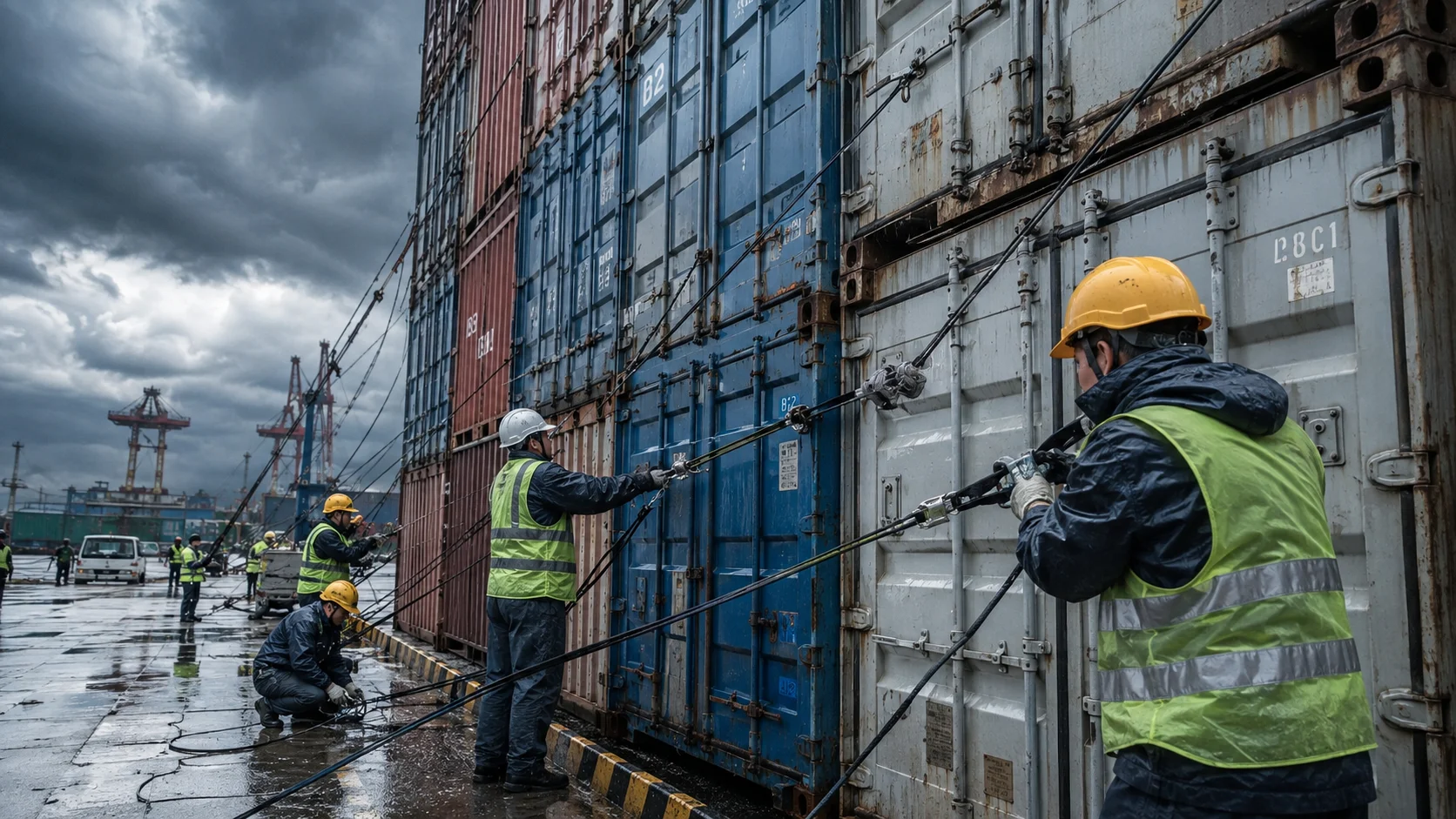
Across all three jobs, one principle holds: a cable tie organises and restrains cable — it is not a structural support. In high wind especially, do not hang the weight of heavy equipment from a run of ties. For suspended or load-bearing duty, step up to a rated clamp or bracket; our overview of the alternatives to cable ties covers metal clamps, cushioned P-clips, and lacing options for exactly that situation.
Choosing the Material: Nylon, 304, or 316?
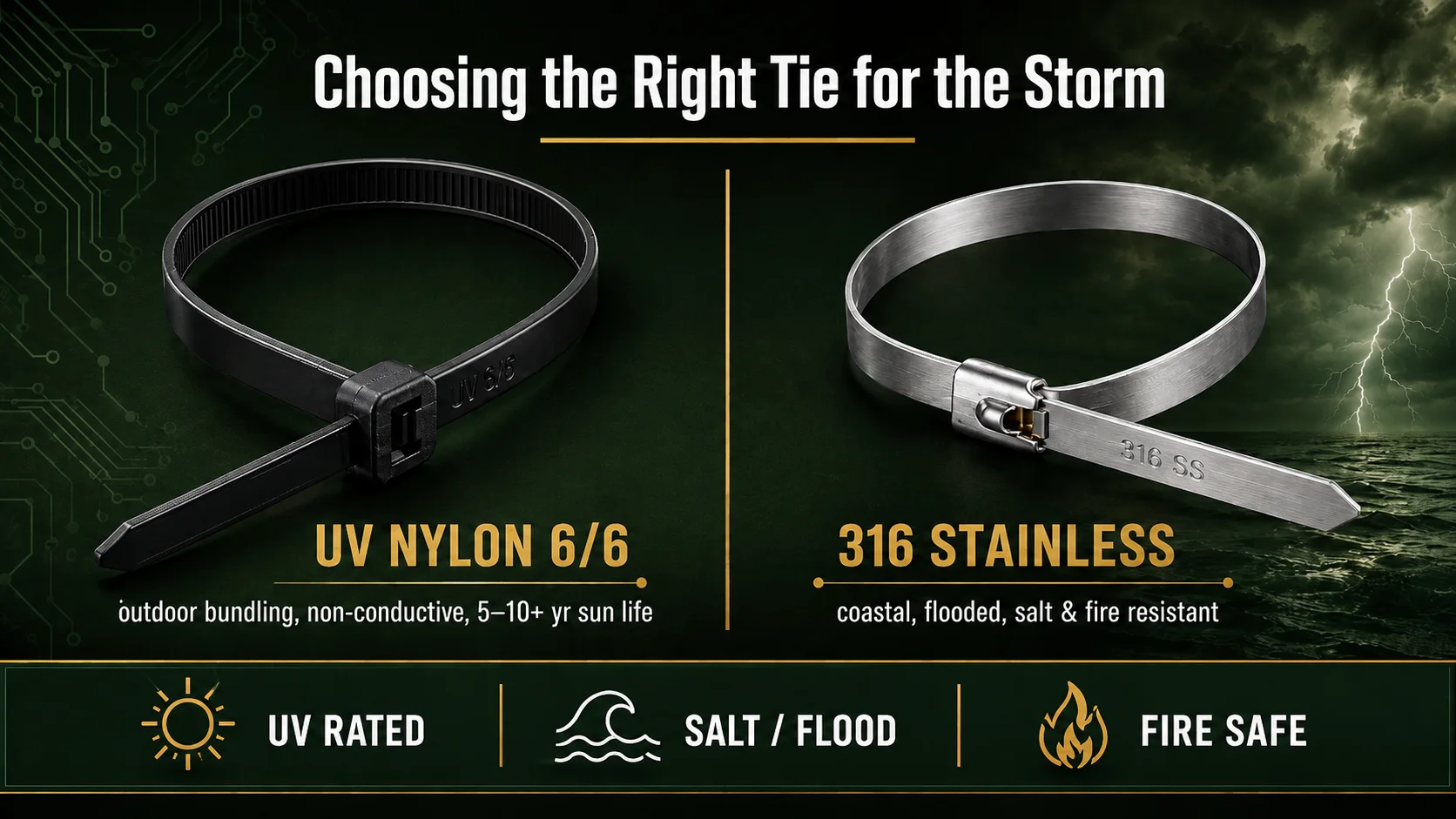
When it comes to storm and outdoor electrical work, there are three main types of materials to consider. First is translucent nylon, which is perfect for indoor work, but not suitable for any outdoor applications. Natural sunlight can cause nylon to become brittle after only a short amount of time.
Industrial cables made with nylon 6/6 and small amounts of carbon black are a huge improvement over nylon. Carbon absorbs UV radiation, which means the tie will not be affected by the sun. For this reason, industrial cable ties are mostly black, as black is the most commonly used color for outside applications. Industrial cable ties are also safe for use around electricity, as they are not conductive.
Stainless steel cable ties made from 304 or 316 grade stainless steel. These cables will not be affected by UV rays or fire at all. Grade 304 is the most common type of stainless steel for use, while grade 316 is the type that will keep anyone safe from environmental hazards like salt, chlorine, or filthy water. The downside of using stainless steel, however, is that it costs more than nylon, requires the use of a special tool to ensure a tight fit, and will conduct electricity. For a full head-to-head, our comparison of stainless steel zip ties vs nylon cable ties breaks down every performance dimension.
| Property | UV-stabilised nylon 6/6 | 304 stainless steel | 316 stainless (marine) |
|---|---|---|---|
| Best storm use | General outdoor bundling, sun-exposed runs | Industrial sites, high heat, fire-sensitive areas | Coastal, flooded, salt-spray, chemical exposure |
| Operating temperature | Approx. -40 °C to +85 °C | Approx. -80 °C to +500 °C+ | Approx. -80 °C to +500 °C+ |
| UV / corrosion | 5–10+ yrs sun life (carbon black) | Excellent; immune to UV | Superior; resists salt and chlorides |
| Electrically conductive? | No (safe near conductors) | Yes | Yes |
| Typical tensile range | Approx. 18–250 lb | Approx. 100–485 lb | Approx. 200–500+ lb |
| Fire behaviour | UL 94 V-2 (self-extinguishing) | Non-combustible | Non-combustible |
The High-Voltage Rule: Be Aware of the Conductor
This rule serves to differentiate between a simple task and a hazardous one. Remember that nylon is an insulator whereas stainless steel is a conductor. It is easy to forget the significance of this point when you are cold, wet, and under the pressure of getting the electricity on again.
Do not use metal cable ties in a way where they can touch, short out or fall on a live conductor. When working near live or recently de-energized high-voltage circuits, use non-conductive UV-stabilized nylon ties instead. Do not use metal cable ties except for structural steel or grounded structures and de-energized wet terminals.
High-voltage repair work can only be done by trained and certified staff who follow the procedures of their utility company. The metal cable tie is just a small part of a larger safety program. However, this is something that can easily be controlled by the person carrying out the repair work.
Sizing for Wind: Breaking Strength Is Not Working Load
One of the biggest errors that buyers make is to interpret the figure on the bag as the load carrying capacity of the tie in use, which is incorrect. The rated figure, for example, 120 lb or 250 lb is actually the loop tensile strength that refers to the point at which the tie breaks when pulled. Thus, in practice you would want to work with it at a fraction of the rated strength, and the untamed forces of the wind at storm time require you to keep a significant safety margin.
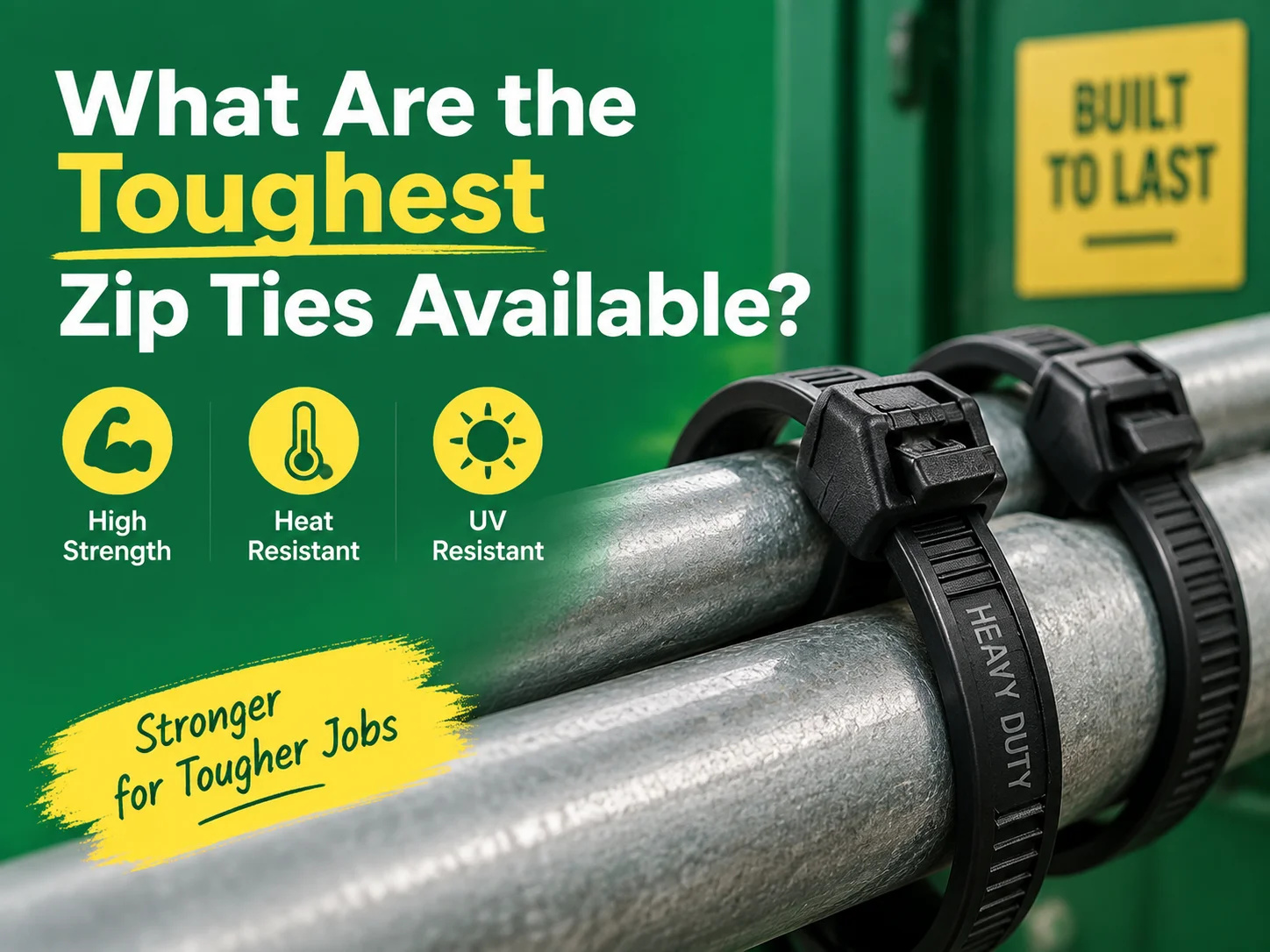
Heavy-duty industrial cable ties usually start at around 120 lb loop tensile strength, although there are also extra-heavy options available, up to several hundred pounds. For more information on their various weight categories and how their width and cross-section affect the weight capacities, see our guide on industrial cable ties.
To protect the bundles exposed to storms, use the ties that are rated for several times the static load weight, choosing a wider strap than what you would be using in weather conditions with no wind.
You can follow two simple rules in achieving this:Add 2-3 inches to the length of the strap you calculate based on the circumference of the bundle so that the tail sits completely.Always use the tensioning tool and cut nylon straps by using the proper cutting tool.
A Pre-Typhoon Cable Tie Checklist
It is essential to evaluate the outdoor electrical assets before the wind strikes. Following are the points to keep in mind:
- Change any clear or old indoor straps on outside lines to new black straps that are UV rated.
- For coastal or flood-risk equipment, it is wise to use 316 stainless ties for places that will be in the saltwater.
- Re-organize the service loops and slack as to prevent it from hitting or rubbing against each other due to wind speed.
- Make sure that the metal ties do not touch any wire that might carry electric current.
- Increase the width of the strap for those ropes that are under load.
Frequently Asked Questions
Can cable ties be used near high-voltage lines?
Indeed, cable organization and restraint are important, but the material you use does matter. UV stabilized non-conductive nylon should be used when working with energized or recently de-energized conductors, while ties made of metal should be limited to ground installations and confirmed de-energisation amenities.
What cable ties are best for typhoon and outdoor use?
The black UV-stabilised nylon 6/6 is an economically viable solution for most outdoor bundling applications and is non-conductive in nature. For coastal salt, extended flooding, high temperatures, or fire-prone areas, one should opt for 316 stainless steel as a heavy-duty alternative. Translucent indoor ties are not suitable for outdoor applications.
Are stainless steel cable ties better than nylon in a storm?
Not in all cases — they are suitable in particular scenarios. Stainless steel has advantages in terms of strength, heat resistance, fire resistance, and corrosion resistance. In equipment designed for coastal or wet conditions, this is of utmost importance. Nylon comes out ahead in terms of cost, installation, and non-conductivity when applied near energized devices. The choice reflects each tie’s location and necessity of having both types of tie in the crews’ possession.
How much weight can industrial cable ties hold in high wind?
Do not load the bags even as much as indicated on the package. The number on the package shows the breaking strength, not the working load. It is also important not to use the ties when there are wind gusts because this process means using most of the rated tensile strength of the item, which means it will not be able to withstand repeated shocks.
Do UV-resistant cable ties survive heavy rain and flooding?
Nylon is effective in terms of managing water and short periods of drowning and the particular type of black nylon that has UV rating survives heat and rain for a long time. In the case of long underwater exposure, especially in salt water, 316 stainless steel is the perfect selection if you consider long-term resistance.
References
- UL 62275 — Cable Management Systems: the defining standard for cable tie testing, loop tensile rating, material conditioning, and listing.
- ASTM International (D6779, G154): material specifications for weatherable polyamide and the accelerated-UV test practice used to validate outdoor cable ties.
- OSHA 1910.269: U.S. safety standard for work on electric power generation, transmission, and distribution, including qualified-worker and clearance requirements.
At igoto, we make industrial cable ties of all varieties, including black nylon 6/6 in different UV-stabilised grades, heavy-duty variants and 304 and 316 stainless steel that can withstand even the worst coastal or flooding conditions. You can surely find what you need for any outdoor equipment to handle typhoons. Visit our website to discover the range.