



Cable Tie Outdoor Guide: UV, Cold & Salt-Rated Fastening
Despite being one of the most inexpensive items to buy and install, a cable tie is among the most likely to fail outdoors. This is because ordinary ties that work fine indoors are not designed to withstand sun, frost, rain, or salty air. Get this crucial detail of selecting a fastener wrong, and you will probably not know about it until the bundle pulls down, the conduit comes loose, or the entire run gets replaced. Outdoor cable ties exist specifically because the environment destroys fasteners in a way that a closet will not do.
This guide explains what makes an outdoor tie different from a regular tie, what materials can withstand weather conditions for many years, what temperature and humidity mean for the fastener, and how to specify and install a cable tie outdoors. In short, it is important to match the material used for the fastener with environmental conditions, read specifications, not rely on the color of the cable tie, and avoid thinking that “heavy duty” or “black” means waterproof.
What Makes a Cable Tie “Outdoor”?
An indoor tie only has to hold a load at room temperature. An outdoor tie faces four separate stresses at once, and any one of them can end its life early. Understanding these four is the whole foundation of choosing outdoor cable ties correctly.
Ultraviolet radiation is the most familiar enemy. Sunlight breaks the chemical bonds in the polymer chains of ordinary nylon through a process of photo-oxidation, and a standard natural or colored tie left in the sun grows chalky, then brittle, then cracks. The defense is carbon black, a pigment that absorbs ultraviolet energy and dissipates it as heat before it can reach the polymer chains. This is why weather-rated ties are almost always black, and why an ordinary black tie without a stated UV claim is not automatically protected. If you want the full picture of how color and additives, not the plastic alone, decide outdoor life, our guide on whether white zip ties are UV resistant walks through it in detail.
Temperature works on the tie from both directions. Heat softens nylon and reduces the load it can carry; cold makes it stiff and eventually brittle. Because outdoor temperatures swing far more widely than indoor ones, a tie that is comfortable in a warehouse may fail on a rooftop in July or a tower in January.
Moisture and humidity are more subtle but still tend to stick around. Because nylon absorbs moisture, it will absorb the water and cause flaws through expansion as the weather goes through cycles of freezing and thawing. Rain, humidity, and condensation speeds the aging process.
The most significant impact from chemicals and salts occurs in coastal and industrial environments. Salt spray, oils, and aggressive chemicals lead to quick corrosion of metal fasteners and can destroy certain polymers.
Materials That Survive Outdoors
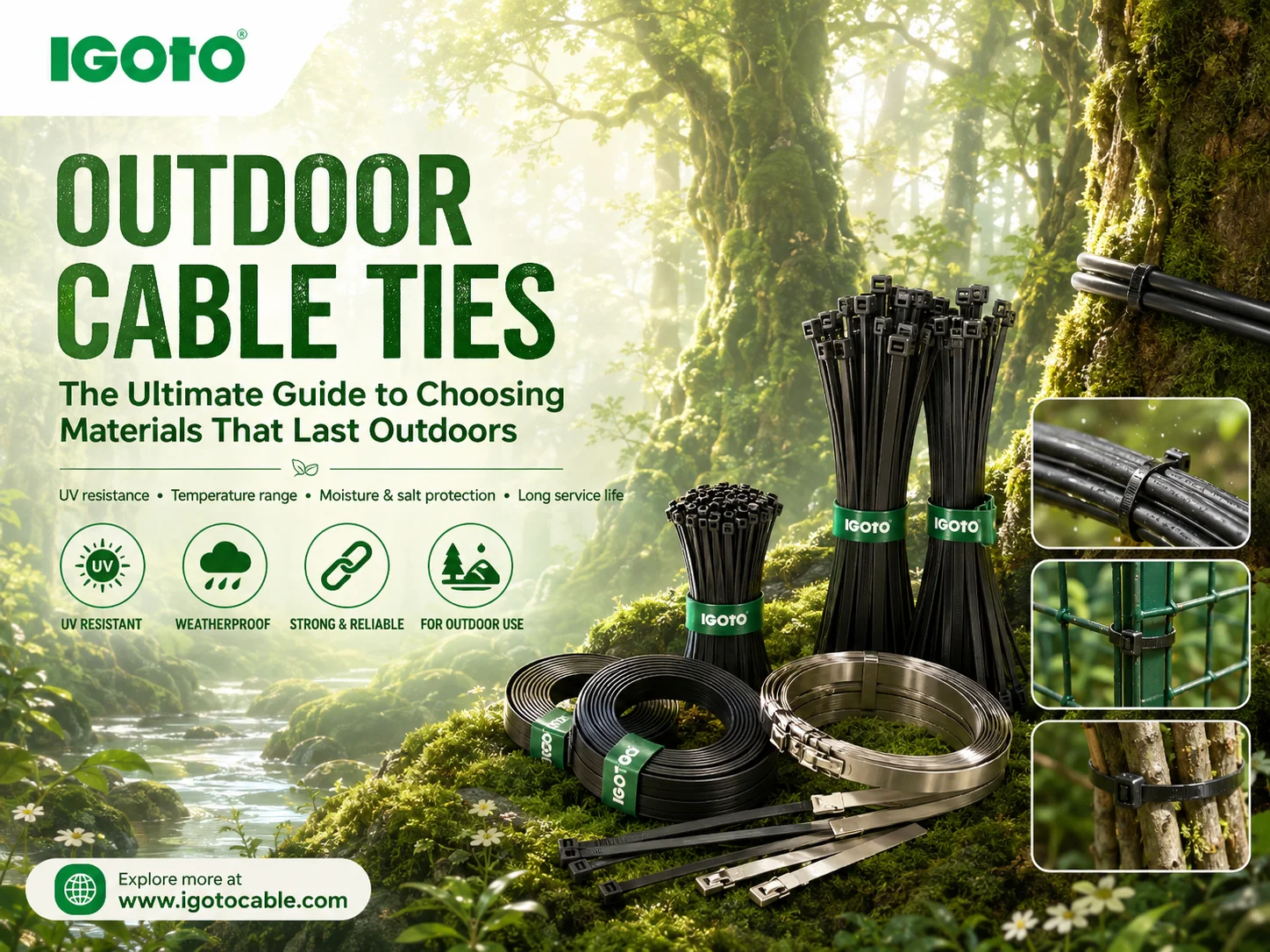
Most instances of outdoor failure are due to the selection of materials based on their attractiveness or affordability rather than their suitability for the condition. The three families of materials that deserve to be employed outside are different from each other in terms of function.
UV-Stabilized Nylon 6/6 (Black)
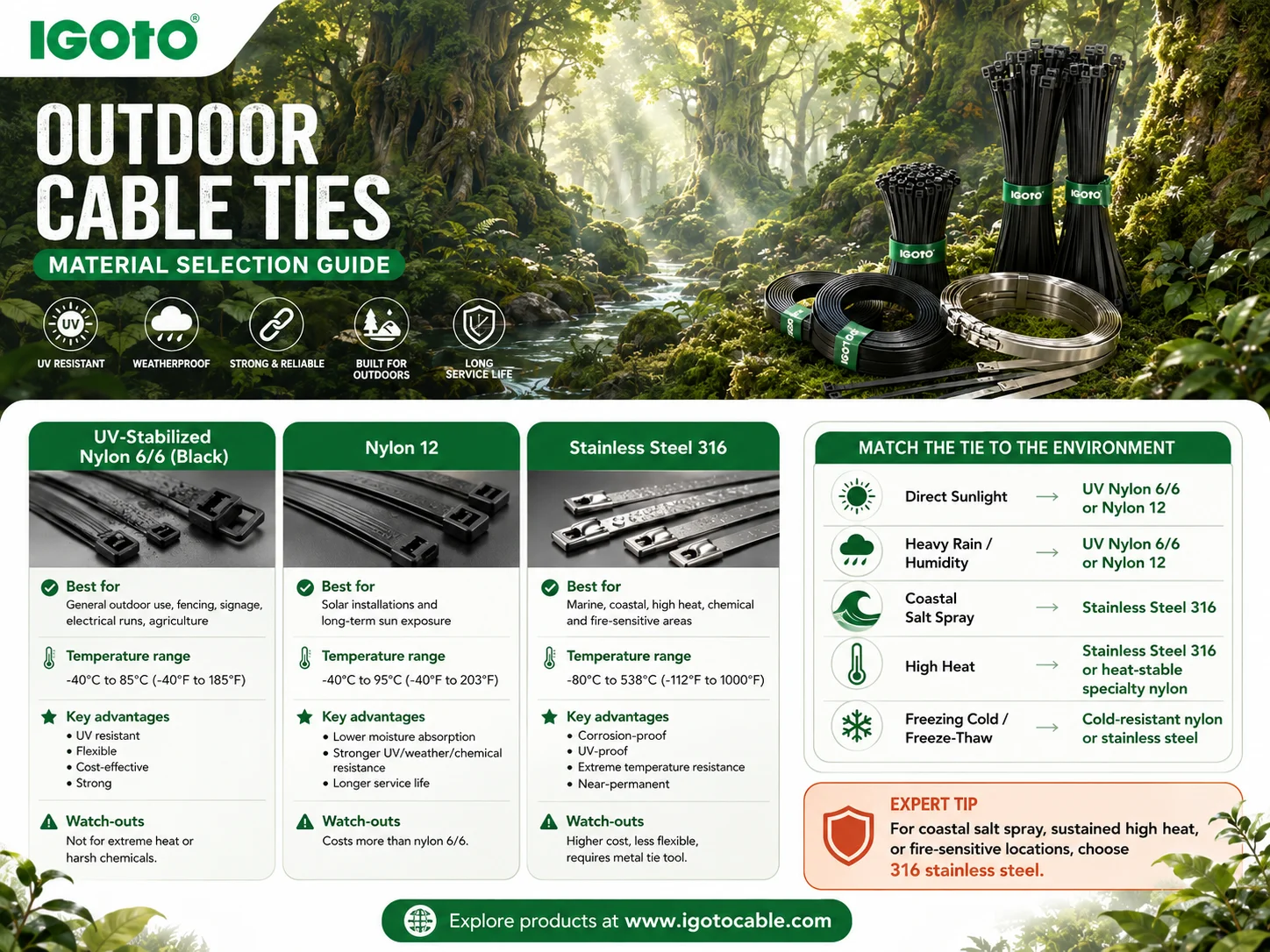
This is the main type of outdoor cable ties used for various jobs. The cable tie is made of standard Nylon 6/6 and carbon black and UV stabilizers added to the resin of the tie to give it strength and flexibility compared to those made for indoor purposes, apart from the fact that it resists sunlight. It can be used within the temperature range of about -40ºF to 185ºF which is between -40ºC and 85ºC and is low-priced. The installation does not require special tools since the same tools used for indoor cable ties can be utilized.
Nylon 12 for Solar and Long-Term Sun
Nylon 12 provides higher durability outdoors. Compared to nylon 6/6, nylon 12 absorbs less moisture, and has better UV and weather resistance, making it the go-to material for solar panel installations and other applications that will stay in the sun for a long time. Since it is significantly more expensive than standard UV nylon, it should only be used in applications where long, trouble-free use justifies the premium expense.
Stainless Steel for Extremes
Stainless steel is the material to use when heat, salt or chemicals outstrip the limits of any polymer. Stainless steel ties can be used at a huge range of temperatures, approximately from -80°C to 538°C, and are practically resistant to any corrosion, sun damage or fire. In particular, type 316 stainless steel is the preferred material in coastal and marine applications because it outperforms nylon when it comes to resistance to salt-water corrosion. The downsides are higher prices, lower flexibility, and the requirement of a specialized tool for tensioning and cutting the ties.
If a tie is to be used in direct contact with salt from the sea or in a fire hazard, do not waste money on premium nylon ties.
Temperature: The Overlooked Half of Outdoor Performance
Most buyers think about sunlight and stop there, but temperature is the second half of what makes a cable tie outdoor succeed or fail. Standard Nylon 6/6 begins to soften near 85°C, so a tie clamped to a black metal roof or an outdoor HVAC unit in peak summer can lose meaningful load capacity exactly when it is under the most stress. In hot locations, a heat-stabilized grade holds its integrity where a standard tie would sag. Our overview of heat-stabilized nylon ties explains where that grade is worth the upgrade.
Cold is a more astonishing danger for the reason that it is unnoticeable until something breaks. After temperature drops, nylon becomes stiff. It may break during installation when the temperature is below around -20 oF and when moisture is frozen, that causes micro-cracks without any noise. The temperature is equally important as UV in places with harsh winters or in places with whether cycles of freezing and thaws. Only cold-resistant grades or stainless steel should be used in the case of cold, wind, or vibration, while the flexibility of a standard nylon material needs to be tested to check its reliability for the installation.
Matching the Tie to the Job
The right outdoor cable tie depends far more on the environment than on the industry name attached to the job. A handful of common applications shows how the same four stresses point to different answers.
Solar energy systems function with years of direct sunlight, necessitating the first consideration of UV performance and leading many installers to select either Nylon 12 or a high UV-grade nylon. When used in agricultural applications, greenhouses, and irrigation, sunlight interacts with moisture and constant handling in a manner where the affordability of black UV-stabilized nylon stakes and ties is most appropriate. Marine and coastal environments use salt corrosion to justify the cost of grade 316 stainless steel. The outdoor HVAC projects add another heating factor to the performance considerations in the form of condensers and compressors which mean heat-stabilized or UV-black grades. Fencing, signage, and outdoor lighting are classic UV-nylon territory, while construction and telecom infrastructure often need heavy duty zip ties in a UV grade to combine outdoor life with real load capacity.
Where a tie must be anchored to a surface rather than wrapped around a bundle, the same material logic applies to the mount as to the tie itself. Adhesive mounts do not belong outdoors; a screw or rivet mount in UV-stabilized nylon, or a stainless mount for marine work, is the durable choice, as covered in our guide to mountable cable ties.
Sizing and Installation for Outdoor Use
Choosing the right material is most of the battle, but a well-chosen tie can still fail if it is sized or fitted carelessly. Outdoor conditions punish mistakes that an indoor installation would forgive.
Start with tensile strength and a safety margin. Compare the weight and wind load of the bundle against the tie’s rated strength and size up when in doubt; the cost difference between a light tie and a heavy-duty one is trivial next to the cost of a failure on an exposed run. Bundles that will be buffeted by wind or vibration need more margin than a static indoor bundle of the same weight. If you are unsure how width and length map to load, our reference on standard cable tie sizes lays out the common ranges, and the broader guide to choosing the right size, strength, and material ties the whole decision together.
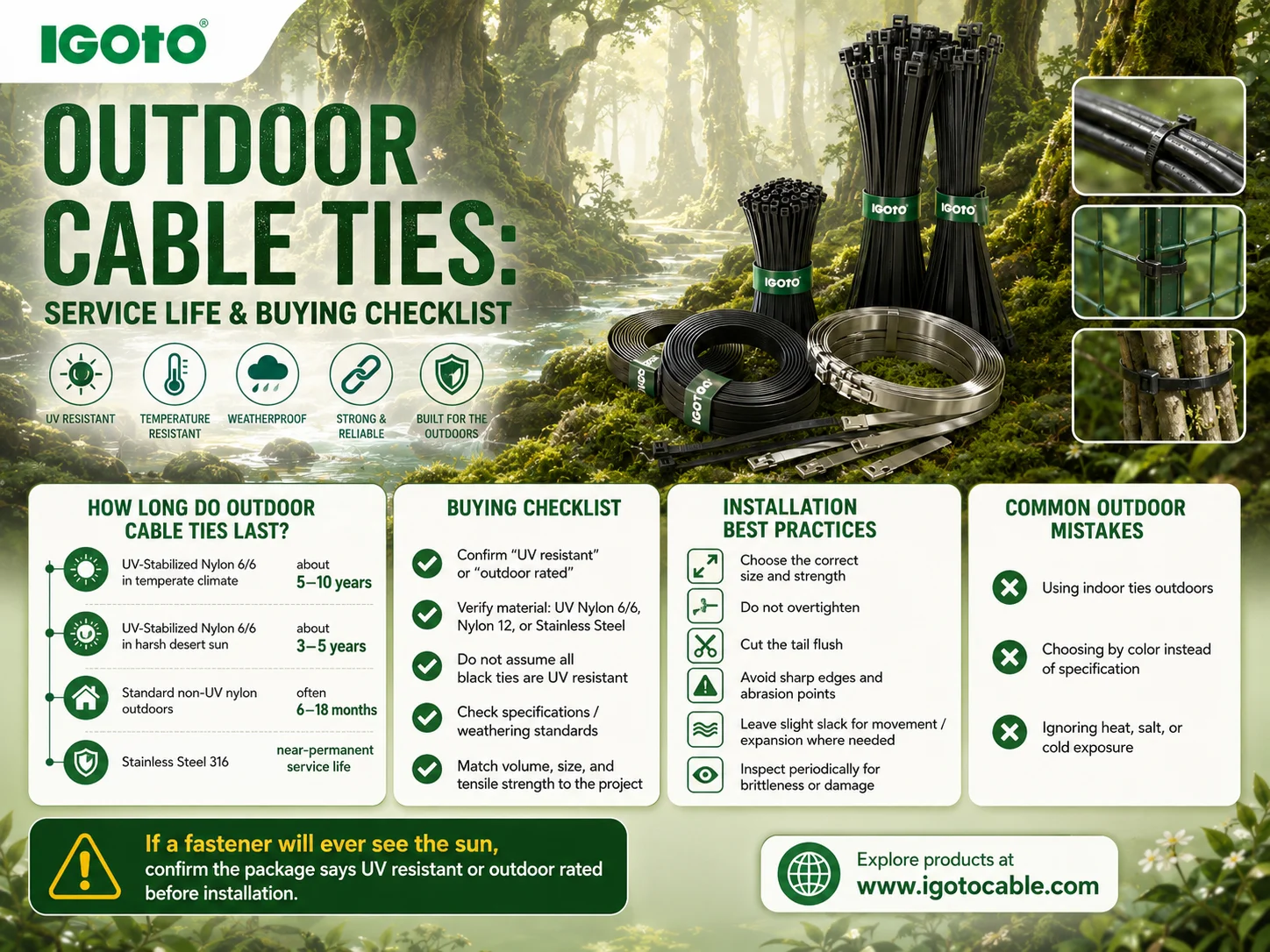
When fitting the tie, pull it snug but not brutally tight. Overtightening concentrates stress at the head and weakens the tie exactly where outdoor aging will attack it first. Cut the excess flush with a proper flush cutter rather than leaving a sharp tail, which both looks cleaner and removes a snag point. Finally, build in inspection: even the best cable ties for outdoor use benefit from a periodic look on long-life installations, so that a tie showing early chalking or stiffness can be replaced on a schedule rather than after it fails.
You should also take note of motion in your plans. Wind, traffic, and machinery vibration will create a constant low-level motion that will cause every hard surface the tie hits to become an abrasion friction point and will eventually cut through the tie without regard to its UV rating. Make sure the tie does not come into contact with sharp corners; use protective edges or a wider version of the tie at places where metal edges are interfaced, and where cables move independently of their supports use ties that can be released or moved instead of permanently tied down against moving objects. Because of wear and tear, it is often the case that some ties will stop functioning before they are damaged by sunlight, so the effect of motion on the material has to be taken into account when choosing that material as well.
One of the most common costly mistakes done outside is using indoor ties for outdoor purposes simply because these ties happened to be on hand. If you will ever attach an object that comes into contact with sun make sure to check that the packaging states that the item is “UV resistant” or “good for outdoor use”.
How Long Do Outdoor Cable Ties Last?
Service life is the information purchasers look for and often try to estimate. The truthful answer depends on the material used and the environment. However, the ranges are pretty much established. For example, a good black UV-stabilized nylon tie may last for around five to ten years in one climate while being reduced to only three to five years in the harsh climatic conditions. If we talk about a natural tie that isn’t UV-stabilized, its strength may already go down within weeks and the cracking will happen within six to eighteen months.
Stainless steel sits in a different category, offering near-permanent service that no polymer can match, at the cost of price and flexibility. If you want to compare polymer lifespans across grades before deciding, our analysis of which plastic zip ties last the longest puts the materials side by side. The practical takeaway is that outdoor life is bought at the point of purchase: the tie whose material was chosen for the job is the one that survives it.
How to Specify and Buy the Right Outdoor Tie
Because so many outdoor failures come from assumptions, the safest habit is to buy on documentation rather than appearance. Three checks catch nearly every mistake.
First, verify the material and stabilizer in writing. Genuine outdoor ties are labeled “UV resistant,” “weather resistant,” or “outdoor rated,” and the material is stated as UV-stabilized Nylon 6/6, Nylon 12, or stainless steel. A black tie with no UV claim is not a UV tie, and a “heavy duty” label describes strength, not weather resistance. Our guide on how to confirm a tie is genuinely UV resistant covers the visual, tactile, and certification checks in depth.
Second, look for recognized test standards and ratings. UV weathering is evaluated against standardized weathering practices such as ASTM G154, and flammability against UL 94V-2. Reputable manufacturers publish specification sheets stating both; if a supplier cannot produce them, treat the outdoor claim as marketing.
Thirdly, the volume should correspond to the sourcing. For a small amount of urgent samples, a contractor pack from a local hardware store is acceptable if the claim for UV is authentic. In case of a larger project, factory-direct sourcing is guaranteed to provide proper load rating and accurate data on UV effects, making it far more trustworthy than retail products, in addition to giving access to custom specifications regarding size, type of material, and tensile properties.
Frequently Asked Questions
Are all black cable ties UV resistant?
No. Black is the most effective UV color because carbon black absorbs ultraviolet light, but a tie is only genuinely protected if the carbon black is present as a UV stabilizer and the packaging states a UV or outdoor rating. Some black ties use non-stabilized dye and offer no real sun protection.
Can I use white or clear ties outdoors for a short time?
To keep it brief, natural, white, and translucent nylon ties are meant for indoor use since they can start degrading in the sunlight in a matter of weeks and should be considered only a temporary solution. For outdoor applications, you should opt for black UV-stabilized ties or stainless steel options.
Do outdoor cable ties work in freezing weather?
Regular UV nylon is able to withstand temperatures as low as -40°F, but hardens and becomes brittle when exposed to temperature that is lower than -20°F, which can cause cracking soon after installation and reduce the material’s strength over time due to cycles of freezing and thawing of moisture. In the case of severe cold and either wind or vibrations, it is more effective to use materials that are cold-resistant or stainless steel.
When should I choose stainless steel instead of nylon?
Opt for stainless steel materials in case of exposure to saltwater, high temperatures, and hazardous fire areas as well as when a permanent fastener is preferred despite its higher cost.
Choosing With Confidence
The environment, not the price tag or the color, decides which outdoor cable ties will still be holding years from now. The sun requires black nylon or nylon 12 that has been treated to resist UV rays, cold temperatures require the steel or cold-resistant grades, while salt requires 316 stainless steel so all specifications have to be verified in writing rather than just assuming. The tie must be compatible with the four stresses faced and the fastener will work efficiently for the life of the installation.
IGOTO manufactures UV-stabilized, heat-stabilized, and standard nylon cable ties across the full size and strength range, backed by 25+ years of production experience and UL, CE, and RoHS compliance. You can explore the complete cable tie product range and request samples or a quotation with your exact size, material, and quantity requirements, so the tie that secures your outdoor installation is the right one for the conditions it works in.